
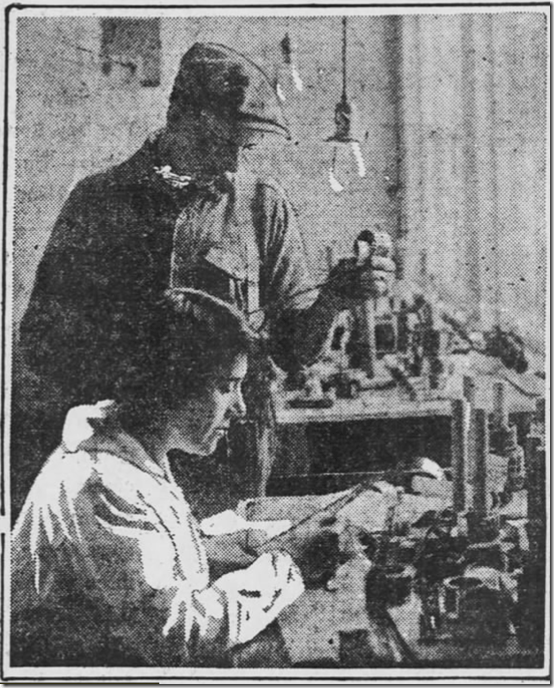
May Brotherton in the Balboa Day Book, 1916.
Women were integral to motion picture production from its very beginning. Working behind the scenes, they dominated the dirty work of cutting and assembly of film and negative for decades. Quick and precise, their work enabled studios to efficiently turn out product. May Brotherton, one of the leading pioneers of cutting, headed the assembly department for Balboa Studios in Long Beach in the mid-1910s, one of the first studios established in California.
Rachael Camp describes the early history of Brotherton and her family in her 2022 doctoral dissertation. The fifth of sixth children born to Elijah and Catherine Brotherton in Worcestershire, England in September 1879, Mary “May” Brotherton followed the lead of her older brothers, taking risks and seeking challenge. Ready for adventure, she joined her father and two older brothers Claude and Clarence in immigrating to the United States in 1895 in search of a better future for the family after his business partner absconded with money from their business. After this small part of the Brothertons settled in Chicago, Illinois, the rest of the family eventually followed a few years later.
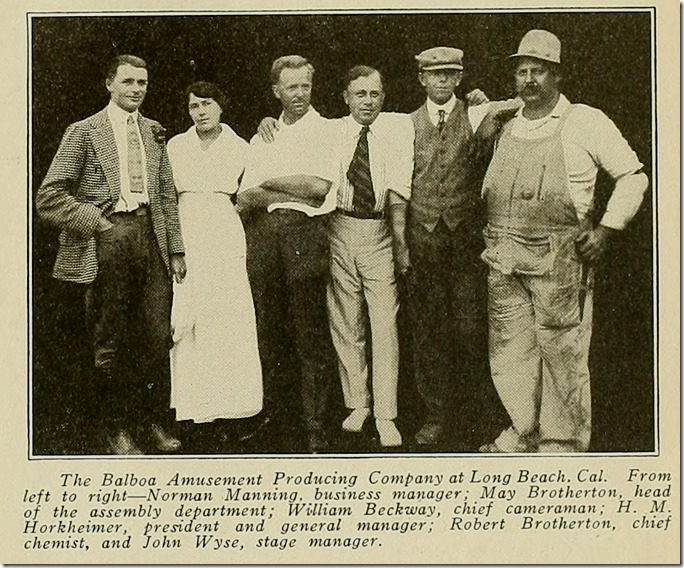
May Brotherton in Motography, 1915.
Moving picture production expanded in the first decade of 1900, thanks to the increasing popularity of films, first in kinetoscope machines and then as part of vaudeville acts. Considered a cheap form of entertainment by mainstream business, moviemaking attracted daring immigrants, women, and people of color looking for opportunity and success in fledgling industries that welcomed their initiative and labor. These mom and pop-style family run business were loosely structured, with employees sometimes taking on multiple roles to save time and money just like theatre companies,.
Quickly realizing the potential to earn large sums entertaining local audiences with films, budding entrepreneurs opened moving pictures in virtually every nook and cranny of the United States, leading to a production boom. Moviegoing expanded beyond immigrants and lower class audiences as middle class women discovered films, leading to an explosion of production. Already part of the workforce, female workers grew increasingly valuable in maintaining film production output and reducing costs, opening virtually all behind-the-scenes filmmaking positions to them. Thanks to Thomas Ince, factory-style filmmaking was introduced, bringing more organization and departments. In this second decade, women came to dominate cutting.
At the beginning of U. S. film production, moving picture studios shot films in sequence, the quickest and easiest way to churn out product, and to develop a story. They hired women as cutters for their attention to detail, manual dexterousness, dependability, and preciseness to cement together scenes. Working in long, factory-like rooms, these cutters took camera negatives to stitch together consecutively shot sequences, tinted or toned scenes, spliced in titles, added in credits, organized dailies, pulled particular shots, cut negative or positive, inspected prints, and assembled edited sequences.
As directors like D. W. Griffith realized the artistic possibilities of developing and improving stories through close-ups, medium shots, long shots, dissolves, fades, cross-cutting, combining multiple storylines, flashbacks, and cuts, editing was born. While several women graduated out of these earlier physical and rote jobs into full fledged creative editing like Viola Lawrence, Irene Morra, Blanche Sewell, Margaret Booth, and Barbara McLean, most female cutting employees remained stuck in these more manual, routine positions.
Like many outside the mainstream, the Brothertons saw ample opportunity in moving pictures thanks to higher than normal salaries. Looking to help financially support their family, Brotherton and her siblings joined Chicago’s Selig Polyscope Film Company in 1906, with May simultaneously working as a film cutter and camera operator. A newspaper story chronicling her life years later called her the “first woman taken into the assembly department” there.
Just three years later, the family packed their bags to transfer to Selig’s Los Angeles studio, gaining larger salaries and leadership opportunities in the process. In May 1913, the entire Brotherton clan joined H. E. Horkheimer’s Balboa Amusement Producing Company in Long Beach at the old Edison western company lot, seeing it through early financial struggles as it established itself in film circles, even loaning Horkheimer money through one dark squall.
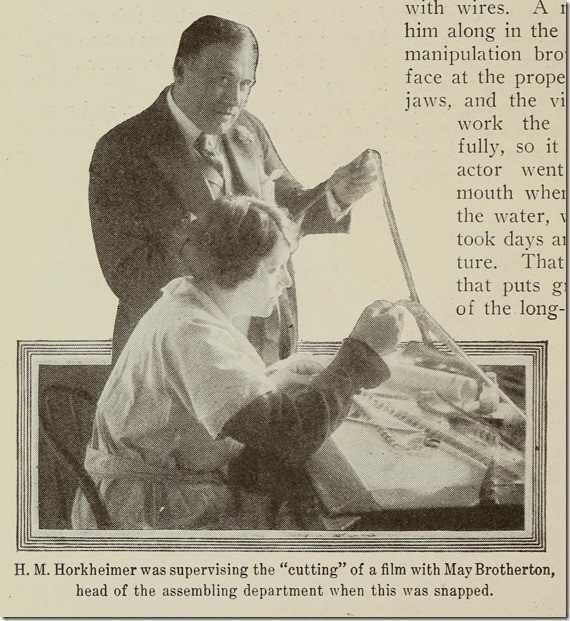
May Brotherton in Picture-Play, 1916.
Brother Robert headed the chemistry department, Joe and Clarence served as cameramen, and May herself led the assembly department, often following the lead of company head Horkheimer. Newspapers and trades found her leadership impressive, featuring her in many stories. The Long Beach Telegram noted her importance to the studio in its November 15, 1915 edition, stating that though no one saw her on camera, “her work is always in evidence,” in that the assembly department pasted together all parts of pictures after they were edited to ready them for exhibition. The 1916 Day Book featured her in Part III of a story about the life of a strip of film, from its creation through filming, cutting, and assembly. The story included an illustration of May and Robert in the assembly room as she pasted together strips of film it its final act of completion before being wound onto a reel.
Brotherton herself explained the workings of the assembly department in a early 1917 syndicated newspaper story. Passionate about cutting, she lovingly described its many duties beyond just cementing strips of film together, using the metaphor, “What the copy desk is to a newspapers, the cutting department is to motion picture making.” After creating a positive from the original film negative, the cutting department completed the puzzle by adjoining titles, credits, and each individual scene, following the script to cement it in order and sometimes trimming the extraneous beginnings and endings of scenes, what she called “the dead stuff.”
While important directors took an active part in shaping their films, the cutting department often handled programmers, gaining some creative responsibility in the process. Not only did they assemble scenes but sometimes rearrange them to clear up confusion or make the story stronger. Occasionally they suggested additional filming to alleviate confusion. Brotherton called the assembly department the “trouble department,” catching mistakes and trying to resolve them before prints shipped to motion picture theatres.
Horkheimer valued her and her family’s loyalty to his company, going on to sponsor her in a 1916 Los Angeles Times subscription contest to win a car, which she bested with flying colors. The Brothertons remained with Balboa until its demise in 1918. May herself quickly found work as laboratory superintendent for Katherine MacDonald’s own producing corporation. After a few years years of hard labor, the company folded due to financial conditions. Brotherton would go on to head the assembly department for B. P. Schulberg’s Preferred Pictures, but found herself adrift when he and his top star Clara Bow moved on to Famous Players Lasky in 1925. At this point, Brotherton took work where she could find it, ending up back negative cutting into the 1940s before retiring from motion pictures.
Dependable, reliable, and strong, Brotherton successfully managed troubles and responsibilities both at work and at home. Remaining single and devoting herself to work and family, she supervised assembly departments while nursing her parents as they aged. After their deaths, she took in her brother Robert after he injured a hand at work. The two eventually moved to the Motion Picture and Television Fund’s Country Home in Woodland Hills per Camp’s doctoral dissertation.
Queen of the cutting and assembly departments at Selig and Balboa, May Brotherton demonstrated leadership and creative responsibility in supervising busy departments and saving troubled films. Trustworthy and talented, she gained the responsibility to sometimes perform creative fixing of production and editing issues. Long forgotten, Brotherton’s talents and management skills demonstrate her importance as an early silent film pioneer.


