
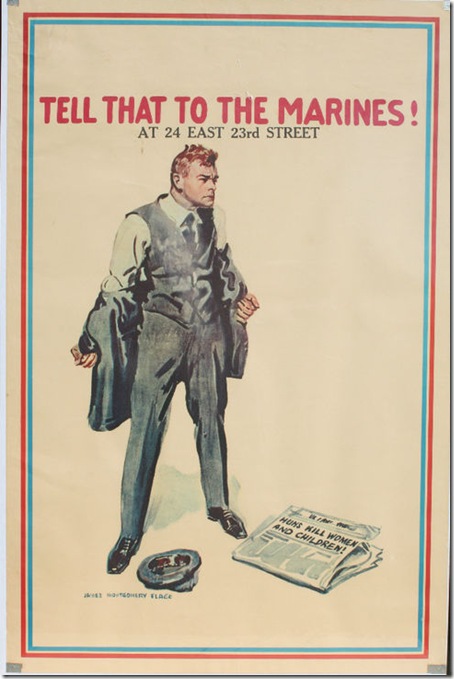
Photo: What is advertised as an original copy of James Montgomery Flagg’s “Tell That to the Marines!” is listed on EBay. Bidding starts at $361.66.
Note: This is an encore post from 2011.
Illustrator James Montgomery Flagg is best remembered today for creating the iconic image of Uncle Sam on a U. S. Army recruitment poster in World War I, but he was also a successful filmmaker during the same period. Not only did Flagg create posters and art titles for film studios, but he also made a series of shorts.
Flagg studied in New York, Paris, and London before illustrating for magazines and books. He became an author himself in the early 1900s, writing and illustrating his own works. Illustrators were well paid; the Feb. 6, 1910, The New York Times estimated that Flagg earned $15,000 for drawing in 1910, and Harrison Fisher made $75,000. In 1914, The Los Angeles Times hired Flagg to author and draw columns.
The artist was also highly patriotic, signing up to draw posters for the Committee on Industrial Preparedness of the Naval Consulting Board in 1916. He would go on to design posters for military preparedness, the draft, loan appeals, and the Red Cross during World War I, and be appointed the official military artist of New York state by its Governor Whitman. For his first film effort, he contributed artwork and titles for the Stage Women’s War Relief Film Division’s first two reel film in 1918.
Famous Players-Lasky also signed him to produce 16 two-reel comedies in 1918. He also drew the posters for the comedies, which came out under the heading of “Sweethearts and Wives.” To support both Famous Players and the war effort, he drew and then gave away for free a poster of a nurse working for the Red Cross.
 His films received excellent notices and seemed to perform well at the box office. One of his first, “Tell That to the Marines,” was called a “…ripping… and living pictorialization” by the New York Times. Flagg starred in as well as created the short “Perfectly Fiendish Flanagan,” which “satirizes the Western bad man of melodrama and movie fame” according to the Dec. 16, 1918, New York Times, which also called it “the best bit of satire without any exception that we have ever seen on screen.” The Los Angeles Times’ May 5, 1919, review of his film “The Good Sport” wished that he wrote titles for other films besides his own.
Flagg’s work was not only hilarious but also smart and challenging. The New York Times’ January 1920 review of Flagg’s “The Spoiled Girl” stated that the film “affords a pleasurable relief from the ordinary run of slap-stick stupidity. When one compares the wit and skill of Mr. Flagg’s work with the meaningless trash, clumsy horse-play and pointless vulgarity of the average screen “comedy,” one feels like exclaiming, “Thank you, Mr. Flagg, thank you.”
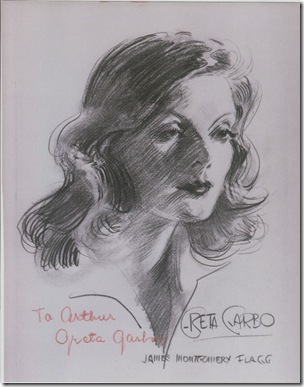
After he completed his contract, Flagg returned to writing and illustrating articles, books, and posters, but he did return to the movie world for a few jobs over the next couple of decades. In 1928, he was hired to draw titles for a First National film. For the film “Gallant Lady” in 1934, Flagg, Diego Rivera, and Howard Chandler Christy, along with three others, were hired to draw their own impressions of the film for the lobby of the Rivoli Theatre in New York City. As he turned to portraiture in the 1930s, Flagg created portraits of such MGM stars as Greta Garbo and William Powell that were used as advertising by the studio.
Image: A reproduction of James Montgomery Flagg’s sketch of Greta Garbo, listed on EBay at $7.50.


I’ve seen this poster in design/WWI books for years, but never knew it was ever associated with a film.
LikeLike