
63 years ago, writers and actors were struggling. Looking for a small share of revenue to help fiscally survive, they asked simply for residuals from post-1948 films sold to television, while studios pled poverty. Both unions went out on strike, the first time two unions walked out at the same time. Today’s strikes echo those vintage ones in many ways, especially with unions supporting each other in solidarity as well as both asking for equitable pay for all their labor in creating entertainment product, especially with new forms of exhibition affecting how audiences access and view entertainment. These issues would be make or break issues for guilds, then or now.
While a few at the top of each profession earned huge salaries, the vast majority collected peanuts for their work, finding it difficult to pay bills. They also received no health benefits and no pensions. At the same time, studios earned high returns selling post-1948 films to television stations desperate for product. Studio heads received salaries putting most of them into the top ten list for highest paid executives in the United States, making tens of times the average studio employee.

On December 22, 1959, Writers Guild of America West resolved a strike against six independent motion picture production companies, signing five-year contracts with Edward Small Productions, Eclipse Films, Reliance Films, Superior Pictures, World Films, and Global Productions, just as they had with five other small independent producers in November on the contract which had expired in March. The contract recognized the right of Writers’ Guild members to receive residuals for sale of post-1948 films to television, the right to reopen talks regarding payment for the sale of films to pay TV, and other rights. For the sale of films to television, writers would receive 2.4% of the gross, or 4% “of the gross after an allowance of 40% for distribution costs.”
The terms would only become effective when the overall industry took part, at which time they would give 2.4% of gross to directors, 7.2% to actors, and even 3% to craft unions such as IATSE. WGA members authorized a strike against major studios if they refused to come to terms over the same issues for the contract which would expire January 15, 1960.
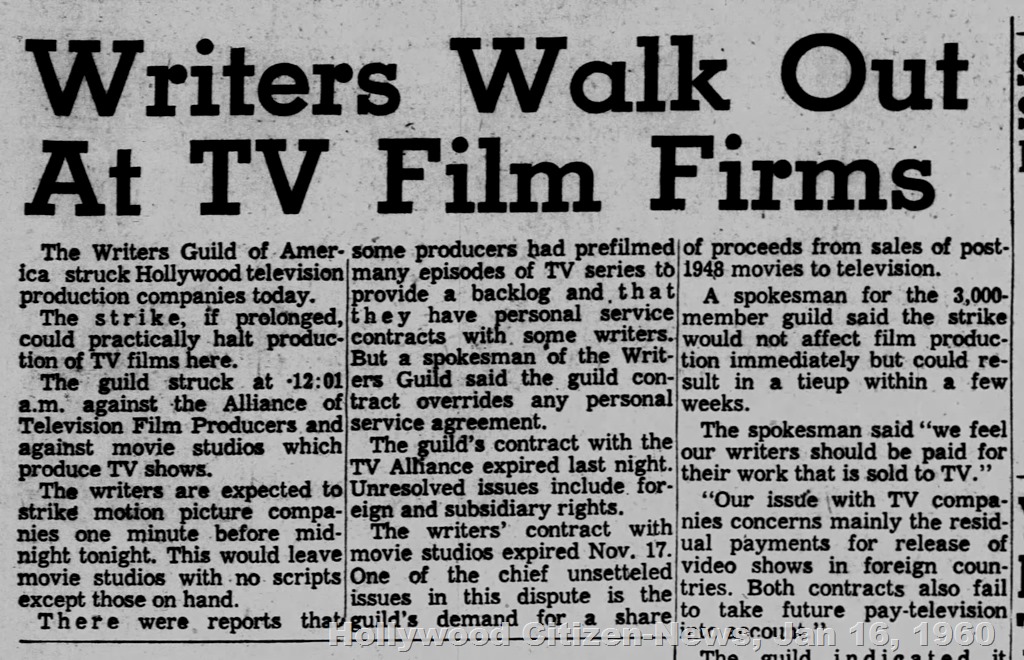
WGA members authorized a strike on January 16 in an overwhelming vote after no headway on contract negotiations, aided by the fact that IATSE stated on January 13 that they would refuse to cross picket lines if other unions also recognized the writers’ strike. Studios were prepared for the current season, held back TV shows and looked for repeats in case the walkout lasted past the normal start date for new season shows. Movie studios were prepared, only eight films were in production and they had others in post production preparing for release. TV and film producers were prepared in case of a long strike and believed they possessed finished product that would last them for months.
Writers took the high road, stating they would simply walk out rather than picket or demonstrate outside studios. By February, studios announced they would lay off behind-the-scenes and production workers if the Screen Actors Guild also authorized a strike over failure to resolve their contract which expired January 31, but for which terms had been extended. Several unions suggested they all negotiate new contracts together, with huge numbers and cooperation thereby ensuring the best terms for all.
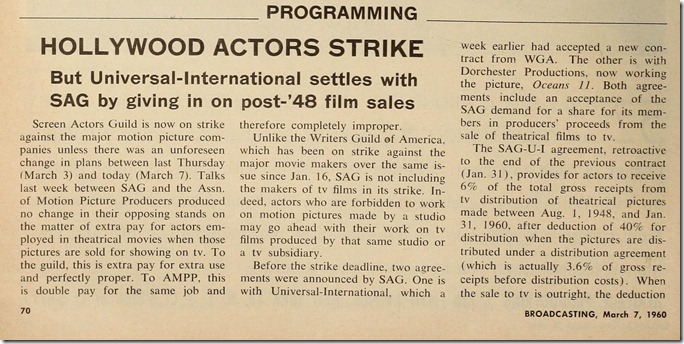
Even before the strike authorization, two major independent producers agreed to the Writer’s Guild terms of making residual payments for post-1948 films sold to television. Frank Sinatra’s Dorchester Productions, the company behind “Ocean’s ll,” and George Sidney’s International-Posa Productions, shooting “Pepe,” agreed not only to this request, but also signed an agreement to pay 20% of their films” TV earnings into a pension fund for IATSE members. Universal-International Studios signed an agreement the previous week to pay residuals for writers on post-1948 films and would also contribute to a proposed pension plan.
SAG voted to go on strike March 7, putting more pressure on the studios due to their larger size and power due to celebrity members. They joined the WGA in walking out but not picketing. They also demanded residuals for post-1948 films sold to television. Studios released statements claiming paying residuals on post-1948 films would bankrupt them, or if that didn’t happen, they would move all production to Europe. Charles S. Boren, Vice President of the Association of Motion Picture Producers, decried that producers would never pay residuals, claiming it would destroy American filmmkaing, telling the Los Angeles Times, “Our system is vital for portraying democracy and the U. S. way of life throughout the world.” The companies also claimed movies had been steadily losing money as more and more people turned to watching free television, in a way the studios’ fault, after their practices of block booking and monopolizing production, distribution, and exhibition were broken up by court decree.
Actors stated they were earning less, having to work harder and harder just to stay even. 80% of actors earned less than $4,000 a year. Most major stars supported the walkout, while people like Glenn Ford, George Raft, and Elizabeth Taylor supported producers. Actor/producers like Tony Curtis and Frank Sinatra supported strikers. Federal mediators arrived in town to help lead negotiations.
Exhibitors dejectedly faced the strike. They were bitter at the studios selling older films to television, putting the medium even more into competition with theatres, and then cutting back on the number of films produced, thereby depriving them of product. Both decisions ironically grew out of exhibitors’ anti-trust lawsuit protesting the studios near monopoly of production, distribution, and exhibition with the 1948 Paramount agreement forcing studios to divest their theatres.
Joe Vogel of MGM told the studios’ stockholders in a meeting that the Association of Motion Picture Producers had hoped to settle but claimed the studios were negotiating reasonably. “We are not taking a stubborn stand, but we cannot give the company’s assets away.”
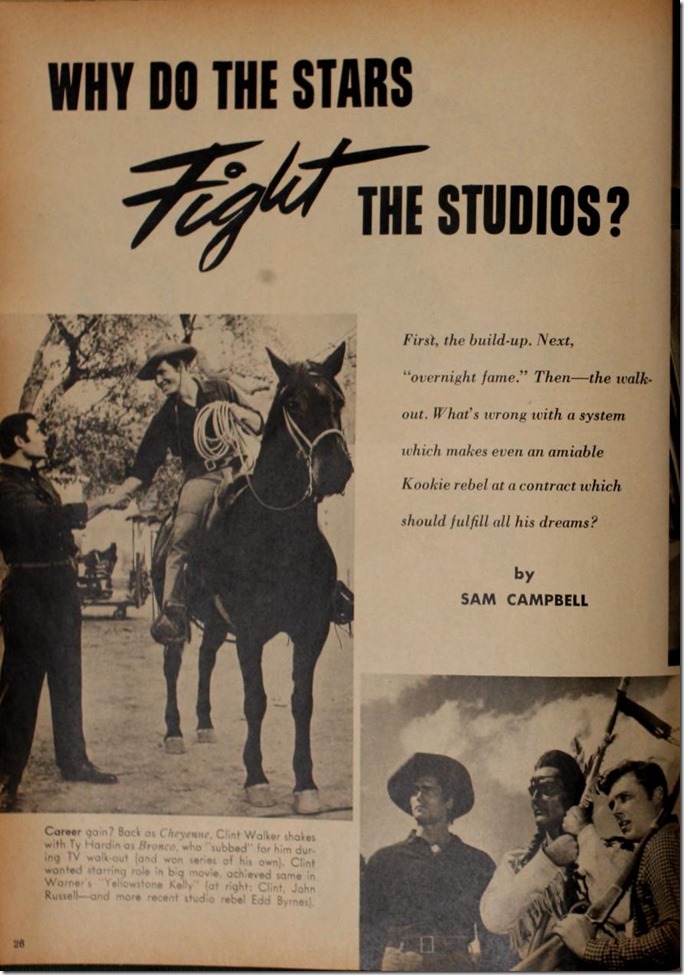
Workers saw it differently, that they intended to reserve all revenue for themselves and render actors, writers, and others strictly wage slaves.Peter Lorre told journalist Bob Thomas in an early March interview, ‘“The movies are no longer an industry. After all, who ever heard of an industry that offered no loyalty to its employees? The studios offer none at all anymore. Making movies used to be fun in the old days. It isn’t any longer. It’s a cold-hearted business.” Tony Curtis foresaw the end of the studios. “The end of the big studio is coming. It was going to happen any way…it just means every moviemaker is going to be an independent.”
AMPP believed their offer of funding a pension plan for striking actors offered the best solution for resolving the walkout. While the major studios refused to consider paying residuals on post-1948 films, they were open to helping fund pension and welfare plans. Since the founding of the basic pension plan in 1953, employers paid eight cents per hour worked by employees to the fund. Retirees first began receiving $75 a month from the fund at the beginning of 1960.
Negotiations dragged on for weeks between studio representatives and guild officials. After a 33-day strike, SAG and studios reached an agreement on a new three-year contract on April 8, 1960. While it offered health and pension programs to benefit actors, the contract ignored post-1948 residuals.
Studios would pay $2.25 million total in 10 equal installments towards a pension plan for actors, who were not covered in an earlier 1953 plan. Producers would put aside $375,000 to establish a health and welfare plan for actors. To help maintain these plans, producers would pay “an amount equal to 5% of actors’ salaries, up to a maximum of $100,000 per actor per picture.” AMPP agreed to pay residuals on post-January 31, 1960 films released to TV, paying actors 6% of revenue after deducting 40% for distribution expenses. If pay TV became a reality and took off, affecting theatrical box office, actors could reopen negotiations on payments. Day players and stunt men would see day rates rise from $90 to $100, and weekly freelance actors would see a raise to $350 from $300.

Negotiations over the WGA Contract dragged on. Guild members voted multiple times on contract offers, turning them down handilly. Not until June 10 after 22 weeks of negotiation did talks resolve issues with film producers over the pact. While writers saw a increase in minimum pay rates, a small percentage of revenues from post-1960 films, and an establishment of pension and health/welfare plans, they also received nothing on post-1948 films. Studios did contribute $600,000 to establish health, welfare, and pension plans for the first time, but writers settling for no residuals from post-1948 films led to a major loss of revenue which they could never make up.
Studios maintained power over all unions thanks to their powerful purse strings by denying any payments on these films, one step ahead of workers. High paid executives demonstrated their savvy in preserving large cash outlays for management, a sad foreshadowing of future negotiations. Two powerful unions negotiating on the same terms at the same time resulted in obtaining some remarkable items for their members, a step forward in labor relations.
May unions continue to remain strong in consulting and advising each other in negotiating equitable and strong contracts for themselves, which will help all other guilds. As in 1960, strength in numbers, patience, persistence, and outside support can achieve wonders.

 ladailymirror.com