
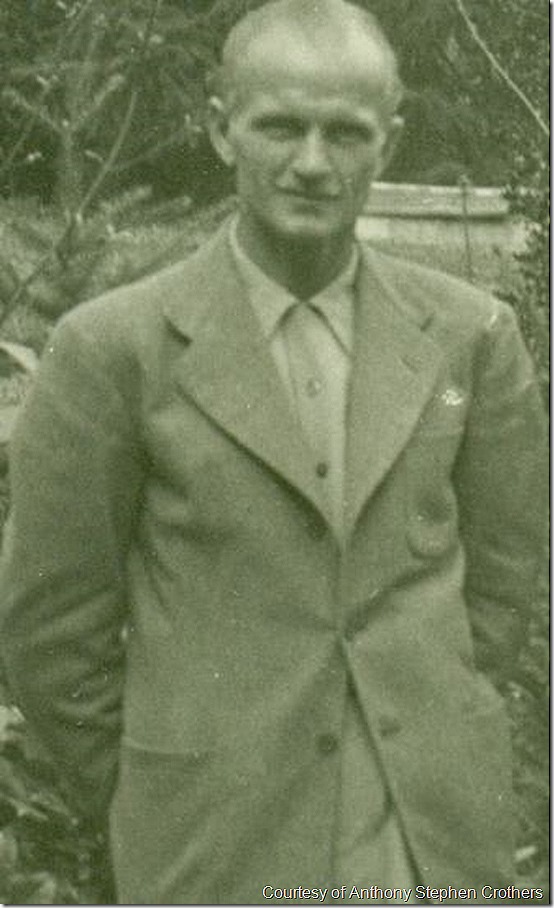
Frederick Crothers in 1949, courtesy of Anthony Stephen Crothers.
Note: This is a guest post by Anthony Stephen Crothers, a regular Daily Mirror reader.
Louella Parsons’ article published in March 1944 referencing Darryl Zanuck’s story and ultimately the picture he made about the bravery of the U.S. servicemen in WWII [“Purple Heart”] dredged up a lot of interesting remembrances and feelings as to the mood of the country and the patriotism the prevailed among the folks here at home at that time.
Zanuck had three kids at the outset of WWII and somehow was able to enlist voluntarily and serve in the military for a time. Most every “red-blooded” American man enlisted or tried to enlist in the service in a wave of real altruism that pervaded our country at that time. Zanuck’s draft status was: married, with three children, which would normally have kept him out of combat.
My father was 37 years old with four children, (I was the youngest), when he tried to enlist in the U.S. military, but the draft board would not take him. In his mind, this was a very humiliating set of circumstances, as he really wanted to serve his country no matter what his family situation was. In later years (he lived until he was 83) with tears in his eyes, he shared his sorrow with me at not being able to go along with the rest of America’s “blood and treasure” to fight the daunting threat that was imposed upon the country with the aggressive act of war by the Imperial Japanese military leadership.
I was a young boy in 1944, but I vividly remember the impact, the tension and ultimately the sacrifices that every American, (men, women and children) had to make during the war.
The discernible difference in the mood of the country then, as opposed to Vietnam, for example, was that there was not only the imminent threat at America’s doorstep, but there was a true sense of patriotism by almost everyone as brothers and sisters to put political beliefs aside and to come together to do what it took to fight the tyranny of one country, Japan, to invade another, the U.S.A.
In my life, these events promulgated great ironies that would haunt me as a member of the “silent generation”1
There was a deep sense of patriotism and loyalty inculcated in me by the example of my parents, their friends and certainly the mood of the average American at this very pivotal time in our country’s history.

Frederick Crothers in 1985, courtesy of Anthony Stephen Crothers.
The Japanese, as a country, was an enemy who shot down our airmen, fought our G.I.’s in “hand to hand” combat and in a great many situations imprisoned and tortured them. This reality was particularly driven home to me personally in the early 1960s when I had occasion to work with several WWII vets who had actually served time in Japanese prison camps in the South Pacific.
These men that I worked with on a daily basis, sparingly shared the atrocities that they saw, and in some cases, were affected by when they were incarcerated in the Japanese concentration camps. In some cases, there were not only tears yet visible sobs from them as they reluctantly told their stories. Needless to say, I was not only touched, yet shaken by their candid portrayals of how they were treated in those camps.
In another irony, in 1966, I became close friends of a Nisei Japanese American who as a first-generation Japanese person was born in the U.S and was relegated to a U.S. relocation center in Central California until the end of WWII.
In the 1940s and 1950s, the Japanese were still referred to, derogatorily, as “Japs” in the media and in many motion pictures. Today, and rightfully so, the term “Jap” has become unacceptable in the lexicon of most Americans.
Which brings us back to Darryl Zanuck, who ultimately became the head of Twentieth Century Fox Studios. Most people weren’t aware of his military service as a married man and father of three who also wrote the compelling story “Purple Heart” and made a movie about it.
Another irony that seems to crop up from time to time is that Zanuck was, at times, deemed a tyrannical studio executive who later was depicted by his son Richard as a befuddled man whose time had come and gone. Darryl Zanuck should probably be reevaluated by his historical deeds and the complete content of his body of work. It sounds to me like he was a patriot.
The last twist to my recollections, is that my father worked in the back lot at Fox Studios for 26 years. My dad, who never got the chance to serve our country and went to his grave regretful of that fact, and Darryl Zanuck who was able to do so, and probably never got much recognition for it.
Darryl Zanuck has been dead for 35 years
My dad has been gone for 28 years
My close Nisei Japanese friend died last year
You know what, even though all this was going on 70 years ago,
somehow, it all matters!
1“silent generation” a term that I have adopted that denotes the relatively few of us who were born before the end of WWII and don’t qualify to be called a “baby boomer”

 ladailymirror.com
I salute your father for his willingness to defend this country even though he was rejected.
LikeLike
I’m quite certain Your Dad, Mr. Frederick Crothers, served His Country on the home front and served it well. The Men, who for one reason or another, who wanted to serve but couldn’t worked their damndest on the war effort at home. My Grandpa, an immigrant from Hungary, was so very proud of his service as an ironworker on our battleships. God Bless the men who served overseas AND the ones who “served” on the home front.
LikeLike
Darryl Zanuck’s title was basically honorary, as it was for most of the Hollywood studio executives who served. Tyrone Power, Jimmy Stewart, Douglas Fairbanks, Jr., Clark Gable, and others really did serve in harm’s way, and directors George Stevens, William Wyler, John Huston, and John Ford did see combat while making films, but the vast majority of Hollywood people like Zanuck served their time at Camp Roach, the Hal Roach Studio, in Culver City, California. People like Ronald Reagan and others made training films, while executives like Zanuck and Jack Warner thought up ways to salute the troops and drum up support for the cause, like Fox releasing the film “Wilson” about President Wilson. Zanuck was one of the great practitioners of the casting couch, lived in Europe openly with his mistress while his wife lived here in the US, and later was befuddled at running the studio, firing his own son in the process.
LikeLike
Further to Mary’s remarks, there were questions in Congress and the press then and later as to what value the ‘Hollywood colonels,’ especially Zanuck, had provided. Frank Capra and those who ran the Motion Picture Unit provided real service, but the executive cohort seems to have been mostly for show – an aspect of the national unity Anthony Crothers refers to above.
The president had declared movies to be an essential industry, so many studio technicians and craftsmen were deemed draft-exempt. It’s possible the senior Mr. Crothers may have been turned away for reasons that had little to do with his qualification.
LikeLike