
 |
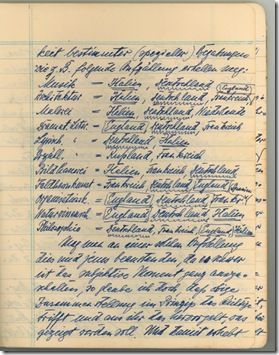 |
Photos: Josef Mengele’s notebooks. Credit: Alexander Autographs.
RECOMMENDED
Randy Kennedy of the New York Times catches up with famous/notorious graffiti artist/tagger TAKI 183 at a book signing for “The History of American Graffiti.”
Rex Huppke’s ‘I Just Work Here’ Column in the Chicago Tribune takes a look at the reaction to Chicago’s Marilyn Monroe statue.
ARCHITECTURE
Scott Timberg of the Los Angeles Times visits John Lautner’s Chemosphere home and talks to owner Benedikt Taschen.
Frank Escher, who was brought in as restoration architect, vividly remembers the place’s condition.”I have to give Benedikt credit for seeing past the disrepair and sad state the house had fallen into,” he says. “It looked like a rundown motel. It had been rented out for 10 to 12 years; it was like the ultimate party house.”
In fact, during much of that decade, the place had been on the market. “It was for sale for so long,” says Taschen, “that it was even in a ‘Simpsons’ episode: a house with a for-sale sign.”
BOOKS
David Hackett Fisher reviews Gordon S. Wood’s “The Idea of America” in the New York Times.
Wood’s latest book is a collection of 11 essays, along with an introduction and conclusion, that encompass his entire career. It reveals more of the author than any of his other work and creates the opportunity for an overall assessment of his achievement.
Wood introduces himself with a familiar line from the poet Archilochus: “The fox knows many things, but the hedgehog knows one big thing.” He celebrates the foxes who flourish in his field, and adds in his modest way, “By contrast, as a historian I fear I am a simple hedgehog. . . . Nearly all of my publications have dealt with the American Revolution and its consequences.”
Writing in the New York Times, Sam Roberts takes a look at Peter Morton Coan’s “Toward a Better Life: America’s Immigrants in Their Own Words.”
NEWS
Alexander Autographs says it sold a collection of journals kept from 1960 to 1975 by Josef Mengele for $300,000. The material was sold to a anonymous Jewish buyer who is “building a private collection for a museum,” according to AP.
A sample of the Mengele material quoted by the auctioneer:
We cannot accept how our ‘natural, Germanic’ religion is being misrepresented. Our Germanic religion was directly connected to nature in which human beings feel logically at home…
The youth movement honored the traditions of our ancestors while remembering our primary cultural values. We had to remember our inner strength, and this was of utmost importance after World War I and the shameful peace that followed. This burden was designed to keep our people in a constant condition of decay. We had to find the deepest sources of German strength to make our restoration possible. We could not expect other people to help us, and we couldn’t rely on religion…What has the Catholic Church done to amend or get rid of the absurd Treaty of Versailles? They had a chance to influence the synods of the Protestant Churches, which make up two thirds of the German people. The new strength had to come from the Germans themselves, and this is exactly where it came from. The youth movement laid the spiritual foundation for the national uprising that was to follow World War I. Later on, the youth movement became part of the great political organization, the Hitlerjugend…We had to liberate Germanic history from Roman and Catholic influences.
The L.A. Daily Mirror and L.A. Crime Beat lovingly prepared by bots from Twitter feeds by paper.li.
[Correction: An earlier version of this post credited the Mengele notebook photos to Alexander Auctions. The firm is Alexander Autographs.]
MUSEUMS
Philip Kennicott of the Washington Post reviews “The Great American Hall of Wonders” at the Smithsonian American Art Museum.
But the exhibition is often disappointing. Claire Perry, a deeply knowledgeable curator, has taken on more than can be managed in a show of modest dimensions, and she has chosen objects that don’t always further her rhetorical aims and all too often lack visual appeal.
Like the museum’s exhibition devoted to George Ault and the art of the 1940s (on view until Sept. 5), the “Hall of Wonders” is elaborated as much in its catalogue as in the visual material on the walls. But unlike the focused and idiosyncratic Ault exhibition, the “Hall of Wonders” isn’t sure what it wants to say. And worse, Perry’s reading of the paintings doesn’t always feel trustworthy. Lots of curators “over read” their material — and a brilliant “over reading” can be thrilling — but Perry simply sees things that aren’t there or are so ambiguous as to be unconvincing.
Jessica Goldstein is writing a series for the Washington Post on undiscovered museums. This week, she writes about the National Building Museum.

 ladailymirror.com