some code


Once Upon a time there were three bears. A papa bear, a mama bear and a baby bear. They all lived together in a big house in the forest. One day

Posted in Black Dahlia, Books and Authors, LAPD, Streetcars | Comments Off on some code

Blogging the Wolfe Book, The FBI Story


There is an individual on ebay who sells copies of Elizabeth Short’s FBI file for $22 and some bidders drive the price even higher. The fact that the files are available online for free has curbed the demand somewhat. But I don’t know which is worse: a seller offering something that anybody can get for free (oh yes, you do get a “bound” version, if you consider a cheap plastic spiral a “binding”) or the people who buy it for $44.89, like sydney20030_3 .

Update: The price on ebay has gone up to $23, plus $5 shipping. Still free on the FBI’s website.

Page 28

In his treatment of the Black Dahlia case, Donald H. Wolfe is going to deal with the relationship between the police and the newspapers in the 1940s, which was definitely cozier than it is now.

“While today there is only one daily metropolitan newspaper in Los Angeles, back in 1947 there were five and all were zealous competitors—especially on a major murder case that had captured the public’s attention.”

I’m at a bit of a loss as to which papers Wolfe is talking about. I can think of four majors in 1947: The Times and the Examiner in the morning, the Herald-Express in the afternoon and the Daily News (no relation to the Daily News of Los Angeles). There were suburban papers in Pasadena, Hollywood, Long Beach and elsewhere, but I wouldn’t call any of them major. And of course while The Times is the major paper today, there is still the Daily News of Los Angeles, which covers the San Fernando Valley, and the Orange County Register (nee the Santa Ana Register).

And the next milepost in the Black Dahlia story, wiring the fingerprints to Washington. Again, Wolfe’s got it wrong:

“According to reporter Will Fowler, when the Examiner learned that the crime lab had sent the fingerprint card of Jane Doe #1 to Washington, editor Jim Richardson had managing editor Warden Wollard call Capt. Donahoe and request that the LAPD supply the Examiner with a copy of the prints.”

Oh boy. This is a trifecta of errors.

First of all, in newspaper hierarchy, the managing editor outranks the city editor, Jim Richardson. Second, Wollard didn’t ask Donahoe for a copy of the prints. And third, when you fingerprint a corpse, you obviously can’t use a fingerprint card. Instead individual squares are applied to each finger.

Watson! The end notes!

Just as I thought. Wolfe attributes this to Will, in a 2003 interview (by then Will was pretty far gone, I imagine) and Will’s autobiography “Reporters.” The question is why Wolfe doesn’t use Richardson’s autobiography, “For the Life of Me.” This is especially mysterious since Wolfe cites the book in his bibliography. Of course we have already found instances of Wolfe citing a book in the bibliography or end notes and ignoring it so this isn’t a first, alas. But it is significant.

Let’s see what Richardson has to say (“For the Life of Me,” Page 298):

“I thought I had done everything that could possibly be done. I couldn’t think of an angle we hadn’t covered. But I missed on one. I missed one that Warden Wollard, then assistant managing editor (note: not the managing editor—big difference) and now editor of the Examiner, spotted that gave us the first big jump on the story, the jump that made it our story from then on.”

[snippage]

“After I had left for the night, Warden was still around when a couple of homicide squad detectives came to the Examiner and asked if they could have our artist’s drawing of the girl for use in the police bulletin.”

Wollard overheard the conversation and suggested sending the prints to Washington by Soundphoto. He didn’t call the police; the police came to the Examiner.

Page 29

More nuts and bolts of sending Elizabeth Short’s fingerprints to the FBI. It’s wrong but not worth pointing out. Just take my word for it, the book is wrong.

Ah, but what’s the source of Elizabeth Short’s fingerprints? Hm. We’re not told and material like this should be attributed. Just as I thought, the Examiner only ran a close-up of one print, not all 10. A puzzlement. Humph. Not in Steve Hodel’s “Black Dahlia Avenger” but there’s a ratty copy in John Gilmore’s “Severed,” although the source isn’t listed. This is shoddy work, folks.

Page 30

“Elizabeth Short had been arrested on September 23, 1943, with a group of soldiers and other girls who were drinking and causing a disturbance near Camp Cooke, an army base north of Santa Barbara, California.”

Uh. No. She was arrested in Santa Barbara, and unless you consider 53 miles “close,” it wasn’t near Camp Cooke. There was no report of a disturbance, nor was she with a big mob of rowdy people. More correctly, she was on a double date and was a minor in possession of alcohol or a minor in a liquor establishment. There’s no excuse for getting these small details wrong since Wolfe clearly had access to the original Examiner (copies of which are included in his book). More important, this constitutes Elizabeth Short’s entire criminal record.

That’s it for today. Tomorrow, it looks like Wolfe is going right to the autopsy. That should be interesting.

Here’s a shout out to the World Book (208.222.174.2)

Rutgers (204.52.215.23), 4 hours and 57 minutes? I’m flattered.

Hurry back!

Posted in Uncategorized | Comments Off on Blogging the Wolfe Book, The FBI Story

Blogging the Wolfe Book, The Houyhnhnms


Our story so far, the two-minute executive summary:

Donald H. Wolfe’s book “The Black Dahlia Files: The Mob, the Mogul and the Murder That Transfixed Los Angeles” has introduced the character of “Uncle Vern,” not a blood relative but the boyfriend of the author’s grandmother.

Uncle Vern is presented as:

  • a disgraced former prosecutor, which he wasn’t (disgraced, yes; prosecutor, no)

  • a mob lawyer (lawyer, yes; mob mouthpiece, not a chance)

  • a house-sitter for Bugsy Siegel in 1946, which is impossible because Siegel didn’t live at the house in question until 1947. Uncle Vern is the source of a story about the murder of Thelma Todd by Bugsy Siegel, buttressed by the book “Hot Toddy” that is entirely suspect.


“Mogul” continues a studied disinterest in the truth, confusion about the jurisdiction of various local government agencies and a nasty phobia about original documents. On the good side, Uncle Vern was an actual person, attorney Vernon R. Hamilton, unlike many of the people in “Severed.”

And in what raises the bar several notches in terms of bizarre endorsements/non-endorsements, “Severed” author John Gilmore is listed in Wolfe’s acknowledgements and even contributed the book jacket blurb: “A haunting account, destined to become a true-crime classic. A must read!” then repudiated this book and told L.A. Weekly he couldn’t appear to support this book in any way.

That’s bizarre—even in the genre of “true” crime.

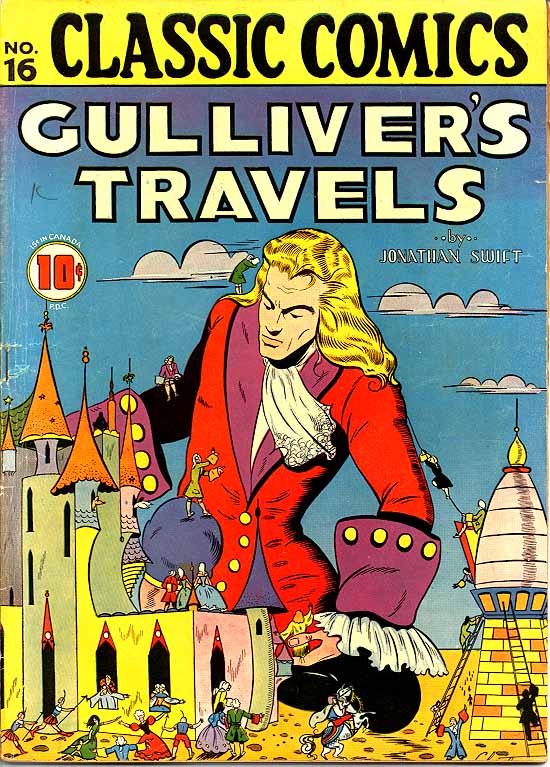
Above, Jonathan Swift’s “Gulliver’s Travels.” Although several segments of the book are quite well known, such as Gulliver’s encounter with the Lilliputians, the final portion of the work, a somewhat utopian society of horses called the Houyhnhnms is largely ignored. They are perfect for our purposes, however, since their vocabulary doesn’t have a word for lying and Gulliver must explain it as “the thing that is not.” Alas, we have found in “Mogul” many instances of “the thing that is not” and I suspect there are more occurrences ahead.

And no sign of how the death of Thelma Todd is in any way related to the Black Dahlia.

Page 26

“On the night Bugsy Siegel was shot to death while sitting on the sofa in his living room reading the Los Angeles Times of June 20, 1947, Vern and one of his pals lugged a large padlocked steamer trunk over to our house and stashed it in the garage. It contained something that belonged to Bugsy and remained in the garage for a number of months.”

Quick, Watson, the end notes. Ah, this is interesting (at least to a total research drudge, I suppose). Page 25 is attributed to the FBI’s files on Siegel, released through the Freedom of Information Act. Unfortunately, there are 2,421 pages in Siegel’s files and we’re not given the document number. An oversight, I’m sure. Luckily they are online (although heavily censored) right here.

Hm. Another volume from Wolfe’s five-foot shelf of secondary sources, “We Only Kill Each Other” by Dean Jennings. I checked to see if Florabel Muir’s “Headline Happy” is in the bibliography (it is) but there’s no use of her description of the crime scene, an unforgettable account (unless you are the author of “Mogul,” apparently) about Siegel’s eyelid being plastered on the wall and blood puddled on The Times dripping down on her satin evening slippers.

Curiously, Wolfe’s bibliography is missing “Beverly Hills Is My Beat,” by Beverly Hills Police Chief Clinton H. Anderson. Although Anderson was out of town on the night Siegel was shot, he fills in details about security in the city, including the fact that police cruised past Siegel’s house every 30 minutes. Given the basic procedures for crowd control and crime scene protection in place in the 1940s and depicted in Anderson’s book, the notion that Uncle Vern and an unidentified friend could spirit away something as large as a steamer trunk is virtually impossible. In light of the many “things that are not” concerning Uncle Vern, I wouldn’t believe this story unless I saw a picture of him and the trunk.

“Uncle Vern also knew a lot about the Black Dahlia case.”

This is a neat little way to tie the murder of Elizabeth Short into what so far has been a long and not terribly accurate digression into vintage malfeasance. Of course, given all the “things that are not” it’s hard to imagine Uncle Vern, the old souse, knowing much about anything.

Page 27

Once again, Wolfe shows an increasingly annoying ignorance of the difference between city and county jurisdictions, saying that Ray Pinker, head of the LAPD crime lab, inked Elizabeth Short’s fingers and obtained prints. This would actually be the job of the coroner, a Los Angeles County agency. Not the city of Los Angeles.

“When Donahoe learned that Examiner staff artist Howard Burke had been allowed into the morgue to make a sketch of the murder victim for identification purposes, Donahoe became angry and questioned the merits of the procedure.”

This is such junk. Attributed to a 2002 interview with Will Fowler, who by that time was barely lucid—at least whenever I talked to him. Will never told me anything like this and I spent lots of time with him. Let’s see if his book “Reporters” says anything about this.

Good for you, Will. Reporters, Page 77: “With no pictures other than the body of the unidentified girl to publish, artist Howard Burke created a likeness of the dead girls’ face from Paegel’s photos.”

That’s enough for today. I have to get going.

ps. OK regular readers (you know who you are)…. Should I keep going or have I made my point? Let me know. I may even enable commenting if you promise to behave yourselves.

Posted in Uncategorized | Comments Off on Blogging the Wolfe Book, The Houyhnhnms

Blogging the Wolfe Book, Uncle Vern

Page 24-25

I was breezing along (“breezing” being a relative term in reading a book at the molecular level) when I came across this little bon mot tucked into a sentence:

“Angry about the threats she was receiving if she didn’t cooperate with Bugsy Siegel and his pals, on December 11, Thelma made the mistake of going to District Attorney Buron Fitts’s office and lodging a complaint against the mobster who had muscled in on her café. She had no knowledge, of course, that the District Attorney of Los Angeles was on the mob payroll and that word would soon get back to the very people who had threatened her.”

Oh? And who might be the source for this little nugget of information? Quick, Watson, to the end notes.

Humph: “Hot Toddy,” Pages 171-172, 184. Now it doesn’t take much skill to find quibbles with Andy Edmonds’ book, even without buying it, nor to discover other accounts that Todd went to the police rather than the district attorney (recall that Wolfe has the annoying little problem of mixing up city and county government).

I’m going to take a rain check for now, but it’s terribly irresponsible to make such accusations without attribution, even if it’s to a potboiler on Hollywood scandals.

Time to trot out Uncle Vern again, the disgraced prosecutor who never was.

Aha! And it is Uncle Vern who tells young Donald his tales about Thelma Todd. Oh I see, Bugsy Siegel killed Thelma Todd, did he? Uncle Vern was working in the D.A.’s office, eh? I didn’t realize the district attorney was operating out of 405 Subway Terminal Building (MU-3790) in the 1930s. (Los Angeles Times, Oct. 27, 1934).

Hm. Hamilton represented Esther M. Jones in her divorce suit against her husband? (Los Angeles Times, Oct. 10, 1935). I guess we can conclusively write off any notion that Uncle Vern was ever a prosecutor.

But what’s this? On Aug. 5, 1942, Uncle Vern (attorney Vernon R. Hamilton) was bombed with tear gas by the Los Angeles County Sheriff’s Department because he had barricaded himself in his home and wouldn’t come out? He was put in jail? And where was this house? 407 N. Normandie? That would be nearly seven miles from South Camden Drive. Oh my! Looks like Judge Edward R. Brand found Uncle Vern in contempt for appearing in the court while he was drunk. And sent Uncle Vern to … jail?

And Uncle Vern was supposedly an attorney for the mob? Getting into the newspapers for showing up tanked in court, being gassed by the police and thrown into the graybar hotel by the judge? For the record, Jerry Giesler was Siegel’s defense attorney in the 1942 trial on charges of killing Harry “Big Greenie” Greenberg and I doubt very much if Giesler would let Uncle Vern as much as carry his briefcase.

Hm. Now Wolfe gives his address as 803 N. Roxbury, a bit of a drive for Uncle Vern if he’s in his cups.

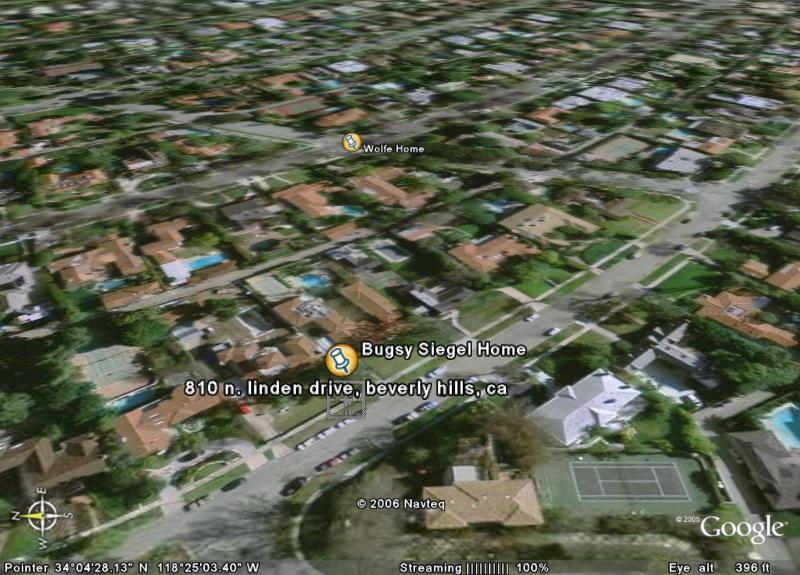
“…Bugsy Siegel and his girlfriend Virginia “Sugar” Hill, lived just behind us at 810 Linden Drive.”

The wonders of Google Earth. Notice the generous definition of “just behind.”

Now Wolfe builds to Uncle Vern the disgraced prosecutor who never was, the mob mouthpiece who never was, having a key to the home on North Linden Drive and taking care of it in 1946 while Siegel and Hill were off in Las Vegas building the Flamingo.

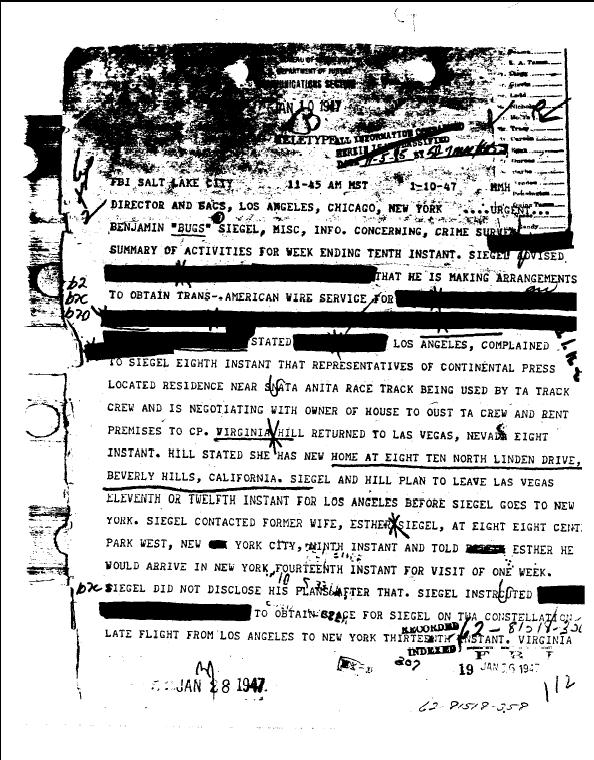
Except for one problem. Siegel didn’t move into the home on Linden until January 1947. How do we know? Because the FBI had him under surveillance.

Her new home? Jan. 10, 1947? And just whom was Uncle Vern house-sitting for in 1946?

Uh-oh.

ps. I’m quite serious about blogging this in real time. Well-intentioned people have tried to clue me in about what’s coming up next. I appreciate your concern, but please don’t spoil the fun, thanks.

Posted in Columnists, Uncategorized | Tagged | Comments Off on Blogging the Wolfe Book, Uncle Vern

Blogging the Wolfe Book, the Lookies


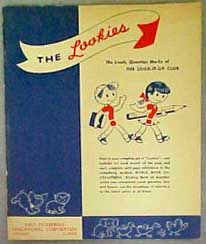
At right, one of the formative publications of my youth, which was included with the purchase of the World Book Encyclopedia. The Lookies had a wonderful motto: “We don’t guess, we look it up.”

Page 22

I really don’t want to get derailed into Thelma Todd as I can’t see what it has to do with the Black Dahlia case. I’m going to take a rain check with the simple proviso that given Donald H. Wolfe’s track record, there are going to be errors and misstatements. I’ll dig into it later if necessary, but this will have to do for now:

“Nevertheless, D.A. Buron Fitts insisted that her death was a suicide, though there were rumors among the movieland cognoscenti that Thelma Todd had been murdered by one of her intimate acquaintances—a mob boss who suddenly left town on the night of Thelma’s ‘suicide.’ ”

In fact, Fitts said: “We want it distinctly understood that we aren’t imputing this to be a murder. But there are circumstances that do not satisfy us. We intend to clear them up.” (Los Angeles Times, Dec. 19, 1935)

Moreover, the Los Angeles Police Department, under the auspices of crime lab chief Ray Pinker (the same man who had his hands in his pockets at the Black Dahlia crime scene), took Todd’s Lincoln and, using a volunteer, sealed the garage and started the engine to see how long it would take to render him unconscious. In 90 seconds, Detective Joe Whitehead was pounding on the door to be let out of the monoxide-filled garage.

It should also be noted that Todd’s death was investigated by the Los Angeles County Grand Jury. And in testifying before the grand jury, Pinker said that blood found inside Todd’s car contained carbon monoxide, excluding the possibility that the stains occurred before she started the car’s engine. According to testimony before the grand jury, Todd became unconscious from the fumes and struck her head as she collapsed, causing a wound that bled.

Eventually, the jurors found the evidence of suicide or accident so compelling that several of them refused to hear any more testimony.

I’ll leave Thelma Todd at this: It’s impossible to say Dist. Atty. Buron Fitts tried to cover up the case when it went before the grand jury.

What are the sources for this nonsense?

Samuel Marx and Joyce Vanderveen, “Deadly Illusions”; Andy Edmonds, “Hot Toddy”; and the Thelma Todd inquest report. Apparently Wolfe has some aversion to original sources such as newspapers. I’m mildly curious about the source of the Todd inquest. But not enough to go digging for it.

Page 24

Oh, more on Uncle Vern, the disgraced former prosecutor who never worked for the district attorney’s office. I don’t have time for this today.

Posted in Uncategorized | Comments Off on Blogging the Wolfe Book, the Lookies

Blogging the Wolfe Book, a Moment of Silence


Wednesday was the 61st anniversary of the kidnapping of 6-year-old Rochelle Gluskoter from the frontyard of a home around the corner from where her parents, Abe and Miriam, were preparing to open their market at 8464 S. Central Ave. Rochelle’s skeletal remains were found in a remote part of Orange County on Nov. 9. 1947. The case was never solved.

Page 21

Now back to all Wolfe’s stuff about “Uncle Vern,” who is presented as a disgraced former prosecutor but really wasn’t. This is terrible research and worse writing. Just an out-and-out lie.

“… resigning in 1938 under a cloud of scandal, along with Mayor Frank Shaw and District Attorney Buron Fitts.”

These comments, along with remarks about Dist. Atty. Steve Cooley assembling an archive of city and county documents on old cases, show a distressing unfamiliarity with local government. The district attorney is a Los Angeles County post, an entirely separate jurisdiction from the city of Los Angeles.

Wolfe is also wrong when he says Frank Shaw resigned—he was defeated in the Sept. 16, 1938, recall election and on Sept. 26, 1938, greeted his successor, Fletcher Bowron, and turned over the keys to his office.

But wait. Buron Fitts not only didn’t resign as district attorney in 1938, he held office for two more years until he was defeated in the 1940 election by attorney John Dockweiler, who had the endorsement of—Mr. Corruption himself, Joe Shaw, Mayor Shaw’s brother. (For the record, The Times endorsed Fitts).

What’s this? Fitts got an indictment against Joe Shaw? Fitts won a conviction against Joe Shaw and William Cormack on 63 counts of selling answers to Civil Service exams for the police and fire departments? Shaw and Cormack were sentenced to five to 70 years in prison?

My goodness. It’s certainly a challenge to say Fitts and Mayor Shaw were in a corrupt conspiracy when Fitts sent the main offender, his brother Joe Shaw, to prison.

Oh boy. We’re heading quickly into vintage malfeasance: Paul Bern and Thelma Todd. I consider myself a specialist rather than a generalist and stick to the Black Dahlia case so I may take a rain check on some of this material unless it turns out to be somehow connected to the murder of Elizabeth Short.

Wolfe dispenses with Bern’s suicide in one line:

“Before the days of tabloid scandal sheets, Buron Fitts had covered up enough crimes and scandals to decimate forests of tabloid pulp. One of the notorious scandals had involved the alleged suicide of Jean Harlow’s husband, Paul Bern, who many believed had been murdered by mobster Longy Zwillman.”

“Many believed?” Like who?

For the record, Bern’s nude body was found Sept. 5, 1932, in the closet off his bedroom, a bullet in his temple and a .38 revolver clutched in his hand in what was apparently a death grip. A suicide note on the table:

“Dearest Dear: Unfortunately, this is the only way to make good the frightful wrong I have done you and to wipe out my abject humiliation. Paul.” He added the postscript: “You understand that last night was only a comedy.”


In 1933, the Los Angeles County Grand Jury opened an investigation of Bern’s death. Fitts said: “If information should be disclosed warranting a reopening of the Bern case, such action will be taken.” The grand jury interviewed more than 50 witnesses and issued a long statement concluding: “We are definitely of the opinion at this time that Paul Bern died as a suicide.

“After a thorough and exhaustive examination, we are of the opinion that the facts as disclosed do not warrant the expenditure of public moneys for further proceedings in this case.” I invite anyone who cares to read the entire statement to peruse the March 1, 1933, Los Angeles Times, first page of Part II.

Not exactly a cover-up, is it?

Suggested further reading: “The Lid Off Los Angeles,” a series of weekly articles in Liberty magazine, Nov. 11-Dec. 16, 1939, which prompted a libel suit by former Mayor Shaw. It’s available on microfilm at the downtown Los Angeles Public Library.

A day’s posting on one sentence doesn’t bode well, does it? Especially when Wolfe says exactly the opposite of what actually occurred.

Techie note: I have enabled an RSS feed. The link is http://lmharnisch.blogspot.com/atom.xml This seems to work once I stopped writing in Microsoft Word and pasting it into Blogger. Blogger, btw, has a toolbar for writing in Word and posting directly to Blogger. We’ll see how it works.

A shout out to:

Texas A&M University (165.91.69.122)

South Bank Polytechnic in London (136.148.1.142)

Vastra Gotaland in Sweden (213.80.115.71)

Broadband Access Pool of Finland (80.220.223.10)

Naples, Fl, Philharmonic (63.107.11.106)

Lucas Film (63.82.98.50)

Hurry on back!

Posted in Uncategorized | Comments Off on Blogging the Wolfe Book, a Moment of Silence

Blogging the Wolfe Book, Time for a Reality Check

I was all set, or so I thought, for today’s entry. And then something fell in my lap that I simply couldn’t ignore.

Let’s suppose you are an established author with a well-known book on a particular subject. Let us further suppose that another writer comes along, uses your book as the backbone for his work, runs a picture of you and praises you in his acknowledgements.

He even has a blurb from you on the book jacket saying that his work is a classic.

Now, someone comes along and interviews you about this book. Do you say it’s a classic? That your picture is in it? That you’re praised in the acknowledgements?

Absolutely not. Instead you completely disavow this book.

I just reread that and it doesn’t make any more sense to me now than when I typed it.

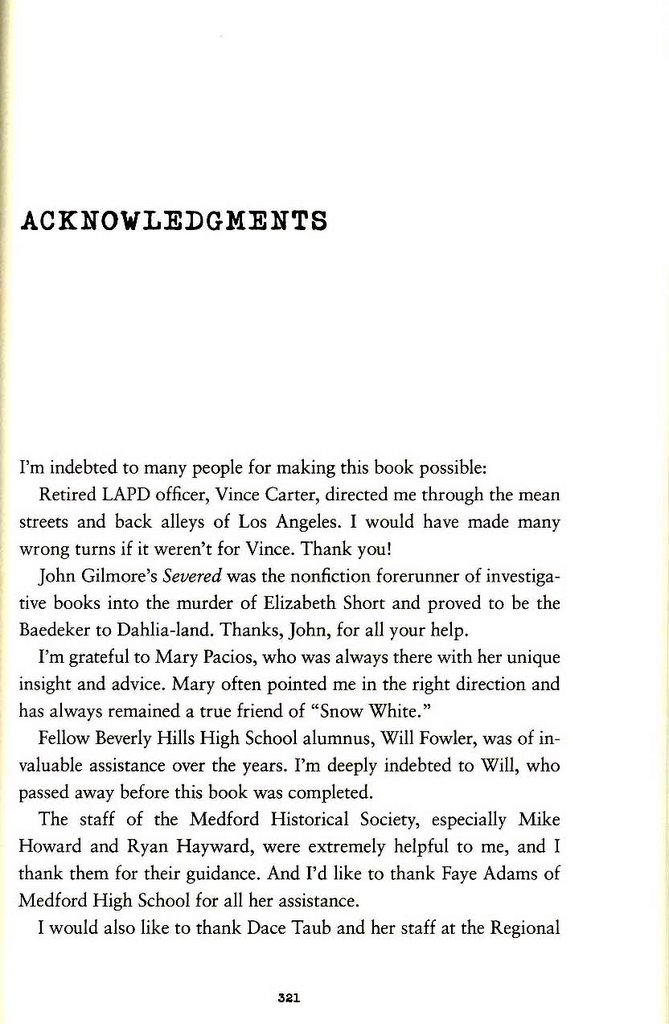
Here is a scan of the acknowledgements from Donald H. Wolfe’s “The Black Dahlia Files: The Mob, the Mogul and the Murder That Transfixed Los Angeles.”

It says: “John Gilmore’s Severed was the nonfiction forerunner of investigative books into the murder of Elizabeth Short and proved to be the Baedeker to Dahlia-land. Thanks, John, for all your help.”

And here’s a scan of the blurb from the book jacket.

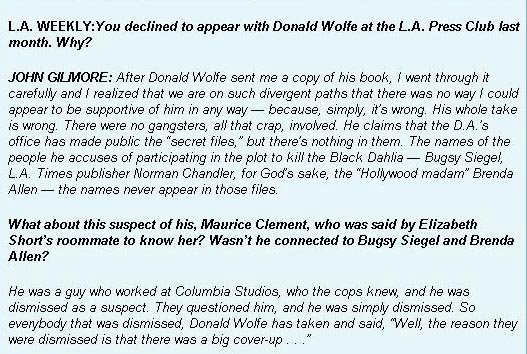
And now here is L.A. Weekly’s interview with John Gilmore. In a screen shot—so there’s absolutely no question that any of this is made up.

This would be like James Ellroy endorsing my research in the documentary “Feast of Death,” and then writing an introduction to Steve Hodel’s “Black Dahlia Avenger,” endorsing George Hodel as the killer. And then refusing to talk about it.

Oh wait. That actually happened.

Curiously enough, L.A. Weekly’s Anthony Mostrom doesn’t seem to ask John Gilmore, “How can you say: ‘There was no way I could appear to be supportive of him in any way’ when you call his book ‘a must-read!’ “?

Nor did Mostrom ask: “Well, John, after writing the jacket blurb for Donald Wolfe’s book saying that it’s a classic, why are you calling it ‘crap?’ Isn’t that considered bad form in the book publishing industry?”

I can only assume follow-up questions aren’t part of Mr. Mostrom’s repertoire. You might want to work on that, Anthony, old boy.

Time for a walk—a long one.

Here’s a shout out to:

UCLA (128.97.48.42)

The Air Force Systems Command (138.13.212.7)

Symantec (65.88.178.10) (you guys rock).

Boeing (130.76.64.15)

Telekom Malaysia Berhad (218.111.148.106)

National Archives and Records Administration (207.245.173.48)

and the Internet Assigned Numbers Authority (173.40.11.131)

Hurry on back!

Posted in Uncategorized | Comments Off on Blogging the Wolfe Book, Time for a Reality Check

Teutonic Thoroughness, Nathan Marsak Style


You might ask yourself what bright, well-educated people with an arts background (art history for Nathan Marsak and Kim Cooper, musicology for yours truly) discuss when they get together.

Of course, the subject is the prevailing market value of Jabberjaw lunchboxes on ebay.

Kim, consulting her laptop: “32 bucks!”

Nathan: “Nooooo! I should never have blown mine up with an M-80!”

This was followed by an e-mail discussion of “Jabberjaw” broadcasts in German, discovery of a catalogue raisone of “Jabberjaw” episodes and the following riff by Nathan:

Jabberjaw: Ich, Jabberjaw. Die Seele von der Nation schlägt als ein Herz im Willen des Mannes.

Glückliche Kinder: Ja, Herr Jabberjaw. Wir sind Ihre Günstlinge. Lehren Sie uns die Wahrheit, als wir von Zarasthustra gelehrt worden sind.

Jabberjaw: Sie können nicht gelehrt werden. Sie können zerstört werden. Das ist Ihr Gebrauch zu mir. Der Wille von den Staatlichen Nachfragen nein weniger.

Glückliche Kinder: Ja, Jabberjaw! Formen Sie uns mögen so viel teutonisches Ton!!

Posted in Uncategorized | Comments Off on Teutonic Thoroughness, Nathan Marsak Style

Blogging the Wolfe Book, Teutonic Thoroughness


Several years ago, I was interviewed by a writer for the German magazine Stern about the Black Dahlia case. In explaining what was wrong with the various Dahlia books, I said: “They lack Teutonic thoroughness.” Of course, it was to be amusing and the writer thought it was an uproarious thing to say. But as a German, he could appreciate the full meaning of that statement, while most American writers wouldn’t understand it.

Here are two models of the good side of Teutonic thoroughness: Ritter von Koechel, above, and Wolfgang Schmieder, who catalogued the works, respectively, of Mozart and Bach. You know from the title that “Das Bach-Werke Verzeichnis,”at left, isn’t going to be a light read.

Page 21

“It was the Hearst papers that gave the Black Dahlia story the biggest play.”

This is certainly true in comparison with The Times, but the Daily News scored several firsts in the Dahlia coverage and even The Times scooped the Examiner on occasion. The competition between the four major papers ensured that no single paper prevailed every day.

Hm. Wolfe’s going to get into his grandmother Bessie Harkins and her boyfriend “Uncle Vern,” a.k.a. Vernon Hamilton, supposedly a former prosecutor. Not a familiar name. Let’s see what happens.

“Vern’s name was Vernon Hamilton, and he had been an assistant district attorney in Los Angeles before resigning in 1938 under a cloud of scandal, along with Mayor Frank Shaw and District Attorney Buron Fitts.”

Wolfe is certainly right that Frank Shaw was corrupt and that he was defeated in a recall election by Judge Fletcher Bowron.

Good grief…. Here’s a historic sidelight. A Vernon Hamilton (a different one, I’m sure) of the Westminster-Midway City Lions Club appears in a minstrel show in June 1956. The idea that people were still doing minstrel shows in blackface in the 1950s is, I must say, breathtaking. Even for Orange County. As for The Times running a picture of two men joking around in blackface, it’s pretty painful.

Hm. This is looking really, really bad. Vernon Hamilton was an attorney in Los Angeles, all right, and—what’s this? had an office in the Subway Terminal Building in 1934? Looks like quite a colorful character who handled several murder cases as a defense attorney. I don’t see anything about him ever being a prosecutor though. Let me double-check. Private practice in 1942, private practice in 1934, private practice 1931, private practice 1928.

Nothing about him resigning in 1938, nothing about him being a prosecutor—ever. Kind of unusual for a defense attorney to take a job that pays less with the district attorney’s office. Looks like Vernon Hamilton was well established in private practice as early as the 1920s. There’s nothing in The Times about Vernon Hamilton being a prosecutor with the district attorney’s office or resigning in 1938—zero. Given Wolfe’s poor track record on accuracy, I’ll have to assume Hamilton probably wasn’t a prosecutor unless I see some conclusive proof.

I hope Wolfe doesn’t hang much of his story on “Uncle Vern” because I don’t want to get derailed into debunking all of this—it’s very removed from the Dahlia case. On the other hand, if Hamilton’s connection to the district attorney’s office is entirely fabricated, “Mogul” is worse than I ever imagined. And it looks like we’re heading into the Thelma Todd case, very far afield from Elizabeth Short.

On the bright side—if one can say there’s a bright side to what appears to be a total lie—is that at least there was a Vernon Hamilton in Los Angeles in the time period and he was even a lawyer. This is light-years ahead of “Severed,” which is filled with purported “interviews” of people who don’t even exist.

I have to go for a walk and clear my head.

Here’s a shout out to:

The Rand Corp. 130.154.0.250

Vatterott College 67.130.177.34

City of Los Angeles 161.149.63.203

Chase Manhattan Bank 170.148.92.42

Fidelity National Title Co. 63.164.5.222

and

Chicago-Kent College of Law 66.158.3.199

Hurry back now.

Posted in Uncategorized | Comments Off on Blogging the Wolfe Book, Teutonic Thoroughness

Blogging the Wolfe Book, the Subject Is Roses

I always cut my roses on Jan. 15 as a memorial to Elizabeth Short, because I remember that on the night before the body was found a neighbor had a strange encounter at the crime scene when he went there to dump some rose clippings.

Frankly, it’s scary to chop my roses down to sticks but sure enough by Valentine’s Day they are coming back to life, especially now that they’ve gotten some 12-18-6.

A couple things before we move on.

I thought it would be interesting to see how Steve Hodel, the retired homicide detective, treated the handling of the crime scene in hopes that “Dahlia Avenger,” despite all its problems, would be more accurate than “Severed” and “Mogul.”

The depiction of the press isn’t all that accurate (“Dahlia Avenger” talks about keen competition for a byline when even the briefest glance at the 1947 papers show that reporters never got bylines except in rare instances). And “Avenger” uses Will Fowler’s yarn—of course I fell for that myself the first time around. Will worked for years to embed himself in the Dahlia case.

But there’s none of the absurd claims of discarded cigarette butts and flashbulbs, curiosity-seekers circling the block and people standing on cars.

Here’s the two-minute executive summary before we move on to Chapter 2:

In the preface and first 20 pages, Donald H. Wolfe’s “Mogul” has made sweeping statements of staggering fiction (“there was no nightlife in the 1940s”), gotten access to original documents but rejected them in favor of a sleazy, sensational paperback written in 1994 (“Severed” instead of the original LAPD summary of the case) and shown a complete disinterest in minor details of spelling names (Betsy Bersinger instead of “Betty Bersinger”).

He has also relied on two mutually exclusive accounts (Will Fowler in “Reporters” and John Gilmore in “Severed” even though Will voices utter disdain for Gilmore). Further, he cites other books as sources but completely contradicts them (Mary Pacios’ “Childhood Shadows” on Betty Bersinger not recalling anything about the body, while “Mogul” goes into great detail on what Bersinger supposedly remembered).

In short, “Mogul” is a $30 book with lousy proofreading and even worse fact-checking that wouldn’t pass muster as a high school research paper.

I’m blogging “Mogul” in real time and not reading ahead, though I did skip to the footnotes and bibliography as any historian would. I don’t know any more about this book aside from the “high concept” (Elizabeth Short gets wrapped up with call girl Brenda Allen, is carrying the love child of Times executive Norman Chandler and refuses to get an abortion, so she’s killed by Bugsy Siegel). But the prospects that “Mogul” is going to suddenly turn into a model of scholarship are not good.

I warned you this would be tedious for readers. It’s even more tedious for me. I don’t need to read another word to know I’m going to find many more gaffes ahead. The only reason I’m doing it is because people keep telling me what a wonderful book this is.

Still, I must say I find the interest in this blog so far quite gratifying. Here’s a shout out to:

Loyola Marymount University, Cal State Northridge, University of Missouri at Rolla, Rutgers University and Tufts University in Elizabeth Short’s hometown of Medford, Mass.

Buena Vista Datacasting (12.31.170.30), Turner.com (64.236.221.6) and castandcrew.com (63.113.17.130).

The U.S. Senate sergeant at arms (156.33.165.26).

Someone in Falls Church, Va., the home of a law enforcement expert whom I respect tremendously.

Somebody in Salt Lake City, home of an enthusiastic but fairly reclusive collector of Elizabeth Short material. Twenty-three visits totaling 5 hours and 17 minutes, thank you, 70.56.97.241!

And who knew the Dahlia would be so popular in Sweden. Four visits for a total of 16 hours? Thank you, 213.80.115.71!

And Pendleton, S.C. Now that’s a surprise. Hurry on back!

Let’s move ahead.

Oh dear.

“The Los Angeles Times put the murder story on the front page of the morning edition of January 16; the headline was less lurid, yet the article vividly described the mutilated victim.”

For the record, as the conservative family paper of Los Angeles, The Times was the only newspaper to keep the Black Dahlia story off the front page except for one day when it covered the false confession of Joseph Dumais. My story on the 50th anniversary was only the second time in half a century that the Black Dahlia made Page 1 of the Los Angeles Times.
This book is brimming with instances in which Wolfe seems absolutely incapable of reading what’s directly in front of him.

I’m going to go check my roses.

Posted in Uncategorized | Comments Off on Blogging the Wolfe Book, the Subject Is Roses

Blogging the Wolfe Book, I’m My Own Grandpaw

Page 16

In the Black Dahlia books, all roads lead to William Randolph Fowler and it would be interesting to see how a sociologist would make a graph of the incestuous literary kinship system.

Will talks to Mary Pacios, who collaborates with John Gilmore on “Severed.”

Will talks to Donald H. Wolfe (“Mogul,” footnotes Pages 361-362).

But there’s more.

Will talks to Robert “I was married to Marilyn Monroe for three days until the studios scotched the deal” Slatzer. “Reporters,” Pages 286-288.

In fact, Will told me repeatedly that he was the ghostwriter on Slatzer’s bogus 1974 book “The Life and Curious Death of Marilyn Monroe.”

“Until recently I considered Slatzer to be a harmless faker—that is, when he lately deceived an entire network with a made-for-TV movie with a title something like, “Marilyn and Me.” (“Reporters,” Page 288).

But wait. There’s more.

Wolfe also talks to Slatzer. In fact Wolfe, the author of “The Last Days of Marilyn Monroe” and “The Assassination of Marilyn Monroe,” mentions Slatzer in his acknowledgements as a friend and contributor. (“Mogul,” Page 322).

And….

Wolfe talks to John Gilmore, who provides a jacket blurb: “A haunting account, destined to become a true crime classic. A must read!”

But wait. There’s still more.

In the unpublished version of “Severed,” in the Gilmore archives at UCLA, there’s a ridiculous section claiming that Elizabeth Short had a lesbian affair with (surprise) Marilyn Monroe, as told by, yes, Robert “I was married to Marilyn Monroe for three days until the studios scotched the deal” Slatzer.

I would be hard-pressed to pick a group of writers less likely to tell the truth than this crowd.

The most interesting thing about all of this is that when I met Wolfe at the district attorney’s office as he was going through the Black Dahlia files, he was incredibly disparaging about—William Randolph Fowler. In fact he told me a very interesting story about a restraining order involving Will. So imagine my surprise to find Will so heavily credited in “Mogul.”

Page 17

Back in those days, few people had television. The one Los Angeles television station, KTLA, was only on the air for three hours in the evening, and the news still belonged to the paper and ink and the radio waves.

For the record, there were two TV stations in Los Angeles in 1947: KTLA and Don Lee’s W6XAO. But at the time TV sets were incredibly rare and broadcasts consisted of test patterns and “Queen for a Day.” Of course television didn’t really get underway until March with the heavily promoted “T-Day.” See the 1947 Project for much, much more on television in early Los Angeles.

The good news is we’re finished with Chapter 1. The bad news is my head is spinning for trying to unravel the tangled web of Dahlia writers. I have to go for a walk.

Bonus picture: Will Fowler and Ray Pinker on the sidewalk at the crime scene. Note that Pinker’s hands are in his pockets, exactly what you’d expect from the head of the crime lab. The only person close to the body is Gilbert Laursen, the LAPD photographer. No cigarette butts and no blackened flashbulbs, just as I said yesterday. I don’t like posting the crime scene pictures. I’m showing this intentionally murky image simply to prove that the investigators didn’t mishandle the crime scene, as is so frequently claimed.

Posted in Uncategorized | Comments Off on Blogging the Wolfe Book, I’m My Own Grandpaw

Blogging the Wolfe Book, the Thrill Is Gone

Page 14

“Hansen studied the body and the ‘sacred setting’ for some time before he stood up and said to Finis, ‘We won’t know what we’re really dealing with here until we get a post mortem.’ He requested that the body be covered until Ray Pinker of the crime lab arrived.”

I could quit here and be a happy man. Wolfe has been given access to the district attorney’s files. He even reprints the first two pages of the LAPD summary on Pages 325-326 of “Mogul.” But clearly Wolfe hasn’t read his own book. If he had, he would know that Pinker beat Hansen and Brown to the crime scene.

No, instead we get “Severed,” Page 10, with its assertion that the body was covered with newspapers until Pinker arrived. (And as a bonus, “Severed” claims Elizabeth Short was cut in half with “something like a bread knife.” I invite anybody who cares to attempt this to carve a turkey with such an implement next Thanksgiving. Let me know how you do).

Time for more Boy on the Bicycle stories (by now he was trolling Norton Avenue from 4 a.m. to when Will got there at 9 a.m. Apparently the Schwinn was getting a five-hour workout that morning).

“Investigators found a man’s wristwatch in the weeds near the body. It was determined that the watch had only recently been lost as it did not appear to be weathered.”

Until Steve Hodel dredged up this wristwatch in “Dahlia Avenger,” it was a footnote to a footnote. Of course Hodel uses it as yet another piece of incriminating evidence to implicate Dr. George “Evil Genius” Hodel in the killing and goes so far as to produce pictures of his father wearing a watch.

Another bit of three-card monte. Wolfe makes it appear that the watch was found by detectives in proximity to Elizabeth Short at the time the body was discovered.

No

And

No

And

No.

First, according to the Herald-Express and the Los Angeles Times, the watch wasn’t found until about four days later.

Second, it wasn’t discovered by investigators, but by Daniel Wright Jr., 16, of 3535 S. 5th Ave.

Third, the watch was found 200 yards south of the crime scene.

“Mogul,” however, reports sternly: “The person, or one of the persons, who disposed of the body, may have discovered that his watch was missing and suspected it had been lost at the site. Perhaps concerned that a fingerprint could be found on the face or back of the steel casing, the owner might have returned in the black sedan in an attempt to retrieve it. Thought it was stated by the press that ‘Police chemists were checking ownership of the military watch,’ no follow-up stories appeared regarding results of the examination for prints.”

Time for my walk.

Posted in Uncategorized | 1 Comment

Location Sleuth

Look what I found while watching the opening of “Some Like It Hot.” Why it’s signage for a 1950s Standard gas station. Hey isn’t that going to be in the shot? Naw, don’t worry about it.

Posted in Uncategorized | Comments Off on Location Sleuth

Blogging the Wolfe Book, the Riddler


Pages 12-15

Here’s a riddle: Let’s suppose for a moment that you are writing a historical piece; nothing terribly esoteric for a scholarly journal but something for the average reader. You have a choice between a schlocky, sensational paperback and original documents that few people are allowed to see.

Wrong.

If you’re Donald H. Wolfe, you’d forget the LAPD summary in the district attorney’s files and pick the schlocky, sensational paperback, “Severed.”

“Mogul,” Page 12; “Severed,” Page 9

“By the time Hansen and Brown reached the new location, reporters from L.A.’s newspapers had converged on the area, littering the street and sidewalk with cigarette butts and blackened flashbulbs from cameras. Several more police and onlookers had found their way to the site—some were driving around the block while others parked and stood on the roofs of their cars for a better view.”

Let’s have fun with this. Here’s a better picture of Aggie Underwood at the crime scene. Note 1) that she is standing in the street. Note 2) the police officer next to her also isn’t permitted to get any closer to the body and 3) notice that the news photographer has to stand on the roof of a car because he isn’t allowed any closer to the body. Also note that nobody is tromping through the crime scene. The books that insist the crime scene was violated are lying.

We turn to Wolfe’s bibliography to check his sources and Ach! Mein Gott this is worse than I thought! Wolfe reproduces the first two pages of the police summary (“Mogul,” Page 325-326) and totally ignores it. In-cred-i-ble.

As clearly stated in the LAPD summary as reproduced on “Mogul,” Page 325, police officers present at the crime scene included, along with responding Officers Perkins and Fitzgerald: “Sgts. Wynn, Vaughn, Forensic Chemist Ray Pinker, photographer Laursen from Sci. Investigation Division, and representatives and photographers from the newspapers. Pictures had been taken by the newspapers of the body. They were later joined by Lt. Leland V. Jones of the Scientific Investigation Division.”

Do any of these people appear in Wolfe’s treatment of the crime scene? Except for Pinker, no. For an alleged history, this is extremely poor work. It’s one thing not to have access to material and quite another to be granted access and ignore it.

Instead Wolfe recycles “Severed’s” treatment of the crime scene, with Hansen bellowing at Pinker in the best Moe Howard fashion “Get over here!” (Cue SFX: bop, slap, bonk!). I almost expect Gilmore to have Hansen say: “Spread out!”

More important, the contention in “Severed” and all the books that follow is an insult to the men who worked the Black Dahlia case. This was not a case of dozens of police officers tromping through the grass, as portrayed in either “Who Is the Black Dahlia?” or more likely “True Confessions” (sorry, I know it’s in a film, but I forget which one).

For the record, there isn’t a single crime scene photo showing anyone in the grass and weeds to the west of the body except for the two lead investigators, Harry Hansen and Finis Brown, and they don’t approach the body until they have been cleared by Gilbert Laursen, the gent in the sweater seen in so many gruesome pictures on the Internet.

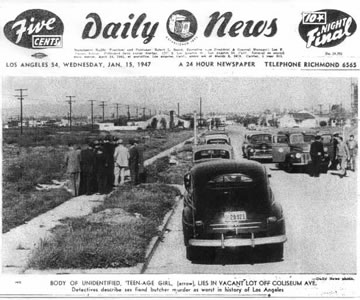
Take a look at the picture above: Nobody is standing in the grass but keeping carefully on the sidewalk. People aren’t circling the block to get a better view. There’s nobody standing on a car except the photographer who took this picture, and that was because he couldn’t get any closer. Bonus fact: This picture is from a website that doesn’t reveal its extreme manipulation of photos. This image has spread and is now deemed an authentic picture of the Daily News front page. In fact, the real Daily News front page had a large white arrow painted on the picture to indicate the body.

If you’ll notice in the pictures, Ray Pinker—one of the leading forensic chemists of his day—has his hands either in his pockets or otherwise secured so he won’t touch anything. These investigators were the elite of their era. Any statement other than that is simply not supported by the facts.

This is why I keep saying “Severed” is 25% mistakes and 50% fiction.

(And let’s backtrack for a moment to “Mogul,” Page 11. Wolfe puts the Hollywood Citizen-News at the crime scene, but that’s not so easily established. The Citizen-News’ Page 1 story reads like a rewrite of the Herald but makes a significant error, wrongly stating that Elizabeth Short’s right leg was broken, virtually ensuring that the writer didn’t see the body. This error gets picked up in a few minor treatments of the Dahlia case, but luckily hasn’t assumed the status of an Internet virus).

“Watson, you see, but you do not observe.”–“A Scandal in Bohemia”

Posted in Uncategorized | Comments Off on Blogging the Wolfe Book, the Riddler

Blogging the Wolfe Book, a Moment of Silence, Please

Today is the anniversary of the Feb. 10, 1947, Jeanne French murder. Frequently linked to the Black Dahlia in the popular imagination and absurdly claimed as one of the umpteen victims of Dr. George “Evil Genius” Hodel in “Black Dahlia Avenger,” French was a tragic, broken-down alcoholic. Spending the last night of her life in a Westside cafe, she dumped the contents of her purse on the bar and picked through the debris in hopes of finding enough money for just one more drink. She had no paper money, nothing more than a few coins. Whoever killed her beat her with the handle of a socket wrench, pushed her out of his car into the street and stomped on her until a rib broke and punctured her heart. A bleak, terrible death.

Her son, David Wrather, told the coroner’s inquest: “She’s gone now and I’m sure she would want me to say the right thing—she made a lot of her own trouble.”

Incidentally, I’m not the only one faulting “Mogul.” Carolyn See’s Washington Post review calls the book: “Old-fashioned porn for those who look at a pretty girl and think of a chain saw.”

Pages 9-11

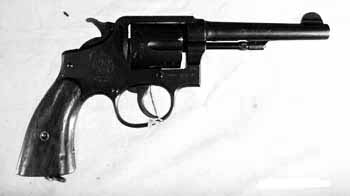
Now it’s time for Will Fowler’s well-worn story about being the first person at the crime scene, Felix Paegel taking a picture of him with the body (“all aloonnnnnee” “nooooobody around”), the cops showing up and pulling their guns (below a Smith & Wesson .38 Victory Model), Will distracting the police with the boy on the bicycle, heading back to the Examiner to put out an extra and then returning to the crime scene to “throw off the competition.”

I fell for this story, even though Will couldn’t produce the picture of himself with the body—and it turns out nobody has ever seen it. He always claimed “somebody swiped during a drinking party or I gave it away or something.”

But like most of Will’s yarns (closing Elizabeth Short’s eyes, loading the body into the hearse, walking through the crime scene so he could fire off the quip: “You know how much these suicides upset me” and the infantile genatalia) it’s simply not true. Will wasn’t the first person at the crime scene and the Examiner never put out an extra. Of the dozens of crime scene photos, not a single one shows him or any reporter anywhere except the sidewalk or the street.

Wolfe lifts Will’s explanation of a 390W, right down to the erroneous meaning of a 415. Will calls it indecent exposure, but any fan of Jack Webb knows it’s disturbing the peace (“The Badge,” Page 305). Will made sure anyone who interviewed him knew it was a 390W as an attempt to get that detail in a story. He once asked me: “Isn’t it amazing that I remember the radio call after all these years?” He fooled me with some of his tall tales, but even I recognized that as an obvious plant.

“Mogul” takes Will’s story pretty much verbatim from “Reporters,” but even here mangles some of the quotes:

“Reporters,” Page 72: “Jesus, Felix, this woman’s cut in half!”

“Mogul,” Page 9: “God, Felix, this woman’s been cut in half!”

And “Mogul’s” facts are wrong too, referring to Officer William Fitzgerald instead of Wayne Fitzgerald, but this is to be expected since Wolfe is referring to “Severed,” Page 3. (If I didn’t mention it, although I’m fairly sure I did, “Severed” is 25% mistakes and 50% fiction).

Good grief! Wolfe can’t even quote from “Severed” without making an error.

Actual name: Wayne Fitzgerald

“Severed”: Will Fitzgerald

“Mogul”: William Fitzgerald

Yet another lesson in why any good writer should do his own research. And avoid secondary sources.

More important, Wolfe ignores Will’s time line.

In “Reporters,” Page 71, Will puts himself at the crime scene at 9:05 a.m., nearly 90 minutes before Betty Bersinger discovered the body, according to Elizabeth Short’s inquest.

Uh-oh.

Instead, “Mogul” rolls the clock ahead to place Will at the crime scene at 10:45 a.m. This is still a neat trick, because according to the inquest, police didn’t get the original call reporting the body until a little before 11 a.m.

What’s this? My eyes just fell on Page 11, in which Wolfe calls it a 309W. (Did I mention this is a $30 book? Where are ReganBook’s proofreaders?)
And I have to come to the defense of Aggie Underwood. Wolfe picks up Will’s story about her kneeling over the body when Will made his second trip to Norton Avenue. In reality, Underwood had been to the crime scene and was long gone by the time Will got there, as shown in pictures taken by the police and news photographers.

Worse yet, Wolfe picks up “Severed’s” claim that “You could see the color drain right out of her like you’d opened a spigot on her bottom side.” Although Aggie had seen many murder victims in her career, the sight of the mutilated body lying in the weeds near the sidewalk knocked her off balance, and [Officer] Perkins remembered that she “staggered backwards, almost right off the edge of the curb—and almost fell down on her keester.”

Can Wolfe quote “Severed” correctly? Of course not.

“Severed” Page 6

“It sort of tickled us standing there,” he says, “and watching her back up—walking backwards almost right off the edge of the curb—almost down on her keester.”

Luckily, we have Underwood’s own account of the Black Dahlia, in her 1949 biography “Newspaperwoman,” written with Foster Goss.

“Newspaperwoman” Page 6.

“One of the four radio patrolmen, who had arrived ahead of homicide detectives, tried to stop me. I said I was from the Herald-Express and brushed past him. I’ve learned that to halt for explanations brings arguments and wastes time.

“In a vacant lot amid sparse weeds a couple of feet from the sidewalk lay the body. It had been cut in half through the abdomen, under the ribs. The two sections were ten or twelve inches apart. The arms, bent at right angles at the elbows, were raised above the shoulders. The legs were spread apart. There were bruises and cuts on the forehead and the face, which had been beaten severely. The hair was blood-matted [note: this is wrong, lrh]. Front teeth were missing [also wrong]. Both cheeks were slashed from the corners of the lips almost to the ears. The liver hung out of the torso, and the entire lower section of the body had been hacked, gouged and unprintably desecrated. It showed sadism at its most frenzied.

“Some of the police argued that she was a woman of thirty-six. Noting the youthful condition of the breasts and the smooth thighs, I said she was much younger.”

Not exactly the account of someone who nearly fell on her keister (note proper spelling).

For the record, here’s a shot (swiped off the Internet) of Aggie Underwood at the crime scene. I have a better version but you don’t need to see it. Nobody does. But note that she’s standing out in the street, well away from the body. The police protected the scene much better than crime authors would have you believe.

Will did get one thing right about the Dahlia case, however. He dispensed with the books in one word: “Lies!”

Posted in Uncategorized | Comments Off on Blogging the Wolfe Book, a Moment of Silence, Please

Blogging the Wolfe Book, Neutral Milk Hotel


I was at a signing at Book Soup last night for Kim Cooper’s “In the Aeroplane Over the Sea” (important note: there’s parking behind the store, otherwise you have to contend with West Hollywood’s insane parking situation. Those people aren’t cruising Sunset Boulevard, they’re just looking for a parking place). The attendant at the lot two blocks away ($7) asked me if I was headed for the Roxy, which made me laugh all night. Yeah, that’s me, Mr. Viper Room.

A common question at the signing: C’mon, Harnisch, are you really going to blog the entire Wolfe book?

I don’t know. People tell me what a great book this is, so I’m obligated to read it. Especially since 1) I met Donald H. Wolfe at the district attorney’s office when he was researching the Dahlia case and even sent him some documents, and 2) he uses some of my material (sans permission or acknowledgement) without changing a comma.

Still, there are rewards to reading a book at the molecular level. For example, I’m continually entertained by “Black Dahlia Avenger’s” absurdly confident statement (Page 3) that the Los Angeles Police Department handled such important murder cases as the “Red Light Bandit” (Caryl Chessman, left, was executed even though he never killed anybody, which was one reason his case was so controversial), Bugsy Siegel (Beverly Hills Police Department) and Fatty Arbuckle (take that, San Francisco Police Department).

Here’s the two-minute executive summary on “Mogul”:

This book is bad. It is based on secondary sources (and doesn’t even handle them well), misspells names, mangles the facts, exaggerates details and suppresses crucial information. All this in the first eight pages of background. Believe me, if a book can’t be trusted with simple information, it isn’t going to suddenly get better when the material gets more complicated.

OK, executives, you can stop reading now. Anyone else, as they say in the Marines: “Follow Me.”

Page 8

The legs were disconnected from the waist… The breasts seemed to have been detached…

I don’t like talking about the condition of the body but this makes it sound as if the legs were separated at the pelvis. Elizabeth Short was cut just above the waist. And the claim about the breasts is wrong, according to the transcript of the autopsy included in the inquest.

Mrs. Bersinger noticed that the head had been badly damaged and that there were red marks on the face. She suddenly stopped pushing the baby stroller and stared at the broken head in frozen disbelief as she realized that the red marks were congealed blood…

This is a nice bit of literary three-card monte (shout out to Nathan Marsak, thanks for the picture, crime buddy). Wolfe needs to introduce the condition of the body so he hangs it on Bersinger, except it didn’t occur that way.

Let’s take “the breasts seemed to have been detached.” To whom did it seem that way? Bersinger? For the record, she doesn’t give interviews. I was lucky enough to talk to her and her husband, John, in 1996, and they are wonderful, gracious people. But she does not like discussing the Black Dahlia murder doesn’t talk to the media any more.

In her interview with me, however, she described her encounter as being very brief. She did not stand and gape at the body, but saw it out of the corner of her eye as she was focusing on the stroller, looked just long enough to realize what was in the grass and hurried down the street to report it.

Since she didn’t talk to Wolfe, he used the original Examiner story and “Childhood Shadows.”

And what do we find in “Childhood Shadows” Page 68?

Uh-oh.

“The head was turned slightly toward her, but Mrs. Bersinger couldn’t see the features. Everything was blurry.”

But what about: “Mrs. Bersinger noticed that the head had been badly damaged and that there red marks on the face”? What about she “stared at the broken head in frozen disbelief”?

Nope. Nobody has ever said that. Not Wolfe’s two supposed sources and especially not Bersinger in her interview with me. Historians don’t get the protection of artistic license—this is called lying.

I mean, don’t you think if you cite something in your bibliography you should use it rather than completely contradict it? Otherwise it’s window dressing. I’m sure they taught students how to write a research paper, with proper footnotes and bibliography, at Beverly Hills High. (“Mogul,” Page 6). That’s the least we demand from students doing elementary research papers in remedial English. Why should we expect less from a $30 book? This means you, ReganBooks.

And for the record, the killer washed and scrubbed the body, so there wasn’t any congealed blood.

I have to go for a walk.

Posted in Uncategorized | Comments Off on Blogging the Wolfe Book, Neutral Milk Hotel

A "C" From the Health Inspector

Page 8

In those days Leimert Park was a nice, middle-class neighborhood on the fringe of the more fashionable Adams District west of downtown Los Angeles.

Here, in a few words, “Mogul” demonstrates its lack of familiarity with two historic Los Angeles areas that are nearly three miles apart, a definition of “West Adams adjacent” that even the lowest real estate agent would find excessive. Wolfe’s psychological map of Los Angeles (an exercise wonderfully described in “Shotgun Freeway”) is a little distorted. (Here’s a clip of the movie).

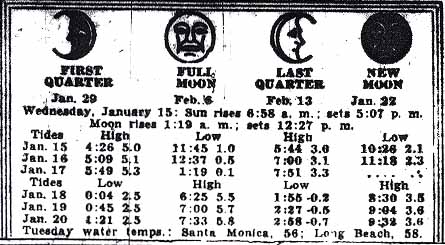
Sunrise was at 6:53 a.m. on Wednesday, January 15, 1947.

Incredibly, even this simply verified fact is wrong. Does this matter by itself? Not unless your faith dictates that you make a religious observation at a particular time. Does it become worrisome when added to all the other errors? Absolutely. More important, if a researcher can’t get simple things correct, how can he be trusted with far more complicated material still to come?

What “Mogul” is setting up in all of this is the discovery of the body, which I assume (remember I’m blogging in real time and not reading ahead) will be followed by the rest of the story told in flashbacks.

This is the standard “Laura” treatment of the Black Dahlia murder, following the structure of the Vera Caspary novel made into the 1944 movie with Gene Tierney, Dana Andrews and Clifton Webb. As Caspary discovered, this is a wonderful structure for a novel—which is quite good and I recommend it—a classic film noir, a crummy play and above-average radio play that aired on the Lux Radio Theatre several times.

Flashbacks are the standard structure used in “Severed,” John Gregory Dunne’s “True Confessions” and James Ellroy’s “The Black Dahlia.” Even Robert Lenski used it in the Lucie Arnaz TV movie “Who Is the Black Dahlia?” Of course the problem is that although this is fine for fiction, it’s terrible for history because the investigation wasn’t linear or chronological. So we’ll see how Wolfe handles this.

At about 10:30 a.m. a Leimert Park resident, Betsy Bersinger….

Uh-oh. This is bad. Really, really bad work. In our mythical restaurant inspection, this would be like the health department discovering roaches in the guacamole. The woman who found the body (a very gracious lady whom I interviewed) is named Betty, not Betsy. This is like writing a history of World War II and referring to Arnold Hitler.

The literary health inspector has just slapped a C on “Mogul.” One more slip and I’m closing you down.

Posted in Uncategorized | Comments Off on A "C" From the Health Inspector

Blogging the Wolfe Book, the Boy on the Bicycle

Page 7

What’s this? Another day on Page 7? Theological scholars don’t scrutinize the Bible this carefully and this is a book you could read in a few hours waiting for a plane at LAX. Don’t give up, we’re closing in on Page 8. I warned you from the beginning that this would be tedious. But you asked why I don’t read Black Dahlia books. This is why. It’s painful.

In the small hours after midnight, Bobby Jones, a young man in his early teens, wheeled his bicycle through a vacant lot near Thirty-Ninth Street and Norton Avenue in Leimert Park.

This is the elusive story about the Boy on the Bicycle at the crime scene. It’s one of Will Fowler’s yarns and the original version goes like this: Will was at the crime scene with photographer Felix Paegel (Will usually threw in lots of distracting details about what kind of flashbulbs Paegel used to divert attention from the fact that Will didn’t have a copy of the picture Paegel supposedly took of him with the body. “And nooooooobody around,” Will always said. “All alooonnnnne.”

In his often-told tale, the cops showed up, pulled their guns and Will explained who he was, suggesting they go talk to the Boy on the Bicycle who was standing nearby.

My first hint that anything was wrong with this was when I told Will I’d found one of the first two police officers at the scene and was going to interview him (which I did). Will became extremely uncomfortable and said something like: “Gee, (nervous laugh) I wonder if he’ll remember pulling his gun?”

When I sat down with the officer, Wayne Fitzgerald, he said: “Bullshit!” And then to make sure I got the point, he said it again: “Bullshit!”

And as time proved, Will wasn’t the first reporter at the crime scene. It took me years to untangle the truth and by then Will was in terrible shape, dying of cancer and in mental decline. One time I was coming over to visit and asked if there was anything I could bring him. Will asked me to pick up some Kleenex and toilet paper. At his apartment on Stern in Sherman Oaks, Will told me where to put the items and when I opened the cabinet, the shelves were full of Kleenex and toilet paper. He was embarrassed and said: “I guess I forgot.”

He got even worse. Before his death in 2004, Will called up and said he’d been institutionalized for six months because he had become violent with someone (Will was a boxer—or at least claimed he was a boxer in his early years. His father, Gene, was friends with Jack Dempsey so I assume at least some part of his boxing stories is true). I never had the heart to call him after that.

I have never located the Boy on the Bicycle, but it isn’t for lack of trying. He’s never mentioned in any of the news reports or documents in the Los Angeles County district attorney’s files.

Here’s Will’s version of the Boy on the Bicycle from “Reporters,” Page 75: “As [the officers] started their investigation, I pointed toward Crenshaw. There was a pre-teenager straddling his bike a block away. ‘Why don’t you question that kid over there? Maybe he knows something,’ I said. I was anxious to get to a phone.”

He next turns up in “Severed,” Page 1:

“Shortly after six o’clock that morning, a boy walked his bicycle through the weeds of a stretch of vacant lots south of Hollywood.”

I read something like that and I just sigh. Leimert Park, despite what you read elsewhere is nowhere near Hollywood.

“Severed” continues: “The boy slowed down to glance back at the sound of a car, an older black sedan, possibly a Ford. The early morning light reflected on the windshield and he couldn’t see anyone behind the wheel…. Almost late for his paper route, the boy gave no further thought to that lone car on Norton. But soon he would find out that someone—whoever had been in that car—had left something so terrible in the vacant lot that for the rest of his life the boy would remember that windshield. He would try to picture a face behind the glass but he never could see one.”

Note that Will puts the Boy on the Bicycle a block from the crime scene on Crenshaw at the time the body is found while John Gilmore, in “Severed,” rolls the clock back to dawn and puts him on Norton Avenue. Wolfe places the Boy on the Bicycle even earlier, “in the small hours after midnight.” And “Severed” never identifies him or gives his age, while Will gives his name as Bobby Jones and calls him a preteen. Wolfe, however, makes him a bit older.

But of course there’s more to the story. Let’s flip back to Todd (also known as Tod) Faulkner’s 1971 feature in The Times. Aha! It’s our friend, the Boy on the Bicycle. But wait. Here’s what Faulker says:

“[Harry] Hansen remembers that reporters and photographers were already on the scene when he and [Finis] Brown arrived. So was a man who had been out walking his dog. So was Bobby Smith, an 11-year-old from down the street who usually played in this field and who now sat quietly astride his bicycle and watched and would remember.”

Nothing about a paper route, nothing about him seeing a car, nothing about spending the rest of his life trying to visualize the face behind the windshield of the car, as portrayed in “Severed.” Faulker wraps up the story of the Boy on the Bicycle by saying: “Bobby Smith, the 11-year-old who sat and watched it that morning from his bike, works for a motor home company out in Van Nuys.”

I’ve never found this kid, nor the motor home company in Van Nuys where he supposedly worked. The Times did publish his picture, however.

Here’s the genealogy of the Boy on the Bicycle story:

1971, Todd Faulkner, Los Angeles Times (making his debut as Bobby Smith)

1991, Will Fowler, “Reporters” (name changed to Bobby Jones)

1994, John Gilmore, “Severed” (not identified)

2006, Donald H. Wolfe, “Mogul” (using the name Bobby Jones), crediting “Severed” and a 2003 interview with Will, who was barely coherent at that point in his life—at least when I spoke with him.

Fortunately “Black Dahlia Avenger,” either misses or ignores this story, or the Boy on the Bicycle (evil genius George Hodel in disguise perhaps?) would be swept up in the vast, shadowy conspiracy in which the LAPD concealed dozens of murders because Dr. Hodel knew who was walking around Los Angeles with a case of VD. I hope that sounds as absurd to you as it does to me.

So how does the story go from Will Fowler to John Gilmore? Through Mary Pacios, author of “Childhood Shadows.” Will describes his encounter in “Reporters,” Pages 88-91:

“Then there was a 13-year-old boy named John Gilmore, the son of a Los Angeles policeman at the time of the Dahlia murder. The elder had little to do with the case then. But after many years of listening to his father recount the unsolved slaying over and over, young John finally published a Black Dahlia piece in what is known in the industry as a ‘junk magazine.’ ”

“It was my impression that John finally succumbed to the fictional bizarre when he claimed to have met Elizabeth [Short’s] killer, ‘Mr. Jones.’ And… heavens to Betsy… John’s informant, who led him to Mr. Jones, was no other than the reliable source: nationally respected ‘Mr. Smith.’ ”

Will continues to describe meeting Mary Pacios, (then Mary Humphrey).

“As a down payment in order to more closely study this woman who desperately yearned for some kind of recognition, I offered to guide her along the difficult route of writing a first book. In good faith, I handed her my Dahlia chapter, the Crane scenario [too much Dahlia insider stuff even for me—lrh] some photo negatives and John Gilmore’s erroneous magazine piece. This, with the proviso that the material would serve only as a guide, and that she would not publish or publicly refer to any of the same until after ‘Reporters’ was published.”….

“It wasn’t until 1990 when Mary sent me her final letter. She wrote that she and John Gilmore had met and the two were going to collaborate on a Dahlia book.”

“My God,” I thought, “now two confused Dahlia nonentities have coupled.”

“Some time later I happened to catch the two on a television talk show where they starred as the ultimate Black Dahlia authorities. They had unblushingly enlarged on their fancies. Now John claimed the murderer had confessed to him before death, and not to police. And Mary had raised Elizabeth in her social station, having had her double-dating with Marilyn Monroe and appearing at fashionable Hollywood nightclubs with the likes of Franchot Tone.”

Does the Boy on the Bicycle really exist? The Times ran a picture of somebody in 1971. But the smart money says he is fiction.

The larger question, however, is why Wolfe draws on “Severed” as well Will Fowler and “Reporters,” which is so dismissive and sarcastic about John Gilmore. Since I’m blogging this as I read in real time, I don’t know the answer. Maybe we’ll find out and maybe not.

Whew. I have to go for a walk. But as promised we are on Page 8.

Posted in Uncategorized | Comments Off on Blogging the Wolfe Book, the Boy on the Bicycle

Blogging the Wolfe Book, Weather Report

Page 7 (Continued)

If the temperature dropped below 35 degrees F in the San Fernando and San Gabriel Valleys, the ranchers had to go out and light their smudge pots to ward off the frost that could damage the citrus crops.

On the night of Tuesday, January 14, 1947, the fruit frost warning had been posted and broadcasted on the ten o’clock news. At that hour few people were out on the streets.

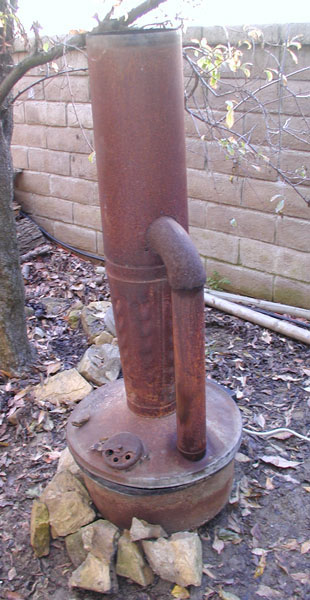
At left, a smudge pot, now nothing but an unpleasant antique in California. In the late 1940s and early 1950s, hundreds of these evil devices, burning diesel fuel, made the air over Los Angeles so polluted that there were days you couldn’t see City Hall from across the street.

I just sighed when I saw this. Time to cue the leaden skies from “Severed.” (Hm. I’d forgotten I was using a flier on hemorrhoids from the National Institutes of Health as a bookmark in “Severed” Clearly I don’t refer to either one very often).

Smudge pots burned for the first night that winter to keep the frost from killing the citrus. The cold had settled in from the cloudless sky that by dawn shone like dull gray metal that revealed no shadows. (“Severed,” Page 1).

Now to dig out the files on the weather, because it’s always reported incorrectly. First with “Severed” and then everyone who follows.

City

High

Low

Date

Los Angeles

60

39

Jan. 15. 1947

L.A. Ground Temperature

61

38

Jan. 15, 1947

Burbank

60

32

Jan. 15, 1947

Pasadena

61

35

Jan. 15, 1947

San Gabriel

60

32

Jan. 15, 1947

Los Angeles

64

39

Jan. 16. 1947

L.A. Ground Temperature

65

31

Jan. 16, 1947

Burbank

63

51 (probably an error for 31)

Jan. 16, 1947

Pasadena

60

40

Jan. 16, 1947

San Gabriel

63

33

Jan. 16, 1947

Southern California forecast for Jan. 15, 1947: Generally sunny today and tomorrow, but with some scattered cloudiness. Slowly rising daytime temperatures but continued cool.

Sunny today? What about “a cloudless sky that by dawn shone like dull gray metal that revealed no shadows?” A cloudless sky that revealed no shadows? How is that possible? And where are the smudge pots?

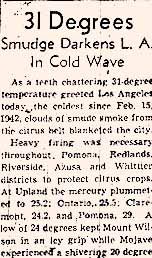
The answer: On Jan. 16, 1947, the Herald-Express ran a story headlined “31 Degrees; Smudge Darkens L.A. in Cold Wave.” Of course, since the Herald was an afternoon paper, it was speaking about the day after the body was found: “As a teeth chattering 31-degree temperature greeted Los Angeles today, the coldest since Feb. 15, 1942, clouds of smudge smoke from the citrus belt blanketed the city.”
Tsk, tsk, tsk. This is what happens when you trust someone else’s research instead of doing your own, especially when you take anything from “Severed,” which I’m fairly sure I mentioned is 25% mistakes and 50% fiction.

As everyone who knows me is well aware, I don’t like the crime scene pictures, but this photo of Los Angeles Times reporter Marvin Miles at the crime scene is appropriate because he’s wearing sunglasses. Regardless of what you read in any of the Dahlia books about brooding darkness and leaden skies, it was a bright, sunny day.

Is it being too petty to note that ranchers have cattle and farmers grow crops? And wonder why Wolfe writes 10:00 p.m. and ten o’clock on the same page instead of 10 p.m. and 10 o’clock? I suppose it is. Broadcasted? ReaganBooks should really hire a couple of good copy editors.

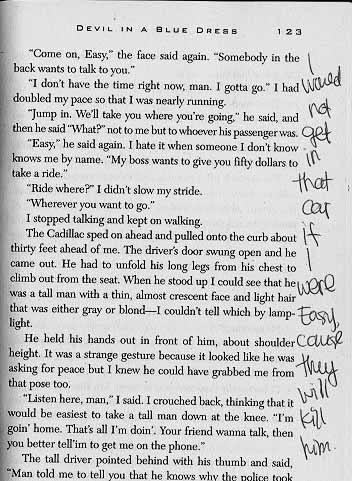
As a writer, I have a visceral reaction to finding books in the trash. They’re so much work. Writers should never be allowed to see the overfilled trash barrels at any publication that does book reviews, where prerelease copies are unceremoniously dumped, not even read, like dead leaves in the fall. So when I took some boxes to Out of the Closet over the weekend I had to rescue a copy of Walter Mosley’s “Devil in a Blue Dress” that was in the dumpster behind the store. The book was annotated on nearly every page, as follows:

Posted in Uncategorized | Comments Off on Blogging the Wolfe Book, Weather Report

Blogging the Wolfe Book, Sniff Test

And how are we doing? Some glaring omissions, a few mangled facts and some major errors. In all, the book isn’t doing well and we’re only on Page 6. If this were a restaurant, the health department would give it a “B” grade and start looking for vermin infestations and improper storage of food. The suppression of any information about the author’s links to Los Angeles Realtors and one of the leading financiers of the 20th century is particularly troubling—and certainly raises the question of whether the book is going to play fair with the reader.

In all honesty, if this were any other book, I would have already quit, because it’s clear that this is going to be a problematic manuscript all the way to Page 402, and life is short.

Still, people keep telling me what a great book this is, so let’s forge ahead.

Page 7

In the 1940s you could listen to … Edgar Bergin.

Oh dear. Clearly, along with purging the staff of fact-checkers, ReganBooks has fired its proofreaders. “Gang Busters” instead of “Gangbusters” might be forgivable. But Edgar Bergen as Bergin? That’s really no way to treat one of the Beverly Hills neighbors.

But by 10:00 p.m. the entertainment came to an end and you knew it was time to go to sleep when the fruit frost warnings came on.

Hm. Let’s dig into the radio logs, shall we? Looks like programs ran until at least a bit past midnight on Jan. 15, 1947.

Posted in Uncategorized | Comments Off on Blogging the Wolfe Book, Sniff Test