Otis Chandler Tribute


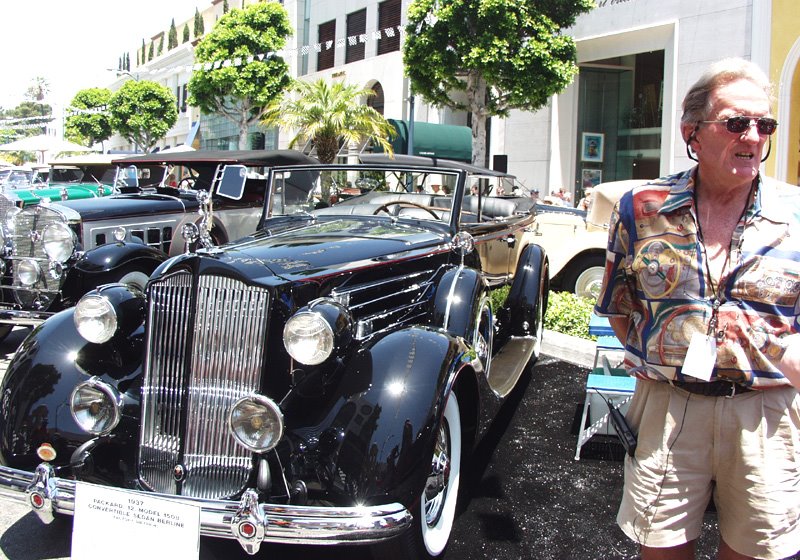
These are audio files I made of the in-house memorial to Otis Chandler (at right with his 1937 V-12 Packard, originally owned by Bette Davis), conducted March 7, 2006. These are field recordings and the audio quality isn’t great. But I am offering them for their historic value. Tom Johnson, the moderator, spoke throughout the ceremony. Each segment lasts an hour.

Part 1:

Speakers are Jeff Johnson; Tom Johnson; Harry Chandler; Cathleen and Michael Chandler; Bill Thomas; Anthony Day; Paul Conrad; and Jean Sharley Taylor.

Part 2:

David Laventhol; Richard Schlossberg III; Francis O’Toole; William Niese; Shelby Coffey III; Bill Boyarsky; John Carroll; and Bettina Chandler.


Posted in Columnists, Uncategorized | Tagged | Comments Off on Otis Chandler Tribute

Blogging the Wolfe Book, Mystery Woman

I’m blogging in real time as I read Donald H. Wolfe’s “The Black Dahlia Files: The Mob, the Mogul and the Murder That Transfixed Los Angeles.” Wolfe has begun with the butchered, anonymous body and is telling the story in flashbacks—at this point, we’re at Elizabeth Short’s mid- to late teens and she’s about to be reunited with her father, Cleo, who abandoned the family years earlier.

So far, the vote on continuing the blog is entirely favorable, with one request for information about my theory (sorry, I don’t want to mix that with the Wolfe material) and one suggestion for an ad revenue stream. Thanks crime buddy!

http://rcm.amazon.com/e/cm?t=heaveishere-20&o=1&p=14&l=st1&mode=dvd&search=%22lord%20peter%20whimsey%22&=1&fc1=&lt1=&lc1=&bg1=&f=ifr

I’ve made a podcast of this session just to give the idea of what it’s like doing this in real time. The audio quality is lousy and there’s an annoying hum. And mostly it’s the sound of me typing. Feel free to ignore it. I would. The music playing in the background is Schubert’s Symphony No. 9 performed by the Pittsburgh Symphony under Mark Wigglesworth.

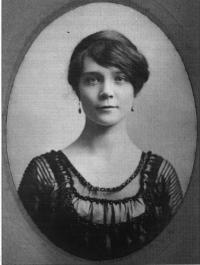
The image, by the way, is the young Dorothy L. Sayers, mystery novelist and Christian dramatist, who could write circles around Agatha Christie on the best day Christie ever had. I would gladly trade every Hercule Poirot story ever written for one Peter Whimsey.

Page 56

“A dozen years after Cleo had vanished and was presumed dead, Phoebe received a letter from him. She was shocked to learn that Cleo was alive and working in the shipyards in Northern California.”

Very well, Watson, to the end notes.

Why my dear Holmes, it’s from John Gilmore’s “Severed,” Page 26.

Now according to Los Angeles County district attorney’s files (“Movements of Elizabeth Short”) Phoebe Short and Elizabeth were walking in Medford and ran into Cleo. Remember that this book is titled “The Black Dahlia Files.”

Oh, but we’re not going to actually use the Black Dahlia files. Why not?

This is actually pretty funny. Wolfe can’t reveal this document because it completely contradicts his nonsense theory about where Elizabeth Short was in the 1940s (remember “Very little is known about Elizabeth’s time in Miami”?) so he’s stuck with “Severed.” It’s much easier to be honest, isn’t it?

http://rcm.amazon.com/e/cm?t=heaveishere-20&o=1&p=8&l=as1&asins=B000CEGW1A&fc1=000000&IS2=1&lt1=_blank&lc1=0000ff&bc1=000000&bg1=ffffff&f=ifr

Oh dear, oh dear. Wolfe says:

“Mary Hernon, a girl who lived next door to the Shorts, remembered that all Elizabeth could talk about during the week before she left for California was Hollywood. “I asked her if she was going to be a movie star,” Mary recalled. “she laughed and told me that’s what she hoped to do, and if you wanted to be a movie star, it wasn’t going to happen to you in Medford. She’d have to go to Hollywood.” An so, on an icy day in December 1942, Elizabeth Short boarded a train in Boston and departed for the land of sunshine—and shadow.”

Now for our source material in “Severed”:

Mary, the little girl next door to the Shorts, remembers the week Betty left. “She was all dressed up in something light blue, and she took my hand as we crossed Salem Street and headed toward the gas station. I remember the station manager stopping his work to come over and talk to her. I guess I stood there shifting from one foot to the other as they chit-chatted and he made a date to see her before she left for California. She said something about Hollywood and as we walked to United Farmers, I asked her if she was going to be a movie star. She laughed and told me that’s what she hoped to do and if you wanted to be a movie star, it wasn’t going to happen to you in Medford. She’d have to go to Hollywood.”


(Oops, I owe Donald H. Wolfe an apology. He got the item about Elizabeth Short replacing a Tremont theater usher who had been drafted from “Severed,” Page 24. Of course it’s not true but then that’s the case for most of “Severed.” And also note that “Severed” doesn’t identify the theater as the Tremont.)

Here we go. I found our mystery girl: “Severed,” Page 25

“Betty would often take long walks by herself, or she would walk and talk with Muriel or the neighbor’s little girl, Mary.”

Now for fun, let’s look at “Childhood Shadows.”

Uh-oh. Mary Hernon is really Mary Pacios!

Don’t tell me you’re surprised.

“Childhood Shadows,” Page 20

On one of our walks, we stopped at the gas station that had replaced the vacant field across Salem Street. The manager stopped what he was doing and came right over to Bette [Pacios’ version of Elizabeth Short’s name]. I can remember standing there and shifting from one foot to the other as the two grownups exchanged a few words, laughing and planning to meet later that night.

Afterward, Bette told me she wasn’t going to Florida. “This year I’m going to California.”

I figured that Bette was going there to be a movie star.

“Well, that’s what I am hoping,” she said. “Not right away. It takes time. But if you want to break into the movies it can’t happen in Florida… or in Medford.”

Now making up names for people is veering dangerously close to “Severed,” which is full of people who don’t exist and things that never happened. I can’t imagine where Wolfe got the name Hernon or why he didn’t identify the woman as Mary Pacios, since he is clearly basing this on “Severed” and “Childhood Shadows.” This is foul work, folks. Did Wolfe honestly think nobody would check this?

I guess he did. Oops.

Time for my walk.

Shout out to:

Sydney, Australia (203.173.142.116)

Los Angeles Public Library (206.170.105.11) Librarians rule! Windows 2000? Upgrade!

Leavenworth, Kans. (4.244.147.63) Windows 98? Upgrade!

Brea, Calif. (68.234.184.255) One of my most loyal visitors.

Reston, Va. (152.163.101.5) Windows ME and IE 5.5 Upgrade!

Hurry back!

Note: I am experimenting with Amazon ads. The first one is supposed to be for Dorothy Sayers items. However it appears to be defaulting to other items.

Posted in Uncategorized | 1 Comment

Comments, Please

Large ImageI’m waiting.

The vote so far:

Keep going: 10 (1 via e-mail).

Stop the insanity! 0

Disclaimer: I’m not a Susan Powter fan. In fact, she drives me crazy.

Special note: Comments are moderated. In other words, nothing gets posted without my prior approval. Anything off-point or extraneous isn’t making the cut.

Posted in Uncategorized | 10 Comments

Blogging the Wolfe Book, Bust of a Man


I have been blogging in real time as I read Donald H. Wolfe’s “The Black Dahlia Files: The Mob, the Mogul and the Murder That Transfixed Los Angeles.”

At this point in the story we are deeply mired in Elizabeth Short’s childhood and have just caught Wolfe in an incredible lie:

“Very little is known about Elizabeth’s time in Miami.”

Of course the Los Angeles County district attorney’s files include a detailed list of where Elizabeth Short lived and worked, including her exact addresses, so this is a through-and-through lie.

Page 54

Let’s see where Wolfe goes with this. I expect the worst.

Hm.

“A former Miami police officer
[note to ReganBooks proofreaders, Miami is not Miami Beach] believes Elizabeth may have initially stayed in the home of a relative of the Short family—Philip Short, who was a lieutenant in the Miami Police Department in the early 1940s and was said to be connected with Meyer Lansky and Syndicate in the Miami area.”

Oh, so, so, desperate for a mob connection, are we? And what is the source for this bit of fiction?

Lead on, Watson.

Not again, Holmes!

Hm. Retired Miami Officer James Newton, 2003. And who precisely is James Newton, a name with which I am not familiar? Let’s see if he is ever further identified.

OK, now before I even start digging, look at all the things we don’t know about James Newton. He’s only introduced as “a retired Miami police officer,” so we don’t know when he retired, his rank, what his assignments were or anything else. For that matter, we only get his name if we go to the end notes. Otherwise he could be another Herman Willis, the fictional detective in John Gilmore’s “Severed.” He could have served from 1970 to 1995, for instance, and not know anything more about Elizabeth Short than Joe Six-Pack.

Any bets before I look as to whether we get any of this crucial information?

To Amazon’s “search inside” feature.

Just as I thought. Not a single word. There are times when I hate being right. This is bad work, folks.

Hm. Wolfe says Elizabeth Short had modeling jobs in Florida. Attributed to an interview with Mary Pacios. I’ve never read anything about that in the original sources.

Page 55

Man, Wolfe is a bold as they come:

“Returning to Medford in the spring of 1942, Elizabeth worked as an usherette at the Tremont, one of her favorite Boston movie palaces, where she replaced a young man who had been drafted.”

First of all, even most superficial research reveals that the Tremont was an old, second-run movie house and there’s nothing to indicate she replaced a man who had been drafted. This is just blue skying some details that nobody will ever check—OK, almost nobody.

In fact, Elizabeth Short worked at the Tremont in 1940. Very poor work on the part of Mr. Wolfe.

Time to smear some conveniently dead people: Elizabeth Short and Donald Griffin, who apparently owned a cafe in Medford, Mass., in a story attributed to Eleanor Kurz.

Oh Holmes, not again!

Watson, research is not pretty.

Pacios’ “Childhood Shadows,” Page 53. Gilmore’s “Severed,” Page 22

Ready for some torture?

“Severed”:

“Eleanor Kurz, a friend of Dottie’s [Elizabeth Short’s older sister] saw Betty often before the war, usually in the restaurant on Salem Street across from City Hall. Mr. Griffin, the owner, was in his fifties, short and stocky, with thinning grey hair, and he wore gold-rimmed glasses.

The restaurant had only a counter with stools. “I remember I hadn’t seen Betty in a while,” Eleanor says, “and she was sitting very straight on the stool farthest from the door, dressed to the minute in a leopard fur coat and hat. She made me feel like a country bumpkin. I thought to myself, Dottie’s kid sister sure has grown up!”

Eleanor said something about not recognizing Betty and how great she looked. “Some people said that Mr. Griffin was Betty’s boyfriend, but I think it was just that he wanted to help her in a fatherly way.”

“Betty had her legs crossed, and she wore dark stockings and suede pumps and a lot of makeup by Medford standards. She was in her teens but looked older—sophisticated.”

Next, “Childhood Shadows”: (Quoting Eleanor).

“Last time I saw Bette [remember, this is how Pacios refers to Elizabeth Short] was in 1941, just before the war, at Griffin’s across Salem Street from our house. Do you remember it? A small square ice cream parlor, it later became a fried chicken place. When you walked in, the stools and counter were to the right. I remember Bette sitting at the stool wearing a leopard fur coat and hat. Dressed to the minute. Sophisticated. I was very impressed! She was so striking! And I thought ‘Dottie’s kid sister has sure grown up! I felt like a country bumpkin. Bette had just come back from a trip. She was very up. Looked like she could have been a movie star.”

“I thought she might be going with Mr. Griffin,” my [Pacios’] mother said. “Bette was in a restaurant across the street all the time. I think she had a father complex. I never saw her with a man, except once on the trolley, coming home from work. She was with an older man.”

Note: Mrs. Pacios only saw Elizabeth Short with a man one time. But thought she was going with Mr. Griffin. Isn’t that rather a leap?

Now what does Wolfe do with all of this?

“When Elizabeth returned to Medford, she was no longer the innocent schoolgirl who had reminded Mary Pacios of Snow White. Eleanor Kurz, a friend of Elizabeth’s older sisters, Dottie and Ginnie, remembered that when Elizabeth returned from Miami, she wore heavy makeup and would often hang around a popular cafeteria on Salem Street owned by Donald Griffin. Elizabeth had only recently returned from Florida in 1942 when Eleanor spotted her in Mr. Griffin’s cafeteria.

“I remember I hadn’t seen Betty in a while and she was sitting very straight on a corner stool furthest [note to ReganBooks, it’s farthest. Even “Severed” has it right] from the door, dressed to the minute in a leopard fur coat and hat,” Eleanor recalled. “Betty had her legs crossed and she wore dark stockings and suede pumps and a lot of makeup by Medford standards. She was in her teens, but she looked older—sophisticated. She made me feel like a country bumpkin. I thought to myself, Dottie’s kid sister sure has grown up!”

Although Mr. Griffin was quite a bit older than Elizabeth, Eleanor recalled there were rumors circulating in Medford that Mr. Griffin and Elizabeth were having an affair. “Some people said that Mr. Griffin was Betty’s boyfriend,” Eleanor stated, “but I think it was just that he wanted to help her in a fatherly way.”

Notice that Wolfe has transposed this incident to after the beginning of World War II. I don’t know if this is accidental or intentional. And of course, Griffin’s little cafe, which didn’t even have tables, gets expanded into a cafeteria. Most of all, Wolfe dives for the bait on Elizabeth and Griffin having an affair.

And of course he doesn’t tell us that Eleanor Kurz is Mary Pacios’ sister.

Oh, oops.

It would be nice to know more about poor old Mr. Griffin, but my archives are a bit thin on Medford city directories and I’d have to check them at the Los Angeles Public Library. Out of the question for this little exercise.

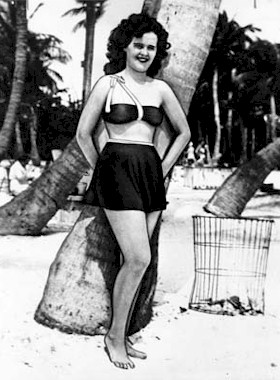
Here’s the bottom line. Everybody’s talking about how sophisticated Elizabeth Short looked when she came home from Florida. OK, here’s one of the pictures from Miami Beach that’s all over the Net. You tell me if this is the image of a femme fatale.

Nope, this is what everybody imagines when they think of the Black Dahlia: Stephen Peringer’s illustration for James Ellroy’s novel.

Now here’s the deal. This blog is incredibly time-consuming. I don’t really need to go any further to prove my point. I’ve caught Wolfe in any number of fabrications and distortions. I have passed the number of pages that correspond to my age, so I’m in fair territory. I’m going to throw this blog open for comments for a week to see if there is enough interest in continuing. I have lots of other irons in the fire, like the upcoming rollout of the successor to the 1947 Project, that are much more fun—and more satisfying.

So, if there’s interest in continuing, I will. Otherwise I’m going to hang it up. I guarantee you, the book is not going to suddenly improve.

Shot out to:

Schifferstadt, Germany (84.173.83.104)

Intercontinental Fragrance, Houston (65.16.203.153)

Bexar County Information Services, San Antonio, Texas (206.254.152.1)

Hollywood Production Center (67.151.223.83)

Let me know!

Posted in Uncategorized | Comments Off on Blogging the Wolfe Book, Bust of a Man

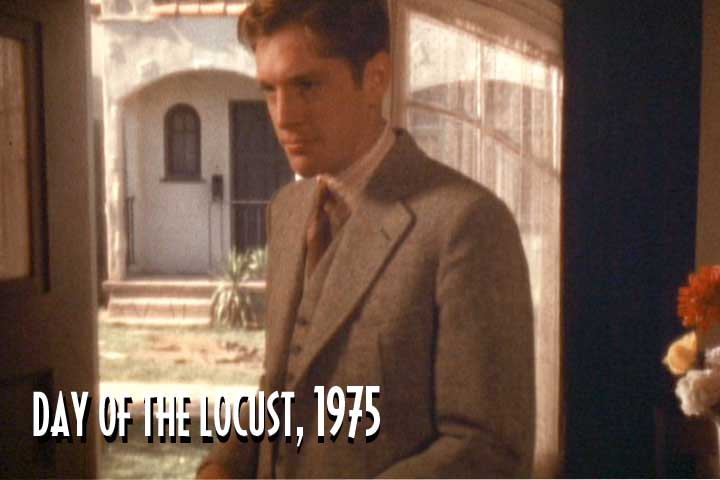
Location Sleuth, "Day of the Locust"


Hey look who’s in “Day of the Locust”: What’s his face from “Ghost Busters.”

Posted in Uncategorized | Comments Off on Location Sleuth, "Day of the Locust"

Blogging the Wolfe Book, Paint by Numbers


I’m blogging in real time as I read Donald H. Wolfe’s “The Black Dahlia Files: The Mob, the Mogul and the Murder That Transfixed Los Angeles.”

Page 52

Wolfe is using the “Laura” format and we’re at the point in the story where we learn about Elizabeth Short’s childhood. Wolfe has dispensed with her father, Cleo Short, at least for now, and is dealing with Elizabeth Short’s childhood illnesses. The narrative about the murder investigation has gone into hibernation as the book introduces buckets of background material.

Page 53

Mary Pacios, author of “Childhood Shadows,” is described as one of Elizabeth Short’s schoolmates, but that’s not really true as Elizabeth was quite a bit older and in fact was Mary’s babysitter.

Good grief. Bob Pacios is introduced as Mary’s younger brother. He’s an older brother and served in World War II. Well, Wolfe had a 50% chance of getting that right and still goofed it up.

Page 54

Now why on earth does Wolfe do this:

“…when Elizabeth was sixteen, Phoebe made an arrangement for her to stay with ‘friends’ in Miami Beach during the winter.”

There’s absolutely no reason to set off “friends” in quote marks unless he’s trying to make some point, although I can’t imagine what it is.

Not the end notes again, Holmes!

Lead on, my dear Dr. Watson.

Hm. “Childhood Shadows,” Page 16.

Well, this is far worse than I thought. Here’s the whole quote from “Mogul”:

“Elizabeth began having asthma attacks shortly after the family moved to the walkup on Salem Street. Muriel remembered that sometimes the attacks were so bad that their mother would have to call the doctor in the middle of the night to give Elizabeth an adrenalin [note to ReganBooks’ proofreaders, that should be capitalized as it’s a trademark] shot. In February 1939, she had to be sent to Boston Hospital for an operation to clear her lungs. The doctors told Phoebe that it would be better for her daughter to be in a milder climate during the wintry months; and in 1940, when Elizabeth was sixteen, Phoebe made an arrangement for her to stay with ‘friends’ in Miami Beach during the winter. In Miami [note: Miami and Miami Beach aren’t the same, as any resident will tell you], she obtained a part-time job at a beach resort and wrote that she hadn’t had an asthma attack or cold during the entire winter.”

And here’s Wolfe’s purported source material from “Childhood Shadows.”

“That same year, Bette Short [note that Mary Pacios refers to Elizabeth Short as Bette, one of several names Elizabeth used during her brief life] turned sixteen and started traveling. Her asthma and lung problems had worsened and she developed bronchitis. Mrs. Short thought Bette might be better off in a warmer climate, away from the coldness and the dampness. She arranged for Bette to stay with family friends in Miami Beach. Bette could spend the winter there earning money as a waitress, figured Mrs. Short, and come back in the spring.”

So where on Earth did Wolfe get this stuff about the doctor making a midnight call to administer an adrenaline shot?

Let’s take a wild guess and try John Gilmore’s “Severed.” Because if it isn’t there, I can’t imagine where he got it.

Holmes! Why are you never wrong! [You know, I’m sure that’s in one of the Sherlock Holmes stories but I’ll be darned if I can find it. One of my favorite quotes, too].

What we have here, Watson, is a brief, unattributed appearance from “Severed,” Page 20.

“Says Muriel, ‘She had asthma like me and Ginnie, but sometimes she had it worse than we did. Sometimes the three of us would be sitting up all night struggling to breathe. We’d take turns sitting in the rocking chair, but when it got really bad Mama would have to call the doctor. He’d come even in the middle of the night and give us a shot of adrenaline.’ ”

Still, nothing about Boston Hospital or an operation in February 1939. I haven’t a clue where Wolfe got that; it’s certainly not in his alleged source material. This is poor, poor works, folks. Obviously, these end notes are merely window dressing that Wolfe never imagined would be verified by a research drudge.

Oh let’s have some fun and check Steve Hodel’s “Black Dahlia Avenger” just for the heck of it. Buried at the bottom of the pile of Dahlia books. How symbolic. Then again, I won’t let Janice Knowlton’s “Daddy Was the Black Dahlia Killer” in the house or it would be at the bottom of the pile. Sheesh, Hodel doesn’t even have an index entry for Medford, Mass. Well, nothing about midnight shots of adrenaline, thanks to amazon’s online search.

And you know what’s really odd? To the best of my knowledge the Shorts were so poor they didn’t have a phone, which was a luxury in 1947. Remember that when Wain Sutton of the Examiner contacted Phoebe Short to give her the song and dance about Elizabeth winning a beauty contest, he called a neighbor.

Page 54

Ho-ho! I wish crime buddy Nathan Marsak were here to lead us all in a chorus of the SLA’s slogan. Donald H. Wolfe, you are so busted!

Here:

“Very little is known about Elizabeth’s time in Miami. The family did not reveal where she stayed, what she did, or who her acquaintances had been. There were only the photos found in Elizabeth’s memory book of unidentified companions and servicemen she met.”

OK, dear readers. The Los Angeles County district attorney’s files list Elizabeth Short’s precise whereabouts in Miami Beach; where she lived and where she worked. The documents in fact, are titled: “Movements of Elizabeth Short Prior to June, 1, 1946” and “After June 1, 1946.” And of course, the people in Elizabeth Short’s scrapbooks were identified. One needn’t look any further than Wolfe’s own book, Page 86.

I swear, the man is absolutely incapable of reading what’s in front of him.

There’s certainly a reason Wolfe doesn’t want to play fair with his readers, and although I’m not positive, I imagine it’s so he can concoct some nonsense about Elizabeth Short’s time in Los Angeles, lifted right from “Severed,” which has fabricated several years’ worth of imagined events such as Elizabeth Short being a junior hostess at the Hollywood Canteen and knowing murder victim Georgette Bauerdorf. (Did I mention that “Severed” is 25% mistakes and 50% fiction?)

So Wolfe is just going to pretend that awkward little list of Elizabeth Short’s jobs and residences stays well hidden.

And this book calls itself “The Black Dahlia Files.”

Time for my walk.

Shout out to:

Manila, Philippines (222.126.25.202), home of the other side of the George Hodel family.

Luxembourg (83.99.59.36)

Dark Horse Comics (70.96.128.8) Usagi Yojimbo rocks!

Greenville, SC (165.247.185.63)

University of Michigan Medical Center (141.214.17.5)

Symantec (65.88.178.10)

East Kentucky University (157.89.225.46)

Hurry back!

Posted in Uncategorized | Comments Off on Blogging the Wolfe Book, Paint by Numbers

Blogging the Wolfe Book, Limbo

I’m blogging in real time as I read Donald H. Wolfe’s “The Black Dahlia Files: The Mob, the Mogul and the Murder That Transfixed Los Angeles.” At the moment we’re enmeshed in the backstory on 1940s newspapers that hasn’t transfixed anyone.

The two-minute executive summary:

After spending several days slogging through Elizabeth Short’s autopsy and pondering the absence of John Gilmore’s key source on the Black Dahlia’s purported “infantile genitalia,” the nonexistent Detective Herman Willis, we’ve found the late Will Fowler, former Examiner reporter and Dahlia source, played several tricks on Wolfe. We also discovered some more ties between Wolfe’s stepfather and Joseph P. Kennedy, but a troubling disinterest in saying anything about Wolfe’s Great-Uncle Bernard Baruch, one of Kennedy’s close associates.

Worst of all, we have found some random smears against Elizabeth Short in which Wolfe cites a source and then embellishes it for no apparent purpose. There are times when I wonder if the man is capable reading what’s in front of him.

Wolfe is telling the story in “Laura” format, in which the discovery of the anonymous, butchered body sets off a series of flashbacks. We’re at the point where Wolfe introduces Elizabeth Short’s father, Cleo, who is going to say she’s no good. It’ll be interesting to see how Wolfe portrays him. And of course Elizabeth Short and the murder have gotten completely lost by now, which is the problem with the “Laura” format when it comes to history. Then again, I’m not sure we can call this book “history.”

Page 50

So far Wolfe picks up the standard newspaper quotes, citing, let’s see… the Herald-Express, Mary Pacios’ “Childhood Shadows” and John Gilmore’s “Severed,” the two former writing partners reunited again.

Page 51

But aha. Here’s another gratuitous smear thrown in for some effect or other:

“It was said that Elizabeth had begun dating a number of servicemen, and Cleo complained that she was seeing a different boyfriend every evening and staying out very late—sometimes all night. A churchgoing Baptist, Cleo admonished Elizabeth for living a licentious life.”

“It” was said? Who is “It?” And what’s the source for this little factual bonbon?

Not again, my dear Holmes!

You know where to take us, Watson.

Ha! Just as I thought. We’re meant to think this is from the Herald, but there’s nothing about her staying out all night. And while the Shorts certainly attended the Baptist Church in Medford, it was only after Cleo abandoned the family. There’s no evidence that he was a regular churchgoer, although being from the South, I’m sure he had been taken to church at some point in his life. (Bonus fact, St. Peter’s Chapel on Mare Island was the Navy’s first nondenominational church in the West. A very cool building).

Oh this is interesting. Wolfe quotes Elizabeth Short’s youngest sister, Muriel, but I doubt very much if she spoke with him. Hm. Let’s check “Severed,” Page 18, the purported source.

Quick, Watson, to the pile of Dahlia books!

Let’s hope it’s not JonBenet Ramsey
. Nope, a perfect word for word quote from “Severed.” I think that’s a first. Of course it’s good to be careful about people who are still alive.

Page 52

Ohhhh. I don’t remember this quote.

“Unlike her sisters, Elizabeth had mood swings, emotional ups and downs. ‘She was happy one moment—sad the next,’ Phoebe said.”

OK, now so far that’s seems to be one of the standard newspaper quotes that everybody uses. But Wolfe adds this:

“I guess she was what you would call a manic-depressive.”

Ooh. This is exciting (OK, “exciting” being a relative term; exciting at least to a research drudge). Source, please!

Los Angeles Examiner, Jan. 19, 1947. Any bets on whether there’s a line about manic depression before I check?

To the file cabinet, Watson. (The first thing anybody should do in tackling the Dahlia case is buy a bunch of four-drawer file cabinets. I promise, if you do the job right they’ll be jammed before you’re done).

OK, Los Angeles Examiner, Jan. 19, 1947.

“Trail New Suspect in Torture Slaying.”


Guess what.

Let’s go back and check the end notes, just to be sure. Yep. Jan. 19, 1947.

Fine. Here are Phoebe Short’s actual quotes (she was interviewed in Los Angeles en route to Berkeley to stay with her oldest daughter, Virginia, until the inquest):

“If I ever get my hands on him, I believe I’d kill him myself.”

Speaking of her return here later in the week, she added:

“The worst is to come.”

In a sidebar, she says:

“Thank goodness the Los Angeles Examiner made it possible for the FBI to identify my daughter in such a short time.”

“Your quick action perhaps saved me many weeks of anxiety and anguish. I prayed that it wouldn’t be she… but it was. I can do nothing more.”

Now isn’t that a fine kettle of fish? Nothing about mood swings, and certainly nothing about being a manic-depressive.

If I were an attorney in court, I’d say it’s not there (correctly) and be done with it. But since I’m taking a scholarly approach, let’s dig up the exact quote. It’s in the Herald-Express for Jan. 18, 1947.

“Elizabeth always wanted to be an actress,” she [Phoebe Short] said. “She was ambitious and beautiful and full of life, but she had her moments of despondency. Sometimes, she would be gay and carefree one moment—then in the depths of despair another.”

That still isn’t Wolfe’s quote, but it’s what you might recall if you were trying to summarize it. Poor work all the same and there’s nothing about manic depression. That’s strictly Wolfe’s embellishment.

Here’s something really cool: A concordance to the Sherlock Holmes stories.

And a cool view from somebody’s office:

Shout out to:

Lucas Film (63.82.98.50) (Running Linux, I’m so impressed).

Bergen (85.164.217.243) and Monet (84.53.11.22), Norway. I’m waiting for my homies in Andoya (current temperature 25 degrees)!

Mr. Pocket PC in Seattle (67.150.216.66)

Reston, Va. (152.163.101.5) MSIE 5.5? Upgrade!

And the same goes for all of you with outdated versions of Firefox!

Hurry back!

Posted in Uncategorized | Comments Off on Blogging the Wolfe Book, Limbo

Blogging the Wolfe Book, Pied Type


I’m blogging in real time as I read Donald H. Wolfe’s “The Black Dahlia Files: The Mob, the Mogul and the Murder That Transfixed Los Angeles.”

At this point in the story, Elizabeth Short’s body has been discovered in Leimert Park, and it has been taken to the morgue and identified. However Elizabeth Short has virtually disappeared as Wolfe bogs down in an explanation of competition between the Los Angeles newspapers in the 1940s.

Page 47

Good grief. It’s hard to believe anybody could make such a major error and state it with utter confidence:

“However, many Angelenos were aware that the identification story had already appeared in the Examiner on the previous day, and Richardson had his revenge by running an interview with FBI Bureau Chief J. Edgar Hoover the following day, congratulating the Examiner for assisting the FBI in the “spectacular identification achieved under extraordinary circumstance.”

The Los Angeles Examiner, Jan. 17:

GIRL TORTURE VICTIM
IDENTIFIED BY EXAMINER, FBI

Los Angeles Times, Jan. 17:

Sex Fiend Slaying Victim Identified
by Fingerprint Records of FBI

Does Wolfe give any citation for this incredible error or did he make it on his own?

Not in the end notes. He did it on his own. I really wonder if the man is capable of reading what is put in front of him.

And while we’re on the subject, one thing that’s revealed in Elizabeth Short’s FBI files (don’t buy them for $23 on ebay; they’re free from the FBI’s website) is the bureau’s sophistication in dealing with the news media.

Hm. This looks worse than I thought.

Now here is what’s in the Examiner, Jan. 17, 1947:

“Praising the Examiner’s enterprise and the clarity of the INP [International News Photo] Soundphotos, the FBI said it considered the identification ‘an outstanding achievement.’ ”

But Elizabeth Short’s FBI file, (uncatalogued, but probably part of document 62-82627-39) includes a tear sheet of the Examiner’s story by Ray Richards, Jan. 17, 1947, that indeed quotes Hoover:

“The action of the Los Angeles Examiner in transmitting to the FBI the fingerprints of the unidentified murder victim was an excellent illustration of cooperation of the press with law enforcement.

“It is such cooperation that aids law enforcement in curbing the increase in crime.”

The article concludes: “In the FBI’s Washington records the case was [illegible] as a ‘spectacular identification’ meaning one [made] under extraordinary circumstances.’ ”

Note: That quote isn’t attributed to Hoover. Now what’s really curious is why this story ran somewhere in the Hearst empire, (we know that because we have the tear sheet) but not in the final, microfilmed edition of the Los Angeles Examiner. How incredibly odd.

Let’s press ahead. Wolfe’s talking about Aggie Underwood. The big thing in the Dahlia case is that as told in her autobiography “Newspaperwoman,” Underwood was pulled off reporting partway through the coverage to work on the city desk and then put back on the story. Let’s see of Wolfe mentions that.

Page 48

Aha, the Black Dahlia nickname. It’s about time. Wolfe gets Aggie’s version from “Newspaperwoman,” (she said she got it from homicide Detective Ray Giese), but misses Jack Smith learning the name from the drugstore in Long Beach and even worse says Underwood sent Bevo Means down to Long Beach to investigate. She was a fellow reporter at that point and wouldn’t have been sending Means anywhere.

For the record, Underwood, Means and Smith got the nickname and both afternoon papers, the Herald Express and the Daily News, used it Jan. 17, 1947.

The important thing, missing in “Mogul,” is that the Herald had come up with its own nickname, “the Werewolf Murder,” and continued favoring “Werewolf” over “the Black Dahlia,” although it used both.

End of the chapter, time for my walk.

Shout out to:

United Arab Emirates (83.110.218.233)

Bangalore, India (61.95.192.96)

Hawthorn, Australia (203.113.238.14)

Branson, Mo. (4.244.183.130) Windows 98? Upgrade!

Note to Internet Explorer 7.0 user (69.232.110.80). Firefox in its various versions is way out in front. Clearly whoever is reading this is into alternative browsers.

Hurry on back!


Posted in Uncategorized | Comments Off on Blogging the Wolfe Book, Pied Type

Blogging the Wolfe Book, Foxy Grandpa


I’m blogging in real time as I read Donald H. Wolfe’s “The Black Dahlia Files: The Mob, the Mogul and the Murder That Transfixed Los Angeles.”

We’re at the part of the story, being told in flashback, where Elizabeth Short has been identified, her mother has learned about the murder from the Examiner, and now there’s bruising competition among the newspapers to find out everything about the murder victim. I’m guessing the yarn of Bevo Means and the Black Dahlia nickname should be next or at least soon.

Page 43

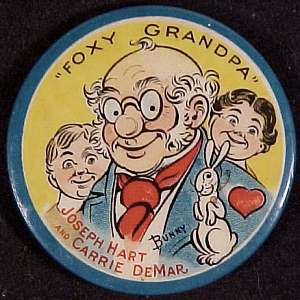
Wolfe is getting into Will Fowler’s biography. I’ll take a rain check on the old foxy grandpa. Like his cartoon counterpart, Will loved nothing better than to pull one over on his gullible nephews. “Tell us about the Black Dahlia case, will you, Foxy Grandpa?” “Oh sure, kids, come on in and I’ll give you the whole story about me and the Black Dahlia.” And then he’d chuckle.

(Sigh. Note to ReganBooks’ proofreaders: Coast Guard should be capitalized. Did I mention this is a $30 book?)

Hm. Next a history of Manchester Boddy’s Daily News, originally known as the Illustrated Daily News.

Oh man, Wolfe is wading into the history of newspapers in Los Angeles. This is why the “Laura” structure (anonymous, butchered body is found and her life is told in flashbacks) is terrible for telling history. The murder story comes to a complete halt for three pages of non-thrilling background on the nuts and bolts of Los Angeles journalism.

I know if I slowed down and read this section I would find mistakes because this book is a bonanza of errors. But in the interest of time I’ll only point out the worst clinkers and come back later if it’s pertinent.

Page 46

I am going to stop up here, though, for one of the worst errors:

“When the Black Dahlia case broke, the editors at the Times would have preferred to keep the hideous murder story on the back pages, however, they were compelled to put the story on the front page for a period of time to compete with the sensational Hearst coverage. Primarily printing Donahoe’s handouts, the Times had few investigative reporters working the case, and much of what appeared in the morning Times was simply a rehash of what had appeared in Heart’s Evening Herald Express or the previous day’s Examiner.”

As anybody with access to the paper knows, the Los Angeles Times never put the Black Dahlia case on Page 1 except for the day when it looked as if Cpl. Joseph Dumais was the killer. The rest of the stories appeared on the first inside page or somewhere near the front because The Times considered itself a family paper. There’s no excuse for getting this wrong. The Times, while certainly behind the Examiner in covering the Black Dahlia case, scored its share of scoops and covered the case to the best of its ability.

The idea of “Donahoe’s handouts” is particularly amusing. The LAPD in the 1940s had no public information officer issuing press releases. Reporters talked directly to the police officers involved in an investigation. This only changed in the 1950s.

What’s the source for this nonsense? Will?

Not the end notes again, Holmes!

You know it, Watson.

Oh, we’re going to hang this on David Halberstam’s “The Powers That Be,” yet another in our five-foot shelf of secondary sources.

To the bookshelf, Watson. Halberstam, Pages 94-122. I hope this doesn’t turn out to be about JonBenet Ramsey, like Wolfe’s citation of “The Cases That Haunt Us.” Nope it’s the whole chapter about the Los Angeles Times. Don’t recall Halberstam writing about the Black Dahlia case, though. (Man, Halberstam’s portrait of Times political editor Kyle Palmer is devastating. Absolutely damning). Nope, not a word on the Black Dahlia case. Nothing about The Times being forced to put the Dahlia on Page 1 to compete with Hearst. This is just Wolfe throwing in nonsense for no apparent purpose.

But don’t take my word for it. As readers of the 1947project know (Happy Foot to crime buddies Kim Cooper and Nathan Marsak. You rock!) the Los Angeles Times is available online through Proquest from the 1880s to 1985. This service is available free through the Los Angeles Public Library (you need a library card to sign on).

Well worth it. There’s a reason historians love libraries!

Shout out to:

Italy (87.6.39.98)

Finland (80.221.155.57)

Branson, Mo. (4.244.183.184) home of the Boxcar Willie Center for the Performing Arts.

Hurry back!

Posted in Uncategorized | Comments Off on Blogging the Wolfe Book, Foxy Grandpa

Blogging the Wolfe Book, Phoning It In


I’m blogging in real time as I read Donald H. Wolfe’s “The Black Dahlia Files: The Mob, the Mogul and the Murder That Transfixed Los Angeles.” So far we have seen very little of “The Mob” and nothing at all of “The Mogul.” There has been a murder but Los Angeles has yet to be transfixed.

This is tediously slow work and all I can say is that what I’m doing is absolutely the worst way to read a book; most shouldn’t be read at the molecular level, but “Mogul” demands nothing less. In fact, as I looked down Page 42, I saw an incredible whopper. It’s stupefying that someone could run all the Black Dahlia books through a blender, toss in some outright fabrication and come up with such a mishmash covered with a veneer of “research,” but Wolfe has done it.

Page 42

So far, Wolfe is using what has become the “paint by numbers” story structure in the Black Dahlia case: the anonymous, butchered body is found and the tale of discovery is told in flashbacks. This is the “Laura” format, a great framework for fiction that’s lousy for history because in reality the investigation wasn’t linear but was a sprawling mess.

We have reached the point in the story where the Examiner is extracting information from Phoebe Short by telling her that her daughter Elizabeth has won a beauty contest, then revealing that her daughter has been killed. This episode survives as one of the most outrageous and cruelest moments in journalism. Let’s see how Wolfe handles it.

Wolfe attributes this section to the standard sources: Will Fowler’s “Reporters,” Jim Richardson’s “For the Life of Me,” and a 2003 interview with Will, who by that time was fairly far gone as far as I know and died the next year.

Some of these errors are so trivial I was going to let them slide, but I changed my mind. Although one mistake by itself is insignificant, when taken together, the preponderance of errors presents a poisonous atmosphere of indifference to the truth, the facts and reflects a rather stunning lack of skepticism and the willingness to repeat—unchallenged—what is obviously impossible. This, folks, is bad work.

First, Wolfe says Phoebe Short was told that her daughter won a beauty contest in Santa Barbara. Of course by then, everybody knew better than that. Phoebe knew she was in San Diego and Richardson knew that Elizabeth Short had been arrested in Santa Barbara in 1943 and shipped home. And why would a Los Angeles paper be calling about a beauty contest in Santa Barbara? Wolfe is just picking up the extraneous, fabricated details from Will’s account in “Reporters,” Page 79.

Richardson’s version, written in 1954, is slightly different. He says Wain Sutton came up with the idea of the story about the beauty contest, “For the Life of Me,” Page 299. And Richardson certainly doesn’t give a location. That’s one of Will’s foxy grandpa embellishments.

But there’s a worse mistake. Wolfe says Phoebe told the Examiner that Elizabeth was returning to Los Angeles with a man named Red.

Now that’s totally wrong. Phoebe actually told the Examiner that her last note from her daughter was sent from San Diego. So let’s see if we can backtrack this gaffe to “Reporters.” Nope, Will says Phoebe read a letter to Sutton that Elizabeth had written from San Diego. “This information made way for another scoop: The disclosure that Elizabeth had left San Diego with a man known only as ‘Red.’ ”

Compare that with “Mogul.”

“Phoebe told Sutton that many men found Betty to be attractive and commented on a letter she had only recently received from her daughter, dated January 8, 1947: ‘It had been written while visiting friends in San Diego,’ she said, and indicated that she was returning to Los Angeles ‘with a gentleman, Betty referred to as ‘Red.’ ”

In reality, Phoebe Short knew nothing about Red. The letter, as quoted in the Examiner on Jan. 17, 1947, said:

“Dear Mother, I’m in San Diego now. I’m living with a girlfriend, Vera French, and I’m working at the naval hospital. I’m feeling fine.”

Where on earth does Donald H. Wolfe get this nonsense of Phoebe Short knowing about Red Manley? Beats me. This is totally fabricated. For what purpose, I can’t imagine. But it’s completely false.

Page 43

Ah. Wolfe is going to repeat Will’s old tale about the Examiner flying Phoebe Short out to Los Angeles and getting a place for her to stay. None of that’s true, since she stayed with her oldest daughter, Virginia, in Berkeley.
Being in my first year of research on the Dahlia case and still placing trust in Will, I might have fallen for that one myself. I liked the man, he was charming and funny, but he lied his head off to me. I don’t think it was malicious, but Will loved to tell tall tales.

And Wolfe says Phoebe flew out for the inquest, which was scheduled for Jan. 22. In fact, the inquest couldn’t be scheduled until someone (ultimately her) identified the body, so this is all totally wrong. It’s amazing how someone can take the facts and garble them so completely.

Before we knock off for the day, what’s the important lesson here?

Will told a vivid story about Sutton’s conversation with Phoebe Short. But to the best of my knowledge, Will wasn’t there and didn’t witness the incident; he only heard about it through newsroom lore. Richardson’s autobiography isn’t perfect, but he at least he was a participant.

In other words, for a conscientious researcher, secondary sources are the root of all evil—well, at least a lot of misinformation.

I just ran across another headache. Remember that Wolfe says Examiner artist Howard Burke went to the morgue to do a sketch of Jane Doe? And that Will says Burke worked from Felix Paegel’s photographs, not the body? (Surely you remember this tedious detail, no?) Well, I just noticed that Richardson says he sent a staff artist to the morgue, “For the Life of Me,” Page 297. Either way, nobody recorded the reaction of Capt. Jack Donahoe, whom Wolfe describes as furious.

Some days, slogging through this book is like digging coal.

Shout out to:

Israel: (217.132.70.253)

Queen Mary And Westfield College (138.37.20.15)

Elsevier Science Publishers (145.36.63.11)

Ntl Infrastructure – Cardiff (86.3.206.64)

Chanute Air Force Base (132.45.192.8)

Hurry back!

Posted in Uncategorized | Comments Off on Blogging the Wolfe Book, Phoning It In

Blogging the Wolfe Book, Tick, Tick, Tick


Page 39

We’re blogging Donald H. Wolfe’s “The Black Dahlia Files: The Mob, the Mogul and the Murder That Transfixed Los Angeles.” Yesterday, one sentence. Today, let’s try to double that, eh?

“The Examiner headline story of Friday, January 17, included the Santa Barbara police photos and an interview with Santa Barbara policewoman, Mary H. Unkefer. Juvenile Officer Unkefer had been called into the 1943 case when Elizabeth Short was arrested for drunk and disorderly and was identified as a minor.”

Hm. I’d really like to move more quickly, but writing such as this doesn’t lend itself to light treatment.

I simply don’t know what Wolfe means when he says “the Examiner headline story” because all newspaper stories have headlines. In fact, as shown on Page 30 of Wolfe’s book, the Elizabeth Short story took a banner headline, about an 8-72-2 all caps with a 4-42-2 ital and a 2-30-2 with the story set at two-column. I won’t bother to decrypt that for the non-pros. Anybody who understands that knows exactly what I’m talking about. Note the eight-column layout, unlike today’s six-column pages.

The Examiner ran one of the Santa Barbara police mug shots—singular.

And no, she wasn’t arrested for drunk and disorderly. It was for being a minor in possession of alcohol. Nothing more.

Further, Unkefer was more correctly a jail matron. Note that Wolfe describes her as a police officer and a juvenile officer, as if he’s not sure exactly what she did.

Page 40

Wolfe goes on to state, without the least factual basis, that Elizabeth Short’s neighbors complained about wild parties.

Uh-oh. Now this is wrong:

“It was obvious to the arresting officers that the soldiers were staying there over the weekend with the girls and that a good deal of drinking was going on.”

This statement is attributed to absolutely no one and is untrue. Nothing like this was ever published in any of the original newspaper stories and is nothing but a pointless and gratuitous smear for the sake of smearing. Real historians don’t do this.

Notice what Wolfe does:

“Miss Green claimed that one of the soldiers found in her bedroom was her husband,” Officer Unkefer recalled. “But we later learned her husband was a soldier overseas.”

Actual quote from the Examiner:

“She was living in a court with a Vera Green,” Miss Unefer [note Wolfe has fixed the spelling—lrh] also said. “There were four soldiers from Camp Cooke in their cottage when they were arrested. Miss Green said one of them was her husband, but we later learned her husband was a soldier overseas.”

Nothing about the bedroom. That’s another gratuitous smear, just for the sake of smearing. This is poor work, folks.

Page 41

A brief and apparently superfluous detour into the use of henna and speculation on how recently Elizabeth Short hennaed her hair before she was killed.

Oh this is cute: “It was also observed that bleach had been applied to her eyebrows.”

Quick, let’s check that…. Wolfe’s thrown it in so causally, but it’s not true. And of course he says: “IT” was also observed. By whom?

Not the end notes again, Holmes!

Absolutely, my dear Watson.

Ha!

HA!

Unattributed. Tsk. Tsk. Tsk.

Now for the record, this nonsense about the bleached eyebrows doesn’t turn up until well after the body was found. And it appeared in the Daily News, along with some other nonsense about the killer trying to change Elizabeth Short’s appearance. Eventually all of this grew into the wholly absurd—but incredibly popular—myth that the killer gave Elizabeth Short some sort of postmortem makeover: washed and set her hair, did her eyebrows, etc.

Oh this is just nuts.

“When Will Fowler returned to the Examiner city room with copies of the Santa Barbara photos and arrest record, Richardson assigned rewrite man Wayne Sutton to locate Elizabeth Short’s mother.”

There are a couple things wrong with this, besides the obvious mistake that Will probably didn’t even go to Santa Barbara. In order for this story to work, Will has to drive up to Santa Barbara, do a bunch of reporting, drive back to Los Angeles and talk to Richardson, who only then has Sutton call Elizabeth Short’s mother.

Total time, four or five hours, given a minimum three hours round trip (probably more before the freeways), plus allegedly finding Unkefer, plus allegedly getting the stuff from the police, (copies of her arrest record? This is in the days before Kinko’s. Imagine the time it would take for a Photostat or a picture to be developed). That would be half a news cycle or more. Any paper that operated like that would be absolutely clobbered by the competition and rightly so.

Did I mention Sutton’s name is spelled “Wain”? Almost everybody gets that wrong. Even Will. Oops.

Time for my walk.

Ps. I can’t imagine anybody finds this all that interesting, but my traffic statistics indicate otherwise. I guess there are some real research buffs out there.

Shout out to:

Griffis Air Force Base (192.100.90.81)

Curitaba, Brazil (200.181.213.181)

Sheppard Mullin Richter & Hampton (12.146.203.100)

Fannie Mae (198.204.133.208) Good grief, still using Windows 98? Upgrade!

And my favorite mystery guest: (172.19.158.186)

Hurry back!

Posted in Uncategorized | Comments Off on Blogging the Wolfe Book, Tick, Tick, Tick

Blogging the Wolfe Book, Wreck of the Old 97


Uh-Oh. All I had to do was read the opening line in this section of Donald H. Wolfe’s “The Black Dahlia Files: The Mob, the Mogul and the Murder That Transfixed Los Angeles” to know…

This is not going to be pretty.

“When the Los Angeles Examiner identified the victim as Elizabeth Short, editor [City Editor—lrh] Jim Richardson sent Will Fowler to Santa Barbara to find out more about her 1943 arrest.”

First of all, what amazes me is how Wolfe has reduced the vast cast of characters in the Black Dahlia case to a handful of people. So far the Los Angeles Police Department consists of the head of homicide, Capt. Jack Donahoe, and the two lead investigators, Detectives Harry Hansen and Finis Brown. The newspapers consist of one city editor (Jim Richardson) and two reporters: Aggie Underwood for the Herald and Will Fowler of the Examiner.

This is like performing Verdi’s “Aida” with a cast of five.

Although Will told me lots of stories—some of them possibly true—about his involvement in the Black Dahlia case, the trip to Santa Barbara wasn’t one of them.

Let’s see what Will says. Quick, Watson, to “Reporters,” Page 77.

What’s this? Will says Elizabeth Short’s autopsy was performed on the afternoon of Jan.15, the day the body was found. But the inquest transcript says that it was performed the next day. As if I needed more proof that “Reporters” is problematic.

Hm. “Reporters” certainly says Will went to Santa Barbara. (“Reporters,” Page 78).

Let’s check with Richardson and see what he says. Interestingly enough, Richardson’s book “For the Life of Me” makes no mention of Will Fowler whatsoever. Curious, eh? Not once.

What’s this?

“She had worked in the PX at Camp Cook [Cooke] about 160 miles north of Los Angeles and as soon as we got the word we sent Sid Hughes racing up there. He prowled the camp records and came up with a lot of stuff and the name of the girl’s mother, Mrs. Phoebe May [Mae] Short, of Medford, Massachusetts.” (“For the Life of Me,” Page 299)

Sid Hughes? Guess who never appears in Wolfe’s book. Yep. Sid Hughes.

Let’s go back to “Reporters.” Does Will mention Hughes in regard to the Black Dahlia? Not in the least. In fact, whenever I talked to Will about the case, he would put on a furious act about Hughes, saying that “his career was in the crapper by then,” and that Hughes was never at the crime scene, despite accounts by Richardson and Underwood, and crime scene pictures to the contrary.

To Wolfe’s end notes. Hm. “Mogul” cites “the Los Angeles Daily Examiner.” Lousy proofreading again by ReganBooks. Did I mention this is a $30 book?

Was Will even in Santa Barbara? His usual repertoire of Dahlia stories included showing up at the coroner’s office and trying to get a fingerprint by using lampblack and a matchbook cover; getting pictures of Red Manley from Manley’s wife, Harriette; covering Manley’s arrest in Eagle Rock; and being present when police opened Elizabeth Short’s suitcases. I don’t recall anything about Santa Barbara.

There is one more place we can check. The transcript of my Oct. 10, 1996, interview with Will, which I did at his apartment in Sherman Oaks. Hard to believe that was nearly 10 years ago.

Guess what: Zero about Santa Barbara.

For the uninitiated, Sid Hughes was an extremely colorful reporter in the 1930s to the 1950s, ending his career at the Mirror. At one time, he was considered the Examiner’s top-notch writer and it was clear from his comments that Will was fairly jealous of Hughes. Will was certainly guilty of minimizing Hughes’ role in the Dahlia case.

In memoriam, Sidney Hughes, who died of a cerebral hemorrhage in 1958 at the age of 50.

Gosh a whole day on one sentence. Well, I did warn you that this is tedious work.

Shot out to:

Portugal (82.102.46.95)

Softbank Bb Corp. of Japan (219.13.121.103)

Atkinson Andelson Loya (65.125.163.34)

Hurry on back!

Posted in Uncategorized | Comments Off on Blogging the Wolfe Book, Wreck of the Old 97

Blogging the Wolfe Book, A Rain Check


After spending so much time on Elizabeth Short’s autopsy, Wolfe is heading into autobiographical material. Given all the nonsense surrounding our last foray into the Wolfe household (remember “Uncle Vern” who used to house-sit for neighbor Bugsy Siegel, except Siegel moved in three years after the Wolfes moved out?) I may take a rain check and come back if this proves to be significant regarding the Black Dahlia case.

Page 36

Wolfe is going to talk about his stepfather, studio executive Jeffrey Bernerd, who died in 1950, although we don’t seem to get that little factual bonbon.

Lots of mob stuff regarding the role of organized crime in the studios.

Page 37

Hm. Joseph P. Kennedy founding Monogram Pictures. Now isn’t this interesting. Wolfe spends an entire page on Kennedy and doesn’t once mention Kennedy’s close associate Bernard Baruch, one of the most powerful financiers of the 20th century. Did I mention that Baruch is Wolfe’s great-uncle? Now why do you suppose he’s left out of this book? I just checked the index and sure enough, there’s no citation for Baruch.

Page 38

More about Kennedy and Wolfe’s stepfather Jeffrey Bernerd. And not a word about good old Great-Uncle Bernard.

I don’t know where any of this is going and it would be a life’s work to check everything here. It doesn’t appear to be at all related to the Black Dahlia case.

But let’s check a random fact and see how Wolfe is doing. He says his stepfather took Alfred Hitchcock out of the cutting rooms and made him at a director.

“It was at Gaumont British Studios that Jeff [Bernerd] was executive producer of such cinema classics as ‘The Lady Vanishes,’ ‘The 39 Steps’ and ‘Pastor Hall.’ ”

Quick, Watson, to imdb!

Looks like Bernerd’s producing credit somehow got left off “The Lady Vanishes.”

And “The 39 Steps.”

You want to make any bets before I check “Pastor Hall”?

Guess what.

No producing credit for Jeffrey Bernerd.

You’re surprised, right?

Sooooo. Let’s see if Jeffrey Bernerd is in Truffaut’s book on Hitchcock. Any bets before I check?

Oh my. Poor Jeffrey Bernerd, forced to make Gale Storm pictures and snubbed by Francois Truffaut. I suppose it’s some oversight that Hitchcock never mentioned him, eh?

Page 39

Wolfe concludes this section by saying the streets of Los Angeles were “mob infested” in the postwar era. Organized crime certainly flourished into the 1950s, when, for example, Jack Dragna died in his sleep (in pink pajamas) in a hotel on Sunset Boulevard. And the assassination of Jack “The Enforcer” Whalen in 1959.

Sun’s out. Time for a walk.

Shout out to:

MasterCard International: (12.22.157.254)

Chase Manhattan Bank of New York: (170.148.92.21)

Universite Du Quebec A Montreal: (132.208.158.100)

Hurry back!
Posted in Uncategorized | Comments Off on Blogging the Wolfe Book, A Rain Check

Blogging the Wolfe Book, Collecting Our Thoughts


The two-minute executive summary:

In analyzing Donald H. Wolfe’s “The Black Dahlia Files: The Mob, the Mogul and the Murder That Transfixed Los Angeles,” we have spent the last week on the identification of Elizabeth Short and her autopsy, finding fiction, literary fraud, a studious disinterest in the facts and an annoying inability to distinguish between city and county agencies.

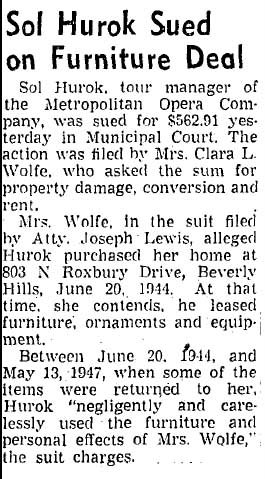
In addition, research in original newspapers has revealed that despite the claims of living near Bugsy Siegel when he was killed in 1947, Wolfe apparently lived elsewhere as his mother sold the house in question in 1944.

And most important, Wolfe makes statements about the autopsy which not only contradict the facts, but contradict his supposed sources. Specifically, Wolfe attributes a statement to former FBI profiler John Douglas that is actually the precise opposite of what Douglas says. If I were Douglas, I would be none too happy about having my work misrepresented in this manner.

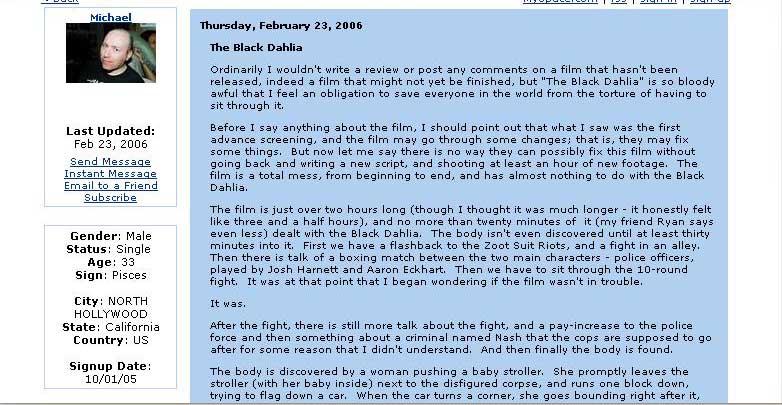
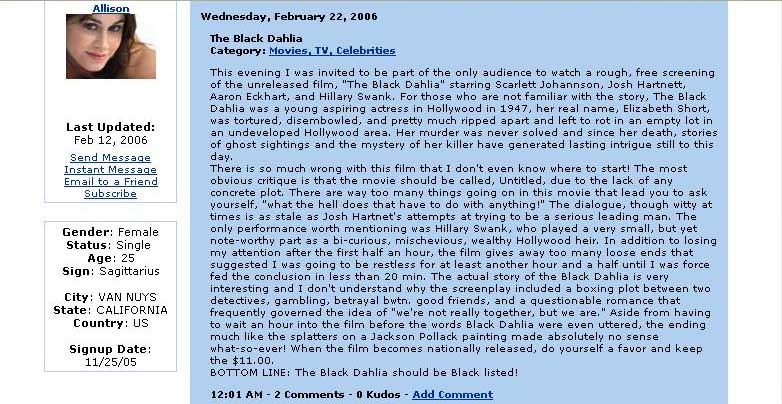
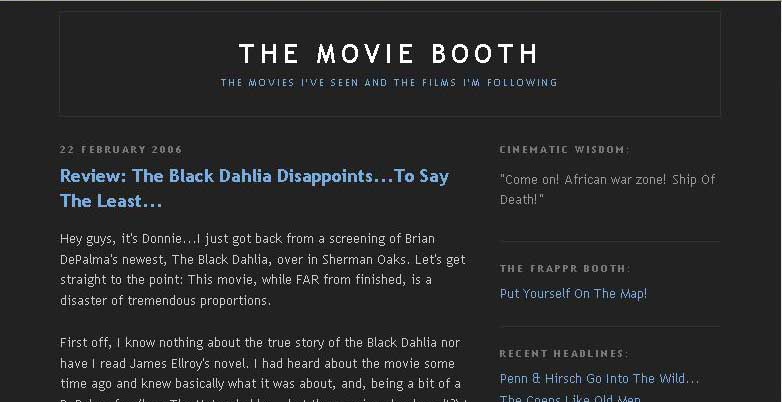
On a minor note, three bloggers have posted reviews of Brian De Palma’s “The Black Dahlia” from an advance screening in Sherman Oaks, all of them absolute pans. A sample comment: “There is so much wrong with this film that I don’t even know where to start!”

Let’s try to finish up this chapter today.

Page 33

“Mogul” states that Elizabeth Short’s autopsy has been lost.

“Yet in the 1970s, duplicate copies of all autopsy reports in Los Angeles were put on microfiche; the inevitable question arises—What secret is contained in the autopsy report that officialdom still does not want the public to know after a lapse of more than half a century?

Well, for me the inevitable question is: When did it disappear? The autopsy could have been swiped by a souvenir hunter (although I imagine it would have shown up on ebay by now) or simply discarded. Unfortunately, many public agencies regard their documents as something less than a priceless repository for historians. I don’t believe it’s any secret that before Hynda Rudd took over, the city of Los Angeles’ archives were a mess. Although Hynda has since retired, the city archives remain a tremendous resource on life in Los Angeles.

The same, unfortunately, cannot be said for the Los Angeles County material, which is a very mixed bag, as reflected by the district attorney’s collection of historic material, a terrific resource, although it is haphazard and incomplete.

“An alleged copy of the autopsy report was printed for the first time in Janice Knowlton’s book, ‘Daddy Was the Black Dahlia Killer’ (Pocket Books, NY, 1995). But this too was suspect and proved not to be the official autopsy report. It was based on a handwritten copy by an ex-officer of the Sheriff’s Department who led Knowlton to believe it was copied word for word from the original. But it was a word for word deception that once again hid the dark secret that the authorities did not want the public to know—a secret known at the time only by Capt. Jack Donahoe, Medical Examiner Dr. Newbarr, Finis Brown, Harry Hansen and the killer or killers.”

Hm. Note the “killer or killers,” taken from the same page of “Cop Talk 101” as “the male suspect exited the vehicle and fled on foot westbound.” Based on the absolutely false claims earlier about two styles of knife work in the killing, I’d say Wolfe is setting us up for some sort of dual murder.

And it’s time to drag in Janice Knowlton. The poor woman was so crazy; absolutely detached from reality. She would call my answering machine and leave long, angry, rambling messages every time a story appeared anywhere about the Black Dahlia case. It was easy to make fun of her while she was alive, but since she committed suicide I’ve only felt pity for her.

Like the coroner’s “Death in Paradise,” “Daddy Was the Black Dahlia Killer” is one of those books I don’t even let in the house. But I do have a photocopy of the section on Elizabeth Short’s autopsy and it’s clear Wolfe isn’t being entirely accurate here.

Luckily, amazon’s search engine will help us out. Hm. Janice Knowlton (and Michael Newton) say they got access to five autopsies on unsolved cases. Let’s see if we can figure out which ones:

First of all, they requested the Gertrude Landon autopsy and were told it was missing (Page 118). (An LAPD case).

Ditto Mary Tate (Page 208). (An LAPD case).

Perhaps they got the autopsy of Laura Trelstad (Page 212), although they don’t say definitively (Page 360). (Long Beach Police Department).

Maybe Geneva Ellroy (Page 277). Ah. They got the Geneva Ellroy autopsy (Page 360). Interesting. Of course, it’s not an LAPD case, but a sheriff’s case.

Maybe Helene Jerome (Page 279).

Well, I just used up my allotment of amazon searches for the day, so this not necessarily burning question will have to wait.

I’ll spare you the word for word textual comparison on the different versions of the autopsy in the interest of time. What I’m doing here is a beach book compared to that.

How accurate is “Daddy’s” version of the autopsy? The base of reference has to be the sworn testimony included in the transcript of the inquest, which Wolfe publishes, Pages 327-338, in a cleaned-up version. (What? It’s been cleaned up? Yep. It’s been photoshopped. If you know where to look, you can see the vestiges of little circles drawn around many of the line numbers. Case in point, Page 336, line 7).

The important note is that as Dr. Frederick Newbarr read his report into the public record, he was interrupted by Deputy Coroner Edwin Lenox, who told him to hurry things along and simply state why Elizabeth Short died. As a result, the inquest transcript is incomplete—sworn testimony, taken under oath, but incomplete.

There’s also a version of the autopsy in the LAPD summary on the case contained in the district attorney’s files. I wonder why Wolfe hasn’t referred to it. Hm. I hope we find out later. If not, that’s a huge omission.

Compared to the inquest transcript, the “Daddy” version makes some copying errors and the are some sections that appear nowhere else. Is it accurate? It’s impossible to say. But it is equally impossible to say that it was a malicious deception. We have to treat it as an unverified (and so far, unverifiable) copy and as such give it less credence than the two official sources: The inquest transcript and the LAPD summary.

Is the autopsy in “Daddy” a “word for word deception?” Frankly, if there’s anything guilty of that, it’s “Mogul,” given the book’s dismal record in distorting the facts and fabricating misinformation.

Let’s push ahead and finish the chapter.

Wolfe says Jim Richardson (again, he was the city editor, not the editor) asked Donahoe for a copy of the autopsy.

Oh no, Will Fowler in action! Here’s a laugh from beyond the grave:

“Fowler disclosed that Richardson was informed by Donahoe that the killer had inserted an earlobe as well as the tattooed flesh cut from the victim’s leg into her vagina.”

Of course, Elizabeth Short had no earlobes and her ears weren’t pierced. Will used to make up things about her earlobes all the time. A foxy grandpa to the end.

I could quibble more, but let’s pack it in for the day.

Oh by the way, in case you thought I forgot, “Daddy” wasn’t the first book to publish Elizabeth Short’s autopsy. That achievement belongs to “Severed,” (1994) Pages 121-124. Now why do you suppose Wolfe doesn’t tell us that? Could it have something to do with the autopsy information being attributed to the fictional Detective Herman Willis?

I wonder.

Shout out to:

France (82.242.89.143)

Hurry back!

Posted in Uncategorized | Comments Off on Blogging the Wolfe Book, Collecting Our Thoughts

Blogging the Wolfe Book, Missing Man Formation


Our story so far: I am blogging—in real time—as I read Donald H. Wolfe’s “The Black Dahlia Files.” It’s been slow going and this is an especially tedious part because I’m examining Wolfe’s treatment of Elizabeth Short’s autopsy. I’m not through and I’ve turned up some outright literary fraud, so it’s prudent to be particularly careful.

Page 33

Let’s pick up where we left off yesterday:

“Yet there is not another cold-case homicide on record in Los Angeles in which the autopsy report has not been made available to the public.”

This statement makes it sound as if autopsy reports are on file at the public library or some reading room, where the curious can simply browse at will.

Let’s take a famous cold case. How about the murder of Geneva Ellroy in 1958? I have an autographed copy of James Ellroy’s “My Dark Places” that deals with his mother’s death, so let’s see. (Bonus fact, James signed every copy of this book in a brilliant publicity stunt—if you call a scrawled “JE” an autograph—so it’s nothing for an ebay dealer to say he has one. What would be rare is to have one that isn’t autographed).

Unfortunately, the curse of having too many books is that you know you own it but don’t know exactly where it is. Luckily, thanks to Google’s search engine on amazon.com, we can delve through the text. (Which is preferable anyway, since “Dark Places” isn’t indexed). Did James get a copy of his mother’s autopsy? Indeed he did. Ah. But did he get it from the Los Angeles County coroner’s office?

No.

He got it because it was in the sheriff’s reports. For the record, retired Sheriff’s Detective Bill Stoner, a wonderful man who worked with James on “My Dark Places,” told me he was extremely unhappy that the polygraph keys were disclosed in the book, even though the murder was decades old at that point. Note particularly that the Ellroy case was a sheriff’s investigation, not the LAPD. Had Geneva Ellroy been killed in the city of Los Angeles instead of El Monte, I doubt very much if James would have gotten access to his mother’s files.

How about closer to home? If the Los Angeles County coroner routinely hands out autopsy reports like the fliers for landscaping and tree trimming hung on the front doors on every home in Los Angeles, I have to assume Wolfe is going to give us the Bugsy Siegel autopsy.

Well, gosh, I broke my vow of not reading ahead to thumb through the section on the Bugsy Siegel murder.

Guess what.

No Siegel autopsy.

(I hope you’re not surprised by that. I’m certainly not). For the record, even the coroner’s own book, “Death in Paradise,” was written based on newspaper clippings rather than official reports and has no bibliography. For the Elizabeth Short autopsy, writers Tony Blanche and Brad Schreiber used newspapers and—incredibly, “Severed,” which is, as I’m fairly sure I’ve said, 25% mistakes and 50% fiction.

What’s this? A search inside “Death in Paradise” doesn’t have a single reference to Dr. Frederick Newbarr, the chief autopsy surgeon in the 1940s. Hm. Well there is a reason I don’t even own this stinker. There are some books I won’t even let in the house and this is one of them.

But here’s a bigger mystery about Wolfe’s book.

Where’s my old pal, Detective Herman Willis? We haven’t gotten to him yet, and we’re nearly done with Elizabeth Short’s autopsy.

For the uninformed, Detective Herman Willis is John Gilmore’s leading source in “Severed” for the Black Dahlia autopsy. It is Herman Willis who provides lots of gruesome details about the coroner’s office, with descriptions of bodies stacked like cordwood. And it is Herman Willis, who in “Severed” provides the key details on Elizabeth Short’s purported “infantile genitalia.”

So where’s Herman Willis in Wolfe’s book? Missing. And why would that be?

As I have pointed out many times, Detective Herman Willis doesn’t exist. The name Herman Willis does not appear in the Los Angeles Times in any relation to the Los Angeles Police Department, he doesn’t appear in phone books or city directories of the period, he doesn’t appear in the ranks of police officers, nor in the directories of deceased or retired officers.

And no retired Los Angeles police officer has ever heard of him.

Years ago, I issued a challenge on this key source of “Severed’s” claims about Elizabeth Short’s purported “infantile genitalia”: What was his serial number? When did he graduate from the Police Academy? When did he make detective?

No attempt has ever been made to answer those questions. Instead, John Gilmore says he changed the man’s name.

Real journalists don’t do this except in rare occasions and they certainly never offer a false name without telling readers that it’s fictitious. Of course the threshold is far lower for a “true” crime book published by Zanja Press and picked up by Amok—if, indeed, these publishers can be said to have any threshold whatsoever.

Of course, the district attorney’s files list everyone who actually attended the autopsy of Elizabeth Short and all people are accounted for without any extra detectives. But I’m getting ahead of myself.

Did I mention that “Severed” is 25% mistakes and 50% fiction? Did I mention that John Gilmore wrote a book jacket blurb calling the Wolfe book “destined to become a true-crime a classic” but has since dismissed it as “crap”?

gtg

Shout out to:

Kddi Corp. (210.234.20.212)

Hurry back!
Posted in Uncategorized | Comments Off on Blogging the Wolfe Book, Missing Man Formation

Blogging the Wolfe Book, Loyalty

Just out of curiosity, I did a Google image search for “loyalty.” I got Johnny Cash flipping the bird (turned into a mock motivational poster); another poster for the Army on its values; a picture of a dog, a huge tattoo reading “Love” and “Loyalty” featuring rosary beads, a cross and other Christian symbols; James Montgomery Flagg’s famous World War I recruiting poster of Uncle Sam; a boomerang; and a couple of ships.

A search for “loyal” brought up a company’s logo; an image of the Boy Scouts; and the cover to Tupac Shakur’s “Loyal to the Game.”

Why am I trying to illustrate loyalty? Because I’m a very lucky man. Lucky because I get to attend the gatherings of two groups whom I respect very much: Retired Los Angeles police officers and retired Los Angeles Times reporters and editors. These are two groups of extremely fine men (and they are mostly men, given the professions and the era) and despite what you might expect, they are very much alike.

Both groups have drinks before lunch, which is a pleasant but not particularly distinguished meal, there’s a little business and a few announcements, a moment of silence for the recently departed and then a speaker. The retired officers say the Pledge of Allegiance, the retired reporters don’t. There’s a little more socializing and then they clear the room.

There’s many other things they share, but what struck me especially, as I attended the retired officers’ luncheon yesterday, was loyalty—loyalty to one another, loyalty to the department (or The Times) and most of all loyalty to the profession.

There are many reasons people become police officers (or reporters) and I don’t think anybody goes into either profession to get rich. Both professions, despite their many differences, require a dedication to integrity and indeed that’s exactly what I have found with both groups. Are there bull sessions? You bet. But what comes through again and again is professionalism and dedication.

I was reminded of that again yesterday when my host told me he was once assigned to ride with an officer who had been transferred over his role in “Bloody Christmas.” My friend told me he rode with this officer for two days, then went to the lieutenant and asked to be reassigned to another partner. He didn’t want to ride with the man because he was too prone to violence.

The reason I’m talking about all of this is because of the portrayals of several figures in the Black Dahlia case: former Chiefs Thad Brown and William H. Parker, and former Capt. Jack Donahoe, who was head of homicide during the Black Dahlia investigation. It is difficult to find three more respected men in the department and until Steve Hodel’s “Black Dahlia Avenger” came along, you never heard a bad word about any of them.

There are certainly those who have a different view of Parker. One of the singular moments of my life was interviewing the late U.S. District Judge David Williams, the first African American federal judge west of the Mississippi, who called Parker “the king of bastards as far as the black community was concerned.”

But among police officers who knew him, Parker is always given the highest respect and admiration, as are Brown and Donahoe. And quite frankly, these retirees take the corruption and cover-up charges against Parker, Brown and Donahoe in “Black Dahlia Avenger” and the other Black Dahlia books as a deep, personal insult. They are nothing less than furious.

Page 33

“Although many former LAPD Homicide detectives, including Harry Hansen, long ago conceded that the murderer was deceased, up until the end of the twentieth century, the Los Angeles County Coroner’s Office continued to refuse the release of Elizabeth Short’s autopsy report, claiming that this public document was being retained because the case was unsolved. Yet, there is not another cold-case homicide on record in Los Angeles in which the autopsy report has not been made available to the public.”

OK, first of all does the LAPD concede that Elizabeth Short’s killer is dead? These detectives were sharp men and always left themselves a way out. They will always qualify it by saying “probably” dead. Considering the number of surviving World War II veterans, it would be illogical to assume conclusively and absolutely that the murderer is dead. He may well be. But we don’t know definitively.

I’m not sure Hansen specifically addresses the issue in the 1971 feature in The Times. Let’s check.

Ah, what’s this? Remember when we talked about: “The fact that the body had been bisected by someone with advanced surgical knowledge was never disclosed at the time and the withholding of this vital information led to a misconception of the crime by both the press and the public that has been perpetuated for decades.”

And what does the 1971 Times profile of Harry Hansen say? “Most bizarre of all was that the corpse had been occupationally bisected and scrubbed clean, points which gave rise to later speculation that the killer had to have possessed more than a passing knowledge of surgery.”

Oops.

And what do we find in Hansen profile? Exactly what I said.

Voila:

“While he was on the case, Hansen refused to speculate either way, saying he preferred facts to suppositions. But, today, so many years after the fact, Hansen does permit himself the subjective luxury of his own opinion.

“It’s fairly realistic to figure the killer is no longer alive. By now, he would have done something, said something, that would have attracted attention. If he is still alive, he’s got it made unless he slips up and blows it. That’s a lot of years that’ve gone by; it would be hard now to go back and dig up new witnesses, new evidence.”

I have to go. In the meantime, let’s play a game: You tell me how many autopsies of unsolved, cold cases have been released in Los Angeles County; cold cases in which no suspect has ever been identified. Wolfe makes it sound routine, but offhand, I’d say the number is few to none.

Shout out to:

Dark Horse Comics (70.96.128.8)

University of Michigan Medical Center (141.214.17.5)

Nashua, N.H. (24.63.32.220)

Hurry back!

Posted in Uncategorized | Comments Off on Blogging the Wolfe Book, Loyalty

Blogging the Wolfe Book, He Walked by Night


Much has been written about poor crowd control at the Black Dahlia crime scene. Here’s an example of LAPD crowd control from the 1948 film “He Walked by Night,” which was the genesis of “Dragnet,” first as a radio show and then as a TV program. The idea of “Dragnet” arose during filming of “He Walked by Night” as Homicide Sgt. Marty Wynn, the technical advisor on the film, talked with actor Jack Webb about all the mistakes Hollywood made in portraying police work.

A frame grab from the movie shows the ropes used to keep people away from the car where a police officer has been killed. Retired Capt. Ed Jokisch has told me many times that in the 1940s, when he worked homicide, the call car had ropes used for crowd control.

Posted in Uncategorized | Comments Off on Blogging the Wolfe Book, He Walked by Night

Blogging the Wolfe Book, The Pinata


So what’s your point, Harnisch? Isn’t there a little schadenfreude here in dismantling Donald H. Wolfe’s “The Black Dahlia Files: The Mob, the Mogul and the Murder That Transfixed Los Angeles”? Didn’t you make your point at the preface?

Absolutely. So, as Sandy Koufax said: “The question is why.”

The answer is that time after time, people insist this book is thoroughly researched and well documented. And this nonsense spreads from one writer to another until it’s in wikipedia and in otherwise reputable books. One of my goals is to show what real research is like: Tedious, time-consuming, labor-intensive, picayune and thorough. And of course I never imagined when I set out that Wolfe’s book would present such a rich lode of fiction and fraud. As the old saying goes: “Even a blind pig finds an acorn once in a while.”

Another blog review of the Sherman Oaks “Black Dahlia” screening is posted and it’s the worst one yet.

Ordinarily I wouldn’t write a review or post any comments on a film that hasn’t been released, indeed a film that might not yet be finished, but “The Black Dahlia” is so bloody awful that I feel an obligation to save everyone in the world from the torture of having to sit through it.

Before I say anything about the film, I should point out that what I saw was the first advance screening, and the film may go through some changes; that is, they may fix some things. But now let me say there is no way they can possibly fix this film without going back and writing a new script, and shooting at least an hour of new footage.

The film is a total mess, from beginning to end, and has almost nothing to do with the Black Dahlia.

Here’s a screen shot:

Page 33

It is impossible for me to translate the noise I just made into type. I scanned the page and it’s loaded with nonsense. Get ready for a long sit.

“The slashed mouth and the blows to the head were characteristic of a rage murder, while the meticulous mutilation and bisection of the corpse with a surgical instrument were indices of a more methodical pathology, suggesting that more than one person may have been involved in the murder and disposition of the body.”

To the end notes, Watson, old boy.

Aha. Wolfe needs an expert so he gets one of the best: John Douglas. But we’re already in shaky territory. Does Wolfe actually interview Douglas? Nope. Another book from the five-foot shelf of secondary sources.

Let me make it perfectly clear: True researchers never use secondary sources if they can avoid it. Repeat after me: Never.

To the bookshelf to dig out “The Cases That Haunt Us” by Douglas with Mark Olshaker. (Hm. I seem to have two copies of “For the Life of Me,” one autographed that I got someplace and another that was a present from Will Fowler for having him over for Thanksgiving one year—Will was a charming man. A real teller of tall tales, but a very charming man).

No.

No!

NO!!!

Oh come on, this can’t be right.

Wolfe cites Pages 324-333 in “The Cases That Haunt Us.” Now in my copy (which, granted, is a uncorrected advance proof) this portion of the book deals with:

Are you ready?

JonBenet Ramsey.

Now I’m going to count to 10 and come down off the ceiling.

OK. Let’s run that quote again:

“The slashed mouth and the blows to the head were characteristic of a rage murder.”

And what does John Douglas (whom I interviewed, by the way—more about that later) say?

Guess what:

“The homicide falls under the heading of lust murder.” (Douglas and Olshaker, “Cases That Haunt Us,” Page 240).

So not only does Wolfe send us to the wrong place (and fudge the details by citing an entire chapter as the source for one sentence). He completely misrepresents what’s said in his alleged source.

To cite a source, make it difficult to verify and then completely contradict what’s said is nothing less than literary fraud that shows utter contempt not only for the readers but for the publisher. ReganBooks, you’ve been had. Did I mention this is a $30 book?

“Autopsy records are ordinarily part of the public record; however, Elizabeth Short’s autopsy report has never been made available to the public. The original explanation for the sealed report was Capt. Donahoe’s claim that it contained certain information that would be known only to the killer and that Homicide [note to ReganBooks’ proofreaders: why is this capitalized?] could use this secret information as a ‘control question’ when establishing the credibility of a prime suspect.”

Again, this is wrong. Autopsy reports are indeed public records when they involve what are deemed natural deaths (like John Belushi) or solved crimes. Autopsy reports on unsolved crimes are normally sealed unless the media go to court in an attempt to gain access. For example, the autopsy of Lana Clarkson, allegedly killed by Phil Spector, has not been released. (Citation: “The full autopsy report was not released at the request of prosecutors, a coroner’s spokesman said.”)

The point is, Elizabeth Short’s autopsy was sealed as are all medical examinations in unsolved crimes.

That’s it for today. Time for my walk.

Shout out to:

Bayreuth, Germany (80.136.118.180)

Hurry back!

Posted in Uncategorized | Comments Off on Blogging the Wolfe Book, The Pinata

Blogging the Wolfe Book, The Funny Papers


Oh dear…. oh dearie, dearie, dear. Just out of curiosity, I decided to check the address Wolfe gave as his home when Bugsy Siegel was killed. This was 803 N. Roxbury Drive (“Mogul,” Page 26).

First the good news. Wolfe actually lived there. Now for the bad news: It turns out that Wolfe’s mother sold the house to Sol Hurok in—what’s this—1944? That’s three (count them 1… 2… 3…) years before Siegel was killed.

This is where Perry Mason would say: “No further questions.” The whole business with Bugsy Siegel and Wolfe’s family is an out and out lie.

Another blog review of the “Black Dahlia” screening is in and it’s even worse than the first.

“There is so much wrong with this film that I don’t even know where to start!”

Where was I? Oh yes. I was about to have a rhetorical conversation with myself about some nits being too small to pick. Let’s backtrack for a moment (what do you mean, backtrack? We’re only on Page 32) to Page 4 in Donald H. Wolfe’s “The Black Dahlia Files: The Mob, the Mogul and the Murder That Transfixed Los Angeles,” which refers to the Examiner press line publishing the paper, including “Felix the Cat.” That didn’t sound familiar to me but I didn’t have the time to check. Then a couple days ago I went down to the Los Angeles Public Library and pulled the microfilm on another story from 1947 and took a moment to check the comics page.

Guess what.

No “Felix the Cat.”

I do have a copy of the Aug. 10, 1945, Examiner in my archives so I checked that too.

No “Felix the Cat.”

The comics lineup for the Los Angeles Examiner in 1947 was:

“Steve Canyon,” “Buz Sawyer,” “Rip Kirby,” “Barney Google and Snuffy Smith,” “Little Miss Muffet,” “Lone Ranger,” “Little Annie Rooney,” “Mandrake the Magician,” “Bringing Up Father,” “Blondie,” “Tillie the Toiler,” “The Nebbs,” “Secret Agent X-9” and “Tommy of the Big Top.”

And yes, I also checked the Sunday comics.

No “Felix the Cat.”

Does this matter in the least? By itself, not in the least. Piled on the heap of other mistakes, misrepresentations and fiction? It shows that even the smallest details in “Mogul” may not stand up to scrutiny. And compared to Wolfe not living near Siegel when he was killed it’s small potatoes indeed.

Now back to the autopsy of Elizabeth Short.

Page 32

“Dr. Newbarr was quoted by the press as saying that he believed the victim was ‘killed and mutilated while tied in a bath tub.’ ”

Well no, Newbarr didn’t say that. He did speculate that she was cut in half in a bathtub [note to ReganBooks proofreaders, bathtub is one word not two. Did I mention this is a $30 book when you include sales tax?], but he never said anything about her being killed in a bathtub, nor that she was tied up at the time.

Of course, we’re not going to get any help from the end notes. Wolfe doesn’t even bother to attribute this because he can’t, so he just says Newbarr was quoted in the press. And of course Newbarr was a smart medical examiner (despite what you may read in Janice Knowlton’s “Daddy Was the Black Dahlia Killer” about him missing things) so he only offered the use of a bathtub as a possible scenario.

Yikes! The following paragraph is totally wrong and completely made up:

“What was clear to Dr. Newbarr and those who had studied the condition of the corpse on Norton Avenue was that the deep cuts were not brought about by the same instrument that was used to severe
[severe? How about sever? Did I mention this is a $30 book?] the corpse. The slashed mouth and cheek areas exhibited the ragged cuts of a knife, while the mutilation and bisection of the body was accomplished methodically with a surgical instrument by someone who was proficient in surgical procedure—two different cutting instruments, two MO’s. One instrument was employed before death and the other was employed after death. The fact that the body had been bisected by someone with advanced surgical knowledge was never disclosed at the time and the withholding of this vital information led to the misconception of the crime by both the press and the public that has been perpetuated for decades.”

Aha. Now here is where Wolfe is apparently planting what he’s going to use as a smoking gun later on. This is only a guess on my part, but since it’s totally false and completely fabricated, I strongly suspect we’re going to hear about this again.

Let’s break this down:

“What was clear to Dr. Newbarr and those who had studied the condition of the corpse on Norton Avenue was that the deep cuts were not brought about by the same instrument that was used to severe [sever!] the corpse.”

  • Danger sign No. 1: This isn’t attributed to anyone. Wolfe never talked to Newbarr, who died in 1976, so it’s a complete mystery as to where he supposedly got it.

  • Danger sign No. 2: Nobody who was at the crime scene ever said this on the record; not Will Fowler, not Detective Harry Hansen, not Detective Finis Brown (the two lead investigators), not reporter Aggie Underwood and not anybody else I can think of.

  • Danger sign No. 3: Nothing like this is in the excerpts of the autopsy report published in the transcript of the inquest.


For Wolfe to just drop this in as though it was well-known fact is nothing more than sheer fiction.

“The slashed mouth and cheek areas exhibited the ragged cuts of a knife, while the mutilation and bisection of the body was accomplished methodically with a surgical instrument by someone who was proficient in surgical procedure—two different cutting instrument, two MO’s.”

The surgical proficiency of whoever killed Elizabeth Short has been well-established. The FBI files excerpt published by Wolfe on Page 341, citing FBI document No. 62-82627-24, correctly states: “The body was cut into around the waist with a very sharp instrument and the cut was very cleanly done—none of the internal organs being touched except [censored]. There is some speculation that the murderer has had some training in the dissection of bodies.”

But there is absolutely nothing about the lacerations to the face being ragged, or anything about them at all.

“The fact that the body had been bisected by someone with advanced surgical knowledge was never disclosed at the time, and the withholding of this vital information led to the misconception of the crime by both the press and the public that has been perpetuated for decades.”

Now wait. Let’s backtrack and pull out Jack Webb’s treatment in “The Badge,” which dates from 1958. I have been told by people (usually dealers who were trying to sell a copy for lots of money before it was reissued—I’m thinking of a particular shop in Pasadena) that this account is the best thing ever written on the Black Dahlia case. Actually, it’s full of mistakes and overlaid with a snide, superior, moralistic commentary on how it’s Elizabeth Short’s fault that her murder was never solved.

But even Webb (“The Badge,” Page 31) alludes to the killer’s proficiency: “Afterwards he (or she) drained the system of blood, scrubbed the body clean and even shampooed the hair [that’s one of Webb’s many mistakes, folks]. Then it was neatly cut in two and deposited at 39th and Norton.”

The perpetuated misconception about the crudeness of the bisection arises in (as we might expect) John Gilmore’s “Severed.” Gilmore, curiously and despite a growing body of evidence to the contrary, continues to insist that the body was sawed or hacked. Have I mentioned that “Severed” is 25% mistakes and 50% fiction?

Tomorrow, Page 33.

Shout out to:

Naperville, Ill. (12.31.231.1) My hometown!

A certain Air Force base in Virginia

RMW Architecture and Interiors (63.124.221.4)

Hurry on back!

Posted in Uncategorized | Comments Off on Blogging the Wolfe Book, The Funny Papers

Blogging the Wolfe Book, The Cloudy Crystal Ball


I have a poor track record with movie screenings, being one of the few people to walk out halfway through a sneak preview of “Boogie Nights,” which I thought was terrible. Of course the kid who conned me into seeing it told me it was “a Burt Reynolds movie” (a few years ago, any passing warm body on Colorado Boulevard in Old Pasadena was at risk of getting dragged into a theater for a screening). The polka music inserted as a placeholder for the soundtrack didn’t help. Imagine my surprise when everybody I knew absolutely adored it.

So I said “no” when someone asked me last week if I wanted to get into the sneak screening of the Brian De Palma movie “Black Dahlia” on Tuesday night in Sherman Oaks. Some people burn ardently for a movie deal, but I’m not one of them. I’m still thinking of David Thomson’s line in his New York Times review of Steve Hodel’s “Black Dahlia Avenger”: “Kevin Spacey should buy the film rights to this book quickly.” I don’t think there’s any way Hollywood could do a film about the Black Dahlia without turning it into a gruesome slasher flick. And I’m certainly not interested in that.

The verdict from someone who did attend last night’s screening: This movie, while FAR from finished, is a disaster of tremendous proportions. Given the quirks of blogs, there’s no telling how long this will stay up, so here’s a screen shot.

On the other hand, after reading a New York Times article about violinist Christian Tetzlaff yesterday, I dug out a recording of his fabulous December 2002 debut with the New York Philharmonic. Not to brag, but I do have my moments.

Page 31

Time for the autopsy in the coroner’s offices in the basement of the Hall of Justice. “Mogul” calls the area “rat-infested.” Sigh. To the end notes once again, Watson. Hm. The sources are Will Fowler’s “Reporters” and coroner’s inquest documents. Will had vivid stories about the coroner’s office, but none of them involved rats. Even John Gilmore’s account in “Severed” attributed to the nonexistent Detective Herman Willis doesn’t mention rats. I don’t buy it.

And now the autopsy, performed by Dr. Frederick Newbarr and Dr. Victor Cefalu. Ah this interesting. One of the telltale markers in bad Dahlia research is the misspelling of Cefalu as “CeFalu” in “Severed.” (Like the Crime Library. Though to be fair, they have asked me to contribute something and I’ve been too busy so far). Wolfe sidestepped that one at least.

Uh-oh. We have just gone from warp speed to impulse power. This could take a while.

“Dr. Newbarr concluded that the immediate cause of death was hemorrhage and shock due to the deep knife lacerations of the face and repeated blows by a heavy metal object to the face and right forehead.”

As Peter Abelard used to say: “Sic et Non,” though not about “true” crime books.

To quote the inquest transcript in Wolfe’s own book, Page 336: “The immediate cause of death was hemorrhage and shock due to concussion of the brain and lacerations of the face.”

I can’t think of a single original source on the Dahlia case that mentions a heavy metal object. And there’s nothing about deep knife lacerations, just lacerations.

Page 32

“There were deep ridges on her ankles, thighs, wrists and neck indicating she had been tied with rope or wire,” Dr. Newbarr stated to an INS reporter. “The victim’s mouth had been slit at each side to the ear while she was still alive. The excruciating pain of this would bring on shock… The blows to the face and head and the brain concussion came from blows from an iron instrument with a blunt edge.”

Now this is bad work, nothing more than an out and out lie. Newbarr never said anything like this to anybody as far as I know. But let’s check to be sure.

Here’s a little background that should help narrow the source: INS (International News Service) was owned by Hearst, so that would indicate a story that appeared in another Hearst paper (for example, the San Francisco Examiner) when it picked up a Los Angeles Examiner story.

Back to the increasingly well-thumbed end notes. Supposedly this is from the Examiner, Jan. 17, 1947. Now there’s absolutely no reason for the Examiner to run an INS story about something that happened locally, so this is extremely suspicious.

And in tracing Wolfe’s citation, we find a dead end. The photocopies of the Jan. 17, 1947, Examiner reposing happily in one of my file cabinets show the only direct quote from Newbarr is: “hemorrhage and shock due to lacerations of the face and concussion of the brain.”

Now there’s a reason Newbarr not only didn’t say this but wouldn’t have said it. Note that Elizabeth Short had been struck in the head. The doctors I’ve consulted tell me that when her face was cut she was almost certainly unconscious from being hit in the head. Alive, yes. Conscious, no.

A day on 2½ paragraphs. Not as bad as a day on one sentence, which I think is a record. But there’s no way to be quick and thorough. And I’m all for being thorough.

Feedback, by the way, seems to be 100% in favor of continuing on Donald H. Wolfe’s “Black Dahlia Files,” so I shall.

Here’s a shout out to:

Croatia (213.191.154.202), who knew?

The Hague (81.69.98.82)

Houghton Mifflin (65.213.77.129) 1 hour, 5 minutes.

GDS Publishing (195.188.172.11)

Pixar (138.72.11.136)

Hurry back!
Posted in Uncategorized | Comments Off on Blogging the Wolfe Book, The Cloudy Crystal Ball