Shout Out to

American Society for Quality (207.67.83.252)

Container Components (64.170.224.101)

Ameritech (68.254.165.55)

Kaiser Permanente (162.119.64.114)

Hurry Back!

Posted in Uncategorized | Comments Off on Shout Out to

Oh You Poor Things


July 11, 1907
Los Angeles

Among the presentations at the current educators convention is a seminar on teaching the arts. If you have ever attended a colloquium on arts education or listened to arts educators, these comments from another era sound depressingly familiar, and for all the progress that may have been made, we have learned so little.

Of course, there are some chestnuts, such as all good art is calming, uplifting and tames the most savage of us; that art only exists if it is useful. “That which is truly cultural is also useful and only that which has utilitarian value can be cultural.”

But my heart sank when I read this:

“The time will come when art teaching will not be considered a luxury but a necessity to the growth and progress of the nation. Let us rejoice that we are facing the sunrise and not the sunset of our culture.”

Lmharnisch.com


Lmharnisch.blogspot.com

Posted in 1907, Black Dahlia, Books and Authors, Education, LAPD, Streetcars | Comments Off on Oh You Poor Things

And Show Them How to Run Casinos

July 10, 1907
Los Angeles

Among the features of an educational conference being held in Los Angeles is a group of Native American students brought by Francis E. Leupp, the commissioner of Indian Affairs.

A Times editorial praised Leupp, saying: “He appears to be guided by great common sense and good judgment while actuated by a sincere affection and regard for the noblest savage race that ever inhabited the Earth.”

In a speech to the conference, Leupp said Native Americans had been misunderstood on the East Coast as well as in the West. “In the East, the Indian is regarded as a perfect being who should have everything he wants while in the West the disposition has been to treat him like a dog. Neither view is just to the Indian. He surely has his faults but at the same time he is far from being the hopeless creature that many have painted him to be.”

Not that Native Americans should be coddled, as shown in the excerpt, above right. Apparently The Times endorsed some governmental “tough love” with Indian nations.

The Times praised the current treatment of Native Americans after years of brutality and neglect, saying: “As a nation, we must rejoice in what is being done for our red brethren. The disgrace of a century of dishonor bids fair to be erased as far as may be by the century of honor and justice in the dawn of which we now stand.”

Native American joke: BIA stands for “Boss Indians Around.”

Lmharnisch.com


Lmharnisch.blogspot.com


Posted in 1907, Black Dahlia, Books and Authors, Education, LAPD, Native Americans, Streetcars | Comments Off on And Show Them How to Run Casinos

A New Prison for Lost Souls

July 9, 1907
Los Angeles

Grace Methodist Episcopal Church on Hewitt Street was barren; the pastor had gone away and the congregation had moved on. And so the City Council, in struggling to house inmates at the crowded, filthy prison on West 4th Street, decided to lease the old church for $100 ($2,052.36 USD 2005) a month as a temporary jail until a larger facility could be built “more nearly adequate for a city of the size of Los Angeles,” The Times said.

In discussing the move, Councilman Wallace berated his fellow lawmakers for neglecting the jail and said the council members were far worse criminals for their neglect than anyone housed in the crumbling structure.


“In the present building there is almost an utter absence of ventilation. We have a building with but one open front, and we fill that front with offices. It appears that we have built a jail to keep the foul air of the prison from escaping that we desire to confine it there, keeping it away from the world.”


Wallace added that on a recent visit to the jail, he found several youths being held with hardened criminals. After learning that they had been caught “bathing improperly clad in a dam back of Eastlake Park” he persuaded police to free them.

“We have been looking complacently at conditions that were condemned 100 years ago,” Wallace said. “We are criminally responsible if we permit conditions to exist at the city prison that make such things possible. It is high time that we do something in the interest of common decency.”

Lmharnisch.com


Lmharnisch.blogspot.com


Posted in 1907, Black Dahlia, Books and Authors, LAPD, Streetcars | Comments Off on A New Prison for Lost Souls

Beer, the Health Drink

July 5, 1907
Los Angeles

See here, you pesky temperance workers, beer is “liquid bread.” It’s good for you.

Lmharnisch.com

Lmharnisch.blogspot.com

Posted in 1907, Black Dahlia, Books and Authors, LAPD, Streetcars | Comments Off on Beer, the Health Drink

Can This Be the Fourth of July?


July 4, 1907
Los Angeles

And how does Los Angeles celebrate Independence Day? With cricket matches and bagpipe contests.


“The Times said: Oratory and music are to replace firewater and fireworks in this year’s celebration of Independence Day. The official program as arranged by the local celebration committee was announced last night.

“Chairman Humphreys says it is arranged so as to present a treat for lovers of music; it consists chiefly of band concerts in different parks and playgrounds, with some speaking, but no fireworks.”

Apparently, there was quite a cricket match between Los Angeles and Santa Monica, as The Times said: “Then came the greatest partnership Southern California has witnessed in first-class cricket for many a long day.”

A sample of The Times’ cricket reportage: “Nash now came in, but only to see Sommerville’s off stump knocked clean out of the ground by Hunt, the ball coming back fast. The score sheet at this time showed 4 overs, no runs, 2 wickets and 4 maidens. The rot was temporarily stopped by Nash and Morris, the former hitting Hunt to square leg for 3 and the latter sent Mather to long leg for 4. In the ninth over, Nash, in hitting out to a straight one from Hunt, misjudged the pace and was bowled.”

There were a few informal fireworks displays: Ah Sing was arrested for setting off firecrackers as he walked along Broadway. He told police he didn’t understand officers’ warnings to stop. Five more men were arrested for setting off firecrackers on Main Street, three of whom were celebrating after midnight.

And there you have it: an old-fashioned Fourth of July.

Lmharnisch.com


Lmharnisch.blogspot.com

Posted in 1907, Black Dahlia, Books and Authors, Fashions, LAPD, Music, Parks, Streetcars | 1 Comment

They Weren’t Fakes


July 3, 1907
Los Angeles

Robert T. Hall, head of the Los Angeles Anti-Fakers League (or Anti-Fakers Society), says shots were fired at him as he returned from an outing to a friend’s summer camp, and he blames local spiritualists and mediums.

He has been leading a crusade against fortune tellers, seers and other practitioners of the mystic arts and in heading for the end of the streetcar line in Edendale, he passed Semi-Tropic Park, a gathering place for spiritualists just outside the city limits, where such practices are regulated by law.

Hall says he’s certain the spiritualists are to blame, adding that since he began his campaign, he has received many threatening letters. Amazingly enough, The Times published his address—and it would be interesting to know how many more threats he received after the paper said he lived at 1042 Santee St.

No one was ever arrested in the attack on Hall, who continued his campaign into 1908. At right, a sample of ads by mediums in 1908.

Lmharnisch.com


Lmharnisch.blogspot.com


Posted in 1907, 1908, Black Dahlia, Books and Authors, City Hall, LAPD, Streetcars, Transportation | Comments Off on They Weren’t Fakes

Number-Crunching the Horseless Carriage


July 1, 1907
Los Angeles

If you ever wondered if the Locomobile or Pope-Hartford got great gas mileage, the answer is no, as shown in the results of the 185-mile Lakeside Endurance Race. In cost and fuel efficiency, the 1907 automobiles were about the equivalent of a 2006 Ford Explorer (MSRP $31,650) or a Range Rover Sport (MSRP $56,085-$69,025).

The car with best gas mileage in the economy competition was the Pope-Hartford, 8½ gallons (21.76 mpg), in the class of touring cars costing $1,501-$3,000 ($30,805.88-$61,570.71 USD 2005).

Next was a Tourist auto, 8¾ gallons (21.14 mpg), competing in the class of touring cars with a price of $1,500 or less.

Another Tourist won in the class for runabouts priced at $1,501-$3,000, 11 1/8 gallons (16.62 mpg).

The winner in the class of touring cars costing more than $3,000 was an American, 11 gallons (16.81 mpg).

The winner in the event for high-powered runabouts was a Simplex roadster, which covered 6 miles in 7:56 minutes, or a little over 47 mph.

Lmharnisch.com


Lmharnisch.blogspot.com

Posted in 1907, Black Dahlia, Books and Authors, LAPD, Streetcars | Comments Off on Number-Crunching the Horseless Carriage

Whats that on your shirt, Phelan?


June 29, 1907
Los Angeles

Through the jail cell’s bars, the officer asked, “Where did you get that blood on your shirt?”

E.H. Phelan, a barber at the Hotel Alexandria, said: “No, I did not beat my wife.” He whispered: “She was drunk and fell down.”

And the blood?

“Why—why-er, you see, she fell down in the backyard and I had to cart her into the house.

“Say, where’s my bail? This ain’t no place for a gentleman.”

The beating of Mary Phelan shocked even the veteran police officers and court officials; it was the worst many of them had ever seen.

“While Mrs. Phelan was visiting with a neighbor about 4:30 o’clock yesterday afternoon, Phelan appeared at the home of J.H. Bradley, 1560 E. 51st St.,” The Times said. “He walked into the room where she was seated and leaped toward her. Grasping his wife’s hair, Phelan began to drag her from the room.

“Screaming for mercy, Mrs. Phelan pleaded to her husband to desist, but he paid no heed to her cries. Twice, he turned upon her, raising a club which he carried as though to strike her. Mrs. Bradley was too much terrified to interfere but when Phelan had dragged his wife down the steps, she ran to a telephone to call for assistance.

“Once out of the house, Phelan began to drag his wife along. Suddenly he struck her a brutal blow in the face and she sank down. Two men saw Phelan knock his wife down when he had dragged her halfway up the steps and as she arose, extending her arms to him in humble supplication, he kicked her in the face. Then he kicked his wife up the steps, across the porch and into the little house.

“Neighbors ran to their homes seeking arms and formed a rescuing party. In the meantime Patrolmen Hickock and Hickock had been detailed from the University Station on motorcycles and arrived soon after the little mob of enraged neighbors had formed.


“Looking through a window leading into a front room of the Phelan house, one of the officers saw Phelan on top of his wife with both hands grappling her throat. He seemed to be prompted by a fiendish delight and was working his hands as he choked the breath out of his half-conscious wife. At this sight, the patrolmen dashed for the front door.

“Phelan heard them coming and ran to open the door. As they showed their stars, the officers forced their way past him. One of them arrested Phelan, who coolly informed the police that his wife was drunk and had fallen and injured herself.

“In a pool of blood, Mrs. Phelan lay on a couch. Streams of blood were trickling from more than a dozen lacerations. When she faintly opened her eyes and saw her husband a prisoner, she vainly sought to rise, but fell back with a low gurgle—blood was choking her. When her mouth had been washed out, she gasped:

“ ‘Oh, thank God, thank God! You have saved my life. In another minute he would have killed me!’ Then she fainted.”

And then the work truly began. Officers had to restrain the neighbors from lynching Phelan as investigators examined the trail of blood from the Bradleys’ home. Someone looked for the broomstick that had finally broken in half as Phelan used it to beat his wife, whose bloody clothes were mostly ripped from her body by the beating.

The Times said: “Her lips were cut and bruised. Both eyes were bruised and blackened so that she could scarcely see. Her nose had been broken and her head was smeared with blood. On the woman’s back were nearly a score of bruises and lacerations. Her breast was bruised and cut and from a wound in her abdomen blood was flowing freely. On her arms and limbs, great welts as large as a man’s wrist stood out plainly.”

And at the hospital, barely able to speak because of the beating, her body nearly shattered, Mrs. Phelan pleaded with officers: Don’t prosecute my husband, he’s my only means of support.

Phelan drew a minimal sentence because his wife refused to testify against him and had it not been for the neighbors’ accounts, he wouldn’t have been prosecuted at all.

“It is a pity that we have no felony charge to prefer against this man,” the prosecutor said. “He has been in the Police Court before on the same charge and the woman at that time tried to shield him. If we could secure the woman’s promise to testify against the husband we might file a felony complaint, charging assault with intent to commit murder.”

Phelan sentenced to six months on the chain gang, but instead became a trusty at the University Station, where he served as a gardener. After public disgust over his light treatment, he was given one of the worst jobs at the jail: cleaning the hobos’ bedding. And Mayor Harper personally ordered that Phelan be put on the chain gang.

Upon his release, The Times said: “Phelan has lost considerable weight since going on the gang. He does not look as prosperous as he did three months ago. Incidentally, he will be accorded no farewell reception by his fellow prisoners, who hate him because of his bullying ways.”

It’s impossible to tell what happened to the Phelans once he was released. In one of those quirks of history, we find a Mary and Edward H. Phelan in Whittier. But they are apparently unrelated to the battling Phelans who moved to Los Angeles from Boston two years earlier.

Note that Google Earth shows the Phelan home still standing and that it’s near the site of the S.L.A. shootout on the other side of Compton Avenue.

Lmharnisch.com


Lmharnisch.blogspot.com


Posted in 1907, Black Dahlia, Books and Authors, Homicide, LAPD, Streetcars | Comments Off on Whats that on your shirt, Phelan?

Shout out to

PaineWebber (162.66.50.2)

IBM (129.33.1.37)

Egypt (217.54.254.97)

Williams College (137.165.29.173)

Peru (201.240.209.140)

Galbraiths Ltd. (217.169.34.76)

Hurry back!

Posted in Uncategorized | Comments Off on Shout out to

Angelenos and Their Cars


June 28, 1907
Los Angeles

Give cars to a bunch of wealthy Los Angeles residents and what do they do? Race them, of course. Not on a track this time, but in an endurance test from Los Angeles to Lakeside. And yes, it’s a bit warmish for an endurance race, especially once the drivers get further inland—100 degrees.


So far, all 62 cars that began the race arrived intact at Lake Elsinore. Note that the drivers didn’t have the advantage of maps.google.com and went via Upland and Riverside.

For a while, it looked as if the machines were going to be stranded in Lake Elsinore because there was no gasoline, but a freight train arrived in time with two carloads of gas. One driver, George Kowonto, suffered heat prostration, The Times noted.

So far, most of the cars have fared well. Forty received perfect scores, while several had points deducted for problems with the coil or the carburetor. “There were a few complaints of road hogging, but not many,” The Times said.

Lmharnisch.com


Lmharnisch.blogspot.com


Posted in 1907, Black Dahlia, Books and Authors, LAPD, Streetcars | Comments Off on Angelenos and Their Cars

A Kinder Simpler Time

A Kinder, Simpler Time

June 27, 1907
Los Angeles

Louise arrived in Los Angeles three months ago from Norway with her four young children. She met a man who worked in San Pedro (we only know his initials, F.G.) and before long, they were married and living in his small home at 825 Tennessee St.

One morning, she got up to make coffee, turned on the stove, took a glass of dark liquid from a shelf and poured it into the coffee pot.

But the liquid was gasoline.

“In a flash, the woman was on fire,” The Times said. “Shrieking with pain, Mrs. Rohan dashed into the bedroom, where her husband was just arising. He seized her and rolled her in blankets until the flames had been extinguished, but too late.”

Doctors said there was nothing they could do for her. She had been burned over 50% of her body and also inhaled the flames, apparently scorching her lungs.

“I do not fear to die,” she whispered to her husband, “but take care of the children and furnish them a good home.”

The Times explained that before installing a gas stove, Mr. Rohan had used a gasoline burner and kept fuel on a shelf in the kitchen.  

This is one of the frustrating moments in historical research. There’s no further record of F.G. Rohan or the children. In fact, the California death records don’t even report Louise Rohan’s death, raising the question of whether The Times misspelled her name. It’s also impossible to locate 825 Tennessee St. in the maps at 1907 HQ. There is a Tennessee just north of Pico on the Westside, but much too far to the west. We can only wonder what became of her four children.

Lmharnisch.com

Lmharnisch.blogspot.com

Posted in 1907, Black Dahlia, Books and Authors, LAPD, Streetcars | Comments Off on A Kinder Simpler Time

Shout out

City of Whittier (4.38.41.75)

City of New York (167.153.5.196)

Hewlett-Packard (161.114.64.72)

A very avid reader in Stuttgart (84.161.22.102)

Hurry Back!

Posted in Uncategorized | Comments Off on Shout out

The Brute


June 26, 1907
Los Angeles

Fred D. Samuels is a monster and nothing less, according to his aunt, Sister Kostka, assistant mother superior of the Ursuline Convent in Frontenac, Wis. As her mother, Maria S. Bowman, lay dying at her home, 1266 E. Adams, Samuels refused to let Sister Kostka (nee Minnie Bowman) see her.

In fact, Kostka charged, Samuels refused to let a Catholic priest visit Mrs. Bowman and refused to grant her a Catholic funeral. Instead, Bowman received two services, one at St. Patrick’s on Central Avenue and another at the Lutheran church on East 46th St.

Kostka complained to the district attorney’s office that Samuels starved Bowman and abused her, leaving bruises on Bowman’s arms from where she was restrained. He did all of this, Kostka said, because he wanted the inheritance, which included $12,000 ($246,282.84 USD 2005) and some property.

“My mother died of starvation,” Kostka said. “She would be alive today but for my nephew. He has a horrible temper and he abused my mother shamefully. He repeatedly held her hands behind her back and forced her into a chair by taking hold of her wrists. I saw the marks of his fingers on my mother’s dead body.”

In an account supported by Mrs. Bowman’s nurse and doctor, Samuels said that Bowman was senile and that the marks on her wrists were from holding her hands so she could receive an injection. She had been unable to eat for the last week of her life, he said.

And he added: “I would not allow the Catholics to bury her because was not a Catholic.” As for not allowing Kostka to see Bowman, Samuels said: “My grandmother hated her and did not want her near her.”

The Times noted that Bowman was the widow of former East St. Louis Mayor John B. Bowman, who was assassinated in 1885.

Lmharnisch.com


Lmharnisch.blogspot.com

Posted in 1907, Black Dahlia, Books and Authors, LAPD, Streetcars | Comments Off on The Brute

Route 66 Begins


June 23, 1907
Los Angeles

The Auto Club of Southern California has begun posting white enamel signs with blue lettering along Foothill Boulevard between Los Angeles and Riverside.

Spending about half a day, auto club President George Allen Hancock and Charles Fuller Gates, who is in charge of the county’s signage, staked the route through Highland Park, South Pasadena and Pasadena, Lamanda Park, Baldwin’s ranch, Monrovia, Azusa, Glendora, Claremont, Uplands, Cucamonga, Etiwanda, Stalder (34.0119/117.3125 to folks with GPS) to West Riverside.

To protect the signs, a $200 reward ($4,104.71 USD 2005) was offered for anyone caught vandalizing them. “For a while the motoring public did not understand these signs,” The Times said, “but gradually their value dawned upon them and then the rest of the highway traveling public understood them too. After that, very few were destroyed. Now it is seldom that any are molested.”

Lmharnisch.com


Lmharnisch.blogspot.com

Posted in 1907, Black Dahlia, Books and Authors, LAPD, Pasadena, Streetcars | Comments Off on Route 66 Begins

You must be kidding


June 22, 1907
Los Angeles

Let’s suppose for a moment that you are a handsome former Army sergeant who has served in the Philippines. Let’s further suppose that you get into a fight in a bar on South Main Street and hit another patron in the face with a heavy beer glass. Then let’s suppose you escape to St. Louis, change your name and start life over.

Which is exactly what Edward H. Freund did. And then he was undone by a woman, or rather two women, since he was courting two at the same time. It seems that one of them wanted a picture of dear Edward and the only photo he had of himself was the wanted posted issued by the Los Angeles Police Department.

So he gave her a copy of the wanted poster.

We know where this is going, don’t we? Edward was held in the local jail on $1,500 bail.

Lmharnisch.com


Lmharnisch.blogspot.com


Posted in 1907, Black Dahlia, Books and Authors, LAPD, Streetcars | Comments Off on You must be kidding

Shout out

acog.org, Kabul, Afghanistan (209.116.152.253)

Sony Pictures (71.134.16.161)

Comcast subscriber in Reading, Pa. (68.82.102.176) Windows 98? Upgrade that antique operating system!

Hurry back!

Posted in Uncategorized | Comments Off on Shout out

Shout out to

Dow Jones (205.203.128.142)

Twentieth Century Fox (216.205.224.52)

E! Entertainment (12.46.6.69)

Jeff Poulin (63.227.219.81)

County-USC Medical Center (163.40.12.37)

San Francisco Public Library (67.115.155.138)

Verizon User, District of Columbia (70.108.61.155)

Hurry back!

Posted in Uncategorized | Comments Off on Shout out to

Summer Heat


June 20, 1907
Los Angeles

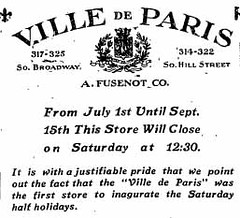
The salesclerks of Los Angeles are steaming—and not over the warming temperatures. Beginning last summer, all the department stores agreed that instead of closing at 10 p.m. on Saturdays, they would close at 12:30 p.m., giving the staff a half-day off with pay.

But the new manager of the Bon Marche, J.W. Eccleston, decided he could increase business by remaining open, incurring the anger of every other merchant—and clerk—in town. Eccleston said: “We have the matter under advisement. We have not determined that we will not close, but we will probably not do so on next Saturday night. We have our side of the story; our employees are unanimously with us and I don’t see that we need any outside sympathy.”

Thousands of store workers crowded into Simpson Auditorium for a meeting on preserving the half-holiday in the summer and closing at 6 p.m. instead of 10 p.m. on Saturdays for the rest of the year. Speeches were made and boycotts were threatened.

In the end, the half-holiday prevailed.

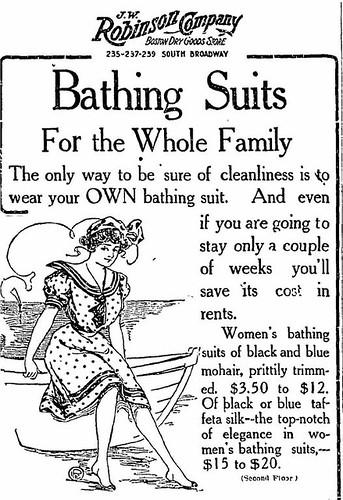
Here’s an inflation reality check:

Women’s mohair swimsuits $3.50-$12 ($71.83-$246.28 USD 2005). Taffeta silk $15-$20 ($307.85-$410.47 USD 2005).

Weather in Los Angeles for June 20, 1907: A low of 55 and a high of 72; at midnight, it was 61 and cloudy.

Lmharnisch.com


Lmharnisch.blogspot.com

Posted in 1907, Black Dahlia, Books and Authors, LAPD, Streetcars | Comments Off on Summer Heat

Soothing Music


June 19, 1907
Los Angeles

What shall we do with the insane? Don’t give them drugs… give them music! (Well, some music).

Dr. E.C. Dent of the hospital for women on Ward’s Island in New York says: “I firmly believe in the curative power of music for insane patients and those who suffer from nervous diseases, but I do not say that music in itself is a cure. It is true that music is now a regular part of the treatment in this hospital systematically employed in reaching and stimulating the brain.”

The musical selections are important, Dent says, because “popular airs … were useless or injurious in the case of a patient accustomed to the classics while the classics would be entirely without effect on the brain of an uneducated person.”

For simple mania, Dent says, slow, dreamy music is best while someone with melancholia is best treated with a stirring air. Dent’s assistant Miss Vescelius has classified music much like drugs: stimulants, sedatives, bromides, narcotics and tonics.

Dent uses Franz’s Liszt’s Hungarian Rhapsody No. 2 as a stimulant (predating Warner Bros.’ cartoons by several decades), and Felix Mendelssohn’s “On Wings of Song” as a sedative. Franz Schubert’s “Ave Maria” is a narcotic and marches and bright waltzes are considered as tonics.

“One day a dear friend mentally and physically at the lowest ebb lay in a half-fainting condition on a lounge as I sat at the piano, singing. Through a sudden impulse, I broke into the old gem ‘She Touched the Hem of His Garment,’ knowing it to be a favorite of the invalid. When I had finished she was standing by my side, with bright eyes and cheeks flushed. ‘I am revived; I am well,’ she said as she grasped me. And it was true that from that hour she improved and rapidly recovered.”

“The time will come when discordant tones in the sick room will be recognized as a crime, just as heinous as giving the sick adulterated drugs or impure food,” Vescelius said.

Although Dent doesn’t give an example of bromides, one might easily suggest, for starters, Tchaikovsky’s “1812 Overture” and Vivaldi’s “The Four Seasons.” I wonder what they would have thought of Steve Reich’s “Come Out.”

Lmharnisch.com

Lmharnisch.blogspot.com


Posted in 1907, Black Dahlia, Books and Authors, Crime and Courts, Food and Drink, LAPD, Music, Streetcars | Comments Off on Soothing Music