Random Shots From Our 12-Bore


Nov. 28, 1907
Los Angeles

  • Ocean Park banned serving alcohol to soldiers in uniform because drunk Civil War veterans from the soldiers home in Sawtelle “were seen reeling about the saloons.”

  • A racing team preparing for the upcoming hill climb on the Box Springs Grade hit a horse and buggy at 45 mph. The Times says the horse veered into the path of the auto, which struck the animal broadside, carrying it 40 feet and throwing it into a ditch. The badly injured animal was shot. Neither the buggy driver nor the men in the car were seriously hurt.

  • Dick Malone, a handicapped man from Sioux City, Iowa, befriended by the Rev. T. Tracy of Church of the Sacred Heart, was arrested at 3rd and Los Angeles on charges of passing forged checks drawn on Tracy’s account.
  • A noisy rooster on Olive Street has provoked a dispute between two neighbors. Former Indianapolis Police Chief David Powell, 80, complained that a rooster owned by a man named Murphy begins crowing at 3 a.m. Murphy moved his chickens back from the neighbor’s residence, and in revenge has constructed a “spite fence” out of quilts and old clothes that blocks all sunlight going into Powell’s room.
  • Miss Godberg, a housekeeper at the home of W.G. Cochran, 1559 W. 2nd St., heard a noise at the front door and upon opening it discovered a man with a handkerchief over his face. She struggled to close the door, but the man forced his way in, so she ripped off his handkerchief and threw him to the floor. The man drew a gun, freed himself from Godberg and fled into the night, The Times says.

  • George Spence, a solicitor for Collier’s Weekly, was taken to the Receiving Hospital after falling into a hole in the street at 2nd and San Pedro, cutting his head and shoulders and bruising his back.

  • Workers digging a deep trench at Avalon on Santa Catalina Island discovered prehistoric Indian remains. “Visitors eagerly awaited to snatch every available opportunity and oftentimes even urged the Mexican workers into quicker action so that they could triumphantly carry off as curiosities pieces of the dead and sacred remains of an extinct race,” The Times says.

  • Walter P. Temple has sued L.F. Lewis over desecration of the family cemetery on the old Workman homestead. The lawsuit says the Workmans, who owned Rancho La Puente, dedicated a portion of the property as a family cemetery, but that Lewis tore down a brick wall, allowing cattle to roam on his ancestors’ graves. Temple’s suit asks that Lewis be barred from any more damage and from plowing over or removing the remains.

An undercover vice investigation went badly wrong when “lady barber” Mary Fisher fled her shop at 451½ S. Main St. clutching a fistful of hair. Police Officer Cook, investigating whether Fisher was offering haircuts and massages as a front for illegal activities, arranged for the full treatment: shave, massage, shoe shine and anything else.

According to The Times, Fisher put steamed towels on Cook’s face, had given him a facial massage and started shaving him when she straightened his hair, only to have his toupee come off in her hand.

“The woman gave one look at the handful of hair sticking to her hand and another at the bald head of her customer and, with a shriek, she dashed for the stairs,” The Times says.

“Hey,” yelled Cook, “give me that hair. I need it!”

Lmharnisch.com
Lmharnisch.blogspot.com

e-mail: lmharnisch (AT) gmail.com

Posted in 1907, Black Dahlia, Books and Authors, LAPD, Streetcars | Comments Off on Random Shots From Our 12-Bore

Who Are Those Guys?


Nov. 27, 1907
Los Angeles

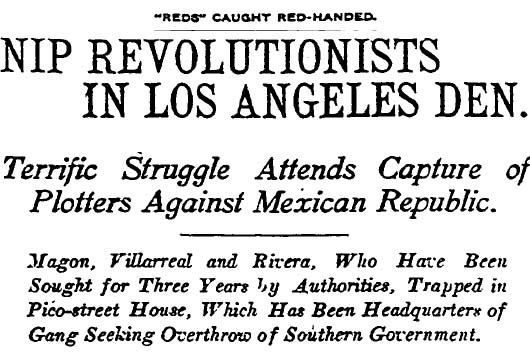
A shadowy, global conspiracy of anarchists is being described in the trial of revolutionaries Ricardo Flores Magon, Antonio Villareal and Librado Rivera in federal court. The fourth defendant, L. Gutierrez De Lara, was charged separately with committing larceny in Sonora, Mexico.

“The first positive evidence of a gigantic conspiracy to overthrow a friendly government was legally introduced,” The Times said. “Although there has been intimation of the danger[ous] character of the three men under arrest, and a partial expose of their cowardly plans to [overthrow] the presidents of this country and of Mexico, the far-reaching character of the junta has hardly been realized, even by government officials.”

Investigators seized letters by the men showing that the “anarchists of this country and of Europe are hand in glove with the leaders of the Mexican junta and that extreme socialists and rabid labor [officials?] have lent their aid to a greater or lesser degree.”

“Arms, bombs and poison were the weapons to be used in invading Mexico…. The wily leaders expected to inflame their ignorant followers to acts of rapine and violence such as characterized the French revolution. For the furtherance of this infamous plot, thousands of dollars has been raised and expended by the leaders,” The Times said.

Shown above, the Arizona lawmen who helped capture the revolutionaries: from left, Capt. F.H. Rynning, Undersheriff A.A. Hopkins, Lt. Billy Old and U.S. Inspector C.T. Connell.

One of the key witnesses in the trial will be A.T. Samuels of the Furlong Secret Service Bureau, who worked undercover selling ads for the revolutionists’ newspaper in St. Louis.

The Times notes that the defense attorneys staged another fundraiser at Simpson Auditorium, collecting $75 “from the socialists, anarchists and poor peons.” The event was “a poor repetition of the mass meeting of a few days ago. The same dreary anarchistic sentiments were uttered; the same Mexican hymns dolefully butchered by the cholo band and the identical [sentiments?] regarding tyranny were enunciated.”

After several speeches, defense attorney A.R. Holston “devoted most of his harangue to an attack upon The Times. He was very much surprised, he said, that this paper had called the former meeting [anarchistic] in character when it had been praised by the Citizen (Labor-Union), by the Common Sense (Socialist) and by the Express.

Bonus facts: Job Harriman was one of the defense attorneys for the McNamaras in the 1910 bombing of The Times and in 1914 founded a Socialist colony named Llano del Rio in the Antelope Valley, just beyond Pearblossom on the road between Palmdale and Victorville. He died in that hotbed of radicalism, Sierra Madre, in 1925 and was buried at Forest Lawn in Glendale.

Lmharnisch.com
Lmharnisch.blogspot.com

e-mail lmharnisch (AT) gmail.com

Posted in 1907, 1910, 1914, Black Dahlia, Books and Authors, Crime and Courts, LAPD, Streetcars | Comments Off on Who Are Those Guys?

How to Drive on Streetcar Tracks

Posted in Uncategorized | Comments Off on How to Drive on Streetcar Tracks

Roving to Monrovia

Nov. 24, 1907
Monrovia

The Times real estate section takes a look at what was then the distant suburb of Monrovia, 22 miles from downtown Los Angeles. The writer notes the increasing use of concrete and stone, explaining that the cost of lumber is forcing builders to use other materials. The writer also notes the broad, shaded verandas of three featured homes as well as the outlines of their roofs.

The story highlights the home of B.R. Davisson on East Orange Avenue, H.M. Slemmons (or Slemon) on North Myrtle Avenue and the home of John C. Rupp at Ivy and Greystone, built for $6,500 ($133,403.21 USD 2005).

Without exact addresses, it would be difficult for me to locate the Davisson and Slemmons homes, but I took a pleasant drive out to Monrovia recently to look for the Rupp house and was happy to find
that it is still standing and in beautiful condition. In fact, it was nice to discover that the neighborhood has quite a few well-maintained historic homes; a contrast to the condition of the houses I located in Pico Heights.

I had a brief chat with the homeowner who gave me a tour of the grounds. He said that Rupp, a financier, built the home for his wife, but that she decided it was too far from Los Angeles and wouldn’t live there. That’s apparently true, because Rupp put the home on the market in 1911.

Note that the ad for the home mentions a solar heater. I have no idea what this was and the homeowner didn’t know anything about it. Obviously a subject for further research.

The homeowner also mentioned the Monrovia Old House Preservation Group, which has a website and offers a self-guided tour. I cannot vouch for these folks, but it does sound interesting and the area has some lovely old homes.

To get to the Rupp house, take the Foothill Freeway and get off at Santa Anita in Arcadia. Turn north and go to Foothill Boulevard and then turn right (east) and then left on Ivy. The home is at 269 N. Ivy. While you’re there, look at the large stone house on the northeast corner, built in 1894. I’ll post some pictures when I get the film developed (we’re old school around here).

Lmharnisch.com
Lmharnisch.blogspot.com

e-mail: lmharnisch (AT) gmail.com

Posted in 1907, 1908, 1911, Black Dahlia, Books and Authors, Downtown, Education, Film, Freeways, Hollywood, LAPD, Real Estate, Streetcars | Comments Off on Roving to Monrovia

Slaughter of the Innocent


Nov. 23, 1907
South Pasadena

Warning: This is a grotesque, tragic story with graphic details.

Pasadena Detective Wallace H. Copping is investigating the murder of a young baby boy, whose half-eaten body was found in a pigpen on the Berry ranch in South Pasadena.

Authorities say the boy, weighing about 14 pounds and less than 10 days old (yes, quite a large baby by today’s standards), was discovered by Mrs. J.H. Anderson, whose husband leases the ranch. Apparently Mr. Anderson picked up the baby’s body as he made the rounds of about 20 homes gathering garbage to feed his pigs.

After the garbage was dumped into the pigpen, Mrs. Anderson “was surprised at the uproar among the swine and investigated.”

“To her horror, she saw the nude body of a baby, with the legs eaten away above the knees and the right arm torn away.” The Times said: “Mrs. Anderson risked her life to rush in and rescue the body of the infant.” Further investigation showed that the baby boy had been struck in the head with a hatchet.

Police dug through the debris, gathering anything that would identify the source of the garbage, and accompanied Anderson as he retraced his route, making inquiries at each home. The body was put on display at a local mortuary, with police taking the names of the hundreds of people who came in an unsuccessful attempt to identify the boy.

Police theorized that the mother had entrusted the baby to the father, who killed the boy rather than find it a loving home. Given the sensational publicity, they hoped that she would recognize the baby’s description and contact authorities. But unfortunately, The Times has nothing further about this case.

Bonus fact: Wallace H. Copping, a Spanish War veteran, died in 1949, at the age of 75.

Lmharnisch.com
Lmharnisch.blogspot.com

e-mail: lmharnisch (AT) blogspot.com

Posted in 1907, Black Dahlia, Books and Authors, Homicide, LAPD, Pasadena, Streetcars | Comments Off on Slaughter of the Innocent

A Love That Would Not Die


Nov. 22, 1907
Los Angeles

Weeping and heavily bandaged from where her drunk, enraged husband had shot her in the head, Ellen Larkin, 38, rose from her hospital bed, staggered to a nearby room and threw herself into the arms of her injured spouse. She covered him with kisses, vowing that she still loved him, and promised that he could come home as soon as he recovered from shooting himself and being nearly beaten to death with a baseball bat by their oldest son.

According to The Times, Jefferson B. Larkin, 45, a sometime teamster, horse player and “remittance man,” had returned to Los Angeles after spending four months in San Francisco while John, 16, the oldest of the Larkins’ four children, supported the family. As Larkin got thoroughly drunk, someone told him that his wife had been unfaithful, so he went to a pawnshop and bought a cheap revolver.

Larkin went in the backdoor of the home at 417 S. Colyton and found his wife in the kitchen with their four children: John, Isabelle, 10; Effie, 6; and Helen, 14 months. “He accused his wife of every vile thing he could lay his tongue to,” The Times said.

Larkin fired and missed, then shot his wife in the head as she leaped to grab the gun, with the bullet entering her scalp above the left ear and coming out the skin at the back of her head. Before he could fire again, John returned from taking his younger siblings to safety and struck his father in the head with a baseball bat with all his strength, then continued hitting him on the shoulders and in the chest.

Staggering to the door, Larkin walked to 7th Street, where he shot himself twice, then wandered to a rooming house, rented a room for $1 and called a doctor. He was expected to survive.

“I am not sorry that I hit him,” John said. “He intended to shoot mother again, but I hit him just in time to daze him. I hardly knew what I had done until after it was all over. I hope he don’t die now that mamma is not hurt.”

At the hospital, Larkin said: “I heard that she intended to get a divorce from me and I came to Los Angeles yesterday to settle matters. I decided to kill her and myself, too. I knew if I did this my mother and father who are in New York would take care of the children.”

Ellen left her husband’s hospital room after they vowed eternal love and affection, The Times said. Meanwhile, John went to the police station to swear out a complaint against his father. “I want to know when he leaves the hospital so that he won’t have a chance to get away from me,” he said. “I’ll put him where he belongs.”

There’s no further record of this case. However, The Times reported next year that a penniless youth named John Larkin had made the trip from Los Angeles to Patterson, N.J., to visit his grandparents. He started out riding on top of a passenger train, but was thrown off in San Bernardino, then snuck a ride on a train to Salt Lake City, where he earned dinner by washing dishes in a restaurant.

Arrested in Ogden, Utah, he served a 10-day sentence as water boy for the chain gang, caught an express train to Cheyenne, Wyo., worked his way to Chicago and then Cleveland. He finally snuck a ride on a train to New York, begged a ticket on the ferry and rode to Patterson on the trucks of the Erie Railroad’s dining car. He was 13.

Mark Twain defines “remittance man” in “Following the Equator.”

Lmharnisch.com
Lmharnisch.blogspot.com

e-mail: lmharnisch (AT) gmail.com

Posted in 1907, Black Dahlia, Books and Authors, LAPD, Streetcars | Comments Off on A Love That Would Not Die

The Murderous Mother


Nov. 21, 1907
Los Angeles

The woman who threw her baby from an inbound train was arrested at her mother’s home at 12th Street and San Pedro after the girl’s nurse contacted authorities, saying that she read about the incident in the newspaper and suspected the woman because she took the baby on a trip while leaving all the infant’s clothes at home.

Louise [or Louisa] Williams, who is in custody in San Bernardino, says the baby’s father “is a worthless mulatto, sometimes employed as a porter on the Salt Lake Overland trains,” according to The Times.

Despite initial reports that a passenger saw the infant thrown from the train and leaped off to rescue her, The Times says that the baby girl was found by a tramp who contacted Mr. Mattock, a nearby rancher. Mattock was afraid to move the injured baby without official permission, so left her there until he could contact police.

Mattock took the baby to his home, but she died of her injuries shortly after a doctor arrived.

On Feb. 19, 1908, Louise Williams pleaded guilty to manslaughter. Cramer B. Morris, her attorney, noted that Williams was only 17 and said she threw the baby off the train because “she was suddenly overwhelmed with the shame of meeting her mother and sisters at Los Angeles, who had not learned of her ruin.”

On March 2, 1908, Williams was sentenced to five years in San Quentin, despite testimony that she was mentally unstable. “After sentence was pronounced, women in the courtroom broke into heartbroken cries, but the girl smiled, apparently unaffected, The Times said.

Lmharnisch.com
Lmharnisch.blogspot.com

e-mail: lmharnisch (AT) gmail.com

Posted in 1907, 1908, Black Dahlia, Books and Authors, Crime and Courts, Homicide, LAPD, Streetcars | Comments Off on The Murderous Mother

Highwaymen Captured


Nov. 20, 1907
Los Angeles

Police battling the current crime wave say they have arrested two men who staged daring holdups on the Ascot Park and Eastlake streetcars, robbing the motormen and conductors as the cars reached the ends of their routes. These holdups had so infuriated local officials that Chief Kern armed bicycle officers with shotguns and ordered mounted policemen to resume patrolling the city.

In each case, robbers waited at the end of a streetcar route, when the trolley was empty except for the motorman and conductor, overpowered the men and robbed them. The bandits only took money or guns.

Officials say that S.A. Kursting and Frank O’Keefe immediately confessed to petty crimes and said they believed the men were trying to avoid more serious charges. Police say a copycat holdup of the Bimini Baths car was staged by the men’s friends to divert suspicion.

Despite the arrests, further holdups continued in San Bernardino and officials of the Los Angeles Railway are considering whether to formally issue firearms to conductors and motormen, some of whom are already carrying guns. A special squad is sweeping through the Los Angeles River bed and railroad yards, arresting hobos and vagrants.

In the meantime, city officials are wondering what to do with men who have been arrested since the jail is full. One suggestion is to build a stockade in the riverbed. The Times notes that many of the men are being herded together and sent out of town. I wonder if this is an instance of the old practice of “floating,” in which police dropped off criminals or other undesirables at the county line.

After reporting the initial arrests, The Times has no further word about Kursting or O’Keefe.

Lmharnisch.com
Lmharnisch.blogspot.com

e-mail: lmharnisch (AT) gmail.com

Posted in 1907, Black Dahlia, Books and Authors, Crime and Courts, LAPD, Streetcars, Transportation | Comments Off on Highwaymen Captured

Crime Wave Sweeps L.A.


Nov. 19, 1907
Los Angeles

An influx of crooks, petty hoodlums and vagrants drawn by good weather and horse racing at Santa Anita are blamed for a siege of crime throughout the city. The jail is so crowded—300 being held in a building designed for 125—that 95 men arrested for intoxication between Saturday night and Monday morning were released because there was no room for them. Drunks who posed no danger were merely put on a streetcar for a ride home, The Times says.

Carl Chrisensen [Christensen?], who had just served two months for vagrancy, was among 35 men sentenced to the chain gang for being homeless. Officers said Christensen begged at the back doors of homes and wore fraternal pins of the Masons and Eagles to gain housewives’ sympathy. When arrested, he was found to be carrying burglary tools, and he was sentenced to six months’ hard labor.

Two black LAPD officers, Glenn and Stevens, said they arrested a pair of robbers while looking for hobos in the Southern Pacific railroad yards near 4th Street. The officers said that one man begged for money while the other man tried to get behind them. Officer Glenn whirled around and stuck his service pistol in the man’s stomach. When arrested, the man was found to be gripping a heavy revolver in his pocket.

Officers Glenn and Stevens also reported raiding a gambling operation at 1st Street and San Pedro, arresting “twenty-two bad Negroes, men and women,” according to The Times.

In other crime news, a woman is being sought after throwing her infant from the inbound California Limited around Rancho Cucamonga. A man on the train saw the baby land in mud and leaped off to rescue it.

Robbers broke into the Dake’s Lunch Room in the basement at 414½ S. Broadway, slid the safe into “a big ice chest” and blew it open with nitroglycerin, taking about $75 ($1,539.27 USD 2005) but ignoring several checks.

“The lunchroom is located on one of the busiest streets of the city and supposed to be protected by the police and by two or three agency officers who patrol the stores, yet the robbers worked with safety and had plenty of time,” The Times says.

Finally, Police Surgeon Joseph B. Tanner is recuperating after a brawl at the Receiving Hospital with Frank Scholtz, who was arrested for being insane. Because the mental ward is overcrowded, patients have to be placed with the general population of the hospital, The Times says.

As Tanner was hurrying to attend to an emergency, Scholtz grabbed him by the coat and began hitting him, smashing Tanner’s eyeglasses so that the broken shards cut his face. Tanner wrestled Scholtz to the floor and the men rolled over and over until Tanner got on top and beat and choked Scholtz into submission, The Times said. Police Surgeon Quint rushed to Tanner’s aid and handcuffed Scholtz, then treated Tanner’s wounds.

The Times is curiously silent on what treatment, if any, was administered to Scholtz.

Lmharnisch.com
Lmharnisch.blogspot.com

e-mail: lmharnisch (AT) gmail.com

Posted in 1907, Black Dahlia, Books and Authors, Crime and Courts, LAPD, Religion, Streetcars, Transportation | Tagged , | Comments Off on Crime Wave Sweeps L.A.

Religious Recycling


Nov. 18, 1907
South Pasadena

Calvary Presbyterian Church at Center (now El Centro) and Fremont was dedicated in a service featuring prominent local religious leaders, including Dr. John Willis Baer, president of Occidental College.

The Times notes that the original church building was located on Columbia Street, but the location was inconvenient, so the church bought the Nazarene Chapel on Center.

The church, which cost $10,000 ($205,235.70 USD 2005) incorporates much of the old First Presbyterian Church of Pasadena, which was at Worcester Avenue and Colorado Street, The Times says.

Fortunately, this church is still standing and I’ll post some shots once I get the film developed.


In other news, Police Chief Kern talks frankly with The Times about the crime wave that is gripping the city.

Destruction from last year’s San Francisco earthquake has deprived career criminals and hobos of their usual winter quarters, so they are heading to Los Angeles, Kern says. In addition, layoffs across the Southwest have sent waves of the unemployed to Southern California.

“From the railroad detectives and mining men of large interests I have learned that nearly all of the railroads are discharging men from all their departments. Men are also being thrown out of work at the mines in Arizona, New Mexico and Nevada,” Kern says.”

“It enormously complicates the police problem and makes life in Los Angeles more dangerous,” the chief says. “To a very large extent they are men who are not in the habit of saving money and they arrive here broke and out of work. The next step is crime.

“I learn from the County Jail that many of the vagrants coming there to serve time are mechanics and workmen who have never been arrested before.”

Kern advocates the creation of a state police department charged, among other duties, with searching all trains entering California to clear them of hobos and vagrants.

Now pay attention:

“OWING TO THE ENORMOUS TERRITORY COVERED BY THIS CITY OUR MEN CAN’T BEGIN TO PATROL IT. WE OUGHT TO HAVE MORE POLICEMEN. I KNOW THAT SEEMS TO BE A CONSTANT CRY, BUT THERE ARE ACTUALLY DISTRICTS OF THIS CITY WHERE A POLICEMAN WOULD BE A CURIOSITY.”


I swear, this should be carved over the doors of the new LAPD headquarters.

Read about the history of Pasadena Presbyterian Church here.

Lmharnisch.com

Lmharnisch.blogspot.com

e-mail: lmharnisch (AT) gmail.com

Posted in 1907, Black Dahlia, Books and Authors, Crime and Courts, Film, Hollywood, LAPD, Pasadena, Streetcars | Tagged , | Comments Off on Religious Recycling

What Happens in the Monkey House?


Nov. 17, 1907
New York by direct wire to The Times

Something curious seems to be going on with opera tenors in the monkey house at New York’s Central Park; perhaps there’s an atmosphere that lends itself to “annoying” people, for the problem of mashers at the monkey house has even inspired a 1907 movie by Biograph.

Luckily, Detective J.J. Cain is on the lookout for malefactors who make lewd advances, having arrested Enrico Caruso the year before.

Cain’s latest arrests are Leon Cazauran, “a slender young man with pale face and large brown eyes” brought to New York to sing in “Thais” at Oscar Hammerstein’s Manhattan Operahouse, and his companion, Claude Modjeska, “a copper-colored young man,” The Times says.

“The charge against both was that of attempting to corrupt the morals of little boys,” The Times says. Cain said he was suspicious of the men because they had visited the monkey house several times before “in the company of small boys.”

Despite the language handicap (Cazauran didn’t speak English and while Modjeska only knew a bit of English, he was able to act as a translator) the men protested their innocence. Modjeska was fined $10 and the men vanished.

Caruso had not been so fortunate the previous year. Although his alleged victim at first refused to testify, Cain pressed the complaint and gave the following account:

The tenor had followed two girls, one of them about 12, and annoyed them. He then turned his attention to three women, one of whom was black, Cain said.

Cain said he saw Caruso move close to Mrs. Hannah Graham of the Bronx, N.Y. “He said he saw Caruso move up close to Mrs. Graham and then saw one of Caruso’s hands glide stealthily through a slit in his overcoat and then saw Caruso pinch the woman. Mrs. Graham turned swiftly and struck Caruso in the chest, crying aloud: ‘You brute! You beast!’ ”

The detective said he intervened after Graham hit Caruso in the chest. Cain added that he had seen Caruso commit other offenses, but “wanted to get him good.”

The spectacular trial ended with Caruso being fined $10. Hmmmm. According to news accounts, Caruso later “attempted to take certain liberties” with a woman in an automobile and in 1913 got in trouble in London, when he pointed at a young woman in the crowded lobby of the Savoy Hotel and said: “You! You!”

When reproved by an American who said: “You shouldn’t do that,” the singer replied: “I am Caruso and I do as I please.”

Bonus fact: Caruso was in San Francisco during the 1906 earthquake.

Lmharnisch.com

Lmharnisch.blogspot.com

e-mail: lmharnisch (AT) gmail.com

Posted in 1907, Black Dahlia, Books and Authors, LAPD, Streetcars | Comments Off on What Happens in the Monkey House?

1423 S. Van Ness

As promised, here are views of the home of Mrs. E.N. Eskey, featured in The Times in 1907. Note the damaged chimney, presumably the victim of seismic Darwinism.

And as a bonus, here’s the home of Igor Stravinsky, which I found in West Hollywood. It was here that Stravinsky and W.H. Auden began writing “The Rake’s Progress” in 1947. When I found the house, I struck up a conversation with a man across the street who was hosing off his driveway. He said had inherited his parents’ house and that when he was a young boy, he met Stravinsky.

Lmharnisch.com
Lmharnisch.blogspot.com

e-mail lmharnisch (AT) gmail.com

Posted in 1907, 1947, Black Dahlia, Books and Authors, Hollywood, LAPD, Streetcars | Comments Off on 1423 S. Van Ness

Fatal Fury

Nov. 16, 1907
Los Angeles

Mrs. Amanda Cook (she is also identified as Jennie and Mary) came to Los Angeles from Boston in 1906 with two of her children in search of her husband, Frederick, a union plasterer and bricklayer. She advertised in the newspapers without success and finally took a job as a cook at the Juvenile Detention Home.

Persuaded by her cousin to seek a divorce, she hired attorney George W. MacKnight, who sought out her errant husband and began divorce proceedings.

One day, after being threatened with divorce, Frederick appeared at the juvenile home and upon seeing his wife, said: “What the hell did you come out here for? Why didn’t you stay with your folks in Boston?”

At his office, MacKnight attempted a reconciliation. When asked if he thought he should support his children, Frederick said: “Yes, but I blow in my money with the boys and cannot save a dollar for the kids.”

Frederick said he didn’t want to get a divorce, so MacKnight asked Amanda if she would take her husband back. “Fred, you know I’ll do that in a minute,” she said. Frederick agreed to rent a house for them as long as MacKnight dropped the case—but the lawyer refused until Frederick made good on his promise.

As soon as the Cooks got into the hallway, Frederick said: “Do you think I’m going to be damn fool enough to support you and those kids?”

His wife replied: “Oh, Fred, you don’t mean that. Why, you just promised to take us back and get a little house for us all together.”

“Well,” Frederick replied, “if you don’t make the lawyer of yours dismiss this case I’ll kill you and him and the judge, too, and if the bum police ever catch me, I’ll kill myself.”

Amanda got a divorce, telling her lawyer: “I’m not afraid of him because he has threatened to cut my throat or blow out my brains a thousand times.”

Frederick began plotting to kill her. His first idea was to murder her at juvenile hall by shooting through a hole he cut in a screen, but he fled after being caught putting a pistol in the opening.

The next idea was far more cunning. A champion roller-skater,

Frederick went to a hairdresser on South Broadway, where he bought a false mustache and had his hair dyed, explaining that he was so well known in roller contests that he was prevented from entering.

On Aug. 27, 1906, he found Amanda on the fast streetcar from Santa Monica, sat next to her and shot her in the forehead, then stood up and shot her twice more. Several passengers grappled with him and got the gun, but Frederick swung free of the moving streetcar “near the Hammel and Denker ranch,” The Times said, and escaped.

Amanda’s bloody body was left between the seats as the car completed its rounds, slowly sliding down until “only the pathetic, shabby little shoes stuck out into the aisle to haunt those who made that terrible ride,” The Times said.

Frederick surrendered a year later in Fort Worth, Texas, claiming the shooting was authorized by “unwritten law” because he caught his wife with another man.

In 1908, he was convicted and sentenced to life in prison at San Quentin. As for the Cooks’ three children (an older child had been left with relatives in Boston) no record can be found.

Lmharnisch.com
Lmharnisch.blogspot.com

e-mail: lmharnisch (AT) gmail.com

Posted in 1907, 1908, Black Dahlia, Books and Authors, Homicide, LAPD, Streetcars, Transportation | Comments Off on Fatal Fury

Imagining the Future


Nov. 15, 1907
Los Angeles

Architect Charles Mulford Robinson has drafted a proposal for downtown Los Angeles that is stunning in its ambition. One portion calls for broad boulevard leading from a proposed Union Station at Central and 5th Street toward Grand, ending at a new public library and art gallery. The other, equally elaborate, calls for a grouping of civic buildings and terraced gardens around North Spring Street, including a new City Hall.

“First of all, and most important in his mind because Los Angeles is a leading tourist center and should strive to make a good impression at the very start, the architect suggests an immense union railroad station with an approach a mile long—a wide thoroughfare lined with beautiful buildings, with spacious parkways, rows of flowering trees and ornamental lamp posts, and with driveways for all classes of traffic,” The Times says.

Robinson’s report is lengthy and detailed, so it’s difficult to deal with in a blog. But it is fascinating to see how early the city was grappling with inventing its future. The library on 5th Street and City Hall on Spring (although on the Temple Block rather than the Bullard Block as Robinson suggested) are quite familiar.

Interestingly enough, Robinson also envisions a network of broad boulevards, including a picturesque drive with elaborate landscaping to Pasadena along the Arroyo Seco.

Search for a copy of “The Improvement of Towns and Cities.”

Lmharnisch.com
Lmharnisch.blogspot.com

e-mail lmharnisch (AT) gmail.com

Posted in 1907, Black Dahlia, Books and Authors, City Hall, Downtown, LAPD, Pasadena, Streetcars | Comments Off on Imagining the Future

Deadlier Than Male


Sept. 19, 1907
Los Angeles

“Hidden somewhere in Los Angeles is a daredevil Spanish woman who should be standing with the Mexican revolutionaries when they are arraigned here in the United States Court,” The Times says.

“Letters recently confiscated show that she was the most daring and reckless anarchist of all the band. Her name is Maria Talivera. She is said to be a beautiful and attractive woman. Her friends and even her husband regarded her as a quiet housewife, intent on cooking frijoles. But in her fry pans she was seeing men fighting, hearing in the sizzle of the grease the clash of arms, the pound of horses’ feet and the din and commotion of a nation’s government overthrown.”

The Times says: “She is the wife of one Marcello Talivera of this city. All the letters show that he was in perfect innocence of what was going on. How little he must have dreamed, when he returned from work at night and told her about his little business affairs, that he was patronizing a woman deep in the attempt to over throw two governments.”

Now this is an interesting research question, for there’s nothing else about her in The Times as Talivera or Talavera (apparently the paper misspelled her name). The Handbook of Texas Online identifies her as the companion and common-law wife of defendant Ricardo Flores Magon.

As Maria Magon, she was indicted Aug. 19, 1918, in connection with seditious editorials published in the Mexican newspaper Regeneracion.

To be continued.

Lmharnisch.com
Lmharnisch.blogspot.com

E-mail lmharnisch (AT) gmail.com

Posted in 1907, Black Dahlia, Books and Authors, Crime and Courts, LAPD, Streetcars | Comments Off on Deadlier Than Male

Revolutionary Defense Fund


Nov. 13, 1907
Los Angeles

An uproarious meeting was held last night at Simpson Auditorium to raise money for the four Mexican revolutionaries being held in the Los Angeles County Jail. The hall was packed with “revolutionists, Socialists, labor unionites, atheists and others of that ilk,” The Times said, noting: “A wild-eyed anarchist with a smoking bomb in his hand was the only thing needed.” “The audience was composed mainly of Mexicans and Spanish-Americans, but not of the better class,” The Times said.

A red flag was hoisted above the Stars and Stripes and red crepe paper was strung throughout the hall, while music was provided by a Mexican orchestra of boys and girls “who were supposed to represent the purity of the cause,” The Times said. Mexican women pelted defense attorney Job Harriman with flowers when he began his address.

In fiery oratory, Antonio Rodriguez, who spoke in Spanish, Harriman and fellow defense attorney A.R. Holston attacked the Mexican government, U.S. officials and the police, The Times said. A speaker read a letter from Antonio Villareal, one of the imprisoned revolutionaries, “filled with abuse of the Mexican government.”

Holston said: “I am a Socialist and a red abolitionist. We will be the saviors of mankind. America is following suit to Russia in its oppression and system of espial. Our officials have gone to school to the Czar of Russia. Our jails have been filled with Mexicans. Let our officials draw their pay from Mexico. We would not accept Mexican currency at one time. Now we seem glad to get it. It is probably better than Roosevelt currency.”

The Times said that the meeting “closed in an uproar. The ignorant Mexicans went out of the auditorium filled with sentiments of anarchy. They had been told that this country was the slave of Mexico. They were given to understand that revolution was praiseworthy and that bloodshed was necessary in such a righteous cause…. The church was openly assailed and the ministers of the Gospel were laughed at as cowards.”

The meeting raised $59 ($1,210.89 USD 2005).

To be continued.

Here’s a link to imprisoned revolutionary L. Gutierrez de Lara’s “The Mexican People: Their Struggle for Freedom.”

Lmharnisch.com
Lmharnisch.blogspot.com

e-mail: lmharnisch (AT) gmail.com

Posted in 1907, Black Dahlia, Books and Authors, Education, LAPD, Music, Streetcars | Comments Off on Revolutionary Defense Fund

A Bad Way With Horses


Nov.12, 1907
Los Angeles

Half a block from his home at 1131 Westlake, John P. Shumway Jr. was badly injured when the carriage he was driving collided with the 11th Street trolley. Shumway was thrown about 20 feet, striking the pavement head-first, and the horse ran for the stable, pulling what was left of the smashed carriage, witnesses said.

Shumway was carried to his home, where his father, Dr. John P. Shumway, treated him for a concussion, bruises and cuts. A year later, the family filed a personal injury suit against the Los Angeles Railway, seeking $10,355 ($204,938.83), although The Times failed to report the outcome of the trial.

Whether Shumway was a troublesome sort before is unclear, but his problems continued. In 1909, he was arrested for passing a forged check for $25 at the Pioneer bar on North Main Street. He claimed that he was given the check for work he had performed and was freed when he promised to repay the money.

A few months later, he was fined $60 for cruelty to a horse. Witnesses said Shumway overloaded a three-horse truck in South Pasadena and “tried to drive up the hill near the ostrich farm.”

“The middle horse was a willing beast, but the others were not much good,” The Times said. “Because the middle horse was willing to work, he was beaten so hard to make him work harder that the blood ran down to his hoofs.”

The judge told him: “I only wish, young man, that you could be tied up to something impossible for you to haul and then beaten to make you haul it. It would do you good.”

And after that, the Shumways apparently disappear from the public record. I suppose you’re wondering why a man who had suffered a bad head injury was cashing a $25 ($494.78 USD 2005) check at a bar. At least I am. Was he a reckless, bad-tempered man all along, or did his personality change after the streetcar crash? Alas, we will never know. But the image of a horse being beaten so badly that blood ran down its legs is ugly indeed.

Zillow says the Shumway horse-beating HQ, built in 1894, is still standing.

Lmharnisch.com
Lmharnisch.blogspot.com

Posted in 1907, 1909, Black Dahlia, Books and Authors, LAPD, Pasadena, Streetcars, Transportation | Comments Off on A Bad Way With Horses

Not Worthy


Nov. 11, 1907
Los Angeles

On a trip to Topeka, Kans., to visit relatives, Lena River Packard of Los Angeles met Edgar (or Edwin) Campbell Arnold, a wealthy wholesale druggist who quickly became her constant companion and ardent suitor. Love soon blossomed and in a few months, Edgar arrived in Los Angeles to claim his bride.

A lavish wedding was arranged, bridal showers were given for Lena and the minister was brought to town from Ventura, where the Packards once lived. Edgar gave her a diamond-studded bracelet as a token of their upcoming marriage.

And then the night before the ceremony, “he said goodnight to his fiancee with unusual fervor and left for his hotel at a late hour,” The Times said. Nothing was heard from him the next day and finally the Packards “began to entertain misgivings.”

The betrothed woman shut herself in her room and refused to see anyone, and there were rumors that Edgar left a heart-breaking farewell note. Her father, F.M. Packard, said: “There will be some queer developments before long.”

Reporters located Edgar back home in Kansas and asked if he would comment on rumors that he left a farewell note saying that he was unworthy of Lena. His doctor refused to let him speak.

Attorneys eventually disclosed that six days before his disappearance was reported in The Times, Edgar wrote: “Lena, for God’s sake think kindly of me for what I am doing. It is best for both of us. I don’t ask you to forgive, you can’t. Only when the pain has worn out, thank me for not going on and making your life miserable. I have tried until I am completely worn out, sick mentally and bodily. God forgive me; I am going out of your life. I am not worthy of any good woman’s love. I could never make you happy. Put me out of your existence.”

Lena replied in a letter to Edgar’s mother:

“I just got up from my bed, where I have been since Tuesday evening, and resolved to write you the whole truth. You know how things were in Topeka—you know how Edgar came out to see me. In May, when we became engaged he gave me a beautiful diamond ring and also some diamond earrings. The day after we became engaged, he asked my parents for my hand, and they gave their consent. I loved Edgar with all my heart and I never loved anyone before in my life. Edgar said he loved me and proved it in every way.

“I have stayed home all summer long and worked with love and patience over my wedding clothes. My dear mother and I have worked so hard. Father has spent hundreds of dollars just to have me fixed to be Edgar’s wife. My clothes are beautiful and God only knows what I’ll do with them now.

“He came on the 3rd, Sunday, getting in at 11:30 o’clock and came right to our home. I was overjoyed to see him and he seemed just as glad to see me. We stayed home all that afternoon and talked. He wanted to see my clothes, so I showed him a few dresses and waists, just as much as I thought proper. He seemed to like every one and seemed to feel bad because I had worked so hard on them. He asked me if I put all that work on the wedding gown just because I loved him and I told him ‘Yes.’ In the afternoon, Monday, he gave me a beautiful bracelet set with five diamonds.”

“My life is blighted,” she wrote, “by the man I thought would make me a kind and loving husband.”

The Packards filed a suit for $25,000 ($494,782.31 USD 2005) in 1908, only to discover that Edgar’s claims of being wealthy were lies. In truth, every penny of the family fortune was controlled by his mother, “a woman with an iron will and a sharp tongue who bitterly opposed the marriage.” Edgar feared that he would be disinherited if he went through with the wedding. The Packards received a $3,000 settlement.

Whether she kept the diamonds is a mystery that will never be answered. Of course, the real question is whether Lena ever married. Unfortunately, Proquest is no help here. Edgar was right about one thing: he wasn’t worthy.

Lmharnisch.com
Lmharnisch.blogspot.com

e-mail: lmharnisch (AT) gmail.com

Posted in 1907, 1908, Black Dahlia, Books and Authors, LAPD, Streetcars | Comments Off on Not Worthy

Dislocation, Dislocation, Dislocation

Nov. 10, 1907
South Pasadena

What sort of monument do we leave for real estate developers? For John B. Althouse, who built hundreds of homes in the Wilshire district, as well as the West Adams district and the San Gabriel Valley, the answer might be nondescript offices and vacant lots.

Here’s the house he built for himself at Oxley and Fremont in South Pasadena, a few blocks from my home. In fact, I pass the corner every day.

Here’s another one he built on Manhattan Place.

Don’t rush out to look for them, though. They’re gone, although the wall around Althouse’s home survived.

Born in Baltimore, Althouse died in July 1939 at the age of 72 at his home, 230 S. Gramercy Place. He arrived in Los Angeles in 1886 and spent 37 years in the real estate business after operating a fruit store at 1st and Main Streets for many years. He constructed hundreds of homes in the Wilshire district and was one of the first members of the Los Angeles Realty Board.

What’s this? One has survived in the West Adams district, 1415 S. Gramercy Place. Also read here. And here. Zillow link.

Lmharnisch.com
Lmharnisch.blogspot.com

e-mail: lmharnisch (AT) gmail.com

Update: Further research reveals the home of Daniel T. Althouse, a partner in Althouse Brothers, at 2125 S. 4th Ave., where he died of blood poisoning in 1914.


Posted in 1907, 1914, Black Dahlia, Books and Authors, LAPD, Pasadena, Real Estate, Streetcars | Comments Off on Dislocation, Dislocation, Dislocation

We Are Revolutionists!


Nov. 9, 1907
Los Angeles

Local sympathizers, anarchists and socialists are organizing a mass meeting to protest the imprisonment of Ricardo Flores Magon, Librado Rivera, Antonio Villareal and L. Gutierrez De Lara, who are being held on charges of trying to overthrow the Mexican government.

After years of avoiding capture, Magon, Rivera and Villareal were arrested Aug. 23 at 111 E. Pico St. after a brawl with Thomas Furlong of the Furlong Secret Service Bureau of St. Louis, along with Los Angeles Police Detectives Felipe Talamantes, [Thomas F.?] Rico and two deputies. De Lara was arrested by U.S. marshals at 420 W. 4th St. on Sept. 27.

The Times said of the August incident: “The street was filling with people. Men and women crowded before the house just in time to see a light survey and a coupe dash up before the door. Then the door opened and out into the light staggered the officers and their prisoners. They fought on the steps and in the street.”


“ ‘We are revolutionists! We are patriots! We are being kidnapped! Help! Help!’ they shrieked.”

In a 1921 letter to his attorney, Magon wrote: “We avoided being kidnapped into Mexico by voicing in the street the intentions of our captors. A big crowd gathered, and it was necessary for our abductors to take us to the police station, and to rapidly manufacture a charge against us.”

The men were defended by Job Harriman, described by The Times as a Socialist agitator.


De Lara said upon his arrest: “I am a student, a writer and, if need be, a martyr. I have written many books. I am now on a cycle of novels in which socialistic questions are discussed. Like Balzac or Zola, I have a mission. I am arrested and thrown into a dungeon. I care not for that, if they furnish me paper, ink and a light.”

To be continued.

Ricardo Flores Magon site


Lmharnisch.com
Lmharnisch.blogspot.com
e-mail: lmharnisch (AT) gmail.com

Posted in 1907, Black Dahlia, Books and Authors, LAPD, Streetcars | Comments Off on We Are Revolutionists!