1423 S. Van Ness

As promised, here are views of the home of Mrs. E.N. Eskey, featured in The Times in 1907. Note the damaged chimney, presumably the victim of seismic Darwinism.

And as a bonus, here’s the home of Igor Stravinsky, which I found in West Hollywood. It was here that Stravinsky and W.H. Auden began writing “The Rake’s Progress” in 1947. When I found the house, I struck up a conversation with a man across the street who was hosing off his driveway. He said had inherited his parents’ house and that when he was a young boy, he met Stravinsky.

Lmharnisch.com
Lmharnisch.blogspot.com

e-mail lmharnisch (AT) gmail.com

Posted in 1907, 1947, Black Dahlia, Books and Authors, Hollywood, LAPD, Streetcars | Comments Off on 1423 S. Van Ness

Fatal Fury

Nov. 16, 1907
Los Angeles

Mrs. Amanda Cook (she is also identified as Jennie and Mary) came to Los Angeles from Boston in 1906 with two of her children in search of her husband, Frederick, a union plasterer and bricklayer. She advertised in the newspapers without success and finally took a job as a cook at the Juvenile Detention Home.

Persuaded by her cousin to seek a divorce, she hired attorney George W. MacKnight, who sought out her errant husband and began divorce proceedings.

One day, after being threatened with divorce, Frederick appeared at the juvenile home and upon seeing his wife, said: “What the hell did you come out here for? Why didn’t you stay with your folks in Boston?”

At his office, MacKnight attempted a reconciliation. When asked if he thought he should support his children, Frederick said: “Yes, but I blow in my money with the boys and cannot save a dollar for the kids.”

Frederick said he didn’t want to get a divorce, so MacKnight asked Amanda if she would take her husband back. “Fred, you know I’ll do that in a minute,” she said. Frederick agreed to rent a house for them as long as MacKnight dropped the case—but the lawyer refused until Frederick made good on his promise.

As soon as the Cooks got into the hallway, Frederick said: “Do you think I’m going to be damn fool enough to support you and those kids?”

His wife replied: “Oh, Fred, you don’t mean that. Why, you just promised to take us back and get a little house for us all together.”

“Well,” Frederick replied, “if you don’t make the lawyer of yours dismiss this case I’ll kill you and him and the judge, too, and if the bum police ever catch me, I’ll kill myself.”

Amanda got a divorce, telling her lawyer: “I’m not afraid of him because he has threatened to cut my throat or blow out my brains a thousand times.”

Frederick began plotting to kill her. His first idea was to murder her at juvenile hall by shooting through a hole he cut in a screen, but he fled after being caught putting a pistol in the opening.

The next idea was far more cunning. A champion roller-skater,

Frederick went to a hairdresser on South Broadway, where he bought a false mustache and had his hair dyed, explaining that he was so well known in roller contests that he was prevented from entering.

On Aug. 27, 1906, he found Amanda on the fast streetcar from Santa Monica, sat next to her and shot her in the forehead, then stood up and shot her twice more. Several passengers grappled with him and got the gun, but Frederick swung free of the moving streetcar “near the Hammel and Denker ranch,” The Times said, and escaped.

Amanda’s bloody body was left between the seats as the car completed its rounds, slowly sliding down until “only the pathetic, shabby little shoes stuck out into the aisle to haunt those who made that terrible ride,” The Times said.

Frederick surrendered a year later in Fort Worth, Texas, claiming the shooting was authorized by “unwritten law” because he caught his wife with another man.

In 1908, he was convicted and sentenced to life in prison at San Quentin. As for the Cooks’ three children (an older child had been left with relatives in Boston) no record can be found.

Lmharnisch.com
Lmharnisch.blogspot.com

e-mail: lmharnisch (AT) gmail.com

Posted in 1907, 1908, Black Dahlia, Books and Authors, Homicide, LAPD, Streetcars, Transportation | Comments Off on Fatal Fury

Imagining the Future


Nov. 15, 1907
Los Angeles

Architect Charles Mulford Robinson has drafted a proposal for downtown Los Angeles that is stunning in its ambition. One portion calls for broad boulevard leading from a proposed Union Station at Central and 5th Street toward Grand, ending at a new public library and art gallery. The other, equally elaborate, calls for a grouping of civic buildings and terraced gardens around North Spring Street, including a new City Hall.

“First of all, and most important in his mind because Los Angeles is a leading tourist center and should strive to make a good impression at the very start, the architect suggests an immense union railroad station with an approach a mile long—a wide thoroughfare lined with beautiful buildings, with spacious parkways, rows of flowering trees and ornamental lamp posts, and with driveways for all classes of traffic,” The Times says.

Robinson’s report is lengthy and detailed, so it’s difficult to deal with in a blog. But it is fascinating to see how early the city was grappling with inventing its future. The library on 5th Street and City Hall on Spring (although on the Temple Block rather than the Bullard Block as Robinson suggested) are quite familiar.

Interestingly enough, Robinson also envisions a network of broad boulevards, including a picturesque drive with elaborate landscaping to Pasadena along the Arroyo Seco.

Search for a copy of “The Improvement of Towns and Cities.”

Lmharnisch.com
Lmharnisch.blogspot.com

e-mail lmharnisch (AT) gmail.com

Posted in 1907, Black Dahlia, Books and Authors, City Hall, Downtown, LAPD, Pasadena, Streetcars | Comments Off on Imagining the Future

Deadlier Than Male


Sept. 19, 1907
Los Angeles

“Hidden somewhere in Los Angeles is a daredevil Spanish woman who should be standing with the Mexican revolutionaries when they are arraigned here in the United States Court,” The Times says.

“Letters recently confiscated show that she was the most daring and reckless anarchist of all the band. Her name is Maria Talivera. She is said to be a beautiful and attractive woman. Her friends and even her husband regarded her as a quiet housewife, intent on cooking frijoles. But in her fry pans she was seeing men fighting, hearing in the sizzle of the grease the clash of arms, the pound of horses’ feet and the din and commotion of a nation’s government overthrown.”

The Times says: “She is the wife of one Marcello Talivera of this city. All the letters show that he was in perfect innocence of what was going on. How little he must have dreamed, when he returned from work at night and told her about his little business affairs, that he was patronizing a woman deep in the attempt to over throw two governments.”

Now this is an interesting research question, for there’s nothing else about her in The Times as Talivera or Talavera (apparently the paper misspelled her name). The Handbook of Texas Online identifies her as the companion and common-law wife of defendant Ricardo Flores Magon.

As Maria Magon, she was indicted Aug. 19, 1918, in connection with seditious editorials published in the Mexican newspaper Regeneracion.

To be continued.

Lmharnisch.com
Lmharnisch.blogspot.com

E-mail lmharnisch (AT) gmail.com

Posted in 1907, Black Dahlia, Books and Authors, Crime and Courts, LAPD, Streetcars | Comments Off on Deadlier Than Male

Revolutionary Defense Fund


Nov. 13, 1907
Los Angeles

An uproarious meeting was held last night at Simpson Auditorium to raise money for the four Mexican revolutionaries being held in the Los Angeles County Jail. The hall was packed with “revolutionists, Socialists, labor unionites, atheists and others of that ilk,” The Times said, noting: “A wild-eyed anarchist with a smoking bomb in his hand was the only thing needed.” “The audience was composed mainly of Mexicans and Spanish-Americans, but not of the better class,” The Times said.

A red flag was hoisted above the Stars and Stripes and red crepe paper was strung throughout the hall, while music was provided by a Mexican orchestra of boys and girls “who were supposed to represent the purity of the cause,” The Times said. Mexican women pelted defense attorney Job Harriman with flowers when he began his address.

In fiery oratory, Antonio Rodriguez, who spoke in Spanish, Harriman and fellow defense attorney A.R. Holston attacked the Mexican government, U.S. officials and the police, The Times said. A speaker read a letter from Antonio Villareal, one of the imprisoned revolutionaries, “filled with abuse of the Mexican government.”

Holston said: “I am a Socialist and a red abolitionist. We will be the saviors of mankind. America is following suit to Russia in its oppression and system of espial. Our officials have gone to school to the Czar of Russia. Our jails have been filled with Mexicans. Let our officials draw their pay from Mexico. We would not accept Mexican currency at one time. Now we seem glad to get it. It is probably better than Roosevelt currency.”

The Times said that the meeting “closed in an uproar. The ignorant Mexicans went out of the auditorium filled with sentiments of anarchy. They had been told that this country was the slave of Mexico. They were given to understand that revolution was praiseworthy and that bloodshed was necessary in such a righteous cause…. The church was openly assailed and the ministers of the Gospel were laughed at as cowards.”

The meeting raised $59 ($1,210.89 USD 2005).

To be continued.

Here’s a link to imprisoned revolutionary L. Gutierrez de Lara’s “The Mexican People: Their Struggle for Freedom.”

Lmharnisch.com
Lmharnisch.blogspot.com

e-mail: lmharnisch (AT) gmail.com

Posted in 1907, Black Dahlia, Books and Authors, Education, LAPD, Music, Streetcars | Comments Off on Revolutionary Defense Fund

A Bad Way With Horses


Nov.12, 1907
Los Angeles

Half a block from his home at 1131 Westlake, John P. Shumway Jr. was badly injured when the carriage he was driving collided with the 11th Street trolley. Shumway was thrown about 20 feet, striking the pavement head-first, and the horse ran for the stable, pulling what was left of the smashed carriage, witnesses said.

Shumway was carried to his home, where his father, Dr. John P. Shumway, treated him for a concussion, bruises and cuts. A year later, the family filed a personal injury suit against the Los Angeles Railway, seeking $10,355 ($204,938.83), although The Times failed to report the outcome of the trial.

Whether Shumway was a troublesome sort before is unclear, but his problems continued. In 1909, he was arrested for passing a forged check for $25 at the Pioneer bar on North Main Street. He claimed that he was given the check for work he had performed and was freed when he promised to repay the money.

A few months later, he was fined $60 for cruelty to a horse. Witnesses said Shumway overloaded a three-horse truck in South Pasadena and “tried to drive up the hill near the ostrich farm.”

“The middle horse was a willing beast, but the others were not much good,” The Times said. “Because the middle horse was willing to work, he was beaten so hard to make him work harder that the blood ran down to his hoofs.”

The judge told him: “I only wish, young man, that you could be tied up to something impossible for you to haul and then beaten to make you haul it. It would do you good.”

And after that, the Shumways apparently disappear from the public record. I suppose you’re wondering why a man who had suffered a bad head injury was cashing a $25 ($494.78 USD 2005) check at a bar. At least I am. Was he a reckless, bad-tempered man all along, or did his personality change after the streetcar crash? Alas, we will never know. But the image of a horse being beaten so badly that blood ran down its legs is ugly indeed.

Zillow says the Shumway horse-beating HQ, built in 1894, is still standing.

Lmharnisch.com
Lmharnisch.blogspot.com

Posted in 1907, 1909, Black Dahlia, Books and Authors, LAPD, Pasadena, Streetcars, Transportation | Comments Off on A Bad Way With Horses

Not Worthy


Nov. 11, 1907
Los Angeles

On a trip to Topeka, Kans., to visit relatives, Lena River Packard of Los Angeles met Edgar (or Edwin) Campbell Arnold, a wealthy wholesale druggist who quickly became her constant companion and ardent suitor. Love soon blossomed and in a few months, Edgar arrived in Los Angeles to claim his bride.

A lavish wedding was arranged, bridal showers were given for Lena and the minister was brought to town from Ventura, where the Packards once lived. Edgar gave her a diamond-studded bracelet as a token of their upcoming marriage.

And then the night before the ceremony, “he said goodnight to his fiancee with unusual fervor and left for his hotel at a late hour,” The Times said. Nothing was heard from him the next day and finally the Packards “began to entertain misgivings.”

The betrothed woman shut herself in her room and refused to see anyone, and there were rumors that Edgar left a heart-breaking farewell note. Her father, F.M. Packard, said: “There will be some queer developments before long.”

Reporters located Edgar back home in Kansas and asked if he would comment on rumors that he left a farewell note saying that he was unworthy of Lena. His doctor refused to let him speak.

Attorneys eventually disclosed that six days before his disappearance was reported in The Times, Edgar wrote: “Lena, for God’s sake think kindly of me for what I am doing. It is best for both of us. I don’t ask you to forgive, you can’t. Only when the pain has worn out, thank me for not going on and making your life miserable. I have tried until I am completely worn out, sick mentally and bodily. God forgive me; I am going out of your life. I am not worthy of any good woman’s love. I could never make you happy. Put me out of your existence.”

Lena replied in a letter to Edgar’s mother:

“I just got up from my bed, where I have been since Tuesday evening, and resolved to write you the whole truth. You know how things were in Topeka—you know how Edgar came out to see me. In May, when we became engaged he gave me a beautiful diamond ring and also some diamond earrings. The day after we became engaged, he asked my parents for my hand, and they gave their consent. I loved Edgar with all my heart and I never loved anyone before in my life. Edgar said he loved me and proved it in every way.

“I have stayed home all summer long and worked with love and patience over my wedding clothes. My dear mother and I have worked so hard. Father has spent hundreds of dollars just to have me fixed to be Edgar’s wife. My clothes are beautiful and God only knows what I’ll do with them now.

“He came on the 3rd, Sunday, getting in at 11:30 o’clock and came right to our home. I was overjoyed to see him and he seemed just as glad to see me. We stayed home all that afternoon and talked. He wanted to see my clothes, so I showed him a few dresses and waists, just as much as I thought proper. He seemed to like every one and seemed to feel bad because I had worked so hard on them. He asked me if I put all that work on the wedding gown just because I loved him and I told him ‘Yes.’ In the afternoon, Monday, he gave me a beautiful bracelet set with five diamonds.”

“My life is blighted,” she wrote, “by the man I thought would make me a kind and loving husband.”

The Packards filed a suit for $25,000 ($494,782.31 USD 2005) in 1908, only to discover that Edgar’s claims of being wealthy were lies. In truth, every penny of the family fortune was controlled by his mother, “a woman with an iron will and a sharp tongue who bitterly opposed the marriage.” Edgar feared that he would be disinherited if he went through with the wedding. The Packards received a $3,000 settlement.

Whether she kept the diamonds is a mystery that will never be answered. Of course, the real question is whether Lena ever married. Unfortunately, Proquest is no help here. Edgar was right about one thing: he wasn’t worthy.

Lmharnisch.com
Lmharnisch.blogspot.com

e-mail: lmharnisch (AT) gmail.com

Posted in 1907, 1908, Black Dahlia, Books and Authors, LAPD, Streetcars | Comments Off on Not Worthy

Dislocation, Dislocation, Dislocation

Nov. 10, 1907
South Pasadena

What sort of monument do we leave for real estate developers? For John B. Althouse, who built hundreds of homes in the Wilshire district, as well as the West Adams district and the San Gabriel Valley, the answer might be nondescript offices and vacant lots.

Here’s the house he built for himself at Oxley and Fremont in South Pasadena, a few blocks from my home. In fact, I pass the corner every day.

Here’s another one he built on Manhattan Place.

Don’t rush out to look for them, though. They’re gone, although the wall around Althouse’s home survived.

Born in Baltimore, Althouse died in July 1939 at the age of 72 at his home, 230 S. Gramercy Place. He arrived in Los Angeles in 1886 and spent 37 years in the real estate business after operating a fruit store at 1st and Main Streets for many years. He constructed hundreds of homes in the Wilshire district and was one of the first members of the Los Angeles Realty Board.

What’s this? One has survived in the West Adams district, 1415 S. Gramercy Place. Also read here. And here. Zillow link.

Lmharnisch.com
Lmharnisch.blogspot.com

e-mail: lmharnisch (AT) gmail.com

Update: Further research reveals the home of Daniel T. Althouse, a partner in Althouse Brothers, at 2125 S. 4th Ave., where he died of blood poisoning in 1914.


Posted in 1907, 1914, Black Dahlia, Books and Authors, LAPD, Pasadena, Real Estate, Streetcars | Comments Off on Dislocation, Dislocation, Dislocation

We Are Revolutionists!


Nov. 9, 1907
Los Angeles

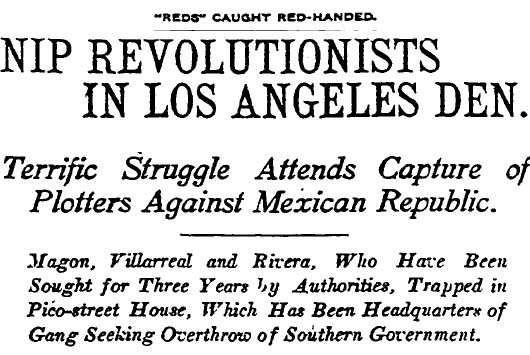
Local sympathizers, anarchists and socialists are organizing a mass meeting to protest the imprisonment of Ricardo Flores Magon, Librado Rivera, Antonio Villareal and L. Gutierrez De Lara, who are being held on charges of trying to overthrow the Mexican government.

After years of avoiding capture, Magon, Rivera and Villareal were arrested Aug. 23 at 111 E. Pico St. after a brawl with Thomas Furlong of the Furlong Secret Service Bureau of St. Louis, along with Los Angeles Police Detectives Felipe Talamantes, [Thomas F.?] Rico and two deputies. De Lara was arrested by U.S. marshals at 420 W. 4th St. on Sept. 27.

The Times said of the August incident: “The street was filling with people. Men and women crowded before the house just in time to see a light survey and a coupe dash up before the door. Then the door opened and out into the light staggered the officers and their prisoners. They fought on the steps and in the street.”


“ ‘We are revolutionists! We are patriots! We are being kidnapped! Help! Help!’ they shrieked.”

In a 1921 letter to his attorney, Magon wrote: “We avoided being kidnapped into Mexico by voicing in the street the intentions of our captors. A big crowd gathered, and it was necessary for our abductors to take us to the police station, and to rapidly manufacture a charge against us.”

The men were defended by Job Harriman, described by The Times as a Socialist agitator.


De Lara said upon his arrest: “I am a student, a writer and, if need be, a martyr. I have written many books. I am now on a cycle of novels in which socialistic questions are discussed. Like Balzac or Zola, I have a mission. I am arrested and thrown into a dungeon. I care not for that, if they furnish me paper, ink and a light.”

To be continued.

Ricardo Flores Magon site


Lmharnisch.com
Lmharnisch.blogspot.com
e-mail: lmharnisch (AT) gmail.com

Posted in 1907, Black Dahlia, Books and Authors, LAPD, Streetcars | Comments Off on We Are Revolutionists!

An EBay Mystery

Nov. 6, 1907
Los Angeles

Here’s a real mystery, although a minor one, and like all real mysteries, it is incomplete and may have no solution.

Exhibit 1: This postcard up for auction on Ebay.

Here’s the front, Burmese fortunetellers.

And the back.

As for the postcard, we find that D.A. Ahuja of Rangoon published a series of Burmese cards. Presumably the card was sent during a voyage because it is stamped “Sea Post Office.” The stamp is from India, a 2 Annas, 6 Pies with the image of King Edward VII. (Here’s one that was used in Bahrain).

Now for the message:

“Kindly accept my sincere sympathies on the loss you have sustained. Was very sorry indeed to hear of the loss.

Kind regards from
Val Leonard 25/11/07”

It’s too bad there isn’t more to the message. Presumably the writer didn’t want to reveal too many details on a postcard. And doesn’t a photo of Burmese fortunetellers seem an odd choice for a sympathy note? Maybe it’s just me.

Note the method of indicating the date, with the day first, then the month and finally the year. The easy guess is that the writer is not an American; but again, only a guess. Who is Val Leonard? A Proquest search turns up nothing.

What’s curious is the cancellation on the stamp “_ASER STREET.” Unfortunately, it’s incomplete, but appears to say rather clearly “25 10 07.” One wonders whether the postal clerk neglected to change the month on the rubber stamp or if something else is afoot.

Also note the address: 150 S. Vendome St., Los Angeles, California, USA is written in dark ink, while the name is so light that it’s nearly unreadable: Mrs. J.F. Hue—something. Or wait. Is it Mrs. J.F. Thie—something?

I recall a Sherlock Holmes story in which the character wrote the name in one manner and the address in another, prompting Holmes to infer that the writer had to look up the address. In this case, however, it seems that the address and message were written at the same time and the name at another. The question of why is one for Mr. Holmes.

Unfortunately, the California death records for 1907 don’t reveal a Hue or a Thie, nor does Proquest, so this line of research comes to an abrupt halt.

We can find out a bit about the address, though. It was a house and was advertised for rent on March 7, 10 and 12, 1907. The question would be whether the loss occurred before March, leaving the house vacant, or after. The answer to that would involve the question of how long it took news of Mrs. J.F’s loss to travel to someone on a voyage and then how long it took the card to arrive. Presumably, it took so long that by the time the card was delivered that Mrs. J.F. had moved to Boulder, Colo. Note that it was a post office box rather than a fixed address. Holmes would have fun with that.

So then, what was the loss? The absence of a Mr. and Mrs. J.F. points toward the loss of a husband, but it could easily be some other loved one.

Now wait a minute. Maybe that’s an “S” as in the capital S of “S. Vendome.” Hmmm. Maybe it’s Mrs. J.F. Shie.

Proquest is seemingly helpful here: A mail clerk named Albert W. Shie was killed in a terrible railroad accident at Colton, Calif., on March 29, 1907, which is shortly after the house at 150 S. Vendome was up for rent. The Times says that Shie had been working on the train from El Paso to Los Angeles for five years and lived with his wife at 555 Ruth Ave. in Los Angeles.

Is this Mrs. J.F.’s loss? Presumably she might be Albert Shie’s mother, but given the information available, it may never be clear.

A fun mystery, thanks to Ebay.

Lmharnisch.com
Lmharnisch.blogspot.com

e-mail: lmharnisch (AT) gmail.com

Posted in 1907, Black Dahlia, Books and Authors, Found on EBay, LAPD, Streetcars | Comments Off on An EBay Mystery

Commitment


Nov. 5, 1907
Los Angeles

John Richie led the bass section of the choir at St. Machar’s Cathedral in Aberdeen, Scotland, while Testristina Adams was a contralto. They sang in the choir for about 10 years, and fell in love.

Two years ago, in hopes of more opportunity, John left Scotland and came to Los Angeles, but not before asking Testristina, a pretty brunette, according to The Times, to marry him. “If I had not said that I would follow him he would never have come,” she said.

Recently, she embarked on a 7,000-mile journey to join John, who works at a Los Angeles hardware company. “She arrived in New York on Monday, Oct. 28,” The Times said, “on the Caledonia after nine days of the most strenuous voyaging that boat had ever experienced. Miss Adams, filled with the thought of seeing her lover after long years of waiting, refused to succumb to the illness which overcame even the stewards and landed in New York after a thoroughly enjoyed passage.”

Testristina said that of the people in her railroad car traveling from Chicago, 80 were planning to settle in Los Angeles. “All of them had nice things to say about California,” she said.

John, 31, and Testristina, 26, were married at the home of friends at 4419 Pasadena Ave. They did not plan a honeymoon trip, The Times noted, because “Miss Adams says she had had quite enough of traveling.”

Aside from John being selected as a soccer referee in 1908, I can find nothing else about the Richies in The Times, despite Testristina’s extremely unusual name (The Times also spelled it Testrestina) but I hope they had a long, happy life together and many grandchildren.

Lmharnisch.com

Lmharnisch.blogspot.com

e-mail: lmharnisch (AT) gmail.com

Posted in 1907, 1908, Black Dahlia, Books and Authors, LAPD, Pasadena, Streetcars | Comments Off on Commitment

Location Sleuth II


Nathan Marsak says:

That’s Sixth and Olive, looking Northeast. The old 1906 Philharmonic Auditorium in the bg, left (after its 1938 Streamline remodel by Stiles Clements, now a parking lot) and next to it to the right is the Parkinson 1931 Title Guarantee Building. That’s why it’s so dark at the right side of the image — that’s Pershing Square.

So right! And on that corner is the Pacific Mutual Building

Posted in Uncategorized | Comments Off on Location Sleuth II

Time to Buy a New One

Nov. 4, 1907
Los Angeles

About a year ago, Eugene Rowe’s little runabout was smashed by a trolley. After some repairs, it won a trophy, but a month later, it was wrecked in the Pasadena hill climb. And then it overturned in a ditch.

Undeterred, and practicing the route of a Thanksgiving run, Rowe and his friend Charles Fuller Gates set off for Box Springs in Riverside County, where the runabout overturned on a curve. Gates was pinned under the car, crushing his left leg. Rowe was thrown clear and although he was badly battered managed to free Gates from the wreck.

The men waited until another car came along and picked them up, and they were taken to Los Angeles on a Salt Lake train.

Doctors at California Hospital say they will be able to save Gates’ injured leg. The runabout, however, was abandoned because the wheels were flattened and it could not be moved. “The radiator was caved in, the tonneau was torn from the frame and the steering gear wrenched loose,” The Times said. “This last accident seems to have put the tough little machine out of business.”

Ps. It was a Ford.

Bonus fact: Gates, a noted racing cyclist of the 1890s, went on to referee motorcycle races and was last heard from in 1915.

Lmharnisch.com

Lmharnisch.blogspot.com

e-mail: lmharnisch (AT) gmail.com

Posted in 1907, Black Dahlia, Books and Authors, LAPD, Pasadena, Streetcars | Comments Off on Time to Buy a New One

Curb Appeal


Nov. 3, 1907
Los Angeles

Mrs. E.N. Eskey is building this 10-room house in Pico Heights, on Van Ness just south of Pico.

According to The Times, the two-story house (with basement) has a first floor divided into a reception hall with an oak staircase leading upstairs. The living room features built-in bookcases and a massive brick mantel. The dining room has a built-in buffet and china closet, with a pantry and kitchen.

The floors are quarter-sawn oak on the first floor and maple flooring in the rest of the house. The Times says there are four chambers, presumably bedrooms, a sewing room and a bathroom upstairs, as well as an alcove.

In the basement, a coal bin and a Rudd heater.

The cost? $5,000 ($102,617.85 USD 2005) a bargain by today’s standards. Note that in March 2004, 1244 S. Van Ness sold for $1,037,500.

Check out Zillow.com

Lmharnisch.com

Lmharnisch.blogspot.com

e-mail: lmharnisch (AT) gmail.com

Update: This house is still standing and has been painted blue. I’ll post some photos once I get the film developed (yes, I’m old-school).

Posted in 1907, Black Dahlia, Books and Authors, Education, Film, Hollywood, LAPD, Streetcars | Comments Off on Curb Appeal

Location Sleuth


Here’s a frame grab from the opening shots of “Double Indemnity.” According to the script, the car driven by Walter Neff speeds through an intersection, narrowly avoiding a delivery truck bearing the sign: “READ THE LOS ANGELES TIMES.”

But tinkering with the photo (the original is very dark, after all we are talking about film noir) shows that the truck apparently reads “Los Angeles Examiner.” Although it’s difficult to be positive, the elaborate “E” on the second line almost surely gives it away as the Examiner. It certainly isn’t the Los Angeles Times. Either way, it’s definitely a newspaper truck as bundles of papers tumble from the back when the driver slams on the brakes.

Here’s one of my favorite passages from the script, describing the Dietrichson house:

“Spanish craperoo in style, as is the house throughout. A wrought-iron staircase curves down from the second floor. A fringed Mexican shawl hangs down over the landing. A large tapestry hangs on the wall. Downstairs, the dining room to one side, living room on the other side visible through a wide archway. All of this, architecture, furniture, decorations, etc., is genuine early Leo Carrillo period. Neff has edged his way in past maid who still holds the door open.”

As for the location, my guess is Hill and 3rd Streets, across from Grand Central Market. Any other ideas?

Lmharnisch.com

Lmharnisch.blogspot.com

Posted in Uncategorized | 1 Comment

Roll On, Ugly River


Nov. 2, 1907
Los Angeles

As part of a new city beautification campaign, Boyle Heights residents have suggested turning the Los Angeles River into a garden spot.

The plan calls for “a long, winding strand of posies and greenery—a narrow, picturesque parking, which will be viewed by practically every passenger who arrives or leaves Los Angeles on any of the transcontinental railroads,” The Times said.

The railroad tracks run next to river from Elysian Park to the southeastern section of the city, The Time says. Landscaping of “nasturtiums, morning glories and other hardy running and climbing vines along the riprapping of the banks, and the planting of such low-growing shrubs at the bases of these riprapped walls as would be of little interference with the rush of the waters” would create a first impression of Los Angeles that would be “the talk of people all over America.”

Lmharnisch.com
Lmharnisch.blogspot.com

e-mail: lmharnisch (AT) gmail.com

Posted in 1907, Black Dahlia, Books and Authors, LAPD, Streetcars | Comments Off on Roll On, Ugly River

Danger Point


Oct. 31, 1907
Los Angeles

John J. Mooney, 23, a Southern Pacific machinist who recently arrived from Butte, Mont., was aboard the West 2nd Street car on his way to be initiated in the Modern Woodmen of America when the brakes failed, sending the car into the southbound Spring Street trolley, killing him and injuring seven other passengers.

The intersection is known as a danger point because of the steep hill on 2nd Street, according to The Times, which noted that another fatal accident occurred there Dec. 24, 1905. Officials say the 2nd Street car stopped at Broadway, then proceeded toward Spring when the brakes failed. The motorman of the Spring Street car accelerated to avoid the oncoming trolley but couldn’t get out of the way.

“Patrolmen were quickly on the spot and stretched ropes about the overturned car to prevent the spectators from interfering with the wrecking crew,” The Times said (now we know what they did before crime scene tape). “The body of Mooney was laid on the sidewalk at one side of the Wilcox building, where it attracted a morbid crowd, composed principally of women.”

According to one of the motormen, the Spring Street car teetered for a moment after the impact and then overturned, crushing Mooney’s head and chest as he tried to crawl out of the trolley. The Times reported that the 2nd Street car had braked to avoid a black cat running across the tracks around Westlake Park, which some passengers took to be an omen.

Curiously enough, The Times did not relate this crash to the other accidents involving rails greased by Halloween pranksters. One might wonder whether the brakes truly failed.

Note the map: The Central Trust Co. has been replaced by The Times Building and the First National Bank has been replaced by the Recycler Building, now wrapped in ads for the Jeep Wrangler. The southwest corner, where the Hollenbeck Hotel once stood, is a parking lot. The new LAPD headquarters will be built on the northeast corner, formerly occupied by the Caltrans building.

Lmharnisch.com
Lmharnisch.blogspot.com

e-mail: lmharnisch (AT) gmail.com

Posted in 1907, Black Dahlia, Books and Authors, Crime and Courts, LAPD, Streetcars | Tagged , | Comments Off on Danger Point

Pi Phidelity


Oct. 30, 1907
Los Angeles

The young men of Los Angeles High School have issued a direct challenge to the Board of Education, defying its authority by enlisting fraternity members despite a ban issued last year.

The chief offenders are the Pi Phis, who just added seven members, The Times says. “Another ‘brat frat,’ as they have been dubbed, recently held high jinks at Levy’s restaurant and made a burning declaration of independence in which the city superintendent of schools and all persons concerned in opposing them were relegated to a place where a fire company would not be a circumstance,” The Times said.

The young women of Los Angeles High are equally rebellious, The Times says. “The sororities at Los Angeles High School have made a number of pledges among the younger girls and the small sisters of sorority members are wearing pins up under the ruching of their high collars—pins of which they are very proud.” (Ruching, in case you are unfamiliar with women’s clothing, is a pleated or gathered strip of decorative fabric).

Greek institutions at Los Angeles High School include the Geks, the Pi Phis, the Phi Sigmas and the Phi Delta Kappas.

After a protracted legal battle, fraternities and sororities were banned in Los Angeles high schools, although the issue flared up intermittently. The final blow apparently came in 1916, when the National Panhellenic Congress ruled that no member of a high school sorority would be admitted to a similar group in college.

Lmharnisch.com

Lmharnisch.blogspot.com

e-mail: lmharnisch (AT) gmail.com

Posted in 1907, Black Dahlia, Books and Authors, City Hall, Education, LAPD, Streetcars | Comments Off on Pi Phidelity

Oh, God, That Bassoon!


Oct. 29, 1907
Los Angeles

Given The Times’ view of unions, it’s a little difficult to determine precisely what went wrong with a production of Ambroise Thomas’ “Mignon” at the Auditorium, but it went very wrong indeed because of a labor dispute.

The traveling company included orchestral players from Italy who had, according to The Times, joined the musicians union. However local union officials, citing labor leaders in St. Louis, appeared shortly before the evening’s performance and insisted that the musicians be thrown out of the union and therefore unable to perform.

Whatever the dispute involved, conductor Agide Jacchia was forced to preside over an orchestra of local players that was almost entirely unrehearsed.

“At intervals during the score, Jacchia would shudder as if someone had stabbed him and an expression of anguish would come into his face,” The Times said. “He would let his baton fall against the music rest and give some fellow in the orchestra a look of agonized reproach.

“But the union musicians didn’t care. They fiddled and tooted on at so much an hour—secure in the knowledge that the union doesn’t care whether they can play or not. In the intervals, they picked their noses and laughed and talked; made fun of the chorus girls and signaled to persons in the audience.”

After the first act, Jacchia was almost inconsolable, The Times said. As soon as he began to calm down, he would suddenly shriek: “Oh God! That awful contrabassoon!”

“His friends would grab him and soothe him down for a while. Then the recollection of the flute or the clarinet or something would strike him. He would start back as a man mortally wounded and murmur in the accents of a man dying a hard death: ‘Oh, God, the bassoon.’ ”

Bonus fact: Jacchia’s resignation on the night of the 1926 season finale gave Arthur Fiedler his opportunity to conduct the Boston Pops. History, alas, does not record whether a bassoonist was involved.

Lmharnisch.com
Lmharnisch.blogspot.com

e-mail: lmharnisch (AT) gmail.com

Posted in 1907, Black Dahlia, Books and Authors, LAPD, Music, Streetcars | Comments Off on Oh, God, That Bassoon!

Gilbert and Sullivan Said It Best

Oct. 28, 1907
Los Angeles

You know the song even if you’ve never seen “Pirates of Penzance”: A policeman’s lot is not an easy one” and that is doubly true for one anonymous former LAPD chief.

The ex-chief has nothing but complaints: “It is the most detestable job ever created.” He can’t get enough men and when he does, many of them are political appointees who have friends in high places but nothing upstairs.

“You find a policeman who has been drunk on duty and guilty of the most extravagant dereliction of duty and resolve to make an example of him. The police commissioners give you an awful look, drag you into a side room and tell you never to make any cracks like that again. The cop turns out to be a cousin of somebody’s.”

And while some detectives are good, others “couldn’t find a lighted streetcar on a dark night,” says the ex-chief.

The local politicians forbid him to arrest their friends and the newspapers attack him for not cutting down on crime. Some influential person’s wife drags the hem of her skirt through spit on the sidewalk and suddenly the department is forced to crack down on minor infractions—much to the humor of the newspapers who mock enforcement of trivial laws.

Then the newspapers run their own investigation about local prostitution and accuse you of ignoring vice. When you conduct a raid, they say you are grandstanding for political purposes, the ex-chief says.

“If you try to sweat a man, the reporters roast you for giving the third degree and if you don’t, they say you are a fool who brings cases into court without any evidence.”

The chief blamed his downfall on failing to accept a check to cover the bail of a rich man’s coachman. Although department policy was not to take checks, the rich man thought he should get preferential treatment—and when he didn’t, he vowed to exact his revenge on the chief.

Interestingly enough, while the former chief complained about political appointments, he said the Civil Service system was even worse. It is no secret that well into the 20th century, some Los Angeles law enforcement officers bought their jobs. Sheriff Eugene Biscailuz, for example, said that early in his career, under the days of political patronage, men were afraid to go to lunch when a new administration took charge for fear that they wouldn’t have a job when they returned.

Lmharnisch.com

Lmharnisch.blogspot.com

e-mail: lmharnisch (AT) gmail.com

Posted in 1907, Black Dahlia, Books and Authors, Crime and Courts, LAPD, Streetcars, Transportation | Tagged , | Comments Off on Gilbert and Sullivan Said It Best