
April 2, 1958

April 2, 1958
April 2, 1958


Above, the popularity of TV westerns spreads to "Ozzie and Harriet." Below, Holy Week is presented in a daily news feature based on the Gospels. It is difficult to imagine that even in the 1950s anybody thought this was a good idea–but then again, the Mirror ran page toppers in something like 48-point Gothic telling readers to go to church for Easter Sunday … Mickey Cohen has a black eye and is in court–how unusual … Republic abandons theatrical releases … And a pilot describes bailing out at 650 mph.


Above, Joseph Greenwald, who played Nick Papadakis in the original Broadway production of "The Postman Always Rings Twice," dies on stage. Below, the Vatican condemns Austrian bishops’ endorsement of the union with Germany because they didn’t get the pope’s permission. "This is the sort of Catholicism that is condemned by all good Catholics," a Vatican radio broadcast says … The Vatican also reports that 50 monks were slain by Spanish loyalists at a monastery in Catalonia. [Note: Today’s full page is especially blurry and I can’t seem to correct it–lrh]
Quote of the Day: "The unmarried, childless woman of the of the ‘individualist type’ can hardly hope to escape functional derangements somewhere in her system. She never abandons hope for marriage and children" –Dr. Russell L. Roles, on Depression-era unemployment that has prevented men from marrying, producing a generation of single women who are competing with "their younger sisters."

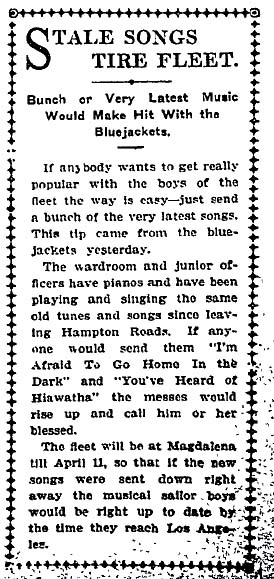
Above, the tars of the Great White Fleet are fed up with the same old songs. I’m not sure about “I’m Afraid to Go Home in the Dark,” but I did find a song titled “I Used to Be Afraid to Go Home in the Dark. And what’s this? “You’ve Heard of Hiawatha” at Indiana University’s sheet music collections. Of course, it’s a model of multiculturalism. Continue reading

 "Jack Smith on Wry," on display at the Huntington Library through May 12, 2008, focuses on the life and works of columnist Jack Smith, an institution at The Times from the 1950s to the 1990s. I asked his son Doug, a colleague for many years, to contribute a piece on the exhibit and he graciously agreed. –Larry
By Doug Smith
Times Staff Writer
These were the photos that framed my childhood: my dad at his Underwood typewriter, smiling smartly; my dad interviewing starlet Jayne Mansfield, a glass of sherry in one hand; my dad in street shoes scribbling while running the indoor track at the downtown YMCA; my dad in Fleet Street finery, aping the visiting Beatles; my dad at the rewrite desk of the old Los Angeles Daily News, ready to grab the headset of his black stanchion phone.
I was the only child I knew whose father had the city’s best photographers on hand to record his every posture and visual gag along with some very serious moments that documented the rambunctious and irreverent life of a newsman in post-World War II Los Angeles.
Now I am revisiting those memories — sharing them, rather — with the other Sunday visitors at the Huntington Library, Art Collections and Botanical Gardens. Since high school art appreciation, I’ve associated that stately institution in San Marino with the icons of high-toned portraiture, "The Blue Boy" and "Pinkie."
 How unexpected then that these remnants of a more recent era we may now rightly view as cynical and crude hold a place of honor in the Huntington’s Library West Hall, in the company of Chaucer, Gutenberg’s Bible, Shakespeare and the Founding Fathers!
And how rewarding that the shoe box we kept for so many years at the bottom of a closet is helping to preserve the story of an era that, for better or worse, was already disappearing when its lighter moments were being captured in these quirky images.
Alone among the hotshot journalists who carried on L.A.’s "Front Page" tradition after the war, my father evolved with his craft into the age of cold type, word processing, color photography and ever more stringent professional standards. His elegantly phrased, humbly introspective columns continued to hold a devoted audience until the week before his death in early 1996.
But one unfortunate habit my father carried from those formative years on the city beat was the daily journalist’s penchant for clearing out all the cobwebs of yesterday’s news at the start of each new day. He never saved anything until well into the 1980s, when he began to carry on published dialogues with readers, requiring that he file their letters away for future reference.
So I felt like something of a sham when my brother and I approached the Huntington soon after our father’s death wondering if they’d have any interest in his "papers." Of course they would, head curator Sara S. "Sue" Hodson said, not realizing that there were really no papers to speak of, just a room full of plaques, civic commendations, books, computer disks, hokey gifts acquired over the years and those old photos.
 I suspected that some of that detritus (one of my father’s favorite words) might have a value, but which particular things? And what value? I dreaded the necessity of going through them. What to keep? What to discard? Would I become a foolish pack rat of precious nothings or be guilty of brutally sending my own heritage to the landfill? The answers had to wait another eight years. Despite our unanimous commitment to the Huntington, Curt and I soon learned that our mother didn’t want anyone poking around our father’s Mount Washington sanctum on her watch. Until her own death in 2004, she left the den as he had, working at my dad’s computer, but keeping his every pencil pot and bookend in place.
When the time finally came, Sue and two assistants spent days, including weekends, digging through things that in some cases may have gone untouched for decades. Time after time they filled their cars: a life-size laminated picture of my dad, notepads, shreds of paper, cartoons, plaques, statuettes, awards, photos of the unidentifiable and several quite beguiling paintings by representatives of Mount Washington’s long-established arts community. (Those they photographed and returned to us.)
And, after all, there were papers. They took away several stacks of file folders that contained mostly reader letters. It gave me a warm feeling to see that we had possibly provided something of value. But more important, when at last Sue said they were done, I had the confidence that every knickknack and faux artifact they didn’t take — a cast plaster Maltese Falcon — was, indeed, of minuscule value and could be discarded without remorse.
 As time went on, we occasionally heard from Sue, who always spoke enthusiastically of the pleasure she and the other archivists were having poring over my dad’s things. She promised that once the tedious work of cross-referencing every item was complete, she would go to work on an exhibit.
My doubts persisted, especially after we got the news from the appraiser who evaluated the gift for tax purposes. Apologetically, he gave us a number that he knew was a lot less than we expected. He softened the blow to our egos by telling us that the collection contained some precious items, principally the reader dialogue and the letters my dad sent home from the Pacific during World War II. But, of those most sought-after records of a writer’s thought process — marked-up manuscripts, drafts, rewrites and self-edits — there were next to none.
In the tradition that shaped him, my dad was generally a first-draft writer, and, ironically, by the time he had been anointed a “Man of Letters” with an honorary degree from UCLA, he was writing on an electronic keyboard, obliterating his every first draft with whatever changes he typed over it.
So it was a little surprising when Sue called not long ago to say the exhibit was taking shape and gave us a date for its opening. Whatever could be in it?
It turns out a lot is in it, all intelligently tied together by those photographs that span my dad’s life at The Times, our life on Mount Washington, our adventures in Baja and the postwar ascendancy of our metropolis and its newspaper.

Jack and Denise Smith, sometime in the 1940s
The curators have reverently placed the exhibit at the far end of the Library West Hall, weaving a pathway to it through the most breathtaking collection of manuscripts and papers one might expect ever to see west of the Potomac.

Jack and Denise Smith, 1991
The lofty image of Abe Lincoln’s portrait gazing over the 13th Amendment to the Constitution, signed in the actual hand of the senators and congressmen who adopted it, is artfully segued to the "Front Page" by a coup de grackle. The oversized book of Audubon’s color engravings is opened to the one of that black bird, known only east of the Mississippi, that my father twice sighted in our Mount Washington yard, causing great consternation and fun in the birding community.
The bird joke is just the beginning of the fun.
 Right away I find some of my dad’s good bad Hemingway and the amusing surprise of some bad writing in his own voice: “I’ll be as nervous as a pregnant nun,” he wrote my mother in August of 1945, imagining their soon-to-be reunion. There are some cards on which he scribbled thoughts both whimsical and serious: “Los Angeles is simply the freest city in the world.”
The exhibit’s strength, of course, remains the breadth of the public conversation he conjured out of the details of his personal life. Examples can be flip: Charlton Heston citing God as the source of the phrase “Winning isn’t everything. It’s the only thing.” “I heard him as I was walking down the mountain.”
They give voice to unknown scholars: Barbara Bilisoly’s offering of a haunting poem by Catullus as the source of my father’s signature phrase, “Spend All Your Kisses.” And they’re hilariously corny: Jim Wade’s takeoff on the POSSLQ generation, writing on behalf of his AFOY (ardent fan of yours) wife on the need for a good “PN (proper noun) for people involved in PMH (pre-marital habitation).”
Sue assures me that correspondence comprises a substantial collection of diverse knowledge, wit and Southern California lore that will serve researchers for years to come. I’m glad for that. But I now see the real value of the exhibit in the connection it makes with those who still fondly remember my dad.
I watch with satisfaction as people work their way around the glass-encased displays that follow the phases of my dad’s career. Invariably they laugh out loud at the Baja station. It must be the story about the toilet in the living room that gets them.
 I find my favorite quotation there: "The snakes, dogs and rodents herein mentioned are also real, and nothing is set forth as having happened that did not happen."
To me, it represents my dad’s genius. Rising above a profession that too often tolerated embellishment in the telling of important events, he treated the smallest things in life as worthy of unwavering truth.
As I am about to leave, I spot a middle-aged woman standing over the Mount Washington case, absorbed in what is certainly the nuttiest photo in the exhibit. It’s a family portrait, my dad seated stiffly in white shorts and plaid shirt cradling a fisherman’s cap in his arm like a three-cornered hat. He’s flanked by my mother and my brother, both dressed in Akron wear but posed with the self-conscious grandeur of "The Blue Boy" and "Pinkie." I’m off to one side armed with baseball bat and glove. Our mutt, Gene Biscailuz, sits at our feet, gazing up at my dad in awe.

Doug, Curt, Jack and Denise Smith
I want to walk up and ask the woman, “Do you know that’s me in the Pittsburgh Pirates hat?”
I watch from a distance instead. I’m 50 years older now, and not the same person as the boy in that picture. Whatever our family meant to her, it’s her memory now, not to be encroached upon.
Doug says by way of autobiography: "I’ve been at The Times 38 years now. My dad was here 40, so I may actually overtake him on that stat. I started as a desk assistant in sports and graduated to suburban reporting. I covered school boards, city councils and society events all over Southern California. I wrote a column called Around the Valley for several years and then switched to Around the Foothills in the Glendale section, which, of course, no longer exists. I started doing data analysis in the mid-1990s and found that to my liking. My title today is Database Editor, which essentially means that I now conduct my interviews by asking questions of large bodies of data."


OK, what actress’ photo was retouched by The Times because her neckline was too revealing?
Fred Ahlert has guessed correctly. I’ll post the answer and some more photos later today!

Frances Farmer in "Flowing Gold," 1940.

Some folks keep pestering me another clue. Fair enough, here’s our mystery actress sitting on a couch with her mother. Now I’ve given it away.

Photograph by the Los Angeles Times
This is Frances Farmer, and this is how you think of her, when you think of her at all.

Let’s roll the clock back to the 1930s, when she was a college student in Seattle.

Her early roles were quite glamorous…

Here’s a still from "Come and Get It."

Then she did a couple of cowboy pictures

Above, a still from "Badlands of Dakota."

"Son of Fury," another costume picture, released in 1942.

And in January 1943, disaster.

Here she is in 1944 with her mother, Lillian, who had her committed to Western State Hospital in Washington.

After divorcing actor and band leader Leif Erickson, she married again in 1954.

And again in 1958.
Frances Farmer died in Indianapolis in 1970. She was 56 years old.

Above, the wonders of "Cinemiracle." Below, police kill one of two men who led officers on a chase in a stolen car … An update on housewives’ boycott of meat, which Paul Coates wrote about a few day earlier … And Bob Burns’ daughter is in trouble again. I have been planning to write about this poor young woman for some time and hope to get to it soon.

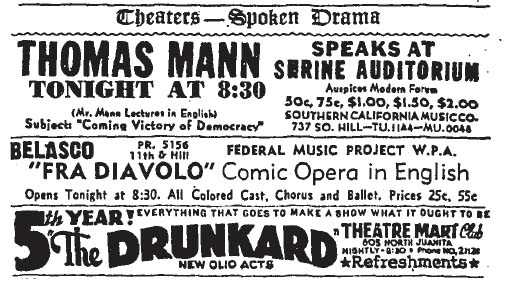
Above, Thomas Mann, “The Drunkard” and “Fra Diavolo” with an African American cast. Below, former President Herbert Hoover (yes, a graduate of Stanford, home of the Hoover Institution) discusses his views on international relations after his European tour.

Above, Aunt Lucy Chiviss. If you look closely, you’ll notice this page says "Wednesday" and "Sunday" and the caption type is pied. Someone was certainly having a bad day. Below, the story of Lucy Chiviss. Yes, I know slave narratives can be problematic and the WPA project on former slaves is a subject unto itself. Still, this a vivid story. The type is barely legible, unfortunately, but the story is compelling. Her description of being sold in the slave market is worth the struggle it takes pick out the words. If I get time I’ll keyboard it into the blog. The Times said she lived at 14th and Clayborne, but I’m having trouble locating Clayborne and I’m wondering if it was an error.

By Keith Thursby
Times Staff Writer
There’s a long line of people
willing and able to criticize the Dodgers for the traffic mess at the Coliseum
Saturday. But what could people have expected?
Unless you’ve been under a
rock for a few days, you know that more than 115,000 people crammed in and
around the Coliseum to see the Dodgers play the Red Sox. The Dodgers provided
free shuttle service to the Coliseum and back from Dodger Stadium and depending
on the newspaper or blogger, it was a disaster or worse.
We did fine.
I left my home in Irvine on Saturday with my
two teenage sons at about noon. The plan was to have lunch and get to Dodger
Stadium by 2. We arrived right on time to find few people and several buses
waiting for baseball fans.
Yes, it was ridiculously
early for a 7 p.m. game. But we had 115,000 reasons for getting there so early.
We got to the Coliseum about
3 and waded through the thousands already there. Clearly we weren’t the only
people arriving early. We got into the stadium a little after 4 and saw the
real baseball highlight of the night, batting practice.
We cheered Vin Scully, ate
overpriced junk food and had a good time with our friends. But we couldn’t help
but notice all the late-comers. We started hearing stories all around us about
people delayed by the long lines at Dodger Stadium.

Los Angeles Examiner Negatives Collection in the the Regional History Collection
of USC Libraries
The Dodgers and the San Francisco Giants on opening day at the Coliseum, April 18, 1958, from "Mobsters, Molls, and Mayhem: A Year in the Life of Los Angeles" at the Doheny Library.
So we decided the easiest
thing to do was abandon ship. We lasted five innings, enough to soak in the
weirdness of baseball at the Coliseum and the drunks and the near-fights and
the knuckleheads throwing peanuts at every Red Sox fan who walked by.
We got to the bus line at 9
and nearly an hour later we were on the way back to Dodger Stadium. It wasn’t
pretty or efficient but for a crowd that big, it was pretty peaceful. We were
back in Irvine
before midnight.
We didn’t want to leave the
game early, but figured it was our only option. And we weren’t
complaining. This was free parking and
transportation, after all, even if it was messy.
I don’t have any baseball
memories of the Coliseum. My memories are the 1984 Olympics, the Rams and Notre Dame or UCLA against USC. But we wanted
to experience Saturday’s event.
So it was beyond crowded. Too
many lines and too little baseball (can’t remember the last time we left
anything early). But my kids and I knew it wouldn’t be perfect, just something
we can say we did.
My friends over the 1947project have done a soft launch of their new
site. Instead of selecting another year for daily entries, my longtime
crime buddies (and some new authors) have chosen a vanished neighborhood:
Bunker Hill. The blog is titled "On Bunker Hill, a Lost Neighborhood Found."
Kim Cooper writes:

This is an inspired project. Years ago, my former wife and I were involved
in a somewhat similar effort in Tucson exploring a historic downtown
neighborhood that was wiped clean for urban renewal. The project was a wonderful way to make amends and ease some of the bad feelings among the Latinos who were displaced from that area.
I wish Kim Cooper, Nathan Marsak, Mary McCoy, John Toomey, Ed Fuentes (author of View From a Loft), Joan Renner, Christina Rice and Joni E. Johnston the best of luck and I’m looking forward to their updates.
Happy Foot!

Above, Clark Gable and Burt Lancaster in "Run Silent, Run Deep," directed by Robert Wise. Below, fighting in the Middle East … For the first time in its history, the Legislature adjourns without a budget. The governor calls legislators back into a special session … A fight breaks out at Los Angeles Speedway when a NASCAR race is canceled because of poor ticket sales and there are no refunds because the money has been seized by the courts … And a contretemps among the royals.


Above, film novice Charlie McCarthy blows his top. Below, vegetable peddler George Sakalis, a key witness in the Earle Kynette case, gets additional protection after complaining that he is being followed by private detectives … The head of the VFW calls for assistance in the form of jobs or pensions for the "Lost Generation" of World War I … Dogs are under a state quarantine because of rabies … And Harold "Bud" Marshall hopes to regain the use of his legs after being paralyzed when he was shot in the spine during a robbery.


I stumbled across this item while researching the previous post. It’s one of the strangest stories I’ve ever seen: Not only does a horse have a wooden leg, but it caught fire when the animal was standing too close to burning rubbish.
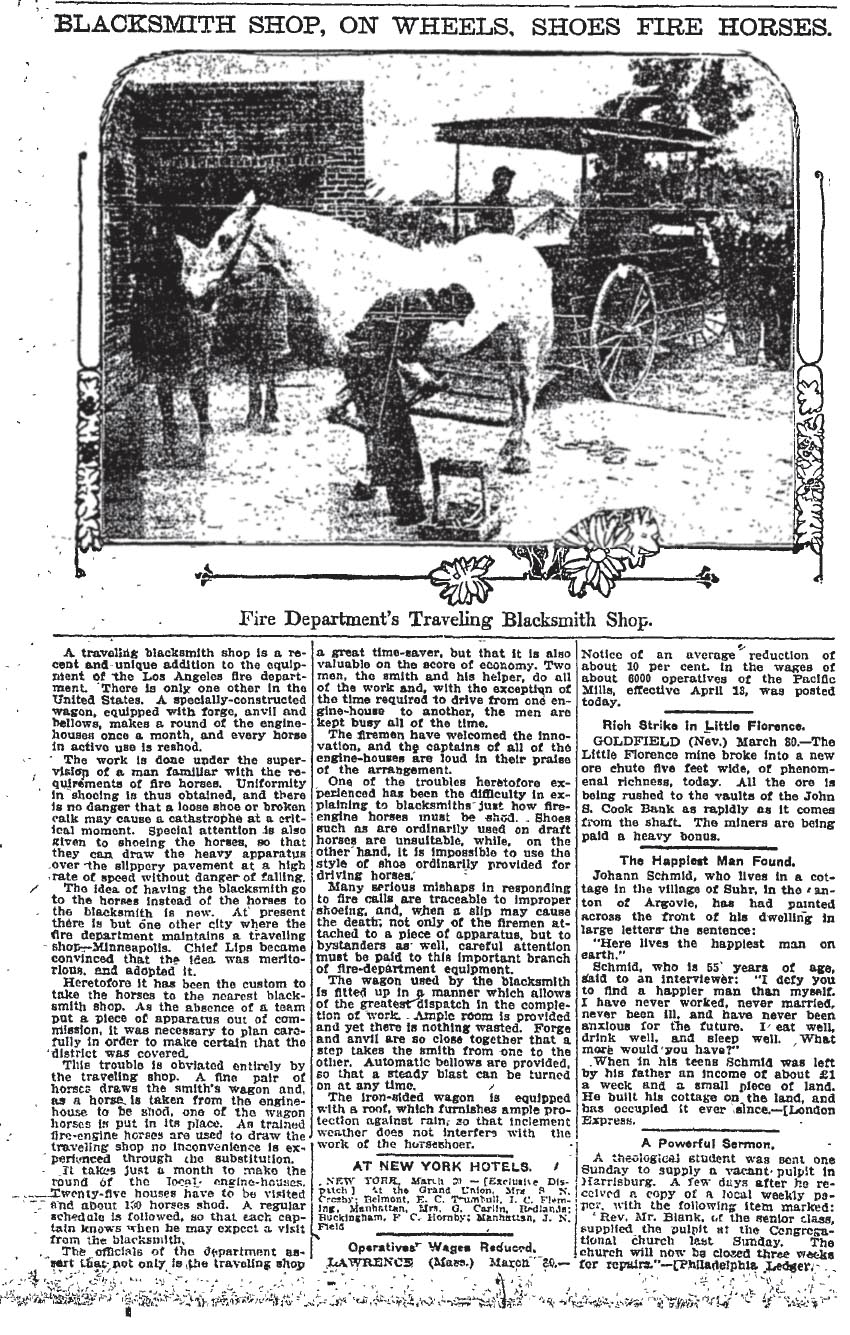
Above, the city introduces the concept of a traveling blacksmith who shoes all of the Fire Department’s horses rather than take them to the nearest blacksmith. The Times says the blacksmith (for some reason, we didn’t use his name) shoes about 150 horses on a monthly rotation. But the new program didn’t last long.


