
April 20, 1958

Dodger-mania spreads to the comics pages!
April 20, 1958

Here’s an interesting sales pitch: Move to Anaheim for the kids. Only 26.5 miles to downtown L.A. Note that the map says "Houston Freeway," which took its name from Houston Avenue and was renamed the Riverside Freeway.

Above, the humble Hollywood cobbler had a colorful past–and no, he wasn’t deported. Below, The Times publishes a photo of jurors in the trial of Police Capt. Earle Kynette in the Harry Raymond bombing, a long stretch from the identification numbers given to jurors today … Note the names of Kynette’s co-defendants: Roy J. Allen and Fred A. Browne. Newspapers in this era usually referred to police officers by their initials, so let this be a warning to Black Dahlia researchers not to confuse F.A. Browne of the Raymond case with F.A. Brown (Finis A. Brown), who investigated the killing of Elizabeth Short. It is so easy to get facts wrong in the Black Dahlia case and so very difficult to get them right … Judge Irvin Taplin, who grew up at the Los Angeles Orphans’ Home, gives a birthday party at the home for his adopted daughter and 125 children living at the facility … And E.V. Durling sings the praises of Dutch Flat on the road to Truckee.


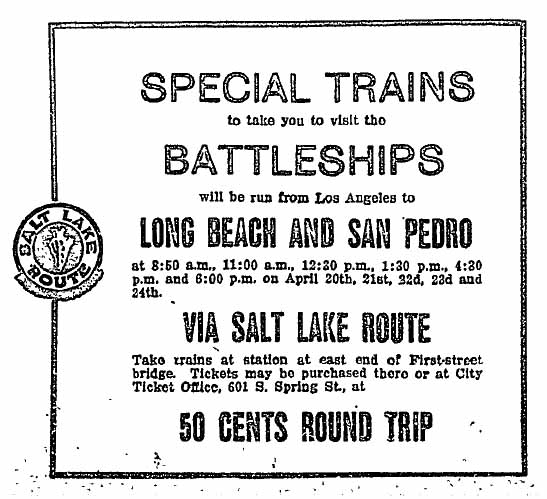
Recall from yesterday that crowds hoping to see the Great White Fleet overwhelmed the city’s transportation systems. Those who managed to get to the wharves at Long Beach, San Pedro, Redondo Beach and Venice overtaxed the ability of boats to take them out to see the ships, The Times said. Even after 5 p.m., when the ships stopped letting visitors aboard, the crowd bought boat tickets merely to a closer look at the fleet. Because it was Easter Sunday in 1908, the fleet’s Rear Adm. Charles M. Thomas, an Episcopalian, attends services at St. Paul’s Pro-Cathedral in Los Angeles and takes Communion at the rail. Continue reading
April 19, 1958
Los Angeles

 One gang was called the Cogents. The other was called the Black Wongs.
At least that’s what The Times said. We don’t know much more than that
except someone died in a fight outside the Kow Kong Benevolent Assn.,
510 N. Bernard St.
His name was Richard Sumii, 16, 3106 N. 9th Ave. It isn’t clear whether
he was a member of the Black Wongs or the Cogents or whether he was
even in a gang. All we know is that he was an honor student at Dorsey
High.
Using The Times stories to reconstruct what happened is bit like
reassembling an ancient pot based on a few shards. Unfortunately, there
isn’t much to go on.
Apparently there was a gang fight outside the Kow Kong center, where a
dance was being held. Louis T. Yamashiro, 17, 912 S. Valencia, and
Takeshi Masukawa, 18, went to Masukawa’s home at 568 N. Virgil Ave.,
got a .45 and returned to the center. According to The Times, Yamashiro
pulled the .45 from his friend’s waistband and was waving it around
when the gun went off, killing Sumii.
Unfortunately, that’s all we have. The Times wrote nothing about a trial. Why Japanese American kids were at a Chinese youth center is something the newspaper never addressed.
California death records show that Louis Tsuneo Yamashiro died June 6, 1985, at the age of 44.

Below, a large number of prospective jurors in the Earle Kynette trial say that are against the death penalty … A local fund-raising campaign, part of a national effort to aid European Jews, will focus largely on the movie industry, The Times says …


The Great White Fleet arrives and the hills along the coast are blackened with people who have come to view the ships. Along the crumbling cliffs near Point Fermin, 40 people plunged 20 feet down a hillside when it gave way, The Times said. Apparently none of them were injured, at least not badly.
Crowds hoping to see the fleet overwhelm the city’s mass transit system to the point of collapse. Passengers began arriving at the Pacific Electric depot (6th Street and Main) at 2 a.m. and by 6 a.m., the area was so crowded that they were boarding the cars before they arrived at the depot to be sure of getting a seat, The Times said.
"Before the day was half through, it was hard to fight your way within a block of the Pacific Electric Building. Main Street all the way to 9th [shout out to Bukowski Square!] was lined with men and women trying to jump the cars before they got to the depot.
"By the time the cars reached the point from which they were supposed to start, every one was jammed, with men and boys standing on the roofs and clinging to inch-wide ledges or to paint blisters on the perilous sides of the cars.
"Hundreds gave up the struggle altogether and went dejectedly home."
The crowds hoping to take the trains fared no better.
Chaos ruled at the Southern Pacific depot, with tickets sold "without system or sense," The Times said. Many people found a shortcut to the platform while other ticket buyers waited in vain to be allowed on the trains. The Southern Pacific’s 11 a.m. train from Los Angeles to San Pedro was 3 1/2 hours late, The Times said.
You’re wondering about autos.
"Had it not been for the long succession of overladen cars groaning by, you might have mistaken it for an automobile parade. There were thousands on the road.
"For weeks, every auto in this city has been engaged. Every garage has had 10 times the number of orders it could fill. By actual count there were 37 machines lying crippled in the ditch at one time yesterday."
As for the ships, "The approach of the fleet was magnificent," The Times said.
"It was first a long, single column of 16 ships turned slightly in toward Long Beach and giving the effect of a wide, oncoming line of prows plowing the water.
"Off Terminal Island, the column made a majestic turn to the left, sweeping around until the bow of the flagship pointed straight at the thronged cliffs, each battleship arriving at the tumbled swirlpools left by the turning Connecticut put across their helms and plowed after until the whole fleet was a vast Masonic triangle. Then came on in a tremendous, awe-inspiring battering ram 3 1/2 miles long."
April 19, 1908
Above, new apartments on Olympic near Albany within walking distance of the "business district." Surprisingly enough, this building is still standing. The structure lost the details of its roof line, presumably in one of the earthquakes over the last century, in a process I call "seismic Darwinism." The distance to
The Times is 2.1 miles, according to Google Maps, which may (or may not) be your definition of "walking distance." Here’s the street view:

Above, note that Robin Ogle was drafted by the Dodgers as a first baseman in 1972. Below, The Times drops the nameplate for the Dodgers’ mug shots and runs a nice, deep picture of Carl Erskine … Also note the Jack Smith byline on the story about the murder of Cecil "Hard Rock" Thomas.


Above, fighting in the Holy Land … Below, jury selection is nearly concluded in the trial of Police Capt. Earle Kynette in the Harry Raymond bombing … Note the brief on the lawsuit brought by former child star Jackie Coogan against his mother and stepfather over the money he made as a youngster … Police officers capture cattle that escaped from the meatpacking plant on Macy Street (now Cesar Chavez). Humorous stories about police chasing (and sometimes killing) livestock in downtown Los Angeles were a staple of local newspapers at least through the 1940s … In an attempt to ease traffic congestion, the city widens and extends downtown streets.
Quote of the Day: "The volume of traffic caused by the city’s continued growth increases faster than outlets can be provided." — Lloyd Aldrich, city engineer


Above, an update on the Doukhobors … Below, the fleet is on its way! And so is Elinor Glyn!
Quote of the Day: "To swear to love for life is an insult to God. Love is an emotion placed in beings by God to induce them to re-create their species. It’s an emotion which no human being can control and it leaves the body as quickly as it enters. " –Elinor Glyn, author of "Three Weeks," May 3, 1908


Los Angeles Examiner Negatives Collection in the the Regional History Collection
of USC Libraries
Dodgers and the Giants, opening day at the Coliseum.
William Dotson at USC’s Doheny Library sent the Daily Mirror an
invitation to a reception for the "Mobsters, Molls and Mayhem" photo
exhibit and even though the event was several weeks ago, it’s been on
our minds for several reasons because the gathering was one of those
troubling crossroads of fact, fiction and fantasy that seem to define
Los Angeles history.
Fiction was the first element the Daily Mirror encountered, as we saw
our old friend James Ellroy inspecting some of the photos culled from
the 80,000 images that were taken in 1958 and are available in the
Examiner collection. The "Demon Dog" of fiction was in a bright yellow
sweater that hardly seemed demonic. It was good to see the old boy;
it’s been a while since the press event for "The Black Dahlia." We
chatted a bit. He’s writing.
Fact, of course, is close to our hearts at the Daily Mirror so it was
gratifying to talk for a few moments with Tyson Gaskill, one of the
curators, about assembling the exhibit. We also chatted with USC
professor Greg Hise, who made some introductory remarks, and Catherine
Quinlan, dean of USC’s libraries.
Tyson, who worked on the exhibit with Andrew Wulf and Jill Breznican,
said going through the old copies of the Examiner to select the images
was a revelation that shattered his preconceptions of the past. The
experience "forever changed my vision of the 1950s," he told the Daily
Mirror. "The 1950s were awful," he said. "It’s hard to convey that. I
thought it was an era of tedium."

Greg, an associate professor of urban planning and history and
geography, took a broader view, noting the scope of the 1.8 million
images taken between 1920 and 1961 in USC’s Examiner collection, along
with the photos in the "Dick" Whittington collection of commercial and
aerial photography. One of the best aspects of the photos, he said, is
that they portray issues like land use and immigration in a visual
manner rather than as abstractions. The Daily Mirror concurs: A woman
sitting on her front porch with a rifle (at left) to keep the state from taking
her home for a freeway speaks simply but powerfully about the issues of
transportation and housing.
Greg as well as Catherine touched on one troubling question that we’re
sure keeps archivists awake at night: What will become of newspaper
images and corporate documents in the Digital Age? Both of them raised
the question of whether it would be possible to stage a similar exhibit
50 years from now using photos from the Los Angeles Times. In 2058,
will a 50-year-old CD still work and will jpeg still be a recognized
format? Let’s cross our fingers.
While we were at it, we ran into the family of John B.T. Campbell, the
legendary–or notorious–editor of the Herald Express. Campbell was the
newsman who nicknamed many of Los Angeles’ famous murders, according to
the late Aggie Underwood. The Daily Mirror didn’t know, until meeting
his descendants, that he was nicknamed "The Tarantula."
We also said hello to Dace Taube of the Regional History Collection, to whom every researcher in Los Angeles owes an incredible debt of gratitude.
And finally, and this is what keeps the Daily Mirror awake at night,
comes fantasy. During the reception, we encountered an individual who
made elaborate claims of personal knowledge about one of the more
famous crimes in Los Angeles history. We listened politely, jotted down
a few notes and were saddened to discover that this person’s tale, with
all its finely embroidered details, was utter rubbish. We suspect we
will never understand what makes people concoct such yarns. We just
wish they would stop.
"Mobsters, Molls and Mayhem" will be on display at Doheny Library through May 15. Tell them "Woof, Daddy-o."
Below, we have Paul Coates and his old pal from Palo Alto, Parkey Sharkey … But what’s this hidden in the ads for the burlesque houses? The Colony Club, Western and 149th Street, has the L.A. Dodgerettes! … Then again, there’s “Johni Dillinger” a.k.a. “Public Anatomy No. 1,” at the Tiffany Club, 3260 W. 8th … And note the comic at the Lake Club: Bert Henry. Henry did a bunch of “party records” for Fax Records (“Bert Henry in the Raw,” “Bert Henry at the Hungry Thigh”) before the head of the company, William H. Door, and his girlfriend were killed in a very nasty way in November 1963. Fax also released a disc titled “Sex Is My Business,” which purported to be interviews with prostitutes. Most of the Fax discs turn up on EBay if you’re patient. If anyone knows whatever became of Bert Henry, drop me a note.

Below, Dodgers over the Giants, 13-1, in San Francisco. Tomorrow is the Big Day in L.A., with a Dodger motorcade from City Hall to the Coliseum, The Times says … Police investigate whether the late Johnny Stompanato was blackmailing Hollywood figures, but the main suspect’s death is a bit of an obstacle … Gary Cooper gets a face-lift. In three years, he’ll be gone … Chimps in space! …


Above, Shirley Temple, Peter Lorre and Mickey Mouse … Below, what do we have in Gothic type above the masthead? Yes, it is Easter Sunday in 1938 … At least 16 Arabs die in a fight between British troops and terrorists in the Holy Land … A devoted dog pays daily visits to the grave of its master in a Bloomington, Ind., cemetery … Britain and Italy sign an agreement that "pulls powers from the abyss of war."


Here’s a model home at 2270 Brentford Road in San Marino. Zillow says the house is still there and is valued at $975,000. I’ll try to swing by there today and get a picture of it.

Above, spiritual advancement- – or the lack of it — becomes grounds for a divorce. Below, "Elephants Stampede" is a two-word headline that says: "Read me." The noise of fire engines rushing to a spectacular 5,000-gallon gasoline blaze in Riverside frightened the elephants of a traveling circus. The fleeing animals rampage through the city, killing a woman, injuring several men and "breaking down palm trees and small buildings" before being captured … Los Angeles prepares for tomorrow’s arrival of the Great White Fleet.

April 16, 1958


OK, cat lovers, who likes Siamese?

Los Angeles Times file photo
Clark Gable and Carole Lombard at their home in Encino, March 29, 1940. And yes, everybody loves that wall.


