Hitler, Chamberlain promise peace, October 1, 1938

Poland demands share of Czechoslovakia

More than 1 million Polish troops are poised to invade. Prime Minister Neville Chamberlain gives the British the Munich agreement and his pledge with Nazi leader Adolf Hitler that Britain and Germany "never will go to war with one another again."

1938_october_01_carol_2
   

Reginald Owen replaces Lionel Barrymore in MGM’s "A Christmas Carol."


1938_october_01_cover

Ronald Colman marries

Neville Chamberlain and the Munich agreement have become such an enduring symbol of the folly of appeasement that it may be a shock to realize how much it was celebrated at the time.

In fact, a United Press dispatch from London reports crowds rejoicing in the streets at the news that war had been averted. "Scenes in the streets were reminiscent of the November night in 1918 when word came of the armistice. Chamberlain was hailed as a liberator."

In Los Angeles, Mayor Fletcher Bowron orders an investigation of an alleged police protection racket.

1938_october_01_page2

Map of Czech territory

At left, Nazis occupy the Sudetenland … Rome welcomes Benito Mussolini as a peacemaker … President Roosevelt says the war crisis in Europe is over …

And in Prague, crowds bitterly denounce the surrender of Czechoslovakia to Germany.

In Los Angeles, the German consul, Dr. Georg Gyssling, blames the Czechs for the crisis, saying the country persecuted the German minority.

1938_october_01_bowron

Police officers transferred

1938_october_01_sports

Cubs tie with Cards, 7-7

Posted in @news, City Hall, Current Affairs, Downtown, Film, Front Pages, Hollywood, LAPD, Politics, Sports | Comments Off on Hitler, Chamberlain promise peace, October 1, 1938

Rosh Hashana, 1951


Rosh_1951_crop

Photograph by the Los Angeles Times

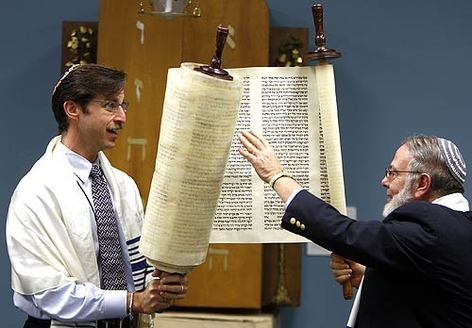
Rosh Hashana preparations in Pasadena, September 1951. The Times reported a novel approach to holiday celebrations all under roof: Orthodox, Conservative, Reconstructionist and youth services. Louis B. Silver, left, was to conduct the Orthodox services while Rabbi Max Vorspan, center, conducted other observances. Charles Price, at right, was to conduct youth services. Musical direction was under Mrs. Norman Hassler, a Christian who had served the Jewish community for 27 years, The Times’ Herb Brin said.

"In many ways, what we are doing here is analogous to the community church idea. It is important that we are Jewish," Vorspan said. "Our job is to satisfy the essential needs of all Jews without breaking the essential unity of the faith.

"It is an indication of a growing feeling on the part of Jews and Christians that the elements which have been dividing us are not nearly as important as the many bonds which should be uniting us."

Posted in Religion | Comments Off on Rosh Hashana, 1951

Movie revival — The Tingler

Coming soon to a theater near you…

1959_1028_tingler

Above, "The Tingler," 1959.

Oct. 31, 2008, 8 p.m. Silent Movie Theatre. Tickets $12.


Posted in Film, Hollywood | 1 Comment

Movie star mystery photo

2008_0929_mystery_pix

Los Angeles Times file photo

Our actress had a long career on Broadway and appeared in silent and sound films as well as on television. She is listed in imdb (more than 50 credits) and Wikipedia.

Update: We have the correct answer from Gregory Moore Greg Clancey (congratulations!) but because he guessed so quickly, I’m going to wait until tomorrow to post the answer in case anyone else recognizes her.

Update 2: Ack! I went too fast. Gregory Moore guessed right. Gleg Clancey, alas, was wrong (but a good guess). Forgive my confusion over two Gregs, whom I was e-mailing at the same time!

Our mystery actress is Mary Boland, who appeared in "The Women," among many other films. How did Moore recognize her? He explains: "We’re both from Detroit."

Mary_boland_1935_0731_crop

Los Angeles Times file photo
Here’s a photo from 1935, when Boland was sued for $150,000 ($2.2 million USD 2007) on rather curious charges. Elizabeth Kummer, the wife of Boland’s nephew, George Kummer, filed a lawsuit accusing Boland of alienation of affections. Boland called the charges ridiculous.  The Times never reported the outcome of the litigation.
Mary_boland_1946_1124_crop
Los Angeles Times file photo
Here’s Boland with Charlie Ruggles, her frequent film partner at Paramount, in a 1948 production of the play "One Fine Day."

According to imdb, they appeared together in 14 films, including "The Big Broadcast of 1936," "Ruggles of Red Gap" and "Boy Trouble."

The Internet Broadway Database lists her stage appearances, including "Hellzapoppin."

Posted in Film, Hollywood, Mystery Photo | 8 Comments

Rams win against Cleveland, September 30, 1968


1968_september_30_ad

Above, Alabama Gov. George Wallace plans a TV appearance for his presidential campaign.


1968_september_30_sports
By Keith Thursby
Times Staff Writer

The Rams moved to 2-0 with a 24-6 victory at Cleveland. The Rams broke open the game in the fourth quarter and the Browns couldn’t do anything on offense.

Players of the game: The Ram defense. A headline in The Times put it this way: "Rams’ Defense So Good It Makes Game Dull."

Paragraph of the game: From The Times’ Mal Florence: "Although the Ram offense didn’t turn killer until late in the game, it had gratifying moments."

Quote of the game: "I think it’s very exciting. The crowd is large and the halftime show was excellent. I just went out for two hot dogs and best of all, today they were hot," said Cleveland owner Art Modell, asked if the game had been the dullest afternoon he had spent in football.

keith.thursby@latimes.com

Posted in Front Pages, Politics, Sports | Comments Off on Rams win against Cleveland, September 30, 1968

Victory for Hitler, September 30, 1938

Agreement hands Czech territory to Nazis

Britain, France, Germany and Italy sign a compromise that is given to Czechoslovakia. If the nation refuses to accept being partitioned, it would stand alone against a German invasion.

1938_september_30_schallert_2
 

Cary Grant is reading the script for "Dodge City" as a replacement for Errol Flynn in a cast that includes Olivia de Havilland and Victor Jory.


1938_september_30_cover

Munich conference

Czech leaders turn to President Roosevelt in hopes of avoiding the dismemberment of their country. "From the man in the street to the highest political personalities of the nation, everyone is depressed and downcast," United Press reports.

In Los Angeles, Mayor Fletcher Bowron moves to overhaul the Civil Service Commission and banishes the Los Angeles Police Department Vice Squad, which had been operating out of the mayor’s office under Frank Shaw …

A tornado kills at least 26 people in Charleston, S.C., and injures several hundred … 

1938_september_30_page2

Text of agreement

At left, an analysis by Pulitzer Prize winner Frederick T. Birchall of the New York Times says that Nazi leader Adolf Hitler got everything he wanted in the Munich conference. His only concession was to accept a longer timetable…

All of Germany celebrates Hitler’s diplomatic victory. The nation finds a new faith in Hitler’s "political finesse," United Press reports. 

Below, Pacifist Bertrand Russell says that war in Europe is inevitable.


1938_september_30_page3

Londoners pray for peace

1938_september_30_page4

Pope gives radio talk


1938_september_30_page6

61 held in vice raids


1938_september_30_sports

Cubs over Pirates, 10-1

Posted in @news, City Hall, Front Pages, Hollywood, LAPD | Comments Off on Victory for Hitler, September 30, 1938

Rosh Hashana, 1948


Rosh_1946_0929_crop

Photograph by Ray Graham / Los Angeles Times
Rosh Hashana at the Jewish Home for the Aged, 325 S. Boyle Ave., in a photo taken in advance, Sept. 29, 1948.  (In 1948, Rosh Hashana began Oct. 3). From left, Abraham Anis, Zelig Meyerson, Baruch Solomon, Joseph Flasterstein, Benjamin Gorelik and Samuel Rosen.

Below, Boyle Avenue via Google maps’ street view.

Larger Map

Posted in Architecture, Religion | Comments Off on Rosh Hashana, 1948

Hershiser breaks Drysdale’s record, September 29, 1988

Orel_hershiser
Photograph by Anacleto Rapping / Los Angeles Times

Orel Hershiser pitches for the Dodgers against Cincinnati, April 14, 2000.

By Keith Thursby
Times Staff Writer

Twenty years ago, I witnessed an important moment in Dodger history. Good thing they don’t need me as an expert witness to recall every detail of the occasion.

Orel Hershiser broke Don Drysdale’s major league record for consecutive scoreless innings by pitching 10 innings against the San Diego Padres. I was in the stands that night. Mitch, my high school friend and a lifelong Dodger fan, was alongside. He was in San Diego County for a seminar, so perhaps I was the one who needed convincing that the drive would be worth it. Since Hershiser needed 10 innings to pass Drysdale, we didn’t expect to see history that night.

Nevertheless, we were there. Maybe the memories are vague because I wasn’t much of a Dodger fan, or because the game was in San Diego and there wasn’t the sense of hometown drama. After all, what Padre fan would want one Dodger to break the record of another?

Were Mitch’s memories any better than mine? "I don’t think the Padre fans were aware of the record because the PA didn’t make a big deal of it until it was done," Mitch wrote in an e-mail. "I remember us changing seats as the park emptied out and we got closer to the Dodger dugout."

San Diego’s stadium was then called San Diego Jack Murphy Stadium, after a local sportswriter, of all things. Homey it was not — it’s one of those dual-purpose stadiums that really don’t fit baseball or football very well. And once the game hit extra innings, many Dodger fans headed north and locals headed home. By the 16th inning, we had great seats since most of them had been vacated.

I certainly recalled that the game went extra innings, but it didn’t seem like 16 until I looked up the game story from The Times. I didn’t recall that Hershiser needed four outs in the 10th to get the record because he struck out Marvell Wynne but the pitch bounced in front of, then over, catcher Mike Scioscia. One thing I have remembered all these years was the name Mark Parent, the journeyman catcher who homered off the Dodgers’ Ricky Horton to give the Padres a 2-1 victory. Maybe I had his baseball card once. But I had forgotten completely that the Dodgers scored in the top of the inning to take a 1-0 lead.

What does this all mean, other than my middle-age memory is pretty sad?  I always chuckle when I see sports fans — often actors — on nostalgic television shows recall the exact day they first were taken to Yankee Stadium or Madison Square Garden. Me? Couldn’t tell you my first Angels, Dodgers or Rams game. I do recall one Notre Dame-USC game only because it was raining and I got hit on the head by the umbrella of a happy Irish fan. Is it really important to remember the details as a fan?  As my friend Mitch put it at the end of his e-mail: "It’s pretty cool to say we were there."

Some of my fondest sports memories are like that, a game where timing and luck made for a memorable experience. Seeing Barry Bonds hit his 500th home run (against the Dodgers) just because we happened to be in San Francisco for a vacation. Seeing Manny Ramirez’s first game as a Dodger just because we bought discounted tickets two weeks in advance.

And seeing the Padres and Dodgers on the night Mark Parent became a name I wouldn’t forget.

keith.thursby@latimes.com


Posted in Dodgers, Sports | 1 Comment

Rams win with last-minute field goal, September 29, 1958

1958_september_29_kerr

Clark Kerr becomes head of the University of California

1958_september_29_sports By Keith Thursby
Times Staff Writer
The Rams opened the 1958 season with a last-minute 30-27 loss to the Cleveland Browns at the Coliseum. Lou Groza kicked a nine-yard field goal with 23 seconds to play.

Players of the game: Fumbles by quarterback Bill Wade and running back Jon Arnett led to Cleveland scores.

Paragraph of the game: From The Times’ Cal Whorton: "It was a truly bitter defeat for the pro-Ram crowd of 69,993 to take. Going into the final period the Rams led 27-14. But those pesky Browns, a team known in grid circles as a club that never beats itself, was not to be denied."

Quote of the game: "Go over and pep him up. He’s blaming himself for the whole thing," said Rams Coach Sid Gillman, motioning to a reporter to talk to Arnett.

keith.thursby@latimes.com

Posted in Dodgers, Education, Front Pages, Sports | Comments Off on Rams win with last-minute field goal, September 29, 1958

San Marino woman commits suicide, September 29, 1958

Above, pro baseball players shatter youngsters’ illusions by refusing to sign autographs. I guess Pat Brown can rule out an endorsement from The Times. Such was the state of political cartoons at The Times before the arrival of Paul Conrad. Continue reading

Posted in Dodgers, Front Pages, Sports, Suicide | 4 Comments

Movie revivals — He Who Gets Slapped

Coming soon to a theater near you…

1925_slapped

Above, "He Who Gets Slapped,"1925.

Oct. 1, 2008, 8 p.m. Silent Movie Theatre. Tickets $10

"He Who Gets Slapped," Lon Chaney, Norma Shearer, John Gilbert.
Posted in Coming Attractions, Film, Hollywood | Comments Off on Movie revivals — He Who Gets Slapped

Los Angeles mayor begins City Hall cleanup, September 28, 1938

Mayor Bowron asks 117 commission members to quit

Two members of the Police Commission resign and the head of the LAPD vice squad announces his retirement.

1938_september_28_capra_2

"You Can’t Take It With You," one of my favorites.

The Monte Carlo Ballet! It stinks!"
 

1938_september_28__cover

Bowron asks 117 to resign

Germany issues a new ultimatum on Czechoslovakia and King George VI places Britain under a state of emergency as President Roosevelt makes another plea for peace.


Quote of the day:
"I have done all that one man can do." –Neville Chamberlain


Italian leader Benito Mussolini says war in Europe is inevitable and tells his generals that fighting will begin in two or three days at most. Thousands of foreigners flee Italy by every available train and boat.

1938_september_28_roosevelt

British fleet mobilized

On the jump, German military trucks and transports rumble through Berlin on their way toward France … Antiaircraft guns are mounted on the outskirts of Berlin …

In England, schoolchildren are evacuated and workers begin building bomb shelters and installing air raid sirens.

Wall Street reacts with uncertainty as war seems near … Greta Garbo sails from Stockholm for New York …


1938_september_28_bowron

City Hall cleanup

1938_september_28_sports

Greenberg hits 57th home run

Posted in @news, City Hall, Downtown, Front Pages, Politics, Sports | 1 Comment

Charles Champlin on Paul Newman


Paul_newman_lat_2000_2

Photograph by Bruce Gilbert / For The Times

Paul Newman, Westport, Conn., April 2000

Hot, Sexy and (Almost) 70

He’s played a rogue’s gallery of rascals throughout his 38-year movie career, but somehow, with Paul Newman in the role, they can’t help but become heroes. How does he do that?

Dec. 18, 1994

By Charles Champlin
Times’ arts editor emeritus

Above the mantelpiece of the huge field-stone fireplace in the converted barn on Paul Newman’s Connecticut acres hangs a grand and garish poster of Buffalo Bill on horseback. It was a set decoration in the showman’s office in Robert Altman’s film "Buffalo Bill and the Indians," in which Newman starred in 1976.

"Immediately after the film was over I hustled the picture out of there," Newman remarked a few days ago. "About four months later I got a note from Altman, saying he’d wanted the picture himself. I said, ‘Bob, that’s the only heroic guy I’ve ever been seen as, and I made up my mind I was gonna stick that thing up.’ "

It is true that while Newman has always borne a close resemblance to a Greek god, and at the age of 69 still does (showing almost no signs of wear and care), he has played an inordinate number of what one writer called "flawed rakes." ("I would take ownership of the phrase," Newman says admiringly.)

Newman certainly has been seen as good and perhaps heroic figures. His Rocky Graziano in "Somebody Up There Likes Me" in 1956 established him indisputably as a movie star, but most of his good guy roles fade before the lingering luminescence of the rascal or worse he was in, for examples, "Hud," "Hombre," "The Hustler," "Cat on a Hot Tin Roof," "Sweet Bird of Youth, "Cool Hand Luke," the alcoholic, burnt-out lawyer who finds redemption in "The Verdict" and more recently the comically villainous business executive in the Coen brothers’ "The Hudsucker Proxy."

The paradox is that Newman, more than almost any actor of his long generation, somehow can’t help being attractive and sympathetic even when by all that is good and holy he shouldn’t be. In "Butch Cassidy and the Sundance Kid," both he and Robert Redford were in the great tradition of lovable rogues, and when their law-breaking pasts caught up with them in a hail of Bolivian gunfire, there was no satisfying sense that justice had been properly done, only a glum regret that there wouldn’t be a sequel.

Newman once complained that in one of his nastiest roles, as the callously insensitive Hud, he tried to be as unsympathetic as he could, hoping the audience would leave, as he told an English interviewer, with "loathing and disgust; instead we created a folk hero."

In "Cool Hand Luke" in 1967, he was the epitome of the ’60s anti-hero, free-spirited and defiantly, fatally self-destructive. He was not by definition a tragic figure, yet he invested his prankster with a kind of tragic nobility that heightened the indictment of an oppressive justice system.

*

It is a glorious fall day in the Connecticut countryside, the sky cloudless, a brisk breeze stripping the last leaves from the trees. Newman does not much like interviews, except insofar as he can talk about Hollywood, movies generally, societal matters, practically anything except Paul Newman. This morning, he says, he is lethargic with anger over the election two days before. It is a "damn-both-your-houses" anger.

"Loyalty to party, loyalty to the whole community, they’ve been replaced by deification of the individual. That’s why Congress couldn’t get anything done. No one would get behind anybody else because everybody wanted authorship. I can only assume or hope that the Republicans will learn from this and be cohesive enough to get something done.

"There are two things that make me sweat: live television and government."

But to the business at hand, and Newman is now back again at the business of being a flawed rake in need of redemption in Robert Benton’s "Nobody’s Fool," set in small-town Upstate New York and based on a novel by Richard Russo.

The film is a kind of socially realistic fable, charming and offbeat, in which Newman plays a construction worker who has abandoned wife and now-grown son, boards with one of his grade-school teachers (Jessica Tandy in her last, fine role), drinks a tad too much, plays cards with his luckless lawyer, flirts a little (avoiding any threat of commitment) and is generally the charming wastrel he ever was. The film opens on Christmas Day in New York and Los Angeles, for Oscar consideration, naturally, and will go wide in February.

He likes the film a lot, which is not invariably true of actors contemplating the vehicle in which they have worked. "It has a human dimension, which is getting to be rare in films these days," Newman said, sitting in the barn, which is a few yards down the yard from his house and contains a projection room and a small kitchen and is filled with family photographs and mementos of his racing activities.

The film "has patience, it has courage; it’s content to let things unfold in whatever human ways they unfold, without worrying about the clock in the cutting room," Newman says, pausing between words, trying, as is his custom, to say just what he means.

"The thrust of the film is the development of the characters. It’s about a guy becoming accessible. Where a guy’s going to go emotionally is less predictable than when you have a very strong plot line–a man’s gotta get the money by a certain time, that kind of thing."

Jessica Tandy was already ailing with cancer when she made "Nobody’s Fool." "She seemed fragile," he says sadly, "but she was a big presence. There was as always something patrician about her attitude, and she never gave any outward indication of whatever turmoil was going on. She was tranquilizing for all of us."

On the making of the film: "I keep thinking nostalgia ain’t what it used to be, but it is. I remember when you had a stable of actors at a studio and you started with the first scene, and then you shot the second scene, and then you shot the third scene, and finally on the last day of shooting you shot the last scene.

"Now you shoot the last scene the week after you’ve started, and people get shuffled in and out because they’ve only got nine days and everything is out of sequence. And how the film comes together in some semblance of emotional buildup is something of a puzzle. You go on instinct a lot. You take the plan, the script, and eliminate the organization and maybe it works better that way."

The miracle of good film acting is that, even when it is done in sequence, as it almost never is any more, the performance is a mosaic of very small shards, most only a few seconds long. Yet if it works, the portrayal not only has a beginning, a middle and an end (ideally of rising interest and impact), it also has a naturalness and a seeming spontaneity that never suggests an actor has been acting.

Newman, trudging through the snow in the fictional North Bath, N.Y. (actually Beacon, N.Y., near the Hudson River), is indubitably Paul Newman, and a welcome sight, too; but he has become Sully Sullivan, a man with a troubled past and a problematic future which are all Sullivan’s. The actor’s identity, although not his presence, has disappeared within the creation. The process is what makes superstars, and Newman, who has been at it for 40 years, remains one of the handful.

He and his wife, Joanne Woodward, whom he met in 1953, had the great luck of coming on-stream as actors in a rich time for the theater and, even more excitingly, in the first years of live television, when everything seemed possible, or at least worth trying.

Newman, having been a radio gunner on a Navy torpedo bomber in World War II, had returned to graduate from Kenyon College and took another year realizing he had no heart for the family clothing business in Cleveland. He did summer stock in Illinois, attended the Yale Drama School and then tackled Broadwa
y, making a strong first impression in 1953 in William Inge’s "Picnic."

"There was such terrific writing being done: Tennessee Williams, Arthur Miller, Albee, Inge. And live television was uncovered ground, unexplored territory," Newman remembers. "And however crude the shows were by today’s standards, that whole era of kitchen-sink drama, which replaced the Group Theater stuff, was just beginning to open up. Paddy Chayefsky was writing, a whole lot of great guys."

But, being live television, it meant there were no second chances. "I remember I was doing an Army drama and I had nine changes and no time to do any of them. I heard my cue and still didn’t have my pants zipped. I buttoned the top button and ran into the set. The officer was Jim Gregory, a wonderful actor, and he saw right away that my fly was unzipped and my shirt was sticking out. I said ‘Sir!’ and tried to hold my hands in front of my pants. He’d never saluted me, but he did now, so I had to salute him back, revealing my difficulties." Newman laughed. "Wicked."

He did a musical version of "Our Town," one of NBC’s first color transmissions, with Frank Sinatra as the stage manager and Eva Marie Saint as Newman’s co-star. "It’s a great piece of Americana, but I’ll tell you something: I’m not much of a singer, and they wanted me to harmonize and somewhere I lost the harmony and never found it again. But you couldn’t retape it; it was all there."

In 1971 the Newmans bought a 1739 farmhouse in exurban Connecticut as a summer house. They had lived in a variety of houses in California (22 in their years there, Newman estimates) and they have a New York apartment. But the Connecticut place, with a small but fishable river running behind it, pleased them increasingly. Newman dreaded the possibility of a glassy modern house being built on the greensward across the river and sought to buy some acreage from the woman who owned the estate. The owner said she would only sell the whole property, and several years later she was ready.

"You get two appraisals made and I’ll get two made and we’ll add ’em up and divide by four and I’ll write you a check," Newman said, and did. He had a footbridge built over the river, the Aspetuck, after a tussle with the township over how high the 100-year high-water mark was. It links the two properties, and the summer house is now the guest house. At the edge of the lawn of the guest house stands a large tombstone Newman gave the children one Christmas, carved with the names of all the deceased family pets, cats, dogs, horses and birds.

The salad dressing that was the beginning of the Newman’s Own charitable enterprise was first made in the barn, in what had once been the stables. "I’m not sure what the Food and Drug Administration would have said if they’d known that," Newman said, grinning.

Newman’s Own, launched in 1982 on an initial investment of $20,000 and administered by Ursula Hotchner, the wife of writer A. E. Hotchner, who co-founded the company with Newman, has through this summer donated $60 million in profits to something like 400 charitable causes here and abroad.

The product line, which has expanded beyond salad dressing to include popcorn and spaghetti sauces, recently expanded again with the formation of Newman’s Own Second Generation organic pretzels, made by a California subsidiary launched by Newman’s daughter Nell.

Newman’s Own is not only sending millions to good causes, it is also creating jobs. "We’ve got two plants here that make the spaghetti sauce, plus one in Europe, plus one in Australia," Newman says, "and we’ve got two bottlers for the salad dressing. You know our slogan: ‘Shameless exploitation in pursuit of the common good.’ "

Last summer at a fund-raiser for the first Hole in the Wall Gang summer camp for children with life-threatening diseases at Ashford, Conn., Newman himself played Sneezy in a very special version of "Snow White and the Seven Dwarfs." Hotchner wrote the adaptation, which was narrated by Joan Rivers. "Melanie (Griffith) took the red-eye in from the coast to be in it," Newman says. She shared a dual Wicked Queen role with dancer Ann Reinking.

Critic Gene Shalit was Grumpy, Tony Randall was Happy and Hotchner himself played Bashful. David Letterman made a surprise appearance. "I was the only one in the cast who didn’t know he was going to be there," Newman says. "You could have driven a railroad car through my mouth. It was a lot of talent for a 225-seat house. We called it the longest run in Ashford history."

There are four more camps open or under construction, in New York State, Florida, France and Ireland. "But they’re not the major preoccupation of the company. We scatter the profits all over the 50 states."

To his regret, Newman has had to end his career as a race driver. "I’m just a little long in the tooth for it anymore," he says. An enthusiasm fired by his role in "Winning" in 1969, Newman found that competitive driving energized his whole life and made the spaces between films not only bearable but enjoyable. "I just like winning," he once told an English reporter. "I despise that primal urge in myself, but it’s really all there is." Woodward, however, who hated the Angst when he was off at the races, made him a pillow that reads, "Winning isn’t everything; it’s how you played the game."

He will continue to co-sponsor his racing team, however, in partnership with Chicago businessman Carl Haas. They imported British driver Nigel Mansell, who was the Indy car driver of the year in 1993.

"But we didn’t win a race, not a single race, this year," Newman says. Mansell decided to abandon Indy cars to go back to the Formula One cars that compete on the Grand Prix circuit. "Michael Andretti is coming to race with us, and Paul Tracy."

Newman, who has proved himself a first-rate director with "Rachel, Rachel," "The Effect of Gamma Rays on Man-in-the-Moon Marigolds" and "The Glass Menagerie," all starring his wife, has been developing another project he would like to direct. But, he says, it’s not easy.

"Getting something accomplished now seems to depend more on the concept of banking than it does on the concept of literature, or the screenplay. And that’s a tough kind of situation because you can’t gather yourself up and get momentum. You can’t say it’s done and let’s get on with it. They say wait a minute. You keep waiting for any number of people to say yes. This guy says yes, but that guy’s gotta say yes and this guy’s gotta say yes and that guy’s gotta say yes, and if anybody gets left out of the loop, including the guy who takes care of the weather reports, then it’s hard to put it together."

He worries about the difficulty of finding the human dimension in scripts and films. He is also uneasy about the violence.

" ‘Pulp Fiction’ is marvelously inventive and eccentric. But I don’t know what to do with the violence anymore. I mean, there’s a difference between the cartoon violence in ‘Slap Shot’ (the film about minor league hockey Newman did in 1977), for instance, which was violent but truly in a cartoon sense. But it’s one thing to make fun of guys who are slugging each other on the ice, and another thing to use comedy to ameliorate the brutality of a guy getting his head blown off.

"It’s certainly the theater of the senses now, as compared to the theater of the mind. They escalate the sensory impact of films now, the noise of them, the violence of them, the sensuality of them, and where will it end? In the Westerns of the ’30s, the sheriff shot the villain at the finish. Now he’s not even remotely right unless he has 88 corpses at the beginning of the picture, just to show that he has the proper intentions.
It’s a score card: Sheriff, 344 bad guys; bad guys, 12 good guys; a few offside penalties."

Newman is fascinated by the possibility of sequels. "You know, you get hold of a character you like and you say, ‘Why don’t we go back and take a look at what he’s doing 25 years later, as in ‘The Color of Money.’ "

Stewart Stern wrote "Rachel, Rachel," with Woodward as a spinster schoolteacher in a New England town, and it won four Oscar nominations, for best picture and for Stern, Woodward and Estelle Parsons.

"So Stewart and I tried to write this sequel. Stewart and his wife live in Seattle. Joanne and I went up to see them a while ago. He’s a docent at the zoo and he’s got his own gorilla. Did you ever try to feed a 400-pound gorilla with a spoon?"

Stern, Newman says, wrote two wonderful scenes for a sequel. In one, Woodward is taking a ballet class with several other middle-aged women. A friend comes to the door of the classroom and mimes to Woodward, "Your mother’s dead." (Mother was always a problem.) In the next scene, back at the house awaiting the undertaker, Woodward’s sister says, "You take care of the dog; I’ll take care of mother." Stewart and Newman even imagined a denouement in Africa. "Wonderful, wonderful idea," Newman says, "but we could just never finish it."

Maybe, Newman says wryly, "It’s in the nature of us old birds to complain about the generation that follows us. But you can’t have good theater without good audiences, just as you can’t have good literature or good pictures without good audiences, and I don’t know where the audiences are now.

"I think there are just two straight plays on Broadway. Many of the theaters are dark. But you’ve got all these wide-eyed kids coming out of Yale, Juilliard, Northwestern, and now the Actors Studio has a course at the New School. What the hell are they all going to do?"

Newman, like all serious and dedicated actors, lives to work at his craft. Enjoyable as the life of a country squire is and satisfying as the good works are that Newman’s Own makes possible, there is nothing like a good part, like Sully in "Nobody’s Fool."

"There’s a lot of humor in it," Newman says. "I hope it comes through."*


Posted in Film, Hollywood, Obituaries | 2 Comments

Movie revivals — Devil in a Blue Dress

Coming soon to a theater near you…

Devil_blue_dress

Above, "Devil in a Blue Dress."

Jan. 13, 2009, 8 p.m. Ramo Auditorium at Caltech.

"Devil in a Blue Dress," with discussion afterward. Frank Capra Film Series. Free.
Posted in Coming Attractions, Film, Hollywood | Comments Off on Movie revivals — Devil in a Blue Dress

Paul Newman, 1925-2008

Jan. 30, 1958
Los Angeles

Update: This was an entry I did in January for the 50th wedding anniversary of Joanne Woodward and Paul Newman. I’m reposting it after learning that Newman has died.

Recognize these young movie stars? I read about lots of Hollywood marriages as I go through the old papers–and even more Hollywood divorces. So as Paul Newman and Joanne Woodward celebrate their 50th anniversary, I thought I’d run a few pictures from the early days.


1958_0130_newman_woodward

1958_0130_newman_hopper_3


Paul_newman_j_woodward_1958_0314_fi
Los Angeles Times file photograph

Woodward and Newman in "The Long, Hot Summer," 1958.

Paul_newman_j_woodward_1958_1128_fi

Los Angeles Times file photo

Newman (reviewing the script of "Rally Round the Flag, Boys") and Woodward at home, November 1958.

Paul_newman_j_woodward_1960_0712_fi

Los Angeles Times file photo

Newman and Woodward–isn’t this a great picture? (Even though it’s unidentified). A reader tells me this is a scene in "From the Terrace."

Paul_newman_j_woodward_1962_0410_la

Photograph by the Los Angeles Times

Woodward and Newman arrive for the 1962 Academy Awards, when he was a nominee for his role in "The Hustler."

Paul_newman_j_woodward_1962_0716_ro

Photograph by R.O. Oliver / Los Angeles Times

Woodward and Newman at the funeral of Jerry Wald, producer of "The Long, Hot Summer," 1962.

Paul_newman_j_woodward_1969_0415_fi

Photograph by Fitzgerald Whitney / Los Angeles Times

Newman and Woodward arrive for the 1969 Academy Awards,  when "Rachel, Rachel" (produced by Newman) was a contender for best picture and Woodward was nominated for best actress.

Email me

Posted in Uncategorized | 28 Comments

Los Angeles history — Valley dining

I loved going to the Samoa House as a youngster growing up in the Valley in
the ’60s.  The rib dinners were great.  I loved the blue cheese salad
dressing.  I recall there were several different rib dinners and the prices
were probably about 4 or 5 dollars per.  On Ventura Boulevard also was Jean’s
Blue Room for French food and the Aware Inn for "New Age" cooking of the
’60s.  Their salad dressing was sold in stores.  My grandmother’s favorite
was the Pump Room, named after the famous Chicago restaurant where she grew
up.  The ceiling of the Samoa House had a series of huge rectangular fans
that would move slowly overhead.  If anyone has an old menu, I would be
thrilled and transported!  And, yes, the Kings Arms and Queens Arms were
special-occasion places like the Sportsman’s Lodge and the trout ponds.

Carl West
’68 Grant Hi

Posted in Food and Drink, San Fernando Valley | 1 Comment

Vin Scully is the best in the business, September 27, 1968

1968_september_27_ads

"Whiskey river, don’t run dry…."

1968_september_27_sportsBy Keith Thursby
Times Staff Writer
Vin Scully’s fans include his competitors in the broadcast booth.
Dick Enberg had just signed a deal to become the Angels’ lead broadcaster, a job he would hold through most of the 1970s. In a story by The Times’ Ross Newhan, Enberg went to great lengths to praise the longtime voice of the Dodgers.
"Vin Scully is the best in the business," Enberg said. "He has showed us all how a game should be called. … I am also not ashamed to say that I have applied some of his techniques to my coverage of football. I expect that I will apply some to baseball."
Generations of Southern Californians grew up listening to Scully and the Dodgers. Enberg became a media presence in the 1960s broadcasting games on radio and TV with UCLA basketball, the Rams and then the Angels.
I listened to a lot more Angel games than Dodger games during the ’60s and ’70s. Enberg had to suffer through a lot of bad teams while in Anaheim, even during the Nolan Ryan years. Watching Ryan pitch was a treat. Watching Rudi Meoli at shortstop was no thrill. But Enberg kept a listener entertained. Maybe he discussed the town the Angels were visiting or a book he had read. And when Don Drysdale joined Enberg in the Angels’ booth, their chemistry helped lighten many a long game.
Enberg certainly was no carbon copy of Scully, but he clearly thought about what made Scully so special.
"Basically, Vin is an intelligent man and never takes himself for granted," Enberg said. "He prepares well and is patient with his good pieces of information. … He also describes the scene as it is happening rather than in the past tense. He knows how to use the crowd and this is an important facet which I have tried to follow in football.
"Baseball provides you with air time that isn’t available in other sports. It provides the announcer with time to be a teacher, and too few announcers take advantage of it. Scully does it with subtlety. He’s not talking down to his fans but he’s teaching them on a low-key level. He’s putting them into the game. He’s whetting their anticipation."
Posted in broadcasting, Dodgers, Sports, Television | Comments Off on Vin Scully is the best in the business, September 27, 1968

Leading defense attorney dies; Dodgers win against Cubs, September 27, 1958

LeCompte Davis dies at 95

Prominent attorney represented the McNamara brothers in The Times bombing and Alexander Pantages in his famous sexual assault case. 

1958_september_27_tiger
Stewart Granger in "Harry Black and the Tiger."


1954_september_16_davis 1933_november_14_lecompte_davis

LeCompte Davis, left, with Frank Bryson in a 1933 embezzlement case.


LeCompte Davis was the member of the defense team, which also included Clarence Darrow and Joseph Scott, who announced to Judge Walter Bordwell that James and John McNamara had decided to withdraw their pleas of not guilty in the 1910 Times bombing and the bombing of the Llewellyn Iron Works. In collaboration with Jerry Giesler, Davis also defended theater executive Alexander Pantages against charges that he raped Eunice Pringle in one of the most notorious Los Angeles cases of the late 1920s and early 1930s. 

At left, Tom Cameron’s 1954 recollections of Davis’ tactics in the courtroom.

Recommended reading: W.W. Robinson’s "Lawyers of Los Angeles." 

1958_september_27_page

James Stewart breaks the sound barrier


1958_september_27_sports

Dodgers and Cubs split doubleheader

Continue reading

Posted in #courts, @news, books, Dodgers, Film, Front Pages, Hollywood, Stage | Comments Off on Leading defense attorney dies; Dodgers win against Cubs, September 27, 1958

Movie revivals — The Cross and the Switchblade

Coming soon to a theater near you…

1970_cross

Above, "The Cross and the Switchblade," 1970.

Sept. 27, 2008, 10 p.m. Silent Movie Theatre. Tickets $10.

"The Cross and the Switchblade," Pat Boone and Erik Estrada.
Posted in Coming Attractions, Film, Hollywood | 1 Comment

Europe at brink of war, September 26, 1938

Diplomats race to prevent fighting

Czechoslovakia destroys bridges along its border to hinder German invasion.

1938_september_26_gable
"Too Hot to Handle," with Clark Gable and Myrna Loy.
1938_september_26_cover Times staff artist Harlan Kirby draws  a Page 1 map of the way Hitler proposes to divide Czechoslovakia. Kirby provided some of the dazzling maps The Times published during World War II.

President Roosevelt appeals to Nazi leader Adolf Hitler and Czech President Edward Benes to negotiatiate instead of going to war … France puts 1.5 million men at the Maginot Line … Confessional Churches in Germany pray for peace … And Fletcher Bowron prepares to take office as Los Angeles mayor.

1938_september_26_bowron

Douglas tests DC-4

1938_september_26_hitler

London prepares to evacuate

Posted in @news, Film, Front Pages, Hollywood, Religion | Comments Off on Europe at brink of war, September 26, 1938