
 Courtesy Hemmings Motor News |
This is the Delta Tau Chi "Deathmobile" from "Animal House." Listed for $19,998. |
Courtesy Hemmings Motor News |
This is the Delta Tau Chi "Deathmobile" from "Animal House." Listed for $19,998. |

Longtime viewers of the History Channel (or "The Adolf Channel" as we call
|
||
|
That’s how The Times’ Cal Whorton referred to quarterback Bill Wade, Wade passed for 257 yards and a touchdown. He broke Van Brocklin’s
|

France signs a friendship pact with the Nazis. |
||||
|
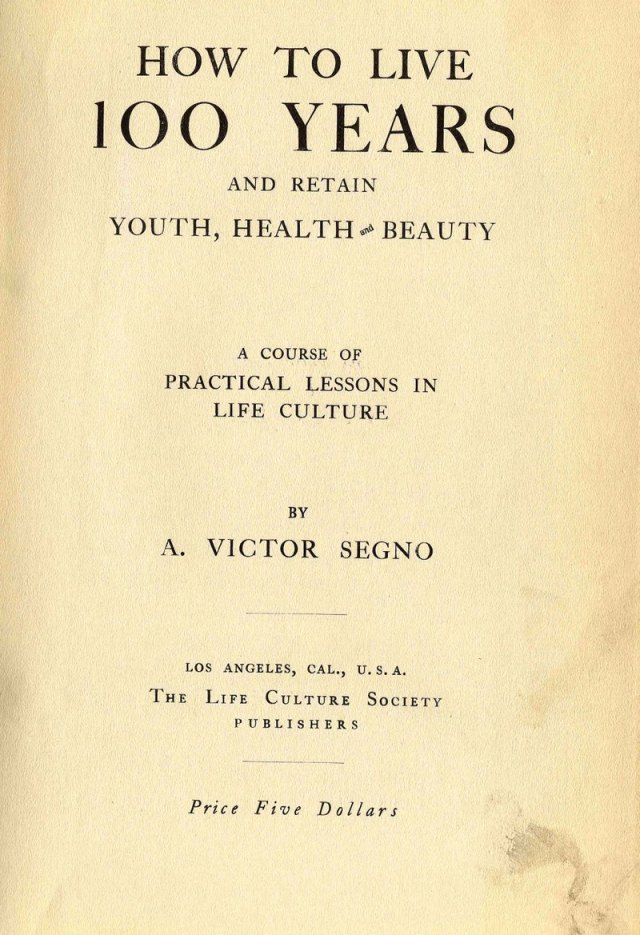 |
“You who desire to live 100 years and retain the characteristics of youth must not allow your head to become bald…. Refuse to make yourself a slave to a hat. A hat should be worn only when absolutely necessary, and stiff, tightly fitting hats should never be worn, for they prevent a free circulation of air and overheat the head and thus kill the hair.”
–A. Victor Segno,
“How to Live 100 Years,” Los Angeles, 1903 |
 |
The English edition of the March 1936 issue of Black Mask has turned up on EBay. This issue features Raymond Chandler’s "The Man Who Liked Dogs." It’s listed as Buy It Now for $299. On the other hand, the e-text is here for free. |
 |
It’s Christmas morning. Your loved one reaches under the tree for that carefully wrapped package. But what’s this? Could it be?
Yes, it’s Col. Sanders’ FBI file! Just what they’ve always wanted! And it can be yours courtesy of the United States government — for free! |
 |
Coach Foch Prepares Her Players
|
 File this under quaint notions of the 1950s: Highway officials taking control |
|||||
|
 |
 "The Principles of Design" by Ernest A. Batchelder of Pasadena is listed on EBay with a Buy It Now price of $95. Which you could do. Or you could buy it via bookfinder.com for $11.50. On the other hand, Google has digitized it here. "The Principles of Design" by Ernest A. Batchelder of Pasadena is listed on EBay with a Buy It Now price of $95. Which you could do. Or you could buy it via bookfinder.com for $11.50. On the other hand, Google has digitized it here. |
|
Robert Gauthier / Los Angeles Times THE TRUE BELIEVER: “I felt that the primary authors of science fiction were opening my eyes … to a better and more fascinating world,” says Forrest J Ackerman of the genre he has championed. Ackerman once was literary agent for Ray Bradbury and L. Ron Hubbard. |
Read Dennis McLellan’s obituary on Forrest J. Ackerman here >>>
Welcome to his planetForrest J. Ackerman, perhaps science fiction’s greatest collector, keeps a dwindling trove open to the public.January 06, 2003 By Hilary E. MacGregor, Forrest J. Ackerman, a.k.a. Mr. Science Fiction, answers the door to his bungalow. Dressed all in black, except for a red shirt, he is the gracious host of his own haunted house. On his left hand is the ring worn by Bela Lugosi when he played Dracula in the 1948 film “Abbott and Costello Meet Frankenstein.” Ackerman’s little home is crammed floor to ceiling with Hollywood horror memorabilia. There is a life-size replica of the robot from Fritz Lang’s 1927 film “Metropolis.” The real robot was destroyed in the film, but 15 years ago Ackerman hired two guys, who spent 600 hours reconstructing her. There is the single remaining Martian machine from the 1953 film “The War of the Worlds.” In front of the fireplace stands the very first Hugo trophy — the equivalent of the first Oscar in the science fiction world — which Ackerman received in 1953 at the World Science Fiction Convention. In a glass box nearby, Ackerman has the beaver hat and the ghoulish teeth that Lon Chaney wore in the lost film “London After Midnight.” Ackerman saw the film on opening day, in 1929. “These are the things that have been most important to me over the last 75 years,” Ackerman says. He’s selling the rest. Fame and obscurity Ackerman is perhaps the greatest science fiction collector of all time, but outside of fandom, his name is virtually unknown. He is the founder of the cult magazine Famous Monsters of Filmland. He was Ray Bradbury’s literary agent, and L. Ron Hubbard’s, too, long before Dianetics and Scientology. He has inspired Steven Spielberg and George Lucas and was sought out by Michael Jackson for advice on his “Thriller” video. He started reading science fiction as a child before the genre had a name and claims to have invented the abbreviated term “sci-fi.” Unlike a lot of collectors, who hoard their troves, Ackerman has always shared his private collection with the public, gratis, every Saturday. An estimated 50,000 visitors traipsed through his hillside home — a 5,800-square-foot, 18-room home on Glendower Avenue in Los Feliz. The “Ackermansion,” as it was called, became a mecca for local science fiction fans and a pilgrimage spot for visitors from around the globe. “There was nothing like it anywhere in the world, and there never will be again,” says Jerry Weist, an author, collector, and comic book and science fiction consultant for Sotheby’s who is selling part of Ackerman’s collection. “The heritage of modern collectors is based on the Ackerman collection. It’s as if one guy in Europe had most of Braque, Picasso, Matisse and Chagall, as if one person had an overwhelming collection.” Part of what distinguished Ackerman from other science fiction collectors was his interest in film. Ackerman embraced Hollywood. Over time, he has collected hundreds of thousands of movie stills, press books and rare movie posters. “If you include science fiction memorabilia as well as literature, no one could touch him,” says David Kyle, 84, a pioneering science fiction book publisher, novelist and fellow “survivor” (as they joke) of the first World’s Science Fiction Convention in 1939. “All because fortunately he was in an area, Hollywood, where the fantastic filmmaking which he was so interested in gave him the opportunity to collect these things.” Over the decades, Ackerman has had offers to buy his collection and convert it into a museum. The failure to preserve it has made some fans weep. It makes Ray Bradbury’s blood boil. “We live in a stupid world,” said Bradbury, who at one time or another has begged executives at a variety of companies, including Rocketdyne, to help preserve the collection. “I said, ‘A special room with all of that will be more fascinating than all that junk you have.’ They didn’t believe in the future. I believe in the future. Forrest Ackerman believes in the future. No one else cared.” Weist estimates that at its peak, in the mid-1960s, Ackerman’s collection would have been worth about $10 million in today’s market. Instead, over the last 30 years, Ackerman, now 86, has slowly had to sell piece after piece to survive. Then, this past summer, as a result of health problems and an expensive and still unresolved legal fight against his onetime business associate, he was forced to dissolve what remained of his collection. Last summer, he moved out of his beloved Ackermansion. He is selling all but about 100 of his favorite objects, including more than 50,000 books. But though he now requires round-the-clock nursing at his small bungalow in the flats of Los Feliz, Ackerman still shares what’s left with anyone who comes to his door. Once again, his doors are open to fans on Saturday mornings. “I call it the Acker Mini-Mansion,” he says. Master storyteller Even here amid his diminished collection, it becomes apparent that the greatest part of Ackerman’s collection is the man himself. He is full of tales of the birth of horror in Hollywood. He saw movies that have been lost forever. He attended Bela Lugosi’s funeral. He attended not just the first World Science Fiction Convention in New York City in 1939, but nearly every convention since. As a teenager, he corresponded with the president of Universal Studios, Carl Laemmle, 62 times, until Laemmle wrote on his president’s stationery, “Give this kid anything he wants.” Fifteen-year-old Forrie Ackerman chose the sound discs to some of the greats of early cinema like “Murders in the Rue Morgue” and “Frankenstein.” Born and raised in Hollywood, Forrie is the ultimate fan. He is still an eager 12-year-old boy trapped in a gangly, 86-year-old man’s body. He delights in bad puns and very silly jokes. He points to a casket covered in embroidered pillows in the front of his living room. “That’s my coffin table,” he says with a wink. “Room for one more…. ” He is well-spoken and a master storyteller. He has an encyclopedic mind that holds data like a computer. He can rattle off obscure movie titles, forgotten movie stars, esoteric movie lore. His stories are what make his objects, much of which look like junk in an adolescent’s bedroom, come alive. There is Bela Lugosi’s cape in the corner, from the 1932 stage performance of “Dracula” in San Francisco. And there, over the dining room doorway, are the seven great faces of horror cinema in life-size 3-D molds: Boris Karloff, Bela Lugosi, Lon Chaney Jr., Tor Johnson, Glenn Strange, Vincent Price and Peter Lorre. Where others display china, Forrie displays models of dinosaurs, monster heads and a skull holding a serving bowl. Where others might hang paintings, Ackerman hangs a wall-size comic strip of Vampirella, which he created in 1958. He walks back toward the bedroom with a mischievous look. “You are over 21,” he flirts, arching an eyebrow. “You can come into my ‘badroom.’ ” In a story that any visitor to the Ackermansion has probably heard, he likes to recount how he fell in love with science fiction, in October 1926. “I wasted the first nine years of my life,” he says in his singsong storytelling voice. He was at a Santa Monica Boulevard newsstand. “Among all the magazines, one popped off the newsstand and spoke to me.” It was Amazing Stories. “That one said, ‘Take me home, little boy. You will love me.’ Three years after I discovered that magazine, my mother said, ‘Son, do you realize how many magazines you have? You have 27. Do you realize how many you will have by the time you are a grown man? You might have 100…. ” Ackerman’s claim of having coined the term “sci-fi” is accepted by the genre’s experts; the “Encyclopedia of Science Fiction” even no Ackerman is not the least bit defensive about that. “Before about 1958 you can look in vain, nowhere in the world will you find that term,” he says. One day, he was driving around and he heard someone on the radio say “hi-fi.” He said to his wife, “Why not sci-fi?” And, to her “immortal embarrassment,” he reports, “My wife said, ‘Forget it Forrie. It will never catch on.’ ” Risk of theft Over the years Ackerman was so eager to share his collection that he kept his doors open even when visitors stole some of his most prized possessions. Once a man had the audacity to call him and try to sell him the sound disc to “Frankenstein” that had been stolen from his collection. “Every once in awhile my heart would be broken when something would disappear,” Ackerman admits. But he never thought of closing the doors. “My wife used to say, ‘What have they stolen now? Why do you let all these strangers come?’ But what’s the use of having 300,000 interesting things if I just sit up here, a crotchety old codger in his house on the hill.” Kyle says many of the earliest science fiction enthusiasts believed so strongly in the genre they would share their knowledge freely, to the frustration of some of their competitors. “We are the last of a breed — of the original science fiction enthusiasts,” says Kyle. “When science fiction was known by only a handful of people, we thought we had discovered something the world didn’t know about. “Mr. Ackerman frequently was doing things to promote the field when other people were just trying to keep it a moneymaking field,” said Kyle. Ackerman, for instance, would help science fiction fans in Mexico start up magazines, and assist Hollywood producers who came to his door asking for stories and suggestions. They would go off full of information, Kyle says, but Ackerman never got any recognition or compensation. “He was taken advantage of,” says Kyle, “time and time again.” During a chat with a visitor Ackerman suddenly leans forward. In a mishmash of what sounds like French, Spanish and Italian that is somehow comprehensible to any liberal arts graduate, he tells a visitor her eyes are beautiful, her height striking. He is speaking Esperanto. “In the 20s and 30s, some science fiction stories of the future mentioned that everyone would one day speak Esperanto,” he says. “For me it was like time travel. It was like going 100 years into the future. And if I could bring back a bottle of something, I would be thrilled. At least I could bring back the language everyone would be speaking.” Something about Ackerman’s snippet of Esperanto seems to capture the soul of science fiction, and of Ackerman himself. It speaks to a utopian vision cherished by people who fantasize about a world where Martians and Klingons and humans can all speak the same language and get along. It is the view of an optimist, the view of a man whose slogan is “Save humanity with science and sanity.” “A lot of us really believed that educating the public with sugar-coated science would make the world a better place,” Ackerman says. “Pure everyday science might not attract a reader, but to surround it with adventure and a spirit of optimism would make it acceptable. I felt that the primary authors of science fiction were opening my eyes … to a better and more fascinating world.” Ackerman does not dwell on his health, the loss of his collection, the lawsuit that continues to drain his finances. As he has his whole life, he looks to the future. To the next time he sees “Metropolis” (his 101st). To his next film cameo (his 106th, in the upcoming movie, “Vampirella”). To the latest visitors to his scaled-down world. ( A Swedish family with an 8-year-old boy named Winter Wolf visited last week.) Although he says thousands of children around the world call him “Uncle Forrie,” his wife, Wendy, died in 1990, and he has no heirs. He has not willed the remains of his beloved collection to anyone. “If I can’t take it with me, I’m not going to go,” he says, laughing. Then he hints at what he really hopes will happen, despite 30 years of failed efforts: “Twenty years down the road, when I pass away, I hope this little bungalow will be maintained just as it is….” |
|
O’Malley told Los Angeles baseball writers gathered in San Francisco The short story in The Times treated the announcement as almost O’Malley died in 1979, and stories dealt with his taking control of The Times’ Penelope McMillan wrote after O’Malley’s death about Peter’s training. "Peter worked in the farm system, in stadium operations and at — Keith Thursby
|
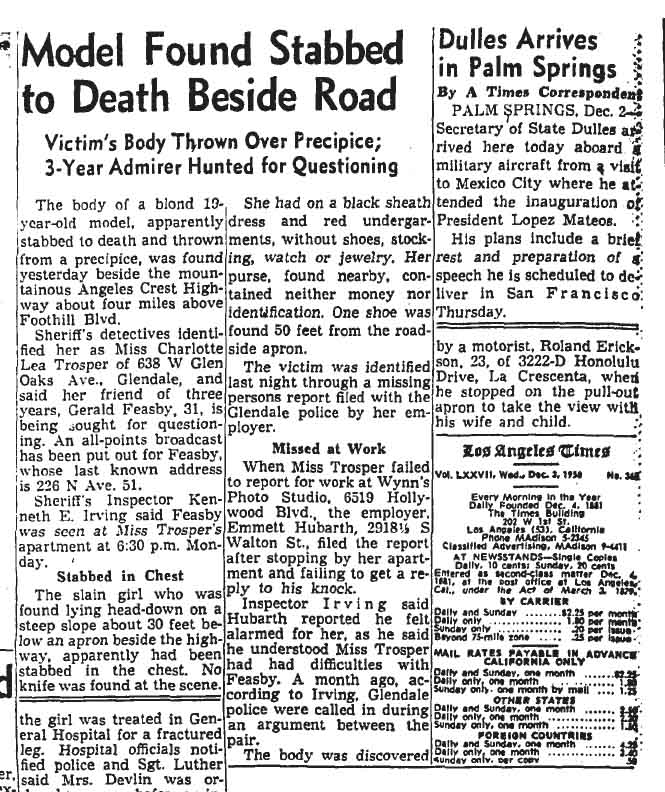
People v. Feasby (1960) 178 Cal.App.2d 723 [3 Cal.Rptr. 230]
[Crim. No. 6783.Second Dist., Div. Three.
Mar. 9, 1960.]
THE PEOPLE, Respondent, v. GERALD BYRON FEASBY, Appellant.
COUNSEL
Ellery E. Cuff, Public Defender (Los Angeles), Richard S. Buckley and Richard W. Erskine, Deputy Public Defenders, for Appellant. {Page 178 Cal.App.2d 726}
Stanley Mosk, Attorney General, William E. James, Assistant Attorney General, and Jack K. Weber, Deputy Attorney General, for Respondent.
OPINION
VALLEE, J. Continue reading

This mystery woman isn’t a movie star. She’s not even a starlet, although she does have a handful of credits on imdb and pops up on ibdb. The real world has been her stage and her drama certainly played out in the press. The Times’ art department went overboard in retouching some of her photos, which is why I’m running them. |
||
|
||

As you can tell, our mystery woman (yes this is the same woman) has been doing some hard living and has ended up in court. For some reason, The Times art department decided she wasn’t quite close enough to the microphone, so they
|
||

Here’s our mystery woman with another famous individual. He’s not identified on the back of the photo, but Daily Mirror readers should have no trouble naming him. Update: Most people recognized attorney Jerry Giesler, congrats!
|
||

As many people guessed, our mystery woman is Gregg Sherwood Dodge. |

You really don’t have to wonder what "She Gods of Shark Reef" is about, do you? |
|
Baseball approved interleague trading for a short period each winter The concept was not unanimously approved by team owners. The Yankees Fresco Thompson of the Dodgers thought the plan would "open the gates" to trade stars from one league to the other. "Say a team owns a Willie Mays and nothing else," Thompson said. "It Sounds a little like the Florida Marlins. Funny that Thompson used the Giants’ star as an example–that must –Keith Thursby |
 Photograph by Susanne Hayek Home designed by Paul R. Williams, Pasadena. |
| The home at 1727 Putney Road, designed by noted African American architect Paul Revere Williams, is on the market for $2,795,000. The agent’s website is here. The home was occupied in the 1940s by George C. Earley, who owned the Chrysler dealership in Pasadena at 337 W. Colorado Blvd. |
 The Parker T-Ball Jotter, 1957 |
Newspapers, magazines and websites are full of holiday gift suggestions. But frankly, in this economy, I can’t in good conscience recommend spending lots of money. (True, I may post pricey items from EBay, but I never recommend them as gifts; they’re just historic curios.)
Here’s an economical present that’s totally retro: the Parker T-Ball Jotter, available in most office supply stores for a few dollars. The Parker (yes, in black) is the ballpoint pen of choice at the Daily Mirror. My only concession to modern times is the gel cartridge. Great for doing the New York Times’ crossword puzzles. |


 ladailymirror.com