Movie Star Mystery Photo


2009_0209_mystery_photo


Los Angeles Times file photo

Just a reminder on how this works: I post the mystery photo on Monday and reveal the answer on Friday. To keep the mystery photo from getting lost in the other entries, I move it from Monday to Tuesday to Wednesday, etc., adding a photo every day. I have to approve all comments, so if you’re wrong your guess will be posted, but if you’re right, you’ll have to wait until Friday. There’s no need to submit your guess five times. Once is enough. The only prize is bragging rights. 

2009_0210_mystery_photo
Los Angeles Times file photo
Here’s another photo of our mystery woman. Three people have identified her: Alexa Foreman, "Carmen" and Jeff Hanna.
2009_0211_mystery_photo

Los Angeles Times file photo
Here’s another photo of our mystery woman.
2009_0212_mystery_photo

Los Angeles Times file photo
And another photo of our mystery woman.
2009_0213_mystery_photo
Los Angeles Times file photo
Here’s the final photo of our mystery woman. She is Jacqueline White and appeared in "Narrow Margin," "Crossfire" and "Swing Shift Maisie." 

Check back Monday for another mystery photo!

Posted in Film, Hollywood, Mystery Photo | 57 Comments

Dodger Tickets Selling Fast, February 13, 1959

1959_dodger_ticket_ebay
This 1959 World Series ticket has been listed on EBay with Buy It Now for $100.

1959_0213_dodgers Dodger tickets for 1959 were going fast.

The team already had grossed $1,250,000 in box seat sales for upcoming games at the Coliseum, according to business manager Harold Parrot, who talked to The Times’ Jeane Hoffman.

"It’s a terrific vote of confidence. And I think Chavez Ravine being settled helped our ticket sales," Parrott said. "People felt they could bear with the Coliseum’s drawbacks for one more season."

This guy was some salesman. He apparently asked the Dodgers to move their dugout because "60% of the reserved seats remain on the third-base side instead of behind the Dodger dugout," Hoffman wrote.

The Dodgers turned down that plan and Hoffman, always looking for a chuckle, had an explanation: "Dodger brass felt it would be betraying those who purchased box seats behind first to get a close look at Walt Alston’s bald spot."

— Keith Thursby

Posted in Dodgers, Downtown, Sports | Comments Off on Dodger Tickets Selling Fast, February 13, 1959

Letter to Three Wives; Branch Rickey Visits L.A., February 13, 1949

1949_0213_brouse_photo01

Meet Albert Brouse, opera singer, performer in "The Drunkard" and collector of all manner of antiques.

1949_0213_brouse_photo02
He was active in the Horseless Carriage Club and at one time owned a fleet of early automobiles.
1949_0213_brouse_2

California death records list two men named Albert Brouse, both born in 1906. Albert Anderson Brouse died in 1984. Albert E. Brouse died in 1979. I wonder what became of all this sheet music and early recordings. 

1949_0213_rca
The "giant screen television" had a display of 126 square inches and cost $4,529.83 USD 2007.

1949_0213_theater
Joseph L. Mankiewiwicz discusses "A Letter to Three Wives." John Wayne finishes "Three Godfathers," "She Wore a Yellow Ribbon" and "Wake of the Red Witch."

1949_0213_theater_02
Gail Russell has "wonderful possibilities," John Wayne says.

1949_0213_sports The Dodgers’ Branch Rickey visited California and was asked why the weather wasn’t good enough for the major leagues.

"There are several cities that could sustain major baseball — Montreal, Los Angeles, Houston, San Francisco and others," he said. "But to change the identity or makeup of the present major leagues seems a most difficult task."

Interesting that Rickey first named Montreal, then one of the Dodgers’ top minor league cities. Wonder how Walter O’Malley would have answered that question in 1949?

Rickey’s official reason for being in town was to check up on the Hollywood Stars. According to the story in The Times, the teams recently signed a working agreement.

"I can’t make champions of the Stars overnight," he said. "But I am going to help them all I can. … Next year Hollywood will be a certain first-division club and a pennant contender right on par with our own two Triple-A teams, Montreal and St. Paul. We have 70 players on the Brooklyn roster right now, which means 30 must go down. Montreal and St. Paul already are pretty well-equipped. So the Stars might surprise this season."

— Keith Thursby

Posted in Dodgers, Hollywood, Sports | 1 Comment

Architecture — Paul Revere Williams

Williams_fern_drive
Photographs by Coldwell Banker
1942_0528_fern_drive Golden_medical

The Paul Revere Williams home at 200 Fern Drive, designed for Valentine Mott Pierce, son of a patent medicine man, has been listed by Catherine "Tink" Cheney" at $3.8 million. 

Posted in Architecture | Comments Off on Architecture — Paul Revere Williams

Matt Weinstock — February 12, 1959


Light in Darkness

Matt_weinstockd
It’s
a worthwhile experience to put down whatever you’re doing for half an
hour today and read something about one of the world’s great men. It
doesn’t matter which of the books about him you read. His wisdom and
humor and particularly his compassion come through in all of them, even
in the vignettes in Reader’s Digest.

I’ve been reading Mark Van Doren’s recently published play, "The Last Days of Lincoln," which covers the last few weeks before his death.

The
end of the war was imminent and the big issue was whether the terms of
surrender should be harsh or generous. Some hotheads were for hanging
the generals and destroying the South. Lincoln patiently tried to
convey to them his feeling that such rash action would only add to the
tragedy of a divided, stricken nation.

1959_0212_tv
AT ONE POINT

Benjamin Franklin Wade, senator from Ohio, bitterly assails Lincoln.
"Be soft and you’ll be sorry. You will unmake or make yourself for
good."

Lincoln replies, "You flatter me. I have never thought of
myself as my own Maker, nor do I now . . . I shall do nothing softer
than reality permits. Reality is my guide in time of darkness."

LATER,
to Gen. Grant, Lincoln says, "I don’t find fault any more with anybody.
Not with fate, even . . . I tried to keep the war from meaning too
much. At the very least it meant enough. Half of this country had
decided to be half of nothing. But half of nothing is exactly nothing,
and the war, I still think, means all it needs to mean if it restores
those people to existence."

To Sens. Wade, Chandler and Sumner
he says, "Your only thought is about how they must learn to live with
us. You don’t appear to consider that we must live with them, and that
this will take some learning, too. I’m doing my best to remember both
parties to the divorce — a miserable divorce, if any at all, for
neither party could move away. Meanwhile, gentlemen, let us all study
to avoid a certain dictatorial tone — it may be mine, it may be yours
— that is not to be tolerated in such perilous times."

 
1959_0212_hula_hoop_salad

* *

1959_0212_western_ro
FATHER & SON STUFF —
This is for those who despair of educational standards. In explaining something a boy said, "I brang it to school." Pater snapped, "What’s that!" "Oh," the boy said, "I brung it to school" . . . At the dinner table a 6th
grader repeated a comment his teacher had made in class about a state
official. His father slammed down his knife and fork and fumed, "I’ll
not have you misled about politics! I’m going to do something about
this!" "Whoa, dad," the boy soothed, "wait’ll after I get my report card."

* *

CONFUSION
in Washington note: On Page 21 of the printed report of testimony
before a Senate subcommittee on the subject, "Experimental Research in
Cloud Modification," there’s a rather classic typo "Dr. Reichelderfer of the U.S. Whether Bureau . . ." 

* *

AMID OHS and ahs
an Anaheim girl was opening her gifts after her wedding a few nights
ago. One lady, known to enjoy a cocktail, watched avidly, and when her
gift came up she exclaimed, "Melanie, you should have seen us wrapping
that package last night. It took three bottles of Scotch tape!"

* *

ONLY IN HOLLYWOOD — Tom Lempertz
did a double take and looked cautiously over his shoulder for the
little green men at a Vine Street market when he heard a man say,
"Well, if you run into anyone who can use a galaxy, let me know." The
man was referring, of course, to the new Ford model, the Galaxie. 

* *
1959_0212_naacp

AROUND TOWN — While covering the flooded area in Benedict Canyon yesterday Jack Leppert,
NBC cameraman, couldn’t help noticing the sandbags propped against
doors and garages were red, green, blue and whatnot. Apparently a
sandbag salesman had given residents a choice . . . Wreckers
demolishing a building on W 2nd Street with the inscription, "Since 1918," have posted a hand-lettered sign, "Adios mis amigos."  

Posted in Columnists, Food and Drink, Matt Weinstock, Politics | Comments Off on Matt Weinstock — February 12, 1959

Paul Coates — Confidential File, February 12, 1959


CONFIDENTIAL FILE

Social Disease Problems Bared

Paul_coates
Guess I might as well admit it. I’m an old man.

I’m
so old I can even remember back to the late ’30s when young men were
adequately, intelligently warned about the perils of venereal disease.

Just a few years before that, things had been sadly different.

VD was something to be spoken about only in whispers. And never in polite company.

Its
victims hid from view, and frequently from treatment. If they sought
help at all, they sought it from the second-story quacks who
specialized in "quick cures."

As a result of the "quick cures"
many of them would up crippled, blind or hopelessly insane. The
diagnosis of their infection was syphilis. But the basic disease they
suffered from, along with all of us who were not infected, was
ignorance.

1959_0212_red_streak
Suddenly, just before World War II, a kind of
hard-headed realism broke out all across the country. At the insistence
of responsible medical people, a campaign was launched to make us
recognize that venereal disease was one of our most serious problems.

We were taught that the only way to solve the problem was to talk about it, and speak against it.

Kids
in school began to lean the dangers of these diseases. Parents began to
learn the common sense of talking sex to their offspring. It was the
war years, and the young GIs in addition to the manual of arms were learning, from another government-sponsored manual, how to avoid contracting VD. 

It was an era of common sense.

But it was short-lived.

Because
a remarkable thing happened around that time. Medical science
discovered that penicillin was the true "quick cure" for venereal
infection.

In the years that followed World War II, we lowered
our guard. We thought the great miracle of penicillin had ended the
2,000-year struggle against the dread social diseases.

By
1951, we had become so complacent that most VD educational programs
were completely eliminated. The generation of parents of which I’m now
a member didn’t think it was necessary to forewarn their kids, as they
had been forewarned.

And so, again, another generation of youngsters has grown up in the same ignorance.

Penicillin, we thought, had wiped out VD, so why talk about it any more?

Real Facts Are Different

1959_0212_lincoln
The
answer to that will shock you. Today — now — 1959, venereal disease
has a reservoir of victims that runs into the millions around the
nation. A frighteningly large percentage of them are drawn from the
ranks of adolescents.

Right in your own home town, city health
officials have just warned the public that VD is again becoming a
serious health menace. And that since 1950, the number of teenagers in
L.A. who have contracted the disease has nearly doubled.

I
talked to one of those kids yesterday. He’s a high school senior. He
comes from an upper-middle-class family, a good neighborhood. His
grades are better than average. He’s a prominent school athlete and
active in student affairs.

But caught gonorrhea. A half-dozen of his fellow students were infected, too.

And, if you ask them why they weren’t more cautious, they’ll tell you they "didn’t know you could still get VD."

Nothing was told to them at school. Their parents didn’t discuss it at home.

That
happened to one high school to a total of seven kids, and maybe a few
more the health authorities haven’t found out about yet.

It seems pretty clear to me that venereal disease is something we better start talking about in polite company once again.

Posted in Columnists, Dodgers, Front Pages, health, Paul Coates | Comments Off on Paul Coates — Confidential File, February 12, 1959

Coming Attractions — Black Broadway

Black_broadway
Selections from black musicals from the 1920s until today will be presented Monday, Feb. 23, 8-11 p.m. at the Catalina Bar and Grill, 6725 W. Sunset Blvd. It is free and open to Actors Equity and SAG members. Info: WesternRSVP@actorsequity.org

Posted in Music, Stage | Comments Off on Coming Attractions — Black Broadway

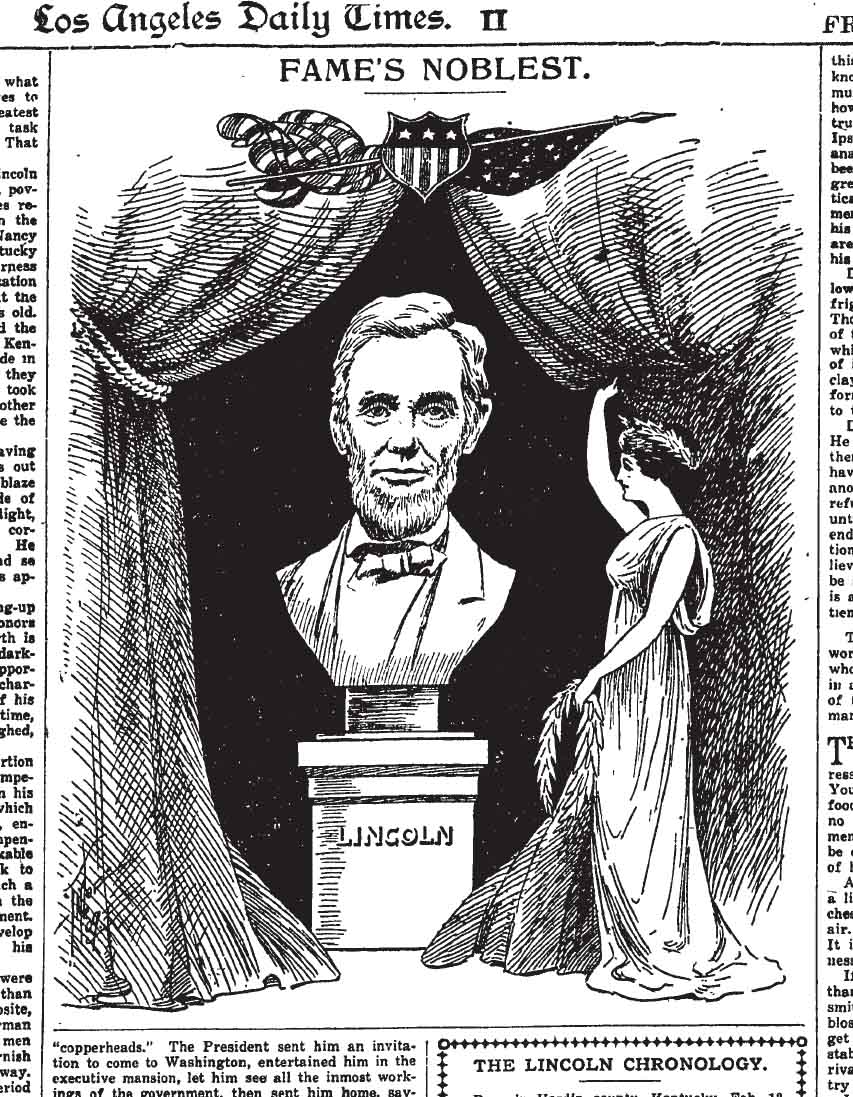
February 12, 1909: Los Angeles Celebrates Lincoln’s Birth

February 12, 1909: Cartoon of Lincoln's bust

The Times devoted enormous coverage to the centennial of Abraham Lincoln’s birth. Most of it is fairly predictable: Stories of Lincoln’s political career, his days as a lawyer, his boyhood, photographs and some memorial poems that are heartfelt but don’t translate to our era. These pages are perhaps most valuable to demonstrate how Lincoln was viewed a century ago.

And then a surprise. The Times published a special section on Los Angeles’ African American community using the Emancipation Proclamation as a point of departure. The section includes profiles of black professionals, civic and religious leaders, prominent women and an account by former slave living in Los Angeles. I frequently fault the city’s mainstream newspapers for ignoring the black community, but in 1909 The Times came through.

A sample:

Continue reading →

Posted in @news, Front Pages, Politics | 1 Comment

Found on EBay — 1936 Chauffeur’s Cap and Badge

Silverwoods_ebay_hat
A chauffeur’s cap from Silverwood’s, with 1936 badge, has been listed on EBay. Bidding starts at $9.99.

Posted in Fashion, Transportation | Comments Off on Found on EBay — 1936 Chauffeur’s Cap and Badge

Matt Weinstock — February 11, 1959


The Flight That Got Away

Matt_weinstockd
You take your profundity where you find it, and today’s significance comes from Bob Timm and John Cook, both 33, who landed their single-engine Cessna Saturday at Las Vegas after 65 days in the air, a new record.

They flew between Las
Vegas and Blythe, with occasional side trips to Los Angeles and
Phoenix. It was estimated they covered a distance equivalent to halfway
to the moon, which is better than the Air Force did with its Pioneer.

Each
morning and evening they swooped low over the Blythe airport and
refueled from a pickup truck driving 90 m.p.h. They lowered a hook to
hoist the refueling hose.

THE FLIGHT started as a publicity stunt for the Hacienda Hotel, where Timm is a slot-machine boss and Cook serves as a free-lance pilot. Somehow it just got away from everyone.

Back on the ground they were asked if they felt a sense of accomplishment. They didn’t.

"It was just something I always wanted to do," Cook said.

1959_0211_metro"It proves a light plane will stay up a long time." Timm said.

So beware, everybody, of those things that seem like a good idea at the time.

* *

ONLY IN BURBANK —
A car stalled in traffic and the driver behind impatiently sounded his
horn. So the driver of the stalled car, a lady named Madonna, got out,
walked back and said icily, "Mister, I’ll honk your horn if you’ll
start my car!"

* *

LICENSE PLATE
I tried to find the light to see
The "Land of Opportunity"
I looked into the dark and saw
The governor of Arkansas.
— ELIZABETH MEITZ

* *

IN RECENT WEEKS Reita Sones,
a working mother, has had three different baby sitters. Last Saturday
when she made no move to leave for work, Jimmy, 4, asked hopefully,
"Gosh, Mom, are you going to baby sit today?"

* *

EVERYONE HAS heard
the hackneyed legend about the bullet which misses, whereupon the
script writer has the intended victim musing, "I guess it didn’t have
my name on it."

1959_0211_masterson
Jan Salter was driving on a narrow, solidly
parked street in Beverly Hills. She was forced to the right as an
oncoming car passed and her fender caught the bumper of a parked car.
As she inspected the damage, she discovered the car she’d tangled with
had the license plate letters, JAN, her name.

That’s the way the fender crumbles sometimes.

* *

AS ANYONE could have guessed, we haven’t heard the last of the town-naming game mentioned here. Try these, by Leo Bartelme of Sherman Oaks: Praise, Ala., Noahs, Ark., Trala, La., Hianlo, Mass., Uranium, Ore., Ominepa, Pa., and Sixanfourar, Tenn.

* *

MISCELLANY —
In the event Allan Dulles’ cloak and dagger boys have a few minutes to
spare, the Diners’ Club directory with the names of hotels, restaurants
and other services available to members lists on Page 25 "I.
Espionage." 2900 Main Street, NW, right there in Washington, D.C.

Posted in Columnists, Environment, Front Pages, Matt Weinstock | Comments Off on Matt Weinstock — February 11, 1959

Paul Coates — Confidential File, February 11, 1959


CONFIDENTIAL FILE

Somebody Does Love a Fat Man

Paul_coates
For years, the Fat Man had ignored those ads that flashed intermittently on his TV screen. The ones that told him to get rid of that ugly excess by exercising in beautiful gymnasiums for just a few minutes a day.

The ones that promised him that he’d end up the envy of all the guys in the block. And the idol of all the girls.

The Fat Man’s lack of interest was reasonable. Even though he was 15, maybe 20 pounds overweight, he had it made.

His wife loved him, just the way he was. So did his kids. He had a good job, a nice home, and respect from everyone who knew him.

After all, he wasn’t THAT fat. There are very few men in their 40s who don’t have at least a little paunch, anyway.

1959_0211_mirror_cover
But last month, he was laid off the job he’d held for years. A bit choosily, he began searching for a new one — for the right spot.

This week, he found it. He was told that he’d been accepted. There was only the routine of the physical.

Then, yesterday afternoon, he paid a final visit to his prospective employer and got the bad news. "The doc says you’re not a good health risk," he was told. "Too fat. Seventeen pounds of extra baggage."

The Fat Man couldn’t believe it. He walked to his car in stupor. Squeezing behind the wheel, he headed home.

Suddenly, one of the beautiful gyms loomed before him. It was on a street he’d traveled a thousand times before, but before he’d never particularly noticed it.

The Fat Man nosed his car to the curb, parked and stepped out.

"I’m interested," he told the man at the desk. "I’ve got to lose weight. Seventeen pounds. How long will it take?"

1959_0211_darnell
The next 15 minutes of conversation doesn’t need repeating. It was the usual salesman-customer give-and-take routine.

Fat Man wanted a short course. The instructor pitched for a special lifetime course. Fat man said it was too expensive. Instructor said it’s cheaper in the long run. Terms are easy, too.

Finally, the Fat Man turned thumbs down. "No," he said. "I can’t see it for $300 or $400. Why, when I was a kid, we used to get all the same things you’ve got here for a $15 annual YMCA membership."

He turned to walk out, when the instructor touched his shoulder.

"Wait a minute," the instructor asked. "Before you go, I’d like you to meet another member of our staff."

Some New Atmosphere

The "other member" was the picture of health-plus. She was the kind of a woman that no man in his right mind would look at only once.

1959_0211_abby
"We’d just love for you to join," she told the Fat Man. "I’d like to sell you the course as a friend."

"A friend?" the Fat Man asked, his face reddening.

The pair sat down, and as the conversation progressed, he was gripped with a crazy, wild idea. He placed his hand on her knee. She did nothing. Just smiled.

"I like you, too," she purred, "but I’ve got a big, strong boyfriend.

"Of course," she added, "if you sign the contract, I’m sure we can figure a way to get together without him finding out."

"Why," pleaded the Fat Man, "can’t we get together before I sign?"

The girl’s eyes were wide with innocence. "Don’t you trust me?"

The Fat Man couldn’t restrain himself any longer. He burst out laughing, got up, walked out, drove home, kissed his wife, and- shaking a finger in her face — admonished:

"No potatoes for me tonight. Is that clear?" 

Posted in Columnists, Dodgers, Film, Front Pages, Hollywood, Sports | Comments Off on Paul Coates — Confidential File, February 11, 1959

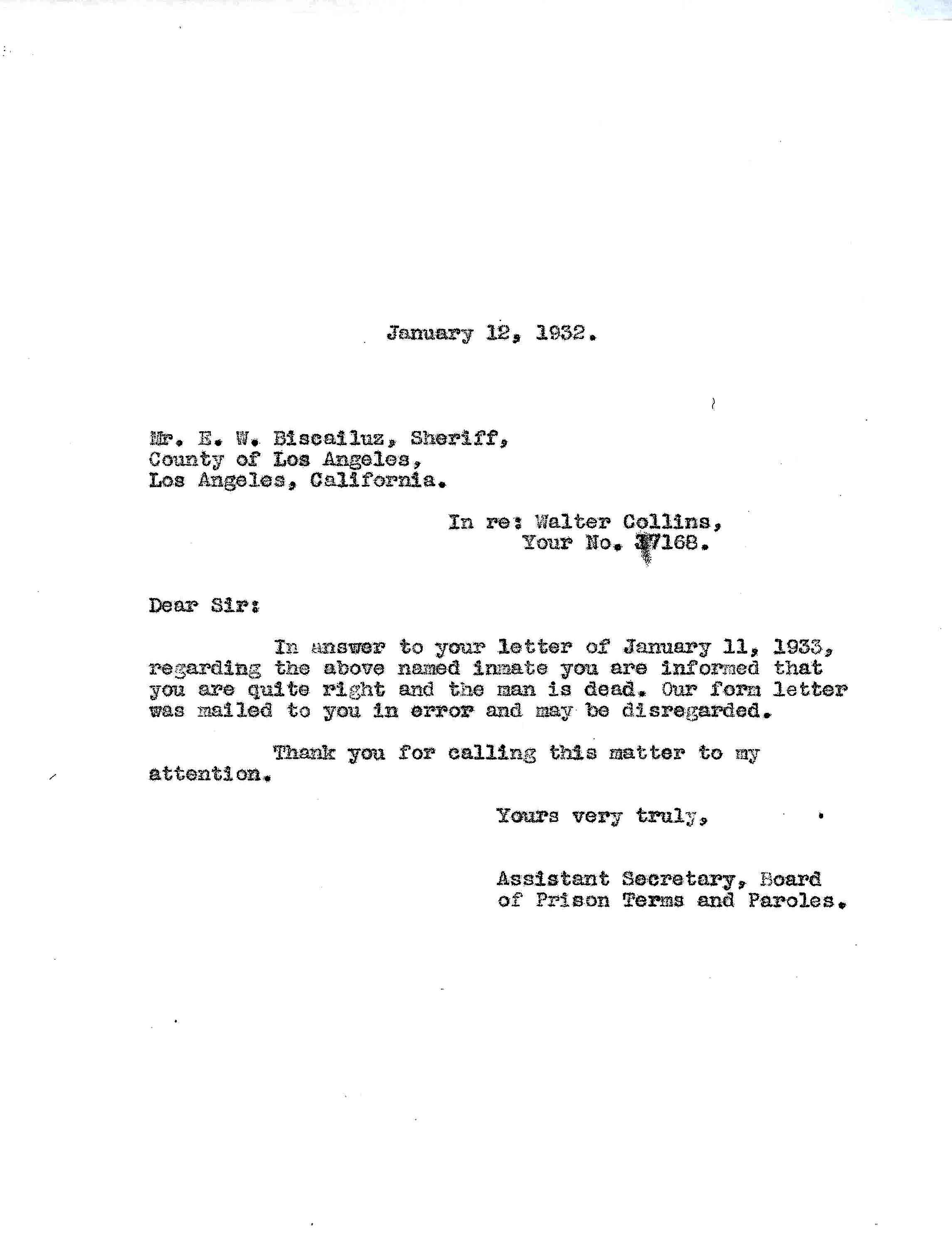
Voices — Christine Collins, January 12, 1933

January 12, 1932: Letter to Sheriff Eugene Biscailuz. Walter Collins is dead. And so we complete our journey through the official documents telling the unfortunate saga of Walter and Christine Collins. I heard from a number of Daily Mirror readers who enjoyed the trek (scanning all these documents was more labor than I expected), one author working on a Collins project who was not terribly pleased that I was posting them on the Internet and from at least one reader asking “who cares?” Continue reading →

Posted in #courts, 1933, Changeling, Film, Hollywood, LAPD | 6 Comments

Santa Barbara Oil Spill; Don’t Change Baseball, February 11, 1969

1969_0211_cover
The Times publishes a Chuck Powers story on the Santa Barbara oil spill. Powers left The Times to become a novelist but died just before his first book, "In the Memory of the Forest," came out.
1969_0211_spill_ro
"Anyone who says he can guarantee
his well won’t blow out is either
nuts or lying."

1969_0211_spill_ro2
"The sea began to boil. While the men watched, the boil began to advance toward the platform, stirring the ocean to a 2-foot froth."


Robert Hilburn reviews Judy Collins at Royce Hall, after "Who Knows Where the Time Goes" was released.
1969_0211_judy_collins

1969_0211_sports
The Times’ Bob Oates asked longtime Dodger official Red Patterson to
give baseball’s new commissioner some advice. "I don’t think there’s
any way to improve baseball by changing a rule–I mean any important
rule," Patterson said.

Oates asked about taking bats away from pitchers or speeding up
intentional walks or having platoons of offensive and defensive players
like football. Each time, Patterson defended the status quo.

Here’s one question and answer:

Oates: "After 35 years in baseball, how would you define its basic
appeal to the American public. What makes it the National Pastime?"

Patterson: "It is a game of real finesse and great skill. The
essence is the battle between pitcher and batter. I never cease to
marvel at the skill and reflexes of major league hitters. They have
only an instant
to judge fastball or breaking pitch and get a piece of
wood on a ball coming at such 1969_0211_sports_rospeed and doing so many different things.
The other baseball value is that it’s the same game your father played
and your grandfather. Football can’t say that."

–Keith Thursby

Posted in books, broadcasting, Dodgers, Environment, Front Pages, Music, Sports | 1 Comment

O.J. Simpson vs. Pat Boone?


1969_0210_oj_simpson
The matchup between O.J. Simpson and Pat Boone probably didn’t happen.

Boone led a celebrity basketball team against some former college
athletes before the Los Angeles Stars’ game at the Sports Arena. An ad
in The Times said the team would include Simpson, then coming off his
Heisman Trophy-winning season at USC. But it’s unclear whether he
played.

The Times’ Dan Hafner actually mentioned the game, probably because
the Stars were so dreadful in the real game that followed. But O.J.
wasn’t included in Hafner’s description. Mike Garrett, Gary Beban and
Bob Klein were joined by former UCLA basketball star Mike Warren in
defeating Boone’s team.

Boone was apparently a gym rat in those days. A brief in The Times
announced that his all-stars–including Bill Cosby!–would play North
Hollywood High faculty the following night to raise money for the
school yearbook.

–Keith Thursby


Posted in Hollywood, Music, Sports | Comments Off on O.J. Simpson vs. Pat Boone?

Architecture — John Lautner


Lautner_baxter

Photograph by Crosby Doe Associates
1958_0810_6850_pine
This is the John Lautner’s remodel of an existing home, done for Anne Baxter. The house at 8650 Pine Tree Place is listed by Crosby Doe Associates at $1,895,000.

Baxter received the home in her 1953 divorce from John Hodiak. It was put on the market five years later.


Posted in Architecture, Film, Hollywood, Real Estate | Comments Off on Architecture — John Lautner

Found on EBay — Batchelder Tiles

Batchelder_tile_deer_left_ebay Batchelder_tile_deer_right_ebay
What appear to be a matched pair of Batchelder tiles showing deer, evidently part of a series of animal tiles, has been listed on EBay. The tile on the left is listed here. The tile on the right is listed here. Previous tiles have included a rabbit, a lion and birds.
Posted in Architecture, art and artists | Comments Off on Found on EBay — Batchelder Tiles

Matt Weinstock — February 10, 1959


Firing-Squad Mood

Matt_weinstockd
A jobless newspaperman subsisting on his unemployment insurance writes:

"My
weekly seance with the female martinet who holds my fate in her hands
reminds me of what I have read of the upheaval in Cuba.

"This
hardened slave of bureaucracy seems to think the money is hers and that
I am a former associate of John Dillinger trying to defraud the noble
state of California. I have been puzzled by the violence that comes
with a revolution, specifically the summary executions in Cuba, but I
am beginning to understand."

* *

ONLY IN HOLLYWOOD —
Iris Bender drove into the parking lot of that well known-drugstore at
Sunset and Laurel Canyon boulevards — well known for its casual
atmosphere — only to find things veryhelter-skelter . Sports cars were
parked irregularly, blocking other cars, and things were generally in a
mess. While waiting for traffic to clear she said to her companion, "I
think these actors have muffled their lanes."

* *

1959_0210_earp
AS HIS READERS
know,
Hal Humphrey frequently assails the ratings systems by which TV
programs are judged — and, more often than not, canceled. When his
wife learned the Fund for the Republic, after a seven months survey,
had named Hal eighth among the nations top 10 critics, she said, "I see
the ratings finally caught up with you."

* *

SEVERAL EMPLOYEES in
a plant in San Fernando Valley are former musicians and they’ve
indoctrinated the place with hip talk. Not long ago one of them went
east on a trip and ran out of money. He wired his boss, "Like I’m hung
up, man."

* *

POSTHUMOUS NOTE — Edward Eugene Nutt was killed in WW 2 and is buried in the National Cemetery in Manila. His sister, Agnes Cupps,
of Hollywood, has always wished to see his grave, and last September,
when a friend came through L.A. in route to the Philippines, she asked
him to take a picture of it.

The friend did, but in locating
the grave he was at first misdirected. As a result, he also brought her
a photo of the clearly marked grave of another Californian, S/Sgt.
Arthur M.Nutt, 27th Infantry, 25th Division, killed March 8, 1945. If his relatives are in the audience she would like to give it to them. 

* *

1959_0210_earp_ro
ONLY IN L.A. —
A sign above the drinking fountain on the 5th floor of the state-leased office building on 9th
and Broadway states, "When you turn water on by hand it must also be
turned off manually." Someone, perhaps a gal who wants no part of man,
has crossed out "manually" and written in "by hand" . . . Everyone
knows about baby sitters but do they know about baby walkers? Rob Lee
was waiting for the confusing signal sequence at Glendale Boulevard and
Glenhurst Avenue to change in his favor when a girl asked. "Will you walk me across?" A switch on the Boy Scout and old lad bit.

* *

SOMETIMES a person just can’t escape the feeling that things are topsy-turvy.
For instance, a hypochondriac I know has gone on a strict diet, which
includes climbing on the wagon, no easy chore for him, literally and
figuratively. Asked why, he replies, "I’m in training to see my
doctor."

* *

AT RANDOM — Gov. Braulio Maldonado’s statement yesterday blaming Las Vegas gamblers for the Rosarito
Beach gambling roust confirmed what the wise boys here have been saying
for a week . . . Jim McNamara, who was there, whispers that the band
played the "Dragnet" theme incha cha cha beat at the graduation of
rookie policemen at the Police Academy . . . In a recent letter, George
Moss needled his brother, who lives in the Texas Panhandle, about
Alaska. His brother replied, "Tell you what. We’ll give the government
five years to fix it up and then if we like it we’ll buy it."

Posted in Columnists, Matt Weinstock | 1 Comment

Paul Coates — Confidential File, February 10, 1959


CONFIDENTIAL FILE

Soothing Music Tempers Justice

Paul_coates
(News
item) Use of background music in the Los Angeles Police Building to
"alleviate tensions" of 280 employees was authorized today by the City
Council.

* *

Scene is an interrogation room in the Police Building. Time: late afternoon.

The
room is simply but tastefully furnished. There is only one
straight-back chair in the center of the room, bathed in the blinding
brilliance of a 300-watt bulb. There is a rococo bug in one corner, and
in the other a Swedish modern stereo hi-fi speaker. From it comes the soft strains of Wayne King’s orchestra playing "The Waltz You Saved for Me."

1959_0210_cover_3
A
recently apprehended burglary suspect, his hair in disarray, his shirt
collar rumpled, sits in the chair. Two veteran detectives, Dan Moriarty
and DanMonahan (their names have been changed to protect the innocent),
are pacing in the semi-darkness on either side of the chair. The
suspect leans forward suddenly:

Suspect — Listen, you guys, I can’t stand this jazz any more. I’ll talk!

Moriarty — Whatta ya mean, jazz? That’s Wayne King.

Monahan —
He plays waltzes.

Suspect —
I don’t mean the music. I mean you guys pacing up and down, and this light in my eyes. I can’t take it any more.

Monahan —
You’re aware, of course, that anything you say might be used against you.

Moriarty —
(admiringly)– Geez, Dan, you really know your manual.

Monahan —
Thanks, Dan.

Suspect —
I had been casing this place for two weeks and . . .
(The Wayne King record ends, and Fred Waring and his Pennsylvanians come on singing "My Funny Valentine.")

1959_0210_smoking
Suspect —
. . . And I finally figured I could knock it over this morning. The night watchman eats his lunch at 2 a.m. and I . . .

Moriarty —
Geez,
Dan, they’re playing that "Funny Valentine" into the ground. That’s the
fourth time they’ve played it wince we’ve been in here with this
citizen.

Monahan
(shrugs) — It bugs me too, Dan, but what can you do? Parker digs it.

Moriarty —
Oh.

Monahan —
He’s a sentimentalist.

Moriarty —
Yeah.

Suspect —
So, I figured if the night watchman is having his lunch at 2 a.m., I can get in through the side window.

Monahan —
Dan, you know, that Waring is the last of the great bands.

Moriarty —
You can say that again, Dan.

Suspect —
I’m no good, boys. I admit it.

Moriarty —
I’ll tell you something, Dan. This Lawrence Welk is coming along pretty fine. He can’t speak so good, but he’s got a helluva beat.

Suspect
(desperately) — I might as well cop out to everything. This isn’t the only job I pulled.

Monahan —
He’s all right for polkas, but he’s no Billy May.

Suspect —
You guys got 17 unsolved heists on the books you’re going to clear up tonight. I did ’em all.
(The record ends and Doris Day comes on singing "I Love Everybody." Monahan paces up and down, tapping his rubber hose in the palm of his hand in time with the rhythm.)

Moriarty —
There’s a girl with style, Dan.

Suspect
(disgustedly) — Gimme some paper and a pencil. I’ll write it out.

Moriarty
(polite but cool) — Don’t be a wise guy, sir. If you got anything to spill, say it to us. That’s what we’re here for.

Monahan —
I’ll take him back to his cell, Dan. He’s not going to talk.
(Monahan and prisoner exit stage right. Captain enters stage left.)

Moriarty —
We didn’t get a thing out of him, captain. He won’t sing.

Captain —
Speaking of singing, Dan, have you dug that new Johnny Mathis album?"

(Curtain)


Posted in Columnists, LAPD, Music, Paul Coates | Comments Off on Paul Coates — Confidential File, February 10, 1959

Voices — Christine Collins, January 11, 1933


1933_0111_county_01

Posted in #courts, Changeling, Film, Hollywood, LAPD | Comments Off on Voices — Christine Collins, January 11, 1933

Random Shot — Update


Marsh_strong_semaphore

Los Angeles Times file photo
I received a couple of interesting notes about the photo of the Marsh-Strong Building. Although the photo isn’t dated, it’s evident the building hadn’t opened yet, so I would place it about 1913.

Marsh_strong_kioskRetired LAPD Officer Max Hurlbut writes:

Call Box Sam (SAM FLOWERS) & I have been communicating regarding
your excellent photos of the Marsh-Strong Building at the triangle of
Spring/Main Streets, between & 8th & 9th.

I asked SAM about the street car semaphore signal on the N/E corner
of Main & 8th in your photo.  He pointed out the control
kiosk/tower across the street.

Downtown horse & auto traffic, by 1911, was horrendous.  The
34-man Traffic Squad of Sergeant J. L. BUTLER used the "whistle system"
(one blast for east/west traffic & two for north/ south) to keep
things moving.

The Acme Traffic Signal Company (located in 621 Marsh-Strong)
convinced the City they could coordinate heavy traffic with the world’s
first connected system of mechanical traffic devices.  The "Acme" used
moving semaphore arms like railroad signals, a red & green light,
and a gong to sound changes.

The first five were installed along Broadway in 1920 and, by 1926,
expanded to 100.  The Acme monopoly ended in 1931 with tri-light
signals installed along Wilshire Boulevard.  (I have the last Acme,
pulled from North Main Street at the Plaza in December 1956).


Posted in Architecture, Downtown, Transportation | 2 Comments