- #courts 1907 1944 1947 Architecture art and artists Black Dahlia Books and Authors Cold Cases Columnists Comics Crime and Courts Downtown Film Front Pages Hollywood Hollywood Heights Homicide LAPD Mary Mallory Matt Weinstock Music Mystery Photo Paul Coates Photography Politics Sports Streetcars Transportation Uncategorized
Categories
- #courts
- #East L.A.
- #games
- #gays and lesbians
- #Jazz
- #Jim Murray
- #opera
- #video
- 1677
- 1781
- 1819
- 1823
- 1847
- 1852
- 1853
- 1855
- 1859
- 1862
- 1863
- 1864
- 1871
- 1872
- 1880
- 1881
- 1882
- 1883
- 1884
- 1885
- 1886
- 1887
- 1888
- 1889
- 1890
- 1891
- 1892
- 1893
- 1895
- 1897
- 1898
- 1899
- 1900
- 1901
- 1902
- 1903
- 1904
- 1905
- 1906
- 1907
- 1908
- 1909
- 1910
- 1910 L.A. Times bombing
- 1911
- 1912
- 1913
- 1914
- 1915
- 1916
- 1917
- 1918
- 1919
- 1920
- 1921
- 1922
- 1923
- 1924
- 1925
- 1926
- 1927
- 1928
- 1929
- 1930
- 1931
- 1932
- 1933
- 1934
- 1935
- 1936
- 1937
- 1938
- 1939
- 1940
- 1941
- 1942
- 1943
- 1944
- 1945
- 1946
- 1947
- 1948
- 1949
- 1950
- 1951
- 1952
- 1953
- 1954
- 1955
- 1956
- 1957
- 1958
- 1959
- 1960
- 1960 Democratic Convention
- 1960 Republican Convention
- 1961
- 1962
- 1963
- 1964
- 1965
- 1966
- 1967
- 1968
- 1969
- 1970
- 1971
- 1972
- 1973
- 1974
- 1975
- 1976
- 1977
- 1978
- 1979
- 1980
- 1981
- 1982
- 1983
- 1984
- 1985
- 1986
- 1987
- 1988
- 1989
- 1990
- 1991
- 1992
- 1993
- 1994
- 1996
- 1997
- 1998
- 2001
- 2003
- 2005
- 2006
- 2007
- 2008
- 2009
- 2010
- 2012
- 2013
- 2014
- 2015
- 2016
- 2017
- 2018
- 2019
- 2020
- 2021
- @news
- A Kinder, Simpler Time
- Abortion
- Adolf Eichmann
- Adoptions
- African Americans
- Animals
- anorexia
- Another Good Story Ruined
- Architecture
- Art & Artists
- art and artists
- Art Seidenbaum
- Artist's Notebook
- Asians
- Ask Me Anything
- Aviation
- Baseball
- Batchelder Tile
- Black Dahlia
- Black Dahlia Book Club
- Blue Dahlia
- Blues
- books
- Books and Authors
- boxing
- Brain Trust
- broadcasting
- Broadway
- Budd Schulberg
- Caryl Chessman
- Cemeteries
- Changeling
- Charles Hillinger
- Chicago
- Chinese Massacre
- Christine Collins
- City Hall
- Civil War
- classical music
- Cold Cases
- Columnists
- Comics
- Coming Attractions
- Countdown to Watts
- Courts
- Crime and Courts
- Current Affairs
- Dance
- Death Rays
- Dodgers
- Donald Wolfe
- Downtown
- Education
- Elections
- Environment
- Eurasians
- Eve Golden
- Fashion
- Fashions
- Film
- Fire Department
- Fires
- Food and Drink
- football
- Forest Lawn
- Found on EBay
- Freeways
- Frightening Food From the 1940s
- From the Reference Desk
- From the Stacks
- From the Vaults
- Front Pages
- Futurism
- Genealogy
- golf
- Grim Sleeper
- Harbor
- Harbor Division
- health
- Heaven Is Here!
- Hill Street
- History
- Hollywood
- Hollywood Division
- Hollywood Heights
- Homicide
- Horoscope
- Hot Stove League
- Howard Rosenberg
- Immigration
- Interior Design
- Jack Smith
- James Curtis
- JFK
- Jimmie Fidler
- Judith Mae Andersen
- Keith Thursby
- L.A. Voices
- Labor
- Lakers
- LAPD
- Latinos
- Lee Shippey
- Lesbian, Gay, Bisexual, Transgender
- Libraries
- Location Sleuth
- Long Beach
- Los Angeles Star
- Los Angeles Times Bombing
- Louis Adamic
- Main Street
- Maria Ridulph
- Marion Eisenmann
- Marion Parker
- Mary Mallory
- Matt Weinstock
- Medicine
- Mickey Cohen
- Middle East
- Millennial Moments
- Motor Sports
- Motorsports
- Museums
- Music
- Mystery Photo
- Native Americans
- New York
- Nightclubs
- Nuestro Pueblo
- Obituaries
- Olive
- One-Page Fact Check
- Pages of History
- Parker Center Cop Shop Files
- Parks
- Parks and Recreation
- Pasadena
- Paul Coates
- Pepe Arciga
- Philadelphia
- Photography
- Pico-Union
- Politics
- Preservation
- Queen of the Dead
- Radio
- Raymond Chandler
- Real Estate
- Religion
- Retro
- RFK
- Richard Nixon
- Robberies
- Rock 'n' Roll
- Roderick Mann
- Ronald Reagan
- San Diego
- San Fernando Valley
- San Francisco
- Science
- Seattle
- Second Takes
- Sports
- Spring Street
- Stage
- Streetcars
- Suicide
- Sunday Journal
- Sunset Strip
- Television
- Temple City
- Theaters
- Thelma Todd
- Tom Treanor
- Track and Field
- Transportation
- travel
- UFOs
- Uncategorized
- Venice Division
- Vietnam
- Walter Cronkite
- Washington
- Web/Tech
- Weblogs
- West Hollywood
- Wikipedia
- Witzel
- World War I
- World War II
- Zombie Reading List
- Zoom
- Zoot Suit
Archives
- November 2026
- October 2026
- September 2026
- August 2026
- July 2026
- June 2026
- May 2026
- April 2026
- March 2026
- February 2026
- January 2026
- December 2025
- November 2025
- October 2025
- September 2025
- August 2025
- July 2025
- June 2025
- May 2025
- April 2025
- March 2025
- February 2025
- January 2025
- December 2024
- November 2024
- October 2024
- September 2024
- August 2024
- July 2024
- June 2024
- May 2024
- April 2024
- March 2024
- February 2024
- January 2024
- December 2023
- November 2023
- October 2023
- September 2023
- August 2023
- July 2023
- June 2023
- May 2023
- April 2023
- March 2023
- February 2023
- January 2023
- December 2022
- November 2022
- October 2022
- September 2022
- August 2022
- July 2022
- June 2022
- May 2022
- April 2022
- March 2022
- February 2022
- January 2022
- December 2021
- November 2021
- October 2021
- September 2021
- August 2021
- July 2021
- June 2021
- May 2021
- April 2021
- March 2021
- February 2021
- January 2021
- December 2020
- November 2020
- October 2020
- September 2020
- August 2020
- July 2020
- June 2020
- May 2020
- April 2020
- March 2020
- February 2020
- January 2020
- December 2019
- November 2019
- October 2019
- September 2019
- August 2019
- July 2019
- June 2019
- May 2019
- April 2019
- March 2019
- February 2019
- January 2019
- December 2018
- November 2018
- October 2018
- September 2018
- August 2018
- July 2018
- June 2018
- May 2018
- April 2018
- March 2018
- February 2018
- January 2018
- December 2017
- November 2017
- October 2017
- September 2017
- August 2017
- July 2017
- June 2017
- May 2017
- April 2017
- March 2017
- February 2017
- January 2017
- December 2016
- November 2016
- October 2016
- September 2016
- August 2016
- July 2016
- June 2016
- May 2016
- April 2016
- March 2016
- February 2016
- January 2016
- December 2015
- November 2015
- October 2015
- September 2015
- August 2015
- July 2015
- June 2015
- May 2015
- April 2015
- March 2015
- February 2015
- January 2015
- December 2014
- November 2014
- October 2014
- September 2014
- August 2014
- July 2014
- June 2014
- May 2014
- April 2014
- March 2014
- February 2014
- January 2014
- December 2013
- November 2013
- October 2013
- September 2013
- August 2013
- July 2013
- June 2013
- May 2013
- April 2013
- March 2013
- February 2013
- January 2013
- December 2012
- November 2012
- October 2012
- September 2012
- August 2012
- July 2012
- June 2012
- May 2012
- April 2012
- March 2012
- February 2012
- January 2012
- December 2011
- November 2011
- October 2011
- September 2011
- August 2011
- July 2011
- June 2011
- May 2011
- April 2011
- March 2011
- February 2011
- January 2011
- December 2010
- November 2010
- October 2010
- September 2010
- August 2010
- July 2010
- June 2010
- May 2010
- April 2010
- March 2010
- February 2010
- January 2010
- December 2009
- November 2009
- October 2009
- September 2009
- August 2009
- July 2009
- June 2009
- May 2009
- April 2009
- March 2009
- February 2009
- January 2009
- December 2008
- November 2008
- October 2008
- September 2008
- August 2008
- July 2008
- June 2008
- May 2008
- April 2008
- March 2008
- February 2008
- January 2008
- December 2007
- November 2007
- October 2007
- September 2007
- August 2007
- July 2007
- June 2007
- May 2007
- April 2007
- March 2007
- February 2007
- January 2007
- December 2006
- November 2006
- October 2006
- September 2006
- August 2006
- July 2006
- June 2006
- May 2006
- April 2006
- March 2006
- February 2006
- June 2005
- May 2005
- April 2005
- March 2005
- February 2005
Trouble Was His Business — Raymond Chandler
"Lady in the Lake" opens Feb. 14, 1947. |
As with "Farewell, My Lovely" and "High Window," The Times failed to review Raymond Chandler’s "The Lady in the Lake." For those who have never seen this film, actors play to the camera, which takes the role of Philip Marlowe in most sequences. Many early film writers dismissed this as an interesting–but failed–experiment and the technique evidently puzzled 1947 audiences expecting a more conventional picture. |
Posted in Film, Hollywood, Raymond Chandler
2 Comments
James Earl Ray Gets 99 Years for Killing King; Angels Want Ex-Dodger, March 11, 1969
1 Killed, 6 Hurt in Crash With Fire Engine
![]() Photograph by George T. Fry / Los Angeles Times Sepulveda Boulevard near Ohio Avenue, May 3, 1961. |
On a morning in May 1961, two 16-year-olds, Judith and Susan, were on their way to University High School. They were apparently juniors as The Times noted that they were wearing their 1962 class sweaters. According to The Times, the Oldsmobile belonged to Susan’s father, Roy, but the story implies that Judith was driving.
About 8:27 a.m., the car made a left turn from northbound Sepulveda Boulevard onto westbound Ohio Avenue, where it was struck by an oncoming fire engine speeding to a rubbish fire on Santa Monica Boulevard. The fire engine pushed the crumpled car 145 feet before crashing into two parked vehicles. Judith was thrown from the car and died before ambulances arrived. Firefighters Philip Toppenberg, Ferdinand Tichenor and Ben Berk tumbled from the back of the fire engine. Driver Frank E. Miller, who was strapped into his seat, was cut on the face and body and William S. Brown, who was riding next to him, suffered a broken leg and internal injuries.
I found the picture of the crash while going through historic Fire Department photos last weekend. At first it seemed like one of those horrible car wreck pictures that were a staple of driver’s ed when I was in high school. Even today, it is a ghastly crash, espcially given the tender ages of the two young women. But I kept wondering if there was more. The Times never reported anything further about the injured firefighters. A little research shows that Judith Ann Egelhoff, 16, was given a memorial service at Westood Presbyterian Church and her father, John, established a memorial fund in her name at West Los Angeles WYCA. (The Times story noted that Judith’s mother had been killed in a crash crash five years earlier). In what looks like a miracle, Susan recovered and returned to school, according to The Times. A year later, she was vice president of the senior class. She attended UCLA, was a member of Delta Delta Delta sorority, and in 1966 married a law student named Robert W. Thomas. |
Posted in Obituaries
1 Comment
Barbie Turns 50!
Note: In honor of Barbie's 50th birthday, here's Elaine Woo's obituary on Ruth Handler, the doll's creator, from 2002. Ruth Handler, Inventor of Barbie Doll, Dies at 85Sunday April 28, 2002 By ELAINE WOO, TIMES STAFF WRITER Ruth Handler, the entrepreneur and marketing genius who co-founded Mattel and created the Barbie doll, one of the world's most enduring and popular toys, died Saturday. Handler, 85, died at Century City Hospital in Los Angeles of complications following colon surgery about three months ago, said her husband, Elliot. The longtime Southern California resident defied prevailing trends in the toy industry of the late 1950s when she proposed an alternative to the flat-chested baby dolls then marketed to girls. Barbie, a teenage doll with a tiny waist, slender hips and impressive bust, became not only a best-selling toy with more than 1 billion sold in 150 countries, but a cultural icon analyzed by scholars, attacked by feminists and showcased in the Smithsonian Institution. Although best known for her pivotal role as Barbie's inventor, Handler devoted her later years to a second, trailblazing career: manufacturing and marketing artificial breasts for women who had undergone mastectomies. Herself a breast cancer survivor, she personally sold and fitted the prosthesis and crisscrossed the country as a spokeswoman for early detection of the disease in the 1970s, when it was still a taboo subject. Recognizing the continuity in her evolution from "Barbie's mom" to prosthesis pioneer, Handler sometimes quipped, "I've lived my life from breast to breast." Born Ruth Mosko, she was the youngest of 10 children of Polish immigrants who settled in Denver. Her father was a blacksmith who deserted the Russian army. Her mother, who was illiterate, arrived in the United States in the steerage section of a steamship. Her mother's health was so frail that Handler was raised by an older sister. When she was 19, she left Denver for a vacation in Hollywood and wound up staying. Her high school boyfriend, Elliot Handler, followed her west and married her in 1938. She worked as a secretary at Paramount Studios while he studied industrial design at the Art Center School of Design in Los Angeles (now Art Center College of Design in Pasadena). When Elliot made some simple housewares to furnish their apartment, Ruth persuaded him to produce more for sale. They bought some workshop equipment from Sears and launched a giftware business in their garage, making items such as bowls, mirrors and clocks out of plastic. With Ruth showing the product line to local stores, sales reached $2 million within a few years. In 1942 they teamed up with another industrial designer, Harold "Matt" Mattson, to launch a business manufacturing picture frames. Using leftover wood and plastic scrap, they later launched a sideline making dollhouse furniture. Within a few years, the company turned profitable and began to specialize in toys. It was called Mattel, a name fashioned from the "Matt" in Mattson and the "El" in Elliot. Early successes were musical toys, such as the Uke-A-Doodle, a child-size ukulele, and a cap gun called the Burp gun, which the Handlers advertised on the new medium of television. It was the first time a toy had been sold on national television year-round. In the late 1950s, Elliot was so preoccupied with the development of a talking doll–eventually marketed as Chatty Cathy–that he was of little help to Ruth when she came up with an idea of her own. Noting their daughter Barbara's fascination with paper dolls of teenagers or career women, she realized there was a void in the market. She began to wonder if a three-dimensional version of the adult paper figures would have appeal. Why not sell a doll that allowed girls, as she would later say, to "dream dreams of the future"? This doll, she mused, would have to be lifelike. In other words, Handler believed, it would have to have breasts. When she took the idea to Mattel's executives, who were men, they sneered that no mother would buy her daughter a grown-up doll with a bosom. "Our guys all said, 'Naw, no good,' " she recalled. "I tried more than once and nobody was interested, and I gave up." Inspired by German Doll She let the project idle until 1956 when, during a European vacation, she spied a German doll called Lilli in a display case. It had a voluptuous figure, reminiscent of the poster pinups that entertained soldiers during World War II. Handler brought the doll home to Mattel's designers and ordered them to draw up plans and find a manufacturer in Japan who could produce it. Handler's dream made its debut at the 1959 American Toy Fair in New York City. Named for her daughter, "Barbie Teen-Age Fashion Model" had a girl-next-door ponytail, black-and-white striped bathing suit and teeny feet that fit into open-toed heels. Mattel sold more than 350,000 the first year, and orders soon backed up for the doll, which retailed for $3. "The minute that doll hit the counter, she walked right off," Handler said. By the early 1960s, Mattel had annual sales of $100 million, due largely to Barbie. The company, then based in Hawthorne, annually turned out new versions of Barbie as well as an ever-expanding wardrobe of outfits and accessories befitting the new princess of toydom. Soon enough Barbie sprouted a coterie of friends and family. Ken, named for the Handlers' son, appeared in 1961; Midge in 1963; Skipper in 1965; and African American doll Christie, Barbie's first ethnic friend, in 1969. The first black Barbie came much later, in 1981. Other dolls were named for Handler's grandchildren, including Stacie, Todd and Cheryl. Under pressure from feminists, Barbie evolved from fashion model to career woman, including doctor, astronaut, police officer, paramedic, athlete, veterinarian and teacher. Over the years, the toy inspired Barbie clubs, conventions, magazines and Web sites. Barbie was immortalized by Andy Warhol, preserved in time capsules and inspired conceptual artists who spiked the doll's hair or posed it in pickle jars to make statements. M.G. Lord, author of "Forever Barbie: The Unauthorized Biography of a Living Doll," called Barbie the most potent icon of American culture of the late 20th century. "She's an archetypal female figure, she's something upon which little girls project their idealized selves," she said. "For most baby boomers, she has the same iconic resonance as any female saints, although without the same religious significance." The National Organization for Women and other feminists targeted Barbie in the 1970s, arguing that the doll promoted unattainable expectations for young girls. If Barbie was 5 foot 6 instead of 11 1/2 inches tall, her measurements, would be 39-21-33. An academic expert once calculated that a woman's likelihood of being shaped like Barbie was less than 1 in 100,000. (Ken was shaped somewhat more realistically: The chances of a boy developing his measurements were said to be 1 in 50.) Handler said she did not take offense at the feminist broadsides and often noted that successful women had played with Barbie and told her the doll helped them enact their aspirations. Even artists' tortured interpretations of Barbie didn't bother her. "More power to them," said Handler, who kept a gold-plated Barbie in her Century City high-rise. "My whole philosophy of Barbie was that through the doll, the little girl could be anything she wanted to be," Handler wrote in her 1994 autobiography. "Barbie always represented the fact that a woman has choices." Rare Achievement for Woman of Her Era Handler herself must have bedeviled feminists. Although Barbie was By 1966, Handler was 50 and Mattel ruled the highly competitive toy world: It controlled 12% of the $2-billion toy market in the United States. "I had my career, my husband, my children, Barbie and Ken, and I was on top of the world," Handler recalled. By 1970, however, her world began to unravel. Handler was diagnosed with breast cancer and underwent a mastectomy. New corporate managers began to diversify Mattel away from toys, and their machinations ultimately resulted in the Handlers' ouster from the company they had founded. To make matters worse, in 1978 Handler was indicted by a grand jury on charges of fraud and false reporting to the Securities and Exchange Commission. She pleaded no contest and was fined $57,000 and sentenced to 2,500 hours of community service. She later attributed her downfall to her illness, which she said caused her to be "unfocused" about a massive corporate reorganization she had begun. When she returned to work after her mastectomy, no one mentioned the reason she had been gone but many gave her sorrowful looks, which reduced her to tears. "I'd been opinionated and outspoken. I had strong leadership skills. I had been running a company making hundreds of millions of dollars a year. We had 15,000 employees. I had a big job. But suddenly," she said, "I was supposed to whisper about what I'd been through." The experience was so unnerving, she told USA Today in 1994, that "I was never able to get back in and grab hold of things as I should have." In 1975, she and her husband were forced out of Mattel. The following year she founded a new company, but not to make toys. Ruthton Corp. in Inglewood was the result of the humiliation Handler experienced when she sought to restore her appearance to its pre-mastectomy state. Her doctor told her to stuff the empty side of her bra with a pair of rolled-up stockings. The effect was so awful that Handler went to a Beverly Hills department store and asked a saleslady for an artificial breast. She was taken to a dressing room and with no explanation was handed a surgical bra and a couple of gloves. She eventually figured out that she was supposed to stuff the bra with the gloves. A New Concept for Artificial Breasts She finally found someone who made prosthetic breasts, but they were little better. "I looked at the shapeless glob that lay in the bottom of my brassiere and thought, 'My god, the people in this business are men who don't have to wear these.' " She decided she should manufacture one herself. The Nearly Me prosthetic breast was made of liquid silicone enclosed in polyurethane and had a rigid foam backing. Handler sold it in lefts and rights according to bra size. Her goal was to make an artificial breast so real that "a woman could wear a regular brassiere and blouse, stick her chest out and be proud." She led a sales team of eight middle-aged women, most breast cancer survivors, into department stores where they fitted women and trained the sales staffs. She fit former First Lady Betty Ford after her mastectomy. Her aggressive tactics included talk-show appearances and handwritten invitations to breast cancer patients. She also had what she called her "strip act": She would remove her blouse to demonstrate that no one could feel or see the difference between her real and prosthetic breast. She was pictured in People magazine yanking open her blouse to flaunt her bosom. By 1980, sales of the Nearly Me artificial breast had surpassed $1 million. In 1991, Handler sold the company to a division of Kimberly-Clark. She went on the lecture circuit to promote her product and tell women about the importance of early detection and regular mammograms. "I didn't make a lot of money in it," she said of the prosthetics business. "It sure rebuilt my self-esteem, and I think I rebuilt the self-esteem of others." Her son Ken died of a brain tumor in 1994. She is survived by her husband of 63 years; her daughter, Barbara Segal; one brother, Aaron Mosko of Denver; five grandchildren; and one great-grandchild. |
Posted in 1959, Fashion
2 Comments
Found on EBay — Bullock’s Wilshire
|
This rather amazing hat by Sally Victor, from Bullock’s Wilshire, has been posted on EBay. It’s listed under Buy It Now at $48. |
Posted in Fashion
Comments Off on Found on EBay — Bullock’s Wilshire
Matt Weinstock — March 10, 1959
In Sharese-Goofs
Example: "Ramshaw (UA) revealed that they were making excellent progress with their cross-bar switching arrangement for use of the periquip." Another: "Borricius The librarian called the engineering department Get the picture? The computing machines now have their own languages, SHAREse. And they’re calling us goofs. * *
Noel Pugh, a student at ELAJC, phoned his girl. Shirley Winstead — object, a date. Their phones are in the PArkview exchange. Unaccountably, In the hour they tried to communicate, Noel and Shirley were interrupting at least 25 times by, among others, people from the Startler and Rosslyn But persistence paid off. Noel made the date. * *
HOOKED * *
"I don’t care about the You could have heard a camera click. * *
TODAY’S LESSON in parental ethics concerns a man who on a recent Saturday took his daughter Dorsev, 9, to the races. She toyed successfully with show bets in the early races. Came the fifth and she instructed pater to bet the Aliwar entry on the nose, against his sage advice. It won for $10.50. Next she wanted to bet $10 on Tall Chief II, a grey ridden by Longden, He * *
MISCELLANY — The posters on the sides of busses Note: Here’s a SHARE reference manual in case you have an IBM-704 taking up your garage. >>> (Ramshaw was Walter A. Ramshaw of United Aircraft Corp.) And here’s the text of UCLA Librarian, with what appears to be the original article. |
Posted in Columnists, Matt Weinstock
Comments Off on Matt Weinstock — March 10, 1959
Paul Coates — Confidential File, March 10, 1959
CONFIDENTIAL FILESome Sons Fail to Take After Father
And frankly, the kid bugs me. At Like every other kid on my block, I joined By the time I could master the devilish
It was, therefore, with some relief that I saw my son not following in his father’s footsteps. Kevin breezed through Tenderfoot knotsmanship faster than you could say Robert Baden-Powell. The boy was a whiz at woodsmanship and a veritable Arrowsmith in first aidsmanship, tying tourniquets on the veins of my forearm, which more often than not made me feel I was going to spin into a faint. But My son is developing into a striking specimen of physical and mental agility. I, however, am cracking up. Last week he came home rather late. "Where’ve you been?" I demanded. "Over at the fire house," he replied. "Why "I was there," he said primly, "because I’m trying to get my merit badge in preventive firemanship. We’re studying household fire hazards." That was the start of a reign of terror from which I still haven’t recovered.
But the course in preventive firemanship changed all that. Now The other day I was entertaining Mortimer Hall, who is the proprietor of Radio Station KLAC We were all nibbling a few fairly expensive hors d’oeuvres and making clever talk when Kevin walked into the living room and announced: "Our garage is a mess." I smiled uneasily at my guests, who live in Beverly Hills and don’t understand about such things. Rags, Clothes, Cans "Oily rags," he went on. "Boxes of old clothes, stacks of newspapers, open cans of paint thinner." He Suddenly, Kevin came back. He was hunched over and "You know what I think," he said frankly, looking at us. "We’ve got a leaky gas pipe. The whole place could blow up."
"It’s getting," she said, "rather late. We should be going." "Ummm," he agreed. They left. In "Why don’t you be more careful," he warned, "that you really put that match out?" "Why don’t you," I warned him back, "go out and throw rocks at people’s windows?" |
Posted in Columnists, Paul Coates
Comments Off on Paul Coates — Confidential File, March 10, 1959
Red Hot Chili Pepper!
Posted in Food and Drink, Long Beach, Music, Stage
Comments Off on Red Hot Chili Pepper!
Trouble Was His Business — Raymond Chandler
Sept. 12, 1943, a feature on the upcoming film "Double Indemnity." |
| Here’s an undiscovered treasure: The Times’ Philip K. Scheuer interviews James M. Cain AND Raymond Chandler on the upcoming production of "Double Indemnity." Chandler tells Scheuer that his next novel, "The Lady in the Lake," may be his last. "There’s no money in them," he says. "Not when 10,000 is considered a good sale!"
Scheuer also says Chandler doesn’t drink. Hm. Note: To mark the 50th anniversary of Raymond Chandler’s death, the |
Posted in books, Film, Hollywood, Raymond Chandler
Comments Off on Trouble Was His Business — Raymond Chandler
Oscar-Winning Writer Dies; Wilt Gets 38 Rebounds, March 10, 1969
Three-time Oscar winner Charles Bracket dies at the age of 78. He also received an honorary Academy Award. |
||
|
Posted in Film, Front Pages, Hollywood, Sports
Comments Off on Oscar-Winning Writer Dies; Wilt Gets 38 Rebounds, March 10, 1969
Civil War in Iraq; Dodgers Plan Don Drysdale Dolls, March 10, 1959
The U.S. plans to keep nuclear bombers airborne at all times in response to the potential threat of a Soviet missile attack. |
||
|
||
|
||
|
Danny Goodman, in charge of Dodger concessions, planned to sell at least 20,000 bugles for fans to serenade the Dodgers and their opponents. And to go with the bugles, there would be Dodger hats, Dodger dolls and, well, Dodger everything you can think of. "There’ll also be Dodger piggy banks, Dodger bath towels, Dodger pillow cases, Dodger bolo ties, Dodger cigarette lighters, bandannas, scarfs, ties, pencil sets, jackets, bracelets, binoculars, money clips, Indian belts, T-shirts, uniforms and caps," Goodman told The Times’ Jeane Hoffman. Is that all? Goodman said he heard one fan during the 1958 season using a bugle to play "Charge!" and thought it would be great to build a horn section within the Coliseum. "A toy manufacturer got the brainstorm of mass-producing the bugles, one-foot long, complete with the required four notes and a sheet of instructions on how to play charge," he said. "They cost $1. Now any fan can purchase a bugle and sound off in whatever key he chooses–from A minor to G flat." Hoffman added that "you could take the noisemaker home and drive your neighbors nuts." :: I’m not sure how many bugles it would take for the sound to make a difference in the Coliseum, a huge ballpark by baseball standards. My worry would be how a well-placed bugle might feel in my ear or across the top of my head. A low point for me at the Coliseum was a rainy Notre Dame-USC game when an Irish fan celebrating a touchdown jumped up holding his outstretched umbrella. I was sitting right behind him, so his umbrella landed on my head. Still hurts when I think about it. –Keith Thursby |
Posted in Dodgers, Downtown, Film, Front Pages, Hollywood, Music, Politics, Sports, Stage
2 Comments
Found on EBay — Batchelder Tile
|
A vendor has separate listings for four pieces of Batchelder tile. There’s a pansy, above left, (bidding starts at $9.99); a Viking ship, middle left, (bidding starts at $9.99); and one of the Mayan pieces that seem to turn up frequently (bidding starts at $9.99). |
|
![]() |
Posted in Architecture, art and artists
Comments Off on Found on EBay — Batchelder Tile
Matt Weinstock — March 9, 1959
Just a Low Character
If I do say so myself, and I do, it was a smashing, brilliantly clever bit of literacy detective work. Basis of the contention was that three characters in "River Kwai were named Weaver, Baker and Grogan Weaver is John D. Weaver, a writer, who
IN FOREMAN’S "Champion" In retaliation Weaver and Baker have repeatedly given the name Foreman to their villains and other low characters. Little My grapevine is throbbing with the news that Weaver, Baker and Grogan have been joined in Foreman’s current opus, "The Guns of Navarone," by a character named Weinstock.
All I can do to refute this libel is to report the truth, which is that I was a corporal in the ROTC, nothing more. * *
PIANIST George Shearing’s blithe indifference to his blindness has become a legend in the music business. One time he arrived late for a date in Chicago and explained he’d driven over with Al Hibbler, * *
THE HIRED HANDS * *
SHADES OF THE PONY EXPRESS * *
AT RANDOM — |
Posted in Columnists, Matt Weinstock
1 Comment
Paul Coates — Confidential File, March 9, 1959
CONFIDENTIAL FILEStymied: One Nice Little Kid in Tokyo
By all rules of medical science, she should have died 10 years ago. But she didn’t. She remained alive. Very much alive. That she is, is a tribute to her stubborn nature. So are some other rather fantastic accomplishments during the past decade. And so is the fact that today, she’s got herself into a rather hopeless predicament. That’s the kind, I guess, she’s learned to handle best. It was in 1949 that Mrs. Warnecke, now 31, was stricken with polio. She and her only son, Mike, then 4, were rushed to the hospital in the same week. From
There again, Lucille Warnecke took exception. Today, But I’m getting ahead of the real story. When Dwight Warnecke, who’s a year older than his wife, married Lucille, they planned to have a big family. But Adoption regulations are strict. But in 1956, the pair began sending inquiries to a Catholic orphans’ home in Yokohama, Japan. And on Christmas Eve of the same year, their first daughter, Mary, arrived. She was 7.
They settled in Glendale, and after a temporary job, Dwight became an assembly-line packer at Van de Kamp’s bakery a year and a half ago. But it wasn’t long before he was promoted to foreman. A few months ago, the Warneckes adopted their second Japanese orphan. Mary, 5, arrived in October of last year. Then Mike, now 14, began pestering for a brother — so last December the Warneckes began proceedings again. However, a month later, Dwight was told by Van de Kamp’s to pack his bags for Kansas City, Mo. He was being made supervisor of a new plant there. Three weeks ago, John Joseph, age 1, officially became a Warnecke. She There Must Be an Answer No airline will take him. He’s too young to fly alone. All the airlines with Japan-U.S. flights have given Mrs. Warnecke the same answer: It’s against policy. It’s The Sisters from the orphanage have also made inquiries in Tokyo, but they’ve been given the same answers. For once in her life, Lucille Warnecke |
Posted in Columnists, Paul Coates
1 Comment
Trouble Was His Business — Raymond Chandler
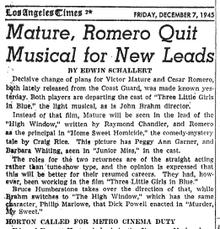
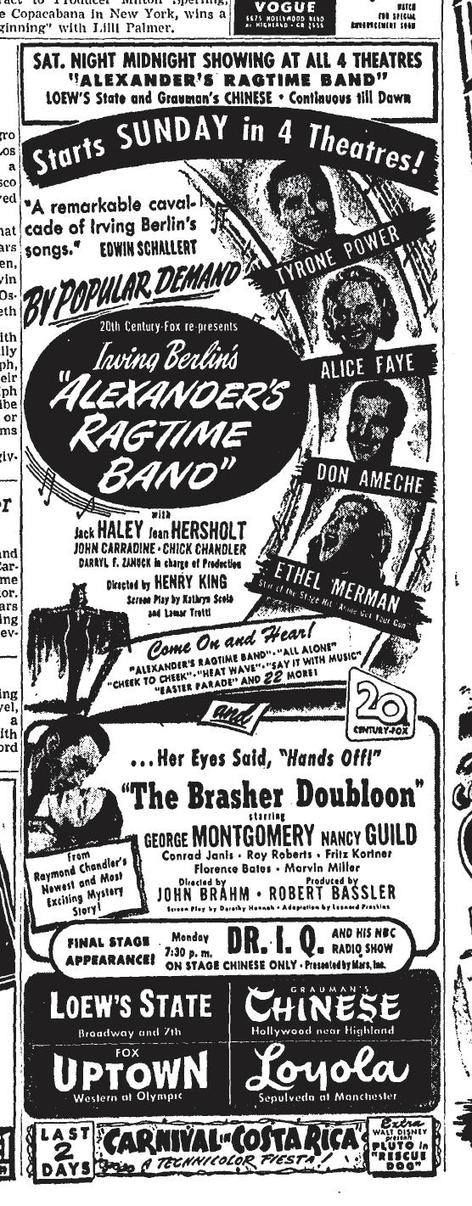
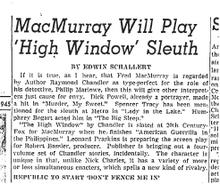
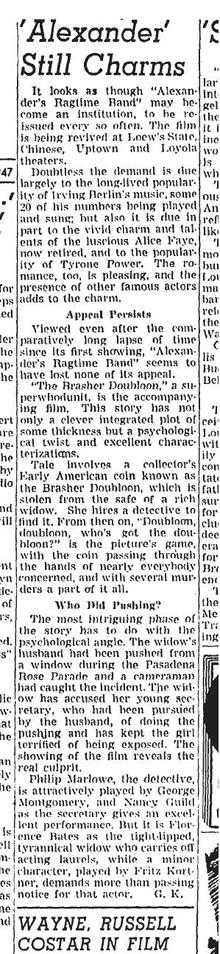
![]() As with “Farewell, My Lovely,” The Times evidently did not review Raymond Chandler’s third novel, “High Window.” When the movie was released as “The Brasher Doubloon,” it was the bottom half of a double bill with the 1938 film “Alexander’s Ragtime Band.” |
||
|
||
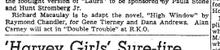
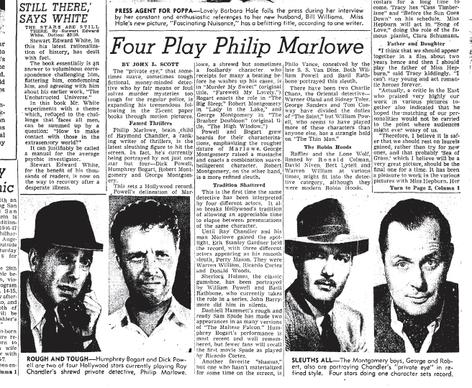
The Times, Aug. 11, 1946: Humphrey Bogart, Dick Powell, George Montgomery and Robert Montgomery all play Raymond Chandler’s Philip Marlowe. Note: To mark the 50th anniversary of Raymond Chandler’s death, the |
Cooking With the Junior League
|
Posted in Food and Drink
Comments Off on Cooking With the Junior League


Philip Marlowe will be played by Fred “