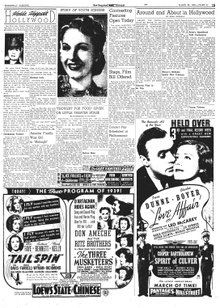
In the Theaters — March 30, 1983


1983_0330_movies  
Posted in Film, Hollywood | Comments Off on In the Theaters — March 30, 1983

Trouble Was His Business — Raymond Chandler

A historic passion

* Author Judith Freeman researched Raymond Chandler’s marriage.

November 07, 2007

By Graham Fuller, Special to The Times

Twenty years ago, Judith Freeman became "obsessed," as she puts it, with Raymond Chandler, whose novels featuring the private detective Philip Marlowe still make up the most iconic literary portrait of Los Angeles. When, in 2003, Freeman began writing "The Long Embrace: Raymond Chandler and the Woman He Loved," she found herself on a quest leading in many different directions.

The author of a short-story collection and four novels, Freeman was raised in Utah. She had moved to Los Angeles in the late ’70s and was living in one of Chandler’s old neighborhoods when she began reading his letters. She became captivated by Chandler’s wife Cissy. A fey, ethereally beautiful sophisticate with a past as a nude model in New York, Cissy was living with her second husband on South Vendome when she and Chandler met around 1913. Their affair began after he’d returned from the Great War, and they married in 1924. At the time, Chandler was 35 and thought his bride was 43. Only gradually did he learn she was 18 years his senior.

It was the absence of information in Chandler’s letters and Frank McShane’s 1976 biography that made Cissy an enigma in Freeman’s eyes and prompted her decision to "possibly bring her to life." As she tried to fathom the nature of the Chandlers’ 30-year marriage — which incorporated elements of courtly love and withstood his alcoholism, philandering, and her long decline into invalidism — she was confronted with the couple’s itinerant lifestyle.

They changed addresses over 30 times in Los Angeles and Southern California. They lived downtown and in Hollywood, in Santa Monica, Pacific Palisades, San Bernardino, Monrovia, Idyllwild and Cathedral City, in the mountains and the desert, sometimes changing residences twice a year. They were as restless as an alley cat on a velvet cushion.

Why they couldn’t stay put is a mystery that might have baffled Marlowe, at least temporarily. Without donning a trench coat, Freeman had a crack at solving it.

"I think Ray was constantly searching," she said, "but they also liked this idea of mobility, the fact that you could get a new car and go to Big Bear for the summers, to the desert for the winters, and if, you didn’t like it, to Santa Monica or Arcadia, Brentwood or Silver Lake. This possibility was introduced not just by the automobile, but by their sense of general detachment from any kind of past family."

Asked if she feels there was a neurotic element in the Chandlers’ nomadism, Freeman said "there is something deeply unsettled about it. In A.A. meetings they use the term ‘going geographic’ of an alcoholic personality to describe that idea of constantly moving, running, probably trying to escape and find at the same time."

"I don’t know if Chandler was running from something," said David Thomson, who wrote a monograph on Howard Hawks’ film of Chandler’s "The Big Sleep." "Maybe he was a kind of hotel writer — a little like Nabokov — in that he never had much need to be ‘at home.’ He had a hero who seems to live in a very plain room and waits to be invited out by fate. I think of him as someone who found his dream and so inhabited it as much as he could."

The Chandlers nearly parted in 1932 when Ray’s persistent drunkenness and workplace affairs cost him his executive job at Dabney Oil.

"This was the major disruption in his life," said Alain Silver, the coauthor of "Raymond Chandler’s Los Angeles." "His peripatetic lifestyle became more urgent. The simplest reason he was constantly moving was that the rent would go up. By the time he could support himself and Cissy with his writing, the moving had become a habit. It maintained the displacement he’d known as a youth." He and his mother had been abandoned by his father when he was 7.

The marriage was threatened again when Chandler was lured to Hollywood in 1943 to write "Double Indemnity" with Billy Wilder. But over the long course, Freeman said, husband and wife sustained each other. Freeman says Chandler was "very conscious" of his knightly code. "I think it was forcibly instilled in him at Dulwich College in England. Then Cissy gave him the wonderfully strange nickname of Gallibeoth" — redolent of Galahad– "when they were still having an affair. This was a persona he adopted and that she completely embraced and reaffirmed, 12 years before he wrote his first short story. She became the enabler of his vision of the private eye who functions as a rescuer of humanity."

Freeman asserts that Cissy provided Chandler with a haven from the corruption, vice and brutality he considered endemic to Los Angeles — and which fueled his finest writing. "They created this little island of civility within this wacky crackpot capital of the world, as Chandler called it. I think he must have been seduced by the city at first, but by the time he got through the studio system he was sick of it.

"There was a kind of banal quality to life that he detested, a lowbrow feeling, and he wanted to get out, and they did. But then, of course, he began to hate the place he found himself in, La Jolla, because of its Cadillac-and-chauffeur atmosphere. Like every other place he had run to, it wasn’t going to be the answer to anything, and he began to regret that he ever left L.A."

Freeman visited all of the Chandlers’ homes that were still standing. Particularly moving are her descriptions of Ray’s study and Cissy’s bedroom in their ocean-side house in La Jolla, where they lived from 1946 to 1954, when Cissy died.

It was there he wrote "The Long Goodbye," in which Marlowe’s isolation, echoing Chandler’s, becomes palpable. He rejects the humdrum existence of his hometown, Santa Rosa, and the decadence of the gated community in "Idle Valley." "I’ll take the big sordid dirty crooked city," he says. "A city no worse than others, a city rich and vigorous and full of pride, a city lost and beaten and full of emptiness."

Freeman’s passion for her material can be off-putting for some. Ben Tarnoff in the San Francisco Chronicle writes that she "spends too much time reflecting on her own encounter with the material to offer a vivid portrait of the Chandlers’ life together." But Richard Rayner, writing in The Times, sees her quest as more poignant, making the book "ache with emotion and loneliness — her loneliness and Chandler’s, the loneliness of following a trail, of a marriage, of writing itself."

Chandler died of pneumonia, brought on by his drinking, in La Jolla in 1959. A wanderer to the end, he spent his last years seemingly looking for another Cissy to protect — and to protect him.

"Their marriage gave him meaning and kept him together," Freeman said. "He romanticized it as almost perfect. But I do think they were happy."

Note: To mark the 50th anniversary of Raymond Chandler’s death, the Daily Mirror is revisiting some of The Times’ stories about his life and influence. We invite the Daily Mirror’s readers to share their thoughts.

Posted in books, Film, Hollywood, Raymond Chandler | 1 Comment

Voices — Maurice Jarre, 1924-2009


1962_1222_lawrence_of_arabia


Q & A MAURICE JARRE

Ode to David Lean

August 8, 1993

By SUSAN KING, TIMES STAFF WRITER


Oscar-winning
composer Maurice Jarre leads the Royal Philharmonic Orchestra in a
special salute to his frequent collaborator, the late director David
Lean, in "Great Performances: Lean by Jarre," premiering Monday on PBS.
Highlighting the hourlong concert are suites from "Lawrence of Arabia,"
"Dr. Zhivago"–including the famous "Lara’s Theme"–"Ryan’s Daughter"
and "A Passage to India." Recorded at London’s Barbican Hall, the
special features clips and behind-the-scenes footage from those classic
films.

Jarre, 69, had composed the music for more than 40 films,
including "The Longest Day," before he was hired by "Lawrence of
Arabia" producer Sam Spiegel to compose that film’s now-legendary score.

Lean,
who died in 1991 at age 83, encouraged Jarre in the use of electronic
and ethnic instruments in film music. Today, the French composer is
recognized as a pioneer in that field. Jarre has received 10 Academy
Award nominations and received Oscars for "Lawrence," "Zhivago" and
"India." His most recent screen credits include "Witness" and "Ghost."

Jarre discussed Lean and the art of film music with Times Staff Writer Susan King.

Was the tribute to Lean your idea?

Yes.
When he died I wanted to do a concert, a tribute to him, in London.
When we recorded "Passage to India" it was with the Royal Philharmonic
Orchestra in London. We decided to do this tribute to David Lean with
the orchestra. Exactly eight days before the concert somebody from a
video company said why not try to videotape this concert because it
will definitely be something we should have an account of. In one week,
they managed to organize the thing. I think everybody was very
concentrated, very professional. These musicians wanted to play better
than just for a normal concert. We did it for David.

You got very emotional at the conclusion.

Yeah,
because when I heard all of this applause, I knew that was not only for
the orchestra and me, but it was for David Lean. So at that point I
almost broke up. His work was really applauded as much as mine.

Is it true you had very little time to compose the music for "Lawrence of Arabia"?

It
was real panic time. I had six weeks to compose two hours of music and
record it. The problem was David was editing the second part of the
movie before the first part, so when I was doing the music I couldn’t
start the music in a chronological order. I had to start the second
part imagining what I was to do in the first part. That was really
another challenge. To make a working schedule perfect, I managed to
sleep every three hours for 10 minutes. I could go just days and nights
without stopping. After that, I had three or four months to recuperate
just sleeping and doing nothing.

I hope your schedule was easier with the other Lean films.

In
the first place, with "Lawrence of Arabia," I arrived at the end of the
picture. With "Dr. Zhivago," I was involved from the beginning and that
was much better. I read the book and the script. I went on location
with David. He was always insisting after "Lawrence of Arabia" for me
to be involved from the beginning and to go on location to have a
little flavor of the artist’s concept for the film. I went to Ireland
for three months for "Ryan’s Daughter" to work on the music there.
"Passage to India," unfortunately … I couldn’t go to India but I was
not too keen on going to India. I like to see India from photos and
films, but it’s not a country I am very interested to see because I
don’t feel comfortable in a tropical climate.

Do most directors you work with want you to go with them on location?

Sometimes
when you work for the first time with the director, the film is
finished and they decide to hire a composer. If I work with a director
more than once, the second time, if he likes what I did with the first
collaboration, he asks me to go on location with him. That’s what I did
sometimes with Peter Weir or Visconti or even John Huston. That’s much
better. When they ask you when the film is finished, you are confronted
with the problem that you have to digest the concept of the director
and the story in a few weeks. Sometimes they work on the film for two
years. How can you in a few weeks be on the same wavelength as the
director and the producer?

Music always seemed to play such an
important part in Lean’s films, even the ones you weren’t involved in
like "The Bridge on the River Kwai" and "Brief Encounter.

Absolutely.
Also with David, it was very interesting. When he was writing the
script with Robert Bolt or by himself, he always put the music cues in
the script. These notes about the music are extremely thorough and
precise. David Lean never had a big musical culture. He loved music and
had tremendous intuition about music, but he never really had musical
references like Visconti or Peter Weir. By the way, Peter Weir, I
think, has the largest spectrum of musical culture I have ever met in a
director. He knows very well classical music, modern music, electronic,
new wave, opera. It’s amazing.

What’s your favorite score you composed for a Lean movie?

Well,
sentimentally I think it’s "Lawrence of Arabia." I met David because of
that. I liked very much "Ryan’s Daughter" because we tried a lot of
little experiments in the sound, music and concept.


Posted in classical music, Film, Hollywood, Music, Obituaries | Comments Off on Voices — Maurice Jarre, 1924-2009

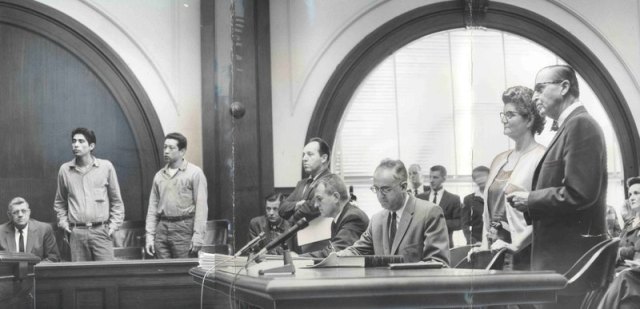
‘Ma’ Duncan

Photograph by John Malmin / Los Angeles Times
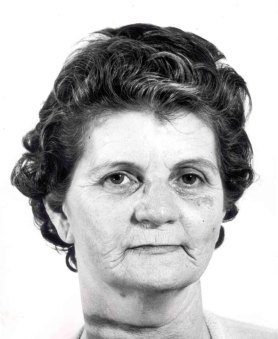
Defendants Augustine Baldonado, left, and Luis Moya stand during the arraignment of Elizabeth Ann Duncan, with attorney S. Ward Sullivan, in Ventura County.

By Catriona Lavery

Elizabeth Ann Duncan hired two men to kill her pregnant daughter-in-law, jealous that the young mother-to-be threatened her incestuous  relationship with her son Frank, 30. Duncan is one of four women executed in California’s gas chamber.

Olga Kupczyk Duncan disappeared in November 1958. She was seven months’ pregnant, 30 years old and newspapermen didn’t hesitate to call her attractive.

Elizabeth Duncan first drew suspicion when police discovered she had illegally obtained an
annulment for her son and his wife. Elizabeth Duncan and Ralph Winterstein, 25, hired by Duncan, secured the separation by posing as
the young couple in court.

Nearly a month after the woman’s disappearance, investigators found her body in the Casitas Pass of Carpinteria, Calif., after Augustine Baldonado, 25, confessed that he and Luis Moya, 22, had been offered $6,000 by the victim’s mother-in-law. The two men beat the young woman with a pistol, strangled her and buried her body in a shallow grave. Coroners investigations found that she was still alive when buried.

Elizabeth Duncan’s bizarre past and penchant for dramatics made the trial a sensation.

Inconsistencies abound

She had been married at least 11 times.

When cross-examined, she admitted to 10 marriages and said, “there might
have been an 11th…. I’m afraid to count the others: they didn’t mean that much to me.” At one point, prosecutors alleged she married 16 times. Duncan conned young men into marrying by telling them she needed a husband in order to inherit a great fortune, promising them a cut.

At first, Duncan maintained she had two children — Frank and a daughter,
Patricia, who died at 15. However, Duncan later admitted she had four other children — three daughters and a son. When Prosecutor Roy Gustafson asked if she loved Frank more than the others, she said yes.

An unnatural love

Despite being married, he still slept at his mother’s home. In his testimony, Frank Duncan proudly admitted he had lived with his mother almost his whole life. Their incestuous relationship and his mother’s subsequent jealousy became the basis of motive in the case.

Newspapers at the time approached the relationship cautiously. The Times only mentions the mother’s “overwhelming love” for her son. The Mirror News refers to an “unnatural love” between the two, but stopped short of calling it incest.

Elizabeth Duncan also admitted to planning to kidnap her son. “Frankie had just lost his mind over Olga,” she testified. “So I called my sister in Los Angeles and told her to rent an apartment for me. I was going to tie him up and take him down there to try to talk some sense into him. I didn’t want to lose Frankie. I couldn’t stand life alone and I knew it.”

The jury took just four hours and 51 minutes to find her guilty.

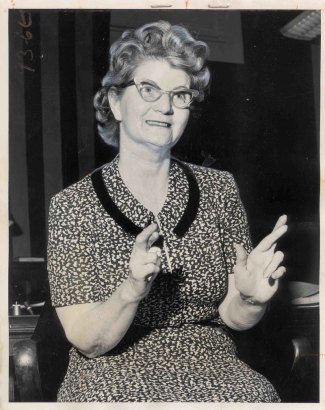
Elizabeth_duncan_1959_0114_crop_2

Photograph by the Los Angeles Times

Frank Duncan and his mother, Elizabeth Ann.

Her execution was delayed twice. Both times Duncan’s lawyers argued “sensational publicity” and other circumstances prevented their client from receiving a fair trial. In 1962, the court refused to hear another appeal.

Frank Duncan, also a lawyer, fought for his mother until the end. At the time of her execution, he was in San Francisco, pleading her case before the U.S. Court of Appeals. The court refused
to take action, and she was executed on August 8, 1962.

Ladies

Elizabeth Ann Duncan was the last of four women executed by gas chamber in California. The others were “the Dutchess” Ethel Juanita Spinelli (1941), Louise Peete (1947) and Barbara Graham (1955). Almost 200 men have died in the same way.

Peete offered one reason for the unrepresentative number. Just before her execution, Peete was convinced she would not die. She said, “The governor is a gentlemen — and no gentleman could sentence a lady to her death.”

Look through the recent columns of Paul Coates and Matt Weinstock for more articles about Elizabeth Ann Duncan.

Posted in #courts, Homicide | Comments Off on ‘Ma’ Duncan

New Light on ‘Dark Shadows’

1970_1028_dark_shadows


[Did we misspell Barnabas all the way through this story? Yes.–lrh]

Frid, Minus Fangs, to Read in O.C.

Performance: The actor has less than fond memories for his years as vampire Barnabus Collins on TV’s ‘Dark Shadows.’

October 26, 1991

By JESS BRAVIN, SPECIAL TO THE TIMES


Like
other artists weary of uncertain careers, Jonathan Frid was about to
cash in the actor’s life and become a teacher. Then the big break came
and spoiled his plans.

In 1967, the Yale-trained Frid, a
sometime Shakespearean who had toured public schools performing the
Lincoln-Douglas debates, won the part of Barnabus Collins, a courtly
vampire on the ABC-TV daytime serial "Dark Shadows." The soap opera
with gothic overtones would run through 1971, spawn two feature-length
movies and a small marketing phenomenon and also earn Frid a footnote
in the annals of popular culture.

1968_0811_dark_shadows
Frid, who never cared for
horror movies as a child (he recalls sneaking off to see matinees of
musicals) would forevermore share Barnabus’ curse: Like the vampire who
spent 175 self-hating years sucking blood, Frid would find his career
kept alive by a predicament he hates.

"Everywhere I go," sighs Frid, now 66, "I get a few morons who expect to see the vampire."

And,
Halloween notwithstanding, he warns that those who expect to see the
vampire tonight will be sorely disappointed when Frid, sans fangs,
appears at Yorba Linda’s Forum Theatre to read a set of short stories
under the somewhat cumbersome title of "Jonathan Frid’s
Fridiculousness."

The program, which Frid describes as "readers
theater," leans heavily on wits from the first half of the 20th
Century, including Robert Benchley, Dorothy Parker and Groucho Marx. He
adds a few items by writers known for somewhat heavier work–Somerset
Maugham and Robert Frost–as well as a couple of modern pieces,
including one by illustrator and humorist Gahan Wilson. "Jonathan
Frid’s Fridiculousness" also contains a few items by its eponymous
performer: a humorous genealogy of his name titled "Freaks, Frights and
Fridians," and a set examining the frustrations of modern telephone
usage.

As a seasonal courtesy, Frid does plan to end each half
of the program with a story drawn from what might be called genre
fiction. "Here There Be Tygers" by Stephen King concludes the first
act, and "The Tell-Tale Heart" by Edgar Allan Poe wraps up the show.

1970_0503_dark_shadows01
"It is," Frid allows, "what’s expected of me."

Frid,
a native of Canada, insists that recent years spent on tour with his
one-man act "have been the happiest time of my life in show business"
but that, inevitably, he finds himself recalling the "Dark Shadows"
that defined his career.

And recalling the program’s
hallmarks–turgid dialogue, shoddy production values and metaphysical
mumbo jumbo–Frid is less than charitable.

"It was just garbage,
just preposterous; even for its day, it was awful," he says. "All of
us, and especially the vampire, would be given these long, convoluted
sentences that go on forever. It was a show that tried to be different,
but most of the time it fell flat on its face.

"Some people try
to apologize for it, saying that’s how television was done in the ’60s.
Well, there was a lot of brilliant television in those days, and we
weren’t a part of it, I’m afraid."

The program’s success–and the continuing fascination that Barnabus holds for thousands of fans–befuddles Frid.

"I
guess there was something vulnerable about the character, if you accept
the idiotic premise of coming out of a coffin after 175 years. It must
have been the vulnerability–I was so humiliated all the time, maybe
there was a bit of humility in my work."

But roles for
ex-vampires were few after the series was canceled in 1971, so Frid
began the odyssey that eventually would lead him to Yorba Linda.

Through
the 1970s, Frid won an occasional small film role, but he largely
remained out of public sight. Unable to shake his "Dark Shadows"
lineage, he finally consented–in exchange for room, board and air fare
to Los Angeles–to attend one of the innumerable conventions staged for
fans of the program.

"They’re a strange lot," he said of the
fans. "I feel like a Martian when I’m among them. Let’s face it: Most
of the people who work in this world, the haves and the achievers,
don’t watch soap operas."

Nevertheless, Frid said he enjoyed the
free travel and so continued to attend "Dark Shadows" conventions
through the 1980s. Tired of answering the same questions over and again
at these events, Frid proposed instead to present readings. First, his
programs consisted entirely of poetry written by "Dark Shadows" fans.

1970_0503_dark_shadows02
"Most
of it’s not very good," he said, "but some of it, at least, wasn’t bad.
They were mostly romantic things based on Barnabus the lovable vampire,
the romantic antihero, you know, the longing and yearning of this man
who was condemned by this curse, the longing and yearning, the longing
and the yearning," Frid says. "Please don’t ask me to repeat any of it."

After
Frid was cast in a 1986 New York revival of "Arsenic and Old Lace," he
regained enough stature to book himself outside of "Dark Shadows"
conventions. Juggling several programs, he now offers different
versions of his readers theater, based on humor, horror or Shakespeare,
playing mainly at schools, colleges and corporate functions.

Frid
finds himself in particular demand this time of year. A New York
foundation engaged him to read a horror story at one of its public
events, and MCI, the long-distance company, hired him to read a
three-minute condensation of "The Legend of Sleepy Hollow" as part of a
Halloween promotion.

Still, Frid recalls a 1963 tour of Pittsburgh’s
inner-city schools as the highlight of his career. "We put on the
Lincoln-Douglas debates in every classroom," he says. "The kids were
poor, and they were tough, but by God they were sharp. It was the most
thrilling thing I’ve ever done."

So then, has Frid given any thought to picking up his long-delayed ambition to be a teacher?

"Well,
I’m almost 70," he says. The former vampire adds without a hint of
irony: "I’m getting a little long in the tooth for that."

Lengthening ‘Shadows’

* The gothic
soap opera is long gone from network TV but not forgotten. As the
series finds new fans in reruns, a festival to celebrate it opens
Friday.

July 6, 2000

By SUSAN KING, TIMES STAFF WRITER

1967_0109_dark_shadows
"Dark Shadows" has seemingly endured about as long as its most beloved character, the 175-year-old vampire Barnabas Collins.

Well,
maybe not that long. But the daytime gothic soap opera, which premiered
on ABC on June 27, 1966, and continued until 1971, simply won’t die. In
fact, the show has found new blood in reruns–first in syndication,
then on PBS and now on the Sci-Fi Channel.

This weekend, an
estimated 5,000 fans are expected to attend the annual "Dark Shadows"
Festival, to be held Friday through Sunday at the Los Angeles Airport
Marriott Hotel.

Among the original series actors scheduled to
appear are David Selby, Lara Parker, Kathryn Leigh Scott, John Karlen,
Nancy Barrett and Mitchell Ryan.

The festivals attract all age
groups, says Parker, who played Angelique. "We have lots and lots of
new fans," she says. "There are people who show up who name their
children Angelique. There are people who have been coming back for 20
years, and they all know each other. For them it’s a real pastime. It’s
based on ‘Dark Shadows,’ but they all know each other and enjoy being
together."

New generations have access to the 30-year-old
program, with all 1,225 episodes available on MPI home video. The
series’ creator, Dan Curtis of "The Winds of War" fame, is even
preparing a stage musical based on the series, and the second "Dark
Shadows" feature film, 1971’s "Night of Dark Shadows," is slated to be
restored.

"Sometimes fans wait for an hour and half just to say
hello," Parker says of the autograph-signing sessions. "They give us
presents. They talk about their experiences and what it meant to them
to be watching the show as teenagers and how much the characters meant
to them. Sometimes it’s quite touching."

"We take it pretty serious," says Scott, who played Josette. "’We raise tons of money for charity."

Though
they played enemies on the series, Scott and Parker are the best of
friends. In fact, the cast is closer now than when they did the series.
"We were young and we were very career-oriented," Scott says. "One of
the reasons why we love going is because there are all of these new
fans who keep coming to the show because of cable. What they are really
interested in is what we are doing now. It would be stultifying if we
went to one of these things and we were lost in some retro world. It
would be horrible."

Scott formed her own publishing company,
Pomegranate Press Ltd., 15 years ago when she wrote her first book, "My
Scrapbook Memories of Dark Shadows." She’s published 43 books,
including five "Dark Shadows" tomes. Her latest, "Dark Shadows Almanac:
The Millennium Edition," which she co-wrote with Jim Pierson, is
currently in stores. And Parker is writing her third "Dark Shadows"
novel for HarperCollins.

"We have all had careers and, actually, acting careers that have gone on gratifyingly long," Scott says.

About
20 cast members, says Scott, normally show up at the festivals.
Jonathan Frid, who played Barnabas and once complained about his
identification with the character, is noticeably absent. "Jonathan
hasn’t come in the last couple of years," Scott says. "He’s been
touring with his one-man show and he lives in Canada. He’ll return.
Others come in from wherever–we get them all."

Scott and Parker say their feelings toward the "Dark Shadows" cult following have changed over the years.

"It
was my first job, and so my feeling was onward and upward" after the
show was canceled, Parker says. "I came to Hollywood feeling extremely
confident that I had done five years on a very successful series. Of
course, I said, ‘I’m putting this all behind me. I am never even going
to think about this show again. I’m going to get on with my life and
become a famous movie star.’ "

Though she never achieved that
stardom, Parker says "Dark Shadows" never "stood in my way at all. I
got to play an awful lot of roles on TV, but I never got another big
series. It just turned out that the thing that gave me the greatest
number of opportunities was ‘Dark Shadows.’ I have come to appreciate
it."

Scott believes she’s put her finger on the enduring appeal
of "Dark Shadows," which premiered the same year as another cult
sensation, "Star Trek."

"It’s always my feeling that ["Star Trek" creator] Gene Roddenberry was a genius like Dan Curtis," she says.

"Gene
Roddenberry went ahead in time, and we went back in time. Both of the
series borrowed liberally from the great classics–from Melville to
Henry James to the Bible. They told universal morality tales. They are
the kind of stories told around the campfire, the kind of stories
children adore and the stories that adults gravitate to."

http://www.darkshadowsfestival.com

Posted in broadcasting, Film, Hollywood, Television | 4 Comments

In the Theaters — March 29, 1980


1980_0329_movies
Posted in Film, Hollywood | Comments Off on In the Theaters — March 29, 1980

Trouble Was His Business — Raymond Chandler


Two true loves

* The Long Embrace Raymond Chandler and the Woman He Loved Judith Freeman Pantheon: 354 pp., $25.95

November 04, 2007

By
Richard Rayner, Richard Rayner’s new book, "The Associates: Four
Capitalists Who Created California," is due out in January. His column
Paperback Writers appears monthly at latimes.com/books.

"I used
to like this town. A long time ago. There were trees along Wilshire
Boulevard. Beverly Hills was a country town. Westwood was bare hills
and lots offering at eleven hundred dollars and no takers. Hollywood
was a bunch of frame houses on the inter-urban line," Raymond Chandler
wrote, in the voice of his detective hero, Philip Marlowe, in 1949.
"Los Angeles was just a big dry sunny place with ugly homes and no
style, but good-hearted and peaceful. It had the climate they yap about
now. People used to sleep out on porches. Little groups who thought
they were intellectual used to call it the Athens of America."

Chandler
first came to Los Angeles in 1912, a time so distant in the city’s
history as to seem almost unreal. The population had only just climbed
above 300,000. L.A. was still shaking from the dynamiting of The Times
by the McNamara brothers, and Clarence Darrow was on trial for alleged
bribery. William Mulholland’s titanic aqueduct was incomplete and no
water had as yet come from the Owens River Valley. Speedy, efficient
streetcars connected downtown with the recently incorporated city of
Hollywood and the distant beach towns. Chandler himself belonged to a
little intellectual group, the Optimists, formed by his friend Warren
Lloyd and meeting weekly at Lloyd’s house on South Bonnie Brae Street.
Music was played, poetry declaimed, literature and philosophy discussed.

At
one of these soirees, Chandler first met Julian Pascal, a concert
pianist and music professor, and Pascal’s wife, Cissy. "Sexy and
experienced, witty and confident, she was everything a young man could
want in an older woman," writes Judith Freeman in "The Long Embrace:
Raymond Chandler and the Woman He Loved." "He was sexually repressed
and shy, inexperienced with women. Little wonder he found her
irresistible."

And irresistible she was. "Cissy was a raging
beauty, a strawberry blonde with skin I used to love to touch,"
Chandler would say later. "I don’t know how I ever managed to get her."
It took awhile: Cissy, twice-married, a former New York model who liked
to do housework in the nude, kept him at arm’s length at first.

Chandler
enlisted in a Canadian regiment and went off to fight in World War I,
in no small part, Freeman argues, "because he found himself in the
untenable position of being in love with another man’s wife." He came
back, or was drawn back, to Los Angeles in 1919. After much argument
and discussion, Julian Pascal agreed to bow out of the picture, but
Cissy and Chandler didn’t marry until 1924, when Chandler’s mother —
with whom he’d been living — died at last from an agonizing cancer.
Only then, or a little later, did Chandler learn that Cissy was not
eight years older than him, as he’d thought, but eighteen. He was 35,
and he’d married a woman of 53.

"All this is the stuff of
passion and novels," noted Patricia Highsmith, whose first book,
"Strangers on a Train," Chandler would help adapt for the 1951
Hitchcock movie of the same name. "But little of the formidable
emotional material that Chandler had at his disposal actually found its
way into his writing."

That’s not quite true. All his life,
Chandler was a divided soul. He was an American, born in Chicago in
1888, yet he grew up mostly in England and received an education at
snooty Dulwich College. He longed to live freely yet had a strict moral
code. He was too troubled ever to be truly happy, and too inhibited and
mannerly to be a freely autobiographical writer.

And yet, this
worked for him, in its own way. His heightened sense of his own
pleasures and dismays passed into how he caught the atmosphere and
moods of L.A. His marriage to Cissy endured, and Los Angeles became a
metaphor for the torture and disappointment he sometimes felt.

"The
Long Embrace" is an exploration of these two relationships — Ray and
Cissy, Chandler and L.A. It is a beautiful and original book, in which
Freeman becomes a double detective, telling the story of this strange
yet loving marriage while also tracking down and visiting everywhere
that the Chandlers lived in Southern California. That’s no small task
because Chandler needed movement like he needed air to breathe. "I kept
the long list of Chandler addresses taped to the wall next to my desk
where I could see it every day: Bonnie Brae Angels Flight Bunker Hill
Loma Drive Vendome Catalina Stewart Leeward Longwood Gramercy
Meadowbrook . . ." writes Freeman. "The list read like a plainsong of
wandering, the liturgy of a long search for a home."

Freeman
sits in bars and drinks gimlets, because Chandler claimed a gimlet
"beat a martini hollow." She waits outside apartment buildings in the
rain and sun. She spends months visiting UCLA’s Special Collections and
the Bodleian in Oxford, going through the Chandler archives. "I felt I
was becoming a bit strange to myself," she tells us. Her quest turns
into an obsession, and "The Long Embrace" starts to ache with emotion
and loneliness — her loneliness and Chandler’s, the loneliness of
following a trail, of a marriage, of writing itself.

Chandler is
so much a part of the furniture that we tend to forget how great he is.
The plots of "The Big Sleep," "Farewell, My Lovely" and "The High
Window" are swift and workably complex, but they didn’t bring much that
was new to the crime story, even in their own time. He despised the
lazy arrogance of wealth and power but lacked the rigor with which
Dashiell Hammett viewed social and political corruption.

No,
Chandler was a romantic, more like F. Scott Fitzgerald than the worldly
Hammett, and through the character of Marlowe he became a haunting poet
of place, this place, Los Angeles, whose split personality of light and
dark mirrored Chandler’s own. He caught the glaring sun, the glittering
swimming pools, the cigar-stinking lobbies of seedy hotels, the
improbable mansions, the dismal apartment buildings, the sound of tires
on asphalt and gravel, the sparkling air of the city after rain and how
the fog smells at the beach at night.

Frank MacShane published
the standard Chandler biography more than 30 years ago, and until now,
no other book has made us view this great American writer afresh. "The
Long Embrace" does. "To take care of Cissy. That was his driving life
force," Freeman writes. Chandler worked in the oil business for Cissy,
and he turned himself into a crime writer for his wife, while feeling
he never "wrote a book worthy of dedicating to her." Through booze, he
rebelled against this bondage but never really wanted to break free.
Freeman speculates, plausibly, that Chandler might have longed for men.
"In ‘The Big Sleep,’ " she writes (she means "The Long Goodbye"),
"there’s simply no question Marlowe had loved Terry Lennox — he moons
after him."

Freeman traces the ups and downs of the marriage and
career with utmost delicacy. We spend time with Billy Wilder and John
Houseman, although "The Long Embrace" offers much more than a mere
retelling. Spurred by Chandler’s restlessness, Freeman writes about
L.A. with a tender precision and yearning that borders on the
religious. "I headed out Sunset Boulevard, past Hollywood High School
and the cheap divey hotels with the leggy hookers out front, past the
Chateau Marmont, where Belushi died of an overdose and the gargantuan
billboards loom over the strip, the Marlboro man and his horse like
gods high in the sky," she notes, describing a drive oceanward. "The
farther you travel the more the air begins to change and become infused
with a marine freshness. A mist develops. A faint fog appears, shot
through with sunshine. A hazy light that says you’re almost to the
beach. You smell the coast long before you see it. You sense you’re
coming to the end of the land."

That’s lovely, a haunting homage
to a man whose own end was bleak. After Cissy died, Chandler burned her
letters, perhaps wishing to keep her to himself forever. He was lost,
and age dumped its garbage on him. He made an unsuccessful suicide
attempt and embarrassed himself with younger women.

"[H]e became
unmoored — some might say unhinged," writes Freeman, who finds herself
repeating again and again variants of the sad phrase: "He began
drinking again." In "The Long Embrace," though, magic has occurred.
Freeman’s identification with her subject is so complete we feel we’re
there with Chandler too. We even believe her when she enters his dying
mind, saying: "I always was a man without a home. . . . Still am."

Note: To mark the 50th anniversary of Raymond Chandler’s death, the
Daily Mirror is revisiting some of The Times’ stories about his life and
influence. We invite the Daily Mirror’s readers to share their thoughts.

Posted in books, Film, Hollywood, Raymond Chandler, Real Estate | Comments Off on Trouble Was His Business — Raymond Chandler

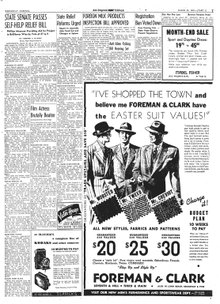
Actress Near Death After Beating; Gehrig in Decline, March 29, 1939

Dewitt Clinton Cook, who admitted attacking actress Delia Bogard, was executed Jan. 31, 1941, in the fatal beating of Anya Sosoyeva.  Bogard died in 1995 in Los Angeles at the age of 74.

Ouch! A Duesenberg Model J sedan for $395 ($5,839.47 USD 2007), the same price as a 1936 Ford deluxe sedan.

At left, Assemblyman Ralph Dills (D-Compton) reads a news article to legislators stating that drinking cow’s milk gives children lower voices–“more like a calf’s than a human’s.”


W.C. Fields blows his lines on Dick Powell’s radio show!

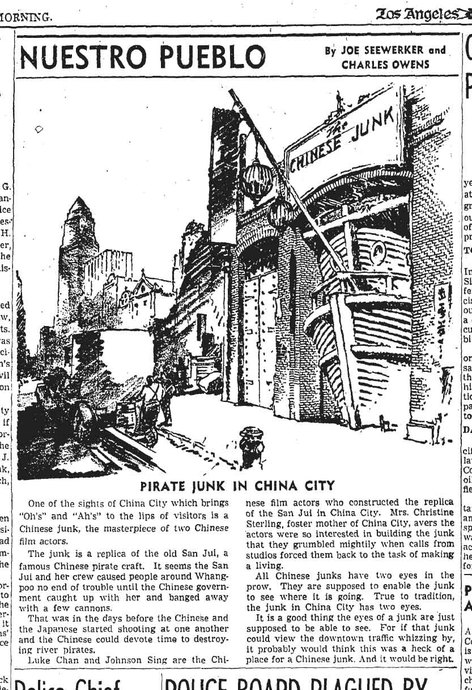
“Apple Mary,” the precursor of “Mary Worth,” drawn by Martha Orr.
Lou Gehrig’s decline was becoming evident, although the cause was still unknown.

The Times ran a wire story from Florida that polled writers covering the Yankees about Gehrig’s status and how it might affect the team’s chances. A few days earlier, the paper had published the news that Gehrig was benched in a spring training game, out of the Yankees’ lineup for the first time since 1925.

“Gehrig has looked pitifully rusty” in spring training, the Associated Press story said.

The story about the writers was tacky, even considering that no one knew the severity of Gehrig’s condition. “I don’t think Gehrig has much to do with the Yankees winning. I don’t think he helped them an awful lot last year,” said Rud Rennie of the New York Herald Tribune.

Gehrig’s consecutive games streak would finally end in May when he pulled himself out of the lineup. “The consecutive game record always was meaningless to me and now that I have ended it you newspaper guys will believe me,” he said. Asked about his return, Gehrig said he hoped
“the arrival of warm weather will enable me to hit my stride.”

— Keith Thursby

Posted in #courts, Comics, Film, Front Pages, Hollywood, Homicide, LAPD, Nuestro Pueblo, Sports | Comments Off on Actress Near Death After Beating; Gehrig in Decline, March 29, 1939

Found on EBay — 1905 Performance of ‘Parsifal’

1905_opera_usher_ebay

Listed on EBay: An usher’s ribbon from the 1905 performances of "Parsifal" in Los Angeles. Bidding starts at $9.99.

1905_0418_parsifal

The 1905 performance of "Parsifal" was such a significant event that The Times published the names of what appears to be everyone who attended. The performance by Conreid’s Metropolitan Grand Opera had most of the Met’s opening night cast, including conductor Alfred Hertz and Alois Burgstaller (Parsifal). 

1905_0418_parsifal_02

Posted in #opera, classical music, Music | Comments Off on Found on EBay — 1905 Performance of ‘Parsifal’

Matt Weinstock — March 28, 1959


No Martians — Yet

Matt_weinstockdAll
right, relax, everyone. You too, Mary Louise. Those cryptic numerals
and markings on streets and sidewalks were not made by slithering
invaders from another planet plotting our destruction.

Perhaps
you too have seen them. Some are long, yellow-painted arrows on streets
with mysterious numbers and letters plus signs on them. A logical
interpretation of the uninformed is that the houses to which they point
are in for it, when the little green men take over.

Then there
are the white markings on sidewalks, usually at corners. Things like 3
AB 3:00 followed by 3 A 2:40 and so on in a lessening scale as are
visible near Audubon Junior High and 37th Street Elementary School

1959_0328_comics
WELL,
they’re
simply designations for proposed work on sewers, storm drains, gas,
water and power lines. Some are survey markings by the city engineering
department for upcoming street resurfacing. It seems there’s more to it
than burning off the top, dumping a load of macadam and letting a
mechanical roller smooth it out. First there has to be what is known as
a profile survey designating the existing elevations.

Next question.

::


EITHER SOMEONE
lowered the chinning crossbar on a Beverly Hills school playground or Bill Ritzi,
deputy D.A., was riding too tall in the saddle. Anyway, he crashed into
it while riding his English bicycle and suffered a broken nose, a bad
gash on the forehead and some loosened teeth.

His doctor, stitching his face, asked what happened.

"I wrote my bicycle into a bar," Bill answered.

1959_0328_gordo"I don’t smell liquor on your breath," the doc said.

So Bill, who doesn’t drink, explained.

::

ADDITIONAL HOLIDAY

We always celebrate Easter twice,
The first time, of course, on Sunday.
The second time we hunt for eggs
Is after we tally up on Monday.

–JUNE ROSS DRUMMOND

::

Miles Davis and John Coltrane,
April 1959


OCCASIONALLY another
slice of music comes along that adds to the already imposing repertoire
of proof that modern jazz is not a meaningless cacophony, as the
unconvinced contend.

The familiar names in creative jazz are Ellington, Kenton, Basie. More recent ones are Brubeck, Hamilton, Shearing, Hefti, Rugolo
and the Mulligan-Baker groups — again to tap the surface. Not long ago
there was Gil Evans’ LP "New Bottle, Old Wine." The other night I heard
"Miles Ahead" with Miles Davis, also arranged by Gil Evans, and went
ecstatic over numbers titled "Maids of Cadiz" "Lament" and "The Duke."

Ask your favorite disc jockey to play them. Maybe he won’t, but ask him anyway. They’re great.

::


IT IS
a
well-established fact that those who live by the telephone shall die by
the telephone, so to speak, which is a prelude to an exchange between a
lady named Harriett and her husband on his return home from the office.

1959_0328_abby
"What kind of day did you have?" she asked.

"The phone
murdered me all day," he said. "I had four
He’s-away-from-his-desk-for-a-few-minutes and three
He-just-stepped-outs."

::


FOOTNOTES —
Penciled
scrawl on a piece of brown paper bag: "Whose picture you using now? One
day the guy smirks over his left shoulder, the next day he smirks over
his right shoulder. When you going to let him smirk down the middle?
Why don’t you use your own picture? The one you took the day you had
the terrible toothache? Three Cushion Mac." You can’t win them all …
Isn’t it awful about the terrible weather the Vero Beach Dodgers are having down there? … All anyone can say is what the others are saying, that George Stevens’ "Diary of Anne
Frank" is a magnificent accomplishment, combining devastating impact
with restraint. Incidentally, a woman who lived through a similar
ordeal had nightmares after seeing it. 

Posted in Columnists, Matt Weinstock | 1 Comment

Paul Coates — Confidential File, March 28, 1959


Confidential File

Mash Notes and Comments

Paul_coates(Press Release) "Americans are too modest!

"Branded as braggarts by the rest of the world, we nevertheless suffer from a highly sensitized cultural inferiority complex.

"We
consider ourselves peerless in science, technology and industrial
know-how, but when it comes to art forms and culture, we meekly take a
back seat to the Old World.

"Let’s stop underselling ourselves.
Let’s realize that we, too, have names to be proud of–names like
Gilbert Stuart, John Singleton Copley, Thomas Sully, JamesMcNeill
Whistler, Winslow Homer, Charles M. Russell and Frederic Remington.
They prove that American art is second to none, and that we can be as
elated about our pictorial representations as the Europeans are about
theirs."

1959_0328_mirror_cover
"Our committee was formed to bring these facts home to
Americans everywhere. We emphasize Western Americana because too many
pseudo-intellectuals tend to frown upon this great art form as mere
‘cowboys and Indians.’ " (signed Committee for the Restoration of
American Western Art, New York City.

–If you haven’t played it, don’t knock it.

::

"Dear Paul,

"The
other night on the ‘Bob Hope Show’ Julie London did a sketch with Hope
during which she kept calling him ‘Adam.’ Unfortunately this has had
serious repercussions for a member of one of our client’s family.

"How
can this be? you are probably asking yourself. Well, Paul, actress
Jewell Lain has a giant (135 pounds) French poodle named Adam. He was
dozing peacefully in the bedroom that fatal evening of the Hope show
when, suddenly, his ears perked up at the melodic call of Miss London
calling "Oh, Adam’ (which was really to Hope on the TV screen).

1959_0328_news_quiz
"The
dog thought it was his owner calling him so he trotted into the living
room only to find her engrossed in the program and paying no attention
to him at all. So he went back to the bedroom.

"Again came the
plaintive call of Julie London, ‘Oh, Adam.’ so the animal trotted
happily into the living room expecting to find his mistress anxious to
see him. But, alas, he was sadly disappointed.

"Two more times
it happened and on each occasion the disillusioned poodle sulkily
returned to the bedroom. When the program was finally over and Jewell
did call him he wouldn’t come. To this very day he won’t respond to her
call." (signed) Dodge, Heigh & Associates, Beverly Hills.

–Neither will I. but one call from Julie London and I’d bark

::

"Dear Mr. Coates,

"Welcome
to the Low Cholesterol Club! Oh, I’m not going to rub it in, the fat, I
mean. I just want to say it isn’t as bad as all that.

"It may
take a while to get used to no butter on the bread and you’ll die when
you smell the restaurant odors. But you’ll get over it and feel better.
Oh, well,Pollyanna, get it over with.

"I just wanted you to
take this to your wife and tell her that veal is low in fat and when it
or chicken are cooked down in a little wine it is pretty darned good.

"Anyway,
Paul, if you can stand it, yogurt makes a wonderful dressing on salad
(spiked up for variations) and we have learned to prefer a piece of
toast slathered with yogurt over a thin film of jelly. You see, we
voluntarily cut out cholesterol foods because I adore my husband and I
wish to keep him for as long as possible.

"I’m sure your wife feels the same way." (signed) Lenore Nicholson, Hollywood.

–About your husband?

Posted in Columnists, Paul Coates | Comments Off on Paul Coates — Confidential File, March 28, 1959

In the Theaters — March 28, 1978


1978_0328_movies  
Posted in Film, Hollywood | 1 Comment

Trouble Was His Business — Raymond Chandler


Tour Casts New Light on Raymond Chandler’s Old L.A.

* A Minnesota couple trace the steps of the novelist’s best-known character.

April 4, 2004

By Erika Hayasaki, Times Staff Writer

Bonnie
Olson stood in the lobby of the Oviatt Building on Olive Street
downtown on Saturday, beneath the ceilings adorned with triangular
glass, and read a passage from the Raymond Chandler novel "The Lady in
the Lake," in which he described this very setting.

"The
sidewalk in front of it had been built of black and white rubber
blocks. They were taking them up now to give to the government, and a
hatless pale man with a face like a building superintendent was
watching the work and looking as if it were breaking his heart," she
read, explaining that the structure was called the Treloar Building in
the book.

"The images he’s able to evoke of Los Angeles and the
past are powerful, maybe more powerful than actually seeing it in
reality," said Olson, who led eight people on a walking tour of
settings for Chandler’s books.

Olson and her husband, Brian,
were in town — from Minnesota of all places — to lead tours based on
their new guide, "Tailing Philip Marlowe."

The self-published
guide, available at Caravan Books on Grand Avenue, points out sites
mentioned in Chandler’s books, whose best-known character was private
detective Philip Marlowe.

Olson said she admires Chandler’s work
because of his poignant storytelling, language and dialogue. He is
studied along with great poets, writers and essayists, she said. Many
consider him to be one of Los Angeles’ quintessential writers, who
weaved real places, people and events into his fiction, a strength that
inspired fellow mystery writer Ross MacDonald to write: "Chandler wrote
like a slumming angel and invested the sun-blinded streets of Los
Angeles with a romantic presence."

For several decades, Olson,
an English teacher, and her husband, who works for the city of
Minneapolis, have been enchanted by Chandler’s descriptions of Los
Angeles, like the steps of City Hall, where Marlowe lighted a cigarette
as the cold wind blew in "Trouble Is My Business." Then there was the
Bradbury Building on South Broadway about which Chandler wrote: "The
dark narrow lobby was as dirty as a chicken yard" in "The High Window,"
in which the structure was called the Belfont Building.

The 2
1/2-hour tour began at the Oviatt Building and continued toward the Los
Angeles Public Library, which Chandler mentioned in "The Long Goodbye."

The
group headed to Bunker Hill, stopping at the top of the mothballed
Angels Flight cable trolley, which Chandler described in "The High
Window."

The group hiked to the 2nd Street tunnel, which
Chandler compared to the barrel of a gun in "The Big Sleep": "The
muzzle of the Luger looked like the mouth of the Second Street tunnel."

When
the couple visited Los Angeles three years ago, they wanted to explore
places mentioned in the novels, which captured the city in the 1930s
and ’40s. But they said they could not find a guide. So they returned
home and combed through all of Chandler’s stories, flagging
descriptions of settings with Post-it notes.

Then the Olsons
visited Los Angeles again, searching for the sites, and spent hours in
the library researching the city’s architectural history.

The
couple put together the 112-page guidebook with the help of family
members and a printer in Fargo, N.D., thinking they could use the books
as Christmas gifts.

"We did it to have fun together," Bonnie Olson said. "We had no idea it was going to be such a niche."

Australian
native Heath Ryan, 32, a fan of Chandler’s book "Playback," moved to
Los Angeles three years ago. He said he already had an idea of what the
city was like from Chandler’s descriptions.

"You get here and feel almost familiar with this place, even though you have never been here," Ryan said.

Ray Chin, 32, a downtown resident, said Chandler’s work has helped him understand how the city has evolved.

"It
isn’t so much the images of the city," Chin said. "It’s the historical
knowledge he gives about the city. It’s fascinating to see all of the
changes."

On Saturday, those on the tour hiked up to Bunker
Hill, where they rested on rows of marble benches in a courtyard
overlooking a pond, surrounded by towering skyscrapers. The outdoor
cafe tables were mostly empty, and a hair salon was closed. Beneath the
courtyard, homeless men and women slept on the grass, and the stairs
smelled like urine.

Many years ago, Chandler described the
setting, in "The High Window," like this: "Bunker is old town, lost
town, shabby town, crook town…. Out of the apartment houses come
women who should be young but have faces like stale beer; men with
pulled-down hats and quick eyes that look the street over behind the
cupped hand that shield the match flame; worn intellectuals with
cigarette coughs and no money in the bank; fly cops with granite faces
and unwavering eyes; cokies and coke peddlers."

Olson read that
passage and her husband explained that this was the neighborhood where
Marlowe found a dead body in an apartment.

"It was a romantic
time, a different time," Ryan said. "There were no freeways. It was the
center of the city. Now it feels a bit dead."

Note: To mark the 50th anniversary of Raymond Chandler’s death, the
Daily Mirror is revisiting some of The Times’ stories about his life and
influence. We invite the Daily Mirror’s readers to share their thoughts.

Posted in books, Downtown, Film, Hollywood, Raymond Chandler | 1 Comment

Dodgers Give Angels the Silent Treatment, March 28, 1969

1969_0328_dodgers

The Dodgers and Angels were playing each other again and at least the Angels were doing their best to rebuild the rivalry.

"Peter O’Malley has instructed all his personnel not to say anything
about the Angels. That’s the word I get. They’re apparently afraid of
something." The Times’ Ross Newhan attributed the quote to a former
Dodger now working for the Angels. There were four possibilities:
general manager Dick Walsh, director of player personnel Lefty
Phillips, scout Kenny Myers and minor league manager Norm Sherry.

The teams last played each other in 1964, when the Angels were still
tenants of Dodger Stadium. The Angels had won the last five games in a
row.

On the record, Walsh said the Angels could talk about their
opponents: "This organization believes in free speech." It’s hard to
believe that The Times couldn’t find a Dodger willing to say something,
anything, to balance the Angel camp. Where was Tom Lasorda?

— Keith Thursby

Posted in Dodgers, Sports | 1 Comment

Lemuel S. Ellis — Early Los Angeles Photographer

1902_0627_dead_photog

Daily Mirror readers may recall from one of the posts on "Spring Street Revisited" the sad story of early Los Angeles photographer Lemuel S. Ellis, left, who died in 1902. 

I recently heard from EBay vendor Tiffany Hadley of Columbia, Ky., who has listed six photos by Ellis. The photos are listed separately with bidding starting at $9.95. Let me make it perfectly clear that I have nothing to gain in any of the EBay items I feature. The point is always to draw attention to bits of Los Angeles history changing hands in the world’s biggest flea market. As with any EBay item, people should investigate an item and the vendor’s rating before submitting a bid.

Main_street_lemuel_ellis_ebay_02

Photograph by Lemuel S. Ellis

This is an adobe home on what appears to be Carr Lane. A notation says it’s on Broadway, although Carr and North Broadway don’t intersect on my earliest map.

Figueroa_lemuel_ellis_ebay_02

Photograph by Lemuel S. Ellis

This is a home somewhere on Figueroa, according to a notation on the back.

Flints_home_lemuel_ellis_ebay_02

Photograph by Lemuel S. Ellis

A notation identifies this as "Flint’s Home." This could be Thomas Flint Jr., a California legislator from Hollister.

Posted in Architecture | Comments Off on Lemuel S. Ellis — Early Los Angeles Photographer

Found on EBay — Elvis Presley

Elvis_pin_ebay02

This isn’t just any Elvis pin. According to the EBay vendor, this was purchased during Elvis Presley’s appearances at the Pan-Pacific Auditorium. Although the dealer gives the concert date of 1958 (when Presley was actually inducted into the Army) the notorious performances were in 1957. Bidding starts at $25.
Posted in Music, Rock 'n' Roll | Comments Off on Found on EBay — Elvis Presley

Matt Weinstock — March 27, 1959


The Scene Changes

Matt_weinstockdNot so
long ago a group of young ladies who worked in the same downtown office
met regularly for dinner at Lindy’s restaurant on Wilshire Boulevard.

These
were gay, informal occasions, relished by all, and even after some of
the girls quit their jobs or got married they continued to gather
there, less frequently, of course, for gossip.

Then their changing lives fanned them out from San Marino to Pacific Palisades to Torrance and they met only rarely.

A
reunion was planned recently and in high spirits and anticipation, with
compasses and watches synchronized, they converged on Lindy’s.

IN DISMAY and confusion, Pat Parks of Torrance reports, they discovered Lindy’s was closed two years ago and demolished a year ago.

1959_0327_blue_streak"In a way," Pat says, "we felt responsible."

This,
of course, is the history of Los Angeles. You not only can’t go home
again, you also can’t even recognize the street it used to be on.

::


TODAY’S

provocative thought concerns a well-known phrase, "In the background of
every successful man stands a woman." It was used, incidentally, when
Mamie Eisenhower was given an honorary doctorate of laws recently by an
eastern college. A heckler in the audience asks, "Who stands in the
background of every unsuccessful man, every criminal, alcoholic and
dope addict?"

These hecklers, always asking embarrassing questions, have got to go.

::

HEAD START

If cleanliness is next to godliness
As I’ve heard some people state,
With atom bombs clean
And clean gasoline
I’m a cinch for that Pearly Gate.

–JEFFREY RIMMER

::


1959_0327_mirror_comics
AFTER
A momentary qualm, Elsie Cordingley, a secretary, thinks the internal revenuers have a wonderful sense of humor.

The
way she added and subtracted in making out her Form 1040 she determined
Uncle Sam owed her $117. But she recently received a card advising her
she had made an error in her tax return. Naturally she had ominous
thoughts. The other day she received her refund check — for $124.

::


A MAN WHO
has a Volkswagen and wanted another has run into a curious situation At the VW
agency he was told there was a six-month waiting list. But some other
dealers, agents for American cars, offer immediate delivery on them —
at a $300 to $500 markup. So he wrote the factory asking an explanation.

He received an immediate reply from K.L. Barths, head of Volkswagenverks, Wolfsburg,
Germany, describing what he called "a sorry condition." The factory is
turning out 2,300 cars a day, he stated, but through circumstances
beyond anyone’s control many of them fall into unauthorized hands. Any other statement about the situation, Herr Barths added, was "mere volklore."

::


1959_0327_abby
ASIDE TO
Hal Humphrey: We’re there, pal. Heard a lady exclaim, "Did you see the so-and-so show on TV last night? The commercials were wonderful!"

::


AT RANDOM —
Overheard by Jim Mahoney
in the traffic fines building: "I guess I’m just arrest-prone!" …
Traffic baffler: A uniformed sailor was driving a green Army car on the
Hollywood Freeway … Julia Nye heard a man in a Hollywood restaurant
say, "What good will it do to send that Duncan woman to San Quentin?
She’ll just marry Caryl Chessman and collect his royalties" … Easter
bunny note: About a dozen jack rabbits were chawing at the weeds a few
yards from the thundering airliners at International Airport … Jack
Price’s appraisal of a delicate situation: The nicest part of flagpole sittin’ is the quittin’.   

Posted in Columnists, Matt Weinstock | Comments Off on Matt Weinstock — March 27, 1959

Paul Coates — Confidential File, March 27, 1959


Confidential File

A Depressing Story Brightens Up a Bit

Paul_coatesYesterday I told you a rather depressing story.

One of its central characters had coldly refused to display any concern for the lives of two young children.

I surveyed the facts with a cynical eye of a newspaperman and concluded that there could be no happy ending.

The two kids had been bitten by a dog.

They
faced the extremely painful and dangerous Pasteur treatment as a
precaution against rabies because, as their father told me, the woman
who owned the dog had spirited it away.

No dog, no quarantine.
And without adequate examination over a period of days, the Animal
Regulation Department obviously had no way of knowing if the dog were
infected.

1959_0327_mintz
To be on the safe side, the kids were scheduled for Pasteur shots.

As I said, I could see no happy ending.

But plagued as I am by cynicism, I had overlooked one very important fact.

There are still some pretty decent people in this city.

Two of them stepped in to rewrite the story’s conclusion.

I don’t know one of them. She remains an anonymous voice on a telephone. But it was she who pinpointed the dog’s whereabouts.

I do know the identity of the other. He is deputy City Atty. Sam Palmer.

And he’s a guy who can get fighting mad.

That’s what he did yesterday when he heard the father’s story.

"It was a case of the general welfare being threatened by the malicious act of one person," he told me.

Palmer
picked up his phone. He called the people who had the dog and got them
to agree to cooperate with the Animal Regulation Department. The animal
was quarantined.

Then the young city prosecutor dispatched a
letter to the woman who disposed of the dog, asking her to be in his
office next Thursday for a hearing.

At that time, Palmer
promised, he will consider filing a misdemeanor complaint against her
charging six separate violations of the law.

"The trouble is,"
Palmer explained, "the laws involved in a case of this kind don’t
contain the kind of teeth they might. But I think this woman, if
guilty, should answer to society in some way.

"I," he added, "have a kid, too.

"It’s
inconceivable to me that anyone would refuse to help when a youngster
is threatened with anything as painful as the Pasteur treatment."

Dog Bite Law Is Specific

Palmer
called to my attention an obscure city ordinance which requires a pet
owner to take positive action in protecting the victim of a bite. The
law says:

"Should a dog or any other animal bite a person … it
shall be the duty of the owner … immediately to notify this
department (health) and surrender said animal to said department."

Palmer
conceded that the ordinance doesn’t allow law enforcement officers much
latitude in investigating animal bite cases when the person who owns
the offending pet refuses to cooperate.

"You can’t," he pointed out, "go around busting down people’s doors."

And, of course, you can’t.

But, if you’re a public official, you don’t have to throw up your hands in frustration in a case like this.

Sam Palmer didn’t.

And I hope he set a precedent.

Posted in Animals, Columnists, Paul Coates | Comments Off on Paul Coates — Confidential File, March 27, 1959

In the Theaters — March 27, 1976


1976_0327_movies  
Posted in Film, Hollywood | 1 Comment

Aaron Spelling and His Mansion


https://i0.wp.com/latimesblogs.latimes.com/photos/uncategorized/2009/03/27/spelling.jpg
Photograph by Mark Terrill / Associated Press

The Spelling mansion in 1993.


The Daily Mirror revisits the story of Aaron Spelling and his Holmby Hills mansion, which is for sale.

HE’S MADE TV WHAT IT IS TODAY

* Aaron Spelling is the most prolific producer in the history of
prime-time TV. Why doesn’t he just relax and retire to Fantasy Island?

September 8, 1996

For the Record
September 29, 1996

   Editor’s note: In the story about Aaron Spelling, The Times did not
mean to imply that he engaged in illegal activity to obtain his wealth,
and The Times apologizes if anyone inferred that he was engaged in
illegal activity.

By Hilary de Vries, Hilary de Vries’ last article for the magazine was a profile of Jodie Foster

On
May 21, Aaron Spelling, vice chairman of Spelling Entertainment Group
Inc., prepared for the company’s annual stockholders’ meeting. A man of
few but precise rituals, Spelling traded in his customary casual attire
and reluctantly put on a white shirt and dove-gray silk suit. He
lunched in his office–the meal served on a silver tray, as usual, by a
uniformed butler–and afterward was driven from the company
headquarters on Wilshire Boulevard west to the Regent Beverly Wilshire
Hotel.

Ever since he took his company public in
1986–solidifying his reputation, if not his reality, as one of
Hollywood’s wealthiest, most enigmatic citizens–Spelling has dreaded
these meetings. A shy, reclusive man, he has never overcome his
distaste for rubbing shoulders with strangers. As much as he loves
producing television–and he does love it again, now that "Beverly
Hills, 90210" and "Melrose Place" have restored some of the luster from
Spelling’s heyday with "Charlie’s Angels," "Fantasy Island" and
"Dynasty"–he prefers to leave the business side to others: Lee Gabler,
his agent; E. Duke Vincent, his producing partner, and Sumner Redstone,
chairman of Viacom, Spelling’s parent company since 1994.

Hillside District Residents Oppose Mansion

Construction: Three houses would be razed to build a 41,000-square-foot home on Tower Road for an anonymous owner.

August 2, 1992

By G. JEANETTE AVENT, SPECIAL TO THE TIMES

BEVERLY
HILLS — Some of Beverly Hills’ usually publicity-shy stars came out
and joined their neighbors this week to protest the building of a
luxurious 59,000-square-foot estate.

Actor Jack Lemmon, former
Hollywood gossip maven Rona Barrett, real estate investor-developer
Stuart Ketchum, a spokesman for MCA President Sidney J. Sheinberg and
about 40 other residents of the city’s exclusive Hillside district sat
patiently during the two-hour public hearing Wednesday, waiting to
express their opposition to the proposed project.

The project
calls for demolition of three homes on the four-acre site at 1146 Tower
Road. Built in their place would be a 41,000-square-foot, two-story,
10-bedroom residence with a basement, copper roof and stone columns in
a neoclassical style. The structure would include a gymnasium, grand
ballroom, cinema, library, wine storage area, china vault and elevators.

Plans
include a guardhouse with six bedrooms for staff, a five-bedroom guest
villa, a tennis court, pool and covered parking for 25 vehicles.
Construction on the buildings, which total 59,000 square feet of floor
space, is set to start in May.

The residence would be almost
seven times as large as the average 6,000-square-foot home in Beverly
Hills–and more than 25 times the size of a standard 1,600-square-foot,
three-bedroom Los Angeles tract house.

Hillside resident Jack
Lemmon, speaking before an emotional and sometimes raucous crowd
opposed to the project, said: "We’re not just talking about a huge
edifice. We’re talking about Mt. Etna.

"Aaron Spelling’s house is like a pimple on the landscape compared to this house."

Spelling’s house, built on six acres in Holmby Hills, is 56,500 square feet. It took nearly five years to complete.

Lemmon said the trend toward building large houses "is turning this city into a rich man’s ghetto."

Other
residents raised concerns about the length and effects of the
construction: noise, dust and workers parking along narrow Tower Road.
Some worried about increased traffic to the house after it is completed.

Lesly
Shelton, whose family has lived on Tower Road since 1945, told the
board that the quality of life that drew residents to Beverly Hills is
being destroyed. "We’re killing the goose that laid the golden egg,"
she said.

Much of the audience’s consternation focused on the
question of who owns the property. The application identified the owner
as Quantieme Establishment.

Lawyer Murray Fischer, the owner’s
representative, said Quantieme Establishment is a foreign corporation
owned by an individual who lives in London and has maintained a
residence in Beverly Hills for 13 years.

Beverly Hills real
estate broker John Bruce Nelson said Thursday that he negotiated the
purchase of the three properties for London resident Robert Manoukian
for $9 million in 1988.

Manoukian has represented the Sultan of
Brunei in various real estate acquisitions and negotiated the sale of
the Beverly Hills Hotel to the sultan, Nelson said. The sultan is
reported to be the wealthiest person in the world. Brunei is a small,
oil-rich, predominantly Muslim country on the island of Borneo.

Manoukian is a resident of London and has two other homes in Beverly Hills, Nelson said.

After
the meeting before the Environmental Review Board, Fischer declined to
further identify the owner, citing security concerns. He stated
emphatically that the individual was not the Sultan of Brunei.

However,
a well-placed real estate source specializing in large estates told The
Times on Thursday that the estate and the home to be built on it are
intended for the sultan.

Fischer and the owner’s lawyer,
Terrence Everett, and architect, Robert Earl, sought to allay
neighbors’ concerns about the home.

Fischer said that there is a
current perception that big is automatically bad but that during the
1930s, ’40s and ’50s large estate properties were the norm.

The
property was consolidated into one lot when Quantieme Establishment
purchased the three adjacent lots in 1988 for slightly more than $9
million. Although individual owners could have bought the lots and
built one substantial home on each lot, Fischer said, the current owner
intends to build a park-like setting.

Contrary to public
speculation, Everett said there will be no pounding of piles for the
foundation, and 300 cubic yards of dirt will be trucked in–about 30 to
60 truckloads, depending on the size of the truck.

Responding to
concerns about workers parking on the narrow street, Everett said
construction workers will park on the premises or be shuttled from
another location.

Fischer said estimates call for the residence to be built in two years.

The
board, which determines whether projects require an environmental
impact report, will reopen the hearing for further public testimony at
2 p.m. Aug. 24. The project will be reviewed by the city Planning
Commission.

Noting the marked differences between the owner and
the property’s neighbors, commission Chairman Richard Putnam instructed
the groups to appoint representatives to try to resolve some of those
differences before the Aug. 24 meeting.

"Have
you ever seen anything more boring?" Spelling groused, as he paused in
the hotel foyer to watch the stockholders shuffle into the Champagne
Suite. "I mean, my God, I’m even wearing a tie."

This year,
Spelling had more reason than ever to feel uneasy as he stood shielded
from the crowd by his PR people and his beefy, unsmiling security staff
just steps away. He was now 73, and while he had shaved his workweek
from five to four days, an inner ear infection left him feeling his age
more acutely. "It was the damnedest thing," he grumbled about his
convalescence. "I couldn’t write, couldn’t watch TV, so boring."

But
Spelling had more than age on his mind. For the past nine months,
Spelling Entertainment had been up for sale. Viacom’s hefty $1
billion-plus sticker price, however, had kept buyers at bay. No offer
had materialized–only a lot of speculative tire-kicking and skeptical
press. The stories infuriated Spelling–one of the few Hollywood
producers ever to have taken his company public–and resulted in the
embarrassing withdrawal of the sale. Now he was in the awkward position
of publicly defending the company he no longer owned but which still
bore his name. "The truth

is, the company has grown and grown,"
Spelling said later in his office. "I have this stupid worry that
shareholders bought stock because of me, people who pay my salary. But
the stock price? That bothers the hell out of me."

Spelling’s
reservations aside, when the meeting got underway, it was clear that
defensiveness would not be necessary. Despite some mutterings,
shareholders nodded happily to news of Spelling’s renewed two-year
contract and the announcement that the new season’s program orders
would top 400 hours. As Spelling smilingly explained from the dais:
"That is more hours than in any year of our history." He has, as it
turns out, another hit on his hands. By meeting’s end, the gnomish,
snowy-haired producer is besieged by shareholders anxious to pump the
hand of the man Redstone expansively introduced as, "a man who needs no
introduction, my very good friend and an unparalleled voice in
entertainment."

*

Creating the impression of being a
peerless force in television may be Spelling’s canniest move–cleverer
even than his much-noted comeback after the cancellation of "Dynasty"
in 1989 put an end to his 18-year reign at ABC, once known as Aaron’s
Broadcasting Company. Beginning with Fox’s "Beverly Hills, 90210" in
1990 and "Melrose Place" two years later, and now supplying series and
movies to three of the four major networks as well as the fledgling WB,
Spelling has pulled off the kind of career second act seldom seen in
Hollywood.

Television is littered with the names of the once
powerful: from the legendary Norman Lear and Grant Tinker to more
recent casualties like Linda Bloodworth-Thomason and Diane English. For
one brief season, 1989-90, Spelling too looked like a dinosaur: all of
his hit series, including "Dynasty," were in ABC’s dumper; an unrenewed
contract; persona non grata at affiliates’ meetings. It was more than
personal failure. It was, as Variety made clear, the end of an era when
beautiful people in beautiful clothes in exotic locales were enough to
earn a berth in the Nielsen Top Ten.

But then, just as abruptly,
Spelling was back. "Beverly Hills, 90210" and "Melrose Place" were more
than hit series; they were, in TV’s meretricious way, history in the
making–the first dramas to win the elusive and coveted Gen-X viewer.
The "King of the Jiggle" had reinvented himself for a new generation.

"Aaron
came back because, like all truly talented people, he has the ability
to reinvent himself," observes Don Ohlmeyer, NBC West Coast president
and a former ABC executive.

"Spelling may not have the quality
of [Steven] Bochco, but he has proven he can get the younger
demographic," adds Chris Neel, an analyst with Media Edge, a New
York-based research company. "So he became hot again everywhere."

Yet
Spelling’s talent, evident this afternoon as he spins dross into gold
before his shareholders’ eyes, lies in producing more than hit series.
It is the ability to sustain the illusion of a single defining vision
over 40 years of broadcasting–making the efforts of hundreds,
specifically his various creative partners, seem the masterwork of one
man. If most of his 50-plus series fade to forgettable with astonishing
ease–think of "T. J. Hooker" and "Starsky and Hutch"–taken
collectively they can be read as a pop cultural history of late
20th-century America.

From the black-and-white "Dick Powell’s
Zane Grey Theater" in the 1950s to the cheesecake "Charlie’s Angels,"
created with Leonard Goldberg in the 1970s, to glitzy "Dynasty,"
created with Esther and Richard Shapiro in the ’80s, to the glossy
twentysomethings created by Darren Star on "90210" and "Melrose Place,"
Spelling not only kept pace with the Zeitgeist, but he became a master
at giving the public the image of itself it most wanted to see.

For
most of us, that meant Southern California, albeit a glossier version.
Even when their casts of nubile young actors populated other fantastic
corners of America, Spelling’s series captured the market on Southern
California decadence and made it one of Hollywood’s most popular
exports. Even a non-Spelling show like "Baywatch" owes its
international mega-hit status to the buffed facade of his California.

"Aaron has a legendary instinct for what the public wants to see," says producer and former Spelling partner Douglas Cramer.

"It’s
more than storytelling; there’s a look that Aaron gets with his shows,"
adds Jamie Kellner, head of the WB Television Network, home of
Spelling’s "Savannah." "It’s the glamour, the fashion, the detail that
audiences, especially women, love."

Yet the irony remains. Not
Spelling’s comeback itself–the 1996-97 season is filled with rebound
ratings winners Bill Cosby, Ted Danson and Michael J. Fox–but that it
happened in an industry so ambivalent about his legacy. More than any
other producer, Spelling shaped television and our responses to it. But
because his image has been that of a panderer–despite his critically
acclaimed series "Family," and his two Emmy award-winning movies "And
the Band Played On" and "Day One"–many in Hollywood came to think less
of the medium of which he was a master. Spelling’s success defined TV’s
second-class citizenship in the heart of the film industry, and his
lack of hypocrisy–he has called his series "mind candy"–remains an
affront to Hollywood’s pious conviction that it creates art rather than
kitsch.

"It’s that huge elite snobbery between television and
film," says director Joel Schumacher, a close friend of Spelling’s. "I
actually have acquaintances who say to me, ‘Joel, why are you friends
of the Spellings?’ I mean, eat s- – -. I would hate to have lived
through this era of Hollywood without knowing Aaron Spelling."

Spelling’s
position in Hollywood is such that his resume, (at 3,000 episodes, the
Guinness Book of Records lists him as the most prolific producer in
history), his wealth (estimated at $310 million in 1994), his
Hearst-sized house (56,000 square feet), even his family (wife Candy
and children Tori and Randy) bear a whiff of the unseemly, the
suggestion that his gains have been ill-gotten. "He lives like a pasha
while foisting that garbage on the American people," grouses one
television producer, daring to voice, albeit anonymously, a common
industry view.

"There is good and there is bad Spelling," says
Tom Shales, the Washington Post’s Pulitzer Prize-winning TV critic.
"But there is never great Spelling, only degrees of terribleness."

Spelling
has many powerful defenders, but even he does not dispute that he has
many more detractors. "I don’t think I’ll ever get their respect," he
shrugs. He is keenly aware that his longevity has as much to do with
fundamental changes in broadcasting–the establishment of the Fox
network, the growth of cable and foreign markets among them–as his own
talents. But that disdain explains why Spelling is something of a
recluse, why he keeps his Emmy awards in his home bowling alley rather
than his office, why he chooses his few friends with such care–chief
among them MCA head Lew Wasserman, Bill Haber, his former agent at CAA,
and now Sumner Redstone–and why he continues to look to the public as
the ultimate arbiter of his worth. Spelling was once, briefly, an
actor, and it is still the audience that he craves. As he characterizes
it even now, "The worst time in my life was when ‘Dynasty’ was canceled
and Variety ran that headline ‘Aaron Spelling’s Dynasty is Dead,’ " he
says in his gravelly voice. "And there were no quotation marks around
‘Dynasty.’ "

*

It is the third week in may, a few days
before memorial day but high noon in the television industry–when
ratings sweeps coincide with annual network announcements of fall
schedules. On the face of it, Spelling would seem to be one of the
losers. In the past few days, he has learned that two series have been
canceled: Fox’s "Kindred: The Embraced" and NBC’s "Malibu Shores" the
latter a much-hyped clone of "90210." And neither of his pilots, "Wolf
Pack," a detective drama for CBS, and "Bullet Hearts," a cop show for
Fox, have made the schedule. With "Savannah" his only hit since
"Melrose Place"–and even that series, together with "90210," has
slipped in the ratings–Spelling’s reentry into prime time appears to
be stalled.

"Spelling still has no real network penetration,"
says Betsy Frank, a TV analyst with Zenith Media. "He remains most
successful developing programming for young, youth-oriented networks
like Fox and the WB."

But here in his office, five floors above
Wilshire Boulevard, laconically puffing on his pipe, Spelling is far
from downbeat. "Dick Powell, my first mentor, taught me one thing: that
the only positive in our business is the negative," he says, smoke
wreathing his massive suite, the size of which, someone once said,
equals "the average 7-Eleven." "And Dick was saying that when there
were only three networks, before cable, before all of it. Look, today I
got a check for ‘The Love Boat.’ Do you know how old ‘Love Boat’ is?
Candy found a channel where it was on five days a week, and another
where it was on six days a week. I thought we were being ripped off,
but then we got this seven-figure check, and I don’t mean a small
seven-figure check."

Ever since taking his company public,
becoming, like Dick Clark, one of the few producers able to turn a
string of hit series into its own source of capital, Spelling has known
that successful television is more than hit ratings and prime-time
lineups. He recognizes what the networks and studios have long
known–that TV is software, able to generate streams of revenue far
beyond a single night’s airing. In that light, the Spelling company’s
lineup is nothing short of a smash–8,000 hours domestic and 18,000
hours internationally. With new orders for 400 hours this season–"7th
Heaven," a family drama for WB, and "Sunset Beach," on NBC, Spelling’s
first daytime soap–the syndication pipeline will be primed again,
generating what Sumner Redstone characterizes as "millions of dollars
in the next year alone."

"Spelling," confirms Jessica Reif, a Merrill Lynch media analyst, "is a cash cow."

As
a holding company, Spelling Entertainment Group Inc. also has
programming from Worldvision–the company’s in-house distributorship
once owned by ABC–as well as Republic Pictures, a vast library of
pre-1974 NBC series as well as such films as "It’s a Wonderful Life"
and "Basic Instinct." But Spelling’s shows, a total of 3,000 episodes,
are big, consistent earners. "Beverly Hills, 90210" plays in 90
countries. "Melrose Place" is shown in 80, not including domestic
syndication that began on the E! channel in August. Even a series like
"Models Inc.," a failed "Melrose Place" spinoff, continues to sell in
France. As John Ryan, president of Worldvision, puts it: "With
Spelling, broadcasters know they are buying a brand name."

Sitting
here with his pipe and his signature "My Favorite Martian" haircut,
Spelling looks as distinctive as a logo. When he speaks, leaning
forward to knock the ashes from his pipe, his voice is raspy, heavy
with smoke and the leavings of his hard Texas twang. It’s a sharp
contrast to his non-cowboy-sized frame; his frail thinness is not quite
disguised by his billowy nylon warmup suit.

Spelling points out
that he has always been slight. As a child, the story goes–the
youngest of five children of Pearl and David Spelling, Russian and
Polish Jewish immigrants who settled in Dallas during the early part of
the century–he had a nervous breakdown and spent a year in bed. As an
actor during his early years in Hollywood, he played villains and
losers in TV Westerns like "Gunsmoke." "I mean, I weighed all of 118
pounds and had these big eyes," he recalls. "I think I played every
kind of dipsomaniac, sex maniac there was."

It’s one reason that
he made the transition into producing. "I was very comfortable," he
rasps, "because a producer is not in front of the camera." Now, fame
has eroded that anonymity. "I don’t know what it is, but Candy and I
can’t go anywhere. I can’t even take the elevator in my medical
building without a doctor asking me for my autograph."

That
anything should intrude on Spelling’s life now seems a violation of the
first order. He has refused to fly since his Air Force years. With the
exception of an annual trip to Las Vegas to indulge Candy’s passion for
gambling, Spelling doesn’t travel. If he goes anywhere, it is by train
or chauffeur-driven limousine and almost always with an armed guard. He
lives with two 24-hour guards at home, the kind of shuttered existence
where even his children have to sign in and out. "We’ve had letters and
threats," Spelling explains. "They’re aimed at me, but saying the
horrible things they would do to Tori and Randy."

He divides his
time between his massive house in Holmby Hills, the site of the former
Bing Crosby estate, where no working journalist has yet crossed the
threshold–"I’m sorry about that," he says–and his office, where he
works late, editing a script into the early evening while the butler
shuttles in and out with cut-glass tumblers. "Aaron can seem frail, but
in business he is far from frail," says Redstone. "I know if I call his
office at 7 in the evening, he is always there."

It is why
Spelling’s work environment is less an executive suite than a den. One
wall is punctuated by a row of oil paintings, landscapes mostly–"I
have no idea what they are," Spelling says absently–but the rest of
the decor is family room circa 1968: photographs of Candy, Tori and
Randy on a side table, an enormous fish tank built into the wall over
one of the sofas, and a pinball machine Candy had custom-made one
Christmas that pumps out the theme music of "The Love Boat" and
"Dynasty" interspersed with family greetings: "I love you, Daddy . . .
. I love you, honey." Spelling laughs as he flicks off the machine.
"The company that makes these usually does them in batches of 1,500,
but Candy got him to make just two."

One comes to realize, if
one spends any time with Spelling, that a certain lack of irony colors
his outlook–his views about television, children, his marriage–and
nowhere is it more evident than in his attitudes toward wealth. Like
all those stories about Candy clipping coupons and Tori furnishing her
Wilshire Boulevard condo with flea market finds, Spelling has his own
ticks. "Candy and I both like to fish when we’re out at our little–and
I do mean little–house at the beach," he says. "If we catch anything,
the cook does it up and we give it to our Hispanic maid. I get a great
pleasure knowing she doesn’t have to buy dinner that night."

It
is what colleagues have learned to call "Aaron’s Jesus complex," says
one former employee. "It’s contrived, but not phony." Like the time
Spelling bundled Tori and Randy into his limo and drove across the
Mexican border to show them real poverty. Like how Spelling regrets
that his mother, the wife of a tailor, died before seeing his house,
the one with 123 rooms, the bowling alley and the fish pond. "I’d give
anything for my mother to see the house now," he says. "She’d say,
‘What, you rented this for the day? Come on, you don’t have to impress
me.’ I swear to you, that’s exactly what she’d say."

It is the
same belief system Spelling brings to television. "Aaron really
believes he’s performing a service with his shows," says a former
colleague, "that he is giving people an escape from the misery of their
lives." And Spelling does not disagree: "We never know what
entertainment does, how it affects people, but I bet if you went down
the street and asked people–not in Beverly Hills–but ethnic groups,
who can’t afford to go to the theater, can’t even afford HBO, ‘What
does television mean in your life?’ you’d be shocked at the answer." *

While
the common theory of Spelling’s fascination with glitz dates from his
own background–"born in a house in Dallas that cost $6,000 with
wall-to-wall people and one bathroom," a story like many he recounts in
his autobiography, "A Prime-Time Life" –there certainly seems to have
been a business argument to such a view. From his first hit series in
1963, "Burke’s Law," which starred Gene Barry as the debonair
millionaire detective Amos Burke, to "Charlie’s Angels," "The Love
Boat," "Fantasy Island" and even his lesser hits, "Hart to Hart,"
"Hotel," and "90210," where a ZIP Code is the ultimate status symbol,
money has been the dominant theme. "What Aaron does really well," says
WB’s Jamie Kellner, "is that whole wealthy-family thing." Adds Joel
Schumacher, who directed Spelling’s "2000 Malibu Road," "Aaron knows we
like to watch rich people fight with each other."

The premise,
evident in some form in almost all Spelling’s series, reached its
height with "Dynasty" in 1981. A rip-off of "Dallas," the prime-time
soap starred John Forsythe, Joan Collins and Linda Evans as wealthy
Coloradans who swapped spouses and mineral rights with abandon.
Although "Charlie’s Angels" remains Spelling’s biggest hit, "Dynasty"
more perfectly captured its decade. In its nine-year run, it made Joan
Collins a star, made costume designer Nolan Miller a household name and
helped power ABC from last to first in the ratings, capping Spelling’s
domination at the network. "People used to say ‘Dynasty’ would never
work," Spelling laughs. "But I know people want to watch rich people
deal with problems that money can’t solve; they want to laugh at the
rich and say, ‘Yeah, you deserve it, you rich mother; yeah, you people
are really sick.’ "

But as the ’80s waned, "Dynasty" began
slipping in the ratings, especially when ABC was faced with NBC’s new
powerhouse lineup headed by "The Cosby Show" and "Cheers." ABC had
acquired a new owner, Capital Cities, and TV as a whole was entering a
new era. Serial drama, Spelling’s forte and the staple of the networks
for more than a decade, was losing ground to the sitcom, whose rebirth
NBC was the first to exploit with "Cheers." And Spelling’s campy
sensibilities were being supplanted by gritty, quirky realism that
began with Steven Bochco’s "Hill Street Blues" and concluded with
Edward Zwick and Marshall Herskovitz’s "thirtysomething" and even David
Lynch’s "Twin Peaks." In 1989, two years after "The Colbys," the
"Dynasty" spinoff, failed, Brandon Stoddard, then ABC’s entertainment
president, pulled the plug on Spelling. "It was probably the low point
of our lives," recalls producing partner Duke Vincent. "In 18 months
we’d had seven shows on the air, and within a year they were canceled.
The new regime wanted to take the network in a totally different
direction, but it proved a bit shortsighted in the long run, because
within two years we did ‘90210.’ "

The arrival of "Beverly
Hills, 90210" in the nation’s cultural landscape has, in its six years,
acquired the stature of myth: the series launched creator Darren Star
("Central Park West"), relaunched Spelling as a producer, indirectly
led to the revival of Heather Locklear’s career (on the "90210"
spinoff, "Melrose Place") and made Tori Spelling (Donna on "90210") a
celebrity. It also cemented the reputation of Fox as a viable network,
what Chairman Peter Cher- nin calls "a very significant development in
the history of Fox." In reality, the series had a far more prosaic,
even happenstance beginning. "We’d been thinking about doing a
continuous drama set in high school for some time," says Kellner, at
the time a Fox programming executive. "And we had this young writer,
Darren Star, but our fear was that it would skew too young, so we
brought in Aaron."

Although a series about a group of wealthy,
status-conscious students at a fictitious Beverly Hills high school was
not an obvious Spelling vehicle, it did allow him to address some
social issues for the first time since his critically acclaimed series
"Family." "While you’re all having fun with ‘90210,’ " he says, "there
are a lot of issues we’ve tackled."

Whatever the merits of
"90210," however, they were not evident during the first six episodes.
Like most dramas, the series took weeks for its audience to build, a
scenario that was repeated two years later with "Melrose Place." Yet
with all the talk about Spelling’s comeback, the fact remains that the
series succeeded on Fox and not one of the three major networks.

"Drama
is what Aaron does best, but dramas are tricky for networks today
because they take time to find their audience," observes NBC’s
Ohlmeyer. "Fox has the luxury of being able to live with a 10 share,
something that a major network can’t."

Indeed, Spelling’s
success on Fox and his subsequent failure to land a prime-time hit on a
major network raise questions not only about his current standing but
also the issue that has dogged Spelling throughout his career–that he
is ultimately a salesman and not a creator. It is a testament to the
extent of his power that few of his former partners would speak for the
record, although it is no secret that Esther and Robert Shapiro,
Douglas Cramer and Darren Star have parted company with Spelling under
less than amicable circumstances. "Aaron loves to take credit for all
his shows, but look at the credits," says one former partner. "Not one
of them says ‘Created by Aaron Spelling.’ But we aren’t supposed to
complain, because this is the man who made us all fabulously wealthy."

"Aaron and I really hit it off," adds Star, "but there is no question that I created ‘90210’ and ‘Melrose Place.’ "

Those
who praise Spelling, however–and the list ranges from former employees
to network executives–cite Spelling’s strengths: his gifts as a
storyteller, his eye for actors and his scrupulous devotion to detail,
down to costumes and hairstyles. These are why, despite the failure of
"Malibu Shores," NBC’s Ohlmeyer scrapped four versions of a daytime
soap, including one developed in-house, to buy Spelling’s "Sunset
Beach," and why WB’s Kellner says, "I go to Aaron first." "Aaron is an
amazing guy," marvels Leslie Moonves, president of CBS Entertainment,
which will air Spelling’s TV movie "After Jimmy" later this month. "He
has the same passion as a 22-year-old on his first pilot. It’s like
it’s life-or-death with him, like he had 10 cents in the bank. That’s
why he’s been around for 40 years."

That approbation of network
heads nonetheless raises another set of questions, namely that of
Spelling’s own retirement. His real age is much debated–some estimates
place it at 76–and recently health problems have interrupted his work
schedule. "I keep losing weight, so I try to eat chocolate," Spelling
says, nodding at the bowls of chocolate–M&Ms, Hershey’s kisses,
kids’ snacks–strategically placed about the office. But from Redstone
on down, one quickly discovers that any discussion of Spelling’s future
seems akin to second-guessing Queen Elizabeth’s reign. "Oh, I wish
you’d been here on a typical day," Spelling says, fumbling with his
zippered leather pouch of tobacco. "If I were just vice chairman, I
would quit in a second. But I’m crazy–I still meet on every story
line, read every outline, give notes on every outline, every script. I
see every rough cut." "Will he ever retire?" asks Vincent, who seems in
a better position than most to know. "Not in my opinion," he adds.
"Aaron is basically a workaholic; this is what he does."

Even
Spelling’s closest friends seem to recognize the emotional paucity of a
life so closely tied to his work. "What’s he got if he retires?" asks
one acquaintance. "That big, empty house and Candy."

It’s as if,
after 40 years of spinning out fantasies for the rest of us, he has
mistakenly shortchanged himself. That in creating a mythic America,
where Aaron Spelling remains his best creation, he is reluctant to
write "The End." Even now, when he recaps his life, the facts seem to
matter less than the telling of them: that his father lost his job at
Sears because Spelling directed one of the first plays written by an
African American to be produced in Dallas; that he performed with the
Lunts in Europe during his Air Force years in World War II; that he was
the first Jewish cheerleader captain at Southern Methodist University;
that he was once partnered with Danny Thomas and, later, Lucille Ball.
It is the kind of life, as he says, "where if you have a dream and you
pursue your dream, you may not get all of it. But even a little part of
a dream, it’s better than harsh reality."

Some say it is more
than the poverty; rather it’s the remains of a more fundamental
prejudice that drive Spelling. "More than just being poor, it’s that
Aaron was a Jew in the South," says one close friend. "That
second-class citizenship is different from anything else in the
country, and that is something he never, ever talks about."

"I
didn’t have a name in school because my name was ‘Jewbaby,’ " says
Spelling, lending credence to a final theory that, beyond the poverty
and prejudice, he remains a lonely and isolated figure. His 25-year
marriage to Candy, his second wife, a former hand model, has endured
more than its share of gossip and innuendo–talk that it is little more
than a marriage of convenience. "How about it’s just nobody’s damn
business," snaps Schumacher. "These are people who’ve been married for
25 years in a town where people can’t stay together for 25 minutes."

Spelling’s
closest relationships seem to be with his children. His house, he
admits, is too big, "but Randy has people over all the time, and Tori
calls and says, ‘I’m bringing four people for dinner, is that OK?’ OK?
Yeah, it’s OK, it’s fantastic." The best two weeks of his life,
Spelling says, were the days that Tori spent convalescing at home after
the removal of wisdom teeth. "I didn’t want her to leave," he says, "I
kept telling her, ‘You don’t feel better, do you?’ "

Yet even
Spelling seems to recognize that a morning of feeding the fish in his
pond and a round of tennis with Randy do not a life make. "I guess if
the kids were married . . . ." he says, letting his voice trail off.
"Should I retire? Is there a reason to retire? I wish," he says, "I had
a reason to retire."

Posted in Architecture, broadcasting, Film, Hollywood, Television | 1 Comment