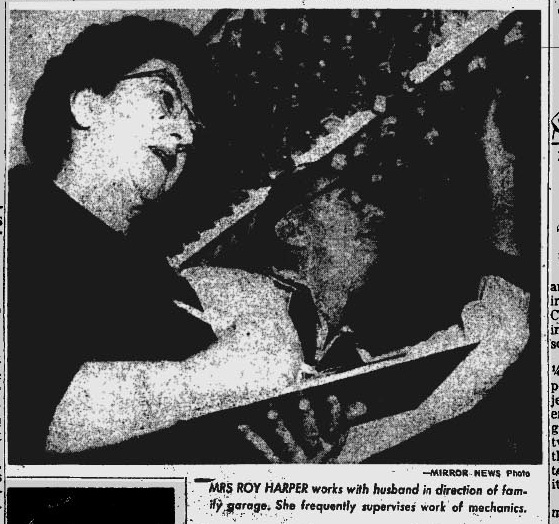
April 20, 1959: It’s a Woman’s World — Auto Mechanic

April 20, 1959: Mrs. Roy Harper, an expert auto mechanic specializing in carburetors.
April 20, 1959: Meet Mrs. Roy Harper, a trained auto mechanic who helps run her husband’s auto garage, where she is apparently a service writer and specializes in carburetors. But the Los Angeles Times assures readers that she’s still ladylike and prefers “high heels and chic clothes” to dirty coveralls and tools in the hip pockets.

Continue reading →

Posted in 1959, Freeways, Transportation | Comments Off on April 20, 1959: It’s a Woman’s World — Auto Mechanic

Matt Weinstock — April 20, 1959

Wanton Juveniles

Matt_weinstockdOn their
return from several months in Europe, a couple learned the furnished
house they own in San Fernando Valley had been vacated by the people
they had rented it to and become the rendezvous of juveniles who held
parties there and damaged it.

They went out to inspect the place
and came upon incredible destruction. All the windows in the house were
broken, the picture frames were gouged and the upholstered furniture
ripped, apparently with a can opener. The senselessness of the
vandalism appalled all of them.

In all the house they found only two objects unbroken — two mirrors. Bad luck, you know.

::


April 20, 1959, Nixon ON THE Universal-International back lot, out of view but a short distance from Hollywood Freeway, where autoists
compete fiercely, a film company is shooting "Spartacus," in which
gladiators battle to death as they did in Rome in 74 BC. Some wag,
impressed by the parallel, has put a sign on the set, "Caesar's
Cloverleaf, 1/4 Mile."

::


 NUMBERS GAME —

Rosetta Bent's preschooler was running around the house chanting "2, 4,
5, 7, 9, 11, 13" and she got the uneasy feeling he might be plugged in
on some cosmic code–until she realized he was repeating the TV
channels … Actor RobertBrubaker's daughter Karyn painstakingly wrote
"1, 2, 3, 4, 5, 6, 7, 8, 9," then asked, "How do you make a 10?" Before
he could answer she squealed, "Oh, I remember what the teacher said.
It's a 1 with a swimming pool next to it!"

::

RARE SPECIES

A gourmet is a man who balks
At cabbage juice and carrot stalks
And still, despite the modern trend
Enjoys the food that shapes his end.

–EDITH OGUTSCH

::


April 20, 1959, Mirror Comics SILLY STUFF keeps happening in bars.

The clientele at the Rainbow was watching a Joe Palooka epic on the TV late show and the plot roared along to the climactic fight scene. The opening round showed a character bopping Palooka (Joe Kirkwood)
around the ring. At this point a young man addicted to wagering on
almost anything said to the man on the next stool, "I'll bet you $3 to
$1 Joe wins." The bet was made.

 As the fight went on and it became apparent the tide was turning the short ender blinked at the TV set, turned to his betting friend and, barkeep Eddie Wingerter relates, inquired suspiciously, "You sure you ain't seen this picture before?"

THEN THERE
was the the customer, possibly an unemployed ad agency man, in the
Brass Rail on West 3rd Street who summoned the management and suggested
renaming the place the Guard Rail.Motivationally, he pointed out, it would give skizzled patrons a protected feeling.

April 20, 1959, Abby "Imagine," he exulted, "a big neon sign out in front reading 'The Guard Rail. The Saloon That Cares.' "

::


PEOPLE KEEP

dreaming up variations on the TV commercial in which the question is
asked, "Do you think everyone should be a dog?" Another answer: "No, I
don't think the other dogs would like it."

::


AT RANDOM –
– In the event an urgent need arises, Gladwill
Hill of the New York Times office here has an excellent recipe for
barbecued armadillo … Bob Johnson has a title with demonstrated fan
appeal when Hollywood gets around to filming "Lolita" — "Some Like a
Tot."

Posted in Columnists, Matt Weinstock | Comments Off on Matt Weinstock — April 20, 1959

Paul Coates — Confidential File, April 20, 1959

Confidential File

Chief Parker Sniffs Lavender, Old Lace

Paul_coatesWilliam Parker, the duly appointed police chief of this teeming metropolis, is all things to all men.

To some, he's a stanch, unflinching
defender of law and order. To others, including, I suspect, Roger Alton
Pfaff, he's the sinister mastermind of a syndicate dealing in the
nefarious traffic of traffic tickets. [Note: Pfaff was Traffic Court
judge for many years–lrh].type

But to me, he's something else. He is, I swear, a homely philosopher.

Beneath his gruff, stern exterior, beneath his cold, gold badge, beats the warm heart of a hopeless sentimentalist.

Even
though he is right here in the swim of things, Chief Parker is
overwhelmed by a wistful desire to return, forthwith, to the good old
days. And when he says "old," he means it.

He revealed this soft side of his nature last week during a speech before the Southern California Hotel Assn.

April 20, 1959, Mirror Cover In
it, he laid the blame for our current crime wave on the fact that we
have somehow slipped away from the manners and morals of mid-Victorian
times.

And come to think of it, he's right, you know. Somehow we have slipped away.

"During
the middle of World War I, America lost touch with the Victorian
principles which had sustained it for decades. It lost these principles
in the name of freedom of expression," he said.

He added that, as a result, Americans have lost much of their ability to distinguish between proper and improper conduct.

Thus, all this cigarette smoking and jazz dancing, because we shook free the shackles of Victoria's genteel influence.

The chief seems to imply that before our urge for freedom of expression, the only peril in society was Pauline's.
And a juvenile delinquent was just a feisty lad like Penrod who did no
worse than swipe pies from the kitchen window sill, kick the gong
around with apipeful of corn silk or hide frogs in his bedroom.

Now
my quaint, Victorian-tainted mother always cautioned me: "Kid, play it
cool. Never argue with a cop." But in this instance, I must disagree.

Life,
no matter what the chief says, was no four-poster bed of roses in those
dear, dead days. There were plenty of shenanigans going on.

April 20, 1959, Stripper Suicide It
was the era when the robber barons of finance wiped out the poor widows
and orphans at the opening of the Exchange every morning. When the
Hudson Dusters, armed with brickbats, roamed Hell's Kitchen. When the
atrocious table manners of Diamond Jim Brady were lauded as
"glamorous." And, while there may have been no sound on Mulholland Drive
except for the occasional raucous cry of a drunken Indian, there was
lots of fancy sparking going on in hansom cabs parked elsewhere.

Jack Had a Ripping Time of It

Across
the creek, Jack the Ripper was staked out near London lampposts in his
search for fallen women. And, I might add, he was finding quite a few.
Over at Horsemonger Lane Gaol they had just hung a Mr. and Mrs. Manning for murdering Mrs. Mannings's
lover, Patrick O'Connor, and burying him under the kitchen floor after
robbing him of everything but his false teeth. Down in theLimehouse ,
enterprising hoods were picking up 3 pounds 2 shillings a head for
every able-bodied seaman they shanghaied aboard waiting vessels.

So,
Chief Parker can slip on his policeman's blue with helmet and retreat
back to those good old days if he wants to. Not me. I like it here.

Posted in Columnists, LAPD, Paul Coates | Comments Off on Paul Coates — Confidential File, April 20, 1959

Cary Grant — Part 1, April 20, 1959

April 20, 1959, Cary Grant

April 20, 1959, Cary Grant

After promoting Joe Hyams' series on Cary Grant on the front page, The Times runs a story that's mostly a denial by Grant with long quotes from the story. "I've never had an interview with Hyams on any subject. The article is completely erroneous," Grant tells The Times.

Posted in Film, Hollywood | 2 Comments

In the Theaters — April 20, 1957

April 20, 1957, In the Theaters
Posted in Film, Hollywood | Comments Off on In the Theaters — April 20, 1957

Second Takes — Billy Wilder

July 5, 1953, Billy Wilder, Stalag 17

July 5, 1953: The ads for "Stalag 17" emphasized that it was a comedy.

July 3, 1951, Billy Wilder, Stalag 17

July 3, 1951: Rumors surface that Wilder will direct "Stalag 17," less than a month after the disastrous opening of "Ace in the Hole."  "Stalag 17" opens almost precisely two years later.

Oct. 11, 1951, Billy Wilder, Stalag 17

Oct. 11, 1951: Hedda Hopper, who panned "Ace in the Hole," reports that Wilder will make a film of the hit Broadway play "Stalag 17" with Charlton Heston.

Oct. 14, 1951, Billy Wilder, Stalag 17

Oct. 14, 1951: A plot summary of "Stalag 17" emphasizing that it's a comedy. Local audiences wouldn't necessarily be familiar with the play, which didn't premiere in Los Angeles until June 1952.

Oct. 24, 1951, Billy Wilder, Stalag 17

Oct. 24, 1951: Casting continues for "Stalag 17." For some reason,
 Hopper ardently used her column to plug Cy Howard, who left the
 film after two weeks of shooting.

 
Dec. 4, 1951, Billy Wilder, Stalag 17

Dec. 4, 1951: Cast change. William Holden will co-star with Heston.

Dec. 19, 1951, Billy Wilder, Stalag 17

Dec. 19, 1951: Casting continues.

Jan. 5, 1952, Billy Wilder, Stalag 17

Jan. 5, 1952: Otto Preminger joins the cast.

Jan. 15, 1952, Billy Wilder, Stalag 17

Jan. 15, 1952: Now Holden is the lead in the film.

Jan. 24, 1952, Billy Wilder, Stalag 17

Jan. 24, 1952: "Stalag" playwright Edmund Trzcinski joins the cast … and
another plug for Cy Howard.

Jan. 31, 1952, Billy Wilder, Stalag 17

Jan. 31, 1952: Peter Graves joins the cast in the critical role of Price.

Feb. 9, 1952, Billy Wilder, Stalag 17

Feb. 9, 1952: Holden's brother Richard Beedle gets a small role.

Feb. 13, 1952, Billy Wilder, Stalag 17

Feb. 13, 1952: The stage version of "Stalag 17" has an all-male cast, but this blurb makes it sound like Paramount is writing women in the film. According to imdb, "Stalag 17" is Audrey Strauss' only film role.

Feb. 15, 1952, Billy Wilder, Stalag 17

Feb. 15, 1952: Another role is cast.

Feb. 16, 1952, Billy Wilder, Stalag 17

Feb. 16, 1952: Cy Howard drops out of the picture and gets a lengthy blurb from Hedda Hopper. In fact, Hopper has given more space to Howard than she has to Holden!

July 16, 1953, Billy Wilder, Stalag 17

July 16, 1953: "Stalag 17" opens in Los Angeles after a premiere in Beverly Hills. Perhaps in response to the disaster of "Ace in the Hole," the ad campaign spins the movie as a comedy. "One of the funniest films of the year" … "best of the war comedy pictures" … "finest comedy drama out of Hollywood this year."

Philip K. Scheuer's review says: "Billy Wilder, one of the most caustic-minded of Hollywood's writer-director-producers, has taken a stage hit by Donald Bevan and Edmund Trzcinski and preserved its essential humor and tragedy with no dulling of its corrosive edges, though he has cleaned it up in both language and situations."

Posted in Film, Hollywood, Second Takes | Comments Off on Second Takes — Billy Wilder

Fidel Castro Visits U.S. Landmarks, Dodgers Beat Cubs, April 20, 1959

April 20, 1959, Fidel Castro at Lincoln Memorial

Fidel Castro visits the Lincoln Memorial. Fifty years later, it's still difficult to
believe this ever happened, but it did.

April 20, 1959, Los Angeles Times Cover

April 20, 1959, Safecracker

Above, a man arrested for safecracking complains: "You can't get good tools anymore."

At left, 22 people are killed and more than 50 wounded during a revolt in La Paz, Bolivia … Joan Crawford's fourth husband, Pepsi executive Alfred N. Steele, dies at 57.  

April 20, 1959, Theater

The Times' Philip K. Scheuer interviews the great cinematographer James Wong Howe.

April 20, 1959, Comics

Ernie Bushmiller's "Nancy" gets all the attention, but "Ferd'nand" is just as peculiar.

April 20, 1959, Dodgers on KMPC April 20, 1959, Sports

At left, Vin Scully and Jerry Doggett on KMPC. And don't forget the "International Harvester Scoreboard!"

Above, the Dodgers are in third place, beating the Cubs, 8-3. Duke Snider hits his first home run of the season, the 332nd of his career. Sports Editor Paul Zimmerman takes a look at whether Stanford will continue in the Rose Bowl after the Athletic Assn. of Western Universities takes over from the Pacific Coast Conference.

Posted in Uncategorized | 1 Comment

Hollywood Wheels — Louis B. Mayer’s Chrysler Imperial

What is billed as Louis B. Mayer’s 1950 Chrysler Imperial has been listed for sale in Hemmings Motor News. No price is included.
Posted in Freeways, Transportation | Comments Off on Hollywood Wheels — Louis B. Mayer’s Chrysler Imperial

Coming Tomorrow! Cary Grant Tells All, April 19, 1959

April 19, 1959, Cary Grant

The Times' front page promotes plans to publish Joe Hyams' three-part series on Cary Grant. But before the series was published, Grant contacted the editors and adamantly denied that he ever talked to Hyams. Check back tomorrow to see what we did.

Posted in Film, Hollywood | Comments Off on Coming Tomorrow! Cary Grant Tells All, April 19, 1959

Body Found on Pasadena Golf Course, May 22, 1906

May 22, 1906, Body Found on Golf Course

Posted in Homicide | 2 Comments

Voices — Art Seidenbaum, 1963


Our Place in the California Sun: From the Past, Reflections for Today

July 29, 1990

By Art Seidenbaum,

[Art Seidenbaum was a columnist for
The Times from 1962 to 1978, book editor through 1984 and editor of the
Opinion section until his death on July 24, 1990.
This
article appeared in The Times on Sunday, Sept. 15, 1963, when Art
Seidenbaum was a cultural columnist for the newspaper.]

A couple of skin-peeling
Sundays ago I was adrift on somebody else's small boat off Malibu not
fishing (because nobody brought a spare rod and I wanted to play
spoiled child anyway). The world seemed transparent. You could look
down past the writhing kelp and see bottom. You could look up at a sky
so clear that infinity made sense. And the great corrugated landfall
that holds us all to the East was only a thin, brown line of substance
sandwiched between both blues.

Instead of compounding doing
nothing by thinking nothing, I was trying, however horizontally, to put
the climate in perspective with the place. How important back there on
shore is the water and the weather? And does the combination of gentle
ocean and moderate temperature really tend to limit what this culture
can create and accomplish?

It is an old argument, really. I
could remember a college course about how colder climates have
stimulated men to greater efforts; if the environment is harsh, then
people have something to conquer. In a more tropical situation, man
tends to build himself a torpid society, lush with natural vegetation
and noonday-napping human vegetables.

We've been accused of it,
all right. Los Angeles and lotus-eaters have been linked for a long
time by the people of chillier places. All the unseparated garbage
about our full bodies and empty heads, our mortal chase after beauty
and our monumental concern about death, our indolent bouncing between
boat and barbecue are byproducts of an old and semiundeserved
reputation for surface worship.

The movies, and the artificial
images they projected, started it. And, truth, the motion picture came
to Southern California because the weather was right–more dry, bright,
outdoor shooting days than anywhere else in the country. Even today,
when most film people dress like three-button bankers who lend hard
money to a make-believe industry, an impression persists that we are a
people in short pants.

When the airframe industry settled here,
it was for similar sunny reasons: more days in every fiscal year for
building, testing, flying. Weather was our early claim to fame. The men
to make the movies and to man the wild blue yonder were imported.
Although they enriched the place, nobody took them very seriously.
Balmy was the atmosphere and balmy was the adjective.

The weather reports also made us, in numbers of new residents, a high-pressure area.

Poor
people came because where you don't have to have storm windows or
snowsuits for the children, it is easier to be poor. Would-be artists
and musicians and writers came for almost the same reason; a back yard
could be called a studio. Couples came here to retire because
consistent weather seemed good for what ailed them. Speculators arrived
because there always seemed to be a new fad under the sun: pools to
swim in, drive-ins for meals or for making love, a sports car in every
garage. Until the '50s, you could make a case that the climate
generated more heat than light.

But within a decade, the
prevailing winds from the East shifted. What had been the aircraft
industry was soaring into other areas: space and the computer sciences.
A new definition of Aristotle's good life–including leisure activities
and time to chase culture–was becoming respectable, even applauded.
And Americans, after centuries of looking to Europe for examples,
gradually began to face the Pacific for the first time. The war and the
new technologies were responsible.

The result has been to
accelerate our steep growth while improving the cast of climbers.
Thousands of fine educators were lured here, no longer afraid that
owning a boat would turn a young scholar into a Yahoo. The very same
sun that browned a beach bum promised to make life fuller and freer for
a professor and his family. Suddenly, it became fashionable to argue
that it is the kids that really matter and that Southern California is
the ideal place to raise them. A weather code.

Scientists of all
sorts brought their searches here. The headiest ones who started a
series of think factories chose Southern California. Instead of numbing
the mind, they figured, the weather made the mundane chores less
difficult, releasing the brain for fancier test flights of its own.

Commentators
on American life in the last half of the 20th Century flew in for a new
look at what was going on here. Many years after the fact, they came to
the conclusion that the old sun stigma was no longer attached. They
wrote dozens of articles that nearly unanimously granted us a new set
of adjectives to grow on: optimistic, pioneering, energetic,
ever-changing, diffused, mobile, rootless.

Pretty much forgotten
were the old cults. Almost ignored was the weather that still caused
all the changes. Instead, the smog which so often slices between the
clear sky and the driving, non-napping natives, became the climate of
comment.

Nothing torpid about the tangling twine of freeways.
The push up from the horizontal to highrise. The increasing density of
people with greater breadth of knowledge. Our observers sniffed the air
a couple of times, wiped their eyes and now began to blast us for
behaving like big-city people in bad-weather places. The hustle. The
random scramble. The urban problems crowned by the gray, gloomy mantle
of man's own smog.

In one way, they are right. All you have to
do is get in a small boat off shore to see the way we've fouled up the
natural, beautiful reason why we came here in the first place.

The
secret is that we've been hellbent to imitate other cities. People
moved in from Chicago and New York with all their old habits. Everybody
was afraid to love the weather too loudly. Safer to act like all that
sunshine isn't really here–and now that we've hidden it in the filth
of our own exhausts, much of the time it isn't.

Pity the poor
locals who have been here all along, who never hid their excitements
under the palm fronds but who went about their business of building
when the over-land sky was transparent every day and when the girders
didn't block the view of the ocean.

We have moved through
several phases as a city. The first was laughter, general laughter from
the outside; even then, all the forces for future bigness were at work.
The second was an awkward age, as we began to grow fast and were
watched with a sort of nervous contempt. Then came the war and all the
postwar explosions people talk about: population, education, culture.
Here, the echoes of each explosion were the loudest. Now we are usually
taken seriously, partly because we have some serious problems that
other Americans realize they, too, will have to face.

But
floating out there, half-baked and brainwashed with beauty, it seemed
to me that in our next phase we ought to become the great
preservationists of all time. Hoard the hills from senseless slicing.
Open the sky again by refusing to let us split up so many hydrocarbons.
Let aesthetics rule because it was a run for natural beauty that
started the stampede. Bury the utilities and the bad taste in
everything from homes to public advertisements. The good weather is
still waiting out there to sustain greatness, not just a cheap, dirty
imitation of somewhere else.

Posted in Columnists | 1 Comment

In the Theaters — April 19, 1955

April 19, 1955, In the Theaters
Posted in Film, Hollywood | Comments Off on In the Theaters — April 19, 1955

Second Takes — Billy Wilder

June 15, 1951, Billy Wilder, Ace in the Hole

June 15, 1951: "Ace in the Hole" opens in Los Angeles.

April 7, 1950, Billy Wilder, Ace in the Hole

April 7, 1950: Billy Wilder is casting a film with the working title "Human Interest Story" and renames it "Ace in the Hole."

  April 13, 1950, Billy Wilder, Ace in the Hole

April 13, 1950: Jan Sterling is cast in the film.

April 20, 1950, Billy Wilder, Ace in the Hole

Hedda Hopper, who had a small role in Wilder's last film, "Sunset Boulevard,"
plugs "Ace in the Hole."

June 16, 1950, Billy Wilder, Ace in the Hole

June 16, 1950: Casting for the film continues.

Aug. 20, 1950, Billy Wilder, Ace in the Hole

Aug. 20, 1950, Billy Wilder, Ace in the Hole

Aug. 20, 1950: The Times finally interviews Billy Wilder. Wilder tells The Times' Philip K. Scheuer: "Class in pictures nowadays has to be smuggled in like contraband and artistry is a nasty word" … "The question about a picture is not whether it is good or bad but whether it is alive or dead….  'Casablanca' was full of holes as a story, but it was alive as a film and the public loved it."

June 10, 1951, Billy Wilder, Ace in the Hole

June 10, 1951: An early example of damage control. Paramount obviously knew a movie as bitter and caustic as "Ace in the Hole" would be a tough sell.

June 16, 1951, Billy Wilder, Ace in the Hole

June 16, 1951: The Times' Edwin Schallert praises "Ace in the Hole": "Controversial and challenged as this Paramount production will prove to be, it has a singular power and fascination. The writing … seems extraordinarily potent." 

June 20, 1951, Billy Wilder, Ace in the Hole

June 20, 1951: Hedda Hopper pans "Ace in the Hole."

Aug. 19, 1951, Billy Wilder, Ace in the Hole

Aug. 19, 1951: "Ace in the Hole" is renamed "The Big Carnival." The movie will languish in obscurity for decades.

Posted in 1950, 1951, Film, Hollywood, Second Takes | Comments Off on Second Takes — Billy Wilder

Minister, Wife Held on Morals Charge, April 19, 1939

April 19, 1939, Joseph Jeffers

April 19, 1939: Joseph Jeffers and his wife, Zella Joy, were accused of engaging  in an illegal act in the privacy of their own home that was so obscene The Times couldn't say what it was. Even their private discussions were obscene, according to the Los Angeles County district attorney's office, which recorded them on a hidden dictograph.

March 22, 1939, Joseph Jeffers

Above, March 22, 1939: Jeffers is charged. At right, April 11, 1939: Jeffers denies the charges.

Aug. 27, 1938, Joseph Jeffers  
Aug. 27, 1938: Jeffers preaches at the Kingdom Church.
 

Jan. 14, 1939, Joseph Jeffers

Jan. 14, 1939: Jeffers charged that he was being prosecuted because of his views against the Jews.

March 24, 1939, Joseph Jeffers

March 24, 1939, Jeffers is freed.

March 29, 1939, Joseph Jeffers

A sermon on "Man in Jail."

April 11, 1939, Joseph Jeffers

April 19, 1939, Joseph Jeffers

Above, Jeffers' followers pray before his hearing, April 19, 1939.
 Below, a witness describes the couple's alleged "unnatural acts," which
 are too graphic for The Times. 

April 19, 1939, Joseph Jeffers

What happened to Joseph Jeffers? Stay tuned!

Posted in #courts, Religion | Comments Off on Minister, Wife Held on Morals Charge, April 19, 1939

Nuestro Pueblo — April 19, 1939

April 19, 1939, Nuestro Pueblo
left
Posted in Architecture, Nuestro Pueblo | Comments Off on Nuestro Pueblo — April 19, 1939

Found on EBay — Bullock’s Wilshire

Dress From Bullock's

Dress From Bullock's Wilshire

This dress from Bullock's Wilshire has been listed on EBay. The Buy It Now price is $65.

Posted in Fashion | Comments Off on Found on EBay — Bullock’s Wilshire

Matt Weinstock — April 18, 1959

On Education

Matt_weinstockdJulius
Sumner Miller teacher physics at El Camino College, is writing a book
and on alternate Sundays (tomorrow) conducts a provocative program,
"Why Is It So?" On KNXT, Channel 2.

Between times he is a stormy
advocate for a complete overhauling of our educational system. when he
gets on the subject his eyes flash, his voice thunders and he pounds
the table.

Unless we do something about it, he feels, we may be lost.

Miller
says, "We have reared a generation of intellectually lazy, illiterate,
picture-reading, mathematically incompetent, culturally lacking boys
and girls."

Worse, he adds, is their lack of values.

As recently as the '20s, he recalls, students received rigorous academic discipline in fundamental knowledge.

"Learning," he said, "was an exciting adventure."

April 18, 1959, Have Yarmulke Will Travel

Then
came the educators, concerned with the "better-adjusted, well-rounded,
whole child." He calls their doctrine "regressive education." It has,
he says, eliminated the formal disciplines which alone can communicate
a body of knowledge and the capacity to think critically.

WHEN RUSSIA SENT ALOFT
the first Sputnik in October 1957, the nation was shocked almost into
panic. It was inconceivable that another nation had surpassed us in
science. There were stern warnings that we must take up the slack in
education, particularly in science, on an emergency basis, to meet the
Soviet threat. It is Miller's belief that nothing will come of the
warnings, that we have already settled back complacently.

April 18, 1959, Mirror Comics If we
are to throw off our present intellectual confusion, Miller thinks we
must write off the present high school generation and start fresh with
first-graders. he estimates the task will take a generation.

A
first step would be to train teachers to a new responsibility. He
considers many of them incompetent and either unaware of or untrained
in the true meaning of teaching.

"NO ONE can be taught
anything," he says. "His interest can be stirred, his curiosity
aroused, his enthusiasm awakened, his imagination fired, and he may go
on to learn it. But not enough teachers are endowed or equipped to do
these things.

"If I had my choice I would have enthusiasm first. The teacher must himself be excited if he is to sell his goods."

Miller
is frequently accused by his colleagues of undue emphasis on his
favorite subject. He denies this. He makes the point that before a
person can understand physics he must be able to read and write.

"By
this," he explains, "I mean the ability to grasp the full and proper
meaning of the printed page and to express ideas in intelligible prose."

Does he consider that his formula for correcting the present sorry state of education is too drastic?

"It's a free country," Prof. Miller replies. "This is my point of view.

::


April 18, 1959, Abby DEDICATED

newsmen have been facing the abhorrent prospect that one of the week's
big stories would remain uncovered, in fact, unmentioned, except in
hilarious conversation. Let's see what can be done.

First, to
set the scene: Crystal Room, Beverly Hills Hotel. The Hollywood Women's
Press Club annual Men's Day luncheon. A couple hundred vivacious folk
have just drunk and eaten well. It's time for the entertainment.

Cowpoke
Rex Allen rides his horse Coco onto the stage. It creates a sensation.
It isn't every day a live horse stomps into the elegant Crystal Room.
Sitting astride, Rex starts singing a song. Coco either disapproves or
decides to steal the scene and —

I guess the newsmen were right. They said it couldn't be done and it couldn't.

::


FOOTNOTES —

Another bit of press high jinks occurred during Atty. Gen. Mosk's press
conference on conditions at Camarillo Hospital. At one point a man who
reporters assumed was a deputy A.G. took over and answered their
questions. Turned out to be fun-loving Pat McGuinness of KNX … The
Embassy Theater advertised "Two Adult Shockers — Adults 60¢, Children
25¢." Presumably the children were shockproof.

Posted in Columnists, Education, Matt Weinstock | 1 Comment

Paul Coates — April 18, 1959

Ventura County

Vice Jury May Call Cohen

BY PAUL COATES
Staff Columnist

Paul_coatesFormer
gambling czar Mickey Cohen may be called before a Ventura County grand
jury to discuss his possible connection with prostitution, commercial
sex parties and organized crime in Oxnard and Ventura, I learned today.

Ventura County law enforcement officers have launched a full-scale probe of a ring which assertedly panders to Hollywood playboys for pastimes now denied them in the rigid confines of the Sunset Strip.

Woman's Tip Told

The
investigation, by police in Oxnard and Ventura and the district
attorney's office, was touched off when a former, self-confessed
prostitute blew the whistle on what she termed syndicated crime in
Ventura County.

She also charged that the gangster invasion of Oxnard and Ventura was masterminded by "certain gentlemen from Detroit."

But
the organization, she alleges, has connections in Los Angeles and many
customers she entertained traveled from L.A. and surrounding
communities.

Cohen Call Told

April 18, 1959, Mirror Cover Cohen's
name was introduced to the case when a source close to the district
attorney's office said the some-time racketeer may be included in
future grand jury subpoena lists.

Mickey, of course, denied any connection with prostitution anywhere.

"Look," he told me, "you know my record. I've never been mixed up in either prostitution or narcotics."

I
asked him if he was on friendly terms with a certain businessman in
Oxnard and if, according to allegations, he had visited the man on
several occasions.

Friend of Friend

"I
have a friend who owns a bar in Oxnard," he began, then interrupted
himself. "No, that's not right. I know a guy whose brother runs a bar
in Oxnard."

That's all Mickey had to say on the subject.

Woodruff Deem, chief criminal complaint deputy for Ventura Dist. Atty Roy Gustafson, told me that his office is heading up the vice probe.

Thus far, grand jurors have heard testimony from 28 witnesses, including the former prostitute.

April 18, 1959, Castro Visits Washington Other
witnesses who appeared before the jury last March 30 include prominent
Oxnard businessmen. They refused to talk with reporters about their
testimony.

The former prostitute assertedly told jurors that she had been the star attraction at numerous parties arranged by the gangster element.

She also charged, it is understood, that one Oxnard businessmen's
organization sponsored some of the stag parties, which featured nude
dancing by girls, the showing of lewd films, and mingling of male
guests and female "stars" before the assembled group.

Party 'Bait'

In fact, she reportedly told the jury, she was used as a lure to tempt men to join the group.

"They'd promise prospective members that they could 'date me' if they'd join," she said.

She
charged that eight girls were employed by the syndicate to operate in
at least four nightclubs in Oxnard and Ventura. The girls' total take
was estimated to be in excess of $5,600 a week, with much more going to
the organization's male leaders.

Was Confident

 Oxnard
Police Chief Al Jewell conceded that his office felt it had a "strong
case" when he took it to the district attorney's office.

Is he disappointed that his investigation hasn't resulted in indictments by the grand jury?

"Well," he answered carefully, "as a law enforcement officer I am always interested in results."

The
alleged vice activities reportedly began about three years ago during a
community battle in Oxnard over the selection of a new police chief.

Crime Fighter

April 18, 1959, How to Tune in Stereo Broadcasts Subsequently,
Chief Jewell, a nominee and dedicated fighter against  crime, was
selected to lead the Police Department after considerable pressure was
brought to bear on the City Council.

Lee Grimes, managing editor
of the Oxnard Press-Courier and grand jury foreman, has refused to
discuss the probe, even with his own reporters.

Deputy Dist. Atty Deem, pressed for an answer on the infiltration of Detroit hoodlums, would only say:

"Well, we do know that there are certain Detroit people in business here."

Fatherhood Charged

The
self-confessed prostitute, who said she made between $200 and $300 on
weekends from her illicit activities, ignited the investigation after a
businessman refused to acknowledge her child, a boy she claims was
fathered by him.

In her discussions with law enforcement officers, she assertedly
charged that one of her sisters in the world's oldest business had been
murdered by the syndicate to prevent her escaping its clutches.

Posted in Columnists, Mickey Cohen, Paul Coates | Comments Off on Paul Coates — April 18, 1959

In the Theaters — April 18, 1953

April 18, 1953, In the Theaters
Posted in Film, Hollywood | Comments Off on In the Theaters — April 18, 1953

Second Takes — Billy Wilder

Feb. 13, 1951, Billy Wilder, Sunset Boulevard

Feb. 13, 1951: Gloria Swanson (Best Actress), William Holden (Best Actor), Nancy Olson (Best Supporting Actress) and Erich von Stroheim (Best Supporting Actor)  are nominated for Academy Awards. "Sunset Boulevard" is nominated as best picture; Billy Wilder is nominated as best director and Wilder, Charles Brackett and D.M. Marshman Jr. are nominated for best story and screenplay. The film's 11 nominations include best art direction, black and white, Edwin B. Willis and Hugh Hunt; best black and white cinematography, John Seitz; film editing, Arthur Schmidt and Doane Harrison; and film score, Franz Waxman.

The film won three awards: film score, art direction and writing.

Feb. 13, 1951, Billy Wilder, Sunset Boulevard

At right, April 18, 1951, Swanson was a sentinmental favorite for an Academy Award, but she didn't win. Instead, the Oscar went to Judy Holliday for "Born Yesterday.." 

April 8, 1951, Billy Wilder, Sunset Boulevard

Feb. 25, 1951, Billy Wilder, Sunset Boulevard

"Since working with a man as stimulating as Billy Wilder, I've become terribly interested in directing," Holden says.

Feb. 25, 1951. Billy Wilder, Sunset Boulevard

"Holden had himself named 'assistant to the director' when Wilder started 'Ace in the Hole,' but they soon called him away to slap on the greasepaint."

March 1, 1951, Billy Wilder, Sunset Boulevard

March 1, 1951: Swanson wins a Golden Globe.

March 29, 1951, Billy Wilder, Sunset Boulevard

The Academy Awards, March 29, 1951.

March 29, 1951, Billy Wilder, Sunset Boulevard
 
March 30, 1951, Billy Wilder, Sunset Boulevard

March 30, 1951, Billy Wilder, Sunset Boulevard

March 30, 1951, Billy Wilder, Sunset Boulevard

March 30, 1951, Billy Wilder, Sunset Boulevard

Posted in Film, Hollywood, Second Takes | 1 Comment