Matt Weinstock, June 17, 1959

Galloping Inflation

Matt Weinstock As all armchair horse players
know, bookmakers don't pay track odds. They limit payoffs to $60 for
win, $24 for place and $12 for show on a $2 bet. Of course, this takes
care of most wagers, but with hardenedhorse players it isn't the principle, it's the money.

Now
some bookies have cut the prices in half, paying $30, $12 and $6 on a
$2 bet and there's a roar of disapproval from the players. They point
out the bookies' average net is 20% of the handle — that's $200 of
every $1,000. They could pay track odds, the players contend, and still
make a substantial profit.

BOOKIES who have cut the odds
say it isn't so. They point out in rebuttal that accepting bets on
horses is fraught with peril. They say protection costs are mounting
and worse, protection is spotty and unreliable. In short, there's
always the risk of aknockover, which means attorney fees, bail bonds and perhaps going to jail.

June 17, 1959, Robbery The players scoff at this and there's talk of organizing the Amalgamated Assn. for the Protection of Horseplayers.

Now please pretend you didn't read the above. There aren't supposed to be any bookies.

::

EVERYONE presumably
has squirmed in the throes of the familiar, frustrating dreams. There's
the one in which you fall endlessly into space. Another in which you
are being stalked relentlessly through an abandoned warehouse by a mad
killer. Another in which a fierce dragon is chasing you, snapping at
your heels as you run and you are at the point of exhaustion.

Well,
a lady dreamer confides that she awoke in a cold sweat the other night,
quivering from what she now, having calmed down, calls her "inflation
dream."

In it she was rushing to the bank to deposit some money
so several emergency checks she'd written wouldn't bounce. Her mad race
was delayed first by the tie-up on the freeway, then by a detour
because of a street excavation, then an accident which held up traffic.

Finally
she arrived at the bank to find it closed. Seeing people inside she
pounded on the door but they ignored her. She pounded and pounded,
frantically, then woke up.

::

PROSPERITY

Though times are improving, the lot of the girl
In the office is hardly a cinch.
For her boss is becoming more playful, the churl,
And she is still feeling the pinch.

–RICHARD ARMOUR

::

JUST INSIDE the wire fence at the northeast corner of 2nd
and Hill Streets where the new State Building is under construction, a
huge tomato plant grows, apparently seeded from a discarded portion of
a workman's lunch. It gets no care, no water, has no blight or worms
and looks as if it will soon have a big crop.

What nettles Bruce
Hooker as he passes it every day is that he recently spend more than
$10 on poison, dusting powder and sprays for the aphids, snails,
grasshoppers and other bugs which infest his weak-willed plants. But
life is like that.

::

CLASSIFIED AD in the employees' publication, Lockheed Star: "Cute Kittens, white and tricolor, to good homes for lite mousekeeping" … Most effective highway sign Mrs. Richard Lujan knows is the one as you leave Ensenada, in Spanish: "Drive carefully. We can wait. Vasquez Mortuary."

::

MISCELLANY — Man with the letters MTA on his license plate can hardly wait to get it changed. People glare angrily at him, apparently thinking he's an MTA
official … All his life John Grover has been curious about the phrase
"ice cream pants." Now he knows. The ice cream cone he was carrying to
his daughter, 9, at Disneyland, dropped all over them … By the way,
if you want to start an argument, inquire why "pants" is/are plural.
After all, there's only one of them. On the other hand, it/they
has/have two legs.

Posted in Columnists, Matt Weinstock | Comments Off on Matt Weinstock, June 17, 1959

Paul V. Coates — Confidential File, June 17, 1959

June 17, 1959, Superman

Confidential File

Orval Faubus Adds to the Ad Absurdum

Paul CoatesI
know I'll hate myself in the morning. But right now, I can't resist the
temptation to confess that I really admire Gov. Orval Faubus.

Can't help it. I just do.

You've
just got to like a lad who pulled himself up by his own meager
bootstraps. In a way, he's actually an inspiration for all of us.

He's irrefutable proof that there's still a chance in this world for everybody. If he could make it to the top, any of us can.

Old
Orval wasn't one of them "privileged" people. He's just a boy from back
in the piney woods of Arkansas. Never had a silver spoon in his mouth
or a humane thought in his head.

But he made it clear to the Arkansas executive mansion. And he did it by dint of sheer, blinding ignorance.

June 17, 1959, Superman Now
he's a famous man. His name is known around the world. He's
interpreted, inaccurately, but widely, as a typical example of American
thinking.

His vicious spouting has made him secretly loved by Communists everywhere.

And the other day he outdid himself.

In
a speech down there in Dixie he announced that if desegregation goes
through in the United States the best thing that could happen to us
would be for the Russians to drop an H-bomb on our country.

And, if that don't rate ole' Orvie a party card, I'd like to know what does.

::

On the other side of the ledger, there's the case of P.D. East.

You remember him.

Last April, I chronicled his troubles as editor of a struggling Mississippi weekly newspaper.

Unquestionably, the troubles were his own making. he questioned the stylishness of bed sheets worn over the head.

It
was five years ago when, stricken by pangs of principle, editor East
made the printed observation that his fellow townsfolk were becoming
overly emotional on certain race issues.

In face of their
insults, threats and boycotts, he continued to hammer away at their
bigotry until his local circulation plummeted from 2,300 to zero.

Today, through out-of-state circulation, he's managed to build it up again to a degree.

He's also built a reputation among the people who don't hate him as a courageous one-man army in the battle for common sense.

Although
he lives surrounded by the sheets of the Ku Klux Klan, he's kept up a
running attack on the callous indecency and insanity of race hatred.

He's done it without venom, but with the sharper weapon of satire.

An example is the "ad" on the front page of East's latest edition:

FOR SALE

"Since it's the policy of this paper to provide service, once again we have  a special offer to make.

"Don't suffer from the summer heat using your regular uniform of a muslin bed sheet.

"Be modern! Inquire about our complete stock of cotton eyelet embroidery designed especially for summer wear in Mississippi.

"Klanettes
may enlarge the holes for arms, but your heads will fit nicely through
the eyelets as they are. Keep cool this summer on your night rides of
mercy…

"Address all order to: Big Brother, Degradation, Miss,
Don't wait! This is election year and a ride may be necessary any night
now."

Put East, the struggling country editor, and Faubus, the
successful politician, side by side — and tell me, if you will, how
such things happen.

Posted in Columnists, Paul Coates | Comments Off on Paul V. Coates — Confidential File, June 17, 1959

A Kinder, Simpler Time: Your Rights

June 18, 1953, Spy

June 18, 1953: Irwin Edelman, Pershing Square orator, is enmeshed in the Rosenberg case. He was convicted in 1949 as a "vagrant dissolute person" in a case that went to the U.S. Supreme Court. In 1953, he sought refuge in the Biltmore coffee shop after a mob of several hundred people chased him out of Pershing Square. He provoked the crowd by saying: "If you are happy about the execution of the Rosenbergs, you are rotten to the core."

June 18, 1953, Spy
Posted in #courts, Downtown | Comments Off on A Kinder, Simpler Time: Your Rights

A Kinder, Simpler Time Dept: Your Transportation

June 17, 1950, Transit Strike

June 17, 1950:  Downtown is jammed with cars after transit workers go on strike. The good news? The new Hyperion sewage treatment plant allows Venice Beach to reopen after being quarantined since 1943.

Posted in Transportation | 1 Comment

Religion and War; Dodgers’ Attendance Declines

June 17, 1969, Faith and War

"You pray that you get back alive and in one piece," says Spec. 5 Michael G. Johnson of Miami.

June 17, 1969, Faith and War

The Times didn't run any photos with Harry Trimborn's nondupe from Saigon about religious faith among the military in Vietnam.  All we have are the words:

"When a man is wounded he is really receptive to religion. But I don't know that their faith is really that much stronger. I think it just gets a little bit more of a workout in times of crisis," says Protestant Chaplain Maj. Richard M. Hochstedler.

I asked a couple of retired LATers what became of Trimborn, but nobody seems to know.


June 17, 1969, Dodgers Walter O'Malley turned a lackluster game into an economics lesson.

The Dodger owner watched his team lose to the expansion Padres, 3-2, and he didn't have much company. The 11,588 was the smallest crowd at Dodger Stadium that season and O'Malley saw it as a sign of baseball's deeper problems.

"It is possible we have diluted the market to the saturation point," O'Malley told The Times' John Wiebusch.

"The fan only has a limited amount of money to spend and we're not going to fool him by giving him a product that is below the standards it was before. It is flooding the market too. Putting Oakland with San Francisco and putting San Diego and the Angels with us. It's a headache right now for all of us."

The Dodgers' attendance was down 79,040 from the previous season. Things were worse in San Diego and Anaheim, where a lousy team and low attendance made Angel officials wonder if pro sports could survive in Orange County.

–Keith Thursby

Posted in Religion | Comments Off on Religion and War; Dodgers’ Attendance Declines

Second Takes — Samuel Goldwyn

June 17, 1959, Samuel Goldwyn

June 17, 1959: Jack Smith's series on Samuel Goldwyn continues.

June 17, 1959, Samuel Goldwyn

"[Robert] Sherwood and I were watching the first cut of the picture," Goldwyn says of "The Best Years of Our Lives." "It was very rough. Sherwood turned to me and sad, 'You know, this moves me.' I said, 'It moves me, too.' But we didn't know it was going to be the great picture it was."

Above, one of the great scenes in "Best Years," which tells the story primarily through Gregg Toland's photography and Hugh Friedhofer's music in long stretches without dialogue. One of my favorite lines: "You're the junk man. You get everything sooner or later."

Posted in Film, Hollywood, Jack Smith | Comments Off on Second Takes — Samuel Goldwyn

Star of Hit TV Show Kills Himself!

June 17, 1959, Superman Commits Suicide

George Reeves, star of "Superman," one of the most popular shows on TV,
kills himself with a 9-millimeter Luger and The Times runs the story
inside. I wonder what the editors were thinking.

Present at the time were Reeves' fiancee, Lenore Lemmon, writer Robert Condon, who was doing a story about Reeves' upcoming exhibition match with boxer Archie Moore, neighbor Carol Van Ronkel and her companion William Bliss. 

June 17, 1959, Superman Commits Suicide

Reeves was furious that Bliss and Van Ronkel arrived about 1 a.m. and said he was in no mood for a party.

He threatened to throw Bliss out of the house, then apologized and went to his bedroom.

"He's going upstairs to shoot himself," Lemmon told the visitors. "See, he's opening the drawer to get the gun." And after the shot was fired, "See there, I told you; he's just shot himself."

Posted in broadcasting, Film, Hollywood, Suicide, Television | 1 Comment

Elderly Woman Fights Officer

June 17, 1899, Brawl  

June 17, 1899: Officer Shand attempts to arrest Magdalena Schultz and after a terrible fight, subdues her with help from Deputy Johnston.

Posted in #courts, LAPD | 1 Comment

Man Tries to Kill Woman Who Rejected Him

June 17, 1889, Assult

June 17, 1889: Charley Harper is accused of trying to kill Mrs. Brown because she wouldn't live with him.
Posted in #courts, LAPD | Comments Off on Man Tries to Kill Woman Who Rejected Him

Found on EBay — Los Angeles Examiner

Los Angeles Examiner, July 2, 1945, War Extra

Los Angeles Examiner, July 2, 1945

A July 2, 1945, issue of the Los Angeles Examiner has been listed on EBay. Notice that it's a war extra, presumably intended for street sales. This is not the edition people would have received at home.

It's impossible to tell from the vendor's photo whether the "crime box" is on the front page. In the late 1940s, the Examiner published a daily list of crimes in Los Angeles and by 1947, when Elizabeth Short was killed, the box was fixed on Page 1. Earlier in the 1940s, however, the "crime box" had no fixed page and often ran inside.

Bidding starts at $9.99.

Posted in Front Pages | Comments Off on Found on EBay — Los Angeles Examiner

Matt Weinstock, June 16, 1959

June 16, 1959, Superman Commits Suicide

This was one very sad day in my young life.  


Blind Justice Sees

Matt Weinstock While absent-mindedly
crossing a downtown intersection, an elderly woman saw the traffic
policeman at the corner coming toward her and realized in panic that
she was jaywalking and probably would receive a ticket.

She
lives in a little hotel nearby on an austerity budget and, not having
the money to pay the fine, she envisioned a stretch in thepokey.

It
was a moment to think fast, and she did. As the officer neared, she
leaned over with a quarter in her hand and apparently picked it up from
the street. As he came up to her she explained it was her last quarter
— this part was true — and it had fallen from her hand while she was
on the sidewalk and rolled into the street.

The young officer
not only accepted her story but added a coin of his own, cautioned her
about the dangers of jaywalking and sent her on her way.

::

A CUSTOMER in
a neighborhood department store offered a check in payment for some
merchandise and the clerk, a high school girl working weekends, went to
the rear and asked the manager if it was OK to cash it. He asked how
big it was and she stretched her thumb and forefinger and said, "About
this big."

::

ONLY IN PASADENA
— As he was about to leave on a week's vacation at the beach a
householder phoned the police and asked if they'd keep an eye on his
house during his absence. The girl took his name and address and asked,
"And who should be notified in case of trouble?"
 
The homeowner couldn't resist it. "Tell the police!" he suggested brightly.

She didn't think it was funny and coldly repeated the questions.

::

OR SO THEY SAY

98% of the folks who bet-
According to my latest census-
At Hollywood Park or Las Vegas say
"Well, at least I made expenses!"

–WALT HACKETT

::

AS TOM Johnson
strolled along an aisle in a supermarket a young lady demonstrator
called out, "Have you tried our delicious sheep dip?" She had a gay
smile but obviously it had been a long, grueling day and perhaps the
words had become meaningless.

Best chip dip Tom ever tasted.

::

INTENSIVE research by Lou Huston has brought to light the origin of a classic American slang phrase.

On
Wednesday nights, he read in an old mythology book, the Norse gods used
to whoop it up at Valhalla. Under the influence of too much mead, the
boss god habitually became belligerent, exchanging blows with Thor,
Loki and the others. As Thor departed for the weekly stag one night his
girlfriend, Freya, called after him. "Remember, don't take anyWoden Knuckles!"

::

A LADY named
Rita awoke Sunday with the woo-wows and her husband sympathetically
shooed their noisy 5-year-old daughter away from her with the
explanation. "Mama doesn't feel good – she ate some butterflied for
dinner last night." This satisfied the youngster temporarily, but 10
minutes later she broke up the show with the query, "Mama, were those
butterflied boiled or fried?"

::

AROUND TOWN — That sly one, Charles Walgenbach, clerk in Department 8 of Superior Court, asks if you know that Washington and Crenshaw meet at the Civic Center. He means reporters Chester Washington and Jimmy Crenshaw, who cover the court beat … The jukebox in a bar on N. Cahuenga Blvd., John Benham
reports, lists a selection titled "When You Were a Tulip." Ah, the old
songs were best! … A woman who was painfully injured in an automobile
accident was taken to a hospital. Her young daughter, reporting her
condition to a friend,malapropped, "She's still under seduction."
Posted in Columnists, Matt Weinstock | 1 Comment

Paul V. Coates — Confidential File, June 16, 1959

June 16, 1959 Huge Door

"A Huge Door Slowly Begins to Swing Open."

Confidential File

If Stomach's Strong, Visit Tijuana Prison

Paul CoatesRobert
Petersen, a slightly built 18-year old kid from Belmont, Cal., was
released from Mexico's La Mesa State Prison, near Tijuana, this week.

He'd
been there for nearly 14 months. His freedom came in the form of a
conditional release after his parents, Mr. and Mrs. William Petersen,
paid Mexican authorities 8,000 pesos ($640 U.S. currency) bail.

Last
week, I detailed the strange circumstances surrounding the boy's arrest
in April, 1958. He was charged with stealing an automobile.

In
spite of strong evidence and other witnesses' statements to support his
claim that he had rented the car from a Tijuana cabdriver to go to San
Diego, and in spite of the fact that he himself returned the vehicle to
the border city, he was found guilty (after spending a year in prison
awaiting a trial which took place without his knowledge) and handed a
four-year sentence.

Finally, last week, the Baja California Court of Appeals came up with a favorable ruling on his case.

But
his actual release was made possible through donations — mostly
anonymous — sent to his parents, who had already exhausted their funds
in attorney's fees, after his plight was publicized here.

Yesterday, I listened to the kid's story of his stay at La Mesa.

It was a chiller — real horror-story stuff.

June 16, 1959, Monorail That such a place could exist a few miles from the United States isn't possible.

But it does exist.

In
fact, it's waiting just south of the border for any American —
juvenile or adult — who wants to take his chances with Mexican justice.

These are some of Robert Petersen's observations after 14 months of enduring a living hell:

The prison, with a current population of approximately 700, is nearly completely prisoner-controlled.

Heroin, marijuana, tequila, beer and prostitutes all are readily available if you've got the money.

Stiletto-like knives, fashioned from steel bed frames, are practically a part of a prisoner's standard uniform.

June 16, 1959, Rambler Petersen
got one in the back while he was sleeping one night. And, as was the
case when he was slashed, variously, on both arms and on the side, he
received no medical attention.

"I was the youngest guy there," he told me. "I was a little guy. They seemed to like to have fights with me."

The boy weighed 115 pounds and stands just over 5 feet tall.
 
When
his parents sent him money, it was immediately requisitioned by the
other prisoners. The same with his clothes. He couldn't even take them
off for his allotted weekly cold shower.

"They even took the family pictures that my mother sent me," he said.

It was Petersen's estimate that 90 percent of the prisoners used marijuana regularly, and 70 percent used heroin.

One of the chief guards had the narcotics and liquor concession. He'd bring it in by the bagful.

Prostitutes lined up to get in on visitors' day. They charged from 50 cents up, and split their take with the guards.

The kid personally witnessed two murders in prison, and watched as another two men died from narcotics.

june 16, 1959, Mirror Comics I
won't bother to repeat his description of the jail menu. But, there
again, those with money and the power to protect it could havefilet mignon.

Petersen
got occasional scraps from some of the richer, more influential
prisoners by washing their dishes, serving as their personal lackey.

He slept on the concrete floor the entire time he was there

Adventure in an Exotic Clime

Then,
there was his seven-day confinement in a pitch-black hole called
solitary. The floor, hosed out quarter-annually, was caked with
excrement. The prisoners, not the guards, sentence you to solitary.

When they finally dragged Bob Petersen out, he was paralyzed from the waist down.

You want more details on the kid's extended excursion to Tijuana?

There's more. Lot's more. But I guess the above will give you an idea of what a pleasant outing it can turn into.

It doesn't read as poetically as the travel folders. But still, it might be an idea to let your own teen-agers browse over it before they cross the border for a little fun.

Posted in Columnists, Paul Coates | 1 Comment

Crash Kills LAPD Motorcycle Officer

June 16, 1935, Madden/Madon

June 16, 1935: Officer A.C. "Scotty" Madon is fatally injured when he swerves his motorcycle to avoid hitting a car at 96th Street and Western Avenue. One of the hazards of research in old newspapers is that names dictated over the phone were frequently spelled phonetically, as The Times did with Madon/Madden.  
Posted in LAPD, Transportation | Comments Off on Crash Kills LAPD Motorcycle Officer

A Kinder, Simpler Time Dept: Family Dispute


June 16, 1946, Suicide Scene

June 16, 1946: Samuel Alson tries to commit suicide after killing his son, Clayton, and the son's fiancee, Loma Quiroz.
June 16, 1946, Murder-Suicide

Sept. 17, 1950, Samuel Aslong

Killer Samuel Aslon escaped from prison in 1950, but The Times never reported whether he was recaptured.

June 16, 1946, Murder- Suicide

Samuel Aslon died May 16, 1982, in San Bernardino County, according to California death records.

Posted in Homicide | 1 Comment

Second Takes — Samuel Goldwyn

June 16, 1959, Goldwyn

Part 3 of Jack Smith's series on Samuel Goldwyn.

June 16, 1959, Goldwyn

Goldwyn describes discovering Vilma Banky — and making her into a star of silent films. He also spent a fortune on her marriage to Rod La Rocque.

Posted in Film, Hollywood, Jack Smith, Second Takes | 1 Comment

Streetcar Kills Motorcycle Officer


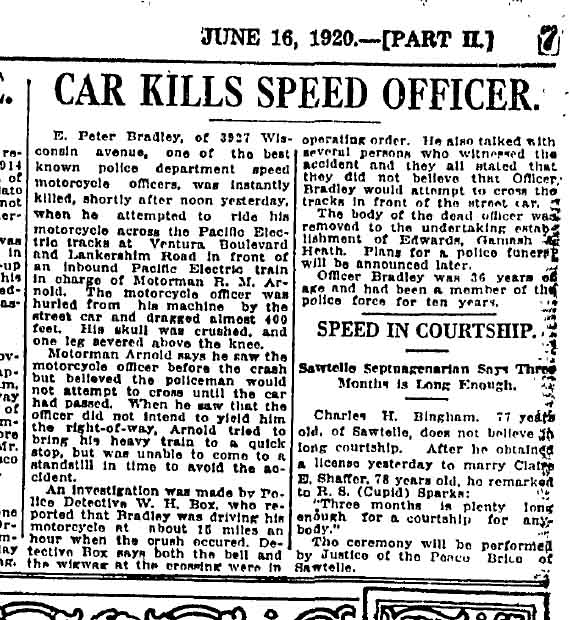
June 16, 1920: Motorcycle Officer E. Peter Bradley is killed when he ignores crossing signals and is hit by an inbound streetcar at Ventura and Lankershim boulevards.
Posted in LAPD, San Fernando Valley, Transportation | 2 Comments

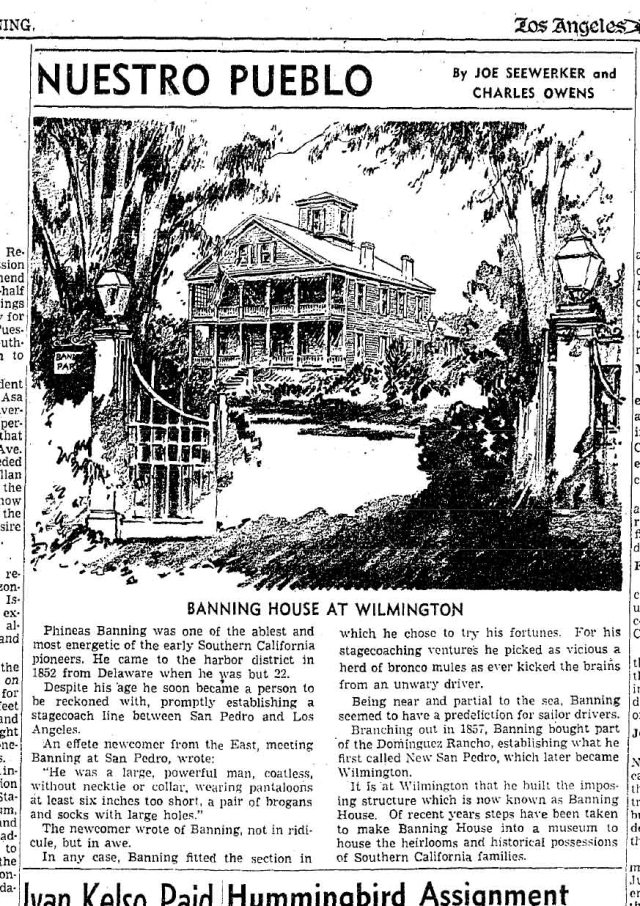
Nuestro Pueblo: Wilmington

Posted in Architecture, art and artists, Nuestro Pueblo | Comments Off on Nuestro Pueblo: Wilmington

Chinese Opium Dens of Los Angeles

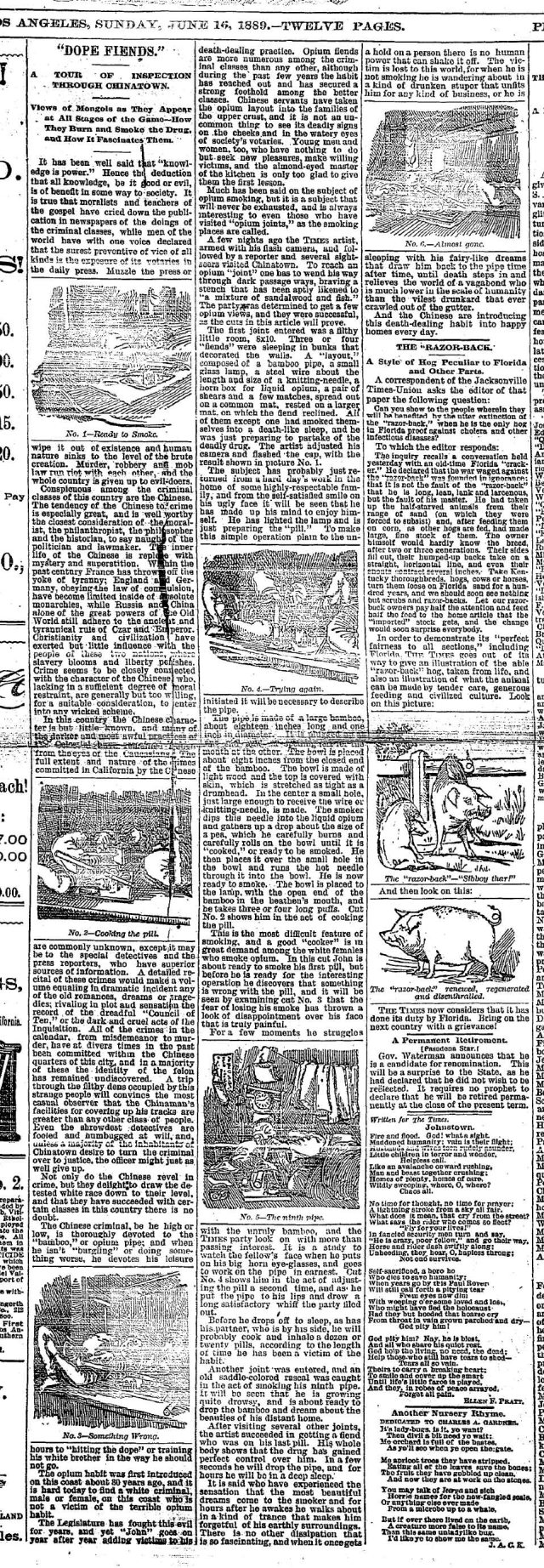
June 16, 1889: After quite a long rant on the degenerate nature of the Chinese — the maids and cooks are corrupting the good white homes of Los Angeles by providing narcotics to young, idle society men and women — the reporter gives detailed steps on how to cook and smoke opium.
Posted in Downtown | 1 Comment

Woman Who Asks Men to Marry Her Is Crazy!

June 16, 1889, Court

June 16, 1889: An update on Louis Silverstein and the case of Minnie J. Hinton, 40, who kept asking men to marry her. And yes, we described a 40-year-old woman as an "old lady."
Posted in Uncategorized | Comments Off on Woman Who Asks Men to Marry Her Is Crazy!

Found on EBay — Old Map of Los Angeles

1954 Thomas Bros. Guide

A 1954 Thomas Bros. Guide for Los Angeles has been listed on EBay. These old maps come in handy around the Daily Mirror HQ. Bidding starts at $9.95.
Posted in Freeways | 2 Comments