Matt Weinstock, July 16, 1959

Tomato in a Hamburger?

Matt Weinstock Again,
the other day, I became embroiled in an old argument. I stood firmly on
my contention that the slice of tomato does not belong in a hamburger
sandwich. Most of the other people at the barbecue held that it does.

Mustard,
relish, lettuce and, if one is feeling brave, onions — yes. Tomato,
no. Furthermore, I'm not so sure about the dill pickle. Let's just let
it lay on the plate, to be eaten or not to be eaten. A pickle is a
matter of mood.

Tomato, I argued, is a nothing flavor, which
diffuses and distorts an already perfect hunk of eating. Not only that,
it adds to the sandwich's thickness, making it difficult to eat.

The opposition scoffed, repeating the ridiculous canard that a hamburger is not a hamburger without a slice of tomato.

July 16, 1959, Liz Renay All
right, so I am exposed as a tomato hater. All I can state is that it's
about time those of us who feel deeply on this subject start a revolt
against this vicious tyranny.

::

WORD STUFF — An announcer on a Lancaster radio station, Jimmie Warrell reports, told of two bicycle riders traveling from "Holiet, Illinois, to La Hoya, California." Those Spanish Js will getcha . . . There's an Ingomar St. in Canoga Park and Stan Wood, an admirer of Ingemar Johansson, says whoever named it may have been psychic but wasn't a very good speller . . . And Herb Schnebble wonders if Al Capone ever passed through El Cajon.

::

DOWN THE MIDDLE
Vacation pleasures
I'd willingly share;
"Wish you were here!"
And I were there.
       — RALPH FREEMAN

::

IN 1950 Paul Werth paid Harry Belafonte $50 for appearing in concert in Town Hall, New York. A few days ago Werth, now with KRHM-FM,
taped a four-hour show with the noted singer for next Monday night and
jokingly suggested that he would be glad to arrange another such
concert and maybe up the ante to $75. Offer laughingly declined.

::

A SOCIOLOGY student at SC made a telephone survey after 9 p.m. to learn how many parents knew of their children's whereabouts.

Of
25 calls, he was surprised to discover, the phone was answered nine
times by children who didn't know where their parents were.

::

A MUNICIPAL
employees cafeteria, which actually serves excellent food, is known
among them as the Ulcer Room. Perverse, those fellows . . . And a Hill
St. gentleman drinker named Chuck, explaining a brief absence from the
bat caves, said he'd been attending "a bourbon seance."

::

july 16, 1959, Miss Cuba AROUND TOWN — Baseball fever note: On coming out of the anesthetic after giving birth to their first child, Martha Dubell, wife of pianist Cy Dubell, asked her doctor, "How did the Dodgers make out?" They lost but she's doing fine . . . Six Bonita High Schoolers
are grateful to Bill Bendix, who put out in his speedboat in Lido Isle
channel and towed their stalled sailboat to safety. And not a press
agent in sight.

::

FOOTNOTES —
Ray Duncan nominates for the trite movie dialogue file the line,
"Forgive? There's nothing to forgive!" The heck there isn't . . . When
the temperature soared over the weekend, adman Joe Vodneck , Pasadena
apartment dweller, took his wife, Adrienne, and daughter, Lisa, to a
nearby motel where they enjoyed the pool and air conditioning. Next morning back to Hotsville
. . . Because of conflicting warnings which have gone out lately over
the wireless Hank Osborne thinks the world is ready for an album titled
"Best of the SigAlerts " . . . Aside to a lady named Julia: Those gals
on Hollywood Freeway islands and shoulders were only part-time
picnickers. Between bites of lunch they were taking the annual state
highway traffic count.

Posted in Columnists, Matt Weinstock, Mickey Cohen | Comments Off on Matt Weinstock, July 16, 1959

Paul V. Coates — Confidential File, July 16, 1959

july 16, 1959, Cover

Confidential File

Some Judges Deal in Real Justice

Paul CoatesTwo weeks ago I quoted you a rather amazing conversation between an attorney and Los Angeles Municipal Judge George B. Ross.

At least, to me it was amazing.

The gist of the judge's remarks to the attorney, who was questioning the severity of the sentence given his client, was:

If
a man pleads not guilty and asks for a jury trial, and he's found
guilty, and I believe he was obviously guilty, it's going to cost him a
lot more than if he pleaded guilty in the first place.

The
attorney, Louis Romero, argued that trial by jury was the right of
everyone, rich or poor. It was not a privilege reserved only for the
wealthy.

He added that levying heavier fines against individuals who used their right of jury trial was a deterrent to justice.

Judge
Ross replied, "Maybe so, but that is what I am doing. That is what
other judges are doing, and you are going to have a to persuade a lot
of judges to change their minds…"

July 16, 1959, Trunk Killer At the time, I questioned Judge Ross' statement that it is a common practice of our courts to soak someone for exercising a constitutional right.

And last week, Mirror News reporter Paul Weeks polled several judges, who both denied and criticized the use of such a policy.

I thought, then, that possibly Judge Ross' attitude was a unique one.

But
today I received a copy of "The Open Forum," official publication of
the American Civil Liberties Union of Southern California.

In it was the following article:

 "A
Long Beach judge who habitually set excessive bail when a defendant
insisted on a jury trial was officially condemned in a ruling handed
down by Superior Judge Frank G. Swain last month.

"The court granted a petition for a writ of habeas corpus in the appeal of Emery Newbern, merchant seaman, and ordered his bail reduced from $500 to the customary $25.

"Judge Swain appointed ACLU counsel A.L. Wirin to represent Newbern in the appeal of Municipal Judge Charles T. Smith's bail policy.

"Wirin argued that the Long Beach jurist had denied Newbern's constitutional rights to reasonable bail solely because the defendant has exercised another constitutional right, trial by jury.

Bail Held Excessive

"Judge Swain held that $500 bail on a drunk charge is 'excessive' and penalizes the petitioner for demanding his constitutional rights.

"
'It is undisputed that the purpose of bail is to assure defendant's
presence in court at the required time and bail set at a figure higher
than an amount reasonably calculated to fulfill this purpose is
excessive under the Eighth Amendment of the U.S.Constitution,' Judge Swain ruled.

"At Newbern's
arraignment, Judge Smith remarked from the bench, 'My policy is that if
you plead not guilty and demand trial by jury and are found guilty, you
are going to get 90 days in jail; and I will bet you 100 to 1 that the
jury finds you guilty.' "

Judge Smith's quoted remark is about
as shocking a statement as I've ever heard attributed to a man paid by
the taxpayers of our country to administer justice.

If it
weren't for the cynicism which accompanies my advancing age, I'd say
that a judge's betting a defendant that a jury will find him guilty is
an inconceivable bit of dialogue. It sounds like something out of a burlesque routine or out of a Moscow courtroom.

However, such bizarre interpretations of justice in our courtrooms are more the exception than the rule.

It's
reassuring to know that there are dedicated men like Judge Swain who
don't feel that the robe is so sacred that its wearers aren't subject
to public criticism when the occasion warrants.

And if Judge Smith made the remarkable statement attributed to him, the occasion certainly warrants.

Posted in Columnists, Paul Coates | Comments Off on Paul V. Coates — Confidential File, July 16, 1959

A Kinder, Simpler Time Dept: Your Movie Stars

 
July 16, 1939, Movies

July 16, 1939: The comedians vs. the leading men in a benefit game at Wrigley Field.  

Posted in Film, Hollywood, Sports | Comments Off on A Kinder, Simpler Time Dept: Your Movie Stars

Nuestro Pueblo

July 16, 1939, Seewerker Nuestro Pueblo

On July 15, 1939, Jane Seewerker, wife of Times writer Joe Seewrker, died in Long Beach. Joe Seewerker and Charles Owens had been producing three features a week, but after Jane Seewerker's death, their schedule went to once a week.
Posted in art and artists, books, Nuestro Pueblo, Obituaries | 1 Comment

Police Court

 
July 16, 1899, Police Court

July
16, 1899: Malicious mischief … selling lottery tickets … speeding … theft and robbery. And yes, The Times refers to a "slant-eyed disciple of Confucius."

Posted in #courts, LAPD | Comments Off on Police Court

Man Dies of Tetanus

July 16, 1889, Tetanus

July 16, 1889: A man dies of tetanus and railroad employees are suspected of raping two passengers.

Posted in health, Transportation | Comments Off on Man Dies of Tetanus

Found on EBay — The Courthouse

Broadway Courthouse A postcard showing an unusual view of Broadway, with the courthouse in the foreground at left and City Hall in the background, has been listed on EBay. Bidding starts at $7.99.
Posted in #courts, Architecture, Downtown | Comments Off on Found on EBay — The Courthouse

Matt Weinstock, July 15, 1959


July 15, 1959, Uras

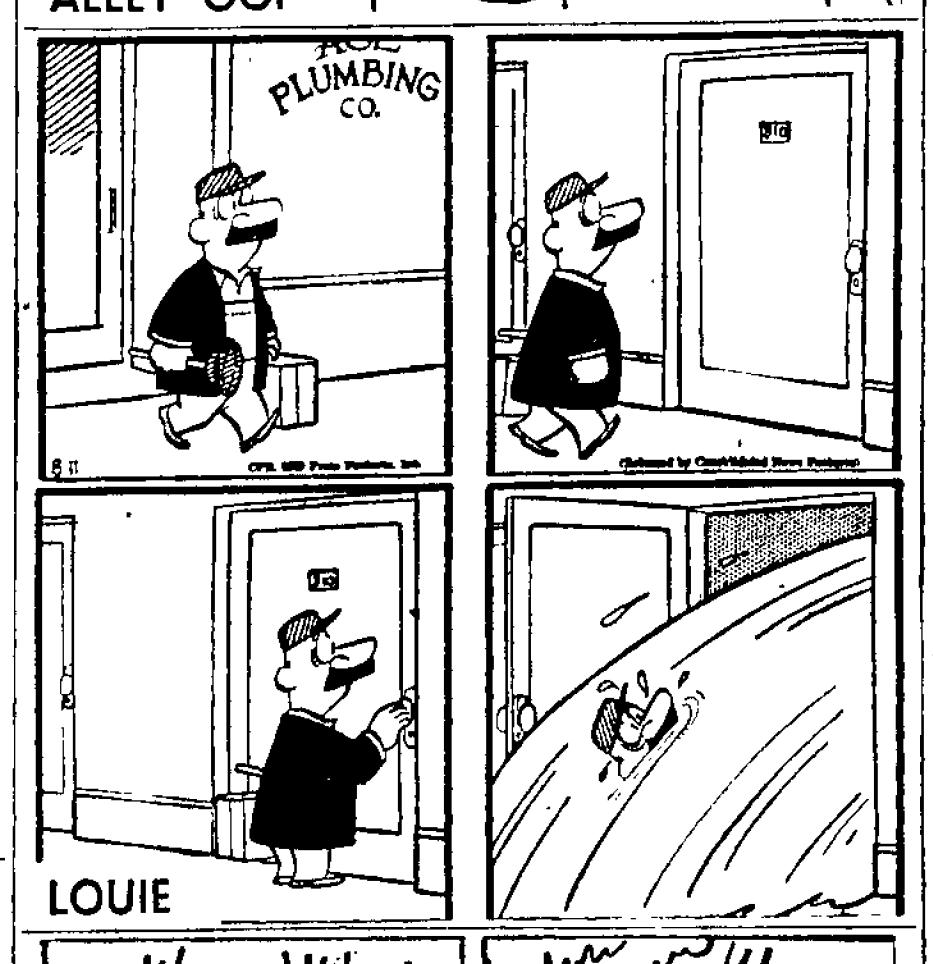
I'm sure "Uras" wasn't pronounced the way you think. Either that or the comics editors didn't have a clue. 

Only in L.A.

Matt Weinstock Sometimes it is
very difficult to make clear to visitors that the natives are not
really as quaint as they seem. Take, for instance, Bob Williams, TV
editor of the Philadelphia Bulletin, vacationing here.

To get
around our spread-out paradise, Bob rented a car. He parked it the
other night at the curb outside the hotel in Beverly Hills where he was
staying.

Next day at 7 a.m. his doorbell rang. A stranger,
polite but with a sense of urgency, asked if Bob would consent to
having his car moved two spaces away. Just give him the keys. He would
do it. Bob asked why. "We need the space for another car," was the
reply.

"IT IS IMPERATIVE," he went on, "that my
employer's car be parked where your car is — in front of the walk
leading from his bungalow. I know it's an inconvenience and I wish you'd take this." He offered a $20 bill, which Bob declined.

Bob,
irked at being awakened by such a trivial matter, wanted to know how
the stranger had located him. His rented car didn't have his name on
it. The stranger said he'd found him through the rental agency, which
was the same one from which his employer had rented his car.

The more Bob thought of it the more it bugged him. He called the hotel manager. The manager refused to discuss it. He called the rental car agency and asked who the other person was, describing the car.

July 15, 1959, Judy Garland

"I
can't give you the name," was the discreet reply. However, he confided
the name of the big aircraft firm to which the car had been assigned.

Baffled Bob will always have a dark suspicion that people here are driven by mad, uncontrollable whimsies. One thing sure — it couldn't have happened in sedate Philadelphia.

::

BREAKDOWN of negotiations and the resultant steel strike reminded newsmen of a classic line in another similar dispute.

A union spokesman said to the management representative, "But you're talking money and we're talking people!" Whereupon everyone cried.

::

July 15, 1959, Garland THE stenographic pool at a large organization has been enhanced by some shapely young girls just out of school and an executive, who likes to keep abreast of developments, dropped in the other day and said to the supervisor, "I see you have some new talent."

"Yes," she replied sweetly, "but all passes have to go through channels."

::

AND THE WAY
Don Perkins heard it, two fellows were chatting over coffee and one
said, "I had a funny dream last night. I dreamed I was 8 years old and
went to Disneyland."

"That's strange," the other said, "I had a
crazy dream, too. I dreamed that Marilyn Monroe came over to my house
and 15 minutes later Jayne Mansfield dropped in."

"You mean they were both there?" the first exclaimed. "Why didn't you call me?"

"I did," was the reply, "and your mother told me you had gone to Disneyland."

::

July 15, 1959, Abby SOMEONE, Bob McMullen
reports, has posted a derisive sign at Laurel Canyon Blvd. and Lookout
Mountain Ave., "Guide Maps to Burned Out Homes" . . . And colleagues
are talking of awarding a plaque for devotion to duty to a TV announcer
who during the chaotic first moments of last Friday's fire kept
pleading for people to keep out of the area. "Please stay home," he
said, "and enjoy the fire on TV."

::

AT RANDOM — On
Sunday Julia Nye counted six family groups enjoying picnic lunches on
Hollywood Freeway islands and sidings — the grassy parts. Apparently
tourists think it's a park . . . A man whose little flower shop is near
a saloon, into which he makes frequent pilgrimages, is known among his
customers as the Petrified Florist. . . Obviously, says Harry Kabakoff, newsboy at 7th and Broadway, the Russian people feel that Mr. K. has an O in front of his name. . . Bruce Baptiste asks a typographical
posy to the officer who on July 9 in the noon heat — above 90 —
stopped and changed a tire for a lady in distress on Harbor Freeway
near Vermont Ave.

Posted in Columnists, Matt Weinstock | 1 Comment

Paul V. Coates — Confidential File, July 15, 1959

July 15, 1959, Evil Woman

Confidential File

Harry Karl's Barber Is Pro Tem Leftist

Paul CoatesWhen
he's not busy totaling the day's receipts, Harry Karl, the shoe tycoon,
is a member in good standing of a social class known as the idle rich.

He is, so to speak, loaded.

Unlike you or me, he doesn't wait until the "January white" sales are announced to replenish his home linen supply.

If
his neighborhood supermarket is featuring ground round as a week-end
special, he's the kind of guy who'll shrug it off and plop a seven-bone
roast into his push-cart.

You get the idea? Money, with Harry, is no object.

Take haircuts. I know, and you know, that at $1.75 a head, barbers are getting away with daring daylight robbery.

But that's not Harry's feelings. For a perfect trim and the proper swivel-chair treatment, he'll go as high as $1,000.

You don't believe me? Well, sit down and hear me out.

July 15, 1959, Race Mixing Recently,
Karl was sitting in Maury's chair at the Beverly-Wilshire Health Club,
pondering a problem of relatively immense proportions, considering the
moment.

He was about to leave on an extended vacation to Hawaii.
While there, he would need a haircut. And Maury, his barber for 22
years, wouldn't be available, obviously, to perform the ritual.

"The only answer," Karl sighed finally, "is for you to fly over after me."

Maury, a man quick to oblige the whims of his customers, agreed to make the trip.

On
schedule, Maury arrived in Honolulu. Karl's chauffeur met him at the
airport and drove him to the hotel. Although it was still before 7
a.m., the barber went directly to his customer's hotel suite.

He
banged on the door until Karl woke up and opened it. The shoe magnate
muttered a sleepy greeting, yawned luxuriously and rubbed his eyes
until he could see reasonably well. What he saw made him turn pale. The
barber's right arm was neatly encased in a plaster cast.

"Maury!" he cried, pointing at it in horror. "What's that?"

"My arm," the barber replied. "I broke it three days ago."

"You
can't do that to me," Karl screamed. "Look at my hair. Three weeks I've
been waiting for you to come over here and cut it. And whatta you do? You break your arm."

"I didn't do it on purpose," Maury pleaded.

July 15, 1959, Mirror Cover "A
thousand bucks it cost me to get you over here," Karl raged, pacing up
and down. "Why didn't you call and tell me you broke your arm? Why did
you come all the way over here?"

Maury shrugged. "You got me the ticket, I figured I might as well use it. I never been to Honolulu before."

Karl
collapsed into a chair and buried his uncut head in his hands. Maury
patted him on the back with his good arm. "Look," he said soothingly,
"we'll go to the hotel barber and I'll give him directions how to cut."

"Directions!" Karl shouted. "You could've done that on the telephone. A thousand dollars you cost me. You're a rat, Maury. You hear me? A rat."

Karl
continued pacing and furiously banging a fist into his hand. Finally,
with an exasperated sigh, he said: "As long as you're here, you might
as well stay for a day."

"No hard feelings?" the barber asked meekly.

"My luck," Karl muttered bitterly. "I got to wind up with a one-arm barber."

Guy Needs Some Killing

"No hard feelings?" Maury repeated. "Let's shake on it."

With
a flourish, he thrust out the "broken" arm. "See? It isn't broken," he
said brightly. "It was just a gag I thought up before I left."

I'd
like to end this story by telling you that Karl took the barber's arm
and broke it. But he didn't. If he had, it would mean flying in Maury's
partner from the mainland.

And, after all, who ever heard of paying $2,000 for one haircut.

Posted in Columnists, Paul Coates | Comments Off on Paul V. Coates — Confidential File, July 15, 1959

Young Florita Tears Up the Town

Jan. 31, 1899, Divorce Court

Jan. 31, 1899: Many people, especially the noir fans, prefer the newspapers of the 1930s and '40s, but I love the turn of the century papers because The Times wrote about everything that happened and didn't spare the details.

Posted in #courts, Food and Drink | Comments Off on Young Florita Tears Up the Town

A Kinder, Simpler Time Dept: Your Movies

July 15, 1938, Movies

July 15, 1938: Norma Shearer and Tyrone Power in "Marie Antoinette" at the Carthay Circle.

Posted in Film, Hollywood | Comments Off on A Kinder, Simpler Time Dept: Your Movies

Police Court

July 15, 1899, Police Court

July
15, 1899: An old panhandler … a man arrested for speeding … theft … prostitution and public intoxication. Yes, The Times referred to an Asian as a "slant-eyed celestial."

Posted in #courts, LAPD | Comments Off on Police Court

Killing in Chinatown

July 15, 1889, Siegel the Hatter  

July
15,
1889: Siegel the Hatter, under the Nadeau Hotel.

July 15, 1889, Killing


July 15, 1889: A killing in Chinatown. The old newspapers never spared the gruesome details.

Posted in #courts, Downtown, Homicide | Comments Off on Killing in Chinatown

Found on EBay — Polytechnic High School

Polytechnic High, Library  

A lot of 12 postcards, including Polytechnic High School, top left, and the library, bottom left, has been listed on EBay. Other postcards include Angels Flight, Bullock's downtown, the fountain at what is now Pershing Square, the alligator farm and the Plaza Church.  Bidding starts at $9.99.
Posted in Animals, Architecture, Downtown, Education, Parks and Recreation | Comments Off on Found on EBay — Polytechnic High School

Matt Weinstock, July 14, 1959

July 14, 1959

Morbid Morons

Matt Weinstock It isn't a nice thing to say but an indignant Hollywood hillsider said it and hoped it might be repeated here.

He lives a few ridges away from Friday's holocaust in Laurel Canyon.

He
said, "If we'd had to evacuate, and we were ready, we'd never have
gotten out because the streets were so clogged with morbid morons who
drove up to the area to see a house burning, preferably one with a
hysterical mother clutching a child, with their clothes aflame, running
out of it."

They came roaring up the side streets adjacent to
the fire zone the moment the smoke mushroomed into the sky, he said,
and kept coming despite constant appeals by firemen over radio and
television, urging everyone to stay away.

Hillside residents, he added, are still shuddering at what might have happened but for the efficiency of the firemen.

It's a sad commentary but there are people like that.

::

July 14, 1959, Secret Bureau THE SENTIMENT
was echoed by John Paley, who lives at 7900 Willow Glen Rd., at the
corner of Woodstock. The fire burned to his fence but his home was
saved by firemen and neighbors. He was evacuated.

Yesterday, as
firemen continued to patrol the area, putting out hot spots,
sight-seers with picnic lunches invaded the area and an ice cream wagon
set up in business.

He heard one woman say disappointedly to her companion, "Look, there are two houses still standing!"

He calls them "spooks" and hopes the hungry wild animals roaming the devastated area may nip them in the rear.

::

AND THEN there was the hillsider who told a friend, "When they said to evacuate I grabbed my two dogs and my unemployment insurance card and went."

::

RETIREMENT of Officer Bill Shurley after 28 years on the LAPD reminded J.M.M. of the Troublesome Thirties, when Main St. was Shurley's beat.

"I never saw him rough-handle a man," recalled J.M.M., a bartender at the time in the old Belmont bar at 5th and Main Sts.,
"and there were some real characters running loose at the time." Among
them were white-bearded, white-robed, barefooted John the Baptist, a
turbaned Indian who claimed to be 350 years old, and a black-bearded
Russian known as Baron Gunpowder.

The Baron would appear at the
Belmont several times a week and order vodka, then virtually unknown.
He would pull the lead up from a .38-caliber shell with his teeth, pour
the powder into the vodka and gulp it down. Meanwhile he would tell of
being chased out of Russia during the revolution, although there was a
rumor that he sold papers at anintersection in Eagle Rock.

July 14, 1959, Abby One
night the regular bartender was off duty and the substitute watched in
amazement as the Baron drank three gunpowder cocktails. But some of the
gunpowder spilled and the bartender touched a few grains of it to his
tongue. "Hey!" he exclaimed, "it's nothing but crushed Sen-Sen!" It was
then recalled that the Baron had always put the shells and bullets in
his pocket after using. He was never seen again.

::

ONLY IN L.A. —
G.B.'s thought while driving at night on San Diego Freeway in West L.A.
near the Santa Monica Blvd. turnoff: The tower of the nearby Mormon
Temple looks like a rocket at Cape Canaveral about to take off, with
the golden angel Moroni and his trumpet as the nose cone.

::

AROUND TOWN — A relucant
youth en route to summer school was listening to a transistor radio,
just like his luckier, non-flunking mates at the beach, while sitting
on a bench, waiting for a bus on WPico Blvd. . . A new sign on Indian Springs swimming pool in Montrose
states, "No sharks here. Come in." And a swimming pool outfit on
Ventura Blvd. "guarantees they can't get into their pools either" . . .
Inflation note: Remember when you used to be "nickleled to death" by the gradual disintegration of your old car? A man at a gas station was overheard remarking he was being "dollared to death" by his jalopy . . . Ted Quillin of KFWB said it: "Help keep Los Angeles clean — send your garbage to San Diego."

Posted in Columnists, Matt Weinstock | Comments Off on Matt Weinstock, July 14, 1959

Paul V. Coates — Confidential File, July 14, 1959

July 14, 1959, Watts Towers

Confidential File

Life Must Go On, Even After Murder

Paul CoatesOn Feb. 19 of this year, Robert L. Mason, 40, went wild with a gun.

He entered the Glendale home of jazz musician Johnny Zorro. He shot Zorro's wife, 31-year-old Mrs. Rona Porrazzo, critically wounding her. And, with two more bullets, he killed Zorro's mother-in-law, Mrs. Susan Jamerson, 52.

At the time of the shooting, Zorro was working in Las Vegas. His son, Page, 5, was the man of the house, and a witness to the murder.

These
facts have all been reported and recorded — by the police, by the
press and by the courts which eventually decided that Mason should die
for his crime.

But what hasn't been reported is the lingering aftermath of the headline case of murder in the first degree.

Yesterday
I met Johnny Zorro for the first time since we were together in the
Glendale Police Station, where Mason was being booked following his
return from Winslow, Ariz.

July 14, 1959, Welfare Zorro was crying at Mason, an acquaintance of five years: "C'mon and face me. Aren't you man enough?"

He
was pounding the table in front of Mason's chair and shouting: "You've
ruined my wife's life, my son's life. My mother-in-law is gone."

Zorro's conversation
with me yesterday bore out too much of his prophecy. A front-page
murder may be forgotten by the public, but its aftermath is still there
to be lived out.

Zorro told me, first of all, about his wife.

"You'll remember," he said softly, "that nobody expected her to live. The bullet had lodged behind her right ear.

"She
was six weeks in the hospital and in bed three months. One side of her
face is still paralyzed. Now, we'll just have to wait."

The young musician added: "Already she's done so many things the doctors said were impossible."

July 14, 1959, Racing Today, Mrs. Porrazzo
walks unaided. But the vision in one eye blurs frequently. She becomes
dizzy quickly. There's always the noise of a roar in her right ear.

"She
wants to get back in her church work. She was real active in it before
the shooting," Zorro told me. "More than anything, though, little Pagie's the reason she's alive today. She wants to live for the boy, for his sake."

Pagie, named by his parents for their friend, Page Cavanaugh, has his memories of the tragedy, too.

"Like
in our telephone number list, we had Mason's name and phone number.
Written in a long time ago," Zorro said. "Without saying anything to
us, little Pagie got a pencil the other day and scratched it out.

"The kid talks about what happened sometimes and he asks me, 'Daddy, do you think he can break out of jail?'"

There's
also a price tag on tragedy, the musician admitted — a tag way out of
line with the family's income. Zorro's wife has undergone three
operations.

"We had two cars," he said. "I sold one. I sold some
furniture. Right now, I guess I still owe about $2,500. I'll just pay
it off little by little."

Family Must Be Preserved

Zorro, a singer who plays the electric guitar, added that he's worked only a couple of times since the shooting.

"Naturally,
I had to be both mother and father to Page when Rona was in the
hospital. I still like to stay home a lot, to be around if I'm needed.

"I know I've got to get back working," he added. "I've been trying, looking around. But things sure seem quiet now. It's tight.

"I'll
stay in the music business," Zorro explained. "I've been supporting
myself in it since I was 16. But I don't know about all the traveling.

"The main thing now," he concluded, "is to keep my family together."

Note: Here are some clippings on the Daily Mirror about the Porrazzo case.

Posted in Columnists, Paul Coates | 1 Comment

A Kinder, Simpler Time Dept: Your Movies

July 14, 1937, Captains Courageous

July 14, 1937: Spencer Tracy and Freddie Bartholomew in "Captains Courageous."

Posted in Film, Hollywood | Comments Off on A Kinder, Simpler Time Dept: Your Movies

Architectural Rambling, R.M. Schindler

R.M. Schindler, Rodriguez House, Glendale
Photo by Susanne Hayek Photography
The 1941 Jose Rodriguez house at 1845 Niodrara Drive in Glendale, designed by R.M. Schindler, has been listed at $2,475,000. The home is an official Glendale landmark. Read more>>>

This home sold for $550,000 in 1999 and for $2 million in 2005, according to Property Shark.

Posted in Architecture, Music, Real Estate | Comments Off on Architectural Rambling, R.M. Schindler

President Carter to Address Energy Crisis; Nolan Ryan Misses No-Hitter

July 14, 1979, Cover

July 14, 1979: The Carter administration's energy crisis… gasoline shortages … Los Angeles County deputies are ordered back to work after a two-day sickout … and Gov. Brown trims the budget by vetoing raises for state employees.

July 14, 1979, Sports In his final season with the Angels, Nolan Ryan flirted more than
once with a fifth no-hitter. Against the Yankees, he lasted until the
ninth when Reggie Jackson singled.

This would have been a controversial no-hitter since Jim Spencer's
liner to center in the eighth was ruled an error on center fielder Rick
Miller. The Yankees were furious and even Angel general manager Buzzie
Bavasi told official scorer Dick Miller of the Herard-Examiner,
"There's no doubt about what it was."

Baseball doesn't use newspaper reporters as official scorers anymore and that's probably a good thing for all concerned.

–Keith Thursby

Posted in Dodgers, Environment, Front Pages, Politics, Sports, Transportation, travel | Comments Off on President Carter to Address Energy Crisis; Nolan Ryan Misses No-Hitter

Why Women Shouldn’t Be Allowed to Vote

July 14, 1899, Women's Suffrage

July
14, 1899: Why women shouldn't be allowed to vote: "The ballot at the present time implies service to the state which women may not give and retain unimpaired their place in the social economy."

Posted in Politics | Comments Off on Why Women Shouldn’t Be Allowed to Vote