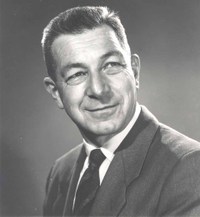
Walter Cronkite — TV’s Father Figure

May 12, 1970, Walter Cronkite

Walter Cronkite, May 12, 1970: "As news disseminators, nobody can touch us. And we have the best informed society in the world's history." He smiled wryly: "That's what worries the Establishment. No Establishment likes the people to be too well informed."

Then with a sigh, he said: "Our glaring weakness is as news gatherers. We are distinctly third-rate. without the newspaper news services, we'd die."

Posted in @news, broadcasting, Obituaries, Television, Walter Cronkite | Comments Off on Walter Cronkite — TV’s Father Figure

Walter Cronkite Interviews LBJ on Kennedy Assassination

May 3, 1970, Walter Cronkite, LBJ

May 3, 1970: Walter Cronkite interviews former President Johnson about the assassination of President Kennedy. Johnson said he was undermined by holdovers from the Kennedy administration.
May 3, 1970, Walter Cronkite, LBJ

Posted in @news, broadcasting, Obituaries, Politics, Television, Walter Cronkite | Comments Off on Walter Cronkite Interviews LBJ on Kennedy Assassination

Walter Cronkite on Nixon Era Attempt to Intimidate TV News

Nov. 26, 1969, Walter Cronkite, Spiro Agnew

Nov. 26, 1969: "It's not reaction to a charge made against us that is the question that is at stake here. It's the reaction to an implied threat to freedom of speech in this country."

–Walter Cronkite, on Vice President Spiro Agnew's criticism of TV news. During his speech, Agnew noted that radio and TV stations are federally licensed.

Posted in @news, broadcasting, Obituaries, Richard Nixon, Television, Walter Cronkite | 1 Comment

Walter Cronkite — Covering Vietnam

April 28, 1966, Walter Cronkite

Walter Cronkite, April 28, 1966: "I am annoyed though, when I see reviews of our specials on Vietnam criticizing us because, as they put it, we didn't clarify the issues. How can we clarify the issues? Washington itself hasn't, so why would we be expected to? All we can do is throw some light on the debate."

Posted in @news, broadcasting, Obituaries, Television, Walter Cronkite | 1 Comment

Walter Cronkite — JFK Dead

Nov. 23, 1963, Walter Cronkite

Nov. 23, 1963: "[Walter] Cronkite's voice broke when he said that the official word had come that the president was dead. Chet Huntley's eyes brimmed. David Brinkley in Washington wore sorrow in his face. [ABC Vice President James] Hagerty held his head and signed."

Posted in @news, broadcasting, Obituaries, Television, Walter Cronkite | Comments Off on Walter Cronkite — JFK Dead

Walter Cronkite on TV News

May 24, 1962, Walter Cronkite

Walter Cronkite, May 24, 1962: "A major problem is that TV is a pictorial medium and we must find what we can to illustrate hard news," Cronkite said. "We are trying to use the remote interview technique that Ed Murrow developed in 'Small World' — when it's called for. Do an interview filming the subject and talking to him via telephone."

Posted in broadcasting, Obituaries, Television, Walter Cronkite | 1 Comment

Walter Cronkite — Anchor Man

June 19, 1960

June 19, 1960: …"A fast-moving, exciting convention — I love it. I wish we could have it every week; this is what television is made for," Walter Cronkite.

June 19, 1960, Cronkite

Posted in broadcasting, Obituaries, Television, Walter Cronkite | Comments Off on Walter Cronkite — Anchor Man

Walter Cronkite on the Suicide of Rommel

March 24, 1946, Cronkite on Rommel's Suicide

By Walter Cronkite, March 24, 1946 on the death of Field Marshal Erwin Rommel: "As soon as he had taken his seat in the back one of the generals immediately handed him the cyanide capsule. He put it in his mouth in the same moment. Even before the chauffeur had started the car and put it in gear to drive away I could see that the field marshal was dying.

Posted in @news, broadcasting, Obituaries, Television, Walter Cronkite | Comments Off on Walter Cronkite on the Suicide of Rommel

Walter Cronkite in a Flying Fortress Over Germany, 1943

Feb. 27, 1943, Walter Cronkite

"Bombs away." Walter Cronkite describes a bombing raid on Wilhelmshaven, Germany, Feb. 27, 1943.  

"This is a lot of fun but sometimes I think it ain't healthy," a flier says.

Feb. 27, 1943

Posted in @news, broadcasting, Obituaries, Television, Walter Cronkite | Comments Off on Walter Cronkite in a Flying Fortress Over Germany, 1943

Found on EBay — Chester Place

Chester Place EBay

A postcard showing a home in  Chester Place has been listed on EBay. Chester Place, near Adams and Figueroa, was developed by Judge Charles Silent. The development was named for Silent's  son Chester, a Stanford student who died in a peculiar accident with a shotgun in 1907.  Bidding starts at $3.25.
Posted in Architecture | Comments Off on Found on EBay — Chester Place

Matt Weinstock, July 17, 1959

Phony Phone

Matt Weinstock A red-hot report
came sizzling this way the other day. A gal named Elizabeth who lives
on Tiger Tail Rd., which should have been the tip-off that things were
somewhat twisted,breathlessly related she saw a boy talking on a telephone while riding a bicycle on Bundy Dr. in West L.A.

Bicyclists chatting as they pumped, if it became a trend, could immeasurably complicate society, so I dutifully ran the report through the grinder. The conclusion — highly unlikely.

Motorcycle
officers have them, of course, but the equipment for a portable phone
weighs around 40 lb. and requires a power unit. Dry batteries won't
work. Ted Schmidt of Pacific Telephone asked an engineer if it were
possible and he replied cagily, "Anything's possible."

But it was his guess that the boy was carrying on imaginary conversation with his toy telephone to impress a gullible gal named Elizabeth.

::

AS ANY old-timer who has passed up dozens of opportunities will tell you, the big money in Southern California is real estate, not shooting craps at Las Vegas or picking longshots at Hollywood Park, and many tales are told thereof.

Biggest bonanza story I've heard lately concerns a man who nearly 20 years ago bought a two-bedroom house in Reseda for $4,000. It's up for sale for $27,500 and it appears, from the action he's getting, that he'll score.

::

SUPPOSE
you are driving in the left lane on the freeway and you look in the
rear view mirror and see two fire trucks bearing down on you.

You
know you should pull to the right but you can't without creating a
hazard because you are in the midst of four solid lanes of traffic.
Meanwhile the fire trucks, red lights flashing, come closer, moving
from one lane to another as cars slow to let them through. What should
you do?

"The main thing is not to panic," says Lee Zitko of the LAFD.
"We know our rigs look ominous coming up from the rear, but they are
not. We use the freeways as little as possible and when we do we travel
at freeway speed. It's fine if drivers can get as far as possible to
the right but if they can't we want them to know we won't push them off
the road."

In the case cited, the fire trucks were responding to
a car which caught fire on the freeway after a crash. When they got to
it the fire was out.

::

FIRST THING
people in other parts of the country ask when they learn you're from
L.A., reports Don McDonald of U-I, just returned from a tour, is, "Is
the smog there as bad as the papers say?"

But he got a different reaction from Jack Guinn, city editor of the Denver Post. When he was here a year ago, Guinn
said, it was so hot he stayed in his air-conditioned hotel room and
turned on the radio. And you know what most fascinated him about the
city? The dramatic traffic bulletins about tie-ups on the freeways.

::

AROUND TOWN — Not long ago Barker Bros. moved its business office from downtown to the West Side and in the reorganization
gave notice of dismissal to seven employees. But more than sympathy
went with the notice. The boss got jobs for all seven elsewhere and
they're grateful . . . James K. Hyde saw a truck on Highway 101 with
the notice on the rear, "Please don't hug me. I'm going steady" . . . A
man picketing a building at 6th and Lucas Sts. wears shorts.

::

AT RANDOM —
Biting line by Lord Bertrand Russell in the S.E. Post in reference to
space travel by man: "As yet, our follies have been only terrestrial;
it would seem a doubtful victory to make them cosmic" . . . Doris
Hellman, who quivers like a leaf in the wind at misuse of the language,
is shaking over the cigar commercial which describes some cigars as
good, others as "ungood" . . . All the summer repeats, Phil Wolfson contends, are giving viewers "telaversion" . . . Gal named Sue likes to ponder over a sign at Venice and Main Sts. "No Parking by Permission Only."

Posted in Columnists | 1 Comment

Paul V. Coates — Confidential File, July 17, 1959

Confidential File

New Criterion for Beauty Contestants

Paul CoatesI see we're on the verge of conducting another Miss Universe Beauty contest. The ripest, most exotic representatives of international young womanhood are — at this very moment — clustered in Long Beach.

They are going to be clothed in skimpy bathing suits, measured by exacting mathematicians, and ogled by scores of professional beauty-oglers, and not a few amateurs.

And I would like to register a protest.

Don't misunderstand me. I'm not yet so old that I want to discourage promenades of beautiful women.

I think we should have beauty contests. They're kicks.

But
if I may, I'd like to insert a little phrase which I coined because it
makes my point so well. To wit: Beauty is only skin deep.

I
mean, selecting the most perfect specimen of womanhood in the world
isn't a task we should undertake with only casual surface study.

According
to the rules of the game as it's played now, all a girl has to do is
parade past some bald heads, be beautiful, a play a tune on the cello,
and make a two-minute talk on "The Wondrous Port of Long Beach."

If
she's reasonably proficient in these skills, she has a chance to walk
off the stage with the title of Miss Universe and the attendant
prestige as the world's most desirable woman.

But unless you're one of those way-outs who dig the cello, is she really?

To
be the world's most desirable girl, a young woman must have the full
potential for becoming the world's most desirable wife, since becoming
a wife is woman's destiny.

Omission Rectified

It seems to me that the judges at Long Beach ignore this fact completely.

As
a consequence, I have found it necessary to cover this glaring omission
by developing the Coates Marriage Quotient Test for all Miss Universe
contestants.

The quiz follows — and answer the questions honestly, young ladies. If you cheat, you're only cheating yourselves.

1 — Do you leave bobbypins in the bathroom sink?

2 — Do you think a wife should be content to live on her husband's income?

3 — Which of the following would you consider to be the ideal date: Tommy Sands, Gen. Charles de Gaulle, Sen. John McClellan, Charles Addams or C. Aubrey Smith?

4 — Do you realize that C. Aubrey Smith has been dead for almost 20 years?

5 — Do you shop for "specials" in the supermarket?

6 — Do you believe in double beds for married couples?

7 — Have you ever been arrested?

8 — Have you ever tossed a Stanley party?

9 — Do you belong to a Christmas Club? (A "no" answer from Buddhists will not be scored against them.)

10 — Do you think Jimmy Hoffa is "cute"?

11 — Do you agree with the philosophy that a woman's place is in the kitchen?

12 — When your checking account is overdrawn, do you blame (a) yourself, (b) the bank?

13 — You are traveling in the outside lane, approaching a busy intersection. You wish to make a right turn. Should you signal the traffic behind you with your right or left arm?

14 — And you say you've never been arrested?

Some Are Non-Americans

The
Coates Marriage Quotient Quiz, properly filled out, should give us an
accurate basis for selecting a winner. But it just occurs to me that
there's only one flaw in this whole thing. Many of the contestants
can't read or write English.

That however, isn't my fault. It's
the fault of the committee. Why do they have to allow foreigners in a
Miss Universe contest, anyway?

Posted in Columnists, Paul Coates | Comments Off on Paul V. Coates — Confidential File, July 17, 1959

A Kinder, Simpler Time Dept: Your Movies

July 17, 1940, Movies

July 17, 1940: Margaret Sullavan and James Stewart in "The Mortal Storm."

Posted in Film, Hollywood | Comments Off on A Kinder, Simpler Time Dept: Your Movies

Movie Star Mystery Photo


 July 13, 2009, Mystery Photo

 Los Angeles Times file photo

Update: As many people guessed, this is Annabella. Above, Feb. 14, 1937: "Wings of the Morning,

Annabella; French Actress Appeared in Gance's 'Napoleon'

September 20, 1996

Jan. 26, 1947, 13 Rue Madeleine

From Times Staff and Wire Reports

PARIS
— Suzanne Charpentier, the French actress better known by her screen
name Annabella for such films as "Napoleon" and "Hotel du Nord," has
died of a heart attack. She was 86.

Annabella, who was once
married to American actor Tyrone Power, died Wednesday at her home in
the Paris suburb of Neuilly-sur-Seine while she was having her morning
tea, her friend Jose Sourillan said.

"She was just sitting there fine and was dead a second later," he said.

Annabella's
career began in 1926 with Abel Gance's silent epic-length "Napoleon,"
which was restored in the mid-1980s by American director Francis Ford
Coppola.

She also starred in a string of 1930s talkies that took
a sentimental view of working-class Paris, including the 1938 classic
"Hotel du Nord."

Among her other films were "Wings of the
Morning" with Henry Fonda in 1937, "Suez" with Power and Loretta Young
in 1938 and "13 Rue Madeleine" with James Cagney in 1946.

"Annabella
is the sparkle that makes 'Wings of the Morning' different," wrote
Times film critic Edwin Schallert. "Pretty and versatile, she displays
unrivaled naturalness in her work."

Annabella returned to France
after her divorce from Power in 1948. She made her final film, "Le Plus
Bel Amour de Don Juan" (The Most Beautiful Love of Don Juan), in 1952.

The actress is survived by a daughter, Anne Werner Power, who lives in Boston.

::

Just
a
reminder on how this works: I post the mystery photo on Monday and
reveal the answer on Friday … or on Saturday if I have a hard time
picking only five pictures — sometimes it's difficult to choose. To
keep the mystery photo from getting
lost in the other entries, I move it from Monday to Tuesday to
Wednesday, etc., adding a photo every day.

I have to approve
all comments, so if your guess is posted immediately, that means you're
wrong. (And if a wrong guess has already been submitted by someone
else, there's no point in submitting it again.) If you're right, you
will have to wait until Friday. There's no need to submit your guess
five times. Once is enough. The only prize is bragging rights. 

The answer to last week's mystery star: Noreen Nash!

July 14, 2009, Mystery Photo

Los Angeles Times file photo

Update: June 15, 1939: Annabella in "Sacrifice d'Honneur."

Here's another picture of our mystery star. Please congratulate Steven Bibb and Dewey Webb for identifying her!

July 15, 2009, Mystery Photo

Los Angeles Times file photo

Update: Annabella, Oct. 23, 1937.

Here's another picture of our mystery woman. Please congratulate Jeff Hanna for identifying her!

July 16, 2009, Mystery Photo

Los Angeles Times file photo

Annabella and James Cagney in a publicity still for "13 Rue Madeleine," Feb. 19, 1947.

Here's our mystery woman with (not much of) a mystery companion. Please congratulate Jane Ellen Wayne, Mike Hawks, Anne Papineau, Claire Lockhart, Rance Ryan, Carmen, Cinnamon Carter, "Laura" fan Waldo Lydecker and Mary Mallory and co-worker Sue for identifying her.  (And Zabadu, whom I overlooked earlier!) 

July 17, 2009, Mystery Photo

Los Angeles Times file photo

Nov. 20, 1946: Annabella and husband Tyrone Power at the premiere of "The Razor's Edge" in New York.

Please congratulate Sonny King, William, Michael Ryerson, Sue, Annie Frye, Sam, Megan Bailey and Stacia for identifying her.

Posted in Film, Hollywood, Mystery Photo | 53 Comments

Apollo’s Unseen Titan


July 17, 1969, Cover

July 17, 1969: Apollo Speeds on Its Incredible Quest.

COLUMN ONE

Apollo's Unseen Titan

Without Gene Kranz to guide him, Neil Armstrong might never have landed on the moon. The obscure but fiery flight director made the crisis decisions that helped the American folk hero make history.


July 3, 1994

By ROBERT LEE HOTZ, TIMES SCIENCE WRITER

HOUSTON — Of the sounds humanity has made on Earth, only a nuclear explosion is louder than the unthrottled thunder of the Saturn rockets that carried men to the moon.

On July 16, 1969, when a Saturn lifted the Apollo 11 capsule free of Earth on its historic journey to the moon, one man hundreds of miles from the launch pad in Florida felt its apocalyptic energy reverberate in his marrow: NASA Flight Director Gene Kranz, on the edge of his seat in the windowless "trench" of NASA's Mission Control in Houston.

July 18, 1969, Cover Neil Armstrong, the Apollo 11 commander, was the first human to walk on the moon. Kranz was the man who guided him the last miles onto its dusty, pockmarked surface.

Of America's secular heroes, few stir the spirit as deeply as the astronauts who a generation ago left the first footsteps on the moon.

But few ever knew the names or the stories of the faceless, can-do engineers who directed them there safely.

If Armstrong–the Apollo astronaut whose features were masked by his mirrored helmet–was the public image of American space prowess, Kranz–the hard-charging flight director–was its private face.

Armstrong was a paragon of Protestant test pilot cool: terse, aloof, unknowable. He was a blue-eyed Eagle Scout with a hesitant, lopsided grin, so shy that there are almost no clear pictures of him standing on the moon's surface, only photographs of his footprints and his shadow. He declined to be interviewed for this story, as he declines almost all interview requests.

Kranz was unabashedly sentimental, a fierce agency loyalist who played Sousa marches in his office to pump up his adrenaline. He relished his in-house reputation as a relentless taskmaster who earned the nickname "General Savage."

Today–25 years after the moon landing–Armstrong is still a national folk hero. Kranz is virtually unknown outside an inner circle of NASA veterans.

What they share is the stuff of history–a journey given only once to the human race.

Both men were born in small Ohio towns barely 100 miles apart at the bottom of the Depression. Both were fighter pilots in the 1950s. They never met until they joined NASA. They never spoke directly during the moon mission. They almost never speak now.

July 19, 1969, Cover They were never so close as when they were farthest apart–when Armstrong, 240,000 miles from Earth, was searching for a safe landing site only a few miles above the moon, with capsule emergency alarms flashing, the on-board computer on the verge of a breakdown, and only scant minutes left before the landing fuel ran out.

For those 13 minutes of the lunar descent, half a billion people held their breath.

The efforts of 300,000 technicians, the labor of eight years at a cost of $25 billion, a Cold War rivalry, and a murdered President's promise hung in the balance.

When Armstrong set the lunar lander down safely, the national victory was so complete that for decades the Soviet government would officially deny that there had even been a race to the moon.

It was Kranz–in a locked control room with a dozen young engineers relaying data buzzing in the earphones of his headset–who decided to override the alarms and give Armstrong the chance to land the spacecraft on the moon.

*

Gene Kranz had a style all his own.

There was the frown, of course. Human nature gave him that. His voice had a flat Midwestern edge that, even at its friendliest, retained a hard edge of reflexive command.

July 20, 1969, Cover Then there was that blond bristle of a crew cut, shaved so close you could see the muscles tighten at the back of his skull when he concentrated. He owed the style to the Air Force and the close trim to a barber in Clear Lake, Tex.

"I was the most emotional of the flight directors," Kranz, 61, said in a recent interview. "Space really got me all honked up."

Kranz has the kind of mind that seems happiest when it is running a dozen trains of thought along parallel tracks–the sort of fellow, friends say, who relaxes by working on a full-scale aerobatic biplane in his garage, pruning prize roses and baking bread all in one afternoon.

As the flight director for the Apollo 11 landing–and head of NASA's entire flight control operations branch–he made $21,432 a year. That was enough to raise six children. Five work in the space program.

But it was the vests his wife made that set him off from everybody else in mission operations.

Before each mission, Marta Kranz scoured the fabric shops of Houston for a bold swatch of material to sew into one of his special flight vests. They became as much a part of the early space program as splashdown cigars and ticker tape parades.

Today, Kranz still has 15 vests in an upstairs closet of the modest home the couple moved to when NASA set up operations in Houston.

July 21, 1969, Cover He proudly lays them out on the sofa for a visitor: Paisley brocades. Silver and gold lame. Carnival stripes. Velvet.

The simplest–a plain white silk twill vest yellowed now to ivory–is what he wore for Apollo 11.

White was the color reserved for the leader of the White Flight, as his flight director's shift was known within mission operations.

White Flight was in charge of the lunar landing.

When Kranz retired this year, NASA also retired the color.

*

As a boy in Toledo, Ohio, Kranz never cared much about rocket ships or spaceflight. But as a military pilot in the Pacific in 1957, he was impressed by the way the launch of the Russian Sputnik galvanized people around the world.

A few years after he was discharged–working as a test engineer at Holloman Air Force Base in New Mexico–he saw an ad in Aviation Week magazine. The government wanted engineers for a fledgling space task group being organized at the federal flight research facility in Langley, Va.

He didn't hesitate.

"I just felt that space was the next thing coming in aviation," he said. "It was higher, faster. It had t
he risk."

July 22, 1969, Cover Before he knew exactly what was happening, he found himself on a plane headed for Cape Canaveral, Fla., with orders to prepare for the first unmanned test of the Mercury Redstone rocket that would later carry the first American–Alan B. Shepard–into space.

"They said, 'Go down to the Cape and write us a countdown.' They put me on an airplane. I had never written a countdown," Kranz said, referring to the complex engineering procedures that lead up to a rocket launch. "I landed at Patrick Air Force Base and didn't even know which way the Cape was.

"There was a guy there in a Chevy Malibu with a surfboard in the back. He says: 'What are you looking for?' I said: 'I got to go out to the Cape.' He said: 'Hop in.' So boom, off we go. I didn't even bother to ask who he was.

"About two-thirds of the way out there I found out it was Mercury astronaut Gordon Cooper. That was my introduction to the original seven astronauts," he said.

When the moment for liftoff came, the Redstone rocket died on the launch pad.

That was his introduction to spaceflight.

*

When Kranz signed up for the space race, he was 27 years old. NASA was still in the making. There was no organized civilian space program to speak of.

 There was no such thing as Mission Control. People like Kranz, his mentor–a short, icy engineer named Christopher Columbus Kraft, the agency's first flight director–and operations chief Walt Williams built it from the raw material of their own personalities and engineering styles.

July 23, 1969, Cover At the apex of the structure they created through trial and error stood the flight director–a single person with absolute authority over operations during a space mission.

He had ultimate control when a manned space capsule was in orbit–and ultimate responsibility if a technical mishap resulted in the death of an astronaut crew.

In the end, it was the flight director's decision to abort a mission–or to proceed in the face of engineering uncertainty.

"The Flight Director may, after analysis of the flight, take any necessary action required for the successful completion of the mission," the mission rules stated.

Any error was unforgivable.

And in the 1960s and early 1970s–the years of Apollo–Gene Kranz thought there was no better job in the world.

*

Kranz became so obsessed with the engineering discipline of mission operations that in the months before Apollo 11 he filled a brown notebook 3 1/2 inches thick with personal notes on how to orchestrate every second of the flight.

 "You have to be intensely aware of . . . pulling this ballet together that involved everybody doing the right thing at the right time under a constantly changing set of circumstances," he said.

But any misgivings, confusion or uncertainty he kept under control and out of view.

"No way can you ever, ever, ever evidence confusion, concern, lack of understanding," he said. "You have to be in charge. You are the guy. You have to be cooler than cool, smarter than smart.

"I did everything by the numbers. I had checklists upon checklists. If I wasn't ahead of everybody on my team, I didn't feel I was doing my job.

"I was constantly testing myself: What am I going to do if. . . ?"

*

In the process, something of Gene Kranz became a permanent part of manned spaceflight.

At the Johnson Space Center in Houston, the Mission Control room Kranz and his colleagues used for Apollo has changed only slightly since 1969.

July 24, 1969, Cover Today, as NASA juggles space shuttle missions and prepares to operate a manned space station, its vocabulary and work habits mimic the obsessive attention to detail and studious nonchalance of flight operations engineers like Kranz and his Apollo colleagues.

During a recent technical rehearsal of an upcoming shuttle flight, loose-leaf binders and foam coffee cups littered the beige and gray flight consoles. The half-light from computer monitors provided much of the illumination.

The faces were young and, in the shadows, energized.

Sprawling at their consoles, the new generation of NASA engineers flirted with simulated disasters.

They were rehearsing landing emergencies with the crew of the upcoming shuttle mission.

They handled each crisis in cryptic murmurs, a language of nods, glances and engineering acronyms. The movements were exaggeratedly casual, the tension so internalized as to be invisible. The calmer things appeared, the worse they must be.

Milt Heflin, lead flight director for the shuttle mission expected to begin Wednesday, watched the exercise from an unused console, patched into the conversations by a frayed headset cable.

Heflin, selected as a flight director by Kranz 11 years ago, called the job "one of the last bastions of common sense." He has handled 19 shuttle flights, including the Hubble Space Telescope repair mission in December–hailed as the most complex space operation since the moon landings.

At the time of the Apollo 11 mission, Heflin was a junior NASA technician fresh out of college. Kranz was 36 and had, for the purposes of flight operations, become common sense personified.

*

With just 10 minutes remaining before Armstrong and Buzz Aldrin were scheduled to swing back around from behind the moon and begin their descent to the lunar surface, Kranz did the one thing no flight director was allowed to do.

He went off the loop.

NASA was so concerned with capturing every aspect of the Apollo missions that all communications–every "loop"–in the control room were to be officially monitored and recorded. History wanted to listen.

But Kranz had set up a private circuit where he could talk to his flight controllers out of official earshot, and now he called them together for a confidential "pulse check."

Stephen G. Bales, then a 26-year-old, $7,000-a-year engineer from Iowa, manned the guidance console for the lunar descent. Twenty-five years later, he sat down at the same gray console and recalled Kranz's words as best he could:

"We are getting ready to do something no one else has ever done. You are trained. You are prepared. We will do well. No matter how it turns out, when we walk out of this room, I will walk out with you. . . ."

July 24, 1969, Apollo Baby

Kranz ordered the doors of Mission Control locked. "Battle short," he sang out curtly, ordering the circuit breakers locked down so no power failure could interfere with the landing operation.

Then, aboard the Eagle, as the lunar lander was named, Armstrong and Aldrin emerged from the radio silence caused by orbiting behind the moon. Alone aboard the orbiting command capsule, astronaut Michael Collins waited for them to start the descent.

Then the problems started.

Communications were unusually distorted and static-filled. Could they get enough data to allow the flight to continue?

Yes.

Go, Kranz ordered.

Then static drowned out all critical data for 30 seconds.

July 25, 1969, Cover When the signals picked up again, radar readings revealed the craft was moving too fast. If it continued to accelerate, it might overshoot the landing zone and Kranz would have to order an abort, Bales recalled.

Kranz stood at the flight director's console, his palms so damp they left perfect prints on his notebook when he leaned forward. Whispering in his ears were a dozen voices from six communications loops and the air-to-ground communications channel.

Then, on board the spacecraft, a power meter failed. No sooner had the ground team responded to that problem than a computer program alarm flashed in the capsule and on the meters in Mission Control. That signaled that the on-board computer was getting overloaded.

"I hear a very innocuous call from the crew: A program alarm," Kranz recalled. "About that time, Steve Bales echoes it. Then it echoes in the back room. Program alarm. Program alarm. Program alarm."

Would they have to abort?

Sitting at the guidance console he occupied when the alarm came through, Bales remembers his controlled panic. "I was still almost in overflow from the first problem. I could not remember what I was supposed to do for the life of me for a second." The alarm kept on.

"We're go on that alarm?" Kranz said, asking if he could let the landing proceed.

Bales hesitated. Voices on four or five loops dissected the problem in a knowledgeable gabble in his ear. Within seconds, he determined, the problem could be safely ignored.

Kranz grunted acknowledgment. The descent would continue.

The computer alarm went off again. "We're go," Bales told Kranz, more confidently. Again the alarm came. Again.

"Hang tight, everybody," Kranz said over the flight director's loop.

"Eagle, you're looking great. You're go," said capsule communicator Charles Duke, relaying Kranz's assent. Duke was the only one in Mission Control allowed to talk directly to the crew in flight.

Once given the go-ahead, Armstrong proceeded as planned and took manual control at 2,000 feet.

His flying skills were so formidable that three times–nursing a crippled jet onto the deck of the carrier Essex, at the controls of an X-15, and then in a Gemini space capsule–he turned near-disaster into triumph.

Aboard the lunar lander, he steered the craft back and forth, seeking a safe spot in the boulder-strewn landscape.

In Houston, a flight controller announced on the loop how much longer the lander could fly as descent fuel levels dropped.

Sixty seconds left.

Thirty seconds.

Fifteen.

Through the static, Aldrin reported seeing dust from the surface, blown up by the engine exhaust.

"OK, engine stop," Aldrin radioed.

When he realized the spacecraft had touched down, Kranz froze.

"Houston, Tranquillity Base here," Armstrong radioed. "The Eagle has landed."

It was 3:18 p.m. Houston time, July 20, 1969.

The muffled cheers and applause from the spectators rumbled through the double-paned glass observation windows into the control room.

Kranz couldn't talk or will himself to move. "The reality hit. It stopped being a simulation in that moment and started being a real event," Kranz said.

Elation was the one thing he had not rehearsed.

To break the spell, Kranz slammed his arm down on his console as hard as he could. The pain allowed him to breathe again.

"I want quiet in this room," he ordered. The mission clock was running.

July 26, 1969, Flat Earth

Two days later he was shaving and noticed his forearm was black and blue from wrist to elbow.

*

Armstrong resigned from NASA within 18 months of his return to Earth and withdrew into the privacy of a small farm outside Lebanon, Ohio, shunning publicity. There would be no autobiography, political campaigns or commercial endorsements.

Until 1979, Armstrong taught aerospace engineering at the University of Cincinnati, then confined his public activities to a few corporate boards and chairmanship of AIL Systems, a small high-technology engineering firm on Long Island.

Kranz gave the rest of his working life to Mission Control.

In 1970, when an on-board explosion threatened the lives of the Apollo 13 astronauts halfway to the moon, Kranz was at the flight director's console and helped save them.

In 1986, Kranz–still in the mission director's chair–had no way to avert disaster as an explosion destroyed the space shuttle Challenger.

And last winter, as space shuttle astronauts repaired the Hubble Space Telescope, Kranz oversaw the entire Mission Operations Directorate from the same chair.

He retired in March.

The third-floor control room, from which he orchestrated the moon landing, is on the National Register of Historic Places. NASA plans to make it a museum exhibit.

Kranz, reflecting on Armstrong's distaste for public attention or adulation, pronounced his own judgment on the Apollo 11 astronaut and, in doing so, unconsciously announced his own epitaph:

"He wanted to do something, rather than be something," Kranz said. "And he did it."

Posted in @news, broadcasting, Film, Front Pages, Richard Nixon, Science, Television, Transportation, UFOs | Comments Off on Apollo’s Unseen Titan

July 17, 1939: Nuestro Pueblo / Hollywood

July 17, 1939: A pen and ink drawing of the Lasky barn by Los Angeles Times artist Charles Owens
July 17, 1939: Nuestro Pueblo stops at the Lasky barn on the Paramount lot, where it’s being used as a gymnasium.

Posted in Architecture, art and artists, books, Film, Hollywood, Nuestro Pueblo | Comments Off on July 17, 1939: Nuestro Pueblo / Hollywood

Chinese Drama Troupe Performs in Los Angeles

July 17, 1899, Chinese Troupe

July 17, 1899: The educators convention underway in Los Angeles brings a troupe of 55 Chinese performers from San Francisco.
Posted in Uncategorized | Comments Off on Chinese Drama Troupe Performs in Los Angeles

Jack the Ripper Strikes Again

July 17, 1889, Jack the Ripper

July 17, 1889: Another horrible murder by Jack the Ripper.

Posted in Homicide | Comments Off on Jack the Ripper Strikes Again

October 9, 1994: Julius Shulman Q & A

Los Angeles Times Interview

Julius Shulman

Capturing the Essence of California Architecture

October 9, 1994

By Steve Proffitt, Steve Proffitt is a producer for Fox News and a contributor to National Public Radio’s “All Things Considered” and “Morning Edition.” He spoke with Julius Shulman at the photographer’s home in the Hollywood Hills

In 1960, Julius Shulman took a photograph that, perhaps more than any other single image, conveys the style, grace and allure of postwar Los Angeles. Inside a steel-topped glass box balanced lightly on a hilltop, two young women in white cotton chat, while the City of Angels sparkles below. It is a picture both nostalgic and modern, the work of a self-taught photographer who truly invented himself.

In 1936, Shulman used a vest-pocket Kodak to snap a shot of a Hollywood home designed by architect Richard Neutra. A brash 26-year-old, he showed the picture to Neutra, and a career was born. Neutra hired him to photograph some of his other projects, and introduced the young photographer to such other leading West Coast architects as R.M. Schindler, Raphael Soriano and Gregory Ain. Shulman’s dramatic prints played an important role in establishing an international reputation for these and other Southern California architects, especially during the ’50s, a period many consider the golden age of Modernism. More than any architect of that era, he created a public image of the California style of design.

Perhaps because he never had formal training, Shulman worked intuitively, eschewing light meters and fancy light-reflecting umbrellas, and relying on nature. Yet, he was a master manipulator, often working at twilight, creating long exposures, opening and closing the lens, while turning lights on and off, to create texture and contrast. His clients often expressed surprise when seeing his images, for Shulman created a vision even they, as the creating architects, had never seen.

Shulman, who turns 84 tomorrow, lives with his wife, Olga, in a steel-frame house designed, in 1949, for them by Soriano. Long walls of glass contrast with corrugated sheet-steel siding. The house is hidden within two heavily wooded acres in the Hollywood Hills.

In 1986, Shulman announced his retirement, in part as a way of expressing his distaste for post-modernist design. But the lure of the lens was too strong, and now, back at work, he’s busier than ever. A retrospective of his early photographs is currently on view at the Craig Krull gallery in Santa Monica, and a biography, “A Constructed View: The Architectural Photographs of Julius Shulman,” by Joseph Rosa, has been published by Rizzoli. Inside his studio-office, Shulman shows off prints and publications, bouncing around the room with the energy of a teen-ager, promising not to retire until he hits 120.

*

Question: What were the elements that came together to make the 1950s so robust in terms of architecture in the Los Angeles area?

Answer: I’d say, first, the economy. The ’50s were glorious years . . . . The population was booming–people were coming to Los Angeles from all over the world. And architects were given free rein. They were allowed to experiment, not in the way that is being done today–these horrible monstrosities being made in the name of post-modernism–but with integrity. The architects of this period, people like Richard Neutra, Pierre Koenig, Gregory Ain–they respected the client. Every line they drew was drawn with the client in mind.

Those were the great years and the result was that, throughout the world, there was a recognition of these architects’ work. I was lucky to be doing the right thing at the right place at the right time. So anytime, anybody wanted a photograph of a modern house, Uncle Julius provided the picture.

Q: Can you describe the essence of the design philosophy of these ’50s Californian architects?

A: I have to backtrack a little to answer that. In the 1930s, it was the heyday of what we call the International style. Architects like Richard Neutra, Raphael Soriano–these men were following a very austere, Bauhaus kind of practice. The result was that many architects who followed people like Neutra began to edit that style of architecture, by doing things like literally raising the roof. They said, “We don’t have to have just a box, let’s add a little character to the design.”

And that was one of the things that happened during the ’50s, and right up to the ’60s. Soriano, for example, who did my house, used an all-steel framework. During the earthquake–it was a shattering, powerful quake–we had not a crack. I am indebted to Soriano for his discipline in using those steel frames. The earthquake has proven this type of architecture is completely successful.

Yet, Soriano didn’t have a client for 25 years. The public didn’t recognize his work; they didn’t buy it. But other architects modified the austerity, began to create more space with higher ceilings, sloping roof lines, and created some character.

Q: So would you say that, in the 1950s, California architects held on to the framework of the Bauhaus, and humanized it?

A: Yes. The dominant feature of contemporary architecture in the ’50s was glass. My house has two window walls, which are 30 feet long. That’s great for us, because we are on a large piece of property, surrounded by a jungle. But, as my wife has always said, put this house on a 50-foot lot on a city street, and it would be a disaster.

Soriano once built a house in Long Beach on a normal, city-street lot. The bathroom faced the street, and he walled it with obscure glass–textured glass. He told the owner she didn’t need draperies because of the obscure glass.

She moved in, had a open house to meet her neighbors, and one of them said to her, “I hope we can be friendly and tell you this. We admire your figure when you take a shower.” The obscure glass provided a perfect view of her silhouette. The next day she got draperies.

So the architects who came down the line refined the architecture. They designed with less glass, more solid walls, more space. And the result was an architecture that became popular throughout the world. You could almost say it was an evolution in design, to fit the needs of more and more people.

Q: What happened in the ’60s and ’70s? Why did modernism in architecture fall into disfavor and disuse?

A: One of the reasons was that the public-at-large still didn’t buy the work of contemporary architects. And by the ’70s, a new breed of architect came on the scene–represented by men like Frank Gehry and Michael Graves and even Charles Moore–who introduced a sloping, high-cathedral-ceiling kind of design. People began to say, “Hey, this is good,” because these designs didn’t have the walls of glass like the ’40s and ’50s designs did. The result was that they began to accept what I call “weird architecture.”

And, right now, we are in still another transition. Even architects like Gehry are beginning to reform their designs. He admits that he is an experimenter, and his work is often not well-received by the public. Nowadays, the elite–the people who can afford it–they want something “different.” They are getting it. And they are paying for it.

Q: Let’s turn back to your career, and the way you use the camera. You’ve said the camera is not important when it comes to taking a picture. What do you mean?

A: The camera is the least important element in our work. Photography is dependent on the eye, the mind, the heart and the soul of the photographer. Many
times, even architects aren’t aware of the presence of their structures, and they will ask, “How did you get this picture?”

In 1937, the architect Stile Clements, one of the old-timers, had done the Coulters Department Store on Wilshire (razed in 1980). The building faced north. He called me–it was late in June–and asked me to photograph it. But he said there was a problem: Because it faced north, he thought I wouldn’t get any sunlight on the face of the building. I didn’t say anything other than that I could photograph it.

Well, being a good Boy Scout, I knew that the sun rises in the summertime in the northeast and sets in the northwest. Architects often don’t know these things. And so I went down early one Sunday morning–I do most of my public buildings on Sunday when there is less traffic, especially in those days. I set up my camera across the street, the sun was beaming across the north face of the building, and I made an 8×10 photograph. I gave it to Clements the next week and he said, “How did you do this, I thought the sun didn’t hit the north side of the building?” And I said, “Oh, it was easy Mr. Clements, I just turned the building to face the sun.”

The point is that I have always tried to be conscious of the site, the direction of the sun–by the minute. I learned to look at a building and know exactly what time of day to photograph, to best reflect and define the quality of the architecture. It has nothing to do with snapping a shutter. My photography is based on the quality of my vision, my feeling for nature, the site and location of a building and what was around the building.

Q: You almost always include people in your photographs, something fairly unique to you in architectural photography. Why people in a picture of a building?

A: For scale, and also to create a feeling of occupancy. When I photograph, for instance, a university building, I will round up some young people and put them in places where they fill in voids in the space. Without the people, you would get a flat, vacant, austere photograph. Sometimes, I will tell people, “OK, that’s it, we’re all through”–and just as they start to move and walk away, that’s when I actually take the picture.

Q: Your photograph of the Pierre Koenig house is, to me, an almost perfect expression of the optimism of the 1950s–the house cantilevered over the city below, and the two women so breezy and sleek and sophisticated. Did you know how dramatic this photograph would be when you took it then?

A: Well, people just love to see that picture. It represents a quality of architecture and photography that is not very well-observed. But the ironic thing is that when I took the exposure in my 4×5 camera, I honestly didn’t know what I had. I saw something–a mood and a scene. But I didn’t realize I had made what would literally be one of my masterpieces.

Q: It seems silly to ask, but who are those two women?

A: Pierre Koenig, the architect, told me he wanted to bring some of his students when I photographed the house, and I told him to have them bring their girlfriends; I’ll use them as models. I never imagined this picture, though–we were doing photographs of the interior of the house. Then I happened to step outside, and I saw the view, and the girls in the house, chatting. I thought, “Wow, this might make a fine picture!” So I set my camera up outside, turned the lights off in the house, and exposed the film for about seven minutes, to capture the lights of the city below. Then we set off a flash inside the house to get the girls on film, and that was it.

Q: So it’s a composite–an image the human eye itself could never experience in reality?

A: Exactly. And can you believe that until I read the title of the new book about me by Joseph Rosa–“A Constructed View”–did I understand that is exactly what I was doing for these 59 years: I construct my view of a building. My wife has always said that I capture a moment which can never be reproduced. No photographer could go back to that Koenig house and reconstruct that photograph–no matter how hard he tried. It was a secret, wonderful moment in my life. It almost makes you feel religious–thank God, I’m an atheist!

You know, I’ve never used an exposure meter. I often use natural, reflected light. I rely on nature, and the picture comes out because I know the value and quality of the film I’m using. I feel blessed that I’ve been ordained, if you will, to do this kind of photography and not only make a success out of it, but to create a success for the architects as well.*

Posted in 1960, Architecture, art and artists, books, Photography | Comments Off on October 9, 1994: Julius Shulman Q & A

Found on EBay — Oviatt’s

Oviatt's Jacket

A men's jacket from Oviatt's Beverly Hills store has been listed on EBay. Bidding starts at $5.99.
Posted in Fashion | Comments Off on Found on EBay — Oviatt’s