October 13, 1959: Matt Weinstock

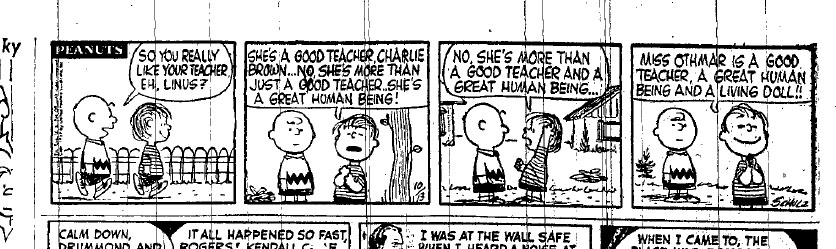
October 13, 1959: PeanutsLinus seems to have rather adult emotions about his teacher in this panel — not appearing in the legacy version of “Peanuts.”

No Shoes but New Wheels

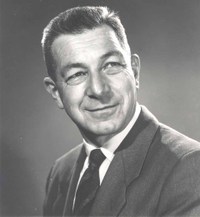
Matt WeinstockThe report that a mother was keeping her children out of school because they had no shoes or adequate clothing came into a child welfare and attendance office and Monty Minock, a worker, was assigned to investigate.

A home call revealed the family’s distress was largely due to the parent’s seeming inability to resist a sale pitch.  As a result, debts had overwhelmed them.  Furthermore, the father had difficulty keeping a job, because creditors moved in and garnished his wages.

He was working again, the wife said, but it would be several days before he received his first paycheck.  That was the reason things were rough and the children had been kept out of school. Continue reading

Posted in Columnists, Comics, Matt Weinstock | Comments Off on October 13, 1959: Matt Weinstock

Paul V. Coates – Confidential File, Oct. 13, 1959

Oct. 13, 1959, Paul Coates  

Still on vacation.

Oct. 13, 1959, Abby

Oct. 13, 1959: The classic Abby column, “Too Late.”

“I am the most brokenhearted person on earth. I always found time to go everywhere else but to see my dear old gray-haired parents. They sat home alone, loving me just the same. It is too late now to give them those few hours of happiness I was too selfish and too busy to give. And now when I go to visit their graves ….” 

Posted in Columnists, Paul Coates | Comments Off on Paul V. Coates – Confidential File, Oct. 13, 1959

Time Running Out for Caryl Chessman

Oct. 13, 1959, Mirror Cover

Eleanor Roosevelt urges clemency for Caryl Chessman.
Oct. 13, 1959, Crash

An evocative story by the late Paul Weeks about a teenager who died in a spectacular car crash while running from the police.  
Eleanor Roosevelt, Aldous Huxley, Ray Bradbury, Steve Allen and Theodore Bikel are among those signing petitions to Gov. Pat Brown asking him to spare the life of Caryl Chessman.

Oct. 19, 1959, Chessman


Oct. 19, 1959: Corrected from a previous post: A victim writes to The Times about Caryl Chessman. I previously said she was one of Chessman's victims.

Posted in #courts, Caryl Chessman, Environment, Front Pages | Comments Off on Time Running Out for Caryl Chessman

A Kinder, Simpler Time Dept.: Your Movies

image

Oct. 13, 1940: Youngsters at the premiere of "They Knew What They Wanted" laughed at Carole Lombard's love scenes. Evidently they did not know what they wanted.

 Oct. 13, 1940, Films

After nearly five years without releasing a picture, Charlie Chaplin is about to preview “The Great Dictator,” his first talking film.

Posted in Film, Hollywood | Comments Off on A Kinder, Simpler Time Dept.: Your Movies

Writers Guild Strikes Over TV Residuals


Oct. 13, 1959, Cartoon  

So here’s how Times cartoonist Bruce Russell shows that an eagle represents Mexico. He gives it a cute little sombrero.

Oct. 13, 1959, Writers Guild

The Writers Guild goes on strike over residuals on TV broadcasts of films released after 1948.

Oct. 13, 1959, Columbus Day

The Knights of Columbus celebrate their namesake in a service at St. Vibiana’s.

Oct. 13, 1959, Pillow Talk

Rock Hudson “carefree bachelor” in “Pillow Talk.”

Oct. 13, 1959, Jerry Lewis

Jerry Lewis in blackface in “The Jazz Singer?” I’m afraid so.  No, it’s not on Netflix. I think I'll be watching "The Rifleman" or Ella Fitzgerald on the Garry Moore show.

Oct. 13, 1959, Orphan Annie

Superstitious natives in “Orphan Annie.”

Oct. 13, 1959, Baseball

Some people just don’t like baseball. I wonder what she would think of ESPN.

Oct. 13, 1959, Sports

Walter Alston is named manager of the year. Trivia note: Alston struck out in his only major league appearance at the plate.
Posted in art and artists, Dodgers, Film, Front Pages, Hollywood, Religion, Sports | 2 Comments

Black Sox Not Guilty!

Aug. 3, 1921, Black Sox 

Aug. 3, 1921: The Black Sox are found not guilty of conspiracy. "Bailiffs vainly pounded for order, and finally, noticing Judge Friend's smile, joined in the whistling and cheering. Hats sailed high in the air, papers were thrown around and the courtroom was the scene of the wildest confusion in any recent Cook County case. "

Posted in #courts, Sports | Comments Off on Black Sox Not Guilty!

Caught Again

Oct. 13, 1909, Arrested  
Oct. 13, 1909: Charles Hummer dodged the police for months after being charged with vagrancy and paying a $100 fine for stealing garden hoses from people’s lawns. He promised to leave town but didn’t. A couple of detectives recognized him when he got on a streetcar and now he’ll be in jail for 180 days. What do you do with a wagonload of stolen garden hose? I haven’t any idea.

Posted in #courts, LAPD | Comments Off on Caught Again

Cooking With the Junior League – St. Louis

meet_us_kitchen Over at Cooking With the Junior League, our friends Mary McCoy and Brady Potts explore the culinary delights of St. Louis with a victory dinner.

Mary writes: The Dodgers pulled off a sweep of the Cardinals, making them the first team to advance to the next round of postseason play, and making this week’s meal from the Junior League of St. Louis a victory meal.  As my father put it, “You’re eating their food, and they’re eating crow.”  Or as Brady put it, “The Dodgers ate the Cardinals’s lunch, so we’re eating St. Louis’s dinner.”

Read more>>>

Posted in Dodgers, Food and Drink | Comments Off on Cooking With the Junior League – St. Louis

Found on EBay – Batchelder Tiles

Batchelder Tile Lions 
https://i0.wp.com/latimesblogs.latimes.com/thedailymirror/images/2008/12/05/batchelder_tile_ebay03.jpg These Batchelder tiles of lions have been listed on EBay. Although I’ve seen quite a few animals, like this tiger at left, I don’t recall seeing lions before. Bidding starts at $25.49.

Posted in Architecture, art and artists | Comments Off on Found on EBay – Batchelder Tiles

October 12, 1959: Matt Weinstock

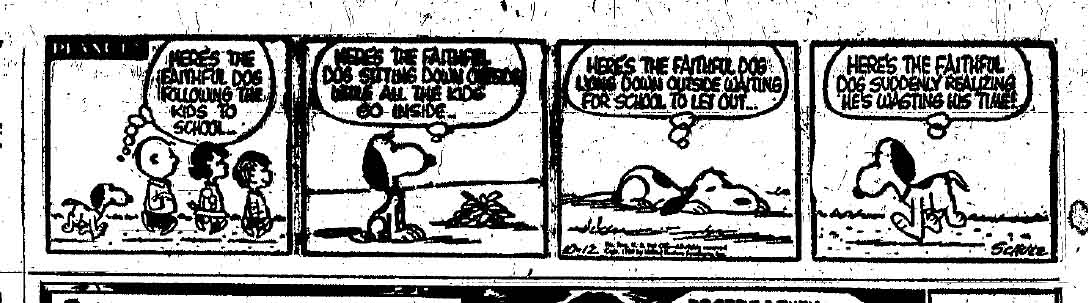
October 12, 1959: PeanutsHere’s another panel you’ll never see in the sitcom legacy version of “Peanuts.” A cynical Snoopy?


Vox Populi

Matt WeinstockA man phoned Lee Warburton the other day and complained indignantly about his failure to expedite the street work which was blocking the caller’s driveway.  “If I’d known this was the way you handle things,” he exploded, “I wouldn’t have voted for you last election!”

“Last election?” Warburton echoed.  “I didn’t run for office last election.”

“Yes you did,” the caller insisted.  “I distinctly remember voting for you.”

And so Warburton patiently, despairingly informed him that it was six years ago that he retired voluntarily as a councilman representing the east section of San Fernando Valley and that since then he has been a private citizen in public relations work. Continue reading

Posted in Columnists, Matt Weinstock, Richard Nixon | Comments Off on October 12, 1959: Matt Weinstock

Paul V. Coates – Confidential File, Oct. 12, 1959

Oct. 12, 1959, Paul Coates

Paul Coates is still on vacation.

Oct. 12, 1959, Dear Abby

Oct. 12, 1959: A divorcee gives a going-away party when she leaves the company – no wives invited! The men were fat and 40 – or 50.

Posted in Columnists, Paul Coates | Comments Off on Paul V. Coates – Confidential File, Oct. 12, 1959

A Kinder, Simpler Time Dept.: Your Movies

Oct. 12, 1939, The Real Glory  
Oct. 12, 1939: The Times devotes a page to “The Real Glory.” It isn’t marked as an ad, but it sure looks like one. The display ad is ruled off from the editorial content and there's nothing to label the page as an advertisement … but it's quite suspicious.

Posted in Film, Hollywood | Comments Off on A Kinder, Simpler Time Dept.: Your Movies

Jealous Boyfriend Stabs Actress to Death

Oct. 12, 1959, John Wayne  

1959_1012_stabbed01

Oct. 12, 1959, Stabbed

Oct. 12, 1959: Chester Harvey Smith stabs LaJean Ethridge to death while on location for the filming of “The Alamo.” He was sentenced to 30 years in prison.

Posted in #courts, Film, Hollywood, Homicide | Comments Off on Jealous Boyfriend Stabs Actress to Death

Final Arguments in Black Sox Trial


 July 30, 1919, Black Sox

July 30, 1921:  "This man, by his own confession, sat in his room at the Warner Hotel here and arranged to receive $10,000 for the dirty work he planned. Then Judas-like, he went downstairs to hobnob with his innocent teammates, and, in his own words, to allay the suspicions of the men whom he had just betrayed.

"He said he'd throw the ball over the fence if necessary to lose the first game. And what happened in the first game? Cicotte, the American League's greatest pitcher, hurling with a heavy heart — by his own confession — and a pocket made heavy by $10,000 in graft, was beaten 9 to 1.

"No wonder he lost. The pocket loaded with the filth for which he sold his soul and his friends was too much. It overbalanced him and he lost."

Posted in #courts, Sports | Comments Off on Final Arguments in Black Sox Trial

President Taft Has a Bully Time in Los Angeles

Oct. 12, 1909, Taft

Oct. 12, 1909: President Taft has a bully time in Los Angeles.

Oct. 12, 1909, Fire 

Oct. 12, 1909: Fire breaks out at 143 N. Gless in “Little Russia.” 

"Eighteen complaints have been filed against members of the Russian colony because of their noisy manner of worship and other disagreeable habits and last night officers were inclined to the belief that someone in the neighborhood set fire to the houses in an effort to get rid of the colony."

And some Chicago police are corrupt.

Posted in Front Pages, LAPD, Politics | Comments Off on President Taft Has a Bully Time in Los Angeles

L.A. in the grips of Gustavo-mania

https://i0.wp.com/www.latimes.com/media/photo/2009-10/dudamel_49754818.jpg

Gustavo Dudamel throws himself into his conducting during his inaugural
performance at Walt Disney Concert Hall as new music director of the
Los Angeles Philharmonic. (Lawrence K. Ho / Los Angeles Times / October 8, 2009)


Through the generosity and kindness of a friend and colleague who gave me his tickets, I was able to hear Gustavo Dudamel last night during his debut week as music director of the Los Angeles Philharmonic.

The informed scribes of the Los Angeles Times (Mark Swed) and New York Times (Anthony Tommasini) have already made their appraisals and I'm not sure there's much for me to add. The concert was recorded for iTunes, so listeners will soon be able to form their own opinions without the interference of nitpicking commentary. But inasmuch as Dudamel's arrival is a landmark in Los Angeles history, I thought I would offer a few lines by reprising — if only briefly — my former incarnation as a music critic.

::

Los Angeles is in the grips of Gustavo-mania and with good reason. The charismatic young Venezuelan has already inspired audiences in a way that makes marketing directors' hearts sing. (The woman sitting next to me flew in from Washington, D.C., just to hear him and already has tickets for the orchestra's upcoming tour). We have not yet christened part of Disney Concert Hall "Gustavowood," as a companion to the Dodgers' "Mannywood," but I anticipate it at any time.

Quite frankly, I was not expecting much because I had heard recordings of Dudamel with the Simon Bolivar Youth Orchestra of Venezuela (reckless, rushed tempos and ragged playing) and the Israel Philharmonic (mostly remarkable because it was a young man leading the Israel Philharmonic). Last night, I was happily surprised.

If you haven't heard the Los Angeles Philharmonic aside from commercial releases, you might wonder how it sounds au naturel. I heard the orchestra many years ago on tour under Zubin Mehta and at the Dorothy Chandler Pavilion, along with live broadcasts over the years, too long ago to recall the orchestra's sound in great detail, although I do remember (indeed, how could one forget?) Mehta's gymnastics on the podium.

More recently I have attended Disney Concert Hall performances thanks to the generosity of various friends who had spare tickets. (Last night's seats were $98 apiece plus tax for the nosebleed section–people in the orchestral world who worry about the crisis in classical music audiences please take note).

The often-cited claim that there are no bad seats in Disney Concert Hall appears to be true. There are certainly nothing like the supporting columns I recall (or seem to recall from my childhood) blocking the view in the upper balconies of Orchestra Hall in Chicago, where my parents took me as a youngster, or the miserably pinched, airless view I had one year for Seattle's "Ring Cycle" in the Glynn Ross era.  

In previous performances I have been seated to the side of the orchestra (Joshua Bell/Herbert Blomstedt–fairly good acoustics) and behind the trombones/tubas (Yefim Bronfman/Xian Zhang–rather muffled). For Dudamel's concert, I was seated in a more traditional area, the upper reaches at the back of the hall.

The first thing that struck me about the orchestra is the high caliber of playing. These days, that's a given, of course. But I think it's worth noting that today, in a top-flight orchestra, all the mechanics of playing are satisfied: The musicians play in tune, they make their entrances, follow their cues and the sections (the horns, the woodwinds, the strings) play cohesively. However obvious and rudimentary these concerns may seem, they are not trivial and any orchestra that can brag of such an achievement is well on the way to greatness.

But not necessarily there. What kept coming back to me as I listened to the orchestra was "ah, the horns are doing this … aha, the oboes are doing that … here are the trumpets … here comes the tympani roll… " It was as if I were listening to 100-plus separate voices, or the various tonal blocks — strings, brass, percussion, etc.– rather than a symphony orchestra. Maybe my expectations have been led astray by too many years of listening to the tricks of recording engineers mixing the colors like a Photoshop of sound. But if I had to describe the way the orchestra sounds to me, I would say I was more aware of the raw individual colors rather than the completed painting.

::

The concert began with "Su," a concerto for sheng and orchestra by Unsuk Chin performed by Wu Wei.

More years ago than I care to remember, I attended an utterly disheartening conference of my fellow music critics in San Francisco. Of course, this was before newspapers in all but the largest American cities slashed their budgets by eliminating coverage of classical music and the fine arts in general. Not that I could entirely blame the editors who made the cuts, given the deplorable state of classical music coverage at most papers. With a few exceptions, my fellow music critics were little prima donnas with dubious credentials, artsy pretensions and limited writing skills who fawned over the one or two big guns from the major newspapers who deigned to rub elbows with the rabble.

I mention this gathering because at a sparsely attended session on the obscure field of world music, one performer said with absolute seriousness that the day would come when world music would share the stage with Bach, Beethoven and Tchaikovsky.  We provincial rubes thought this was the funniest crackpot idea we had heard in years and wrote it off as "Well, you know, it IS San Francisco. Maybe that kind of thing goes here but not in [fill in the name of your favorite small  town]."

My crystal ball was certainly cloudy that day. Since then we have had Yo-Yo Ma and the Silk Road Project, along with a great deal of exotic influences in film scores so that world music has indeed entered the common repertoire.

In light of that, I suppose it is no surprise to find a concerto for sheng (an ancient Chinese instrument now fitted with chromatic keys) on the same program with Gustav Mahler's Symphony No. 1.

In brief, "Su" is a pleasant, nonthreatening modern work of shimmering colors that's interesting to watch in performance mostly because Wu Wei is an enthusiastic, athletic musician who bounces when he plays — and his bright red scarf and black outfit certainly add visual drama. Tones are produced on the sheng by blowing as well as sucking air through the instrument. The sheng has an amazingly wide range of tonal colors and most reminded me of some old-school "musique concrete" in which tape-recorded sounds were played backward.

::

Which brings us to the Mahler.

I suppose if you asked 50 people, you would get 50 different ideas of the Symphony No. 1. Like everyone else, I have distilled a sonic ideal of how the work should be. It is uniquely mine, based on dim recollections of a graduate seminar on Mahler, and a quirky blend of Kurt Masur and the New York Philharmonic in a noisy broadcast from Tanglewood, a dab of an old Bruno Walter LP, some Bernard Haitink and the Royal Concertgebouw Orchestra, some New York Philharmonic under Lorin Maazel, Dietrich Fischer-Dieskau bouncing his way through "Songs of a Wayfarer," and maybe  a dash of Leonard Bernstein–but only a dash, because for me a little Bernstein goes a long way.
 
It's not Dudamel's job to conform to the unarticulated and ever-evolving notion of the Mahler that I carry around in my head because he hasn't any idea what it is and he might well disagree with it. For that matter, I might disagree with it myself in a year or two because it's never complete but always reshaping itself.

In that context, how does Dudamel see Mahler? Well, Dudamel is a r
emarkable, young conductor and a remarkably young conductor. Some folks have made much about his conducting the Mahler from memory, but honestly, it's so well known these days, I'm surprised it's not in karaoke bars, along with the Shostakovich Fifth, which I have nicknamed "The Inescapable." Mehta (who is not one of my favorite conductors by a long shot) used to get a fair amount of press by conducting from memory, but it's nothing special anymore.

In general, Dudamel's Mahler First is a rollicking, buoyant work. He took some of the slower passages a bit faster than I like (the third movement's mournful satire on "Frere Jacques" could stand to be a bit more funereal for my money) and the faster passages a bit slower than I care for. What struck me the most was how he seems to save his best for the final movement. Last Saturday's live performance of Ludwig Van Beethoven's Symphony No. 9, broadcast from the Hollywood Bowl, was really nothing special until the finale. In the same way, the Mahler was a nice, competent job until the last movement, when the orchestra put some muscle and passion into it.

And as I listened to the Mahler, I got to thinking that this is a young man's approach to the work–not necessarily immature, but youthful and inspiring. I won't be around to hear how Dudamel does the Symphony No. 1 when he's in his 80s, as Masur is now. But I would be curious to know what it's like. I would anticipate that rather than being youthful, it will be a reflection on the remembrances of youth.

Is Dudamel on the verge of establishing a reputation as one of the prime Mahler interpreters of his generation? No–absolutely not. But he handles it well. In our mania for the superlatives of the "Lake Woebegon " era, where all children are above average, it may seem a crime to call the performance workmanlike, serviceable and competent, but those are not small accomplishments. And in reality, truly spectacular — and memorably awful –  concerts are few and far between. One or two per season if you're lucky. Most will be in the great middle, where this concert fell toward the high end.

::

I'm probably in the minority when I say that for me, the true test of an orchestra isn't necessarily the big, raucous works like Mahler symphonies or Richard Strauss' tone poems, but the delicacy of Mozart. I am extremely curious as to how Dudamel sees the works of our favorite fellow from Salzburg.

One other thing worth mentioning. Based on what I have read and observed, Dudamel appears to see himself with a fair amount of humility. During the extended applause and standing ovation at last night's concert, Dudamel threaded his way deep into the orchestra to acknowledge the soloists and generously shared the spotlight.

Conductors rather notoriously come in all shapes and sizes. Most of the old-fashioned conductors of the recent past were merciless tyrants. Some of today's laureate stars are famously egotistical and aloof. Young Gustavo Dudamel appears to be a far more humble, outgoing and therefore inspiring fellow and I suspect the Los Angeles Philharmonic's musicians and audiences will flourish under his care.

Posted in classical music, Downtown, Music | Comments Off on L.A. in the grips of Gustavo-mania

A Kinder, Simpler Time Dept.: Your Movies

Oct. 11, 1938, Judy Garland

Oct. 11, 1939, Babes in Arms

Oct. 11, 1938: Judy Garland leaves her prints in concrete at Grauman’s Chinese Theatre before the premiere of "Babes in Arms."

Posted in Film, Hollywood | Comments Off on A Kinder, Simpler Time Dept.: Your Movies

Witnesses Scheduled in Black Sox Trial

July 27, 1921, Black Sox

Chick Gandil, Buck Weaver, Swede Risberg and Happy Felsch are expected to testify in the Black Sox trial.

July 27, 1921, Black Sox

July 27, 1921, Rothstein

Arnold Rothstein says he didn’t pay $10,000 for the missing confessions in the Black Sox case.  Rothstein also says he has no connection to the World Series scandal.
Note: The 1919 World Series is over, but as long as I got started on the trial, I’m going to follow along in upcoming days.

Posted in #courts | Comments Off on Witnesses Scheduled in Black Sox Trial

President Visits L.A.!


Oct. 11, 1909, Taft

Over the years, Edmund Waller “Ted” Gale drew many variations on “Miss Los Angeles” before adopting the best known version, a Latina. Above, here she is in 1909, welcoming President Taft.

At right, Miss Los Angeles, Feb. 26, 1920

Feb. 26, 1920, Gale l

 
Oct. 11, 1909, Taft  

Although this poem is unsigned, I would suspect it’s by John S. McGroarty, whose poems frequently appeared in The Times. Hal Coffman, who died in 1958 at the age of 75,  was a syndicated artist who worked in New York and later in Fort Worth.   This is why you don’t want anyone cutting up your archival editions. 

Oct. 11, 1909, Cover

Oct. 11, 1909: President swings through Los Angeles for a day. He stops in San Pedro, Wilmington, Los Angeles and visits the San Gabriel Valley and Riverside before leaving for Arizona. One notable stop is the home of his sister, Mrs. W.A. Edwards, 2600 W. Adams St.

Oct. 11, 1909, Editorial Page

The Times publishes a glowing editorial about President Taft: "If we were to institute a comparison we would say that only the great Lincoln in the dark days of the war between the states ever faced more exacting duties than those Mr. Taft is called to meet and perform. Mr. Taft has a mighty advantage over that of his glorious predecessor. He comes to these duties with a wisdom acquired by long study of law and statesmanship, rounded out by experience of a varied nature extending over many years."

Oct. 11, 1909, Protest

One of the most interesting aspects of the presidential visit is the large demonstration at the Plaza of “Anarchists, socialists, Mexican revolutionaries and Holy Jumpers.” Our old friends Detective Felipe Talamantes and Sgt. Charlie Sebastian, the future police chief and mayor, put in an appearance in dealing with the protest.  Recall that The Times bombing is little less than a year away.

June 3, 1903. Holy Jumpers

June 3, 1903: Holy Jumpers come to Los Angeles — and women are playing slot machines!

Posted in art and artists, Comics, Downtown, LAPD, Politics | Comments Off on President Visits L.A.!

Found on EBay – Dyas-Cline

Billy Wilshire Gunsmith W.H. Billy Wilshire dies, Oct. 11, 1935.

holster_dyas_ebay
This shoulder holster from Dyas-Cline Co. sporting goods in Los Angeles has been listed on EBay.  Dyas- Cline became Cline-Cline about 1913, which would make this holster older than I suspected. Bidding starts at $6.50.
Posted in Downtown, Fashion | Comments Off on Found on EBay – Dyas-Cline