A Jovial Nixon Tells Strangers He’s Bob Hope, Makes Prank Phone Calls


Nov. 4, 1959, Richard Nixon

Vice President Richard Nixon interrupting early morning walk on Wilshire Boulevard to watch sidewalk repairs, lingers to talk sports with Vic Salazar, left and another worker.

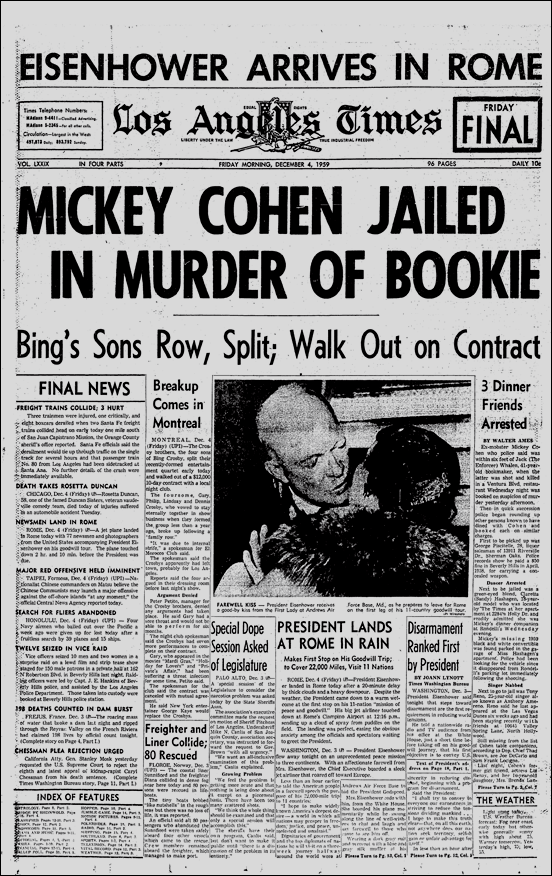
Nov. 4, 1949, Times Cover

It's easy to find weird stories about Richard Nixon, before and
after his presidency. Even in a paper like The Times that for years
boosted his political career, it doesn't take much investigating to
locate something worth rereading.

Today's example is a story of Nixon walking along Wilshire
Boulevard, having a hamburger for breakfast and…wait for it….
talking to real people. The headline even announces, "Nixon Takes
Stroll and Talks With Strangers."

"Normally I have hot cereal for breakfast but this is the equivalent
of 11 a.m. Washington time and I feel like having lunch," he said. At
least he wasn't over-analyzing it. What else did he have for lunch?
Would you believe buttermilk and coffee?

His waitress didn't recognize him. "He looks like a nice gentleman," she told The Times' reporter.

"I'm Bob Hope," Nixon said.

–Keith Thursby

Nov. 4, 1959, Richard Nixon 

Nov. 4, 1959, Richard Nixon

Nov. 4, 1959, Jean Baptiste Poulin

The sad story of Jean Baptiste Poulin, local musician, who almost lived to be 100.

image 

The Board of Supervisors asks why the MTA is switching from streetcars to buses while Los Angeles is trying to reduce smog. It’s a good question. Let’s see if I can find the answer.

Nov. 4, 1959, Career
Dean Martin, Anthony Franciosa and Shirley MacLaine star in “Career.” And it’s not on Netflix!

Nov. 4, 1959, Sports

USC President Norman Topping apologizes for an incident during the USC-Berkeley game in which USC guard Mike McKeever hit Cal halfback Steve Bates with a rolling tackle while they were out of bounds on the sideline. The referees didn't call a penalty on the play.
Posted in Environment, Film, Front Pages, Hollywood, Richard Nixon, Sports | 3 Comments

Nuestro Pueblo

Aug. 5, 1938, Nuestro Pueblo 

Aug. 5, 1938: Joe Seewerker and Charles Owens feature the Bethlehem Baths at Vignes and Ducommun, which closed in 1926.

Note: The original run of Nuestro Pueblo concluded in 1939. I’m going back and picking up the entries that I missed the first time

Posted in Architecture, art and artists, books, Nuestro Pueblo | Comments Off on Nuestro Pueblo

Police Officers May Unionize

 Nov. 4, 1919, Comics
Some aspects of being a parent haven’t changed!

Nov. 4, 1919, Police Union

March 8, 1946, Police Union
 March 8, 1946, Police Union

Nov. 4, 1919: An attempt is made to organize the Los Angeles Police Department under one of the railway workers’ unions. Over the years, there were several attempts to unionize the LAPD (the Los Angeles Police Protective League, which now represents officers, was originally established in 1922 in cooperation with firefighters to protect a new retirement system). As late as March 8, 1946, Mayor Fletcher Bowron strongly opposed efforts to unionize the department.

Posted in City Hall, LAPD, Politics | Comments Off on Police Officers May Unionize

Deputies Protect Black Suspects From Lynch Mob

 Nov. 4, 1909, Lynch Mob 


Nov. 4, 1909: The daughter of Leonard Dunmore is shot to death while trying to rescue her father from being burned alive. Dunmore was dragged from his home, doused with oil and set on fire over suspicions that he had burned several houses in Knoxville, Miss.

Posted in #courts, Countdown to Watts | Comments Off on Deputies Protect Black Suspects From Lynch Mob

Found on EBay – Los Angeles Examiner

examiner_headline_history_crop 

This book of Los Angeles Examiner front pages from World War II has been listed on EBay. I’ve only seen these books on EBay so I’m not positive but judging by the vendors’ photos, the reproduction appears to be fairly readable. The Examiner was once the leading paper in Los Angeles but merged with the afternoon Herald-Express to form the Herald Examiner in 1962 and is little more than a memory these days. Bidding starts at $24.95.
Posted in @news, books | Comments Off on Found on EBay – Los Angeles Examiner

Matt Weinstock, Nov. 3, 1959


    image

Lockheed has plans for a monorail system for Southern California.

Haven in Cyprus

Matt Weinstock

    How does it go, one may wonder, with those resolute citizens who muster the courage to drop everything and leave the rat race for peace and quiet elsewhere?
   
John Plake, Hollywood publicist, who made the big decision some months ago, writes from his haven in Nicosia, Cyprus: "I just saw where the Dodgers were in the World Serious, or am I mistaken?  I don't understand baseball very well but as far as I could tell Charles Neal made two touchdowns.  Looks like L.A. is getting Togetherness through baseball.  Norrie sure made headlines in his clash with Mr. K.  Where was Sheriff Biscailuz all that time?  We're happy here.  We don't have any anxieties about how we're going to pay the rent.  I'm only afraid that at the end of three years I won't be fit for employment in the states.  I've always said I would like to have been born 75 years ago and it's pretty much like that here."
   
One gets the notion that John not only doesn't care about progress but is also opposed to the inalienable right of every American to have a nervous breakdown.

::

image     NOW AND THEN the editors of the erudite Yale Review get out a brochure to prospective subscribers that is itself an experience in reading.  The current one has this passage: "We would by no means imply that we can give you only a filboid studge kind of justification for reading The Yale Review.  We require of our writers lucidity and so far as their matter permits, grace."
   
Who you calling a filboid studge, Mac?

::

ALTERNATIVE
Our State Dept. says that
    Russia needs
To woo us not with words
    but deeds,
So: what if Pravda's crude
    condemning
Gives way to rude ICMB-
    ing?
–F. MENDELSOHN JR.

::

    IT WAS, as authorities reported in relief, a safe and sane Halloween.  Oh, maybe a little mischief here and there but no real mass vandalism.
 
   Out my way, for instance, some boisterous boys swiped the huge, hollowed-out pumpkin from a neighbor's doorstep, tossed it high in the air and let it fall with a pistol-shot squash in front of my house.  Quite a mess to clean up next day but you figure on things like that.

    On the other hand there was the group of hysterically babbling teen-age girls, about a dozen of them, who pounded so hard on the door they almost broke it in.  When it was opened they stormed into the house, screaming like outraged witches.  They didn't wait to be handed candy bars, they snatched them rudely out of my hands and, without a thank you, took off into the night, ranting wildly.

    Gave me the frightening feeling that Halloween is no longer so much boisterous as it is girlsterous.

::

    BY CONTRAST there was the happy 6-year-old boy who came to the door and, on receiving his tribute, held out his hand, containing two jelly beans, and said joyfully, "Here's some for you!"  This youngsters parents are going to have to take him in hand and teach him the rudiments of blackmail or he'll be out of it.

::

Nov. 3, 1959, Peanuts

    A LAWYER ran into a police lieutenant he has known for  a long time and said, "I heard you got transferred — what did you do?" 

    "I don't know," the bewildered officer replied.  "All I did was say there was no such thing as the Mafia."

::

    AT RANDOM — A man phoned the Shrine Auditorium for some information about the opera "Andrea Chenier" and John Northcutt briefly outlined the plot in which two principals are beheaded.  "Is it a tragedy?" the caller inquired . . . If a Santa Monica cutlery shop wants to know who has been phoning and asking for Mack the Knife, I have  a full confession from the culprit . . . A Redondo Beach couple who went into a restaurant in Big Bear for breakfast were puzzled by a note attached to the menu stating, "Please do not order boiled, poached or scrambled eggs today."  They concluded the chef was eggcentric or possibly an eggomaniac . . . Inevitably there's a windshield sticker that states: "Help Stamp Out Traffic Cops."


Posted in Columnists, Comics, Matt Weinstock, Transportation | Comments Off on Matt Weinstock, Nov. 3, 1959

Charles Van Doren’s Statement – Full Text

Nov. 3, 1959, Van Doren Statement  

Nov. 3, 1959: "I would give almost anything I have to reverse the course of my life in the last three years. I cannot take back one word or action; the past does not change for anyone. But at least I can learn from the past. I have learned a lot in those three years — especially in the last three weeks, I've learned a lot about my life. I've learned a lot about myself, and about the responsibilities any man has to his fellow men. I've learned a lot about good and evil. They are not always what they appear to be."

Posted in broadcasting, Television | 1 Comment

A Kinder, Simpler Time Dept.: Your Movie Columnist

Nov. 3, 1940, Hedda Hopper 

Nov. 3, 1940: C.B. and “North West Mounted Police.”

Posted in Film, Hollywood | Comments Off on A Kinder, Simpler Time Dept.: Your Movie Columnist

Nixon and Kennedy Visit L.A.

Nov. 3, 1959, Richard Nixon  
Vice President Richard Nixon and his wife, Pat, arrive in Arcadia.

Nov. 3, 1959, Times Cover

 
Nixon voices confidence the Republican Party … And the MTA is increasing fares on buses and streetcars from 17 cents to compensate for raises granted to union workers.

Nov. 3, 1959, Kennedy

Sen. John F. Kennedy (D-Mass.) says Americans have it too easy … Former Mayor Frank Shaw is back in the news … And the last Civil War veteran is in failing health, The Times says. 

Nov. 3, 1959, John F. Kennedy

"What has happened to us as a nation?" Kennedy asks. "Profits are up, our standard of living is up, but so is our crime rate. So is the rate of divorce and juvenile delinquency and mental illness. So are the sales of tranquilizers and the number of children dropping out of school."

Nov. 3, 1959, Richard Nixon

Look who’s traveling with Nixon: Herbert Klein and Rosemary Woods. And he plays the piano!

Nov. 3, 1959, Battle of the Coral Sea 
Coming soon: “A Summer Place.”

nov. 3, 1959, Sports  

The Dodgers name Bobby Bragan as coach, replacing Charlie Dressen, who went to the Braves.

Nov. 3, 1959: Richard Nixon and John F. Kennedy are both evasive in answering questions about the 1960 presidential race. It’s interesting to contrast the idealism of Kennedy’s speeches, in terms of banning nuclear weapons tests, with Nixon’s comments assessing his political career to date. Kennedy seems to be looking forward while Nixon is looking back. Of course, Nixon is meeting with his earliest supporters so his retrospective makes sense. But it's still interesting.

Posted in Film, Front Pages, Hollywood, Politics, Richard Nixon | Comments Off on Nixon and Kennedy Visit L.A.

A New Comic in The Times

Nov. 3, 1919, Comics

Beginning in October 1919, The Times added “Gasoline Alley” to its daily comics, which included “The Gumps,” “Mutt and Jeff” and “When a Feller Needs a Friend” – or whatever Clare Briggs titled his strip that day. 

Nov. 3, 1919, Runaway Girl

Nov. 3, 1919: Lulu Pipe abandons Orange for the lights of the big city. Her mother says they may have been a little too strict with Lulu.

Posted in art and artists, Comics, LAPD | Comments Off on A New Comic in The Times

Paul V. Coates – Confidential File, Nov. 3, 1959

 
Nov. 3, 1959, Erwin Walker
Erwin “He Walked by Night” Walker is recaptured.

Japan of Today Has Its Lost Generation

Paul Coates    TOKYO — There are striking things you see when you look at a country 14 years after it lost the most devastating war in its history.
   
You notice immediately that defeat doesn't mean what you always thought it did.  At least, not defeat at the hands of the United States.

    Historically, to the victor go the spoils.  And to the vanquished go the ravages of a ruined economy, humiliation, starvation and enslavement.

    But that isn't the way we do it.  We take the spoils, then we give them back, with exorbitant interest, to the nations we conquer.

    I was first made clearly aware of that a year ago when I visited Germany.

    East Berlin looked like what it was — part of a nation in defeat.  Its people wore threadbare clothes.  Their faces were pinched from the effects of fear, unhappiness and, I suppose, just plain not enough to eat.  The streets on the Communist side of defeated Germany were still in ruins.

    But a block away was a whole world away.

    West Berlin was a thriving metropolis of well dressed, well fed citizens who formed queues to get into the jammed department stores, movies, restaurants and night clubs.

    The same thing is true here in Tokyo.  They lost the war.  But with the help of their conquerors, business, every day, in every way, is getting better and better.

    It proves the rule that the way for a nation to become prosperous is to go to war with the United States.  And lose.

    But you can't argue with our role of benevolent victors.  Because of it, Japan today is a vital Asian outpost of democracy.  It is the one major Oriental country that seems immune from the cancerous spread of communism.

image

    There is, however, something basic that the Japanese sacrificed in defeat.

    When we gave them a democratic way of life, we necessarily took away from them the standards of behavior they had known for countless centuries. 

    Suddenly, their emperor was no longer divine.  The religion that told them they were invincible and taught them family respect was, if not lost, at least confused.  The old moral values were valueless.

    And, if you're looking, you can see that, too.

    Atheism is widespread among the young people of Japan.  Ask them, and surprisingly many will admit they can no longer accept the Buddhism of their parents, because loosing the war disproved it.

    And they can't accept Christianity because it's the religion of a people who dropped the A-bomb on Hiroshima.

    The result of this groping around for something to believe in created a kind of social tragedy in Japan.

    All of a sudden there was a "juvenile delinquency" problem.

    In the past, the unruly youngster was rare.  If he existed at all, he was effectively handled within the family circle.

    But families, in the traditional Japanese way, began to fall apart in the postwar years.  Westernization set in.  And with its benefits it brought its liabilities.

They Learned From Us

    The scourge of American rock 'n' roll spread to Tokyo.  Cheap American movies dedicated to the preposition that crime may not pay, but it's glamorous, began flooding Japanese theaters.
   
With their flair for mimicry, the teenagers of Tokyo took to the ducktail and narrow-gauge pants.

    In a country that never before heard of the word-marriage "kid-gangs," juvenile crime has now become the nation's No. 2 police problem.


Posted in Columnists, Film, Hollywood, Paul Coates | Comments Off on Paul V. Coates – Confidential File, Nov. 3, 1959

Men Sentenced for Hitting Women

Nov. 3, 1909, Pig'n Whistle 

Pig’n Whistle – next to City Hall on Broadway.

Nov. 3, 1909, Wife Beaters

Nov. 3, 1909: Justice Williams hears several cases involving violence against women. A blacksmith was sentenced to 100 days in jail for hitting his wife and a lodger was sentenced to 180 days in jail for striking his landlady. 

Posted in #courts, Food and Drink | Comments Off on Men Sentenced for Hitting Women

Found on EBay – ‘Quick, Watson, the Camera’

Quick Watson Book

A copy of “Quick Watson, the Camera,” has been listed on EBay. Long out of print, “Quick Watson” is terrific survey of photographs by the Watson family and was edited by the late Delmar Watson, formerly of the Mirror-News. Bidding starts at $9.99.
Posted in @news, books | Comments Off on Found on EBay – ‘Quick, Watson, the Camera’

Matt Weinstock, Nov. 2, 1959


Nov. 2, 1959, Peanuts

Power of a Pet

Matt Weinstock     An old man whose increasing bitterness in his last years antagonized his family and friends died recently.  Despite their feeling toward him and toward each other because of him, they all came to the funeral.  He belonged to an early L.A. family and was, after all, the last remaining link with a colorful past.

    There was tension in the chapel during the service and it carried over to the graveside ceremony.  Even the clergyman who conducted the service was conscious of it.

    And then, after the last "Amen" at the cemetery, as the mourners silently headed for the mortuary limousines and their cars, someone asked, "Who's going to get Clarabelle?"  Someone else exclaimed, "Yes, who is Clarabelle?"

    The tension snapped and suddenly members of the family, estranged for nearly 25 years, were chatting amiably and laughing and exchanging information about children and grandchildren.

    The clergyman and undertaker, seeing the dormant good will gushing around them, signaled the chauffeurs to move away from the cars so the family would have time to make the renewal complete.

    Clarabelle is the old man's profane parrot.

::

image    A WOMAN made several purchases in an art supply store, then asked timidly if she was entitled to a professional discount.

    The salesman asked, "Do you paint?"  She replied, "I try."  He pursued, "Do you sell any of your work?"  She replied, "Yes, some."

    He made some notes on the sales slip and remarked, "I think you qualify, all right."  Then he added a final notation under Description of Applicant, "Modest artist."

::


COMSTOCK LOAD
The censor, in his quest for
    things impure,
Finds every limpid stream
    a running sewer,
And lets each low,
    descending sun
See from his hand some
    worthy "Tsk!" begun.
        –DON QUINN

::

    RUDY CLEYE, the sports car enthusiast who operates the Blarney Castle restaurant, is still talking about the unprecedented incident that happened when he was driving through New Mexico in the recent First American International Rally.

    Near Santa Fe he passed a cattle truck after trailing it for more than two miles.  A highway patrolman promptly stopped him and cited him for doing 72 mph and passing the truck illegally.
   
Rudy said it wasn't so, insisted he'd passed the truck legally.  He pointed out he was taking part in a rally, not a race, and that there were dozens of other participants behind him.  He explained the drivers were extra careful because a moving violation automatically eliminated them.

    When the officer, making derogatory remarks about sports car drivers, handed him the ticket
to sign Rudy refused and the procession headed for  a nearby court.

    After the officer said his piece the judge asked if the truck had been loaded with cattle.  It had.  How fast was it going?  Under 55.  How fast was the defendant going after passing the truck?  The legal limit, 60.  How had the officer been able to determine that Rudy had required 267 feet to pass the truck, as he had testified, when his vision was obscured?  The officer had no satisfactory answer and the judge, to every one's amazement, not only dismissed three charges against Rudy but cited the officer for possible perjury.

::

   QUOTE & UNQUOTE — A garage attendant in a Civic Center building is having such bad luck selecting winners in the weekly football pool that a friend kidded, "Is it true that  you picked the wrong winner of World War II?" . . . You can't fool Harry Kabakoff, newsboy at 7th and Broadway, who says, "The reason so many guys are loaded with money these days is that they started from scratch."


Posted in Columnists, Comics, Matt Weinstock | Comments Off on Matt Weinstock, Nov. 2, 1959

Paul V. Coates – Confidential File, Nov. 2, 1959

 Nov. 2, 1959, Mirror Cover
TV game show winner Charles Van Doren says everything was a fake.

There's a Strange Girl in His Bath

Paul Coates    TOKYO — You know what you've always heard about those Japanese public baths?  Well, don't believe it.
   
We Americans have  an innate suspicion of any culture which makes a public excursion of so private a matter as a bath.  To this day, we still gossip about the Romans who took their ablutions in mixed frolic.  We look askance at the coeducational baths of Sweden.

    And because the Orient, despite Jack Douglas, remains inscrutable, we distrust the Japanese public bath over all.  So, it isn't simply that we're evil-minded.  It's simply that we have never known what goes on behind those steamy doors.

    Therefore, in the interests of creating better understanding, I went to a Tokyo bathhouse that was advertised in an English-language paper as:  "Best bath in Tokyo.  Good massage.  Most pretty girl attendants."

    When I handed the address to a cab driver, he gave me a sly, toothy grin which, I must admit, unnerved me  a bit.  But which, I subsequently realized, didn't mean what I thought it did.  The grin was merely to inform me that he couldn't speak or read a word of English, and had no idea where I wanted to go.

    After I played charades by taking a pantomime bath in the back seat, he got the message and delivered me, oddly enough, to the right address.

    A gentleman in horn-rimmed glasses bowed me to a small room on the second floor and handed me a yellow slip of paper to be filled out later, "Contest for bestgur'," he informed me, "Winner gets r'uving cup."

    On the contest form were three questions I was requested to answer about the girl who attended me: "1- Does she give good consideration? 2- Is she so sweet? 3- Does she speak in a softly manner?"
Nov. 2, 1959, Abby
    While I waited for her to appear and meet these qualifications, I looked around for the rest of the crowd.  But there was nobody there except me.  Finally a girl in halter and tennis shorts came in and helped me to disrobe.  It could have been embarrassing.  Instead, it was almost insulting.  I've never in my life been looked at with such disinterest.

    Then, as though I was a piece of flabby finnan haddie, she shoved me into a steam box where I bubbled and boiled away for awhile.  After I was done to a turn, she opened the box, motioned me to sit on a wooden slab about six inches off the cold marble floor, and began soaping my back.

    And if you've never sat scrunched up six inches off the floor while a strange girl soaped your back, don't ever.  It's an utterly degrading experience. 
 
   Suddenly she began hitting me in the face with pail full after pail full of hot water.

    "Tha's enough," I was finally able to sputter, "You wanta' drown a person?"

That Grin Again

    But she gave me that familiar, toothy grin meaning that she too, didn't understand a word of English, and continued throwing water in my face.

    Just as I was about to go down for the third time, she stopped.  And I, too weak to protest, was deposited into a wooden tub of scalding water.  Then I was dried out, stretched out, unmercifully pummeled on the back and shoulder muscles, dressed and ushered out the door.

    Over my shoulder I tossed her a baleful look, spit out a remaining mouthful of water, and tore up the contest blank.

    Anyone who treats me like that don't get no r'uving cup!


Posted in broadcasting, Columnists, Paul Coates, Television | 1 Comment

A Kinder, Simpler Time Dept.: Your Movie Columnist

image 

Nov. 2, 1939: Hedda Hopper, matchmaker.

Posted in Columnists, Film, Hollywood | Comments Off on A Kinder, Simpler Time Dept.: Your Movie Columnist

1 Passenger Survives Plane Crash


Nov. 2, 1959, Cover  
Nov. 2, 1959: Notice the cover story by the late Ruben Salazar.

Nov. 2, 1959, Nancy
Women simply can’t do anything, can they?

Nov. 2, 1959, Mexico

"In Los Angeles County are 600,000 Mexicans. Of this number 100,000 retain their Mexican citizenship. The rest have become U.S. citizens." You might expect this story to be patronizing, but it isn't. In fact, reporter Cordell Hicks makes an effort to show that many Mexican Americans are either assimilated or comfortable with dual cultures.

Nov. 2, 1959, Dondi 
Dondi shows how to negotiate with the opposite sex.
Nov. 2, 1959, Mexicans


"Where do these Mexican-Californians live here? Work, shop, find recreation, go to church?
The answer — everywhere.

"A great number of families live in East Los Angeles — and there are families in Windsor Square and Hancock Park. Sundays find them at the historic Old Plaza Church, the area where Los Angeles was founded by Sonorans from San Gabriel — and they are to be found at St. Brendan's.

"They line up for menudo at La Esperanza on N. Main St. on weekends — and you find them at the Los Angeles Countyr Club for a late breakfast Sundays…."

Nov. 2, 1959, Comics
“Grrrrrrr”
Nov. 2, 1959, Beloved Infiden

 
Beloved Infidel” is opening at Grauman’s Chinese. Oh look, it has the average six stars on imdb. And no, “Beloved Infidel” isn’t on Netflix.

Nov. 2, 1959, Sports
Sports Editor Paul Zimmerman says the NCAA is worthless.
Posted in Uncategorized | Comments Off on 1 Passenger Survives Plane Crash

Neighbors Seek to Block Home for Japanese Children

Nov. 2, 1919, Comics  

Resolved:


That in the course of human events woman will have her rights. And she should be free. When she frees herself from the tyranny of dressmakers and of milliners, the tyranny of Mrs. Grundy and the "gab fest" then she can be free from the imaginary tyranny of men. When we are all free from from the tyranny of fear and superstition then Mrs. Woman will have her rights. But the pursuit of a thing is more interesting than the possession thereof. Will woman vote when she gets the chance? I think not, Irene. Wouldn't a big bargain sale put election day out of business, Maggie? Yes, Yes…

Nov. 2, 1919, Home

For sale: 737 N. Olive, Burbank.

[googlemaps https://maps.google.com/maps/sv?cbp=12,28.59,,0,-4.51&cbll=34.173499,-118.316478&v=1&panoid=2sWA9Yt70bcaBpYF6D9vHA&gl=&hl=en” width=”550″>
View Larger Map
Nov. 2, 1919, Children's Home

Nov. 2, 1919: Neighbors don’t want a home for Japanese children established at 1843 Redcliff St., but the city attorney says there’s no legal grounds to stop construction, which had already begun. 

Posted in #courts, Architecture | 1 Comment

Love Was Just Chickenfeed

Nov. 2, 1909, Shoes 

Shoes on sale for $3.50 ($82.86 USD 2008).

 Nov. 2, 1909, Briefs

Nov. 2, 1909: A neighbor becomes infatuated with a young woman after borrowing chickenfeed from her. Eventually her stepfather complains to authorities … Abbie Sheehan, 17,  is sent to the Door of Hope after being arrested in a Japanese rooming house, where she was living with a Chinese … And drivers accused of speeding say their speedometers weren't working properly.

Posted in #courts, Education, Fashion | Comments Off on Love Was Just Chickenfeed

A Kinder, Simpler Time Dept.: Your Movie Columnist

Nov. 1, 1938, Hedda Hopper 

Nov. 1, 1938: Hedda Hopper begins writing a column on Hollywood. I thought it would be interesting to spend a month surveying her newspaper career.

Posted in Columnists, Film, Hollywood | 1 Comment