


 The persons probably most amused by the movie and TV stereotype of the American Indian are the scores of Indians themselves now working in industry in the L.A. area.

- #courts 1907 1944 1947 Architecture art and artists Black Dahlia Books and Authors Cold Cases Columnists Comics Crime and Courts Downtown Film Front Pages Hollywood Hollywood Heights Homicide LAPD Mary Mallory Matt Weinstock Music Mystery Photo Paul Coates Photography Politics Sports Streetcars Transportation Uncategorized
Categories
- #courts
- #East L.A.
- #games
- #gays and lesbians
- #Jazz
- #Jim Murray
- #opera
- #video
- 1677
- 1781
- 1819
- 1823
- 1847
- 1852
- 1853
- 1855
- 1859
- 1862
- 1863
- 1864
- 1871
- 1872
- 1880
- 1881
- 1882
- 1883
- 1884
- 1885
- 1886
- 1887
- 1888
- 1889
- 1890
- 1891
- 1892
- 1893
- 1895
- 1897
- 1898
- 1899
- 1900
- 1901
- 1902
- 1903
- 1904
- 1905
- 1906
- 1907
- 1908
- 1909
- 1910
- 1910 L.A. Times bombing
- 1911
- 1912
- 1913
- 1914
- 1915
- 1916
- 1917
- 1918
- 1919
- 1920
- 1921
- 1922
- 1923
- 1924
- 1925
- 1926
- 1927
- 1928
- 1929
- 1930
- 1931
- 1932
- 1933
- 1934
- 1935
- 1936
- 1937
- 1938
- 1939
- 1940
- 1941
- 1942
- 1943
- 1944
- 1945
- 1946
- 1947
- 1948
- 1949
- 1950
- 1951
- 1952
- 1953
- 1954
- 1955
- 1956
- 1957
- 1958
- 1959
- 1960
- 1960 Democratic Convention
- 1960 Republican Convention
- 1961
- 1962
- 1963
- 1964
- 1965
- 1966
- 1967
- 1968
- 1969
- 1970
- 1971
- 1972
- 1973
- 1974
- 1975
- 1976
- 1977
- 1978
- 1979
- 1980
- 1981
- 1982
- 1983
- 1984
- 1985
- 1986
- 1987
- 1988
- 1989
- 1990
- 1991
- 1992
- 1993
- 1994
- 1996
- 1997
- 1998
- 2001
- 2003
- 2005
- 2006
- 2007
- 2008
- 2009
- 2010
- 2012
- 2013
- 2014
- 2015
- 2016
- 2017
- 2018
- 2019
- 2020
- 2021
- @news
- A Kinder, Simpler Time
- Abortion
- Adolf Eichmann
- Adoptions
- African Americans
- Animals
- anorexia
- Another Good Story Ruined
- Architecture
- Art & Artists
- art and artists
- Art Seidenbaum
- Artist's Notebook
- Asians
- Ask Me Anything
- Aviation
- Baseball
- Batchelder Tile
- Black Dahlia
- Black Dahlia Book Club
- Blue Dahlia
- Blues
- books
- Books and Authors
- boxing
- Brain Trust
- broadcasting
- Broadway
- Budd Schulberg
- Caryl Chessman
- Cemeteries
- Changeling
- Charles Hillinger
- Chicago
- Chinese Massacre
- Christine Collins
- City Hall
- Civil War
- classical music
- Cold Cases
- Columnists
- Comics
- Coming Attractions
- Countdown to Watts
- Courts
- Crime and Courts
- Current Affairs
- Dance
- Death Rays
- Dodgers
- Donald Wolfe
- Downtown
- Education
- Elections
- Environment
- Eurasians
- Eve Golden
- Fashion
- Fashions
- Film
- Fire Department
- Fires
- Food and Drink
- football
- Forest Lawn
- Found on EBay
- Freeways
- Frightening Food From the 1940s
- From the Reference Desk
- From the Stacks
- From the Vaults
- Front Pages
- Futurism
- Genealogy
- golf
- Grim Sleeper
- Harbor
- Harbor Division
- health
- Heaven Is Here!
- Hill Street
- History
- Hollywood
- Hollywood Division
- Hollywood Heights
- Homicide
- Horoscope
- Hot Stove League
- Howard Rosenberg
- Immigration
- Interior Design
- Jack Smith
- James Curtis
- JFK
- Jimmie Fidler
- Judith Mae Andersen
- Keith Thursby
- L.A. Voices
- Labor
- Lakers
- LAPD
- Latinos
- Lee Shippey
- Lesbian, Gay, Bisexual, Transgender
- Libraries
- Location Sleuth
- Long Beach
- Los Angeles Star
- Los Angeles Times Bombing
- Louis Adamic
- Main Street
- Maria Ridulph
- Marion Eisenmann
- Marion Parker
- Mary Mallory
- Matt Weinstock
- Medicine
- Mickey Cohen
- Middle East
- Millennial Moments
- Motor Sports
- Motorsports
- Museums
- Music
- Mystery Photo
- Native Americans
- New York
- Nightclubs
- Nuestro Pueblo
- Obituaries
- Olive
- One-Page Fact Check
- Pages of History
- Parker Center Cop Shop Files
- Parks
- Parks and Recreation
- Pasadena
- Paul Coates
- Pepe Arciga
- Philadelphia
- Photography
- Pico-Union
- Politics
- Preservation
- Queen of the Dead
- Radio
- Raymond Chandler
- Real Estate
- Religion
- Retro
- RFK
- Richard Nixon
- Robberies
- Rock 'n' Roll
- Roderick Mann
- Ronald Reagan
- San Diego
- San Fernando Valley
- San Francisco
- Science
- Seattle
- Second Takes
- Sports
- Spring Street
- Stage
- Streetcars
- Suicide
- Sunday Journal
- Sunset Strip
- Television
- Temple City
- Theaters
- Thelma Todd
- Tom Treanor
- Track and Field
- Transportation
- travel
- UFOs
- Uncategorized
- Venice Division
- Vietnam
- Walter Cronkite
- Washington
- Web/Tech
- Weblogs
- West Hollywood
- Wikipedia
- Witzel
- World War I
- World War II
- Zombie Reading List
- Zoom
- Zoot Suit
Archives
- May 2026
- April 2026
- March 2026
- February 2026
- January 2026
- December 2025
- November 2025
- October 2025
- September 2025
- August 2025
- July 2025
- June 2025
- May 2025
- April 2025
- March 2025
- February 2025
- January 2025
- December 2024
- November 2024
- October 2024
- September 2024
- August 2024
- July 2024
- June 2024
- May 2024
- April 2024
- March 2024
- February 2024
- January 2024
- December 2023
- November 2023
- October 2023
- September 2023
- August 2023
- July 2023
- June 2023
- May 2023
- April 2023
- March 2023
- February 2023
- January 2023
- December 2022
- November 2022
- October 2022
- September 2022
- August 2022
- July 2022
- June 2022
- May 2022
- April 2022
- March 2022
- February 2022
- January 2022
- December 2021
- November 2021
- October 2021
- September 2021
- August 2021
- July 2021
- June 2021
- May 2021
- April 2021
- March 2021
- February 2021
- January 2021
- December 2020
- November 2020
- October 2020
- September 2020
- August 2020
- July 2020
- June 2020
- May 2020
- April 2020
- March 2020
- February 2020
- January 2020
- December 2019
- November 2019
- October 2019
- September 2019
- August 2019
- July 2019
- June 2019
- May 2019
- April 2019
- March 2019
- February 2019
- January 2019
- December 2018
- November 2018
- October 2018
- September 2018
- August 2018
- July 2018
- June 2018
- May 2018
- April 2018
- March 2018
- February 2018
- January 2018
- December 2017
- November 2017
- October 2017
- September 2017
- August 2017
- July 2017
- June 2017
- May 2017
- April 2017
- March 2017
- February 2017
- January 2017
- December 2016
- November 2016
- October 2016
- September 2016
- August 2016
- July 2016
- June 2016
- May 2016
- April 2016
- March 2016
- February 2016
- January 2016
- December 2015
- November 2015
- October 2015
- September 2015
- August 2015
- July 2015
- June 2015
- May 2015
- April 2015
- March 2015
- February 2015
- January 2015
- December 2014
- November 2014
- October 2014
- September 2014
- August 2014
- July 2014
- June 2014
- May 2014
- April 2014
- March 2014
- February 2014
- January 2014
- December 2013
- November 2013
- October 2013
- September 2013
- August 2013
- July 2013
- June 2013
- May 2013
- April 2013
- March 2013
- February 2013
- January 2013
- December 2012
- November 2012
- October 2012
- September 2012
- August 2012
- July 2012
- June 2012
- May 2012
- April 2012
- March 2012
- February 2012
- January 2012
- December 2011
- November 2011
- October 2011
- September 2011
- August 2011
- July 2011
- June 2011
- May 2011
- April 2011
- March 2011
- February 2011
- January 2011
- December 2010
- November 2010
- October 2010
- September 2010
- August 2010
- July 2010
- June 2010
- May 2010
- April 2010
- March 2010
- February 2010
- January 2010
- December 2009
- November 2009
- October 2009
- September 2009
- August 2009
- July 2009
- June 2009
- May 2009
- April 2009
- March 2009
- February 2009
- January 2009
- December 2008
- November 2008
- October 2008
- September 2008
- August 2008
- July 2008
- June 2008
- May 2008
- April 2008
- March 2008
- February 2008
- January 2008
- December 2007
- November 2007
- October 2007
- September 2007
- August 2007
- July 2007
- June 2007
- May 2007
- April 2007
- March 2007
- February 2007
- January 2007
- December 2006
- November 2006
- October 2006
- September 2006
- August 2006
- July 2006
- June 2006
- May 2006
- April 2006
- March 2006
- February 2006
- June 2005
- May 2005
- April 2005
- March 2005
- February 2005
Beating Victim Identified
Posted in books, Front Pages, Homicide
1 Comment
Nuestro Pueblo
| |
| Aug. 12, 1938: Joe Seewerker and Charles Owens visit a produce stand on Atlantic Boulevard run by a man “who looked as though he had seven kids and lumbago.” At least we learn that Owens did the driving and picked the sites.
Note: The original run of Nuestro Pueblo concluded in 1939. I’m going back and picking up the entries that I missed the first time. |
Posted in art and artists, Food and Drink, Nuestro Pueblo
Comments Off on Nuestro Pueblo
Nation Observes Armistice Day

|
| Nov. 11, 1919: Among the activities planned in Los Angeles for the first anniversary of the end of World War I is a "war pageant showing a night battle scene in all its phases." Interestingly enough, a similar re-creation of combat was staged at the Coliseum after World War II. |
Posted in Front Pages
1 Comment
Found on EBay – Oviatt’s
Here’s a remarkable item from Oviatt’s – a necktie that the vendor says belonged to James Benton Van Nuys. And by remarkable, I mean remarkably hideous. But it is from Oviatt’s, one of the most distinguished men’s stores in Los Angeles. Bidding starts at $39.95. |
Sept. 3, 1962: J. Benton Van Nuys dies at the age of 79.
Posted in Fashion, San Fernando Valley
Comments Off on Found on EBay – Oviatt’s
Matt Weinstock, Nov. 10, 1959
|
The Satirizing Americans
Many of them take a quiet delight in satirizing the phony characterization. Among these is Carl Gorman, technical illustrator at Douglas Aircraft's publications department in Lawndale. [Note: Gorman was the father of Native American artist R.C. Gorman — lrh]. Gorman is also well known for his paintings of Indian life and Arizona desert scenes under his Navaho name, Kin-Ya-Onny-Beyeh. It is frequently necessary for supervisors and coordinators to hold policy conferences, which may cancel or change work already done. Not long ago the brass had their heads together in spirited debate and the hired hands, watching from a distance, feared the worst in revised plans. One workman, Frank Terry, brightly suggested that maybe they were discussing a promotion list. ::
A PHYSICAL education teacher at a junior high school in San Fernando Valley was instructing a class in basketball and while explaining the rules, placed her hands on one girl's shoulders to demonstrate overguarding and asked, "Now, what foul did I commit?" "Togetherness," a smart girl named Stephanie replied, breaking up the proceedings. ::
::
AGAIN Joe Marshall, manager of what he contends is the zaniest construction company in town, doesn't know what to do about the help. The other day Benny Branch was spraying the interior of a building while a helper held an extension light. "Throw the light on the floor," Benny said. "OK," the assistant said, and did, breaking the bulb. If they'd just whistle while they work, Joe broods, instead of all that crazy stuff. ::
A SERVICE MAN finished filling the vending machine in the Police Building with cartons of milk, locked it and left. When he returned half an hour later a trusty was waiting for him. "You left your money box here," he said, "so I took it to the property room for safe keeping." A trusty, in case you forgot, is a prisoner who does odd jobs around the station. ::
Over coffee, J. Farrington Barrington Arrington, the sage of Bunker Hill, became thusly eloquent: "The canopy of innocuous desuetude continues to descend over the contemporary scene. The dynamism has gone out of the individual and a rigid retrogression has gripped society." "I think I know what you mean," his wife said, "it's drink and be merry for tomorrow is uncertain — judging by the beer cans and empty bottles in the hallway trash boxes." ::
|
Posted in art and artists, Columnists, LAPD, Matt Weinstock
1 Comment
Paul V. Coates – Confidential File, Nov. 10, 1959
|
Evelyn Is a Real Old Hand at Drum Beating
 I'm not one to go around saying I told you so. I'm not one to go around saying I told you so.But I did. Three years ago I warned you about Eloise's alter ego, Evelyn Rudie. I told you that she was an artful woman. That behind that saccharine smile of innocence was one of the most calculating, wily women of Hollywood, Zsa Zsa Gabor not withstanding. This I knew long before Miss Rudie's unscheduled flight east to consult Mamie about her Hooper rating. Shortly after television and Evelyn were born, I had the occasion to interview the child star on a TV show. Miss Rudie was 6, going on 7, at the time. And I was practically old enough to be her father. Or at least her older brother. But you know Hollywood. About a week after the show, I received a thinly disguised letter of affection from the tyke. Being a married man, I naturally ignored it. In fact, I destroyed it immediately. When one has a wife one just doesn't leave that kind of perfumed mail spread all over the living room coffee table. Then, a few days later- it was the first week in February — came note No. 2. This one didn't beat around any bushes. It asked, bluntly, did I want to be her Valentine?
And it was signed, "Love, Evelyn Rudie." Assuming that this thing she felt for me was nothing more than childish infatuation, I decided to play it as a big joke. I was at a Sunset Strip restaurant with a group of friends when I let it drop, during a lull, that I'd been getting these letters. "She seems so sincere. I'd hate to hurt the poor child. But, really — the difference in our ages," I said. "It would never work." As I said it, Leo Guild, a notorious eavesdropper who worked for the Hollywood Reporter, appeared over my left shoulder. "WHO seems so sincere?" he asked, not very casually. Envisaging Evelyn and I being linked as the latest twosome in tomorrow's editions, I answered him: "I was just telling the folks here, Leo, that Evelyn Rudie has been sending me the most intimate letters, and I'd just hate to hurt the poor-" "Evelyn Rudie?" he interrupted. "You been getting those letters, too?" My face fell. "Too?" Guild nodded. "She's been doing that for years." "Years?" I cried. "She's not even 7 yet." "Well," he qualified, "for a few years, anyway." "And," he added, "she just sent me a note asking if I'd be her Valentine." This, I dutifully reported to you three years ago. Evelyn Rudie is a sneak. She double-dates, but without an extra girl. Just to get her name in the columns. This Mamie Eisenhower routine, I'm convinced, was strictly another one of her publicity schemes.
|
Posted in broadcasting, Columnists, Front Pages, Paul Coates, Television
Comments Off on Paul V. Coates – Confidential File, Nov. 10, 1959
A Kinder, Simpler Time Dept.: Your Movie Columnist

|
| Nov. 10, 1947: Hal Wallis’ script “Be Still, My Love,” is “too stupid to shoot.” "Be Still, My Love," from a novel by June Truesdell, was to be about a Southern California college teacher who kills one of her students for making a pass at her. It was intended for Barbara Stanwyck, who was cast in "Sorry, Wrong Number" instead. The film was eventually made as “The Accused” with Loretta Young. |
Posted in Columnists, Film, Hollywood
1 Comment
Dodgers Don’t Expect Any Bargains
|
|
|
Nov. 10, 1959 The Dodgers were feeling generous. Frank Finch reported on the team's prospects during the interleague trading period and found Vice President Buzzie Bavasi talking about what teams he could help. "With that short porch in left field at Fenway Park, Boston could use a right-handed hitter. And I think we could help Washington and Kansas City too. Whether they could help us again is something else again," Bavasi said. What could lousy teams like Washington and Kansas City provide the Dodgers? Maybe a place to dump spare parts, since Finch noted the world champion Dodgers suddenly appeared loaded with plenty of excess outfielders and pitchers. — Keith Thursby |
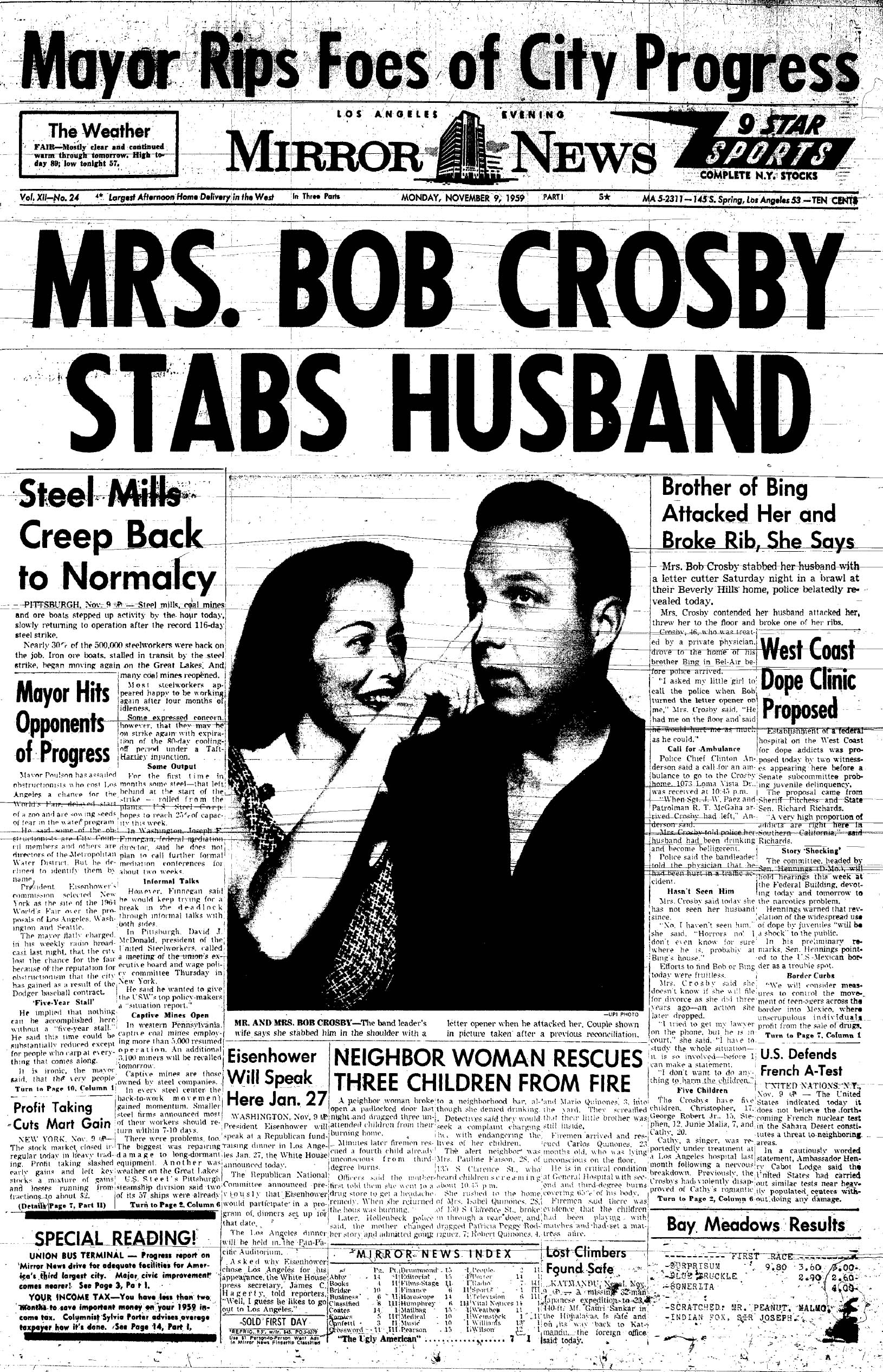
Wife Stabs Bob Crosby
|
Nov. 10, 1959: June Crosby stabs her husband, Bob, with a 10-inch letter opener during a fight.
She tells Beverly Hills police that she grabbed the letter opener to fight him off after he pushed her down during a violent argument. Her husband says she fell when they were struggling over the letter opener. "We've had family arguments before," the bandleader says. "I guess this one just exploded. She seemed to go into a rage. She was so hysterical. The first thing I knew she came at me with both her fists." The Times says most marijuana and 50% to 75% of the heroin coming into Southern California is from Mexico.
|

Sheriff Peter Pitchess says authorities are hampered in fighting drugs by the exclusionary rule — limiting officers' authority to search a person and seize evidence based on probable cause — and the requirement that narcotics informants be named in open court.
|
|
Simone Signoret visits Los Angeles with her husband, Yves Montand. She is "small and plump and charming and intelligent," The Times' Philip K. Scheuer says.
|
|
|
Mexico, U.S. Blame Each Other After Border Crackdown Fails

Lerdo’s Typical Grand Mexican Orchestra and “Eyes of Youth” at Tally’s Kinema at Grand and 7th and “Her Game” at Tally’s Broadway, 833 S. Broadway.
|
| Nov. 10, 1919: A plan by American and Mexican authorities to deport 100 to 200 “undesirables” to the U.S. was repeatedly postponed because the "hopheads, thieves, gamblers and those who live from the earnings of others" could not be found. Finally, the Mexican police turned over 13 men who worked at the Owl, a gambling house closed by government edict. The men were freed through the efforts of “Booze” Byers, one of the Owl’s proprietors, and allowed to return to Mexico … And although Wagner's operas provoke riots by World War I veterans in New York, patrons of a Parisian theater vote in favor of performing the German composer's music. |
Posted in #courts, Architecture, Film, Food and Drink, Hollywood, Music
1 Comment
Woman Whistles for a Cop
|
|
| Nov. 10, 1909: Hope Whittaker, who works until midnight as a cashier at the Peking Cafe, carries a police whistle in case of emergencies and used it when accosted by Eric Eich. Officer Blaisdell arrested Eich after Whittaker said: "This man's trying to insult me." Eich was sentenced to a $30 fine or 30 days in jail. |
November 9, 1959: Matt Weinstock
Those Quizzes
 Clearly it’s no more possible to control the gags about the quiz show scandal than it is to control the mushrooming scandal itself, and the other day a group of coffee break philosophers of my acquaintance got around to the subject.
A man named Marvin contributed the subversive thought that in addition to handling out its annual Emmy awards next year the television business should offer a special Ananians award, on the occasion of which the band should strike up with “Pony Boy.”
A cynic named Jerry suggested a Stoolie award, but he was quickly smothered on the grounds that this was strictly a police matter.
Posted in Columnists, Countdown to Watts, health, Matt Weinstock
1 Comment
November 9, 1959: Paul V. Coates – Confidential File
Trials and Tribulation of Doodles Weaver
 It’s an axiom thought up by Sir Isaac Newton and perpetuated by Hollywood:
What goes up must come down.
And its proof sat in front of my desk, in striped shirt and gaudy suit, a shade less subtle than mustard.
His professional, comical name was Doodles Weaver.
“People think I’m important,” he was explaining to me. “Everybody’s heard of Doodles Weaver. The American public really likes me.”
With nervous vigor, he tamped the tip of his burned-out cigar in an ashtray on the edge of the desk.
Then he said, “But I can’t get a job. In this town, I can’t.”
Posted in Architecture, Columnists, Paul Coates, Transportation
Comments Off on November 9, 1959: Paul V. Coates – Confidential File
A Kinder, Simpler Time Dept.: Your Movie Columnist
|
|
| Nov. 9, 1946: “Claudette Colbert and a dozen other people would like to adopt Natalie Wood, 7-year-old girl who played in ‘Tomorrow Is Forever’ and who goes to 20th for ‘The Ghost and Mrs. Muir.’ ” |
Posted in Columnists, Film, Hollywood
1 Comment
Cops Pose as Beatniks to Catch Drug Suspects
|
Like, dig the crazy berets on the fuzz, daddy-o! |
|
One New York detective even wrote poetry to fit in with the beats!
Jack Webb’s cult classic about the newspaper business is about to open. Jack Webb, left, William Conrad and James Bell in “—30—.” |
|
"A Doctor Must Marry His Profession … Nothing Else!" |
 Elgin Baylor scores 64 points, an NBA record, as the Lakers beat Boston, 136-115. |
Posted in Comics, Film, Front Pages, Hollywood, Sports
3 Comments
Architectural Rambling – Hollywood
| [googlemaps https://maps.google.com/maps/sv?cbp=12,228.65,,0,4.34&cbll=34.099212,-118.341731&v=1&panoid=YAvDmGQwU9jUHJUW_dzSjA&gl=&hl=en” width=”550″> |
| Nov. 9, 1919: Two large homes are being built in Hollywood. But don’t go looking for them. They are long gone. |
Posted in Architecture, Film, Hollywood
Comments Off on Architectural Rambling – Hollywood
Woman Driven Mad by Divorce Attempts Suicide
| |
| Nov. 9, 1909: Emma Rogers divorced her husband, then began having hallucinations when she failed to reconcile with him and he remarried. She tried to kill herself in a restroom at the Chamber of Commerce, but her aim was bad and she only wounded herself. |
Yet Another Killer Dad in the Black Dahlia Case
|
|
| With the publication of Steve Hodel’s “Black Dahlia Avenger” and “Most Evil,” I assumed that the market for “Daddy did it” claims about the Black Dahlia case was exhausted, particularly after the tragic suicide of Janice Knowlton, who began this bizarre publishing genre with “Daddy Was the Black Dahlia Killer.”
But no. Throw onto the pile of claims about conveniently dead “killer Dads” the one being offered by Dennis Kaufman, a Sacramento man who says his stepfather, Jack Tarrance, (you guessed it) killed Elizabeth Short and committed the Zodiac murders. And yes, there is a movie in the works. Unlike some crime writers, I am a specialist rather than a generalist. The Black Dahlia case is one I know well, but I’m only familiar with the outlines of Zodiac, so I’ll skip anything involving Tarrance and the Zodiac killings. Here’s a brief explanation of what’s wrong with the claim (it’s not even good enough to call a “theory”) linking him to the Black Dahlia case.
There were no letters from the killer. There were no postcards from the killer. There is no handwriting to compare. Zero.
None. All the rest of the mail was the work of anonymous crackpots. The fact is that in the weeks after the killer sent some of Short’s belongings to the newspapers, there was a deluge of mail from pranksters. Every bit of it was a joke. That anyone is taking this mail seriously 60 years later is a sad reflection of the pitiful lack of skepticism among amateur researchers, writers and book publishers.
It is not impossible to answer the question of where Tarrance was in January 1947 at the time of the Black Dahlia killing – but it’s a fair amount of work. The test will be whether these folks will even attempt to fill in the blanks or content themselves with a lot of mumbo-jumbo about penmanship in hopes of a book/movie deal. Note: The two images of crackpot mail are from the Herald-Express/Herald Examiner photo archives. Some of the Herald’s Black Dahlia material, including these images, is at the Los Angeles Public Library and has been posted online, and many photos are in the John Gilmore archives at UCLA Special Collections. The screen grab of Tarrance’s honorable discharge is from KOVR. |
Posted in broadcasting, Homicide, LAPD, Television
1 Comment
 ladailymirror.com