Matt Weinstock, Nov. 28, 1959

  Nov. 28, 1959, Steve Roper“Don’t Want Police”

Nature Study

Matt Weinstock

    More than two years ago a certain teen-ager trapped me into attending a school carnival.  She permitted me to buy her a hot dog, a soft drink, ice cream and cotton candy.  She induced me into playing some silly fishing-pole and hoop-throwing games of chance in an effort to win gimcracks I didn't want.  It was all for a good cause, the PTA.

    But this wasn't the real reason she'd lured me to the carnival.  She'd heard baby alligators would be on sale and for reasons which are obscure she wanted one.
   
Fortunately, by the time she steered me circuitously to the booth, the alligators had all been sold.  We settled for a two-inch salamander, which we took home in a water-filled polyethylene bag.

image    PROBABLY NOTHING in the world is as useless as a live salamander.  It just lies there on a water-covered rock in a bowl, meditating.  It also wriggles when touched or picked up.  This makes little girls scream.

    At first she fed it and changed the water regularly, but as months passed it became apparent she wasn't interested in the salamander's problems, which can be lumped into one big one — survival.

    But Sal, a friendly if impassive little devil, thrived on starvation and neglect or at least refused to die.

    Now Sal has a new home.  I sneaked it into a fishpond where I'm sure life will be easier.  And I wish to point out that scientists who put mice and monkeys into space missiles may be missing a bet.  They should never underestimate the power of a salamander.  Come what may, it's my candidate to survive.

::

    THEME OF the new Cole swimsuit line, disclosed at a recent fashion showing, is Tahiti.   Reporting on the event, which featured Tahitian music, dancing and cocktails, Paige Thomas, who is a girl, says, "It was a great success-the sword dancers didn't decapitate a single editor!"

::

    PAOLO
Did Francesca pay Paola
    Or was it the other way
        'round?
There's little doubt that
        neither, though,
    Were by conventions
    bound.
    –G.L. ERTZ

 
::

   A MARKET IN Monterey Park recently advertised a soap powder at a reduced price and the supply was quickly depleted.  But thwarted women shoppers saw a large stock of the stuff through the open doors of the storeroom and prevailed upon employees to replenish the supply.  Meanwhile, glaring fiercely,  the women poised their carts at vantage points to swoop in on the bargain.

    Reminded Ken Williams of what his folks had told him about the opening of the Cherokee Strip.

    He also recalled how he used to help stir a cauldron of boiling soap made from cracklings and lye.

    "There was the danger of getting burned," he said, "but not of getting maimed in a stampede."

::

    FOOTNOTES — Had your confusion quota for today?  The Wisconsin Badgers, who will play the Washington Huskies in the Rose Bowl, will work out at the stadium of the East L.A. College Huskies on Brooklyn Ave. . . .


Posted in Columnists, Paul Coates | Comments Off on Matt Weinstock, Nov. 28, 1959

Paul V. Coates – Confidential File, Nov. 28, 1959


Mash Notes and Comment

 Paul Coates   "Dear Paul,

    "You might remember me.  I'm Memphis Weed's singer friend from Hollywood.

    "Memphis wrote to you once about me and the songs I recorded.  You printed his letter and then you printed a letter I wrote you after that. 

    "I've been reading you regularly ever since.

    "You seem to write  a lot about the problems of people who end up in jail for one reason or another, what it's like and the things that happen to them.
   
"I remember when I was in the City Jail on a traffic warrant for two days once. 

    "How different it is and how quickly you are forgotten by the public!"

(signed)  Kirk Atello, P.O. Box 233, San Clemente.

image     –-You know how it is, Kirk.  Out of sight, out of mind.

::

    "Mr. Paul Coates:
   
"In last Saturday's paper, you stated that you knew who was president of the United States in 1875.

    "If you are that well educated and brilliant, why do you stay in the newspaper business?" 

(signed)  Gordon Stuart, 1015 Galloway St., Pacific Palisades.

   –It's that damn printers' ink.  It gets in your blood.

::

    "Dear Paul,

    "Ho!  Without looking it up or asking somebody, who WAS President in 1875?"

(signed)  J. Farrell, 20452 Ruston Rd., Woodland Hills.

    –-Ho, yourself!  Zachary Taylor.

::

    "Dear Coates:
   
"In your smug answer to the poor lady who lost the stove, you told her you knew who was president in 1875.

    "But conspicuously absent from your answer to her was the NAME of the man who was
president in 1875.
 
  "Being the suspicious type, I immediately deduced that (1) you didn't REALLY know who was president in 1875, and (2) you were too lazy to go look it up.
 
  "After reading your column, I got curious and not being the lazy type, I DID look it up.

    "I'll give you a clue.  He's buried in Grant's Tomb!" 

(signed)  Big Billy, Long Beach.

    -Zachary Taylor?

::

    "to Paul Coats, the Mirrow News,

    "California 20, Stanford 17.

Nov. 28, 1959, Abby

    "Paul this was big game day at Stanford.  I was with my wife at a greek bar in Palo Alto but I got rid of her, she was giving me a bad time and I jumped in my Taxi and drove in front of the Yellow Cab office Palo Alto.

Looking for Custermer


    "I was looking for a custermer, there was fifty people in front of the Yellow Cab office waiting for a cab, the big game was over, but the Yellow Cab dispatcher wouldn't give me any of his custermers.

    "But there was a party of six from the Mirrow News L.A.  One was John Hall boxing sports editor.

    "He said thats Parkey Sharkey, lets take his cab.

    "They did Paul and took me to a bar on Bayshore Highway for a beer and dinner.  John Hall Mirrow News tipped me a dollar plus two beers.

    "You never gave me any money Paul even though we known each other for years, how come Paul?"  (signed)  Parkey Sharkey, Palo Alto.

    –I don't want to cheapen our friendship by making it commercial.

Posted in 1959, Columnists, Paul Coates | Comments Off on Paul V. Coates – Confidential File, Nov. 28, 1959

A Kinder, Simpler Time Dept.: Your Movie Columnist

Nov. 28, 1965, Debbie Reynolds 
Debbie Reynolds – still too busy for bitterness!
Nov. 28, 1965: "You make mistakes in your personal life and you profit by them and you make mistakes in your career. Sometimes advisors counsel you incorrectly, get you into a wrong contract and you end up being used. It's difficult to evaluate things when you're young. I feel if the handling of my career had been disastrous I wouldn't be around. I've had only one agency over all the years; they've made mistakes, so have I."

Note: Hedda Hopper died Feb. 1, 1966, (the next day’s editions of The Times carried obituaries on her and Buster Keaton), so I’ll fill out the month with a few earlier columns. What’s your opinion, Daily Mirror readers? Should Hopper’s column become a regular feature?

Posted in Columnists, Film, Hollywood | 1 Comment

Pilot Dies When Plane Hits House in Compton


Nov. 28, 1959, Cover

Nov. 28, 1959: A plane crashes into a home at 519 W. Greenleaf in Compton.

Nov. 28, 1959, Mink Jeans

Mink jeans? Are you serious?

Nov. 28, 1959, Freeways

Running freeways through the upper floors of existing buildings is a startling concept – but it’s not new. As envisioned in the 1930s, the Los Angeles freeway system was quite futuristic and this was one of the key concepts. Another component was parking structures inside all four circular ramps of each  exit/entrance cloverleaf. 

Nov. 28, 1959, Rostropovich

Mstislav Rostropovich plays the Shostakovich Cello Concerto with the Los Angeles Philharmonic, conducted by Arturo Basile. Times critic Albert Goldberg says: "It is a big and exciting piece, of far greater substance and musical worth than the composer's recent Eleventh Symphony. Shostakovich seems to have found himself again in this work."

What's this? "Respighi's "Roman Festival" is "about the noisiest and emptiest piece of claptrap ever written for a symphony orchestra."

Nov. 28, 1959, Dotty

Chocolate cigarettes? Thanks, dad!

Nov. 28, 1959, Sports

USC hopes to defeat Notre Dame for the first time since 1939.

Braven Dyer writes: "You old-time football fans will recall the tremenders between Knute Rockne and Howard Jones. Four of their first six battles were decided by a total of five points. Played every other year back here after the Big Ten season closed, they drew national attention and kept students and faculty at Notre Dame in a dither of excitement the week of the game. David Condon, Chicago Tribune columnist who attended ND, recalls his freshman history class. On Saturday morning, his history professor opened the session by saying, 'You boys never have seen Southern California play. Let me diagram their offense for you.' And he strode to the blackboard and did so."

Posted in classical music, Freeways, Front Pages, Music, Sports | Comments Off on Pilot Dies When Plane Hits House in Compton

An Unlucky Address

 
Nov. 28, 1919, Briefs 

Nov. 28, 1919: A nervy bandit.

May 12, 1924, Poison
May 12, 1924: More trouble at 824 Francisco St.

March 4, 1932, 824 Francisco 
March 4, 1932: Even more trouble near 824 Francisco St.

 
Nov. 28, 1919: A nervy bandit orders a woman out of her house while he burglarizes it, then gets in a fight with a neighbor who tries to stop him. He leaves his hat in the struggle,  and police say it may reveal his identity.

Posted in Downtown, LAPD | Comments Off on An Unlucky Address

Digging for Solomon’s Treasure

Nov. 28, 1909, King Solomon's Treasure
 

Speculators are excavating at the Pool of Siloam in hopes of finding King Solomon’s treasure.

Nov. 28, 1909, Insane 

image

Nov. 14, 1909: Flames roar through an Illinois coal mine, trapping hundreds underground.  

Nov. 28, 1909: Mine inspector Theodore Fellows is being taken to an insane asylum after becoming a raving maniac because of the horrors he witnessed at the St. Paul mine disaster in Cherry, Ill

Posted in #courts, Religion | Comments Off on Digging for Solomon’s Treasure

Matt Weinstock, Nov. 27, 1959

  Nov. 27, 1959, Peanuts

image Another panel you'll never see in the legacy sitcom version of "Peanuts."

Dog's Day in the Sun

Matt Weinstock

    Inasmuch as the subject was brought up here, it's only fair that we have a final report on Glenn Shahan's miniature schnauzer, Henry.  It may be recalled that Henry developed a persistent hacking cough and  a veterinarian said the only thing was to send him to Palm Springs for a week in the dry sunshine.  The pooch, not Glenn — he can't afford it.

    While there Henry lounged around in a plush Doggie Dude ranch, presumably with swimming pool and chuck wagon chow.  As a result of mention here he received three hand-knit sweaters, a car coat, a parka, an Ivy League cap, several boxes of dog candy and a flock of get-well cards.  Furthermore, he flew back from Palm Springs, his health recovered.

     He also acquired a furtive look and Glenn suspects he is secretly planning another cough so he can go to Acapulco next time.  Take Glenn's word for it, he's only going one place — back to obscurity.

::


image    THE
controversy over the Pasadena art find reminded Jeff Davis of a classic story heard in art circles.

    Just before WWII a South American millionaire bought a Titian in Italy for a high price.  Fearing the broker would tip off government officials and he wouldn't be able to get it out of the country, he hired an artist to do a portrait of Mussolini over the Titian and he got it through without trouble.

    When it arrived in South America the owner hired an expert to remove the Mussolini portrait.  He did so, then scraped off a little of the Titian preparatory to restoring it.  Underneath he found another portrait of Mussolini.

::

    LIKES GIRLS
Seven radiant maidens
    vying for Rose Queen-
Lovelier contestants seldom
    have been seen.
Good thing I'm not judging
    or they all would ween!
    –JUAN LIGHTHEART

::

    A PUBLICIST who is on all sorts of mailing lists received an invitation the other day to a $100-a-plate dinner in January.  He happens to be unemployed at the moment and any thought of attending it is out of the question.  But he was fascinated by its note of urgency.  "Better hurry," it concluded, "first come, first served."

::


    FURTHER PROOF
that school teachers watch over their little ones in more ways than parents suspect was contained in this note, printed in huge letters, which Craig Atterbury, 6, brought home:  "Dear Mother: I was not a good citizen today at school.  I walked under the slide, I bothered four children and I ran through Miss Rattray's game circle."

::

    THEN THERE WAS the letter Kimberly Clement, 5, brought home from her kindergarten teacher, Toni Criley, at Silver Spur school in Rolling Hills, titled "Teacher Observations": "Kimberly is a happy, well-adjusted girl who co-operates cheerfully with others.  She is a good worker, finishing every project she starts.  She speaks clearly and distinctly.  She learns easily and enjoys using the concepts and words which she has learned.  However, she sometimes seems to daydream during class and thus misses some of the things which are said."

::


    ON THE EVE
of another football week end let us unleash two inescapable thoughts which seem to permeate a topsy-turvy season:

    1.  All football is dull when your team loses.

    2.  Gloating is what the opposition does, never you.

::


    AT RANDOM —
When a sporting postman on a Hollywood beat delivers a postage-due letter to recipients  with gambling instincts, they flip a coin — double or nothing . . . Pictorially and dramatically the $15 million movie "Ben-Hur" is magnificent.  But it does get gory here and there.  In fact, after the press review one gal remarked, "No wonder the price of ketchup went up!" . . . A pleasant gentleman sat down at deputy registrar Bernard Wiener's table in front of a market at Sepulveda Blvd. and Devonshire and said he had changed his residence and wanted to re-register.  After he'd gone, a bell rang for Wiener.  It was Ken Maynard, his boyhood idol.  He regrets he didn't express his admiration.

Nov. 27, 1959, Abby 

Posted in art and artists, Columnists, Comics, Matt Weinstock | 1 Comment

Paul V. Coates – Confidential File, Nov. 27, 1959

 
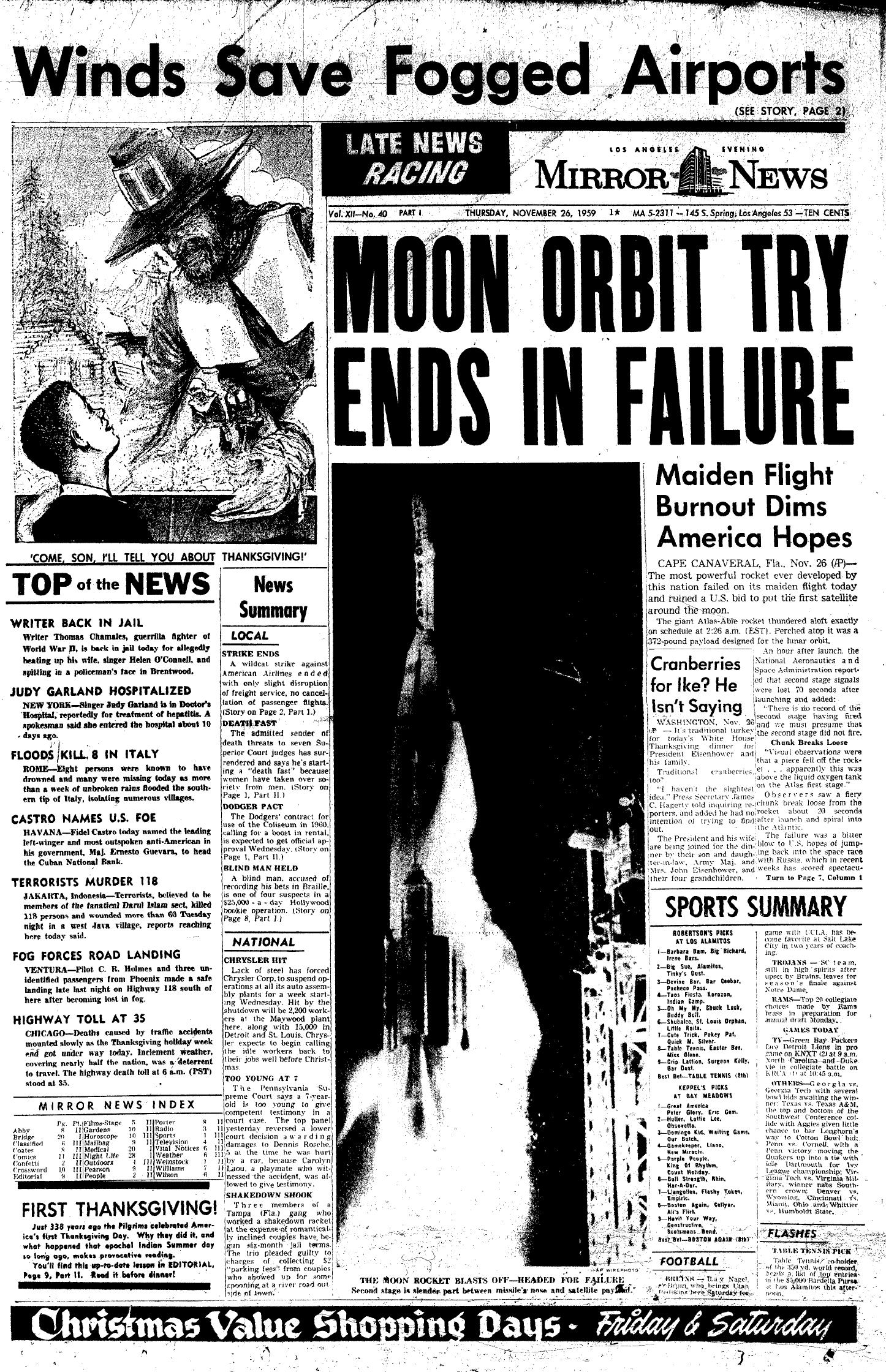
Nov. 27, 1959, Mirror Cover

Baby Given Away by Unwed Mother

Paul Coates    Yesterday was Thanksgiving but the girl who wandered timidly into my office wasn't giving thanks.

    Her green eyes were rimmed with red as she sat down.

    "The lady in the bar on Vermont told me maybe it would help if I went to the newspapers," she said.

    The she introduced herself.  Her name was Mary.

    She was short and skinny and looked a lot younger than the 26 years she admitted to.

    "I don't know if you can," she continued.  "Maybe it's just silly for me to come here."

    Reporters have a stock line about, "Well, if there's anything we can do, we'll certainly try."  I gave it to her.

    She accepted it.

    Then, the formalities over, she told me:

    "I gave my baby away and I want it back."

    "Gave it away?"

    "I did," she repeated.  "I really didn't want to, but people kept telling me it was better.  They said it would be brought up better, with a good education.

    "You see," she added.  "I wasn't brought up too good.  I guess that's what they figured."

    "Who did you give it to?" I asked.
Nov. 27, 1959, Nixon Poll
    "To the adoption people." Mary stared at the floor, hiding her wet eyes, showing only the brown roots of her bleached hair.  "The county, I guess it was."

    "They told you it would be better to give your baby away?" I asked.

    "No, they didn't say that."  She shook her head.

    "Other people said it.  The adoption people said I could have my baby, but I was afraid.  You see, I didn't have any job.  I should have asked my mother if I could have gone and lived with them, but she didn't know about my baby.  She's in the East.

    "But my stepfather.  He's so funny.  He wouldn't want any babies around."

Baby Born Out of Wedlock

    I asked how long the baby'd been gone.

    "I signed the papers in August.  They kept talking to me every week — the adoption bureau.  They were asking me every week to make up my mind so finally I said I'd give them my baby."

    In vigorous self-consciousness, the girl rubbed the back of her neck.

    "I never been married," she continued.  "I don't even know where the father is."

    "But you know who he is?"

    "No.  I went with a lot of sailors.  You see, at the time, I was living in San Diego."

    She sat silently for a minute, still rubbing her neck.

    "But I pray a lot," she began again, hopefully.  "I don't really go to church on Sundays.  I should but I don't have any good clothes to wear.  I go in the afternoons sometimes when nobody's there.

    "Now, I been praying every day."

    "Did you ever see your baby?" I asked.

    "Only one time, last July.  Right after it was born."

    The baby was "it," always "it."

    She added, "I don't even remember what it looks like now.  I don't know if I'd know it if I saw it."

    "Was it a boy or girl?"  I asked.

    The girl looked at me strangely.

    "It was a boy-baby," she answered, almost in anger.  "But what difference does that make?  It was my baby."

    For the first time since she sat down, she looked me in the eye.

    "You can't help me, can you?" she said.  "It's too late, isn't it?"

    Then she left.

Posted in Columnists, Paul Coates, Richard Nixon | Comments Off on Paul V. Coates – Confidential File, Nov. 27, 1959

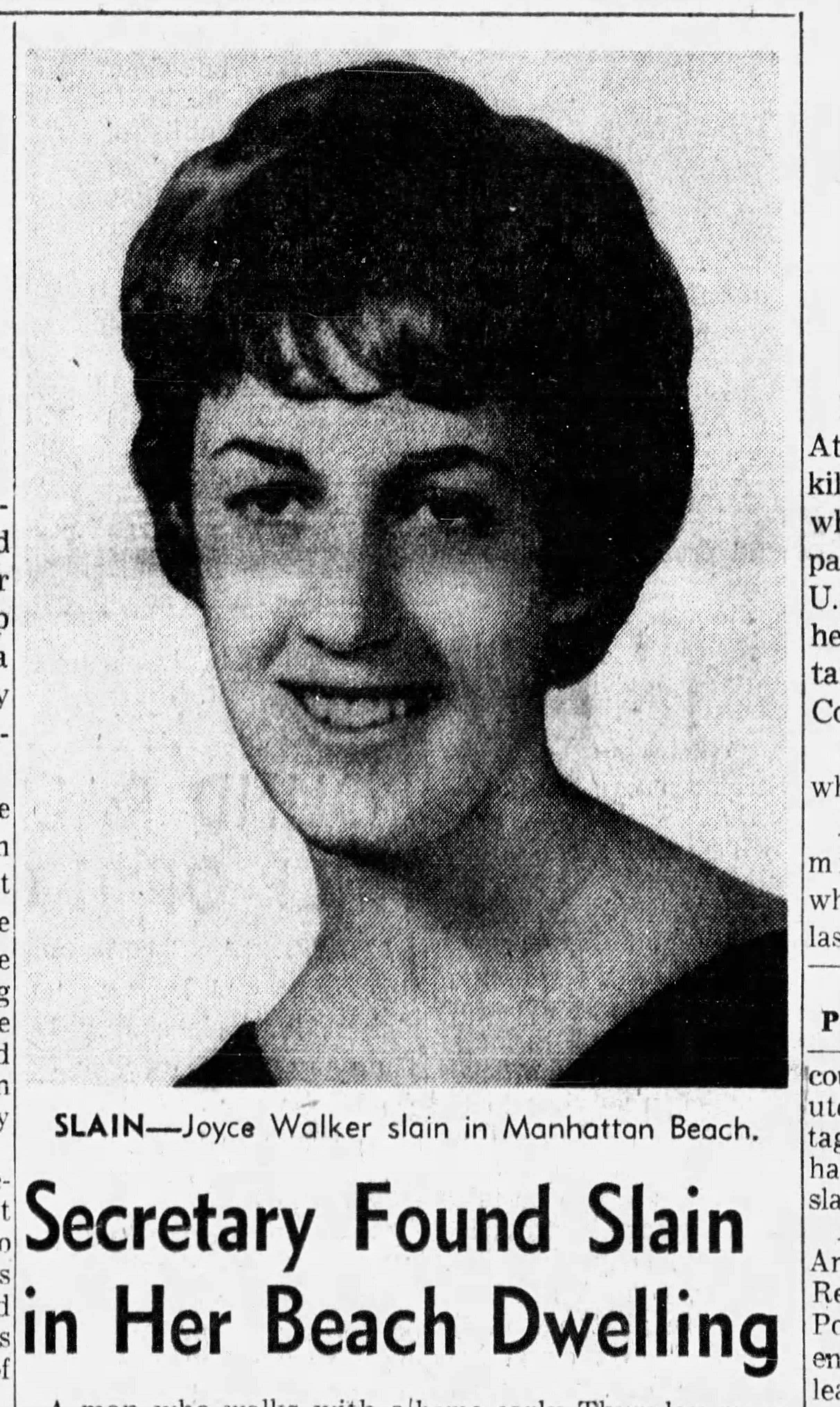
November 27, 1964: Secretary Found Stabbed to Death in the ‘Thanksgiving’ Murder

November 27, 1964: Portrait of Joyce Gail Walker. November 27, 1964: The death of Joyce Gayle Walker is one of the more haunting killings of the 1960s. I’m not sure it was ever solved. I can’t find any follow-up stories on it.

Continue reading

Posted in 1964, Front Pages, Homicide, Jack Smith | 1 Comment

A Kinder, Simpler Time Dept.: Your Movie Columnist

Nov. 27, 1964, Hedda Hopper 

No. 27, 1964: "Neiman-Marcus always has something new for the ladies at Xmas time. This year it's suction bras covered with sable. One press and they're on for the evening. Made by our own Willys of Hollywood."

Posted in Columnists, Film, Hollywood | Comments Off on A Kinder, Simpler Time Dept.: Your Movie Columnist

Movie Star Mystery Photo

Nov. 23, 2009, Mystery Photo
Los Angeles Times file photo

Update: This is Creighton Hale in a photo dated Feb. 17, 1924. He died in 1965.
Aug. 12, 1923, Creighton Hale

Aug. 12, 1923: Newcomer Creighton Hale is making a picture with "Ernest" [Ernst] Lubitsch. [ProQuest shows that The Times frequently misspelled his name].

Just a reminder on how this works: I post the mystery photo on Monday and reveal the answer on Friday … or on Saturday if I have a hard time picking only five pictures; sometimes it's difficult to choose. To keep the mystery photo from getting lost in the other entries, I move it from Monday to Tuesday to Wednesday, etc., adding a photo every day.

I have to approve all comments, so if your guess is posted immediately, that means you're wrong. (And if a wrong guess has already been submitted by someone else, there's no point in submitting it again).

If you're right, you will have to wait until Friday. There's no need to submit your guess five times. Once is enough. The only reward is bragging rights. 

The answer to last week's mystery star: Milton Sills!

Nov. 24, 2009, Mystery Photo
Los Angeles Times file photo

Update: Creighton Hale and Irving Cummings in an unidentified photo dated March 4, 1924.

Here’s our mystery fellow with a mystery companion. Please congratulate Carmen, Mike Hawks, Nick Santa Maria and newcomer Vidor Fan for identifying him.

Nov. 25, 2009, Mystery Photo
Los Angeles Times file photo
Jun 16, 1929: Creighton Hale in a publicity photo for “Paris Bound,” a play produced at the Hollywood Music Box. 

Here’s another photo of our mystery star!

Nov. 26, 2009, Mystery Photo
Los Angeles Times file photo
Update: Creighton Hale, Kent Smith and Ann Sheridan in “The Sentence,” later changed to “Nora Prentiss,” April 9, 1947. 

Our mystery fellow and some mystery companions. Please congratulate Mary Mallory for identifying him. And special congratulations to Mike Hawks for identifying Tuesday’s mystery companion.

Nov. 27, 2009, Mystery Photo
Los Angeles Times file photo

Creighton Hale and his Boston terrier in an undated photo. Please congratulate Dewey Webb, Don Danard, Jenny M., Michael Ryerson, Gregory Moore, Stacia, Thom B and Alexa Foreman for identifying him.

Posted in Film, Hollywood, Mystery Photo | 37 Comments

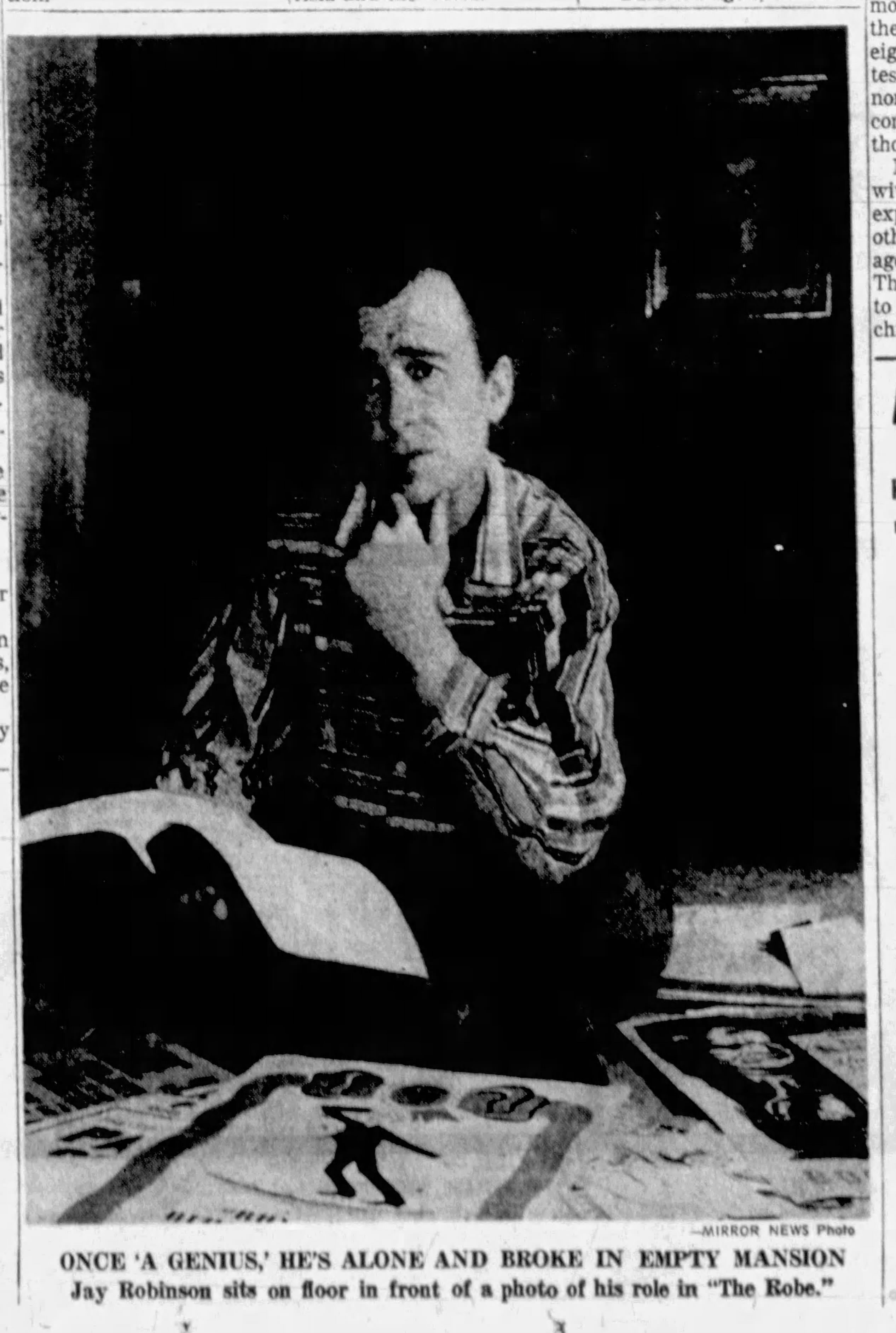
November 27, 1959: Hollywood’s Forgotten Genius

November 27, 1959: Hollywood's forgotten genius
Jay Robinson sits in his Bel-Air mansion on Stone Canyon Road.


November 27, 1959: Hollywood’s forgotten man sat on the bare floor of his empty mansion. Jay Robinson was alone with the posters of his past.

Not long ago filmland called him a genius.

He made $3,000 a week then. Friends and rich furnishings filled the house. There was laughter and music.

Continue reading

Posted in 1959, Film, Hollywood, Sports | Comments Off on November 27, 1959: Hollywood’s Forgotten Genius

Actress Divorces Husband Over Remarks About Movie Industry

Nov. 27, 1919, Corset

Prince Albert Calais wears a corset, but on doctor’s orders.

image 


Nov. 27, 1919: Actress Ruth Villmore Eversole, known professionally as Ruth Royce, sues for divorce because her husband got angry when she came home late. He also made derogatory comments about her and her friends in the movie business.

Posted in Uncategorized | Comments Off on Actress Divorces Husband Over Remarks About Movie Industry

Court Fight Over Cook’s Biscuits

 
Nov. 27, 1909, Gambling 

Charges are dropped against men accused of violating the law on public speaking in parks.
Nov. 27, 1909, Biscuits
 

Nov. 27, 1909: Lucene Farr, an African American cook, tries to recover $40 after quitting her job at the boarding house of Alice Eisen because  Eisen criticized Farr’s biscuits as “nothing like her mother used to make.”

Posted in #courts, Food and Drink | Comments Off on Court Fight Over Cook’s Biscuits

November 26, 1959: Matt Weinstock

November 26, 1959: Farah Diba

Cop and Robber

Matt Weinstock Citizens can be thankful for policemen like Dalton Robert Patton, whose funeral was held yesterday.

Patton, 58, who retired from the LAPD in 1943, was not a “front page cop.”  He preferred to work quietly, without fuss.

Friends yesterday recalled his classic encounter with a safe cracker.  Patton, detective captain at Hollywood station, spent months tracking him down and had him, as the saying goes, “dead bang.”

But to everyone’s consternation a jury acquitted him.  After the trial the burglar said, “No hard feelings, captain.  And I want you to know I’ll never crack another safe in your division .”

Continue reading

Posted in Columnists, Matt Weinstock | Comments Off on November 26, 1959: Matt Weinstock

November 26, 1959: Paul V. Coates – Confidential File

November 26, 1959: Mirror Cover

Nothing So Dread as He With Fanatic Eye

Paul Coates, in coat and tieIt’s my guess that E.B. (Jet) Simrell — the 46-year-old ex-market owner who surrendered to the FBI yesterday after having threatened the lives of seven judges — figures he’s got one big card to play in his crusade against the “un-feminine, all-powerful American woman.”

And it’s my opinion that he’s sadly wrong.

If Simrell carries out his plan to “fast until death to win unanimous approval of the truths for which I fight,” he might win himself a little public pity.

But that’s all.

Long ago, he lost sight of the objectives of his fight.  And with them, he lost everything, including, possibly, his sanity. Continue reading

Posted in Columnists, Homicide, Paul Coates | Comments Off on November 26, 1959: Paul V. Coates – Confidential File

A Kinder, Simpler Time Dept.: Your Movie Columnist

Nov. 26, 1963, Hedda Hopper 

Nov. 26, 1963: Margaret Leighton says: “I haven't been bored since childhood, but feel I'm really rather dull. A career is all right until age 26. After that you might wish you hadn't become an actress.” And she says of former husband Laurence Harvey: “I don’t want to be just friends with people I’ve been married to.”

Posted in Columnists, Film, Hollywood, Stage | Comments Off on A Kinder, Simpler Time Dept.: Your Movie Columnist

Thanksgiving, 1959

Nov. 26, 1959, Thanksgiving

Bruce Russell’s take on Thanksgiving.

Nov. 26, 1959, Thanksgiving

Nov. 26, 1959, Letter to Wives

Wives – remember all the times dad “sits with the kids and ‘entertains’ them while we do our personal little chores.”

Nov. 26, 1959: “Nothing less than a revival of our Founding Fathers' spiritual faith can halt the moral decay weakening our nation, a decay on which the evil called communism is already feeding. Our American ideal was rooted in a religion that respects every man and worships his Creator. Communism, based on the dogma of Karl Marx — who despised all religions — debases man and venerates the state.” 

Posted in Fashion, Food and Drink | Comments Off on Thanksgiving, 1959

Thanksgiving, 1908

1908_1122_thanksgiving

Above, Thanksgiving, 1908

"Did the Pilgrim Fathers have salads at their Thanksgiving feasts? Nay, verily!"

How Did Thanksgiving Get to Be Turkey Day?


History: The All-American feast took its time becoming the holiday we all celebrate today.

Thursday November 15, 1990

By CHARLES PERRY,
TIMES STAFF WRITER

1908_1120_harris
Thanksgiving didn't come into the world fully formed. We don't even know when the first Thanksgiving Day took place, only that it was sometime between Sept. 21 and Nov. 9, 1621.

The Pilgrims certainly had no idea of founding an annual holiday, either. The first Thanksgiving was strictly a one-shot event. Similar ad hoc days of thanksgiving were proclaimed from time to time in Massachusetts over the next 50 years–usually by the churches, rather than by the civil authorities–but it was Connecticut that made Thanksgiving an annual event, starting around 1647.

The custom of having an annual Thanksgiving Day spread throughout New England in the 17th Century, but as yet it did not include any idea of commemorating the First Thanksgiving. If anything was commemorated, it was a later Thanksgiving when the crops had failed and the Massachusetts Bay Colony came very close to starvation.

In 1631, everybody was down to a daily ration of just five grains of corn when a day of fasting and prayer was proclaimed for Feb. 22. Miraculously, on that day a ship returned from England with food supplies, the colony was saved and the fast day turned into a feast. There is a very old New England custom, now mostly forgotten, of serving every diner five grains of corn before the meal in memory of the hardship and the deliverance of that year.

The holiday actually met a certain amount of resistance as it spread. Since the "pagan" holiday of Christmas was not celebrated in Massachusetts until the 19th Century, Thanksgiving was often thought of as essentially a Puritan substitute for Christmas.

Thanksgiving made no headway in the South, for instance, and probably it was only because the Dutch colonists had celebrated what they called Thankday that it was accepted in New York. When the British governor of Rhode Island proclaimed Thanksgiving in 1687–doubtless thinking he was doing his subjects a big favor–Puritan-hating religious dissidents celebrated the holiday so contemptuously he threw some of them in jail. Rhode Island didn't start celebrating Thanksgiving until 1776.

In 1776, of course, Thanksgiving was not a Puritan but a Patriot holiday. That year and every year throughout the Revolutionary War, the Continental Congress declared a national Thanksgiving to boost morale. George Washington also declared Thanksgivings as President in 1789 and 1795, as did the following Presidents occasionally until about 1815.

Still, the holiday did not catch on. That took two things: the migration of New Englanders throughout the Northern states, enthusiastically taking their holiday with them, and one very determined lady, Sarah Josepha Hale.

Sarah Hale was born in Maine in 1788 and had powerful childhood memories of Thanksgiving. In 1826 she published a novel containing a plea for a national Thanksgiving holiday. In 1846, as editor of the influential Godey's Lady's Book, a combination fashion and literary magazine, she began her campaign in earnest. From then on, she wrote at least two editorials a year on the subject and deluged public figures with correspondence about the need for Thanksgiving. She even included a chapter on the campaign for a national Thanksgiving in her book on etiquette.

The South dragged its heels for a while–when the governor of Virginia considered the idea in 1855, it was denounced as a relic of Puritan bigotry (probably a code word for Northern abolitionism), but the next year his successor just proclaimed the holiday without soliciting advice, and it was a success.

In 1859, Thanksgiving was celebrated in every state of the Union except Delaware, Missouri and recently admitted Oregon, and Sarah Hale expressed the hope that the holiday could unify the country against the gathering clouds of the Civil War.

That didn't happen, of course, but during that war she persuaded Abraham Lincoln to declare a national Thanksgiving Day, intended to be celebrated annually. He established the date we follow now, the fourth Thursday in November. After the Civil War, Thanksgiving was encouraged as a way of healing the wounds of the struggle.

The menu at the first Thanksgiving in 1621 was simply whatever the Pilgrims, with the help of the friendly Wampanoag Indians, could put together: venison, wildfowl (mostly turkeys and ducks), fish and cornmeal. Even today, the Thanksgiving table is supposed to groan with abundance, but in the 19th Century it really groaned. Sarah Hale–whose vision obviously influenced how we celebrate Thanksgiving–described one table loaded with chicken pies, goose, ducklings and three kinds of red meat as well as turkey, and another crowded with plum puddings, custards and pies of all sorts.

She was emphatic, however, that turkey held pride of place among the meats and pumpkin among the pies, and these are still the essential Thanksgiving dishes for most people. How did they get this status?

It's a little hard to say. As the largest bird available, turkey is certainly a prime candidate for a feast. In the course of the 19th Century, it became the absolute essence of what we call "Turkey Day," partly because it was a time of culinary nationalism when Americans boasted that they had the best ingredients in the world and therefore the best food; the native bird was obviously the right one for the native feast. In his 1878 book "A Tramp Abroad," Mark Twain describes getting homesick for American food in Europe and lists about 75 American specialties. Prominent among them are "Roast turkey, Thanksgiving style. Cranberries, celery."

Cranberry sauce was already strongly associated with turkey. As early as 1663 a visitor to New England had written, "The Indians and English use them (cranberries) much, boyling them with Sugar for Sauce with their meat, and it is a delicate Sauce." Nineteenth-century cookbooks throughout the country recommend serving turkey with cranberry sauce (sometimes cranberry jelly or, as in the original Fanny Farmer cookbook, cranberry punch), even in non- holiday contexts. It must have been the universal American taste, helped by the fact that cranberries keep well and could be shipped easily.

The necessity of pumpkin pie is a little harder to explain. In the 1650s, a visitor to New England noted that the colonists were eating apple, pear and quince pies like Englishmen, and had largely given up pumpkin pie. Maybe the homely pumpkin pie made a comeback in the late 18th Century when New England developed a taste for "plain fare," rather than fashionable European dishes. They kept their English plum puddings and apple and mince pies, but elevated the homespun pumpkin over them.

The New England menu was profoundly influential, but of course it had to be adapted to local circumstances. It was hard to start a meal with oysters in the Midwest. Certain new food habits might invade the menu, too. Olives and gelatin salads were gourmet novelties in late 19th-Century America. On the whole, though, our Thanksgiving dinners are simpler than our ancestors'. The effect has been to reinforce the special status of turkey with cranberry sauce and pumpkin pie.

At the same time every group in the country has tended to add its own traditional feast day specialties to the menu, perhaps gumbo crowding out New England's creamed onions and chocolate cake the non-pumpkin parts of the dessert. The process continues today; in many households, turkey is accompanied by pasta or enchiladas.

It has often been pointed out that the First Thanksgiving was not the first thanksgiving in this country. There had been thanksgiving feasts in Virginia and the short-lived Popham Colony in Maine, years before the Pilgrims came.

We celebrate what is basically a New England Thanksgiving because New England made the festival its own. Its people had not come here as Englishmen and agents of the king, but to found a new society. In 1896 Edward Everett Hale, au
thor of "The Man Without a Country," wrote of the first Thanksgiving: "The Festival itself was a reminder that they had turned over a new leaf. It was a thick leaf, too, and nothing could be read which had been written on the other side."

Posted in Food and Drink, Front Pages | Comments Off on Thanksgiving, 1908

Times Opposes Picture Brides

Nov. 26, 1919, Cartoons  

Edmund Waller “Ted” Gale on a Thanksgiving theme – a union turkey.

Nov. 26, 1919, Picture Brides

Nov. 26, 1919: The Times editorializes against picture brides, charging that they are just a maneuver around a California law that prevents Japanese immigrants from owning land.

Posted in #courts, Comics, Immigration | Comments Off on Times Opposes Picture Brides