A Romantic Entanglement for Future Times Columnist


Feb. 28, 1920, Lee Shippey  
 

Feb. 28, 1920: My heart skipped a beat when I pulled up this story. Could this be our own  Lee Shippey, author of “The Great American Family” and “It’s an Old California Custom?” Yes it is.

Posted in books, Columnists | Comments Off on A Romantic Entanglement for Future Times Columnist

Body Found in River

 
Feb. 28, 1910, Body 

Feb. 28, 1910: The old newspapers didn’t hold back on gory details, like this story about the unfortunate fellow found in the San Joaquin River in a bag weighed down with rocks.

Posted in Homicide | Comments Off on Body Found in River

Matt Weinstock, Feb. 27, 1960

Briton's a Stevereno

Matt Weinstock     I've been reading the short stories by Peter Ustinov in the Atlantic and wondering how he does it.  Acting, speaking, traveling — and writing superlative fiction, I mean.  In the versatility sweepstakes, he's Britain's answer to Steve Allen.

    Ustinov was in town briefly this week for additional scenes in "Spartacus" — he plays Batiatus, head of a gladiator school who buys a  slave named Kirk Douglas — and the big answer came through.

    His secret is an amazing ability to concentrate.  He can write anywhere — on  a plane, sitting with his family (three children) beside his swimming pool or between "takes" on a movie set — without losing the continuity of a story. 

 
Feb. 27, 1960, Finch TrialFred Banker, studio attache, swears he could write under water.

    Some of his stories are grotesque, others deal with characters who have emerged from the chaos and ashes of World War II, as the one in this months Atlantic, "The Loneliness of Billiwoonga."  They all have, like their author, great zest for life, compassion and irony.

    Of course, he happens to be a genius, which also helps.

::
    WHILE DRIVING on Angeles Crest Highway, en route to an auto racing rendezvous near Palmdale, Art White's brakes went out.  He nursed his Morgan speedster along until he came to Vincent's garage at Highway 6.  Vincent turned out to be a racing enthusiast and started to work on the brakes — for which a new part had to be made, when an emergency call came in — a tow job for a car that had overturned.  As he left, Vincent told Art to use whatever equipment he needed — he had a complete line of expensive English and German tools — handed him a new pair of overalls so he wouldn't get dirty, and said, "Leave whatever you think it's worth."

    In all the world Art does not think he'll ever encounter such hospitality as he did in a lonely, one-man garage in the desert.

::


    CLASSIFIED
We'd do well to consider
What Symington said:
That we've been less
    missiled
Than we've been misled.
        DON QUINN

::
    THE STORY IS told about a writer who in a talk before the Ebell Club here many years ago urged his richly dressed club-woman audience to get closer to the common people and thereby achieve better understanding.  His plea was not received enthusiastically and afterward, relating the incident to a friend, he said, "I should have remembered the old adage:  See no Ebell, hear no Ebell, speak no Ebell."

    Fine, but along with others, doubtless, I've always wondered where the club got its name.  The answer has been furnished by Frances Kirschenbaum of the UCLA library reference department.

    Dr. Adrian F. Ebell graduated from Yale in 1863 and became a noted lecturer on art, literature and women's advancement.  Later he established a natural science academy which offered a travel and study plan in Europe to women.  After he died in 1877, a group of women in Oakland, Cal., where he had visited the year before, formed the Ebell Society, the first woman's club in the state.  Since then, everyone has heard a great deal about Ebell.

::


    FOOTNOTES —
This is the big night for aficionados of Miles Davis, who plays the saddest, most haunting trumpet you ever heard, and in the past few years has become one of the giants of jazz.  Although I am a piano addict, I'll be there.  Shrine Aud . . . Preparation for the Squaw Valley Olympics also included a 150 man cleanup crew, recruited here by Sydney Rosenberg of the American Building Maintenance Co.  Ten of them can speak five languages . . . A reporter on a suburban paper turned in an item about the theft of  a two-foot zero, a letter in a sign, and a proofreader who handled the copy said, "I knew someday we'd get a story about just nothing" . . . A W Pico Blvd. beauty salon gives trading stamps.
Posted in #courts, Columnists, Homicide, Matt Weinstock | Comments Off on Matt Weinstock, Feb. 27, 1960

Paul V. Coates – Confidential File, Feb. 27, 1960

 
Feb. 27, 1960, Mirror

Mash Notes and Comment

Paul Coates    (Press Release)  "Marriages are sometimes shaken or dissolved for reasons hidden in the parents' unconscious mind," Dr. Harry F. Tashman reveals in "The Marriage Bed."

    "This book, by one of New York's leading analysts, gives to married people and those about to wed a new awareness and understanding of the psychological factors that control their lives.

    "In 'The Marriage Bed,' Dr. Tashman sums up 30 years' successful experience in analyzing men and women whose marriages have been severely shaken or dissolved for reasons seldom understood by either husband or wife.

    "While 'The Marriage Bed' deals with the problems arising from marriages it is not a 'sex book' in the superficially accepted sense of that term.

    " 'The marriage bed' can be likened to a garden's bed of soil,' Dr. Tashman writes in describing married life.  'Though it be fertile, it needs care, attention and devotion.  Weeds that appear must be uprooted  . . . ' " (signed) Ben Hall Associates, New York City.

    –Yes.  And while you're about it, that vanity table could use a good dusting.

::

     (Item)  "SWITCH NOTE:  London police arrested a woman for attacking a man.

    "Police discovery:  The attacker was actually a man dressed like a woman.

    "Then the police questioned the man who had been attacked.  He turned out to be a woman."  (signed)  The Insider's Newsletter, New York City.

    –In those London fogs what you don't know won't hurt you.

::

    "Dear Paul,

    "Me and my buddies who work out in Chatsworth in a Standard Station have been feeling out people along the line of who should be running for President of the United States.

    "We have suggested Paul Coates for President and George Putnam as your running mate.

    "You might be surprised to know that you have a bigger, more sincere following than most people imagine.

    "I know you hear a lot of screwball ideas, but why don't you let it drop that you are going to run with George as your buddy and see how many people write you about it.

    "I'd vote for you two.  Talk the idea over with George."  (signed) R.A. McCracken, 17401 Sherman Way, Van Nuys.

    –George Putnam has already gone on record as "definitely not interested in the Vice Presidency."

::

 
    (Press Release) "There is at least one actress in Hollywood who doesn't really care whether the new pancake look from Paris becomes popular or not.

    "Unlike some other stars who have been widely quoted on their opinions, Dodie Drake just could not care less.

    "Dodie, the talented actress and director of the hit show 'Pajama Tops,' currently at the LeGrand Theater, who measures 38-22-36, had only one comment when asked about the new style:

    " 'It won't work.  Not on me anyway!  No matter what I do.  I just can't seem to look like a pancake!"  (signed) Robert G. Morgan, Publicity, 4409 Sunset Blvd., Hollywood.

    –I wish I could help you, Dodie, but I can't even boil water.

Feb. 27, 1960, Abby

Posted in Columnists, Paul Coates | 1 Comment

Americans Lower Expectations for Presidency

Feb. 27, 1980, Op/Ed 

Feb. 27, 1980: This page is such a time capsule of the 1980s that I couldn’t decide on one story. There's Baltimore Sun columnist Matt Seiden's a piece on the war between humans and computers, an essay by Calvin Zon on Haitian refugees in Florida, Paul Conrad on the Iran hostage crisis and J.F. terHorst on Americans' dwindling expectations for U.S. presidents.

TerHorst writes: "Every year divisible by four, America dutifully chooses a president amid the hope that somehow the right individual will be selected to lead the nation. And, somehow, America lately seems to have gotten less than it bargained for.”

He adds, "Over the last quarter-century [George] Gallup says, the record of the last six presidents amounts to a steady and persistent erosion of the hopes we had in them and for them." 

Posted in art and artists, Columnists, Politics | Comments Off on Americans Lower Expectations for Presidency

A Kinder, Simpler Time Dept.: Your Movie Columnist

Feb. 27, 1965, Hedda Hopper 

Feb. 27, 1965: Hedda Hopper gives a plug to “My Mother, the Car!”

Posted in broadcasting, Columnists, Film, Hollywood, Television | 1 Comment

Movie Star Mystery Photo


       Feb. 22, 2010, Mystery Photot
Los Angeles Times file photo

Update: Our mystery fellow is Daniel Frohman, shown above left with Pola Negri and Jesse Lasky  in a photo dated Oct. 8, 1922.

This week’s mystery fellow is the man on the left in the high collar. He’s with two mystery companions.

image 

“I never weep in my beer – it spoils the beer.” – Daniel Frohman.


Just a reminder on how this works: I post the mystery photo on Monday and reveal the answer on Friday … or on Saturday if I have a hard time picking only five pictures; sometimes it's difficult to choose. To keep the mystery photo from getting lost in the other entries, I move it from Monday to Tuesday to Wednesday, etc., adding a photo every day.

I have to approve all comments, so if your guess is posted immediately, that means you're wrong. (And if a wrong guess has already been submitted by someone else, there's no point in submitting it again).

If you're right, you will have to wait until Friday. There's no need to submit your guess five times. Once is enough. The only reward is bragging rights. 

The answer to last week's mystery star: Anna Sten!

New photos after the jump!

Continue reading →

Posted in Film, Hollywood, Mystery Photo, Obituaries, Photography | 20 Comments

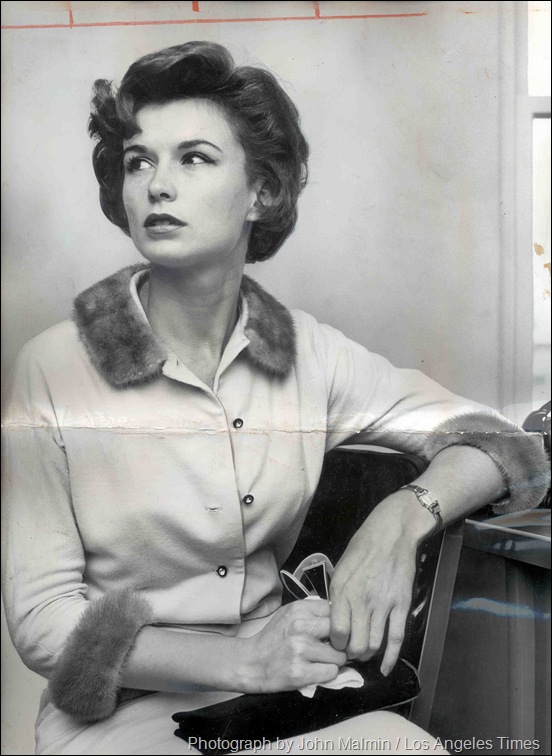
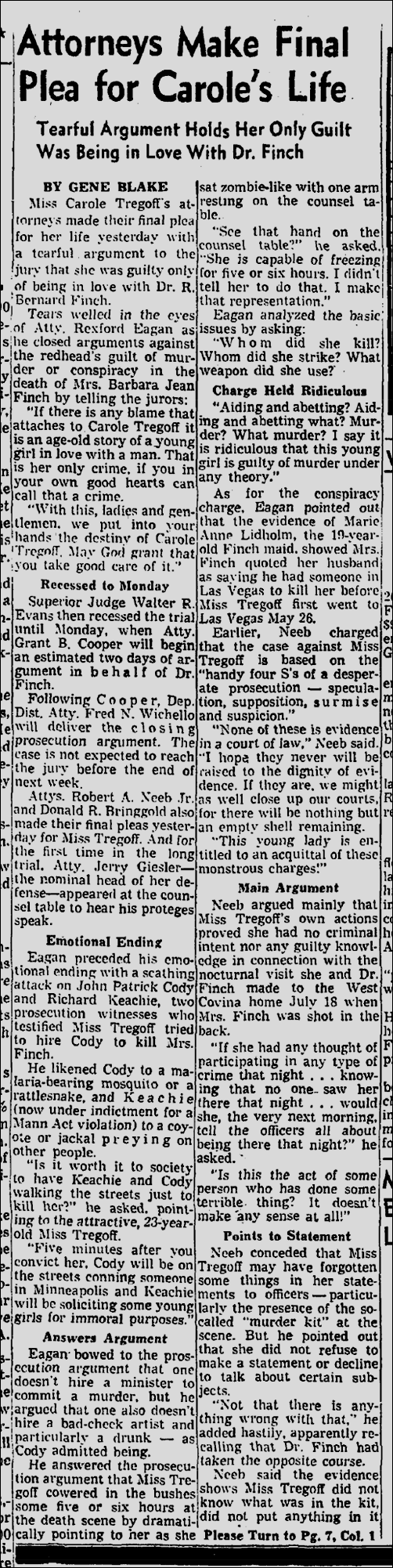
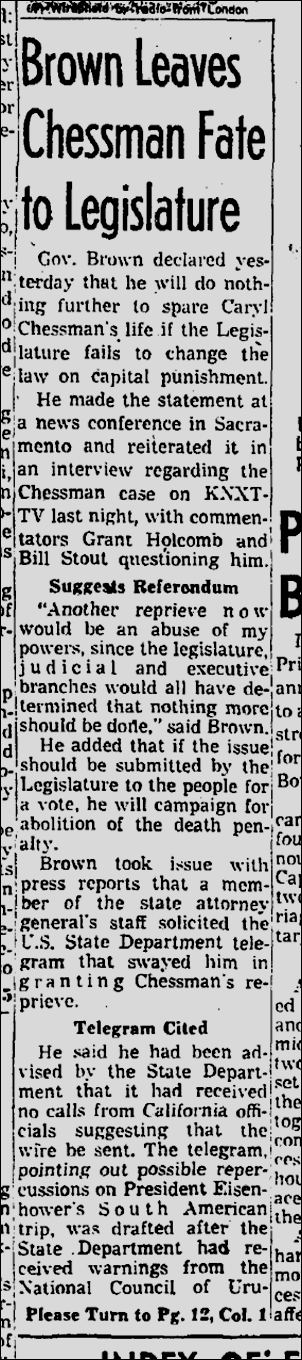
Closing Arguments in Finch Trial; Chessman’s Fate Up to Legislature

Photograph by John Malmin / Los Angeles Times

July 22, 1959: Carole Tregoff waits to be questioned by investigators.

Los Angeles Times file photo

Feb. 19, 1960: Students on Market Street in San Francisco protest the upcoming execution of Caryl Chessman.

Feb. 27, 1960: Attorney A.L. Wirin defends Caryl Chessman and Mickey Cohen. Years ago, I interviewed Wirin’s partner, Fred Okrand, who said that defending Cohen paid for their ACLU work. Notice that The Times identifies Cohen as a “former hoodlum.”
Posted in #courts, Homicide, Mickey Cohen, Photography | Comments Off on Closing Arguments in Finch Trial; Chessman’s Fate Up to Legislature

America Rejects Its Rural Roots

Feb. 27, 1920, Briggs
“When a Feller Needs a Friend,” by Clare Briggs.

Feb. 27, 1920, Urbanization 

Feb. 27, 1920: “How Ya Gonna Keep Them Down on the Farm?” You can’t, according to The Times’ Harry C. Carr, who says former servicemen are abandoning farming in favor of work in the cities.

Posted in art and artists, Columnists, Comics | Comments Off on America Rejects Its Rural Roots

Mob Beats Strikebreakers, Police

Feb. 27, 1910, Streetcar Strike 

Feb. 27, 1910: Crowds in Philadelphia attack non-union men operating the streetcars, beating them and the police officers protecting them …  F.D. Underwood, president of the Erie Railroad, says: "There is a growing spirit of greed in this country that can only be equal to that of savages" … and  Pittsburgh Police Supt. Thomas S. McQuaid opposes brutality under the "third degree" but says taking away the right of police "to question a prisoner would be a menace to public safety."

Posted in #courts, Transportation | Comments Off on Mob Beats Strikebreakers, Police

Matt Weinstock, Feb. 26, 1960

The Court Is a Stage

Matt Weinstock     One of the travesties of court procedure is that most divorces are obtained on grounds that have little or nothing to do with the breakup of the marriages.

    The ladies come into court and testify that their husbands stayed out late or complained about their cooking or used profanity and the mental cruelty became simply unbearable.  They avoid mentioning the real cause of most breakups, usually a third person, to avoid embarrassing their spouses, who have agreed on that basis not to contest.

    All that is hardly  a secret, but reporter Charles Ridgway had never heard it spelled out so clearly as the other day as he rode down a Courthouse escalator behind a handsome but graying actress and her attorney and overheard this exchange:

    "Well, were you nervous?"

    "Not too bad."

    "At one point I thought you were going to crack."

    "No, but I'm glad I memorized the script so well."

::

    IF BOB ANDREWS hadn't heard the lady say it, he wouldn't have believed it.  Bob, who lives in a nearby city, complained about  a $3.25 overcharge on his phone bill and demanded an accounting.  The bill was rectified but the phone company lady said he was at fault.

    "You dial the phone too slowly," she said."

::


    SWITCH TO AIR
My lungs can now function,
My throat isn't sore,
I am smoking much
    less now
And enjoying it more.
        MARVIN PRESS


::


    IT'S AN OLD
refrain that down in Mexico they have got no snow.  Likewise in L.A.  But that hasn't kept youngsters from enjoying the same thrill, tobogganing down grass-covered slopes on homemade sleds.  It has been going on for generations.

image     This year, a lady who lives on what she calls Whitening Heights reports, it's earlier and bigger than ever, due to the impetus of the Olympics.  Usually the kids wait until summer when the grass is dry and slippery, but the snow stuff in Squaw Valley has them eager.  She reports they're using old boards with runners, even heavy pieces of cardboard, and she has imparted her knowledge of the subject to them by suggesting they put wax or bacon rind on the runners.

    Let them enjoy the sport while they can.  The way things look, pretty soon there won't be any empty hillsides.

::

    "WORDS FAIL ME," Frank J. Heffler writes, "as I leave to clean up a direction sign near our church at 79th and La Tijera Blvd.  Some idiot has painted a swastika on it.  I can't understand the senselessness of this act.  I pity these people.  It seems that narrow-mindedness is on the upswing here as well as in some sections of the South.  Our church of Christ is a progressive, Protestant, Christian institution open to all peoples.

::


    ANYONE ELSE
besides George Newman catch the irony in the story from New York that a $22,300,000 housing project to provide homes for 1,317 families has been approved for Ebbets Field, former home of Brooklyn Dodgers?  Meanwhile, on a clear day in Chavez Ravine, once designated as a housing project, you can see where second base is going to be.

::


    OOPS,
the instructor in a class on investments at L.A. High night school said, "The forces of interest make a blond fluctuate."  Could be but it was a fluff.  He meant bond . . . J.G.Novotny, history teacher at Fulton Junior High in Van Nuys, rewards pupils who turn in perfect exam papers with one Blue Chip stamp.  Now there's a real incentive.

::


    MISCELLANY —
A passenger in Sam Berk's cab confided he'd won $20 on Chessman's reprieve.  Didn't say whether he favored the decision or simply thought it was a good bet . .. Racketeers are taking advantage of the nation's religious revival by peddling fake recordings and blessings and soliciting funds, Dick Mathison warns in Coronet.  So beware . . . One thing about leap year, Frank Barron says, we beat the landlord out of one day this month.

Feb. 26, 1960, Abby


Posted in Columnists, Matt Weinstock | Comments Off on Matt Weinstock, Feb. 26, 1960

Paul V. Coates – Confidential File, Feb. 26, 1960

 
Feb. 26, 1960, Mirror

So Mexico's Justice Is Just, Eventually

Paul Coates    Pfc. Robert Peterson, U.S. Army, dropped by my office yesterday on his way back to Ft. Ord.

    He was a headline last June.  I'd worked on his story.  But yesterday, when he walked in my door, I didn't recognize him.  I couldn't remember who he was.

    In fact, even after he refreshed my memory, I found it hard to believe that this was the same teen-age kid I'd interviewed some eight months ago.

    I had talked to Peterson last summer immediately on his release from Baja California's state penitentiary.  At the age of 17, he'd been tossed into one of the foulest prisons in the world on the charge of auto theft.

    Protesting his innocence all the while, he'd spent 14 months in the prisoner-ruled, barbed-wire jungle waiting for Mexican justice to make up its mind.

    While there he was beaten, robbed, starved, knifed and — more than once — marked for death by some of the vicious killers with whom he shared his cement floor.

Feb. 26, 1960, Finch Trial     When I met him last summer on his release, he weighed 110 pounds.  Knife wounds on his back and arms were still an ugly purple.

    Yesterday, he weighed in at 140.  The knife scars were still there, he told me, but they were covered by his olive-drab dress uniform.

    "It takes time to get healthy again," he said.  "In the first four months after my release, I only put on five pounds.

    "I couldn't eat.  Even steak, I couldn't.  I'd just look at it and get sick."

    Shortly after his 19th birthday last September, Peterson signed up for a two-year hitch in the Army.  He won his promotion to private first class a few days before Christmas. 

    But now, he said, he was on medical leave.  His stomach still hadn't made the adjustment from stale watery beans to normal foods.

    There are other scars, too.  Some mental: 

    "Nightmares.  The other guys in the barracks wake up sometimes because I'm screaming.

    "I'm screaming, 'Alvero, don't kill me.'
   
    "Alvero was one of the real bad guys.  He said it wouldn't do any good if I got out of the prison alive.  He'd follow me, he said.  He'd find me and kill me.

    "I suppose I shouldn't worry, but sometimes, I do."

    The only visible physical scar is on Peterson's left hand.  The large numerals "1-9-5-9" are tattooed, one number on each of his fingers.

    "They held me down and did that just before I left.  They said they didn't want me to forget my — my nice vacation in Mexico, they called it.

    "I don't need that tattoo to remind me,"  Peterson added.

    Long Year Awaiting Trial

    The kid had spent a full year in state prison before he was given a trial.  And then, he was never called to testify in his own behalf.  He was just told that he was found guilty and sentenced to four years.

    His parents, who live in Belmont, Cal., scraped up money to appeal the decision and two months later, the Baja California Court of Appeals decided that he could go out on conditional release for $640 bail.  His parents didn't have the money but it came in fast from anonymous donors who read of his plight.

    I asked Peterson if he'd ever heard anything further about his case.

    He nodded that he had.

    "About two weeks after I got back in the United States," he said, "my parents got a letter from the Consulate  in Tijuana.  It informed them that the Court of Appeals made a final decision.  They reversed the guilty verdict against me.

    "They said," he added, "that I was innocent."
   

Posted in #courts, Columnists, Homicide, Paul Coates | Comments Off on Paul V. Coates – Confidential File, Feb. 26, 1960

‘Kramer,’ ‘All That Jazz’ Get 9 Oscar Nominations

Feb. 26, 1980, Oscars 

Feb. 26, 1980, Oscars

Feb. 26, 1980: "Apocalypse Now," "Kramer vs. Kramer," "Norma Rae," "All That Jazz" and "Breaking Away" are nominated as best picture of the years. Plus Peter Sellers for “Being There,” one of my favorites, and Al Pacino before he turned into a self-caricature.

Posted in Film, Hollywood | 1 Comment

A Kinder, Simpler Time Dept.: Your Movie Columnist

image 

Feb. 26, 1964: Hedda Hopper writes, “Stanley Kramer's remarks before presenting Paine Knickerbocker, of the San Francisco Chronicle, as best critic of the year were insulting. We all cringed.” Now I’m wondering what he said. Anyone have any idea?

Posted in Columnists, Film, Hollywood | 1 Comment

Officer’s Shot Saves Partner’s Life

Feb. 26, 1960, Gov. Brown

Feb. 26, 1960, Sharpshooter 

Feb. 26, 1960: Gov. Pat Brown will answer questions about granting a reprieve to Caryl Chessman … and on skid row, Officer V.P. Farmer shoots an ex-convict who is holding a gun to the head of Officer Ernest Searles Jr. "I'm no marksman but I guess we had God on our side," Farmer says.

Posted in broadcasting, Caryl Chessman, Downtown, LAPD, Television | Comments Off on Officer’s Shot Saves Partner’s Life

Gardener Kills Principal, Commits Suicide After Setting Fire to School


image

Feb. 26, School Killing

"He is depressed and melancholy. He has illusions of persecution and that people are always working against him."

Feb. 26, 1920, Huntington Hall

Huntington Hall, 1790 Fremont Ave.

Feb. 26, 1920, School Killing

Feb. 26, 1920: A gruesome story of insanity and murder at Huntington Hall, a girls’ school in South Pasadena. The school became Oneonta Academy for Boys in 1922 and in the 1930s was known as Oneonta Military Academy. 

Posted in Education, Homicide, Suicide | Comments Off on Gardener Kills Principal, Commits Suicide After Setting Fire to School

California Limited Sets Speed Record

Feb. 26, 1910, California Limited 
Feb. 26, 1910: The Santa Fe’s California Limited cuts hours off the trip from Chicago to Los Angeles, hitting 65 mph between Gallup, N.M., and Winslow, Ariz.

Posted in Transportation, travel | Comments Off on California Limited Sets Speed Record

Artist’s Notebook: Corvette Driver

2010_0221_san_dimas_parkinglot2 
“Corvette Driver,” by Marion Eisenmann

Feb. 22, 2010: Marion Eisenmann sends a drawing of a Corvette and its driver that she saw over the weekend.

Marion writes: After heading out for a bike ride with two male friends at Bonelli Park, I short cut the second loop and made it back to the parking lot a little bit  earlier. Similar to the cyclist of the “Les triplettes de Belleville,”  I arrived there with my last breath. Suddenly, my attention was  consumed by a lady leaning onto the back of her red Corvette. 

Debbie was dressed in a petrol-towards-green blazer and  complemented her lips with pink. She was awaiting some of her 250  members of the PVCA, which stands for Pomona Valley Corvette  Association.

Of course she noticed my curious scanning looks, and  before she could say anything, I smiled at her and said "I am an  illustrator and you were an interesting object to me." She smiled and a  few seconds later, she said, "If I had known I would be observed by an  illustrator today, I would have lost 10 pounds."

We both laughed,  and I quickly gave her back "Just caught the moment in time."

I asked Marion if she draws cars so well because she worked on a project
for VW/Audi.
She says, "Well, yes, I did do my diploma thesis at
their design studio, saw a lot of sketches, cars in development and
learned about their visual construction, yet my interpretations were
for a calendar and used to be more comical than anything else."

Note: In case you just tuned in, Marion and I are visiting local landmarks in a project inspired by what Charles Owens and Joe Seewerker did in Nuestro Pueblo. Be sure to check back for another page from Marion's notebook.

By the way, Daily Mirror readers have asked about buying copies of Marion's artwork. Naturally, this is gratifying because I think Marion's work is terrific, and one of my great pleasures is sharing it with readers. We have decided that the project is a journey about discovering Los Angeles rather than creating things to sell. Marion is busy with other projects and says she isn't set up to mass-produce prints but would entertain inquiries about specific pieces. For further information, contact Marion directly.

Posted in art and artists, Marion Eisenmann, Transportation | Comments Off on Artist’s Notebook: Corvette Driver

Matt Weinstock, Feb. 25, 1960

 
 Feb. 25, 1960, Elvis

Mad Memories

 
Matt Weinstock     The prohibition era (1920-1933) was a long time ago but to many persons it remains the most unforgettable time of their lives.  It had for them an aura of pleasurable deviltry.
 
    It also provided the setting of the rise of gangsterism and lawlessness, but that's another story which can be seen regularly on TV.
 
    Last weekend some people in Laurel Canyon who revere the memorable past invited 40 guests to an old-fashioned home brew party.
 
    THEY PROCURED a big crock and the makings from one of the several markets around town which stock them, and put up four batches — 56 quarts — of the bubbly stuff.  In their case, being somewhat on the sybaritic side, they used wild rice instead of malt.
 
    The hostess reports that 48 of the 56 bottles were consumed and  a fine time was had by all.  And after the imbibers downed their first jug the same old silly smiles that she remembers from 1928 came over their faces.
 
Feb. 25, 1960, Elvis     Only one mad moment occurred.  A writer moved over to a group where a surgeon was describing a particularly grisly operation he had lately performed.  The writer, unaware of the narrator's identity, was appalled.  Afterward he asked in deep concern of the man standing next to him, "Is he a doctor?"  Assured that he was, the writer said, "That's a relief!"
 
::
 
    SPEAKING OF home brew, a large lady in a Glendale Blvd. bar announced savagely that she would be a prime murder suspect if she ever located her spouse.
 
    "Don't say that, ma'am," Leo the bartender said, "we're all gentlemen here!"
 
    At which, Frederick Keller reports, she looked around and snorted, "Gentlemen! Why, this looks like the second Appalachian meeting!"
 
::
 
    STALEMATE
I always liked my game
    of chess,
My play is quite meticulous,
Chessmen are supposed
    to move
But this is most ridiculous.
        WALTER JARVIS
 
::
 
     MONDAY Bob Simmons, 30, of Bellflower, a phone company employee, went scuba diving with two friends off a deserted beach about two miles south of Laguna.
 
     They had swum out past the breakers when Bob had difficulty clearing his face mask.  He became exhausted and tried to head for shore.  His companions went on, not knowing of his distress.  His wife, Cindy, saw from the beach that he was in trouble but no one was around.
 
    Just then three young couples on a picnic arrived.  Told of Bob's plight, the three youths, about 18, rushed fully clothed into the 10-foot deep water and pulled Bob out.  A woman nurse happened by and gave artificial respiration.  Bob's heart had stopped.  Meanwhile, one youth ran to the highway and waved down a policeman, who summoned help.
 
    Bob, who was unconscious for hours, is going to be all right and his wife Cindy hopes the boys who saved him, the nurse and the officer may see this and understand how grateful they are.  In the excitement she didn't get their names.
 
::
 
    DR. Vierling Kersey, president of the L.A. College of Optometry, spoke on eyestrain at the California Optometric Assn. congress the other day and afterward held a press conference for high school newspaper reporters who were present. 
 
    In various ways they all asked the same question:  "If we didn't get so much homework, we wouldn't get eyestrain, would we?"
 
    Dr. Kersey, former superintendent of city schools, replied unblinkingly, "Are there any other questions?"
 
::
 
    AT RANDOM — Man I know received a token bottle of sweet-smelling stuff with this note from the press agent: "Only 72 hours ago the contents of this bottle, Arpege perfume, were succulent flowers peacefully basking in the warm sun of southern France.  Only three dawns have passed since they were plucked, processed and placed on your desk."  The next step is obvious.  You order it from your favorite supermarket . . . Bob Ritchey thinks people will look back on February, 1960, as the month they had to look twice at the headlines to see if they were about Caryl or Carole.


Posted in Columnists, Matt Weinstock, Rock 'n' Roll | Comments Off on Matt Weinstock, Feb. 25, 1960

Paul V. Coates – Confidential File, Feb. 25, 1960

 
Feb. 25, 1960, Mirror Cover

On Man's Ingratitude to Man, With 20% Off

Paul Coates    Sammy is 46 years old, a newsboy, a coffee-addicted graduate of Judge Clifton's drunk court, and — by his own admission — nobody's angel.

    For 30 of his years he's been hustling sheets on Broadway.

    He grew up on city street corners — an environment conducive to many things, not all of them good. 

    From it, he fashioned his personal, peculiar code of ethics.

    Ask him, and he'll tell you, "If you're going to beat a guy put of something, beat a guy who's got something."

    If it's meant as a self-appraisal, it's not a fair one.  I've heard people complain about Sammy's affection for four-letter words, and, before Judge Clifton frightened him off Devil Drink, about his ability to stay out of Lincoln Heights — but I've never heard anybody say that he was a slow man with the change for a dollar.

    Sammy bent over backward not to be.

Feb. 25, 1960, Caryl Chessman     He specialized in protecting, helping the underdog.  Maybe, because he considered himself in that category.  A temporarily unemployed reporter who had used up all his friends could always turn to Sammy for the price of another drink.  So could any of the rest of his customers, and a lot of them — at some point in their lives — hit bottom once or twice.

    That's what Sammy was most famous as:  an easy touch.

    And that's how this matter last summer came about.  Sammy had retired as a newsie.  He sold his corner and became what you might call a street-salesman.  Costume jewelry.  Sport shirts.

    But he kept in touch with old friends.

    And one old friend was an attorney, with nice offices downtown.  Once Sammy had helped him out with a $300 loan and the attorney was prompt in repaying him.

    It was on a warm evening last June that the barrister found Sammy sipping coffee in a downtown cafe.  There were the usual greetings and the lawyer sat down.

    "Sammy," he said, "I've got a land deal going.  I need $5,000 cash to put it over and all I've got is $3,500."

    The conversation progressed and the newsie admitted that he had some acorns in the bank.

    "Since I been off drink, I been saving," he said.  "I got just about exactly $1,500.  But it's my last money."

    The lawyer assured him that he'd have it back in no time.  Three months or less.  There was no risk involved.  The deal was solid.

    So, a couple of days later Sammy withdrew his savings and took them up to the lawyer's office.  The lawyer gave him a promissory note — payment on demand.  He wrote it out for $1,800.  Three hundred extra for you, Sammy," he said.  "I'm going to make money on this deal.  I'd like to see you make some."

Feb. 25, 1960, Freeways     Three months went by and Sammy didn't hear a word.  He checked with the attorney and was told that the deal was slowed down by paperwork.  But he'd get his money.

    More days passed and Sammy's nervousness increased.  He'd spotted his attorney friend at the tables in Gardena.  Sammy pressed him and the attorney slipped him a few small bills.  That's the way it went for the next few months.  Whenever Sammy looked him up, he got $25, $50 an, occasional $100.

    As of a couple of months ago, there remained $975 outstanding on the note.  Then the payments stopped.  Sammy was told that he was making a pest of himself.

The Way the Geetus Falls

    Another attorney — an old customer of Sammy's — heard about the newsie's troubles.  He volunteered his aid and telephoned attorney No. 1.

Feb. 25, 1960, Westminster Hotel

    "I'd like to oblige," the borrower said, "but I just don't have the money to pay him back.  That's all."

    So Sammy's old customer took the next logical step.  He filed an action in court demanding payment.

    Attorney No.1 filed his answer the other day.  He borrowed the $1,500, he admitted.  And he still owed a good chunk of it.  But the extra $300, he said, Sammy certainly wasn't entitled to that.  That was usury.

    If you live in the city long enough you hear everything.


Posted in Architecture, Caryl Chessman, Columnists, Downtown, Front Pages, Paul Coates | Comments Off on Paul V. Coates – Confidential File, Feb. 25, 1960