Matt Weinstock, March 1, 1960

March 1, 1960, Mirror Cover

Way Out Walkout

Matt Weinstock

    A great many people walked out on Miles Davis and John Coltrane, two great men of music they had primarily come to see and hear, at last Saturday's jazz concert at Shrine Auditorium, thereby provoking a recurrent point of controversy in listener-ship.

    The Miles Davis sextet was the main event of the evening, last on the program, eagerly awaited.

    Without any formality they went into a way-out number. It went on and on, with Davis and Coltrane alternating on solo passages.  After about 15 minutes a few people got up and left.  Then more and more, particularly during Coltrane's solos.  He probably blows more notes than any other saxophonist but they seemed meaningless and repetitious.

    Most of those who got up and left doubtless felt that whatever it was the group was trying to convey wasn't coming through to them and they'd had it.  After all, they'd applauded wildly for the polished, subtle Modern Jazz Quartet, which preceded them.


Continue reading →

Posted in #Jazz, Columnists, Matt Weinstock, Politics, Richard Nixon, Rock 'n' Roll | Comments Off on Matt Weinstock, March 1, 1960

A Kinder, Simpler Time Dept.: Your Movie Columnist

 
March 1, 1960, Hedda Hopper
March 1, 1960: Hedda Hopper writes about Claude Rains’ 60 years in show business.

Posted in Columnists, Film, Hollywood, Stage | Comments Off on A Kinder, Simpler Time Dept.: Your Movie Columnist

‘We Don’t Want the Pope Running the Country’

image

“I’d Like to Examine This Young Woman!”

image 

March 1, 1960: Samuel Lubell focuses on Vice President Richard Nixon in his survey of Southern voters and dismisses Democrats' chances, but there's a more complicated portrait of the South buried a few paragraphs further into the story. 

Look at the sampling of quotes: "The Supreme Court has made its decision and it makes no difference who is president" …  "There isn't any difference between the Democrats and Republicans on segregation" …  "No candidate will agree with the South" and "The South can't win. The rest of the country is against us."

And how about the quote on Sen. John F. Kennedy (D-Mass.) “We don’t want the pope running the country.”

Continue reading →

Posted in Comics, Countdown to Watts, Film, Hollywood, Politics | Comments Off on ‘We Don’t Want the Pope Running the Country’

Paul V. Coates – Confidential File, Feb. 29, 1960

Feb. 29, 1960, Mirror Cover

Bringing Up Beverly; by Mother Aadland

Paul Coates

    While the rest of you were idly accomplishing a variety of things over the week end, I was interviewing Mrs. Florence Aadland.

    Mrs Aadland, mother of Beverly, protege of the late Errol Flynn, found her way back into the news with the disclosure that she had gone to the Sunset Strip apartment of a 32-year-old skin diver named JackDulin.  She was looking for her daughter.  Jack had inhospitably welcomed her with a load of shot from an old English pistol.

    Preliminary to this, Mrs. Aadland had made an unsuccessful court attempt to retrain him from dating her 17-year-old daughter.  When I met with her she was still smarting from this setback.

    She barely made it inside my office before announcing, "If the man who came up with that verdict calls himself a judge, then I'm Lana Turner."

    It was following this rather intriguing commentary on the American judicial system that we got down to the subject of our two-man seminar:  The care and feeding of precocious children.

Continue reading →

Posted in Columnists, Film, Hollywood, Mickey Cohen, Paul Coates | Comments Off on Paul V. Coates – Confidential File, Feb. 29, 1960

Kennedy and Catholicism

Feb. 29, 1960, Kennedy 

Note: For quite a while, the Daily Mirror has been clicking along in perfect synchronization with the past. Mondays were Mondays and Fridays were Fridays. No more, because 1960 was a leap year and 2010 isn't.

Feb. 29, 1960: The Times’ Robert T. Hartmann takes a look at Sen. John F. Kennedy's Catholicism, a central issue in the 1960 presidential race.  "The deep-rooted concern over a Catholic chief executive stems not wholly from blind prejudice but from the original sense of the term 'Protestant,' " Hartmann writes.

"The often unspoken question is whether Kennedy would be subject to, and responsive to, the discipline and direction of the Roman Catholic clergy while executing the office of the president of the United States." 

On the jump, Hartmann says Jackie Kennedy is a liability – she’s too beautiful!

“Finally, and this compounds his other problems, there is Mrs. Kennedy. She is also too young, too rich and too beautiful — not in a classic way but with the exotic elfin features of a high-fashion model. Those who know Jackie Kennedy like her very much. But to strangers she is visibly bored by campaigning, no match at politics for the practiced partners of Johnson, Humphrey, Nixon and Symington.”

Continue reading →

Posted in Film, Hollywood, JFK, Politics, Richard Nixon | 1 Comment

Ultimate Baby Einstein? Sperm Bank Specializes in Nobel Winners

Feb. 29, 1980, TRS-80

Look! It’s a Trash 80 with 64K RAM and an 8-inch floppy drive for only $3,450 [$8,902.02 USD 2008].

Feb. 29, 1980, Sperm Bank

Feb. 29, 1980: Let’s see … a sperm bank of Nobel-winning scientists. These children should be at least 30 now.Wonder what they're up to.

Continue reading →

Posted in Immigration, Science, Web/Tech | Comments Off on Ultimate Baby Einstein? Sperm Bank Specializes in Nobel Winners

From the Vaults: ‘Dr. Jekyll and Mr. Hyde’ (1920)

 image

April 13, 1920: “Dr. Jekyll and Mr. Hyde'” at the Million Dollar Theatre… Not for weaklings and mollycoddles!  – with Jesse Crawford at the Organ.  

Note: Since we began in 2007,  the Daily Mirror has wanted to provide posts about historic films, but like the rest of the DM, we wanted to make it a unique, personal view. We found a fresh, original voice in Anne Elisabeth Dillon, who works around the corner from us on the National copy desk. Please welcome her — lrh

Jekyllpatient I feel unqualified to talk about “Dr. Jekyll and Mr. Hyde” (1920). Watching a silent film is like studying a museum piece. It's so stylized that it doesn't feel anything like what we know as a movie; talking about it should require an advanced degree of some kind. But it's still available for movie-watching yahoos like me to just sit down and watch. Which I did the other night, and I loved it.

At first it's just a blast to sit down and watch a movie from 1920. The lighting flickers like a lantern – I kept thinking how great it would look projected on the wall of a nightclub. The costumes are exquisite. Everyone wears fabulous eyeliner.

Also, this was my first John Barrymore movie, and yummm… he was called the Great Profile, but he is truly beauteous from all angles. So tall and regal! And the title cards have gorgeous Art Deco-style designs on them.
April 11, 1920, Barrymore, JekyllSure, the stylization is sort of distancing for the modern viewer, but after a while you do get caught up in the story.

Dr. Jekyll has some out-there scientific ideas, but morally speaking he is extremely virtuous, what with running a low-income medical establishment (the shots of Edinburgh's poor, standing around his waiting room hoping for affordable healthcare, are shockingly familiar, even with the abundance of picturesque shawls) and being engaged to the good and kind Millicent.

Millicent's dad, Sir George (Brandon Hurst, who is no slouch himself in the profile department) is a good friend of Dr. Jekyll's and takes him out for a night at the dance hall. There we meet dancer Gina, who is dangerously Italian – we deduce, from her one-shouldered outfit, that she is not so virtuous as Millicent. Dr. J. is fascinated by her, and shortly thereafter gets cracking on his famous potion.

Continue reading →

Posted in Fashion, Film, From the Vaults, Hollywood | 2 Comments

Downtown Parking Ban to Ease Traffic

Feb. 29, 1920, No Parking 

To ease congested streets, Los Angeles will ban street parking from Figueroa to Los Angeles streets and 1st to 9th streets. Notice that Spring hasn’t been straightened out yet, another attempt to relieve traffic. 

Feb. 29, 1920, Parking

Feb. 29, 1920, Parking

Feb. 29, 1920, Children 

L.O. Keown  and his wife (God-fearing, churchgoing, hardworking people, The Times says) were too busy to teach three of their eight children to speak English, so the youngsters made up their own language. Now child welfare officials want them to break them of the invented language and have them speak the language that “is their birthright.”

Feb. 29, 1920: If the plan to ban parking in downtown Los Angeles sounds familiar, that’s because it is. Back in 1908, the city did something similar with horse-drawn freight wagons. 

"At every corner where two streets cross, we used to see an express wagon, as many as four at a junction, standing there most of the day waiting for business to come to them. And at some places were these big furniture vans almost as big as a house," one unidentified councilman said, according to The Times of May 16, 1908.

And The Times manages to drag in a little riff on women shoppers and their long-suffering husbands who can wait in no-parking zones for no more than two minutes. 

I can't say it often enough: Traffic congestion in Los Angeles is at least a 100-year-old problem. If there were easy answers, it would have been resolved decades ago.

Posted in Downtown, Education, Freeways, Transportation | 1 Comment

Doobie Brothers, Billy Joel Shut Out Disco at Grammys

image 

image

Feb. 28, 1980, Jim Murray

Feb. 28, 1980: The Doobie Brothers' "What a Fool Believes" wins the Grammy for best single while Billy Joel's "52nd Street" wins for best album. Bonus appearance: Bob Dylan! … and Jim Murray writes about Spectacular Bid.

Posted in Columnists, Rock 'n' Roll, Sports | Comments Off on Doobie Brothers, Billy Joel Shut Out Disco at Grammys

Hearing on the Gas House, Part 3

DSCF1900 

Sept. 8, 1959: This is the third part of a transcript of testimony by “Holy Barbarians” author Lawrence Lipton before the the Los Angeles Police Commission on the Gas House, the Beat hangout in Venice.  Part 1 is here. Part 2 is here.

Excerpt: “A square is a person who is a conformist with the ways and — of society, its institutions; does not question them and — does not subscribe to the way of life of a Beatnik. This does not mean he is an anti-Beatnik. He might be a Sunday Beatnik who comes around only on weekends for his fling….”

Continue reading →

Posted in Uncategorized | Comments Off on Hearing on the Gas House, Part 3

A Kinder, Simpler Time Dept.: Your Movie Columnist

Feb. 28, 1939, Hedda Hopper  

Feb. 28, 1938: Hedda Hopper writes, "I chatted, for the first time, with Franchot Tone. A fine, intelligent actor. His crooked smile always annoyed me, and suddenly I knew it was to cover up an inferiority complex. I'd like to see him do Adolphe Menjou parts." And Bill Fields wishes her good luck! 

Posted in Columnists, Film, Hollywood | Comments Off on A Kinder, Simpler Time Dept.: Your Movie Columnist

U.S. Doomed by a Culture of Leisure

image

“Give Me Your Pistol, Buck. Mine’s Overheated!”

Feb. 28, 1960, This Week 

In 1960, The Times was inserting This Week magazine in the Sunday papers. The editor was William I. Nichols, who countered the phrase “Better Dead Than Red” with the slogan “Better Brave Than Slave.”
 

image 

"This Week's first editor, Mrs. William Brown Meloney, wrote the words quoted on the eve of World War II. We reprint them now, as a tribute to her — and to mark the 25th anniversary of the magazine's first issue, which appeared Feb. 24, 1935. It is now a full generation since these words were written, but even in a world of missiles and H-bombs their message remains unchanged."

–William I. Nichols, Editor

Feb. 28, 1960, Whitman

The prolific Howard “Crisis in Morals” Whitman begins another series in The Times, launched with a pithy comment by a conveniently anonymous companion. This one reminds me of the “Athens vs. Sparta, U.S. vs. the Soviet Union” lectures we had in sophomore history class. 

Feb. 28, 1960, Whitman

“It is doubtful that teenage charge accounts will solve our youngsters’ problems of civilized behavior, sex orientation, respect for elders or serious preparation for adult living,” Whitman says.  [What a curious mention of homosexuality – or at least I take it that way. Hm. – lrh] 

Feb. 28, 1960, Gallup Poll

Sen. John F. Kennedy (D-Mass.) leads Democratic candidates in the latest Gallup poll, beating former Illinois Gov. Adlai Stevenson, Sen. Lyndon Johnson (D-Texas) and Sen. Stuart Symington (D-Mo.) in hypothetical matches.

image

The Times op-ed page reeks of must and mildew: Yet another stodgy, cliched political cartoon by Bruce Russell, and a piece by Kyle Palmer lobbing another hand grenade at the Democrats. Palmer is usually described as The Times’ political powerbroker, a staunch Republican who made Richard Nixon. But he strikes me as a sad fellow who was utterly blinded by his agenda.  

Feb. 28, 1960, Carl Furillo
image

Feb. 28, 1960, Carl Furillo

Feb. 28, 1960: Are the Dodgers going to get rid of Carl Furillo, who played only 50 games last season?  The answer will come in May.

Posted in art and artists, Comics, JFK, Politics, Richard Nixon | 1 Comment

A Romantic Entanglement for Future Times Columnist


Feb. 28, 1920, Lee Shippey  
 

Feb. 28, 1920: My heart skipped a beat when I pulled up this story. Could this be our own  Lee Shippey, author of “The Great American Family” and “It’s an Old California Custom?” Yes it is.

Posted in books, Columnists | Comments Off on A Romantic Entanglement for Future Times Columnist

Body Found in River

 
Feb. 28, 1910, Body 

Feb. 28, 1910: The old newspapers didn’t hold back on gory details, like this story about the unfortunate fellow found in the San Joaquin River in a bag weighed down with rocks.

Posted in Homicide | Comments Off on Body Found in River

Matt Weinstock, Feb. 27, 1960

Briton's a Stevereno

Matt Weinstock     I've been reading the short stories by Peter Ustinov in the Atlantic and wondering how he does it.  Acting, speaking, traveling — and writing superlative fiction, I mean.  In the versatility sweepstakes, he's Britain's answer to Steve Allen.

    Ustinov was in town briefly this week for additional scenes in "Spartacus" — he plays Batiatus, head of a gladiator school who buys a  slave named Kirk Douglas — and the big answer came through.

    His secret is an amazing ability to concentrate.  He can write anywhere — on  a plane, sitting with his family (three children) beside his swimming pool or between "takes" on a movie set — without losing the continuity of a story. 

 
Feb. 27, 1960, Finch TrialFred Banker, studio attache, swears he could write under water.

    Some of his stories are grotesque, others deal with characters who have emerged from the chaos and ashes of World War II, as the one in this months Atlantic, "The Loneliness of Billiwoonga."  They all have, like their author, great zest for life, compassion and irony.

    Of course, he happens to be a genius, which also helps.

::
    WHILE DRIVING on Angeles Crest Highway, en route to an auto racing rendezvous near Palmdale, Art White's brakes went out.  He nursed his Morgan speedster along until he came to Vincent's garage at Highway 6.  Vincent turned out to be a racing enthusiast and started to work on the brakes — for which a new part had to be made, when an emergency call came in — a tow job for a car that had overturned.  As he left, Vincent told Art to use whatever equipment he needed — he had a complete line of expensive English and German tools — handed him a new pair of overalls so he wouldn't get dirty, and said, "Leave whatever you think it's worth."

    In all the world Art does not think he'll ever encounter such hospitality as he did in a lonely, one-man garage in the desert.

::


    CLASSIFIED
We'd do well to consider
What Symington said:
That we've been less
    missiled
Than we've been misled.
        DON QUINN

::
    THE STORY IS told about a writer who in a talk before the Ebell Club here many years ago urged his richly dressed club-woman audience to get closer to the common people and thereby achieve better understanding.  His plea was not received enthusiastically and afterward, relating the incident to a friend, he said, "I should have remembered the old adage:  See no Ebell, hear no Ebell, speak no Ebell."

    Fine, but along with others, doubtless, I've always wondered where the club got its name.  The answer has been furnished by Frances Kirschenbaum of the UCLA library reference department.

    Dr. Adrian F. Ebell graduated from Yale in 1863 and became a noted lecturer on art, literature and women's advancement.  Later he established a natural science academy which offered a travel and study plan in Europe to women.  After he died in 1877, a group of women in Oakland, Cal., where he had visited the year before, formed the Ebell Society, the first woman's club in the state.  Since then, everyone has heard a great deal about Ebell.

::


    FOOTNOTES —
This is the big night for aficionados of Miles Davis, who plays the saddest, most haunting trumpet you ever heard, and in the past few years has become one of the giants of jazz.  Although I am a piano addict, I'll be there.  Shrine Aud . . . Preparation for the Squaw Valley Olympics also included a 150 man cleanup crew, recruited here by Sydney Rosenberg of the American Building Maintenance Co.  Ten of them can speak five languages . . . A reporter on a suburban paper turned in an item about the theft of  a two-foot zero, a letter in a sign, and a proofreader who handled the copy said, "I knew someday we'd get a story about just nothing" . . . A W Pico Blvd. beauty salon gives trading stamps.
Posted in #courts, Columnists, Homicide, Matt Weinstock | Comments Off on Matt Weinstock, Feb. 27, 1960

Paul V. Coates – Confidential File, Feb. 27, 1960

 
Feb. 27, 1960, Mirror

Mash Notes and Comment

Paul Coates    (Press Release)  "Marriages are sometimes shaken or dissolved for reasons hidden in the parents' unconscious mind," Dr. Harry F. Tashman reveals in "The Marriage Bed."

    "This book, by one of New York's leading analysts, gives to married people and those about to wed a new awareness and understanding of the psychological factors that control their lives.

    "In 'The Marriage Bed,' Dr. Tashman sums up 30 years' successful experience in analyzing men and women whose marriages have been severely shaken or dissolved for reasons seldom understood by either husband or wife.

    "While 'The Marriage Bed' deals with the problems arising from marriages it is not a 'sex book' in the superficially accepted sense of that term.

    " 'The marriage bed' can be likened to a garden's bed of soil,' Dr. Tashman writes in describing married life.  'Though it be fertile, it needs care, attention and devotion.  Weeds that appear must be uprooted  . . . ' " (signed) Ben Hall Associates, New York City.

    –Yes.  And while you're about it, that vanity table could use a good dusting.

::

     (Item)  "SWITCH NOTE:  London police arrested a woman for attacking a man.

    "Police discovery:  The attacker was actually a man dressed like a woman.

    "Then the police questioned the man who had been attacked.  He turned out to be a woman."  (signed)  The Insider's Newsletter, New York City.

    –In those London fogs what you don't know won't hurt you.

::

    "Dear Paul,

    "Me and my buddies who work out in Chatsworth in a Standard Station have been feeling out people along the line of who should be running for President of the United States.

    "We have suggested Paul Coates for President and George Putnam as your running mate.

    "You might be surprised to know that you have a bigger, more sincere following than most people imagine.

    "I know you hear a lot of screwball ideas, but why don't you let it drop that you are going to run with George as your buddy and see how many people write you about it.

    "I'd vote for you two.  Talk the idea over with George."  (signed) R.A. McCracken, 17401 Sherman Way, Van Nuys.

    –George Putnam has already gone on record as "definitely not interested in the Vice Presidency."

::

 
    (Press Release) "There is at least one actress in Hollywood who doesn't really care whether the new pancake look from Paris becomes popular or not.

    "Unlike some other stars who have been widely quoted on their opinions, Dodie Drake just could not care less.

    "Dodie, the talented actress and director of the hit show 'Pajama Tops,' currently at the LeGrand Theater, who measures 38-22-36, had only one comment when asked about the new style:

    " 'It won't work.  Not on me anyway!  No matter what I do.  I just can't seem to look like a pancake!"  (signed) Robert G. Morgan, Publicity, 4409 Sunset Blvd., Hollywood.

    –I wish I could help you, Dodie, but I can't even boil water.

Feb. 27, 1960, Abby

Posted in Columnists, Paul Coates | 1 Comment

Americans Lower Expectations for Presidency

Feb. 27, 1980, Op/Ed 

Feb. 27, 1980: This page is such a time capsule of the 1980s that I couldn’t decide on one story. There's Baltimore Sun columnist Matt Seiden's a piece on the war between humans and computers, an essay by Calvin Zon on Haitian refugees in Florida, Paul Conrad on the Iran hostage crisis and J.F. terHorst on Americans' dwindling expectations for U.S. presidents.

TerHorst writes: "Every year divisible by four, America dutifully chooses a president amid the hope that somehow the right individual will be selected to lead the nation. And, somehow, America lately seems to have gotten less than it bargained for.”

He adds, "Over the last quarter-century [George] Gallup says, the record of the last six presidents amounts to a steady and persistent erosion of the hopes we had in them and for them." 

Posted in art and artists, Columnists, Politics | Comments Off on Americans Lower Expectations for Presidency

A Kinder, Simpler Time Dept.: Your Movie Columnist

Feb. 27, 1965, Hedda Hopper 

Feb. 27, 1965: Hedda Hopper gives a plug to “My Mother, the Car!”

Posted in broadcasting, Columnists, Film, Hollywood, Television | 1 Comment

Movie Star Mystery Photo


       Feb. 22, 2010, Mystery Photot
Los Angeles Times file photo

Update: Our mystery fellow is Daniel Frohman, shown above left with Pola Negri and Jesse Lasky  in a photo dated Oct. 8, 1922.

This week’s mystery fellow is the man on the left in the high collar. He’s with two mystery companions.

image 

“I never weep in my beer – it spoils the beer.” – Daniel Frohman.


Just a reminder on how this works: I post the mystery photo on Monday and reveal the answer on Friday … or on Saturday if I have a hard time picking only five pictures; sometimes it's difficult to choose. To keep the mystery photo from getting lost in the other entries, I move it from Monday to Tuesday to Wednesday, etc., adding a photo every day.

I have to approve all comments, so if your guess is posted immediately, that means you're wrong. (And if a wrong guess has already been submitted by someone else, there's no point in submitting it again).

If you're right, you will have to wait until Friday. There's no need to submit your guess five times. Once is enough. The only reward is bragging rights. 

The answer to last week's mystery star: Anna Sten!

New photos after the jump!

Continue reading →

Posted in Film, Hollywood, Mystery Photo, Obituaries, Photography | 20 Comments

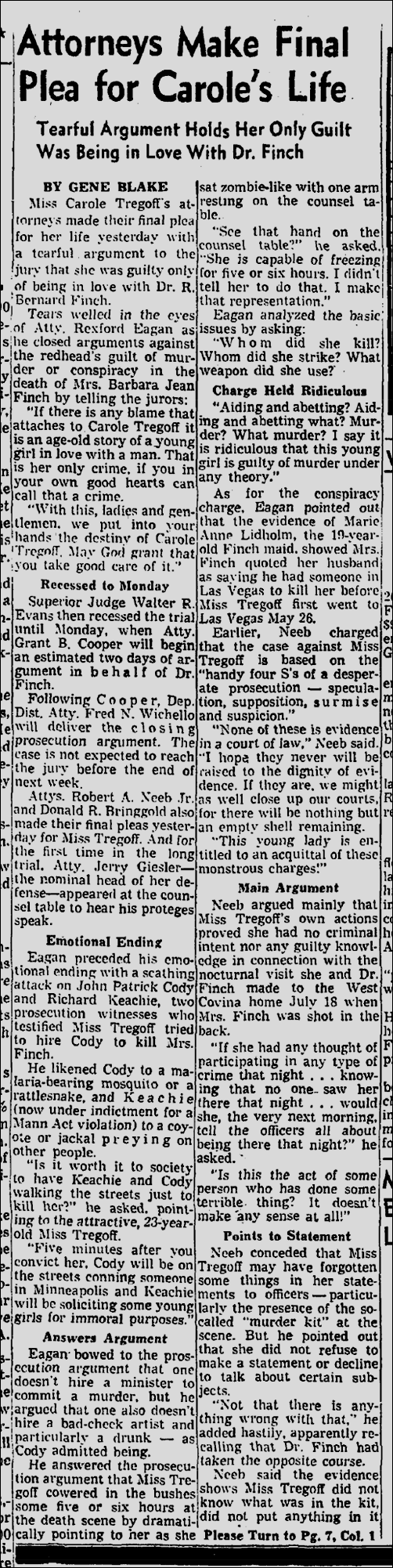
Closing Arguments in Finch Trial; Chessman’s Fate Up to Legislature

Photograph by John Malmin / Los Angeles Times
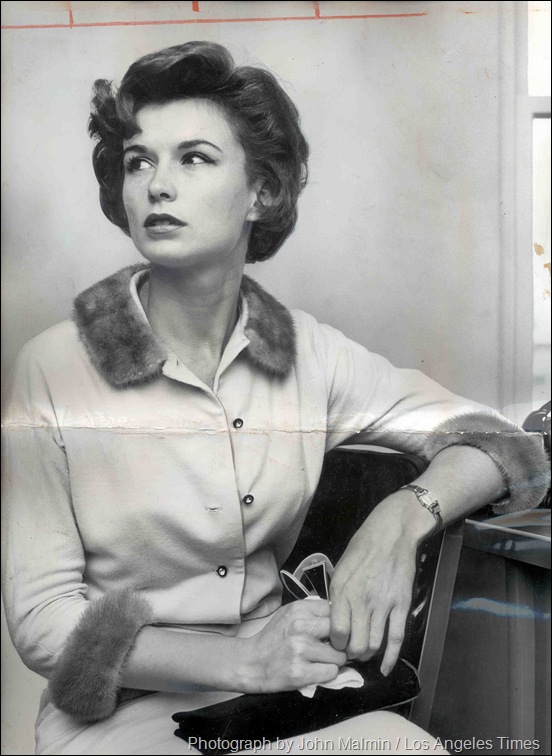
July 22, 1959: Carole Tregoff waits to be questioned by investigators.

Los Angeles Times file photo

Feb. 19, 1960: Students on Market Street in San Francisco protest the upcoming execution of Caryl Chessman.

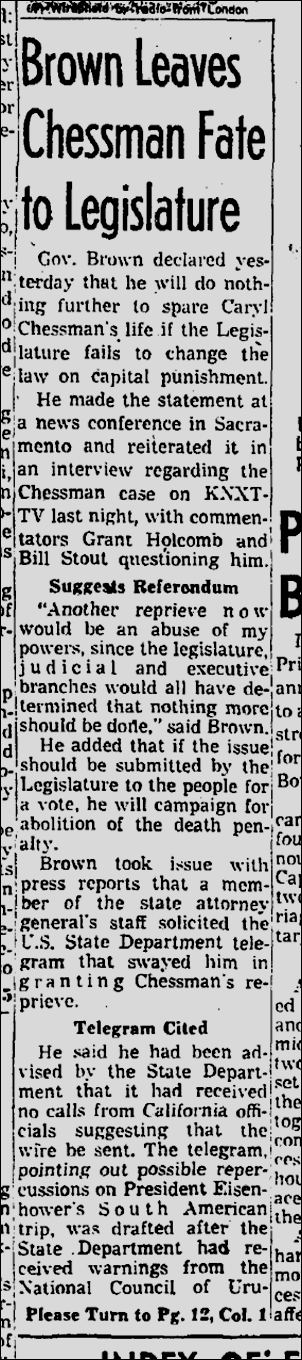
Feb. 27, 1960: Attorney A.L. Wirin defends Caryl Chessman and Mickey Cohen. Years ago, I interviewed Wirin’s partner, Fred Okrand, who said that defending Cohen paid for their ACLU work. Notice that The Times identifies Cohen as a “former hoodlum.”
Posted in #courts, Homicide, Mickey Cohen, Photography | Comments Off on Closing Arguments in Finch Trial; Chessman’s Fate Up to Legislature