
| |
|
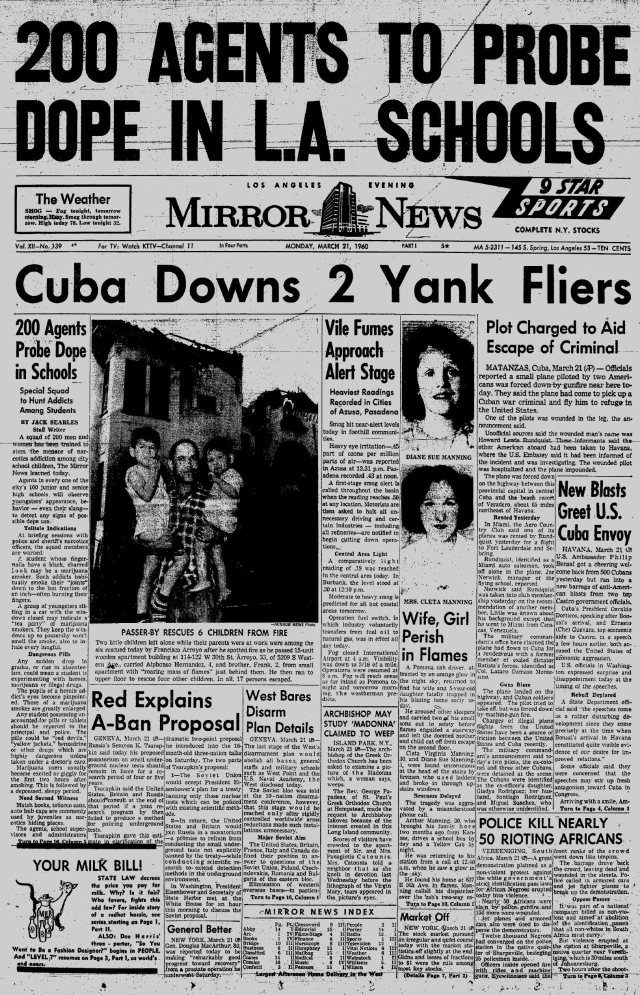
March 22, 1970: The Dodgers destroyed the Angels in radio ratings. |
| |
|
March 22, 1960: Pat Nixon supported herself after her parents died, including work as a movie extra. Look for her in “Becky Sharp.” On the jump, “The Rise and Fall of Legs Diamond” … and Roy Campanella is taken to New York for treatment after suffering a dizzy spell at the Dodgers’ training camp in Vero Beach, Fla. |
| |
|
March 22, 1920: The Times says Annette Kellerman takes too many risks to get accident insurance or life insurance, but she can get “coverage” – so to speak — for her figure. |
|
|
|
March 22, 1910: Oil executive A.B. Cohn says "… the Lakeview gusher can be seen sprouting oil like a miniature volcano for 20 miles across the desert country and it is impossible to approach within a reasonable distance of the well unless one is prepared to take a shower bath in crude oil. The oil, he says, is being thrown from the well in a stream as thick as a man's waist to a height of 300 feet.” It’s interesting to speculate on the environmental effects of letting these wells gush onto the ground, where the oil was collected in open reservoirs. |
Note: Larry is posting items from 1920 and 1960 this year, and I will be watching movies from those years and writing about them, alternating weeks. This week is 1960's turn.
And I owe you people something of an apology, because I have another Roger Corman movie this week. It was my stupid mistake – I got all excited to watch "The Wasp Woman" because I've had a postcard of the movie poster for years and have long cherished it. (That's a good reason to watch a movie, right? Seriously, look at that thing. It is so great.)
I had no idea it was a Corman joint, although if I had thought about it or Googled it, or looked at the small print which is very small on a postcard, I could probably have figured it out. Still, I'm out of time to find something else, and besides, he won an honorary Oscar the other week, so here we are. Next time I'll have something more respectable, or at least directed by someone else, I promise.
”The Wasp Woman” is an interesting time capsule of a tale. Cosmetics executive Jan Starlin (Susan Cabot) is told by her advertising department that her cosmetics are not selling well because she's just getting too old. So Jan poses the logical question: “Supposing a more powerful form of royal jelly could be obtained – from the queen wasp, for example — would you suppose that might have some rejuvenating effect on a human being?” Turns out Jan has already hired an eccentric scientist (Michael Mark) to develop just such a royal jelly. The effects are not what she expects!
| |
|
Pulling a Chessman?
"I am in the City Jail on a phony beef," it begins. "About 2:30 a.m. March 1 I was forced into a car by four men. One had a knife in my back. I was taken for a ride, beaten, robbed and thrown out of the car. After which they worked me over by trampling me on the sidewalk." The letter continues, "Soon afterward, while staggering around in a daze, a patrol car came upon the scene. I tried to tell them my story but they would not let me explain. I told them that the men on the car had my billfold but they refused to investigate by search. Apparently the men in the car convinced them that they had never seen me before, that I was possibly out of my mind. Of course, the majority overruled." ::
IT GOES ON, "The outcome was my appearance in court at which I was sentenced to 90 days. Because the judge refused to listen to my story I feel you should know the facts about my case. It was not only a frame but I was denied the right to at least explain my plight." |
 |
Journalism Lesson From a Dixie Editor
What she did, she called me up — collect — from her flat in the Bronx just before Christmas last year with the hint that it would be “nice” if I got her something different as a present. My custom, every Christmas since my first by-line, had been to send her a year’s subscription so she could keep tabs on my progress in this dog-eat-dog world of journalism. And I never, until the moment she broke the news to me on the phone, suspected that she was bored to death with it all — completely disinterested in how I was doing or what I was writing. “It’s not that I don’t enjoy your column,” she explained gently, the way mothers explain those things to their sons. “It’s just that I get the news here anyway.” At the time, the answer seemed logical enough, but lately, I’ve been thinking. If a struggling columnist’s own mother won’t read him, who will? And why won’t they? |
| |
|
March 21, 1941: Westbrook Pegler breaks down the organization of the Army and compares it to the way the service was arranged in what was then known as the World War. |
|
|
|
March 21, 1960: Jack Smith profiles retired Gen. Holland Smith, who died in 1967 at the age of 84. |
| |
| March 21, 1920: William A. Marr says his motorcycle doesn’t work well unless he’s going 40 mph. |
| |
|
March 21, 1910: Rancher David W. Dwire, a powerfully built Los Feliz rancher, is found shot to death, completely clothed except for his right foot. His missing hat, shoe and stocking are found 100 yards away. Is it murder or suicide? |
| |
|
March 20, 1926: I have to say, Peg was a pretty fair sports columnist, as he shows in this piece on the Phillies. He writes: "They will lose with rousing reluctance, the customers will see earnest, if not polished, baseball. There will be a World Series in which the Phillies will have no interest and next spring the Phillies of Philadelphia will come all the way to Florida to work themselves into good losing condition again." |
| |
|
March 20, 1960: The Dodgers were giving up hope they would open the 1961 season in their new Chavez Ravine stadium. Walter O'Malley complained to The Times' sports editor, Paul Zimmerman, about the "little delays" that kept construction from starting. |
| Los Angeles Times file photo Update: This is Anne Nagel in a publicity photo stamped Sept. 17, 1936.
July 8, 1966: Anne Nagel dies of cancer at the age of 50. |
|
|
| |
|
March 20, 1960: The Gallup Poll says: “…the Republican Party nationwide continues at one of its lowest ebbs in basic voting strength.” I have to wonder whether results like this set off any alarms among Republicans. Perhaps later stories will provide an answer. It certainly won’t come from Times political editor Kyle Palmer, who continues to write as if Vice President Richard Nixon will be virtually uncontested in the presidential election. |
| |
|
March 20, 1920: After reading this long litany of crime, I began to wonder if The Times was merely going to catalog everything that was wrong with society or provide a solution -– perhaps a call for more police officers. The answer is on the jump. |
| |
|
March 20, 1910: The Commissioner General of Immigration reports that there are 3,457 fewer Japanese in the U.S. and Hawaii, due to a decrease in immigration and an increase in emigration. The largest category of non-laborers is “no occupation,” but includes women and children. |
| “?” |
Pig Stickers, En Garde
"In a few days we leave here (North Island) for South Island, where the hunting is fantastic. Up to about 75 years ago there was no native game. They were imported, flourished (no predatory animals) until they threatened to overrun the country, with the result the government sent out extermination crews to thin out the herds. Now there are all kinds of deer — chamois, thar, fallow, whitetail, sambar and elk. All over the area are European boar. Local sports go in for pig-sticking. Dogs track down the boar and drag him by the ears. Then the hunter steps in with his knife. This can be ticklish, as wild boars go up to 500 pounds and don't like the idea of having their throats cut. By the way, no hunting license is needed, and there are no game limits. |
 |
Mash Notes and Comment
 (Press Release) "John Mason Brown is a conversationalist critic whose verbal outpourings since birth have never ceased to be witty and original, as well as readily and steadily forthcoming . . . " (Signed) Esquire Magazine, New York city. –Like the day he was born he had them in stitches when he turned to the nurse and said, "Hurry up with that umbilical cord, Honey. I want to contemplate my navel." ::
(Press Release) "Reinhold Schmidt, the Bakersfield grain buyer who reports he recently flew to the Great Pyramid of Gizeh, Egypt, in a space craft from the planet Saturn, will be in Los Angeles Thursday night March 24, to tell the public about his experiences in a lecture sponsored by the Amalgamated Flying Saucer Clubs of America. "The widely known speaker, who made nationwide news with his first extra-terrestrial contact near Kearney, Neb., in November of 1957, will speak at 8 p.m., in Severance Hall, 940 S Figueroa St. |
 The letter, neatly written in pencil, is from a man named Arthur.
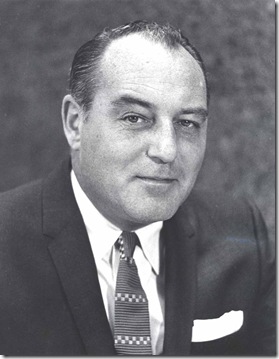 My mother didn’t exactly cancel her subscription to The Mirror News.


