
| |
|
April 10, 1940: How come Metro finds such difficulty in fitting Hedy Lamarr with a story? The biography of Lola Montez has never been screened. |
| |
|
April 10, 1940: How come Metro finds such difficulty in fitting Hedy Lamarr with a story? The biography of Lola Montez has never been screened. |
| Dec. 19, 1975: President Gerald Ford chats with Supreme Court Justice Warren Burger, center, after John Paul Stevens, right, was sworn in as the court’s newest member.
|
|
Dec. 20, 1975: The Times’ Linda Mathews covers Senate confirmation hearings on Supreme Court nominee John Paul Stevens. “Sen. Edward M. Kennedy (D-Mass.), another member of the Judiciary Committee, grew visibly frustrated at his inability to elicit from the taciturn Stevens his opinions about a range of constitutional issues. Finally, when Stevens answered a particularly convoluted question with a simple 'No,' Kennedy exploded. “ 'No?' Kennedy said. 'That's all you have to say? Well that's the most precise answer I've gotten from you.' “Ignoring Kennedy's sarcasm, Stevens remained genial. 'Well, that's the most precise question I've been asked,' he told Kennedy." |
|
|
|
April 10, 1980: One of two unidentified hostages shown on Iranian TV gives a tour of a warehouse apparently used for intelligence by the NSA and CIA. On the jump, do doctors spend more time with male or female patients? |
| Mayor Alexander’s electric car! |
|
April 10, 1910: Mayor George Alexander says he’ll still be chauffeured on his official duties but is learning how to drive an electric Waverly phaeton for personal use. The 70-year-old mayor of Los Angeles says, "This chauffeuring is serious business. You know, there's a whole lot to learn in managing this machine so you won't try to run over the curbstones. But I'll get there, all right." |
| |
Bed Burners Beware
Too often there are stories in the papers about persons who are badly, even fatally burned by falling asleep with a lighted cigarette. Well, something has been done about them.
An amendment to the fire code, Sec. 57.20.17B, which went into effect Dec. 31, 1959, provides that any person who through carelessness, negligence or any other means whatsoever set a fire to any bedding, furniture, rugs, curtains or drapes, and thereby endangers the safety of others and property, shall be guilty of a misdemeanor — maximum penalty $500 fine or 180 days in jail.
Get the picture? A man who maybe was overtaken by the sandman after seven martinis falls asleep while smoking in a hotel room. Not only is he likely to wake up on fire but there's a possibility he'll make the jug.
|

|
Mash Notes and Comment
(Newsletter) "VAGABONDING WITH VANDERBILT, by Cornelius Vanderbilt . . .
"I WRITE AS I PLEASE . . .
"People are always writing me and asking why I don't write 'exactly' what people tell me instead of making my own deductions.
"Here is a sample of how some of their suggestions would come out:
"At a cocktail dinner dance at the very exclusive Miami Beach Bath Club, I sat between two elderly ladies of great wealth. The retired admiral's wife doubted the possibility of WW III and she told me of the trouble she was having with her new dentures.
"I advised her to take out the lower and eat soggy foods.
"Her reply: 'But I'm not even wearing the uppers!' . . .
|
December 1930: Broadway and 3rd Street. |
| The Los Angeles County Transportation Authority Library and Archive is a wonderful source of old photos. Here's one of Broadway at 3rd Street taken in December 1930. The Times Building in the center-right portion of the image, with the tower, is the one built after the October 1910 bombing. This image and others of downtown Los Angeles may be seen here.
I read this picture as a traffic jam: Two lanes of cars, bumper to bumper, another set of cars parked at the curb and a line of three streetcars. Whoever took this picture evidently stood somewhere on the first car, either the running board or the front bumper. And we want the streetcars back on Broadway?
Dec. 14, 1930: Sure enough, the topic of the day is how to relieve traffic congestion. The proposed solution was a subway. And no, we didn’t build one. I can’t say it often enough: Traffic in Los Angeles is a century-old problem that defies simple solutions. |
| “Young Tom Edison Was a Bad Boy!” |
|
April 9, 1940: Are those Saturday afternoon air jaunts of Jimmy Stewart and Olivia de Havilland dress rehearsals for an elopement, as intimates insist? … Now it's Akim Tamiroff who's bought a ranch and gone in for racehorse breeding. |
| Los Angeles Times file photo Update: This is vaudeville star Kitty Doner in a 1925 publicity photo. Doner died Aug. 26, 1988, in Los Angeles at the age of 92.
Dec. 23, 1925: Kitty Doner appears as a man in “Twenty Minutes in Paris” at the Orpheum.
|
|
|
|
Aug. 5, 1981, President Reagan fires striking air traffic controllers. |
|
April 9, 1960: Screen Actors Guild President Ronald Reagan and actor Charlton Heston shake hands with Charles S. Boren and Columbia Vice President B.B. Kahane on a tentative agreement to end the 33-day film strike. In 1981, President Reagan said he had no choice but to fire thousands of air traffic controllers because they took an oath not to strike. “It’s not a case of firing – they’ve quit,” Reagan said. On the jump, the Senate approves the civil rights bill after eight weeks of debate … and Frank Sinatra fires blacklisted screenwriter Albert Maltz for a proposed production of “The Execution of Pvt. Slovik." |
Five years after “Birth of a Nation,” D.W. Griffith directed this five-hankie melodrama based on a hugely popular stage play. If you're fond of rambling 19th century novels or four-week 1970s TV miniseries, with tragic heroines and broad casts of colorful characters, here's the 1920 silent film equivalent. Lillian Gish stars as Anna (“But we may as well call her Woman” intone the title cards), who undergoes 147 minutes of trial and tribulation before she can find happiness.
Yep, that's a two and a half-hour silent film. I sat down the other night thinking “Well, let's see how much of this we can get through tonight.” But 145 minutes later I was still on the couch, completely engrossed, bellowing “Look out for the waterfall!” Griffith knew what he was doing, it seems. And thankfully there are no Klansmen to be found at all.
The first half of the plot is straight out of “Tess of the D'Urbervilles.” Anna's mother sends her to the big city to request financial help from wealthy relatives. (Mothers: Do not do this.) Anna falls afoul of a heartless, resplendently lipstick-clad seducer (Lowell Sherman; and yeah, I know the silent film actors all wear lipstick, but he just wears it so very well) and returns home bearing a shameful bundle, ending up in a home for fallen women. Eventually she finds work with a farm family. Can she find love with the family's kind, strapping son (the achingly beautiful Richard Barthelmess)?
| The 1889 City Hall on Broadway just north of what is now the Victor Clothing Building. Notice that there are no fire escapes.
|
|
April 9, 1910: A fire that broke out in the janitor’s basement office could have quickly set the whole building ablaze, The Times says. The pipes were insulated with felt wrapped in ordinary paper, which had come loose and was hanging down in long strips. In a later era, the pipes would have been insulated with asbestos, which – as we know now – presented its own problems. On the jump … Is bad grammar grounds for divorce? |
| “And When You Go Up to the Front Desk, the Librarian Looks at You With Her Great Big Eyes, and She….”
|
The Fourth at State
A crew of painters has been working on the sixth floor of the Hall of Justice, where the district attorney's offices are located. One painter was slapping his brush just outside the DA's press-room, which has no designating sign on the door and has clear glass panels through which persons in the hall can see in. After working there awhile he asked a passing deputy DA, "What do those guys do in there? They're always on the phone." He paused, looked around, saw the coast was clear, then said confidentially, "I heard there was a bookmaking going on in the Hall of Justice, and I wondered if a fellow could place a bet in there?" The deputy DA, recalling a man had been arrested a week before as a bookie suspect on the seventh floor, assured the painter they were only reporters phoning in their stories. |

|
Two Women Tell of Some Frantic Hours
For Gwendolyn Tarpy and Pauline Rose, the day of danger is over. It's two weeks buried in old headlines. But to them its immensity remains undiminished. It began on the afternoon of Wednesday, March 23, when they walked into the Tennessee State Prison at Nashville. Mrs. Rose handled the scrip accounts of the prisoners. Mrs. Tarpy was her assistant. It was their biweekly routine to visit the penitentiary to permit the prisoners to draw against their accounts. But that day, routine met violent interruption. Raymond Farra, 25, a life-termer and ex-mental patient, and Robert Rivera, 22, doing 40 years for armed robbery, overpowered two guards, got their guns and held the two women, plus 17 other prison employees, guards, inmates and visitors, captive for 25 hours. |
| |
|
April 8, 1940: Don't let Charlie Laughton's flabby appearance fool you. He has a grip like a blacksmith … She's been gone for more than a year, but RKO workers invariably cite Katharine Hepburn's screwy doings when they want to top your best Hollywood anecdote… |
| |
|
April 8, 1960: Don Zimmer, the Dodgers' vocal and often-angry backup infielder who thought he should be starting or at least playing, finally got his wish to leave L.A. as the big name in a four-player trade with the Cubs. The Dodgers received three youngsters, including Ron Perranoski, who anchored the Dodger bullpen for several seasons. Zimmer had been seeking a trade just about since the Dodgers arrived from Brooklyn. On his way out of town, he made it clear he blamed Manager Walt Alston for his troubled times in L.A. "I know he doesn't care for me," Zimmer told The Times. "That's because I'm always after him to play me or trade me." The Cubs weren't the answer for Zimmer. The Mets picked him up in 1962. He also played for the Reds, Senators and the Dodgers again. –Keith Thursby |
| Sept. 19, 1887: A comment on the use of “cholo” in a 1910 story prompted me to look for the first occurrence in The Times. ProQuest’s search engine is imperfect – it mistakes “cholera” for “cholo” — but this seems to be one of the earliest appearances. |
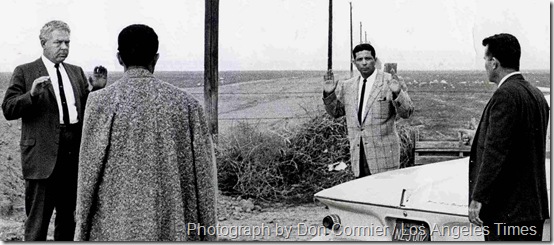 Photograph by Don Cormier / Los Angeles Times |
| Regular Daily Mirror readers will be familiar with Detective Danny Galindo, who died Tuesday at Huntington Memorial Hospital in Pasadena. Here he is in 1963, taking the part of Karl Hettinger, center, in a reenactment of the “Onion Field” killing with Sgt. G.H. Bates, left, as Officer Ian Campbell; Sgt. Pierce Brooks, right, as Gregory Powell, and suspect Jimmy Lee Smith. |
| |
|
March 10, 1960: The Times published the Hot Stove League as a daily feature, but I’m posting them once a week so they’ll last longer. Is Don Blasingame safe or out? |
| The Times’ nameplate before the 1910 bombing, with The Times Building at right. The revised nameplate of 1913 shows the building on fire.
|
|
April 8, 1910: I thought it would be interesting to look at how the October 1910 bombing changed The Times’ nameplate. The Times’ eagle, which was on the roof of both buildings, remains on display in the Globe Lobby, but it has acquired a new base since the 2007 exhibition at the Huntington Library, Art Collections and Botanical Garden, above. |


