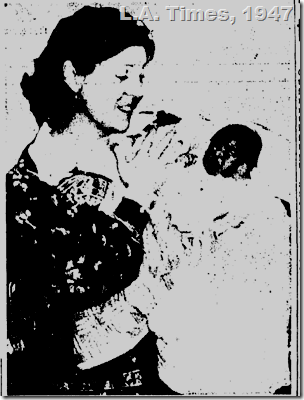

Aug. 15, 1942: The good news: The Times writes about African American troops. The bad news: The story is one stereotype after another.


Aug. 15, 1942: The good news: The Times writes about African American troops. The bad news: The story is one stereotype after another.
August 12, 1959: “People said it was just a whim — that they couldn’t understand why a young girl wanted to study law — that it would all go to waste — that I’d just spend time and money and then get married.”
The magnificent Russian dancers are gone, leaving behind a vivid memory. Their seemingly impossible footwork, their leaps, their precision was breath-taking.
I saw them Monday in their final appearance in Hollywood Bowl, and afterward, while the tremendous impact of their grace and agility was still fresh, went backstage with Tom Cassidy of KFAC and Frania Natasha Igloe, the painter. Mrs. Igloe, exiled from Russia in her youth, speaks the language and we thought we might elicit some interesting comments.
August 12, 1959: One man is killed and six are injured in the collapse of a bridge being built over the Pacific Electric tracks on Charlotte Street north of the San Bernardino Freeway near Soto Street.
Yesterday, I got the inside story on a weapon which could win a major battle in the cold war for us.
It wasn’t devulged to me by an atom scientist or a rocket engineer.
I got it, instead, from a retired schoolteacher.
And — unorthodox and overly simple as it sounds — I’m convinced that our government ought to squander a few bucks on investigating its possibilities.
The former schoolteacher, whose name is Helen Bowyer, readily admitted to me that her idea wasn’t an original one.

Note: This is an encore post from 2005 and originally appeared on the 1947project.
Dr. Stanley Dean Johnson sounds like quite a fellow. He’s a specialist in the works of John Donne, having received his bachelor’s and master’s from the University of Missouri and his doctorate from Yale, where he was Phi Beta Kappa.
He taught English at Northwestern from 1939 to 1943, when he enlisted in the Army, and was discharged as a first lieutenant in the Transportation Corps in 1946. In the fall, he was hired as an English instructor at UCLA.

Aug. 12, 1944
Geraldine Fitzgerald’s sparkling performance as Edith Galt, second wife of Woodrow Wilson, creates a new and fresh interest in her. Fitting, I think, that Jack Warner should again lend her to Darryl Zanuck, for he did more to bring out her talents as an actress than any other producer.
Laird Cregar had a change of heart and is back in the East. George Sanders ditto. Cregar went on eight weeks suspension, but apparently thought better of his revolt and is back on the lot.
LEO: Uneventful maybe as far as important advance (events?) go. Takes on different aspect in domestic affairs, personal interests. Much depends upon your disposition, cheery manner.
From the Philadelphia Inquirer via Fultonhistory.com.
Reminder: Boxie and I will be doing a live “Ask Me Anything” on George Hodel and Steve Hodel on Tuesday, August 19, at 10 a.m. Pacific time on YouTube.
Can’t make the live session? Email me your questions and I’ll answer them! The video will be posted once the session ends so you can watch it later. Remember, this is ask me anything, so please remember to ask questions rather than make comments. Thanks!

Note: This is an encore post from 2006.
Aug. 12-13, 1907
Los Angeles
Despite the name Bismarck Cafe, police call the saloon at Main and Winston Streets the Bucket of Blood because it’s a continual source of crime and violence.
It is a place, The Times says, “of drunken debauchery among girls of tender ages, painted women and men. Into this immoral pesthole, young girls are enticed nightly to drink and listen to a band concert. Although the police make arrests in this dive every night, it is allowed to run unmolested.”

Someone is always giving someone a plaque or a scroll for extraordinary conduct or service and this is to suggest that a medal or trophy be struck for Gregor Piatigorsky. But not for playing the cello, at which he is world famous. For cautious driving.
Nine years ago, after taking driving lessons for six months, Mr. P. ventured out on his own. Only one thing bothered him — the fierce, unrelenting refusal of motorists coming from the opposite direction to permit him to turn left at intersections. It became a complex. And for nine years Mr. P. has never made a left turn.
Wait a minute, the Beats reject things like beauty contests. What’s with this?
Now don’t get me wrong, comrade.
I’m for peace at any reasonable cost. And I definitely am in favor of Nikita Khrushchev’s visit to our country.
But the administration’s switch in attitude toward the Soviets has thrown all Americans into a spin.
I mean, like it’s so sudden.
For years, we’ve been conditioned by editorial cartoons to think of the Russians in general as bearded, heavy-booted bomb carriers, and Khrushchev in particular as a monstrous kewpie doll with a rummy nose, a rather unattractive mole on his cheek, a silky smile, and a bloody knife stashed up his sleeve.
Aug. 11, 1969: The Times brings out an extra for the La Bianca killings.
Note: In keeping with the Daily Mirror’s practice of posting original documents in Los Angeles history, often for the first time, we present former Deputy Dist. Atty. Vincent
Bugliosi’s opening statement from July 24, 1970, in the Charles Manson trial.
Bugliosi gave copies of his remarks to reporters covering the trial, including Sandi Gibbons, now of the district attorney’s office, who provided a photocopy. Bugliosi’s statement is a model of clear writing; there’s barely a word out of place. The text has been edited to conform to Times style but has preserved Bugliosi’s occasional errors (“their” for “there,” for example). This is in part to preserve the quirks of the document … and to make it easy to trace copies that are posted on other websites without permission.
[handwritten notation: “I have Xed myself from your world.”]
OPENING STATEMENT
TATE – LA BIANCA MURDER TRIAL
Note: This is an encore post from 2005 and originally appeared on the 1947project.
Someone found them shot to death on the floor of the Portal Motel at 2775 N. Cahuenga: two men completely clothed except for their shoes, each with a bullet in the head and another in the stomach. The pistols, one of them a Japanese Nambu war trophy, were also recovered—each had been fired twice.
Their cars were in the parking lot. One was registered to 25-year-old Robert Haskell Blum, 4671 Pickford St. The other belonged to 27-year-old John Darold Sever, 539 Ruberta Ave., Glendale. Maps show that the Portal Motel is about midway between the two homes on the main highway between Los Angeles and the San Fernando Valley.


Aug. 11, 1941: Walter P. Palmer and William S. Raney are killed when their plane goes into a spin during a flying lesson and crashes into a bean field at Woodley Avenue and Oxnard Street in Van Nuys, which is now somewhere in the middle of the Sepulveda Basin Recreation Area. Continue reading
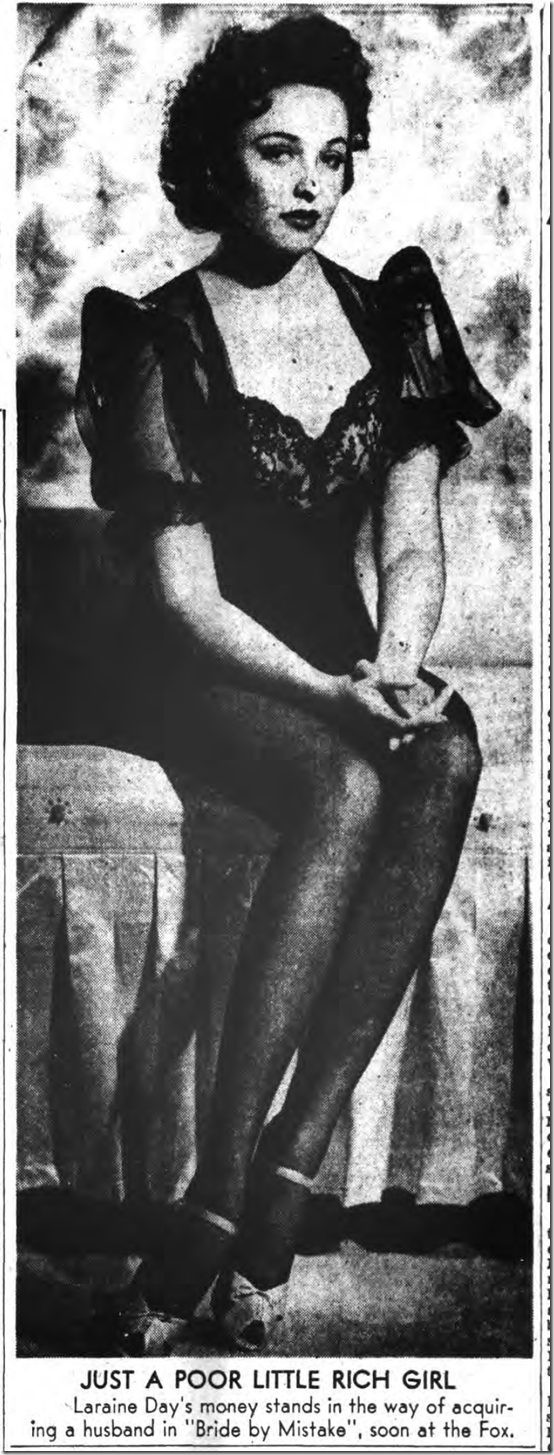
This week’s mystery movie was the 1935 MGM film Sequoia with Jean Parker, Russell Hardie, Samuel S. Hinds, Paul Hurst, Ben Hall, Willie Fung and Harry Lowe Jr. Continue reading

“What Happened to Mary” courtesy of Mary Mallory.
Note: This is an encore post from 2014.
Distinct and beautiful advertising often sells products better than the actual item, its story or its usefulness. Early film, music and book publishing companies quickly realized the value of beautiful hand-drawn illustrations to attract consumer interest and purchase. Colorful lithographic posters, handbills, trade paper and sheet music enticed the public to attend mass entertainment, patronize restaurants or buy music. Finding ways to combine two or more industries in one medium would exponentially grow business as well.
In publicizing their new 1912 serialized film series, “What Happened to Mary,” the Edison Film Company introduced the idea of combining forces with other media or business companies to more efficiently and cheaply grow audiences for their products. This radical idea led the way to what is now an everyday practice for selling tent-pole films, major television series, blockbuster books, mega music albums or popular Broadway shows to American consumers.
Growing out of Thomas Edison’s early film experiments in the 1890s, the Edison Manufacturing Company ranked as one of the major moviemaking concerns in the late 1900s-early 1910s. Such stars as Charles Ogle, Marc McDermott, Viola Dana and Mary Fuller regularly appeared in their moving pictures.
Mary Mallory’s “Hollywoodland: Tales Lost and Found” is available for the Kindle.
The penalty for firing an antique broomhandle Mauser with shoulder stock: You get shot and lose one of your loafers.
Let us try to understand a weird incident that took place a few days ago at International Airport.
A lady waiting for her delayed jet flight to Chicago to take off was chatting with a fellow passenger, and the conversation turned to jet planes and what would come next.
Out of the blue he said casually, “We’re already there. I get mail regularly from outer space.”
She thought he was joking but he wasn’t. He was a true believer in flying saucers. She isn’t and asked if he had such a letter with him, she’d like to see it. He reached in his pocked but seemed to have mislaid it.
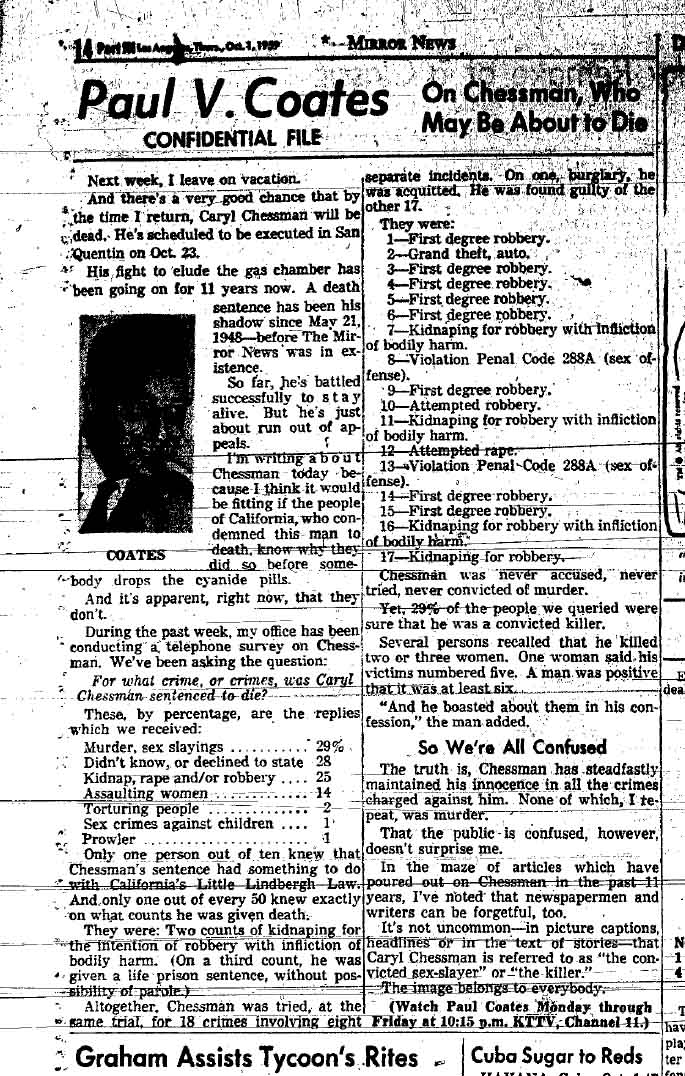
Confidential File
I try. Believe me, I try.
At every opportunity, I warn you all of the countless pitfalls of life in these treacherous times of high-pressure merchandising.
Repeatedly, I’ve written you little lectures on the pointlessness of purchasing more than one lifetime membership to a dance instruction studio.
I’ve cautioned you time and time again about the risk of signing your name on a blank contract.

How smart is your dog? Read the Gettysburg Address to your faithful friend and find out. No, I mean it!
Answers below. No cheating, Princess! Continue reading
August 10, 1958: Ernie Bushmiller’s “Nancy,” in which Nancy and Sluggo unravel a mystery.

Note: This is an encore post from 2005 and originally appeared on the 1947project.
Building contractor Robert Beryle regarded the 762-foot Broadway tunnel, excavated in 1901 through Fort Moore Hill, as his masterpiece. Another crew was building the 1,045-foot 3rd Street tunnel at the same time and an informal competition developed between the two to see which would be finished first.
In 1949, the city decided to remove Fort Moore Hill, where another Beryle building, Los Angeles High School, was located, as well as the Broadway tunnel.
Beryle died Oct. 17, 1949, at the age of 90, a few days before the arch, all that was left of the Broadway tunnel, was pulled down. In his final days, Beryle often told his family stories about the tunnel’s construction, so they kept the secret that it had been destroyed.
In 1948, The Times’ list of tunnels included:
August 9, 1960: Buck Rogers: Caltechium is the ultimate weapon!
Aug. 9, 1960: Matt Weinstock writes about a story that was told at the farewell party for Paul Weeks (d. 2007), who was leaving to become the Mirror’s Washington correspondent. In fact, Weeks remained in Washington (spoiler) after the Mirror ceased publication in early 1962.
CONFIDENTIAL TO BETTY: The only woman who looks good carrying a torch is the Statue of Liberty. Date others and forget him, Abby says. Continue reading