
| Los Angeles Times file photo |
|
|
| Los Angeles Times file photo |
|
|
Los Angeles Times file photo The trial of Clarence Darrow. Do you recognize the young Jerry Giesler to Darrow’s left?
|
In one folder, I found a map that a pressman drew on a piece of scrap paper showing where he was when the bomb went off and how he got out of the building. In another, there was Jim Bassett’s interview with May Goodan, Harry Chandler’s daughter, in which she talked about taking drives with her father through the barley fields outside Los Angeles and how he would say that it would all be homes someday. Rather than focusing exclusively on retelling the story, I have been looking at questions such as “Who owns history?” “Who gets to tell the story?” and “Why is memory so fragile?” How is it that an incident that was so thoroughly documented at the time has been so completely recast over the last century? Why is it that most people in Los Angeles today have no idea precisely where the bombing occurred? Or why? Jimmie Fidler fans, don’t worry. He and Tom Treanor and Matt Weinstock and Paul Coates will be back. But right now my life is all about research. |

|
|
Aug. 19, 1970: The Dodgers were saved by a pitcher described as "23, right-handed and super cool." Sandy Vance pitched a five-hitter to beat the St. Louis Cardinals, 7-2. The Times' John Wiebusch, who gave Vance the "super cool" label, said Vance wasn't Manager Walt Alston's first or even second choice to fill in as a starter. But Alston was impressed. "He's going to be a good one," Alston said. "He has remarkable concentration and he's a much improved pitcher." Injuries shortened Vance's career to parts of two seasons with the Dodgers. Speaking of Alston, longtime baseball official Frank Lane predicted his eventual successor with the Dodgers' would be minor league manager Tom Lasorda. "I don't think there's any question that when Walt Alston decides he wants to stay in Ohio that Lasorda will be the man to replace him. That is unless some other club hasn't snapped him up first." — Keith Thursby |
| |
|
Aug. 18, 1960: A man goes into a place that sells hearing aids and … Matt Weinstock has the story. Also on the jump, Richard Nixon talks about civil rights during a campaign stop in Greensboro, N.C. DEAR HOWARD: Not all women are naturally round, firm and fully packed. And a man who would turn down a girl just because she wasn't "all there" isn't all there himself, Abby says. |

|
|
Aug. 18, 1960: Paul Coates has an update on one of his regular characters, Desmond Slattery. Also on the jump, Jim Denyer has a piece on the FBI’s “most wanted” list. I don’t recognize Denyer’s byline, but I’m assuming he was one of the Mirror staffers who got a turn at a writing column. |

|
|
Aug. 18, 1960: You don't very often see the phrase "nearly maimed" in headlines for baseball stories. Don Drysdale escaped serious injury when he was struck by a line drive, then he lost the game on the next pitch when Chicago's Ernie Banks homered to beat the Dodgers, 1-0. And how tough was Drysdale? "If Don was shaken up, he didn't show it," wrote The Times' Frank Finch. "When Manager Walt Alston asked him if he was hurt, Drysdale said, 'Gimme the ball and let me pitch.' " Great quote but some dubious journalism. Just where was Finch when he heard Drysdale say that? — Keith Thursby |
| |
|
Aug. 17, 1960: A motorist wins a battle over a parking ticket (it wasn’t filled out properly) … and one Whittier market has such a problem with kids stealing cigarettes it doesn’t even bother to report them. CONFIDENTIAL TO UPSET MOTHER: The least lovable child needs the most love. Force yourself. Also on the jump: Some employers are switching to staggered work hours in an attempt to ease traffic on the freeways. Yes, this is 1960 and yes, freeway traffic was a problem 50 years ago. And yes, this is when Los Angeles still had streetcars (d 1963). |

|
|
Aug. 17, 1960: Paul Coates writes about an economic boycott against African Americans in the South who register to vote. |
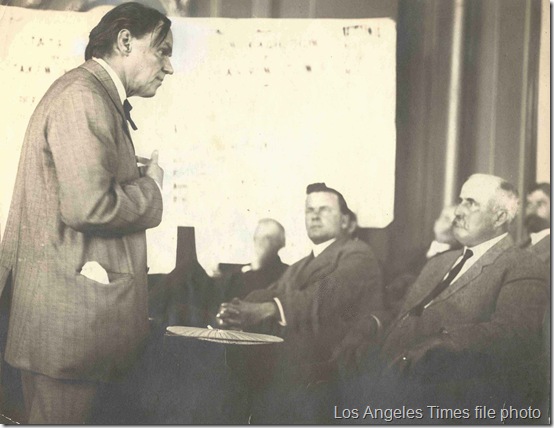 Los Angeles Times file photo Clarence Darrow addresses the jury during his 1912 trial in Los Angeles on charges of attempting to bribe jurors while defending the McNamara brothers in the 1910 bombing of The Times. [Update: This photo was published in The Times on Aug. 15, 1912. An earlier version of the post said the photo was taken in 1913, the date that was written on the back of the picture].
|
| Dear Daily Mirror readers: Posting will be light this week because I’m going through The Times archives at the Huntington Library to research a story for the centennial of the Oct. 1, 1910, bombing. I’ll continue posting mystery photos, but it’s unclear whether I’ll have time to do anything more. |
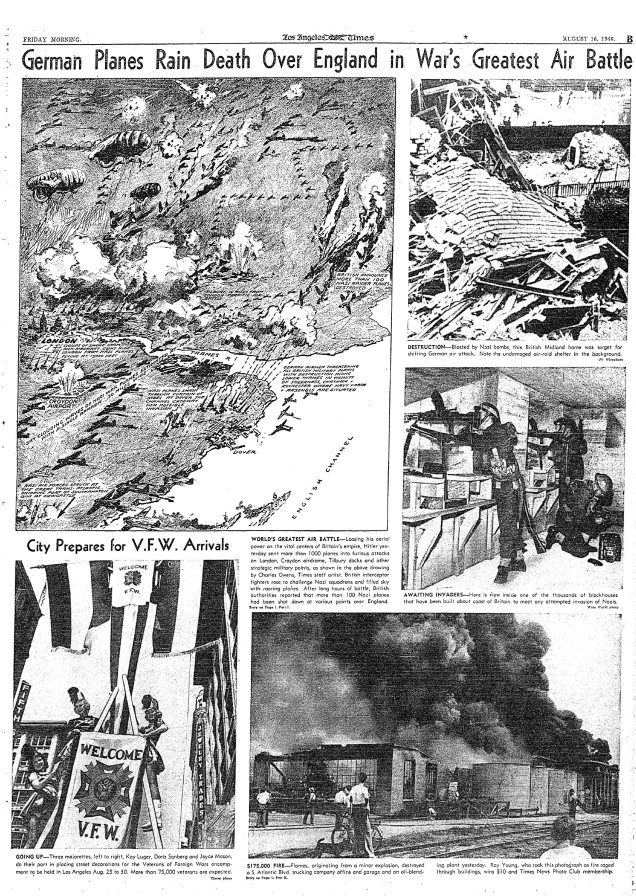 The Times publishes a war map by Charles Owens.
August 16, 1940: Joan Crawford is mulling the notion of a second adoption as companion for her recent first, Jimmie Fidler says.
Continue reading
 People with funeral fetishes, I have got the movie for you, and it is Roger Corman’s “House of Usher.” (Yes, I am beaming affectionately at you, my dear goth friends.) The first in a rash of Corman films taken from titles by Edgar Allan Poe, “Usher” is one of the most faithful that I have seen and also, alas, just about the least fun. But if you have a thing for funerals, it’s great! And for the rest of us, there’s Vincent Price in a blond wig.
The plot makes a bit free with Poe’s story, although it’s nothing like the deranged embellishments of, say, “The Raven,” in which Vincent Price and Boris Karloff cast spells on each other over dinner while Peter Lorre flaps around in a man-sized raven suit. In “The Fall of the House of Usher,” an unnamed friend comes to visit Roderick Usher in his big creepy old family mansion; Roderick’s sister Madeline swans around being sickly and eventually gets buried alive. That’s pretty much the plot here, except that the friend has been named Philip Winthrop and he arrives as Madeline’s fiance. It’s a short story (my copy runs 19 pages) so there’s a lot of standing around.
But hey, we’re standing around with Vincent Price, and he’s got a blond wig on! Check him out after the jump: He looks like Captain Von Trapp. Price plays Roderick Usher, who is not at all happy to see Winthrop (Mark Damon) on his doorstep. The “Winthrop, you must leave!” starts right off the bat. But apparently Winthrop met Madeline (Myrna Fahey) back in Boston and got engaged to her and is determined to visit her at home, even though all she does is put on nightgowns and swan around being sickly. Winthrop mostly interacts with the hostile Roderick and with the butler, Bristol (Harry Ellerbe), who is useful for providing expository details such as the family inclination toward catalepsy.
 |
 This hat from Oviatt’s has been listed on EBay. Bidding starts at $375 or Buy It Now at $450. As with anything on EBay, items and vendors should be evaluated thoroughly before submitting a bid. |
| |
|
Aug. 15, 1960: Remi A. Nadeau has a new book coming out: "Los Angeles — Conquistadors to Commuters," Matt Weinstock says. The final title was “Los Angeles: From Mission to Modern City.” CONFIDENTIAL TO SHORT ON LONG ISLAND: If what you say is true, it would appear that your husband has more than a financial obligation to his secretary. No mere employee can be this fireproof, Abby says. |

An 8-point buck attacks construction worker John C. Kenworthy in Encino. Other construction workers and a cement salesman pull the deer off Kenworthy and kill it by twisting its neck.
|
|
Aug. 15, 1960: Paul Coates roams the Hollywood Walk of Fame and wonders why there’s nothing for Charlie Chaplin – or for him. And yes, Chaplin has a star. And no, Paul Coates doesn’t. |
| Los Angeles Times file photo
|
|
Here’s our weekend mystery guest. I like to keep things more informal on the weekends so I’ll post all the comments as they come in rather than waiting. This week’s mystery guest was Tod Andrews! |
| |
|
Aug. 15, 1910: Florence Nightingale dies in London at the age of 90. |
|
In wartime Rome, Tom Treanor interviews a young woman about her career and her expectations for marriage and a family.
|
|
Aug. 14, 1940: Ha! Negro theaters down South advertise Rochester in letters a foot high, while Jack Benny gets three-inch billing, Jimmie Fidler says. |
|
|
|
Aug. 14, 1910: Although the content has changed dramatically, the selection of Sunday newspaper features hasn’t changed much in a century: There was an emphasis on the performing and visual arts, books, and things for children, like the comics pages. Few of the comics are familiar today, but one enduring strip (despite its painfully racist elements) is Winsor McCay’s beautifully drawn “Little Nemo in Slumberland.” On the jump, continuing coverage of labor: The attempted bombing of streetcar facilities during a strike in Columbus, Ohio, and The Times Sunday workers’ page. Under Gen. Harrison Gray Otis, The Times of this era drew a sharp distinction, casting itself as an enemy of unions and a friend and ally of workers. The bombing of the Los Angeles Times is a month and a half away. |

