
|
Tom Treanor, who was killed covering World War II for The Times, on housing in Rome. |
|
Aug. 23, 1940: George Raft's been startling New York natives by making nite club rounds in bedroom slippers, Jimmie Fidler says. |
|
Tom Treanor, who was killed covering World War II for The Times, on housing in Rome. |
|
Aug. 23, 1940: George Raft's been startling New York natives by making nite club rounds in bedroom slippers, Jimmie Fidler says. |
Photograph by Larry Harnisch / Los Angeles Times
|
| I visited Hollywood Forever Cemetery over the weekend to see the memorial to victims of the 1910 bombing of the Los Angeles Times. I was told that The Times’ eagle has been missing its wings since at least 1990 and indeed, they are gone.
Four of the victims were buried elsewhere. Assistant City Editor Churchill Harvey-Elder, for example, is in Rosedale Cemetery. After visiting Hollywood Forever Cemetery, I went over to Rosedale to see if I could find his grave, but the office was closed. Rosedale, which is on Washington Boulevard just east of Normandie Avenue, is an older cemetery with narrow roads, and I ended up getting caught in a funeral procession that parked en masse for a graveside ceremony. |
*claps hands to face, shakes feathered hair, screams*
I'm sorry! I meant to do this last week. Larry pitched this idea when he first started running posts from 1980, and I thought "ooh, there's a Friday the 13th in August" and then I didn't think about it again until, well, last Friday morning, when my "House of Usher" post had just gone live. Well… "Friday the 13th" itself was released on May 9, 1980, so at least there is precedence for not getting the date quite right. That counts… right? ….
Besides, there's no actual mention of Friday the 13th in the movie. It's given as the date for much of the action, but nobody ever says "Boy, I sure hate Friday the 13th! Things always get crazy!" or anything like that. This is fitting; the movie intentionally follows the template of the tremendously successful "Halloween" (1978), which was originally titled "The Babysitter Murders" and involves the holiday largely as window dressing. In the coming years "My Bloody Valentine" (1981) and "April Fool's Day" (1986) would treat their own holiday themes much more seriously. For the original F13, though, it's just all about the camp counselors.
And what counselors they are! Not a single camper is to be seen in this film, unless you count the drowning Jason (was he a camper or just an employee's kid that nobody was really in charge of?) shown in flashback. This film is concerned about the counselors, thank you, the nubile teenagers in high-waisted shorts and crisp white panties. This film clearly knows which side its bread is buttered on! All the action takes place on the day before Camp Crystal Lake is to open, so at least there's a good reason: the story centers on the counselors who are helping get the camp ready. Sadly for them, that will never happen.
| |
This still from Theda Bara’s lost film “Salome” has been listed on EBay. Bidding starts at $9.99. |
| Los Angeles Times file photo
Here’s our mystery guest with a mystery companion! |
|
Here’s our weekend mystery guest. I like to keep things more informal on the weekends so I’ll post all the comments as they come in rather than waiting. This week’s mystery guest was Raymond Hackett. |
|
Aug. 21, 1960: The Lakers of Los Angeles were coming together. West Virginia University Coach Fred Schaus was hired as the team's new coach. "It was an opportunity that comes once in a lifetime," he told UPI. The team already had a great young player in Elgin Baylor, and the Lakers' top draft choice was Jerry West. Schaus coached the Lakers until the 1966-67 season, then become the team's general manager. Earlier in the month, the Lakers turned down $200,000 from the St. Louis Hawks for Baylor and they hoped West would soon join Schaus, his old college coach. "The Cleveland AAU team is bidding for Jerry's services. Naturally I hope he joins me out here," Schaus said. — Keith Thursby |
| |
|
Aug. 20, 1960 – DEAR ABBY: My husband stays home just long enough to eat, sleep and change his clothes. Our children hardly ever see him. This has been going on for 10 years. Last month I thought I heard a prowler so I called the police. A police officer came and offered to stay with me until I got over my nervousness. I made coffee and we had a wonderful visit. He's a big, good-looking bachelor, but it isn't what you think. I don't cheat on my husband even though he cheats on me. This policeman has been dropping in for coffee every night around midnight. Only someone who is as lonely as I was can realize what his visits mean to me. I have heard that my neighbors are beginning to talk. Should I explain that this is an innocent, clean friendship. Or do you think I am doing wrong? [I wonder if she's related to the woman who gave a house key to the milkman, don't you? lrh] |
|
|
|
Aug. 20 1940: CONFIDENTIAL COMMUNIQUE TO Lili Damita: I sort of agree with you that marital separations are helpful in families where both husband and wife are of fiery temperament but don't you honestly feel that five or six months apart every year is overdoing it? |
| Los Angeles Times file photo |
|
|
Los Angeles Times file photo The trial of Clarence Darrow. Do you recognize the young Jerry Giesler to Darrow’s left?
|
In one folder, I found a map that a pressman drew on a piece of scrap paper showing where he was when the bomb went off and how he got out of the building. In another, there was Jim Bassett’s interview with May Goodan, Harry Chandler’s daughter, in which she talked about taking drives with her father through the barley fields outside Los Angeles and how he would say that it would all be homes someday. Rather than focusing exclusively on retelling the story, I have been looking at questions such as “Who owns history?” “Who gets to tell the story?” and “Why is memory so fragile?” How is it that an incident that was so thoroughly documented at the time has been so completely recast over the last century? Why is it that most people in Los Angeles today have no idea precisely where the bombing occurred? Or why? Jimmie Fidler fans, don’t worry. He and Tom Treanor and Matt Weinstock and Paul Coates will be back. But right now my life is all about research. |

|
|
Aug. 19, 1970: The Dodgers were saved by a pitcher described as "23, right-handed and super cool." Sandy Vance pitched a five-hitter to beat the St. Louis Cardinals, 7-2. The Times' John Wiebusch, who gave Vance the "super cool" label, said Vance wasn't Manager Walt Alston's first or even second choice to fill in as a starter. But Alston was impressed. "He's going to be a good one," Alston said. "He has remarkable concentration and he's a much improved pitcher." Injuries shortened Vance's career to parts of two seasons with the Dodgers. Speaking of Alston, longtime baseball official Frank Lane predicted his eventual successor with the Dodgers' would be minor league manager Tom Lasorda. "I don't think there's any question that when Walt Alston decides he wants to stay in Ohio that Lasorda will be the man to replace him. That is unless some other club hasn't snapped him up first." — Keith Thursby |
| |
|
Aug. 18, 1960: A man goes into a place that sells hearing aids and … Matt Weinstock has the story. Also on the jump, Richard Nixon talks about civil rights during a campaign stop in Greensboro, N.C. DEAR HOWARD: Not all women are naturally round, firm and fully packed. And a man who would turn down a girl just because she wasn't "all there" isn't all there himself, Abby says. |

|
|
Aug. 18, 1960: Paul Coates has an update on one of his regular characters, Desmond Slattery. Also on the jump, Jim Denyer has a piece on the FBI’s “most wanted” list. I don’t recognize Denyer’s byline, but I’m assuming he was one of the Mirror staffers who got a turn at a writing column. |

|
|
Aug. 18, 1960: You don't very often see the phrase "nearly maimed" in headlines for baseball stories. Don Drysdale escaped serious injury when he was struck by a line drive, then he lost the game on the next pitch when Chicago's Ernie Banks homered to beat the Dodgers, 1-0. And how tough was Drysdale? "If Don was shaken up, he didn't show it," wrote The Times' Frank Finch. "When Manager Walt Alston asked him if he was hurt, Drysdale said, 'Gimme the ball and let me pitch.' " Great quote but some dubious journalism. Just where was Finch when he heard Drysdale say that? — Keith Thursby |
| |
|
Aug. 17, 1960: A motorist wins a battle over a parking ticket (it wasn’t filled out properly) … and one Whittier market has such a problem with kids stealing cigarettes it doesn’t even bother to report them. CONFIDENTIAL TO UPSET MOTHER: The least lovable child needs the most love. Force yourself. Also on the jump: Some employers are switching to staggered work hours in an attempt to ease traffic on the freeways. Yes, this is 1960 and yes, freeway traffic was a problem 50 years ago. And yes, this is when Los Angeles still had streetcars (d 1963). |

|
|
Aug. 17, 1960: Paul Coates writes about an economic boycott against African Americans in the South who register to vote. |
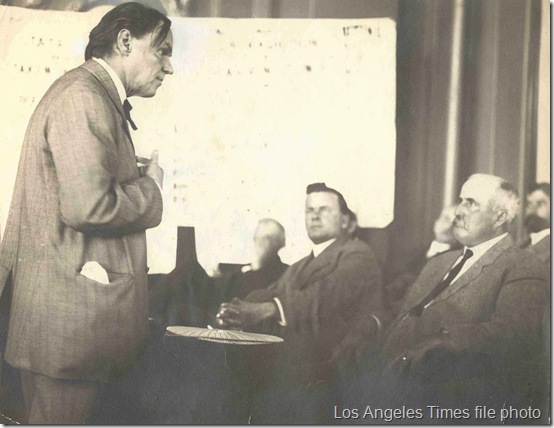 Los Angeles Times file photo Clarence Darrow addresses the jury during his 1912 trial in Los Angeles on charges of attempting to bribe jurors while defending the McNamara brothers in the 1910 bombing of The Times. [Update: This photo was published in The Times on Aug. 15, 1912. An earlier version of the post said the photo was taken in 1913, the date that was written on the back of the picture].
|
| Dear Daily Mirror readers: Posting will be light this week because I’m going through The Times archives at the Huntington Library to research a story for the centennial of the Oct. 1, 1910, bombing. I’ll continue posting mystery photos, but it’s unclear whether I’ll have time to do anything more. |
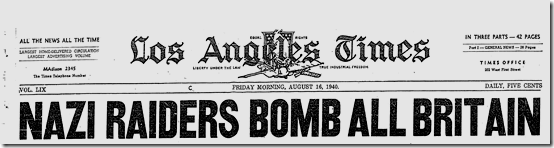
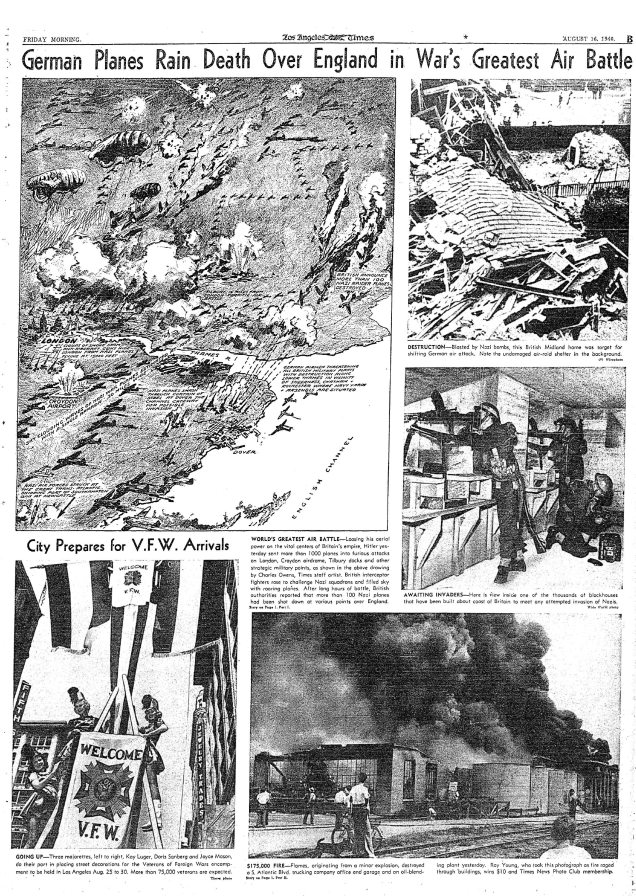 The Times publishes a war map by Charles Owens.
August 16, 1940: Joan Crawford is mulling the notion of a second adoption as companion for her recent first, Jimmie Fidler says.
Continue reading


