
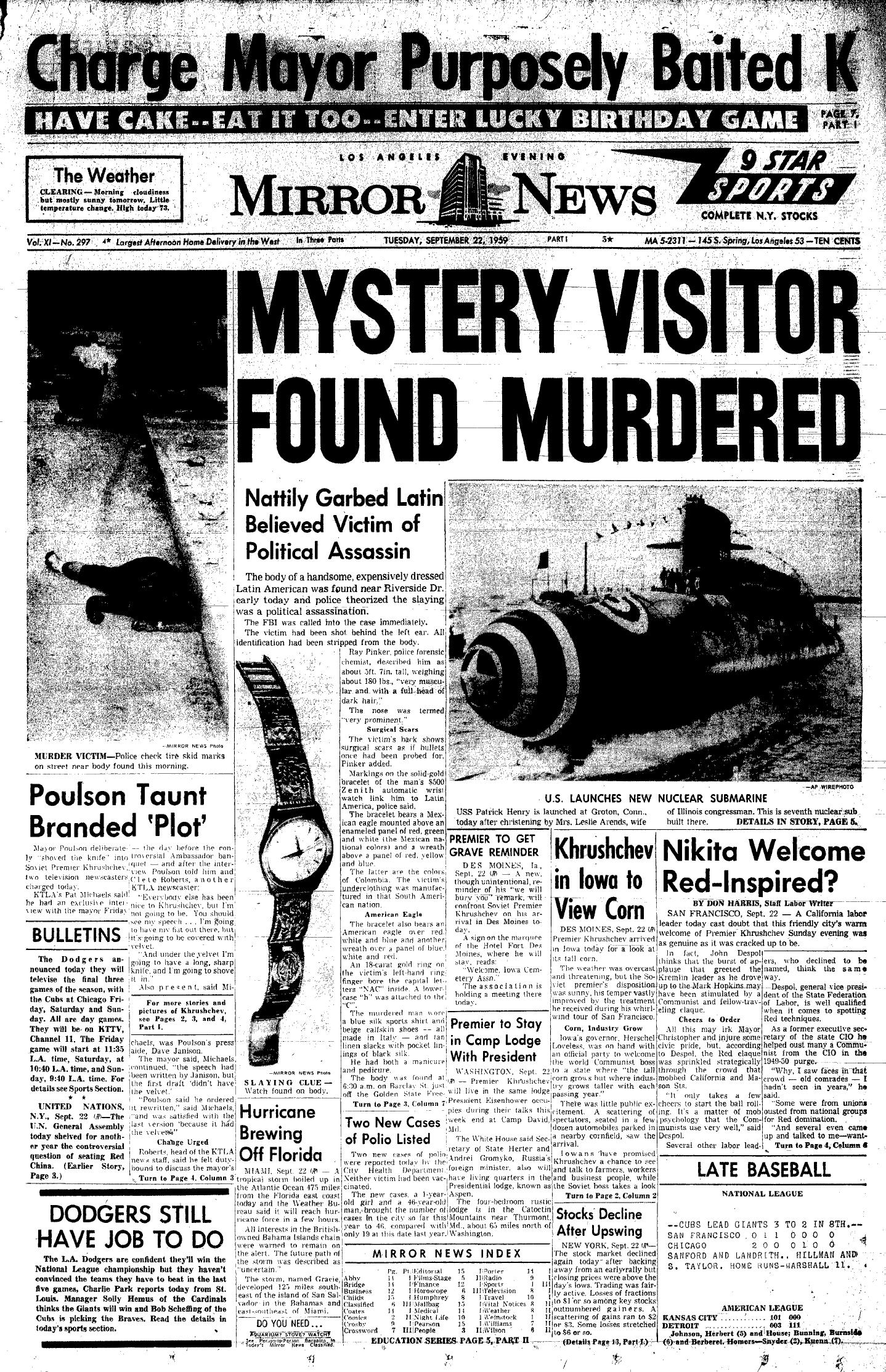
 September 22, 1959: Mayor Poulson deliberately “shoved the knife” into Soviet Premier Khrushchev, two television newscasters charged today.
Paul Coates takes a survey on what people think about the visit of Soviet Premier Nikita Khrushchev.
September 22, 1959: Mayor Poulson deliberately “shoved the knife” into Soviet Premier Khrushchev, two television newscasters charged today.
Paul Coates takes a survey on what people think about the visit of Soviet Premier Nikita Khrushchev.
Note: This is an encore post from 2005 and originally appeared on the 1947project.
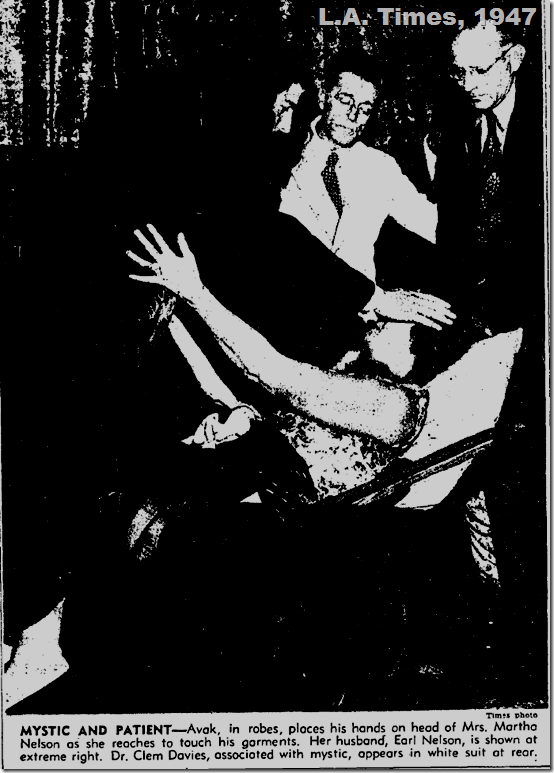
And then he was gone as if he had never been here at all. The hundreds of people who threw themselves at his feet to kiss the hem of his robes or simply to occupy the chair where he had been sitting were nothing but a memory.
He was Avak Hagopian, a somber 20-year-old from Kharadag in Azerbaijan, and working in Tehran as a mechanic—or a goldsmith—the stories vary. He paused one day as he was about to bring down a mallet and was struck with a vision, a vision that returned twice more. With faith in God, he would cure the sick, the blind and the diseased. The young man with the dark, intense eyes grew a beard and let his hair flow to his shoulders. He became “Avak the Healer” or “Avak the Great,” performer of miracles.
Continue reading
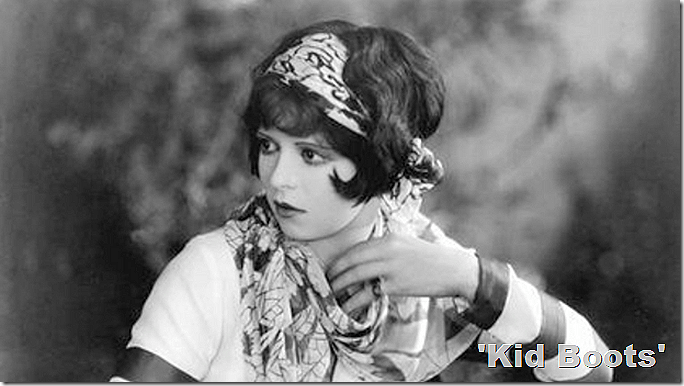
Clara Bow in Kid Boots (1926).
The Los Angeles Silent Film Festival achieved remarkable success for its debut the weekend of September 12-14, drawing large, young, and enthusiastic crowds eager for silent films. Organized as “a celebration devoted to the artistry, innovation, and enduring power of silent cinema,” the festival screened a combination of well known classics and recently restored films, offering a little something to please everyone. Produced in conjunction with the American Cinematheque and Mount St. Mary’s Department of Film, Media and Communication, organizers Thomas Barnes, founder of Retroformat Silent Films, Kelby Thwaits, Director of Graduate Programs in Film, Television, and New Media at Mount St. Mary’s, and filmmaker Brooke Dammkoehler, the LASFF revealed the power of silent films to still emotionally speak to us today.
Over the weekend, the Festival recognized two archivists for their contributions to the field. Renowned author and respected film historian Anthony Slide received the LASFF Award for Film Scholarship to recognize how his “research and writing have rescued films, artists, and stories from obscurity.” For more than 50 years, his erudite research, audio commentaries, essays, and writing of such books as Lois Weber: The director Who Lost Her Way in History and The Silent Feminists have educated cinemagoers and deepened their understanding of the workings of the silent film industry and its founding pioneers..
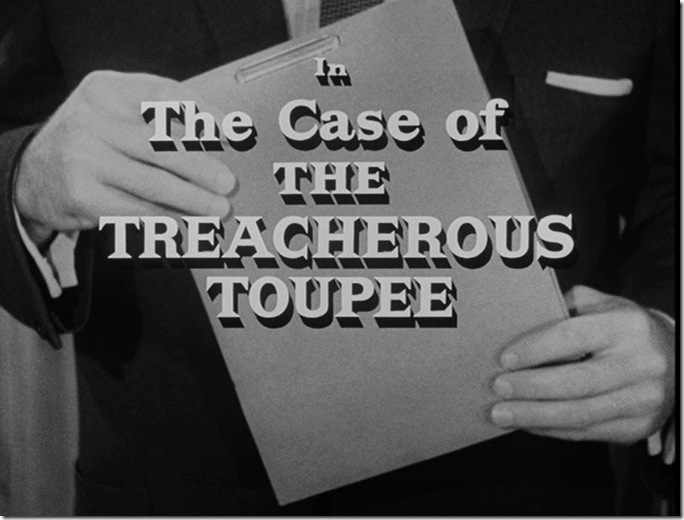
This week’s mystery movie was the 1960 episode The Case of the Treacherous Toupee, which opened the fourth season of Perry Mason.
With Raymond Burr, Barbara Hale, William Hopper, William Talman, Ray Collins, Peggy Converse, Philip Ober, Bert Freed, Cindy Robbins, Thomas B. Henry, Robert Redford, Nelson Olmsted, Dee Arlen, Jonathon Hole, Frank Wilcox, Lindsay Workman, Juney Ellis, Rita Duncan, Hal Smith, Len Henry, George E. Stone, Lee Miller and Patricia Marlowe.
Perry Mason is available on DVD from Critics’ Choice Video and is streaming on the web. Continue reading
Note: This is an encore post from 2006.
September 22, 1907
Los Angeles
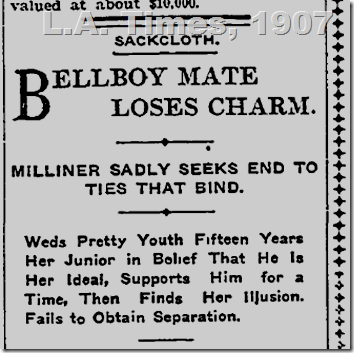
She was 34 and a successful businesswoman. He was a 19-year-old bellboy at the Hollenbeck Hotel.
Emma and George Lloyd were married and for a time were quite happy, with Emma running her milliner’s shop at 2132 Downey Ave., and George getting a job as a waiter in an Eastside restaurant.
| September 21, 1959: “After many months of research and collaboration, writers Harry Essex and Irving Shulman have finished a pre-sold novel based on [Roscoe “Fatty” Arbuckle’s] life and the sensational scandal that marred it. The title, ‘Fatty.’ ” (This book was evidently never published–lrh). |
| Sept. 21, 1959: Paul Coates writes about the damaging effects of Little Rock, Ark., closing its schools over integration. |

Note: This is an encore post from 2006.
September 21, 1907
Los Angeles
It is one thing to know in the abstract about racial intolerance at the turn of the 20th century and quite another to have to read it in the daily paper. I will spare you the long quotes in pidgin Chinese dialect, but trust me, they make the Charlie Chan movies look like models of multiculturalism.

Note: This is an encore post from 2005 and originally appeared on the 1947project.
Marie (The Body) McDonald, 23-year-old film actress, last night was married to Harry Karl, 33, shoe merchant, in a quiet civil ceremony at the home of Karl’s parents, Mr. and Mrs. Peter Karl, 829 N. Orlando St.
Superior Court Judge Edward R. Brand performed the ceremony, after which the wedding party attended a reception at the Mocambo restaurant on the Sunset Strip.
The couple will fly to New York for a three-week honeymoon, Karl said, and then return to live in Los Angeles.
Miss McDonald and Karl met at a Hollywood party 15 months ago. It was the second marriage for both. The actress divorced Vic Orsatti, theatrical agent, in Nevada five months ago. Karl was divorced from his first wife, Mrs. Ruth Karl, two years ago.
 Note: This is an encore post from 2006.
September 20, 1907
Los Angeles
For weeks, Colorado mining investor John Geisel, 57, had confided in his diary as he felt his mind and his life coming unraveled “Good God,” he wrote, “for the first time today I began to fear that I could not control my thoughts.”
Sept. 19, 1957
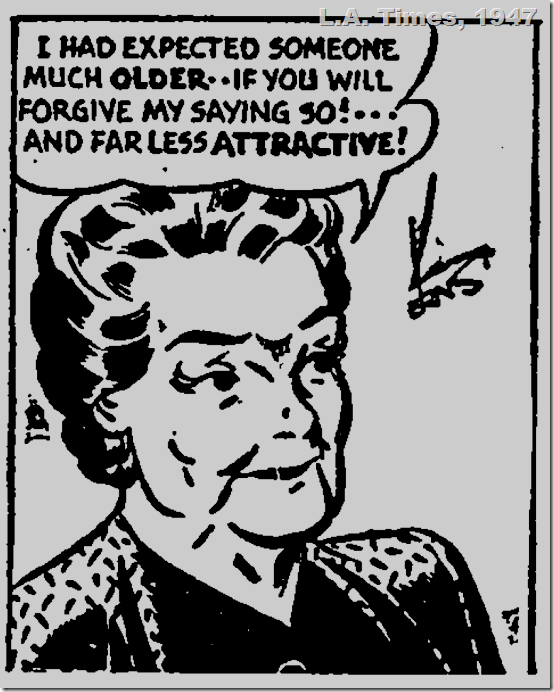
 Never underestimate the power of little old ladies.
I did, two days ago.
I accused a frail, grandmotherly type, born circa 1887, of pulling an amusing little con game to gain herself a free meal or a few bucks
pocket change.
She answered classified ads–I pointed out–representing herself as a wealthy, slightly eccentric old dame. Promising to buy $1,000 pieces of furniture or invest a fast ten grand in some business venture, she would then commence to wangle a free dinner invitation or “suddenly” discover she’d lost her change purse and “borrow” an easy five or ten
bucks from the unsuspecting advertiser.
In Tuesday’s column I mentioned a visit by Granny to the home of interior decorator Barney Feldman. Continue reading
Note: This is an encore post from 2005 and originally appeared on the 1947project.
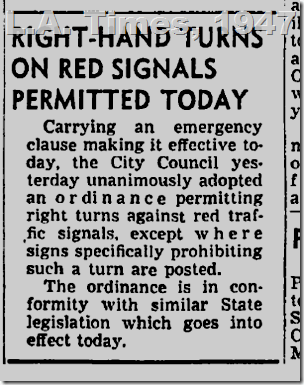 Adopted across the country and lampooned by Woody Allen, Los Angeles’ right turn on a red light was born in obscurity. Although the city used traffic semaphores (mechanical devices with metal arms reading “STOP” and “GO” that swung out of the signal—just like in the old cartoons and the opening of “Double Indemnity”) instead of lights, the right turn on red was in effect as early as 1939, when the City Council sought to ban them.
The state Legislature banned the right turn on red in 1945, but because cities were allowed to post exceptions, three survived: Mission Road at Macy Street and Sunset Boulevard at Castellar Street (now Hill Street), both downtown; and at Ventura and Lankershim Boulevards in the Valley.
Restored in 1947, the right turn on red remains the birthright of all L.A. motorists.
Bonus factoids: The city experimented with synchronized signals in 1922 to ease traffic. The length of a stop was cut from 45 seconds to 30.
“The traffic situation is Los Angeles’ single biggest problem,” The Times said — in 1924.
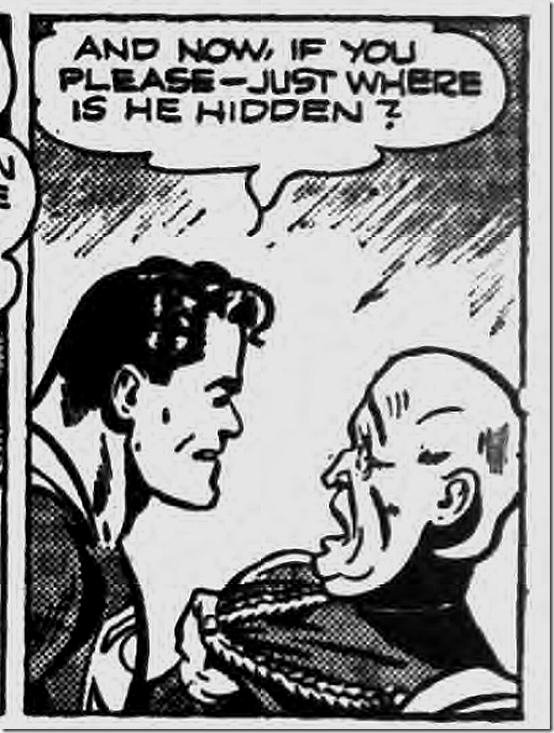
Sept. 19, 1944
Walter Winchell says: FDR’s desk has four new miniatures of his sons in uniform. The Copacabana’s new revue starring Joe E. Lewis is the talk of the town. Before Pearl Harbor there were 3,000 Jap organizations in the U.S. The G-men have whittled them down to two.
Danton Walker says: The Pentagon Building personnel is in a dither over Gen. Lear’s determination to move out all officers and swivel chair strategists under the age of 45 who can be used in more active service…. Washington is hopped up over the persistent rumor that the Russians will join us in the war on Japan as soon as the Nazis are pushed off Russian territory.
Louella Parsons says: The much-sought after Academy Award winner, Jennifer Jones, who has had all the studios bidding for her, makes her next movie for Hal Wallis. Yes, indeed, over the weekend David Selznick read the script by Ayn Rand, liked it, and told Hal that Jennifer was free to start any time. So apparently the trouble with 20th is all settled…. I was interested to hear that Ayn Rand, author of “Fountainhead,” had prepared the script. Wonder what happened to “Fountainhead” if it is to be filmed?
From the Philadelphia Inquirer via Fultonhistory.com.
Continue reading

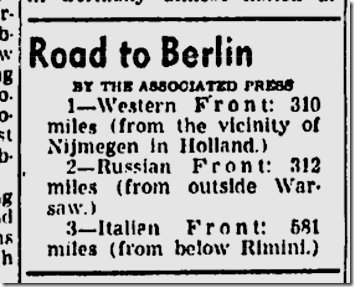
September 19, 1944
At a Town Hall luncheon at the Biltmore, RAF Wing Cmdr. Christopher Currant tells the audience that what we now know as the V-2 rocket is the greatest argument against isolationism.
“It can be dropped on New York without any difficulty. It is merely a matter of fuel,” he says.
Currant also says that the morale of German fliers is extremely low and added: “Both American and British fliers were disappointed when during the invasion of France they found no air resistance. We had expected the greatest air battle of all times.”
Times reporter and columnist Gene Sherman files a first-person report from Palau and describes fierce fighting against the Japanese.
“The waves lap at a naked Marine whose body was burned yesterday in a shell explosion. He lies with his arms upraised. Another Marine kneels with bowed head in prayer at an ammunition box.”
Opening today: “Kismet” at the Egyptian, Fox Ritz and Los Angeles theaters.

 Note: This is an encore post from 2006.
Sept. 19, 1907
Los Angeles
“Hidden somewhere in Los Angeles is a daredevil Spanish woman who should be standing with the Mexican revolutionaries when they are arraigned here in the United States Court,” The Times says.
“Letters recently confiscated show that she was the most daring and reckless anarchist of all the band. Her name is Maria Talivera. She is said to be a beautiful and attractive woman. Her friends and even her husband regarded her as a quiet housewife, intent on cooking frijoles. But in her fry pans she was seeing men fighting, hearing in the sizzle of the grease the clash of arms, the pound of horses’ feet and the din and commotion of a nation’s government overthrown.”
Note: This is an encore post from 2005 and originally appeared on the 1947project.
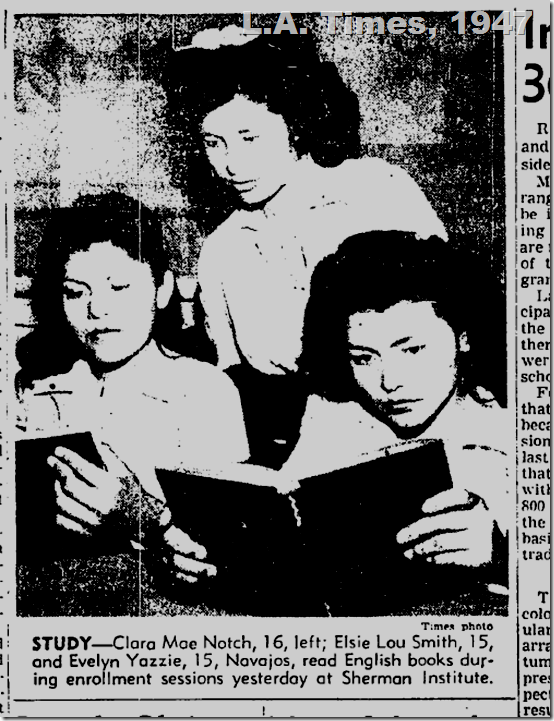
RIVERSIDE—A contingent of 369 Navajo Indian boys and girls from New Mexico and Arizona has arrived at Riverside’s famed Sherman Institute.
Many of the youngsters, who range in age from 10 to 18, will be introduced to formal schooling for the first time, but others are returning for the second year of the Navajo educational program.
Last year, emphasis was principally on trade schooling, but the younger Navajos, many of them unable to speak English, were brought here for basic schooling.
| Everyone seems to be trying to settle on what Mr. K. “should really see” when he gets to L.A. — ranging from beatnik joints to supermarkets to the interchange and freeway traffic, Matt Weinstock says. |
|
September 18, 1959: “The only trouble with a woman who ‘wants a man’ is that everybody knows it,” Dear Abby says.
|
| Paul Coates writes of Richard Swanson’s death: “At SC, for example, there are 32 fraternities. I’m told, on excellent authority, that at least 90% make hazing an annual practice. There’s a university regulation forbidding it. Now, there’s even a state law against it. Yet the students make no secret of their ceremonies. I’m not so naive as to believe that the school administrators didn’t know what was going on. They did know. But, in spite of a growing list of pointless deaths which result from the practice, they did nothing to stop it.” |

September 18, 1944
After spending Labor Day in Pawling, Republican nominee Thomas E. Dewey drove to New York for conferences with John Foster Dulles, his adviser on foreign affairs, and Herbert Brownell, Republican National Committee chairman. The next day, on an 11-car special train, accompanied by 65 reporters, he started on his 6,700-mile campaign trip to the Pacific coast. In Philadelphia, he delivered his opening campaign speech.
Ever wonder what would happen of Salvador Dali was a commercial artist?
Life features Ed Wynn’s whimsical “inventions.”
And after the war, get ready for television.
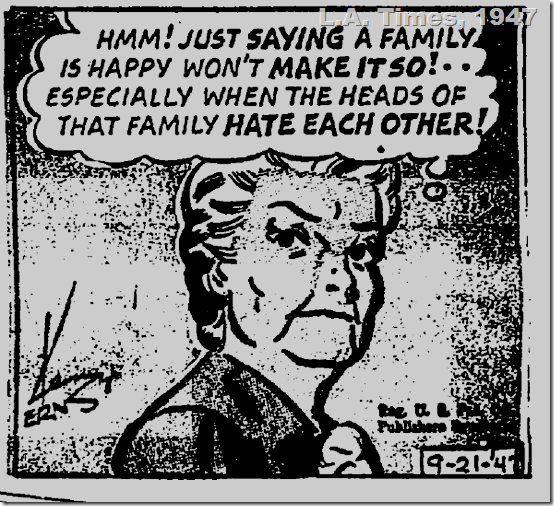
 ladailymirror.com