The Christine Collins letters
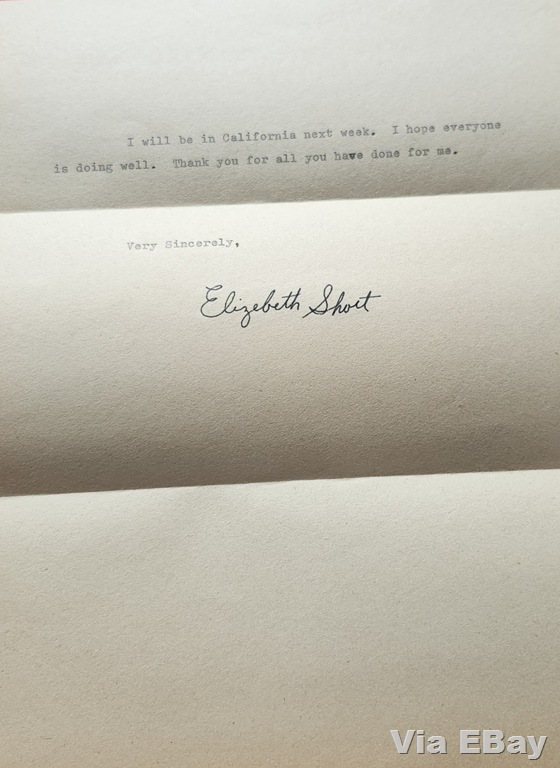
The woman whose tragedy inspired the Clint Eastwood movie “Changeling” tells her story in her own words.

From the California State Archives Continue reading

From the California State Archives Continue reading

Note: This is an encore post from 2007.
January 4, 1907
Los Angeles
Mayor-elect Arthur C. Harper stood before 200 members of the Municipal League and their friends in a dinner at Levy’s who were eager to hear what he planned for his incoming administration.
Today the focus is on that thriving city north of South Pasadena. The bands will play, the crowds will roar, the traffic will snarl.
But in all the gigantic gymkhana there will be no mention of those unsung heroines, the nameless little old ladies of Pasadena who have also done so much to bring fame to their city. So let us pay tribute.
Historically they don’t rate much, but sociologically they have had a great impact on civilization.
THEIR ORIGIN is blurred, but legend has it that around 1934 an ad appeared somewhere stating, “For Sale–1924 Marmon. Like new, Used only to drive to church on Sunday by retired old lady in Pasadena.” Continue reading
In this business, all years go by fast. But ’58, somehow, seemed to be out to break records.
It just doesn’t seem like a year ago this week that I sat down with Tim Moore, TV’s fabulous Kingfish, after his famous shotgun feud with his in-laws.
He told me then: “A man who’s got three score and 10 years behind him ought to retire, and that’s what I’m going to do.
“I’m going to go home to Rock Island,” the veteran showman said. “I’m going to sit down on the porch. And I’m going to loaf.
“And,” he added, “I’m going to do it slowly.”
But Kingfish never quite made it home. He died in General Hospital just before Christmas. Continue reading
Note: This is a post I wrote in 2006 for the 1947project.
Also notice that because newsprint was scarce, the Los Angeles Times didn’t publish the classified ads so it could provide adequate space for stories – I cannot imagine any American newspaper doing that today.
Deer Fokes:
All us 100% red blooded Americans done our customary number of stooped things in 1946 an no doubt will do ‘em all over again come 1947.
Likewise we done some good things. Fo’ instance Mistah Capp done tole me how, visitin’ Army horse-pittles, he seen us doin’ a good job for our handy-capped boys whose laigs an eyes an innards we had to use up during the late, lamented (espeshly by our enemies) war.

It is an era of compulsions. Apparently everyone has had them all along but now it’s considered not only proper but fashionable to express them, no matter in what murky paths they lead.
Publicist Doris Hellman, for instance, cannot abide the sight of a market cart separated from its flock. When she sees one standing lonely and downcast on a lawn or sidewalk, sometimes several blocks from its home, she stops her car, identifies it, and phones its location to the market. She cannot understand how shoppers can be so inconsiderate as to leave them stranded.
At first she was caring for only one market’s homeless carts. The compulsion grew and now she keeps on the lookout for the grocery chariots belonging to five stores in her neighborhood. Continue reading
(News item) CHICAGO, Dec. 30 — Wilbur Geoffrey Gaffney, associate professor of English from the University of Nebraska, today revealed the results of a 10-year study on the significance of names.
His conclusions: You are what your name has made you. Your career is determined by your character and your character is determined, perhaps unalterably, by the name under which you grew to adulthood . . .
Now some of you think the professor is a bit of a kook to make that claim. I don’t. For a long time I’ve had the feeling that a person’s given name is a clear indication of his personality and his occupational possibilities.

Note: This is an encore post from January 2020.
Since TCM is featuring Mary Astor, here’s a brief post on her lost movie “New Year’s Eve.” (A tip of the hat to Lou Lumenick, who tweeted about the movie on — New Year’s Eve.) I also uploaded a version of this post to IMDB, in case you see it there.
Fox originally announced the film under the title “Strong Arm,” based on the story “$100” by Richard Connell, published in the August 1928 issue of Cosmopolitan Magazine. The film was supposed to star Lois Moran and George O’Brien in the leads, under the direction of J.G. Blystone. Fox initially planned the movie as a talkie, but released it as “New Year’s Eve,” a silent directed by Henry Lehrman with sound effects and music, designated “sound on film.” Continue reading

Note: This is an encore post from 2013.
Just in time for New Year’s, we’ll take a look at a “lost drink,” making a brief inquiry into San Francisco’s Pisco Punch, made famous by Bank Exchange saloon owner Duncan Nicol (often spelled Nichol or Nicoll), who died in 1926 without revealing the recipe.

Note: This is an encore post from 2006.
December 31, 1907
Los Angeles
His name was W.H. Reynolds and the old watchman for E.H. Howard Contracting had laid out all night after being beaten up and thrown in the weeds by two robbers who said they were garbage men looking for the closest dump.
A woman who saw the assault contacted the University Station and police searched all night in the area around Alameda Street and Washington Boulevard, where Reynolds lived in a small, ragged tent. It wasn’t until daylight that two patrolmen found him lying face down and he was taken to the Receiving Hospital.
Continue reading
Again this year there’s an unmistakable though unorganized trend toward calling everything off between Christmas and New Year’s Day and letting the week drift itself out, which it does anyway.
Nobody feels up to anything, especially answering the phone or paying attention to the stern, year’s end admonitions by savants and politicians.
They’re recovering from the Dec. 25 overindulgence and bracing themselves for the Jan. 1 bacchanalian revel.
Actually all they’re interested in, besides having a little fun, is getting through the week alive or at least not spending a night in the drunk tank. Everyone is frightened by the traffic statistics. Continue reading

Note: This is an encore post from 2017.
Joe Vogel asks if there was a Queens Cocktail. The answer is yes.
According to the Jamaica Long Island Daily Press, Jan. 24, 1935, the Queens Cocktail debuted at the Hotel Commodore in a toast to President Roosevelt. Via Fultonhistory.com.
(No word yet on the Staten Island Cocktail — and boy that sounds like a straight line).
Feeling good all over, today. In this age of neurotic juveniles and delinquent parents, I, at least, have met my responsibility as a father.
Maybe you don’t know “Where Are Your Children, Tonight,” but I know where mine were, last night.
They were with me, getting a firm foundation in their religious training.
While other youngsters were out carousing in poolrooms, dancing in dance halls and lounging in front of pizza parlors whistling at girls, mine were in the balcony of Fox Wilshire Theater.
I took them there to see “Solomon and Sheba,” a wall-to-wall, silver-screen, religious epic about two nice kids in love. In living color. Continue reading


December 30, 1941: It seems that local women didn’t get the memo about the being the “Greatest Generation.” They’re a bunch of slackers in the war against the Axis and don’t want to work as air-raid wardens.
“Los Angeles women have been challenged and they are not meeting the challenge,” says Mrs. John Stearns Thayer, head of the California Federation of Women’s Clubs.
“Even in the small towns of the San Joaquin Valley I found registration for all services 100%. Los Angeles women are lagging with an indifference and a selfishness that is most disturbing. They are asking other women to work overtime to protect them — and that is terribly unfair.”
It seems that women lose interest once they discover that there’s no uniform (gasp!) and there’s no pay (ahem).
“They Died With Their Boots On” starts tomorrow at the Warners Hollywood and Downtown. (Added feature, “Rhapsody in Rivets.”)
Tom Treanor writes that wartime sacrifices will be good for Americans, who have gotten soft and lazy. “More walking won’t do many people harm. For the long haul, there are streetcars and buses? Remember them?”
Jimmie Fidler says: Mary Astor, who turned over her husband (Manuel del Campo) to the Canadian R.A.F. months ago, has now turned over her private plan to Uncle Sam.

Note: This is an encore post from 2006.
December 30, 1907
Los Angeles
James Sullivan, 64, was a prisoner of the Confederates held at Belle Isle, Libby and Andersonville, where he and war correspondent Albert D. Richardson escaped by tunneling for three months with a spoon.
Henry Russell, formerly of the 4th Cavalry, was held at Andersonville and Benjamin L. Gorsuch of the 1st Maryland Infantry was captured and sent to Belle Isle. James Sherwood was with the 10th New Jersey. John Ryan, 77, was with 7th New York Heavy Artillery.

Note: This is an encore post from 2013.
December 20, 1934: In case you doubted me (but you wouldn’t, would you?), here’s a recipe for the Bronx Cocktail, from the Amsterdam Evening Recorder, courtesy of FultonHistory.com.
In case you plan to mix one up, a Bronx Cocktail is one part Italian vermouth, three parts brandy and a dash of orange bitters. Shake well!
Notice that there are also three variations of the Manhattan.

Dec. 3, 1957-April 26, 1958
Sycamore, Ill

Note: This is an encore post from 2007. Jack McCullough was convicted in 2012 of killing Maria Ridolph. He was released from prison in 2016 and charges were dropped.
Maria E. Ridulph* was a 7-year-old girl from Sycamore, Ill., who was kidnapped Dec. 3, 1957, and whose decomposed body was found April 26, 1958, near Woodbine, a tiny, unincorporated settlement in rural Jo Daviess County, about 98 miles northwest of her home.
Many details of the case are murky because the only witness was 8-year-old Cathie Sigman, who was playing with Maria in the frontyard of a neighbor’s home at the time of the abduction and gave different versions of the incident as the investigation unfolded. Like Maria, Cathie lived on Archie Place, five houses west of the Ridulph home on the south side of the street.
Maria was the youngest of four children born to Michael and Frances Ridulph, who lived in a white frame house with blue shutters at 616 Archie Place ** in Sycamore, a rural town of 7,000 people 68 miles west of Chicago. The Ridulphs had two older daughters, Patricia 16, and Kay, 15, and a son, Charles, 11. Although many people lived or worked on farms, Michael had a job at one of the few factories in town. Continue reading

Photo: “The Sleuths at the Floral Parade.” Credit: Mary Mallory, the Collections of the Margaret Herrick Library.
Note: This is an encore post from 2011.
The Tournament of Roses Parade is going on its 122th year, and grows more elaborate and beautiful every year. Bands, floats, cars, horses, and even celebrities take part in this festive annual event. This year, Paramount Pictures is even entering a float celebrating its 100th anniversary, honoring “Titanic” and “Wings,” the first feature film awarded the Best Picture Oscar by the Academy of Motion Picture Arts and Sciences in 1927/1928.

By the end of 1938, Weldon sensed that he was a marked man and that death was not far off. He could have stayed out of Los Angeles and maybe he would have lived–at least for a while. But he evidently decided to face whoever it was that killed him in what The Times called the “perfect murder case” — a case that was never solved.
Earlier that year, Weldon divided his extensive Los Angeles gambling operations with his four partners and used his share of the money to invest in Inland Empire real estate and buy the Morongo Valley Lodge near Palm Springs.
The IRS soon brought a tax lien on his earnings for 1936 and by that summer, he resumed bookmaking operations. On Aug. 10, 1938, he and three other men were arrested at 7404 Santa Monica Blvd. Under extensive questioning by the district attorney’s office, Weldon freely discussed illicit gambling in Southern California, The Times said. Continue reading

This week’s mystery movie was the 1957 Warner Bros. film Top Secret Affair, with Susan Hayward, Kirk Douglas, Paul Stewart, Jim Backus, John Cromwell, Roland Winters, A.E. Gould-Porter, Michael Fox, Frank Gerstle and Charles Lane. Continue reading