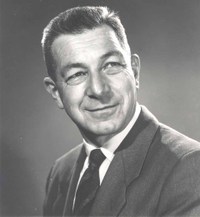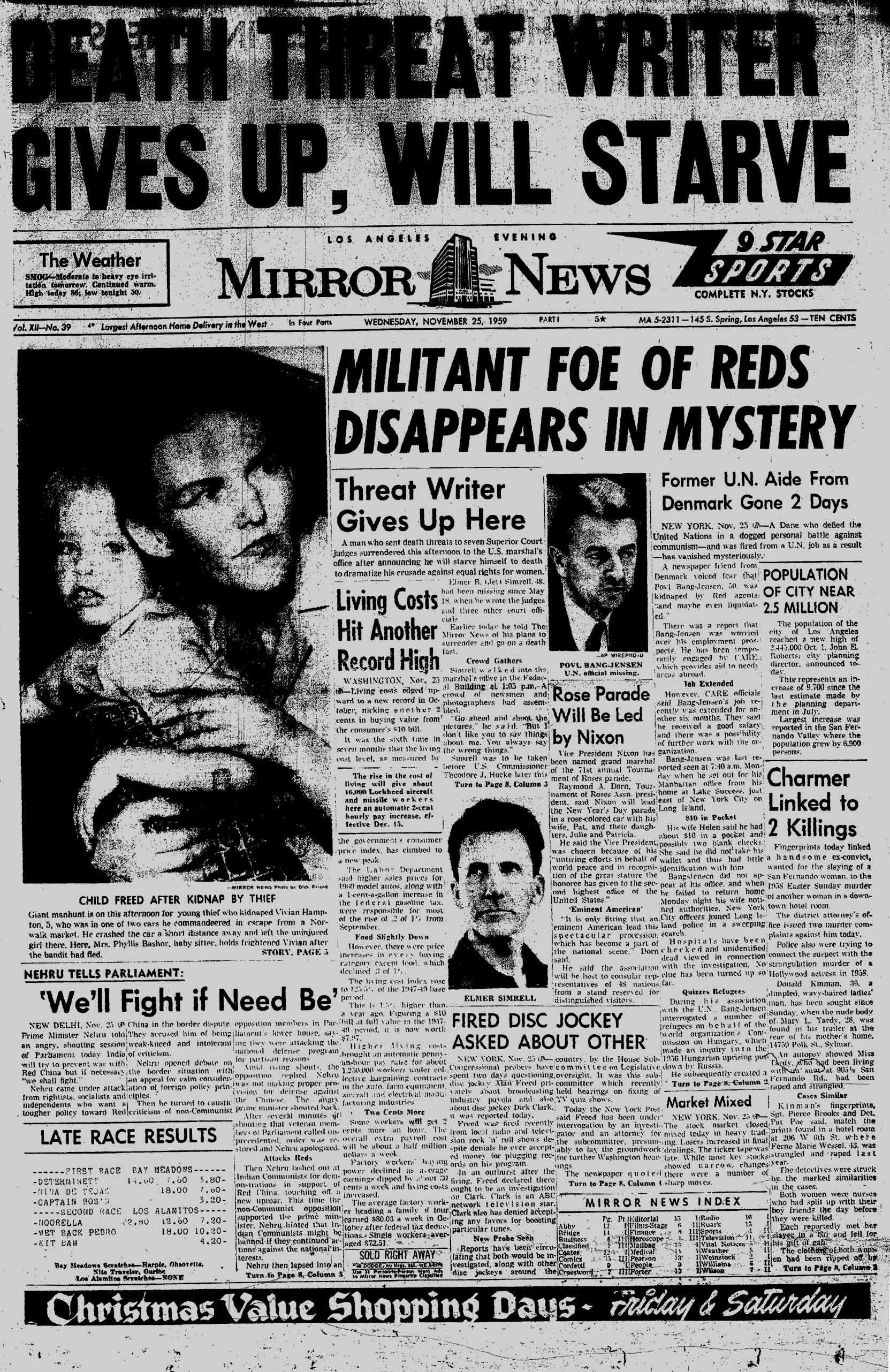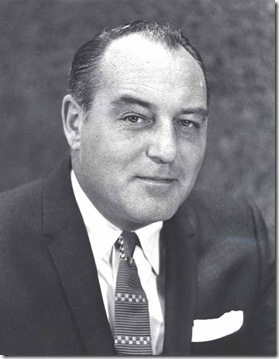
This is the Ask Me Anything on George Hodel and Steve Hodel for November 2025. In this session, I discussed Steve Hodel and the genesis of the first Black Dahlia Avenger book in 2003.
I also discussed: Continue reading
This is the Ask Me Anything on George Hodel and Steve Hodel for November 2025. In this session, I discussed Steve Hodel and the genesis of the first Black Dahlia Avenger book in 2003.
I also discussed: Continue reading

November 18, 1941: Jimmie Fidler says that new Alan (Paramount white hope) Ladd and Sally Wadsworth romance won’t please his studio, which is readying a “wolf” buildup.
Young schoolchildren who are found after tests to be retarded are placed in a Point 1 group, as it is called, and given special tasks to perform.
A little boy in such a group in a suburban school was instructed as part of his therapy to plant radish seeds in the school garden. Soon he harvested a large, healthy crop. As he proudly took his radishes into class the teacher discreetly asked why he had planted them in a circle instead of rows.
“That’s the way you get them in the market,” the boy explained innocently.
A commercial vegetable grower heard of the incident and now grows his radishes in circles. The idea, he realized immediately, is a boon to stoop labor required for the job. Continue reading

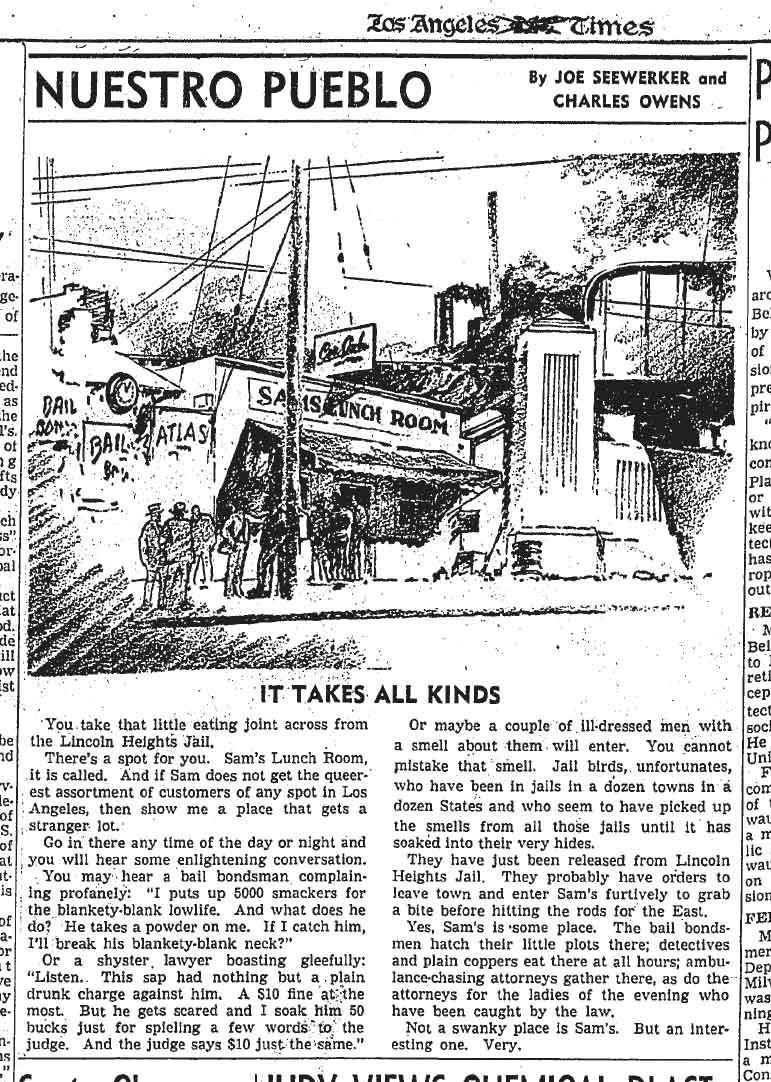
Jerry Baker, the promising young coffee-house poet, appeared in my office yesterday afternoon, shortly after being released from Lincoln Heights jail.
He sat down, gazed fondly at an open pack of cigarettes on my desk, and informed me, “You smoke my brand.”
I offered him one. He took it, thanking me.
“I’m here,” he said, “because I’m told you’re a fair man. You have a good reputation. You come very highly recommended.”
Borrowing a match, he lit his cigarette.
“In fact,” he continued, “not one, but two of my cellmates recommended you as the man to see.” Continue reading

1:05: Jets take a 32-29 lead on a 26-yard field goal by Jim Turner. Raiders’ Charlie Smith returns kickoff to Raider 22-yard line.
:50: Raider quarterback Daryle Lamonica hits Charlie Smith on a 20-yard screen play. With a 15-yard facemask penalty tacked on, the ball moves to the Jet 43.
NBC Cuts Away to Heidi
:42: Lamonica to Smith on a 43- yard TD pass. Oakland leads, 36-32.
Continue reading
Note: This is an encore post from 2005 and originally appeared on the 1947project.
This dental accessory, imported from England, surfaced in Los Angeles in November 1947 and by January 1948 had altered its slogan slightly to “Wine-Colored Toothpaste,” in ads featuring “local model Betty Reid” and offices at 8572 Hollywood Blvd. It apparently vanished from Los Angeles drugstores in 1954, but continued to be sold in the United Kingdom with offices based at 225 Bath Road, Slough SL1 4AU. A Google search reveals that it remains elusive but in demand in 2005. A user writes “the effect is not at all Dracula-like.”
Quote of the day: “A child born now can expect to live to be 100 if he’s given proper care in infancy and youth, and if he avails himself of present medical knowledge through his adult years.”
Dr. Edward L. Bortz, president of the American Medical Association.
November 17, 1941: Reporter Mary Shaw Leader is honored posthumously for her work in covering Abraham Lincoln’s Gettysburg Address. Leader, a reporter for the Hanover Spectator, walked 15 miles to Gettysburg, Pa., to cover the Lincoln’s talk.
“She carried his full three-minute text in the weekly Hanover newspaper while most journalists gave their space to principal speaker Edward Everett’s flowery oration of nearly two hours or merely announced that Lincoln also spoke.”
Times reporter Cecile Hallingby writes a first-person account of a weekend at Camp San Luis Obispo as one of 80 “U.S.O. Dates for Defense.”
“The big dance at the camp Saturday night, at which the ratio of solders to girls was about 10 to 1, was definitely voted the outstanding event of the weekend.”
Jimmie Fidler says: RKO’s “Mexican Spitfire at Sea” at a glance — Marion Martin: “This is my third ‘comeback.’ I’ve gone up and down in this business so often I’m developing a bounce.”

This week’s unsuitable mystery movie was the 1963 British film The World Ten Times Over (released in the U.S. in 1966 as Pussycat Alley), with Sylvia Syms, Edward Judd, June Ritchie, William Hartnell, Sarah Lawson, Francis De Wolfe and Davy Kaye. Continue reading

Note: This is an encore post from 2006.
November 17, 1907
New York by direct wire to The Times
Something curious seems to be going on with opera tenors in the monkey house at New York’s Central Park; perhaps there’s an atmosphere that lends itself to “annoying” people, for the problem of mashers at the monkey house has even inspired a 1907 movie by Biograph.
Luckily, Detective J.J. Cain is on the lookout for malefactors who make lewd advances, having arrested Enrico Caruso the year before.

After a business failure several years ago a young man decided to pursue the career he’d always wanted — teaching. He was aware that it meant a drastic change and involved great sacrifice but he and his wife decided it was worth it.
He went back to school, and, meanwhile, got a part-time job. His wife also worked. To keep the house running smoothly, the three young children were assigned regular duties and responsibilities. After dinner, for instance, they quietly took their own dishes into the kitchen to be washed.
Recently after a long, hard struggle the husband got his credential and his teaching assignment and he and his wife decided to celebrate by dining in a good restaurant, something they’d denied themselves for several years. Continue reading

Erle Stanley Gardner, you either like or dislike.
He’s easy to categorize.
If you don’t like him, he’s a troublemaker, a rebel who gets his kicks by destroying the public’s illusions concerning the integrity and intelligence of our district attorneys and police.
As author of more than 100 Perry Mason mystery novels, he’s continually belittling these public servants. His man Mason always shows them up.
As a private citizen, Gardner founded the now-famous Court of Last Resort, which, in freeing dozens of innocent men from prison, has proved in fact that our system of justice isn’t infallible. Continue reading
Above: Barbara Graham, one of four women to be executed in California, along with Juanita “the Duchess” Spinelli, Louise Peete and Elizabeth Duncan. |
||||||||
|

Note: This is an encore post from 2006.
November 16, 1907
Los Angeles
Mrs. Amanda Cook (she is also identified as Jennie and Mary) came to Los Angeles from Boston in 1906 with two of her children in search of her husband, Frederick, a union plasterer and bricklayer. She advertised in the newspapers without success and finally took a job as a cook at the Juvenile Detention Home.
Persuaded by her cousin to seek a divorce, she hired attorney George W. MacKnight, who sought out her errant husband and began divorce proceedings.

Note: This post has been getting a lot of traffic recently and I couldn’t figure out why. The answer: A biking blog linked to the post a few days ago because Pat Hines, one of the victim’s friends, has been in the news. I originally wrote the blog post about the Nov. 15, 1981, incident in 2005 for the 1947project.
Sue was 29, tall, blond and athletic with dimples every time she smiled—her big, clunky glasses the only thing that might betray a degree in quantum mechanics—when she left her husband in Austin, Texas, and a job writing for scientific journals, found an apartment right below the Hollywood sign and began turning out screenplays. She had just finished “Death in New Venice,” about a female detective.
Early one morning shortly before Thanksgiving, while it was still dark, she parked her Mercedes at Gladstone’s, 17300 Pacific Coast Highway, the usual gathering spot for the Santa Monica Swim Club, which was planning a bike ride up the coast to Point Mugu.
Some swim club members avoided this newcomer, who had arrived in Los Angeles two months before, because she seemed unsophisticated and took risks that weren’t appropriate for life in a huge city. “Her eyesight wasn’t that great, she’d never lived by the water and here she was swimming before sunrise in the cold ocean,” said Richard Marks, one of her friends.

![]()
November 3-16, 1943: It’s almost impossible to get a clear idea from these stories of what was actually occurring at the internment camp at Tule Lake. Early in the saga, one official said “there’s nothing to it,” but later on there are accounts of a riot that may have been staged “on direct orders from Tokyo” and allegations that Japanese at the camp “buried thousands of pounds of fresh pork and used tractors to play polo.” No, really!
In editorials , and in news accounts by Kyle Palmer, The Times had encouraged the evacuation and internment of Japanese in the strongest language. One editorial included below alleges that Dillion S. Myer, head of the War Relocation Authority, was a squishy soft liberal New Dealer (another bete noire of The Times) who refused to take a hard line with “disloyal” Japanese and says that the camps should be put under Army control.
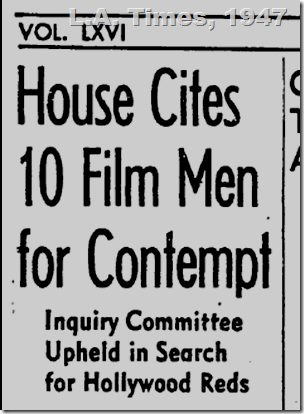
The Dies committee, named for Rep Martin Dies Jr. (D-Texas), referred to in some stories will become better known as the House Un-American Activities Committee. You may have heard of it. If you haven’t, you certainly will.
Opening soon: “Lassie Come Home” and “Young Ideas” at Grauman’s Chinese, Loew’s State, Fox Uptown and Cathay Circle.
November 15, 1909: Dr. Alice Bush of Oakland sues for divorce, charging that her husband, R.K. Morgan, failed to disclose something rather important.
The lynchings in Cairo, Ill., are endorsed from the pulpit and in the press. Saying that lawlessness was common in the area where a woman was killed, the Rev. George M. Babcock of Church of the Redeemer, Episcopalian, says: “This defiance of law and order made the lynchings necessary to secure justice.” F.A. Thielecke, editor of the Cairo Bulletin, says: “Cairo’s disgrace is not the mob, but the conditions that made the mob necessary.” Continue reading

Note: This is an encore post from 2006.
November 15, 1907
Los Angeles
Architect Charles Mulford Robinson has drafted a proposal for downtown Los Angeles that is stunning in its ambition. One portion calls for broad boulevard leading from a proposed Union Station at Central and 5th Street toward Grand, ending at a new public library and art gallery. The other, equally elaborate, calls for a grouping of civic buildings and terraced gardens around North Spring Street, including a new City Hall.
“First of all, and most important in his mind because Los Angeles is a leading tourist center and should strive to make a good impression at the very start, the architect suggests an immense union railroad station with an approach a mile long—a wide thoroughfare lined with beautiful buildings, with spacious parkways, rows of flowering trees and ornamental lamp posts, and with driveways for all classes of traffic,” The Times says.

November 14, 1909: The problem with identifying the man gamboling about the top of Angel Flight* without clothing is that none of the women who complain to police have taken a good look at him.
And Eddie Foy offers advice to aspiring actors: “When you next visit a theater, note how few real actors there are in the company. With some, every word spoken is distinct, every action suits the word and the audience clearly understands, not only what the actor is doing and saying, but why he is doing and saying it. On the other hand, note the indistinctness and the mealy-mouthedness of the majority.” Continue reading