For Tuesday, we have another mystery woman from the Library of Congress. Anybody recognize her?

For Tuesday, we have another mystery woman from the Library of Congress. Anybody recognize her?

Note: This is an encore post from 2005 and originally appeared on the 1947project.
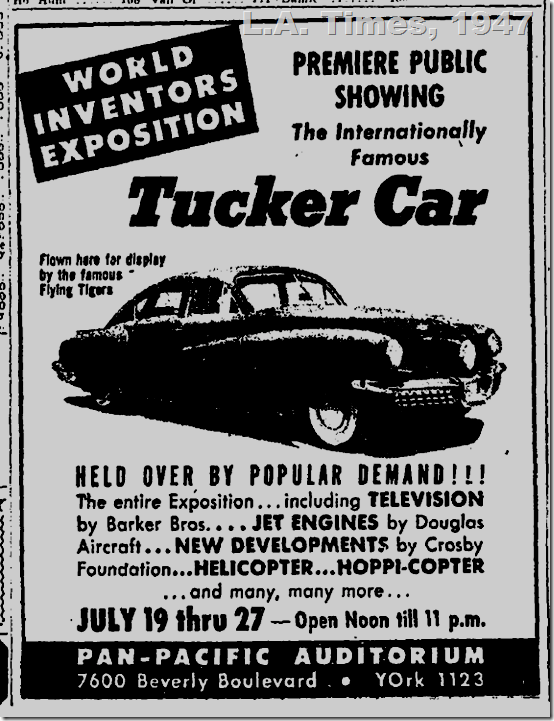
Those curious metal arrays being installed with great ceremony on the city’s rooftops are antennas, for this is the year of the one-eyed wonder: Television.
In 1947, merely watching TV was newsworthy, as when the convalescing Babe Ruth tuned in for a double-header between the Giants and the Dodgers, and Pius XII made history as the first pope to have a television.

Photo: Hugh Herbert, honorary mayor of Studio City, courtesy of Mary Mallory.
Note: This is an encore post from 2012.
Tomorrow is election day. Elections and politics are important to everyone, be they Joe Citizen or Joseph Kennedy. Over the years, celebrities have entered the political arena, some to support candidates, some to raise their fading glory, and others because they truly hoped to provide public service. In the 1930s and 1940s, many Hollywood stars served as honorary mayors in their communities, bringing recognition to their local neighborhoods and advocating for public services, roads and parks to better people’s lives.

Eve Golden sends along this picture to see if anybody in the Brain Trust can help the Library of Congress identify our mystery woman.

Note: This is an encore post from 2006.
June 4, 1907
Los Angeles
After months of inquiries that involved undercover investigators posing as patients, the State Board of Medical Examiners has taken action against Chinese herbalists in Los Angeles. In addition to arresting the doctors in question, authorities charged everyone involved as investors in the companies, issuing warrants for some of the most prominent members of the Chinese community.
“It is alleged that in one case a patient who was charged high prices for Chinese treatment received a bottle that contained simply the juice boiled from alfalfa,” The Times said. “It was contained in a fancy bottle that looked as if anything it held might be good for what was the matter with almost anybody. It was a fine piece of glass with Chinese hieroglyphics up and down the sides and there was an odor about the fluid different from … anything else sold in a pharmacy or doled out by the ordinary physician.”
Note: This is an encore post from 2005 that originally appeared on the 1947project.
It was a tough problem for the armed services. In March, an Air Forces lieutenant at Tachikawa Air Base and “a beautiful Japanese girl” killed themselves in a former geisha house at Hinomachi, and the week before, another couple committed suicide at a Shinto shrine because they were going to be separated.
Also in June, a former soldier who renounced his U.S. citizenship to marry a Japanese woman was sentenced to six months in prison for illegally buying merchandise using his American ration card.
Note: This is an encore post from 2006.
June 3, 1907
Los Angeles
It was to be one of the grandest society weddings of the season: An orchestra was hired, a caterer had been selected after lengthy interviews, gowns for the bride and bridesmaids had been sewn and the Hotel Lankershim had been hired for the occasion.
In preparation for the grand event, Dr. Harris C. Garcelon and his fiancee, Genevieve Smith, attended the wedding rehearsal at Christ Episcopal Church performed by the Rev. Baker P. Lee.

Note: This is an encore post from 2005 and originally appeared on the 1947project.
The Erwin Walker case is the crossroads of several important stories. The victim was Loren Roosevelt, fired in the 1930s as Arcadia’s police chief in an ugly political fight that included an attempt to recall the mayor and allegations of bookie joints near Santa Anita.
The detectives included two famous names from the Black Dahlia case: Capt. Jack Donahoe, head of homicide, and Detective Marty Wynn, who became friends with actor Jack Webb while serving as a technical advisor on “He Walked by Night,” a 1948 film based on the Roosevelt murder.

Note: This is an encore post from 2006.
June 2, 1907
Los Angeles
The Hamburger Department Store announces plans for a theater just south of its new building on South Broadway at 8th Street, designed by the architecture firm of Edelman and Barnett.
According to plans, the horseshoe-shaped theater is to seat 1,600 people, with a balcony and a gallery. The stage is to be 40 feet by 80 feet, with a proscenium 36 feet wide and 32 feet high.

Was “Godzilla” inspired by a 1947 radio hoax?

Note: This is an encore post from 2006.
June 1, 1907
Los Angeles
Voir dire, in which lawyers question prospective jurors, is a rough and tumble affair, especially when the case involves prostitution.
The matter at hand involves Tom Savage, boss of the 8th Ward, known as the “Bloody Eighth,” on charges of running a disorderly house, the Arlington Hotel, in the Tenderloin.

Note: This is an encore post from 2005 and originally appeared on the 1947project.
Memorial Day, 1947, was a spectacle marked with a parade from Westwood to the veterans cemetery, services for Spanish-American veterans in Pershing Square and even a tribute at Hollywood Memorial Park to 21 Times employees killed in the 1910 bombing, as well as those who died in World War II (Tommy Treanor, RIP).
The largest gathering was at the Coliseum, where the multitudes sang “The Star-Spangled Banner,” recited the Pledge of Allegiance and listened to Ronald Reagan read the Gettysburg Address.

Note: This is an encore post from 2005 that originally appeared on the 1947project.
You can’t help but notice in going through old newspapers that suicides and divorces (especially in the days before no-fault divorces) were treated as daily “brites,” brief stories to break up other news. Papers finally stopped covering suicides in the belief that they merely encouraged people to kill themselves and suicide stories are quite rare today unless a well-known individual is involved (like the recent death of pianist Linda Martinez). They certainly wove a grim thread into the fabric of the daily paper.

May 29, 1947: The Daughters of the American Revolution, holding its annual convention in Washington, affirms its ban on African American performers at Constitution Hall.
A story by the Associated Negro Press notes that Eleanor Roosevelt resigned from the DAR over its refusal to allow Marian Anderson to perform at the hall in 1939. The story also says that Hazel Scott was denied permission to perform there.
“Since that time [the] Tuskegee choir has been permitted to perform in a benefit for the institute. But the concert was picketed by defenders of democracy in the capital city.”
ps. At its convention, the DAR opposed Communists in government and called for wholesome motion pictures for children.
The DAR also adopted a resolution against “implanting false and un-American ideas in the minds of children and youths … either by loose and careless interpretation or by deliberate misrepresentation” of the “true facts of history.”
Note: This is an encore post from 2006.
May 31, 1907
Los Angeles
In one Memorial Day observance, Col. James H. Davidson of Pasadena addresses the crowd at Memorial Hall.
He says, in part: “Another decade or two and taps will have sounded and lights will be out for the entire muster roll of Civil War veterans. Let us see who made possible the perpetuity of the Union, who fought its battles and upheld the flag, who filled the ranks, who rushed to the rescue, who died on sea and land that our great nation might survive.
“It was the men behind the guns, the private soldiers and sailors of the Civil War. Their valor, their heroism, their endurance, made possible those brilliant names of generals and admirals that blaze on the pages of our country’s history.”

Note: This is an encore post from 2006.
May 30, 1907
Los Angeles
Hop Chung is in trouble again.
Chung, it seems, is no stranger to the legal system, with a police record going back to 1883. Ten years later, he and customer D.E. Dorsey were arrested at Chung’s laundry at 1st and San Pedro for fighting over a bill.

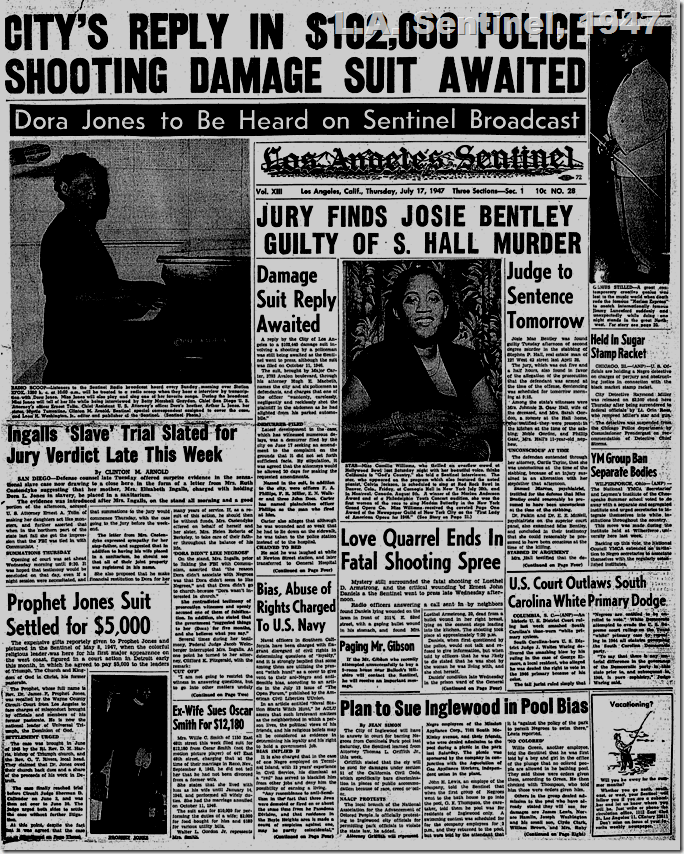
May 29, 1947: You may recall that the Los Angeles Times devoted two paragraphs on Page 6 to the acquittal of 28 men in the lynching of Willie Earle.
In contrast to the disinterest of The Times, the Sentinel published a Page 1 story and several sidebars on the case, including reports that the Los Angeles chapter of the NAACP was calling an emergency meeting for June 1 to urge passage of a federal anti-lynching bill.
And I don’t need to tell you what The Times editorial position was on a federal anti-lynching law, do I?
A story from the ANP (Associated Negro Press) from Greenville, S.C. said:
“The general feeling was that no one had expected a conviction of the 28 whites, nor was there anything less than a jury disagreement expected. The forthright prosecution and conduct of the trial did lead them to hope that a few would be convicted of the conspiracy charge and given a year or two in jail.”
![]()
Note: This is an encore post from 2005 and originally appeared on the 1947project.
WASHINGTON—A full-dress investigation to learn the extent of Communist infiltration of the Hollywood film industry and whether Federal officials or agencies encouraged production of motion pictures with anti-American doctrines was arranged today by the House Un-American Activities Committee in the wake of a subcommittee report which charged “White House pressure” was responsible for “some of the most flagrant Communist propaganda films.”

This week’s mystery movie has been the 1932 RKO picture “The Age of Consent,” with Dorothy Wilson, Arline Judge, Richard Cromwell, Eric Linden, John Halliday, Aileen Pringle and Reginald Barlow. The screenplay was by Sarah Y. Mason and Francis Cockrell from the play “Crossroads” by Martin Flavin. Photographed by J. Roy Hunt, art direction by Carroll Clark. It was directed by Gregory Lacava. The associate producer was Pandro S. Berman; the executive producer was David O. Selznick.
“The Age of Consent” is available on DVD from Warner Archive.

Above, a clip of “Restoring a Lost Silent Film: How to See “Rosita” by Dave Kehr from the Museum of Modern Art.
In 1922, legendary German film director Ernst Lubitsch and “America’s Sweetheart” Mary Pickford searched for new challenges in developing their careers. Lubitsch yearned to conquer America, the world’s leader in film production, proving he could create successful and moving pictures on both sides of the Atlantic. Pickford hungered to break free from the sweet young girl roles she successfully portrayed and play real women full of meat, passion, and power. “Rosita,” the story of a peasant gypsy singer who pines for a nobleman but instead gains the obsessed attentions of the lecherous king, brought them together.
In the late 1910s and early 1920s, the German film industry dominated the world’s screens with its artistry and technical wizardry, with such striking films as “The Cabinet of Dr. Caligari” (1920), “Destiny” (1921), “Nosferatu” (1922), and “Hamlet” (1921) displaying remarkable camerawork and skill. Director Lubitsch, king of German film directors, exhibited great versatility, turning out visually stunning epics as well as comic farces, including “Carmen” (1918), “The Doll” (1919), “Madame DuBarry” (1919), and “The Loves of Pharaoh” (1922).
Mary Mallory’s latest book, “Living With Grace: Life Lessons from America’s Princess,” will be released June 30.