
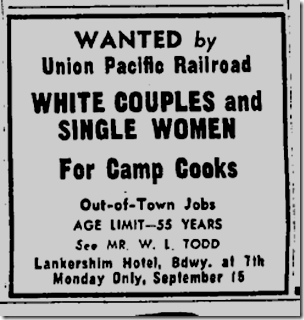
Sept. 14, 1947: Let’s see. White couples or single women wanted. Age limit 55 years.
No, we don’t do this anymore.
Sept. 14, 1947: Let’s see. White couples or single women wanted. Age limit 55 years.
No, we don’t do this anymore.
Note: This is an encore post from 2005 and originally appeared on the 1947project.
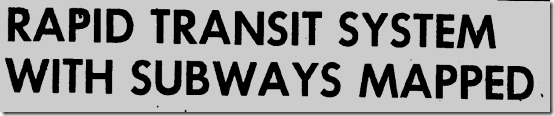
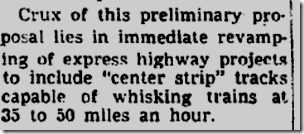 Someday an inquisitive person studying the history of transportation and urban planning will tell the world exactly what became of Los Angeles’ 1947 blueprint for dealing with transit problems. In the meantime, we’ll have to settle for the knowledge that at least they made a valiant effort. They certainly knew what was coming—without much argument, you could call them futurists.
A committee sponsored by the California Chamber of Commerce spent 19 months studying transportation issues and warned that someday Los Angeles would have a population of 5 million (the 2000 population of Los Angeles County was 9,519,338, with 3,694,820 for the city of L.A.).
“High-speed rail transit arteries plus a system of downtown subways alone can save Los Angeles from disintegration into a hodge-podge of unconnected municipalities,” The Times said in quoting the project’s advocates.

Note: This is an encore post from 2006.
Sept. 13, 1907
Los Angeles
The family was too poor to take a streetcar, so Concepcion Parra, 60, and her sister Mrs. J.L. Ghiotto began walking the 12 miles to El Monte with Parra’s 5-year-old granddaughter, Delphina Verde, to see the girl’s mother. To save time, they took a shortcut along the streetcar tracks.
Around State Street, they jumped back to avoid a southbound car from Pasadena and were hit by a northbound car. Parra (or Parras) and Ghiotto were thrown clear by the collision, but Delphina was crushed under the wheels.
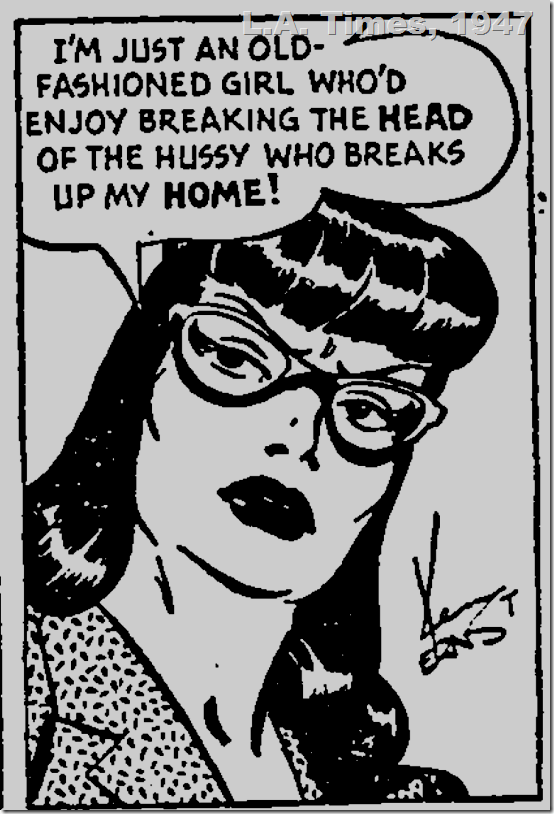

Note: This is an encore post from 2005 and originally appeared on the 1947project.
Henry R. Wagner of San Marino will be 85 years old Sept. 27 but the Zamorano Club couldn’t wait that long. In order to surprise Dr. Wagner, it celebrated his birthday at its monthly dinner Wednesday night—and the members got a surprise, too.
Never before had a woman been introduced to the club, but at that dinner Mrs. Wagner, Dorothy Huggings of San Francisco and Ruth Frye Axe, Dr. Wagner’s present secretary, were honor guests.
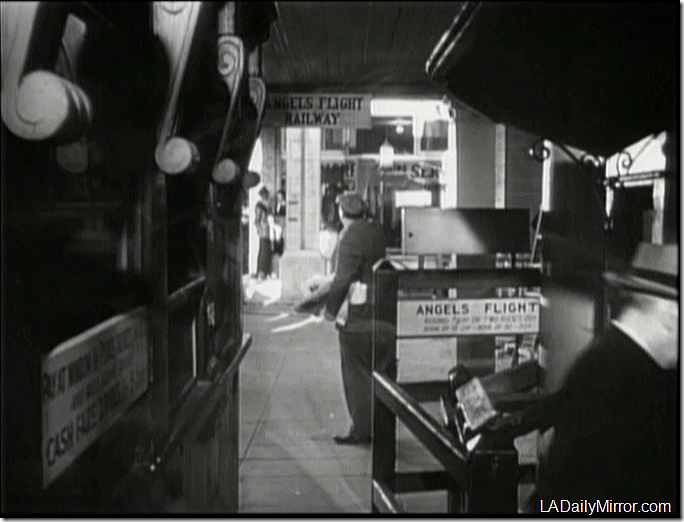
Here’s the sequence of shots in “The Unfaithful” showing Angels Flight, photographed by Ernest Haller, edited by Alan Crosland Jr.
In image No. 1, we have a news vendor and the upper entrance to the funicular.
“Boogie-Woogie Blue Plate” is No. 2on this week’s juke box hits.
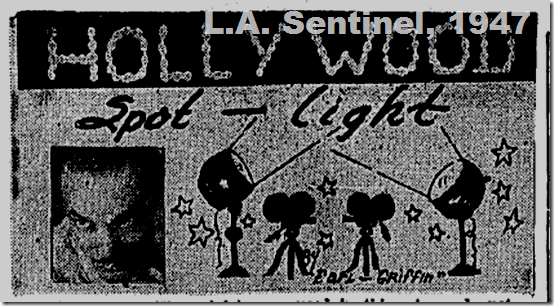
Sept. 11, 1947: KLAC disc jockey Al Jarvis replies to Earl Griffin’s criticisms in last week’s Sentinel. “To knowingly plug a sponsor who discriminates against the Negro race is contrary to every belief I have ever had or ever will have.”
Note: This is an encore post from 2005 and originally appeared on the 1947project.
“Big Bill,” driver for Maier & Zobelein, blockaded a procession of cars on Spring Street yesterday afternoon because he was insulted and angry. He had driven his big brewery wagon too close to the tracks and a passing car rolled one of the kegs of beer into the gutter and spilled the contents. For revenge, “Bill” drove his wagon into such a position that not a car could pass north on Spring Street and the trolley coaches began to pile up behind the foam cart.
The team was allowed to stand and “Bill” went into the saloon to refresh himself and cool off as much as possible.
 Note: This is an encore post from 2006.
Sept. 11, 1907
Direct Wire From New York
Wow! Now this is the kind of quote one simply doesn’t see every day, at least in the 21st century. The Victorians certainly had a different attitude toward women’s physiques:
“The woman who gets the proper sort of corset will have the fashionable figure, even if she weighs a ton.”
Note: This is an encore post from 2006.
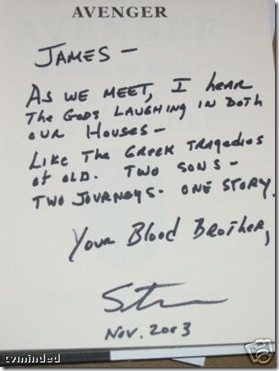
OK, I’ve had my fun with Ellroy’s copies of the “Avenger” books. The hardback stands at $38 and the paperback at $29. Despite my minimum bids, there is always the risk that I might end up with these turkeys!
Good luck, folks, I will be watching on the sidelines, listening to John Coltrane’s “Love Supreme.”

A fascinating look at what middle America saw at the movies from the 1910s through the 1950s, the 54th Annual Cinecon Classic Film Festival provided an excellent slate of films running the gamut from silents to sound, musicals to westerns, revealing how films can unite audiences rather than create walls.
While no major finds rose to the top, overall the entire program provided solid entertainment and featured such recurring motifs as odd wards entrusted with children, mad writers, sardines, a financially struggling population, immigration, and an “arrogance of power.” Favorite actors unexpectedly popped up multiple times, from Walter Brennan, Andy Devine, Monty Woolley, Zasu Pitts, J. Carroll Naish, T. Roy Barnes, Walter Catlett, Louise Fazenda, Luis Alberni, John George, and Allison Skipworth, and such stars as Colleen Moore and Jack Oakie, received multiple opportunities to shine.
Festivities kicked off Thursday night with a 1913 Kinetophone short following the reception. A primitive early attempt at uniting picture and sound, the experiment failed because of multiple technical issues. This short demonstrated that, a prelude to the “Singin’ In the Rain” scene where unctuous Julius Tannen overenunciates to emphasize that this is a talking picture.
Mary Mallory’s “Living With Grace” is now on sale.
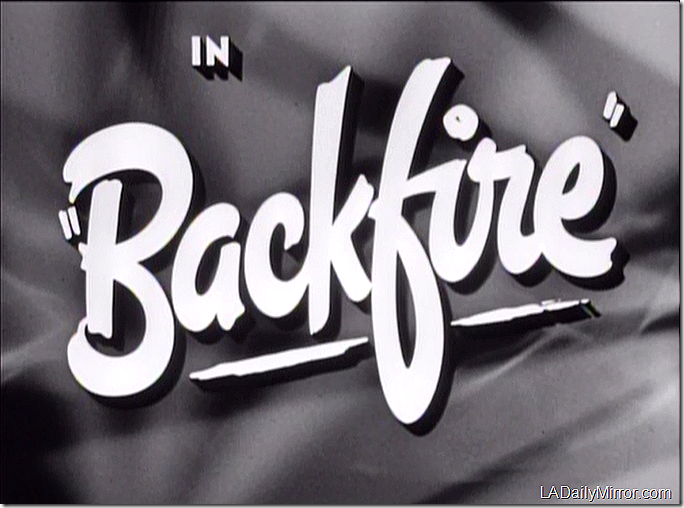
This week’s mystery movie has been the 1948/1950 Warner Bros. film “Backfire,” with Viveca Lindfors, Dane Clark, Virginia Mayo, Edmond O’Brien, Gordon MacRae, Ed Begley, Frances Robinson, Richard Robert, Sheila Stephens and David Hoffman.
Screenplay by Larry Marcus, Ivan Goff and Ben Roberts from a story by Larry Marcus. Photography by Carl Guthrie, art direction by Anton Grot, set decoration by William Wallace, makeup by Perc Westmore, Miss Lindfors’ gowns by Milo Anderson, Miss Mayo’s gowns by Leah Rhodes. Music by Daniele Amfitheatrof, produced by Anthony Veiller and directed by Vincent Sherman.
“Backfire” is available on DVD from Warner Archive in a film noir set that includes “Cornered,” “Desperate,” “The Phenix City Story,” “Dial 1119” “Armored Car Robbery,” “Crime in the Streets” and “Deadline at Dawn.”

Befuddled and often tongue-tied onscreen, beloved character actor Charlie Ruggles possessed sharp business and organizational skills off screen. He parlayed a love of dogs into a profitable kennel business for several years in the 1930s and 1940s, working to ensure proper, healthy living conditions and behavior for the canines in his charge.
Born in Los Angeles in 1886, Ruggles began appearing on the stage not long after graduating from high school, though his father hoped he would follow him into the wholesale drug business. The young man quickly found his footing, earning wide praise for theatrical appearances around California and on the Broadway stage in 1914. Not long after, Ruggles followed his younger brother Wesley, a future director, into the moving picture business, becoming a well respected performer for over 50 years.
Mary Mallory’s “Living With Grace” is now on sale.
Note: This is an encore post from 2005 and originally appeared on the 1947project.
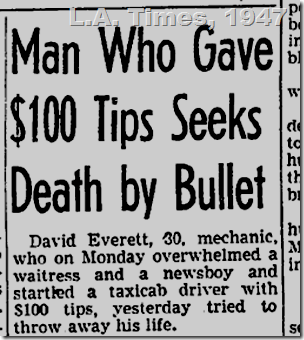 There are some obstacles that even love cannot overcome, or so David Everett has discovered. The 30-year-old mechanic is in critical condition at Torrance General Hospital after shooting himself in the head and neck in despondency over his frustrated love for his 17-year-old first cousin Janet. And yes, she lives in a trailer park.
Everett is the man who was handing out $100 tips the other day after withdrawing all his money from the bank. Not just to Flora Killingsworth for bringing him ham and eggs, but to 15-year-old newsboy Edward Grant for a nickel paper, and to a cabdriver who took him to Glendale. To top it off, Everett ripped up some $100 bills and threw them in the street.

Note: This is an encore post from 2006.
Sept. 10, 1907
Los Angeles
A very uncertain day. No evil omens glare anywhere but in all aspects there lies a heavy veil, defying those who would peer into this day. Beware, therefore, of all and any unconsidered act. Promise nothing unless you comprehend clearly the full scope and limit of the pledge. Sign neither note nor contract this day without full security in your hand. Avoid speculative enterprises like the plague.
“A red flag flows wildly” this day. Take heed that neither spark nor flame be left carelessly in dangerous places. Do not retire tonight without guarding against fire with much more care than usual. A great fire is threatened for a large city on the Atlantic Coast this night.
Note: This is an encore post from 2005 and originally appeared on the 1947project.
In New Delhi, unimaginable carnage. “I counted the bodies of at least 30 Moslems, men, women and children, who were chopped up like beef by bearded Sikhs at the main New Delhi railroad station as they were about to leave for the safety of Lahore in the Moslem Pakistan area of the Punjab,” says James Michaels of United Press.
In Hamburg, British troops force thousands of Jews from Exodus 1947 to disembark in Hamburg, Germany. “Many of the Jews, frustrated in their dream of celebrating the Jewish high holy days a week hence in Palestine, began to wail. They shouted against “Hitlerism” and being returned to “this land which is a bloody graveyard of millions of Jews,” according to Associated Press.

Note: This is an encore post from 2006.
Sept. 9, 1907
Los Angeles
More than a year before the 1908 presidential election, Republican William Howard Taft is far and away the favorite over Democrat William Jennings Bryan in a straw poll reported by The Times.
 Note: This is an encore post from 2006.
Sept. 8, 1907
Los Angeles
Jack Foster, a handsome, blond actor who is the toast of the vaudeville circuit, noticed a young lady standing at 3rd Street and Main after a show.
Seeing that she was alone, Foster said: “Rather late for you to be out all by yourself, isn’t it, girlie?”
Note: This is an encore post from 2006.
An incredibly curious thing happened yesterday. I’ve been taping segments for an “America’s Most Wanted” episode on the Black Dahlia and the producer called to see if they could get some shots of me in the Biltmore bar talking to Detective Brian Carr, who is assigned to the case.
The Biltmore usually charges astronomical fees for filming and sometimes even buckets of money won’t gain access if the shoot is related to the Black Dahlia, which I learned with another TV production. However, Universal came up with buckets and buckets of money to rent big chunks of the hotel, (including the 10th floor with the Presidential Suite) for a press event publicizing Brian De Palma’s upcoming movie.
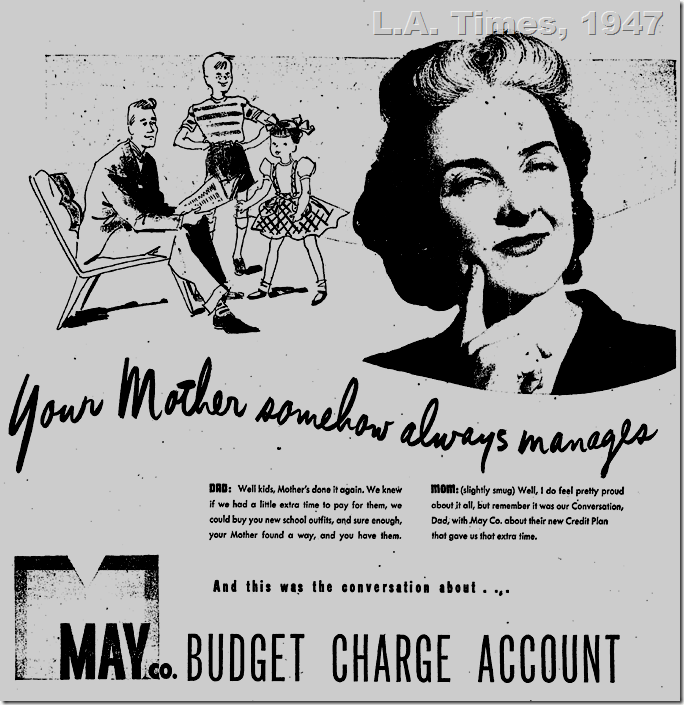
Sept. 7, 1947: Oh, the innocence here.
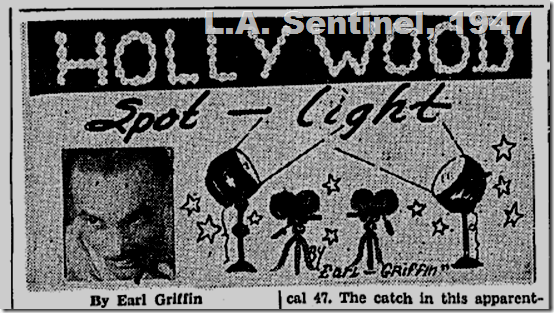
Sept. 4, 1947: Earl Griffin gives some hard shots to disc jockey Al Jarvis of KLAC-AM (570, in case you’re Atwater Kent is working). Jarvis was credited with using black artists on his radio show as early as 1933, but the L.A. Sentinel columnist says Jarvis “has hoodwinked the public into believing he was the ‘great white father’ of our group.”
Griffin goes on to critique an ad on Jarvis’ “Make Believe Ballroom” for a housing development that didn’t say the homes were restricted to whites. He also criticizes a listeners’ contest for records made by members of Local 47 of the musicians union without saying that black musicians were barred from Local 47.
Jarvis, dubbed “the dean of disc jockeys” by the Los Angeles Times, died of a heart attack in 1970 at the age of 60 after a long career in radio and early television.
 ladailymirror.com