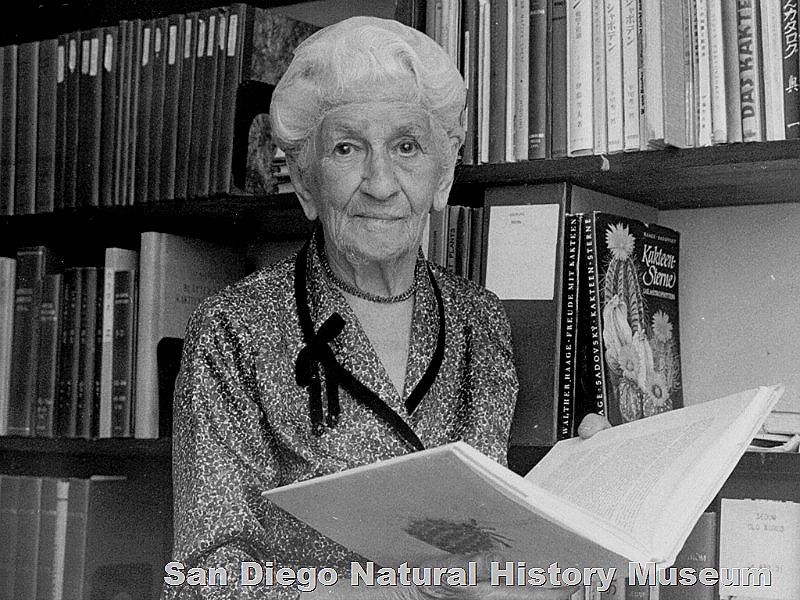
Ethel B. Higgins in an undated photo, courtesy of the San Diego Natural History Museum.
Hollywood welcomed artists long before the film industry descended on the town. Many were women, pioneering in music composition and publishing like Carrie Jacobs Bond, or in photography, like Ethel Phoebe Bailey Higgins. Virtually forgotten today, she served as Hollywood’s top artistic photographer in the early 1900s, before becoming one of California’s leading botanists in the 1930s and 1940s.
Ethel and her parents George and Mary moved to Los Angeles after he retired in 1900. Born in 1846, former Quaker George was heir to an oilcloth factory and investor. Ethel, their only daughter, was born 1866 in Vassalboro, Maine. Thanks to her family’s wealth and social status, she pursued higher education, attending the Wesleyan Seminary and Female College at Redfield before teaching high school in Massachusetts. She moved across country with her parents at the age of 34, looking for new adventures and horizons.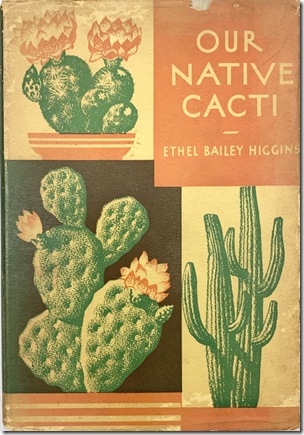 Not long after arriving, Bailey fell in love with photography. Unlike many who just loved taking snapshots, she possessed an excellent eye for capturing details and personalities as well as arranging compositions, attracting the attention of Los Angeles photographer Frank Schumacher for whom she apprenticed and worked. She took the plunge and moved away from her parents’ home on West Adams to set up her own residence at 114 Prospect Avenue in Hollywood, soon setting up her own photography studio in 1902.
She was not the first female photographer in Los Angeles; there were several female operated studios downtown. Many were widows carrying on their husband’s trade, while other upper middle class women like Anna Desmond and Maud S. Lee possessed the financial means to pursue their passions as a business, not just a hobby. Bailey promoted herself as a portrait photographer in the 1906 Hollywood City Directory, purchasing ads at the tops of several pages describing herself as a “portrait photographer,” describing her talents as capturing personality and working well with children. The directory also featured a few of her photographs of local landmarks such as the new Union High School, the under construction Immaculate Heart Academy, as well as the Methodist Church.
Bailey earned a great commission as well, receiving the right to provide the photographs for the 1905 Hollywood Board of Trade booklet “The Story of Hollywood,” written by Mary E. Croswell. Croswell paints a glorious picture of the area with her colorful prose, accentuated by Bailey’s stunning photos. Obviously intended to lure new residents to the city, and a foreshadowing of how artists would flock to its boundaries, it features text describing Hollywood virtually as an oasis and lists statistics and facts demonstrating the quadrupling of population in five years, as well as its great transportation, banking, communication, weather, schools, churches, social organizations, climate, property values, improvements, and recreational opportunities. Bailey captures the schools, churches, homes, and major attractions.
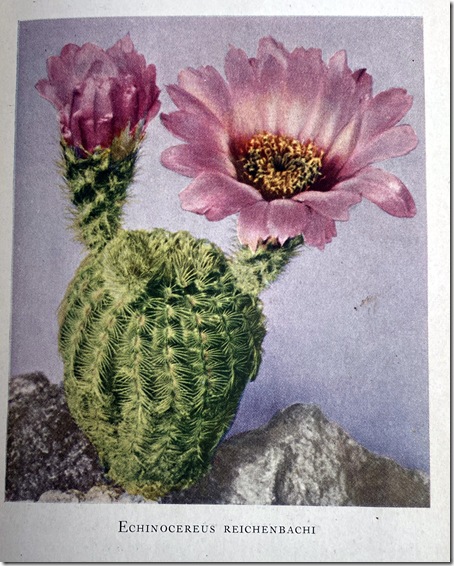
Lace cactus, Echinocereus Reichenbachi, artwork by Ethel B. Higgins.
“The graceful pepper tree, whose ever green and fern-like leaves give glimpse of its hidden bunches of coral berries, shades the wide avenues and boulevards. The residences are elegant in every respect.” This golden land,“an earthly paradise so near the metropolis of the Southwest has naturally drawn to it the most cultured of people. Artists, musicians and writers famous the world over have gathered here and formed the nucleus of an ideal society.” It describes in loving detail the magnificent churches, graceful Hollywood Hotel, and the elegant DeLongpre gardens.
At the same time as she documented Hollywood and shot portraits, Bailey began focusing her attention on the smallest details of plant life, taking what she called “plant portraits.” Advances in photography and processing allowed for greater differentiation in color and the capturing of texture, bringing out minute matters due to differences in shading. Many of her striking images, of people, landscapes, and plant life, won recognition and awards in photography shows held by groups such as the Camera Club, both the local and state branches.
By the teens, Bailey focused almost exclusively on shooting plant life. Libraries in Alhambra, South Pasadena, and Pasadena exhibited her handwork. Her renown spread, with libraries across the state exhibiting her handcolored photographs of California flowers. In 1914, the Pasadena Library acquired 100 colored images of California wildflowers from Bailey, noting to the Pasadena newspaper that the images “would be of special value in teaching botany in schools.” The city’s Board of Trade soon borrowed some of the photographs to exhibit in their offices. The California State Library also purchased 250 of her botanic images. The San Diego Panama California Exposition from 1914 until 1915 also exhibited some of her enlarged prints.
Bailey opened herself to more of life than just photography. She fell in love for the first time at the age of 46, marrying fellow Alhambra resident, automobile accessories manufacturer John Clements Higgins. In 1915, the couple moved to El Centro, where he opened a plant manufacturing automobile parts and she worked as bookkeeper and secretary. Bailey Higgins devoted her free time to studying botany.
 As her world expanded, so did her art. Bailey Higgins’ talent for documenting California native plants bloomed, as did her passion for flora. Her photography became the avenue for cataloging the state’s native plants and flowers and a way to convince others how easily they could be grown in home gardens. She began corresponding with botanists at universities, botanic gardens, and even the Smithsonian, increasing her knowledge while sharing her illustrations with them. Camera Club dedicated two separate rooms to Bailey Higgins’ photographs recording wildflowers and cacti for a late teens exhibit in Palo Alto, one of several institutions and schools recognizing the quality of her work.
The Sacramento library was one of several institutions hosting an exhibit of 86 of Bailey Higgins’ colored images in 1919, drawing large audiences. The show documented native plants of particular areas, tinted to match their actual colors, preserving the history of California’s flora. Bailey Higgins employed her sharp photographic skills to accurately capture the state’s plant life, becoming one of the state’s recognized experts in her field. As such, magazines such as “Better Homes and Gardens” published her work on flora, amply illustrated with her own photographic images. She also published the book “Our Native Cacti” in 1931. These articles and books kept Bailey Higgins alive, financially and mentally, after her husband died of grief and shame in 1930 after going bankrupt in the Great Depression.
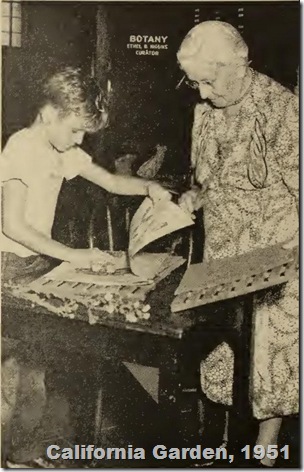
At the age of 67, when many retire, the San Diego Natural History Museum named Bailey Higgins an assistant curator of botany, acknowledging her importance to the field. She began lecturing and giving tours at the museum, as well as traveling through both California and Mexico to document plants. Bailey Higgins wrote articles, gave presentations at state and national conferences, and continued exploring. Upon returning to San Diego, she created accession records for each specimen, giving provenance and history to each item.
Fellow botanists exchanged specimens and plants with her, each enhancing the others’ knowledge and collections. The San Diego Natural History Museum acknowledged Bailey Higgins’ work in compiling lists of San Diego County plants, as well as her remarkable vitality, by allowing her to continue working. Vital and productive, Bailey Higgins revealed her secret for living a long and productive life as “having a lively curiosity and a sense of humor.”
The intrepid Bailey Higgins’ deep experience led the Museum to eventually name her chief curator. Energetic and dedicated, she continued her work until the age of 96 before retiring in 1962. Productive until the end, she passed away at a rest home near San Diego just a few months later. Passionate and driven, Bailey Higgins conducted pioneering work as Hollywood’s first female photographer and as California’s leading female botanist, demonstrating the power of intelligent, ambitious women to leave outstanding marks in their fields.

 ladailymirror.com