The San Francisco Silent Film Festival offered a tantalizing Grand Tour across the cinematic universe in their recently concluded festival, educating and edifying audiences with thoughtful programming, excellent film accompaniment, and the chance to connect with other silent film cineastes.
This year’s timely theme centered around the grind and struggles of working class people just trying to survive hardships and adversity with character and morality intact. Life was about serving community not self, bettering the lives of others. Mini themes revolved around the Klondike, independent, take charge women, seedy/cut-rate carny/circuses, and the threatening sea.
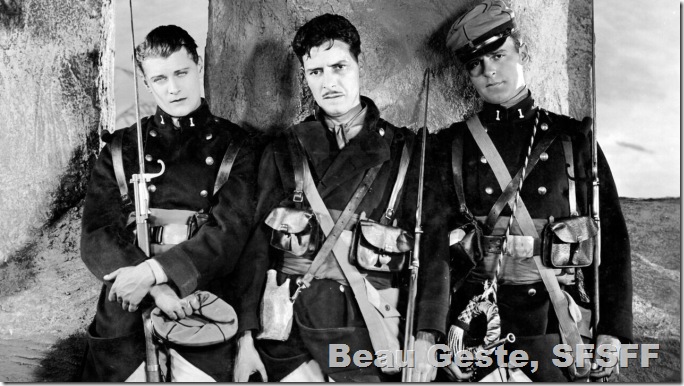
Beau Geste (1926) starring, from left, Ralph Forbes, Ronald Colman and Neil Hamilton.
The festival’s full programs kicked off Thursday morning with their annual, informative campaign “Tales From the Archives,” with archivists recounting their restoration projects. Bryony Dixon of the British Film Institute recounted trying to restore film clips of Stoll Pictures’ Sherlock Holmes’ short films with the atmospheric program, “A London Particular: Fog, Film, and the Great Detective.” Thomas Christensen of the Danish Film Institute recounted how all Danish silent films are digitized and freely available, with some intriguing lesser known films discovered to boot.
Archivist Elena Tammaccaro and Arold Lozano, managing director of the Chaplin archives described the work in returning Chaplin’s masterpiece “The Gold Rush” to its original 1925 look. James Mockoski of Maltese Film Works revealed he and the Film Preserve’s Robert Harris’ work in restoring Paramount’s surviving silent features, presenting the work in bringing “The Affairs of Anatol,” “Beau Geste”, and “The New Klondike” back to life with original tints and footage. Accompanist Stephen Horne provided atmospheric background scoring.
“Silent Sherlock: Three Classic Cases” showcased three short Stoll Pictures’ films starring the inimitable Sherlock Holmes and adapted from each of Conan Doyle’s works. Basically telling the story rather than showing, the great detective recounts how he solved each intriguing case with deep deduction and impersonation. Each featured excellent lighting and production design along with lead actor Eille Norwood in ripping form. Horne, Frank Bockius, and Guenter Buchwald created a lovely theme/studio cue in strong march style, augmented with solid percussive suspense and violin underscoring.
Elmer Clifton brought evocative tension and drama to the excellent 1927 Cecil B. DeMille Productions “The Wreck of the Hesperus.” The first film adaptation of Henry Wadsworth Longfellow’s epic narrative poem of the same name, the movie builds in foreboding and bracing fashion through forbidden romance and furious storm. Featuring excellent early costume design by Gilbert Adrian and screenplay adaptation by future director John Farrow, the film showcases fine acting by Samuel DeGrasse, Virginia Bradford, and Frank Marion and colorful supporting work by Alan Hale, Ethel Wales, and Francis Ford. Buchwald, Sascha Jacobsen, and Mas Koga provided expressive accompaniment with lilting sea chanty, growing dramatic minors, and crashing seastorm.
The evening closed with the rousing restoration of Paramount’s 1926 French Foreign Legion rouser, “Beau Geste.” A rousing story of character, morality, and honor directed by master director Herbert Brenon, the three English brothers surreptitiously join the French Foreign Legion after their Aunt Lady Patricia Brandon (Alice Joyce) great blue sapphire disappears. Ronald Colman, Neil Hamilton, and Ralph Forbes give emotional performances, supported by fine turns by reptilian Noah Beery, scheming William Powell, and refined Alice Joyce. Mont Alto’s emotional and rousing score brings the moving film to life, highlighted by dramatic visuals, stirring action, and tales of brotherly love and loyalty. Artcraft’s beautiful restoration vividly brings to life one of the 1920s’ greatest adventure stories.
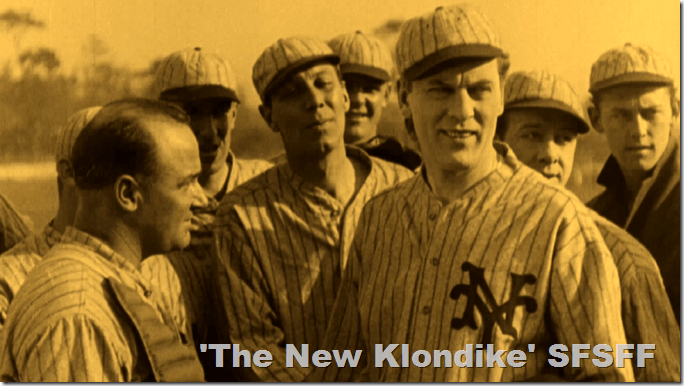
The New Klondike (1926).
Friday morning kicked off with Artcraft Picture’s lovely new restoration of “The New Klondike,” a blending of baseball spring training and chicanery in Florida real estate booms in an adaptation of a Ring Lardner short story. Set in sunny, glorious Miami beach and surrounding areas, the film tells the story of aging baseball star Tom Kelly, (Thomas Meighan) at odds with his scheming manager, who end up at odds over developing Florida swampland into upscale real estate tracts. Budding director Lewis Milestone adds a touching scene demonstrating Kelly’s big moment in winning his team the World Series the year before. Paul Kelly provides rollicking comic relief as goofy baseball savant Bing Allen, an early model for Tim Robbins’ goofy “Nuke” Laloosh in “Bull Durham.” Mont Alto provided toe-tapping, bouncing accompaniment keeping proceedings light and airy.
A mythic narrative of the raging sea and its hold on rugged seamen, the French film “Island Fisherman” combined striking imagery, lighting, and luminous performances from its two main stars in its foreboding and touching tale. Authentic Brittainy dress, dance, and customs enhanced the emotional hold of the story. Buchwald and Bockius” add Breton musical touches and a slowly growing foreboding doom.
Artcraft’s beautifully restored Cecil B. DeMille sexual drama “The Affairs of Anatol” featured dramatic Handschiegl color, glamorous gowns by Clare West, and lavish opulence by set director Paul Iribe in a lush tale of flirtation, seduction, and marriage. DeMille’s star-studded cast – Bebe Daniels, Wallace Reid, Theodore Roberts, Agnes Ayres, Elliott Dexter, Monte Blue, and Gloria Swanson – switch partners and desires in this adaptation of Arthur Schnitzler’s sexually stimulating story. Mont Alto once again gave rich texture and sensual playfulness to DeMille’s flirty tale.
Anna May Wong brings pensive expressiveness to the wistful “Song,” her first starring role overseas. Homeless and about to be attacked on a desolate beach, a luminous Wong is rescued by a fugitive knife thrower with major problems of his own. She demonstrates emotional vulnerability and determination as the plucky but sad waif as she searches for money to restore the eyesight of her strange savior. Though demonstrating fine acting chops, Wong’s character once again shows an Asian character sacrificing happiness for the good of others. Horne and Bockius provided an evocative, dark accompaniment to the little seen work.
Theodor Dreyer’s slyly comic masterpiece “Master of the House” reveals feminist sensibilities as it portrays an emotionally cruel, domineering husband pushing his wife to the edge of a nervous background before his former strict, toe the line nanny gets in some delicious comeuppance and revenge. Strong performances, sly wit, and dramatic visual storytelling reveal the strength of women and the humbling of the husband. Christensen of the Danish Archive received the festival special award before the screening of the emotionally powerful work.
Director Clarence Brown combined threatening menace, emotional connection and acting, and dramatic visuals in his rousing adventure tale and new restoration, “Trail of ’98,”demonstrating the life-life shattering journeys obsessive fortune hunters went to in their search for Klondike gold. Daring stunts and larger than life visuals arrest the senses with their stark brutality, accentuated by dramatic lighting and sets. Ralph Forbes and Dolores Del Rio bring emotional frisson and passion as the dedicated lovers, with fine character turns from Karl Dane, Tully Marshall, George Cooper, Russell Simpson, and Emily Fitzroy. Harry Carey oozes nastiness as the scheming, narcissistic Jack Locasto, who meets a fiery end. Horne’s evocative score features delicate romance, wistful loss, and muscular energy as it rises and falls with the dramatic movements of the work.
Anny Ondra charms the pants of skirt chasing English lords in the energetic, toe tapping German film, “Saxophone Susy,.” Vivacious, flirtatious Ondra changes places with her more plain Jane friend on their cruise to dult schooling in England, providing comic flapper flair. Walking the line of under age desire by her aristocratic father, the infectious film features plenty of slapstick, comic dancing, flirty romance, and nonstop fun, enhanced by Buchwald’s Bockius, and Mas Koga’s jaunty, cocky little score. Just watching the film led to comic highlights for the weekend, as the festival tried three times to bring up English subtitles as pianist Buchwald noted that technical details in French or German “were’n’t that important.” Finally archivist Thomas from Dusseldorf provided comic live translation on the fly, adding wry timing and lighthearted charm to the evening.
Tom Mix’’s upscale gent saves the girl and the small town’s honor in his quest to find the man who killed his father in the1921 film, “Trailin’.” Mistaken for an effete Easterner, Mix demonstrates his western bonafides with elaborate rope tricks, athletic horse riding, and daring stuntwork opposite scheming cattle jocks. Mix’s easygoing charm steals Eva Novak’s heart and audience love in the film, focusing on themes of loyalty, honesty, and generosity, timely then as it is now. As a late replacement, Wayne Barker’s rollicking western score keeps things light and on the move.
My closing film for the weekend, “Song of the Scarlet Flower” provided dramatic nature visuals and cinema verite realism of rural Finnish workers enjoying life and love. Director Mauritz Stiller lovingly pans lush Swedish landscapes, sentinel forests, and captures passionate dancing and customs of every day workers in a story of finding maturity and responsibility. Actor Lars Hanson astonishes with his athletic skills rolling and dancing a log down river rapids as the footloose and earthy logger looking to reconcile with his loving but stern family. The Guenter Buchwald Ensemble provided a delicate adaptation of the original score, filled with native dances, gentle themes, and lyrical feel.
Filled with lovely music, touching stories, and teachable moments, this festival provided a refreshing antidote to all the depressing losses and disasters occurring around the world. The San Francisco Silent Film Festival’s deep and thoughtful programming highlight connections and similarities with other nations and cultures, opening viewers’ eyes to how we all benefit from a rich banquet of music, art and opening our eyes and hearts to those around us.

 ladailymirror.com