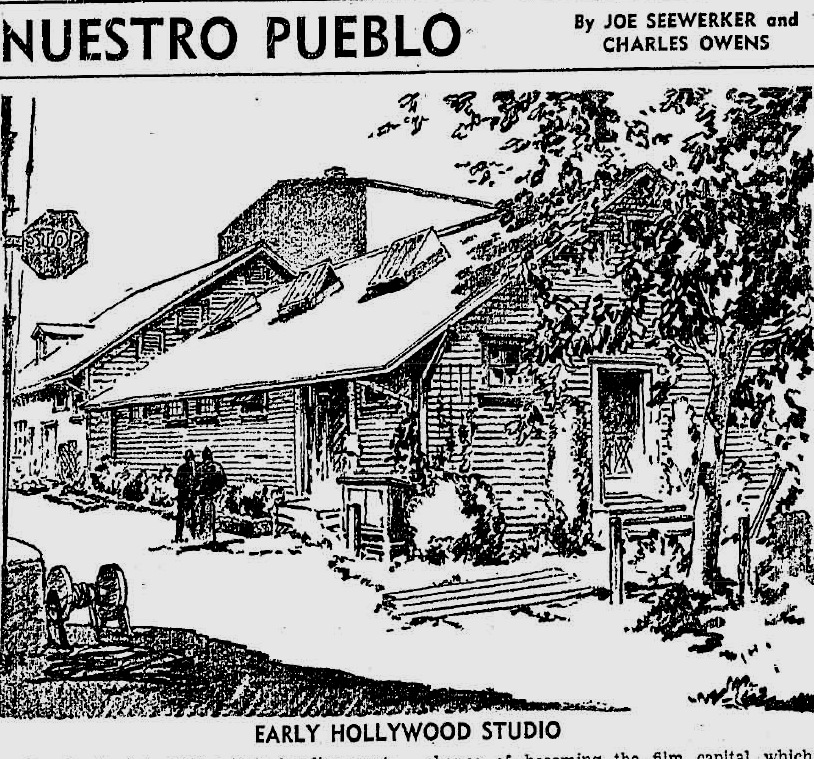
July 17, 1939: Los Angeles Times reporter Joe Seewerker and artist Charles Owens visit the Lasky Barn, being used as a gym on the Paramount lot.
One Hundred Twenty Four years ago, what is now the Hollywood Heritage Museum began life as a humble little barn in the farming town of Hollywood, California. Just twelve years later in 1913, it first served as a moving picture studio witnessing the evolution of the community from bucolic rural community into the world’s filmmaking capital.
The rich “frostless” belt and soil around Hollywood gave birth to a wide variety of crops. Everything from citrus to figs to melons to even pineapples grew around the community, from the canyons down to the flatlands. The area from around Prospect Avenue and Gower Street down to what is now Santa Monica Boulevard and Cahuenga Boulevard featured bountiful lemon orchards, rich in output and taste.
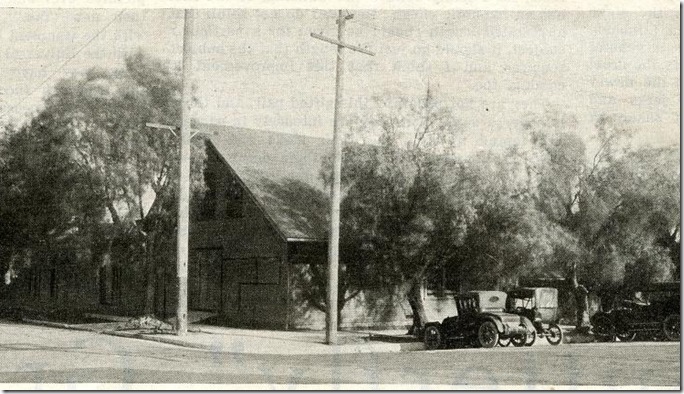
The Lasky barn as seen in 1915.
Capitalist Robert J. Northam loved the beautiful views, rich land, and slow, country ways when visiting Hollywood in early 1901. Land manager for the Abel Stearns Rancho Company in the Huntington Beach area, investor and real estate speculator, the wealthy horse fancier visited property on which to build a magnificent country estate. On February 1, the businessman spent $10,000 to purchase nine and a half acres of lemon groves from Mrs. Eunice Hambrick and $5,000 to buy five acres from Mrs. Beveridge west of Vine Street.
Northam hired architect L. B. Valk April 11, 1901 to design a luxurious country hacienda. Respected for his stately churches and schools around Southern California, Valk designed an elegant Mission Revival mansion that would cost $17,707 at the southwest corner of Prospect Avenue and Vine Street, hidden behind a citrus grove and an avenue of stately palm trees that gave the property its name, “Casa de las Palmas.” Historian John McGroarty in his early book “From the Mountains to the Sea: a History of Los Angeles,” would later call the estate “one of the show places of the beautiful Hollywood district.” Valk also created a simple two-room barn across the street at the southeast corner of Selma Avenue and Vine Street to stable horses and pack citrus that cost “nearly $5,000” to build. It included two sets of stalls to allow one set to be cleaned while the other was occupied.
Financier Northam’s ranch served not only as a quiet respite from stressful business in downtown Los Angeles, but also as a successful lemon producer. Each year’s harvest sold to the nearby Cahuenga Valley Lemon Exchange, which shipped out train carloads across the United States. It seemed whatever Northam invested time or money in, produced profitable results.
By summer 1904, Northam and second wife Leotia were ready to move on from the property. Orange County real estate man Jacob Stern purchased the acreage July 25, 1904 for $30,000. Born in Saxony, Germany September 20, 1859, Stern arrived in California in 1889 to start a mercantile business in Fullerton. Looking to grow his savings and investments, Stern established the Stern Realty Company to purchase and remodel neglected or abandoned ranches around Placentia and Fullerton to sell to incoming settlers. The successful mogul began hawking real estate out of an elaborate office in downtown Los Angeles’ Pacific Electric Building.
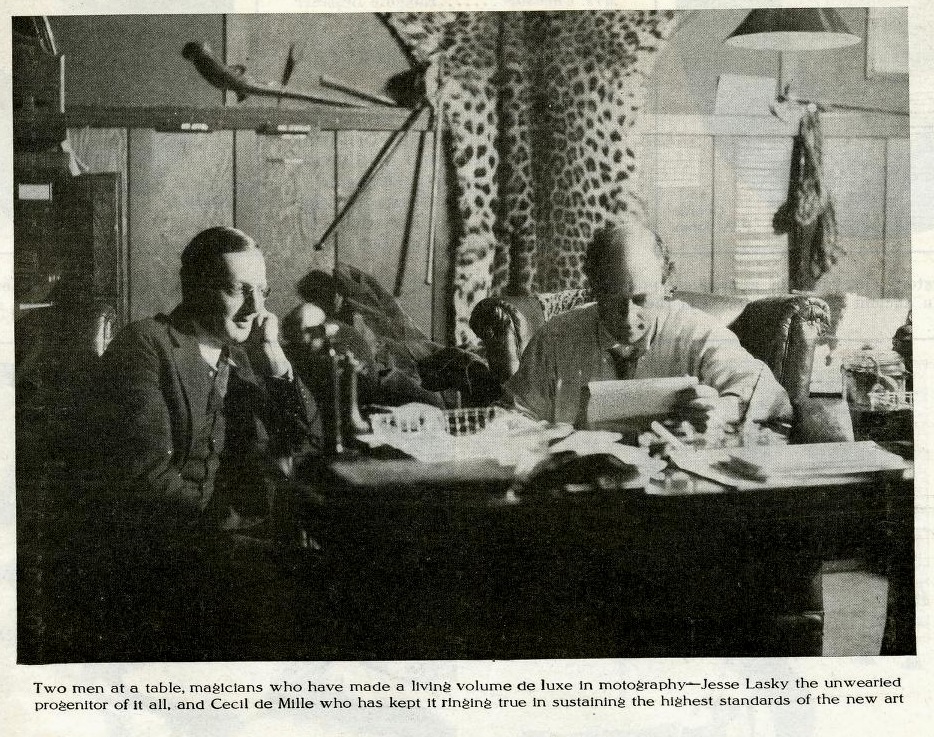
Jesse Lasky, left, and Cecil B. DeMille at work in 1915.
Stern saw the Hollywood estate as a way to acknowledge his success and enjoy the good life. The thick palm trees lining the driveways now obscured the view to his little barn catty corner across Vine Street from the elaborate mansion. Not only did the barn continue to serve as the packing and crating location for the ranch’s lemon harvest and as stable for horses, the structure was enlarged to serve as a carriage house/garage for one of Hollywood’s first automobiles.
Hollywood played host to a burgeoning new field of entrepreneurs in 1909 as terrible winters back east forced fledgling moving picture companies to travel to the West Coast looking for sun. The sunny warm climate attracted these hearty pioneers, as did the rich, diverse landscapes located nearby. Al Christie and David Horsley established the first film studio in Hollywood at Gower Street and Sunset Boulevard in October 1911 when they purchased the former Blondeau roadhouse to serve as their Nestor Film Company studio. Soon, others followed.
Ambitious young men L. L. (Louis Loss) Burns and Harry Revier recognized Stern’s small barn as the perfect location for expanding their growing film empire. Burns, proprietor of the Benham Indian Trading Store in downtown Los Angeles, had produced a documentary of the Moquis Indian tribe in 1911 before joining forces with erstwhile director/producer Harry Revier in July 1912. Revier, a former theatre man, opened the Majestic Theatre in Salt Lake City, Utah in 1911 and attempted to form a film company there before joining other small motion picture producers.
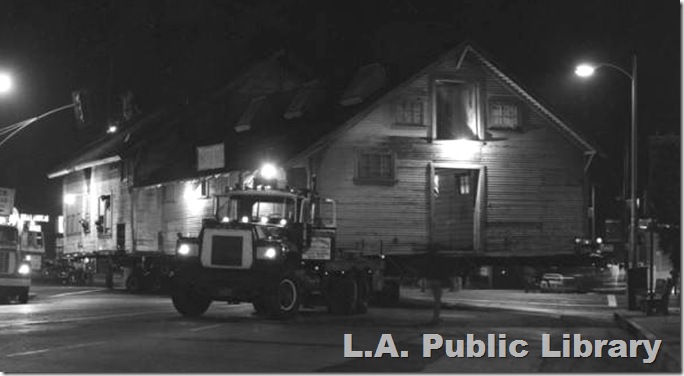
Moving the Lasky barn in 1979, courtesy of the Los Angeles Public Library.
The two men formed a partnership with others to create a Fox Motion Picture Company in 1912, attempted to organize a newsreel company called the Argus Weekly to cover major news stories, and did establish the Burns & Revier Laboratory/Studio at the former Kinemacolor Studio near the intersection of Sunset Boulevard and Prospect Avenue.
In February 1913, Burns and Revier leased 6284 Selma Avenue from Stern to establish the site as an independent production facility and extend their empire. They erected a laboratory addition to the Barn as well as constructed an exterior stage out among the lemon trees. Two weeks later they pulled a permit with the City of Los Angeles to create a small room inside the structure to assemble motion picture film.
Former Cecil B. DeMille colleague E. A. Martin served as their first tenant when he produced the Efsco Film Company movie “Opportunity” at the facility. Former vaudevillian and Mack Sennett comedian Fred Mace established his own company here in April to create split-reel comedies, some starring actress Tsuru Aoki in her first screen appearances. At the moment, however, none of these early films are known to survive. After a few months, Mace disbanded his company to join the New York-based Thanhouser Film Company. Though not a renter, director Lois Weber was the first to capture the barn on film, as her 1913 film Suspense shows it in a car’s side mirror as it drives up Vine Street.
Burns and Revier searched out tenants for a few months while the Barn sat empty after Mace moved on. In late December, fledgling film producer/director Cecil B. DeMille considered the facility adequate enough to launch filming of the Jesse L. Lasky Film Manufacturing Company’s inaugural production of “The Squaw Man.” The film’s enormous success in early February 1914 would set DeMille, Lasky, and Samuel Goldwyn on their way as founding film pioneers in Los Angeles. Recognizing the need to control their own destiny, DeMille approached Stern to purchase the barn, lab, and property outright in 1916. Stern’s little barn served as the nucleus around which Paramount Pictures was born, thus becoming one of Hollywood’s first true landmarks.

 ladailymirror.com