
Black Dahlia: Murder, Monsters, and Madness in Midcentury Hollywood, by William J. Mann, Simon & Schuster, 464 pages, January 27, 2026, $31.
Like a game of Clue with an actual cold case to solve, a well-worn list of suspects in the 1947 Black Dahlia killing released 22 years ago continues to provide the “true” crime community and the multimillion-dollar industry that feeds it with endless possibilities for speculation and, occasionally, another book.
Was it the murderous Dr. George Hodel at the Sowden House in a gruesome attempt at surrealist art? Mob nightclub owner Mark Hansen at the Florentine Gardens hiring morgue-trained assassin Leslie Dillon to take care of a troublesome dame? Army butcher Carl Balsiger in a fit of violence?
All of them are fakery and fraud by writers Steve Hodel (the ongoing Black Dahlia Avenger franchise launched in 2003), Piu Eatwell (Black Dahlia, Red Rose, 2017) and Eli Frankel (Sisters in Death, forthcoming in October 2025) who, if they read all of their source material, knew their suspect wasn’t the killer and proceeded anyway. Truth is the first victim for a “true” crime author with hopes of making The New York Times bestseller list and everything that goes with it.
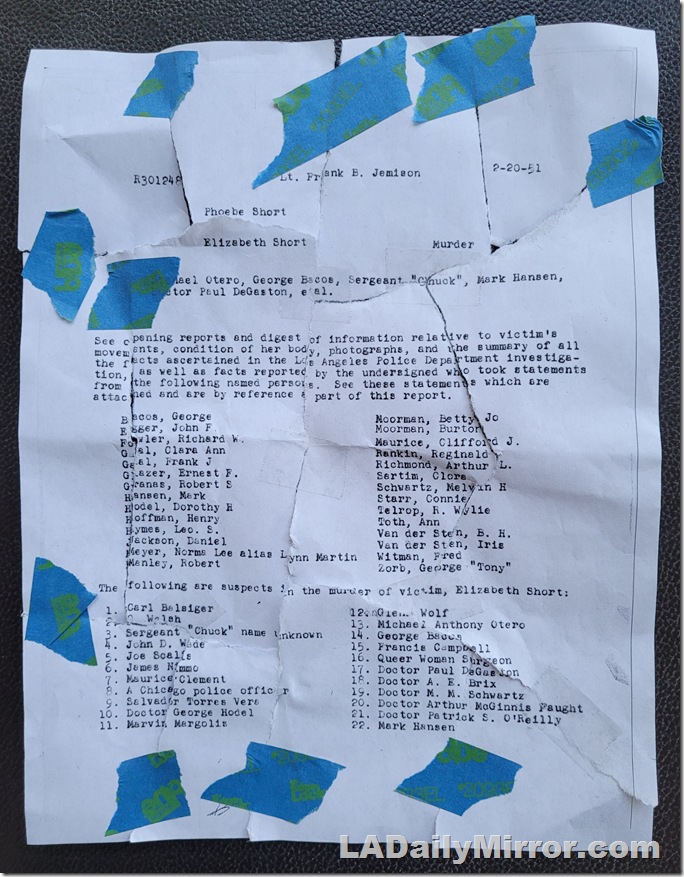
The list of usual suspects in the Black Dahlia edition of Clue. The best thing to do is tear it up; everyone was known to the police, investigated and eliminated.
Obviously (or perhaps not) relitigating the list of usual suspects in the murder of Elizabeth Short is a fool’s errand. Detective Harry Hansen, who headed the investigation from the day he was sent to the crime scene until the day he retired in 1968, was adamant that although police interviewed hundreds of potential suspects, they never talked to the killer. This roll call of the innocent (or at least the not guilty) was compiled by the Los Angeles County district attorney’s office of people known to the police, ensuring that every one had been exhaustively investigated, except for a few like “Sergeant Chuck” and “A Chicago Police Officer,” who were never found and may not have existed.
The latest entry in the Black Dahlia edition of Clue comes from William J. Mann, who won an Edgar Award for Tinseltown (2014). Mystery writer Megan Abbott has already proclaimed Murder, Monsters, and Madness the best book she has read on the Black Dahlia case, evidently not pausing to consider just how low the bar is on this subject, given the dismal quality of the aforementioned books, plus John Gilmore’s Severed (1994), Janice Knowlton’s Daddy Was the Black Dahlia Killer (1995) and Don Wolfe’s Black Dahlia Files (2006), a work so fraudulent that it earned the author a lifetime ban by the district attorney’s office.
Mining the well-traversed district attorney’s files in the Black Dahlia case, augmented with FBI reports, news accounts, public records, and occasional interviews with less-informed descendants of the main figures, Mann has amassed the ponderous resources for what could have been a strong book. The challenge for any author, and the book’s downfall, is in interpreting this unwieldy amalgam of material, some good, some not. Traps, false leads, contradictory statements, and distracting detours are everywhere to snag the incautious author. Research is only half the battle for the conscientious writer, who must know what to include, what to question, and what to reject, and this is one of the book’s weak points.
Mann sets out with two laudable goals: To strip away the numerous myths surrounding Elizabeth Short, and to eschew any attempt to solve the case, which he views as hubris. The result, however, is the precise opposite. Mann’s depiction of Elizabeth Short plunked down in Hollywood as Tom Sawyer in ankle-strap shoes brings us no closer to her. The book speculates wildly on one of the usual suspects in a far-fetched solution, then attempts to recant with a “never mind.”
The fundamental challenge in writing about the Black Dahlia case is the young woman from Medford, Massachusetts, on whose bones so many “true” crime empires are built. Is she the aspiring actress? The husband-hunting woman of prey? The femme fatale who stepped out of a film noir? The sex worker who took one too many chances? The party girl who slept her way across Hollywood until death gave her the fame she wanted all her life? The tropes of the “Black Dahlia mystique” are easy and we find them in crime shows, podcasts, articles and especially Los Angeles’ thriving death tourism industry. The reality is far more remote and maddeningly difficult.
Elizabeth Short, the enigmatic victim of the murder, crossed paths with hundreds of random people during her brief time in Hollywood in the summer and fall of 1946. Instead of being the Black Dahlia, who went on hundreds of dates, Elizabeth Short was the woman who went on one date hundreds of times, a carefully scripted encounter with a parade of presentable men who were a safe escort. All but one, apparently.
Nicknamed “the Deanna Durbin of Medford High,” Elizabeth Short remains as elusive as ever, and for good reason. Long before the news stories, the magazine articles and web posts, the TV shows and YouTube videos, and all the miserable books, Elizabeth Short was the first person to fictionalize her life; she was a stranger, even to her family and friends. Her two closest confidantes, roommates Anne Toth and Margie Graham, told detectives and reporters that they didn’t know much about her, and Graham’s accounts to police and reporters show that Elizabeth Short mostly lied to her.
The Short family fared no better. Like the character of Vicki Lester (Janet Gaynor) in A Star Is Born (1937), Elizabeth Short wrote weekly letters to her mother that were generically upbeat and imaginary, intended to assure the folks back home that everything was fine in the sun-drenched land of movie make-believe.
The result is the “Black Dahlia mystique,” like a set of Russian nesting dolls. Beginning with what has been written about her, we open the first doll to find a smaller one, and a smaller one, until we reach the figures that constitute what Elizabeth Short fictionalized about herself: the war hero’s grieving widow with a dead son; the woman with a hospitalized fiance, hoping that he would be released in time for their wedding; the girl who was afraid to break up with her jealous boyfriend.
She crafted her stories to elicit sympathy, and perhaps a little money, from the hundreds of strangers she encountered. Elizabeth Short’s favorite role was the attractive young woman from a fine Boston family who was aghast at the uncouth wilderness of Hollywood; she was just a bit pressed for cash and needed a small loan to tide her over.
Stripping away these personas, we find the smallest doll: a tiny fragment of her personality in a few precious lines in her otherwise generic letters. Her friends and acquaintances often repeated her fictional stories, supplemented with what they observed. Elizabeth Short rarely talked about herself in anything approaching the truth.
Like the others on the infamous list, Mann’s suspect was interviewed and cleared by police, as documented in a Police Department memo released by the district attorney’s office, but that is clearly no impediment in the realm of “true” crime. This suspect, whom I’m deliberately not naming, is introduced fairly far along in the story and one has the suspicion that someone suggested a book that “solved” the killing would generate better sales.
As Mann works toward his strained solution, he fills the book with a copious exploration of the gritty carnival sideshow of marginal characters who crossed paths with Elizabeth Short, some of it valuable, some of it marred by speculation and infuriating mistakes. In the latter part of the book, Mann takes an irrelevant detour demonstrating just how far afield some investigators were willing to go to pursue the case.
Murders, Monsters, and Madness may offer an alternative to those seeking relief from the deafening echo chamber of Steve Hodel’s endless updates and sequels in his Black Dahlia Avenger franchise – a retired homicide detective’s 22-year campaign to accuse his father of every famous unsolved murder on the planet. But this latest entry on one of the usual suspects isn’t a better answer – merely a different one.
The larger question is the nature of what has been called the “true crime ecosystem” of armchair sleuths, fandom and documentary filmmakers in which this book is only the latest example of fraud and fakery. This is a multimillion-dollar industry and balanced against the income from a popular podcast and related subscriptions, tours and merch; monetized videos; and the occasional book, the truth is casually discarded.
To prospective Black Dahlia authors with visions of a New York Times bestseller, perhaps an Edgar Award, a cover story in People magazine and maybe a lucrative TV or movie deal: More than a dozen names remain among the usual suspects who might provide fodder for yet another book on the murder of Elizabeth Short. “Queer Woman Surgeon” is waiting for you.
Note: Elizabeth Short’s family and LAPD Detective Mitzi Roberts, the caretaker of the Black Dahlia case when the book was written, declined Mann’s requests for interviews. I also declined, though I am credited in the text and end notes.

 ladailymirror.com
This is a pity, because I enjoyed TINSELTOWN both times I read it. Did Mann solve the murder of William Desmond Taylor? I dunno. His arguments seem plausible, but would they convince a jury?
When I gave my talk on Elizabeth Short to the Mystery Writers of America earlier this year, I scrupulously avoided drawing any conclusions. I have no idea who killed her, and I made that clear. I presented the facts of her life as best I could derive them from reputable sources. One being your live blog of the Wolfe book, a master class in what I call “interrogating memory.”
LikeLike