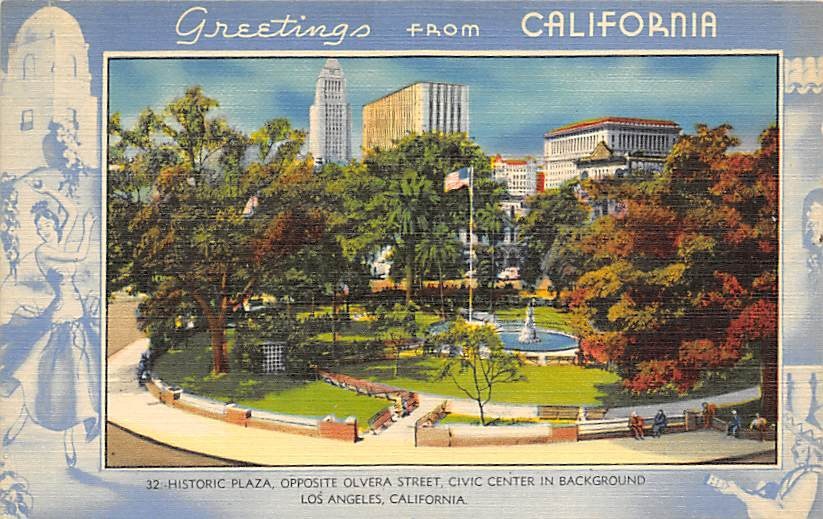
The Plaza in a 1940s postcard.
From El Pueblo’s beginnings, ethnic and cultural diversity has enriched the population of what became Los Angeles. Multiple immigrant communities searching for a better way of life put down roots, providing a rich tapestry of foods, arts, music, and ideas, the lifeblood of our community. This blending of languages and cultures gave Los Angeles heart, character, and roots. The Plaza at its heart became a city gathering place. It hosted speakers and musicians chronicling the city and its politics as the early community’s free speech area, and then later saw officials round up people to repatriate to Mexico. More than 90 years later, protests over the seizure of immigrants and resident citizens took place in and around El Pueblo, reechoing the past.
Forty four hardy pioneers – Spanish, Natives, Africans, and mixed race colonists – walked six miles from the San Gabriel Mission to establish El Pueblo de Nuestra Senora la Reina de los Angeles de Porciuncula September 4, 1781 on land actually belonging to Tongva and Gabrielino tribes but under the control of Spain. These new settlers brought courage and determination into developing and growing a thriving settlement. Their successful cultivation of grapes and other crops demonstrated the richness of the land, eventually luring other adventurers westward. Little did this small band of pilgrims realize they were planting the seed out of which a mighty and culturally diverse city would grow.
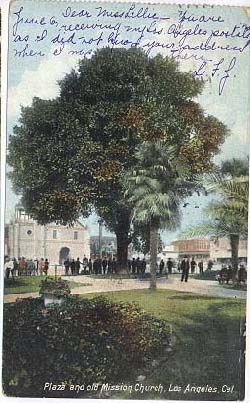 For the next 100 years, the area around the Pueblo and its plaza matured under Spanish and then Mexican leadership, part of Alta California. The construction of Zanja Madre, the mother ditch which brought life nourishing water from the Los Angeles River, allowed cultivation of diverse crops in the rich, fertile soil. Alta Californios succeeded on ingenuity and traditional techniques passed down through generations.
After military troops commanded by John C. Fremont defeated local Californios led by Andres Pico and acquired the territory for the United States in 1847, white settlers gradually migrated westward. The boom and bust of Gold Rush fever around the Sacramento River after 1849 led disillusioned miners to immigrate to little Los Angeles, a trickle that would explode into gushing streams of residents. These new migrants expanded the city southward and westward and away from the Pueblo, beginning the massive explosion in population turning the tiny burg into metropolis.
As these people moved away, however, the area around the plaza became a diverse oasis, home to not only the city’s Mexican population, but also its Chinese and Italian migrants. Staying together gave them strength and sense of purpose. Over time, the area surrounding the Pueblo grew time worn and shabby, as the city increased investment in more upscale neighborhoods, while neglecting its original heart.
The first decade of the 1900s witnessed increasing industrialization around major cities and the shrinking of rural America as big business and capitalists merged corporations and companies and loosened safety regulations. Labor union membership exploded as workers increasingly protested exploitation, especially at a time of deep financial uncertainty after the Panic of 1907. The stock market came close to crashing after an attempt to corner the market of Augustus Heinze’s United Copper Company, leading to a run on banks and collapse of brokerages and causing crowds to demand action and change around the country.
The city of Los Angeles opened the Plaza at the heart of El Pueblo as a place of free speech in 1909 in the economic fallout, after virtually shutting it off everywhere else around the metropolis in the wake of protests. The Los Angeles Daily Herald and Councilman Wallace led the charge to allow free speech again, with Wallace stating in council, “Good government is helped by allowing free speech. Large liberty in free speech is beneficial. Restraint is considered persecution and any propaganda increases under persecution.” Street preachers, progressives, Communists, union leaders, and others both denounced living and working conditions and offered their own solutions for improving life when allowed to speak again at the Plaza.
Rallies in the Plaza grew more pronounced after October 1929 as the stock market crash decimated American’s fortunes and livelihoods. Socialists and Communists urged working together to end hunger, poverty, and exploitation, while the unemployed sometimes congregated at the Plaza. Angry at those demanding change of the status quo, many conservative civic leaders and police urged stronger measures “protecting the city from agitators and subversives,” from arresting people to committing violence. Law enforcement followed through, arresting outspoken protesters at the Plaza, breaking up rallies, and putting leftist groups under surveillance. Speech was now often censored by police who prevented some from speaking or arrested others for their vocal condemnation of conditions and urging those present to fight back.
Across the country, many angry and resentful citizens took their economic frustrations out on immigrants, blaming them for terrible conditions and lack of work. Many urged the deportation and repatriation of virtually every immigrant from anywhere in the world, especially Mexicans, even though many of these people provided the backbreaking labor needed to pick the food people ate. Immigration officials found the Plaza an excellent location for meeting quotas and rounding up people of various nationalities to deport to their home countries. Beginning in 1931, they visited the site to nab unexpecting immigrants as well as American citizens and immediately “repatriate” or deport them to Mexico. By the end of the year, newspapers wrote, “Labor shortage due to repatriation of thousands of Mexican vegetable field workers faces the Southwest today.”
More than 90 years later, protestors once again took to the streets as history repeated itself. Fervent protests against the seizure and disappearance of immigrants and U S. citizens alike arose near El Pueblo and its Plaza, the original free speech hub of Los Angeles. The city seemed to be reliving tragic moments of its dark past. The ebb and flow of history continues, recalibrating the importance of the Spanish and Mexican heritage and influence in establishing and developing our city.

 ladailymirror.com