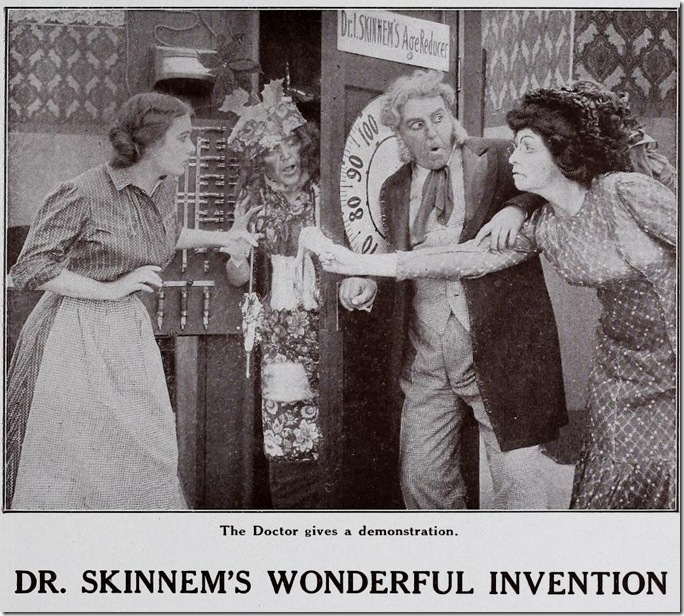
A still from Kalem’s Dr. Skinnem’s Wonderful Invention (1912).
Long before the advent of trailers, television, and the internet to publicize movies, photographic stills sold motion pictures and stars to the general public. Scene stills were originally simply used as illustrations to sell movies to theatre owners through exhibitor bulletins and to suggest genre and action to potential audiences. Over the next couple of decades, studios developed new ways to organize and produce the images, as well as forming stills departments to organize the production and development of photos.
A new form of entertainment at the dawn of the twentieth century, moviemaking possessed no rules or regulations in how to create, market, or exhibit films. Early pioneers made it up as they went along, finding the best practices and tools in how to organize their industry. Producers and studios at first copied publicity and selling tools of theatre, the circus, and vaudeville, creating eyecatching lithographic posters to attract consumers and shooting photographs of important scenes more as marketing tools to exhibitors.
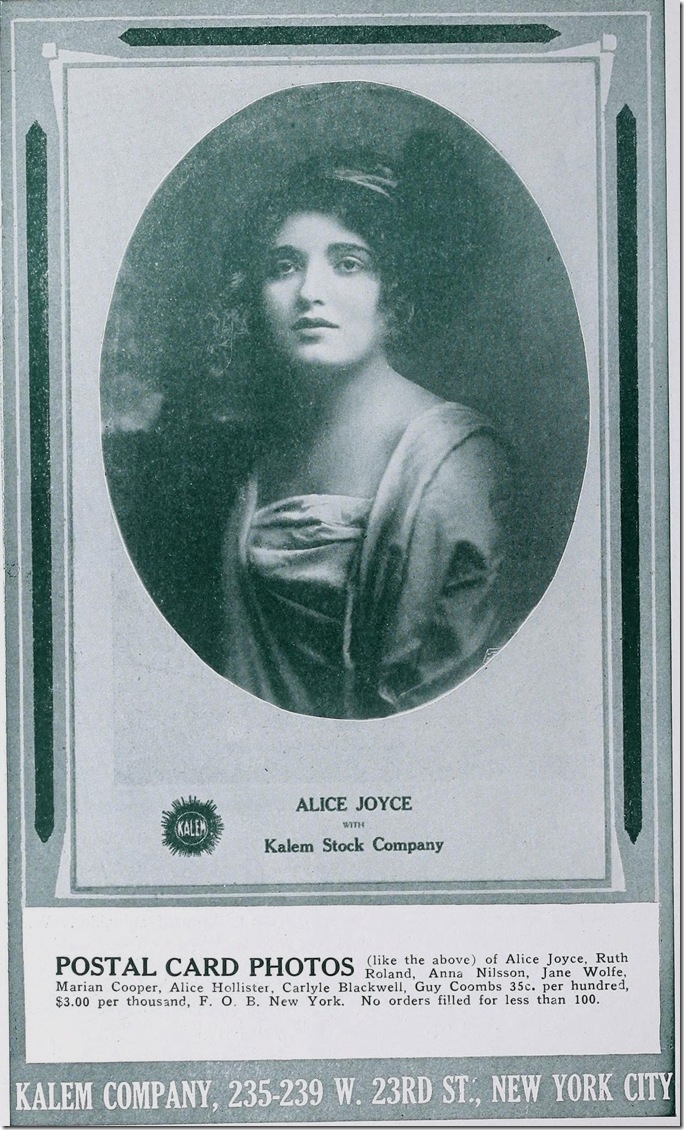
Alice Joyce, one of the Kalem Stock Players, promoted in a 1912 postcard.
Cameramen quickly organized actors at the end of scenes to shoot still photographs for publicity, virtually ignoring portrait photography in the late 1900s and early 1910s. Many of these early cameramen had served as photographers before joining the business, so possessed some experience in shaping a mood or image through their lens. Scene stills received virtually no credit on publishing in the early 1910s, as it was considered mostly the work of the studios’ cameramen. These men employed 8×10 glass negatives for these publicity images, rendering them highly detailed and precise, like high res digital today.
Studios focused on scene stills as their early marketing elements, trying to shape publicity as they painted with light. They hired leading photographers in their cities to shoot portraits of each studio star to employ on their selling materials and to create personality posters for theatre lobbies. As early as 1910, Kalem employed a composite image of their stock company in publicity materials, later employing the individual images to sell personalities such as as postcards or stills for film fans by 1911. Other studios followed suit shortly thereafter. For the occasional prestige or blockbuster of its day, studios would hire a leading portrait photographer to shoot stylized portraits and scenes of films, such as the ones Albert Witzel shot of Theda Bara for the Fox films “Cleopatra” and “Madame Du Barry” in 1917, all credited to him.
Film personalities quickly realized that studios’ main focus was selling films, not stars. Copying practices of theatrical and vaudeville headliners, they paid for a series of portraits with top photography studios, such as Witzel, Frank Hoover, Nelson Evans, and Fred Hartsook in Los Angeles, the forefathers of film portrait photography, distributing the prints themselves to magazines and newspapers to build their own recognition, popularity, and salaries. Stars could spend thousands of dollars for up to 10,000 of these glamorous headshots, which often included candids around holidays or fashion. While these images gave them name recognition and glamour, they sometimes produced a widely different image of the personality than what the studio hoped to project.
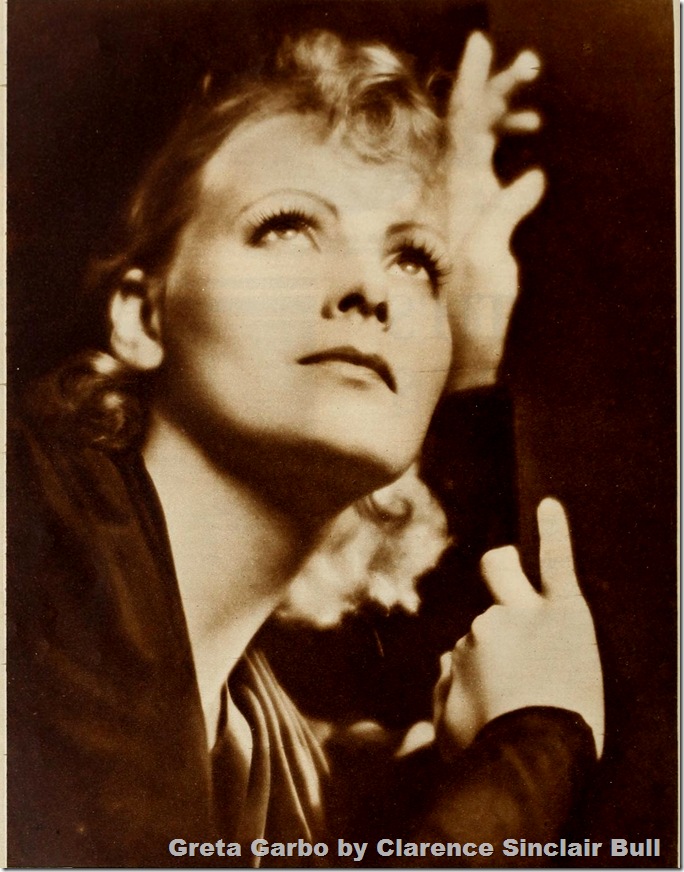
Greta Garbo by Clarence Sinclair Bull, Screenland, 1930.
For several years, studios followed both these practices, though exhibitors and trade magazines began reporting on the bland and stale look of the scene still images. Colin C. Solomon described the proper usage of scene stills in a thoughtful 1917 Moving Picture World article. He called a good advertising still “a high quality photo showing striking action and good lighting. Such a “still” will reproduce into a cut or enlargement that cannot fail to attract attention, and to attract attention in a prime purpose of motion picture advertising.” To his mind, this type of photographer should be a newspaper stringer or advertising man, one who could create dynamic action rather than that of a posed still at the end of a scene. Most of these film cameramen had come into the field as artistic photographers, and often arranged something elegant rather than something that truly sold pictures. Through the 1930s, trades would implore the need for “pictures that tell a story.”
Production output came to be more organized at studios as well, as they shot more and more images as film stock and cameras improved and magazines and newspapers turned more heavily to photographic images to illustrate stories. Cameramen originally shot and produced their own images, but as film and still production increased, they often outsourced development and production of stills or hired independent contractors for these services. Studios often appointed one person to head the stills department and another to head the dark room, with assistnts to help in the processing and development.
To keep track of their productions and later all the stills, studios created a code system. Many started with the number one and ascended numerically, but others created their own system, such as Fox employing directors’ names and numerical codes, others using a lettering system that referenced the film title, and so on. When they began shooting and organizing portraits and off camera images of stars, studios created a code system for these just as with scene stills, some studios starting once again at number one and ascending and others employing the initials of the star’s name. Each company also eventually created their own code system to organize costume, set, makeup, and location reference stills, usually employing the production code number for each title. Some studios even created their own general publicity codes as well.
Unfortunately, codes were could be changed at the last minute. Some stills are listed under the original title, not release title. Employees sometimes made mistakes, noting the wrong code on stills or attaching the wrong snipe to an image. At times, states’ rights’ exhibitors or distributors would change names or create their own codes, causing even more confusion.
Deciding to take all photographic images under the studio umbrella, conglomerates began organizing their own stills departments in the early 1920s, differentiating labor as with other departments and divisions in order to speed production and save money. The leading portrait photographer often headed the entire stills department, in a hierarchy composed of stillsmen, off-camera and special event specialists, and lensmen to shoot set, costume, makeup, and location reference stills. Other assistants did the back breaking work in the lab of preparing chemical baths, processing and developing prints, retouching, noting code and attaching snipe, and sending them on to publicity for Production Code approval and use.
Photographers though, sometimes filled in for others due to busy production schedules, illness, or slowdown in work. Studio head Clarence Sinclair Bull sometimes shot set reference stills at MGM, placing himself so his reflection would be visible in mirrors or other reflective surfaces and sometimes even blind stamping prints with his name.
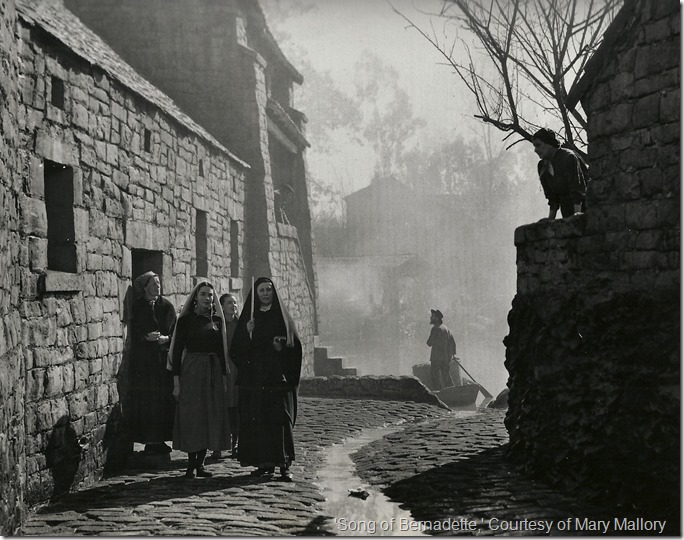
“A close second as the Best Production Still Out-of-Doors, is this beautifully composed and lighted scene from “Song of Bernadette,” 20th-Century-Fox production, by Stax Graves,” entered in the Academy of Motion Picture Arts and Sciences stills category. Courtesy of Mary Mallory.
Much of the focus in these newly created stills departments focused on creating all types of publicity material to promote both productions and stars for press booklets and exhibitors, but especially for magazines and newspapers, read by most people in the United States at the time. These images were freely mailed by the studios to these trades and papers by the thousands in a quid pro quo system, as the print media required thousands of images to fill the many pages of their editions.
Studios only required the acknowledgment of the studio in a caption if images were printed. To assist these papers and magazines and their myriad departments, studios shot candids of stars preparing food, playing sports, modeling clothes, traveling to scenic locations, appearing with pets, working around the home, participating in hobbies, and posing for holiday stills. Candids would also be shot on filming locations, on trips for premieres, around town, anything that could help promote stars or movies. While they still often shot 8×10 negatives on black and white stock, an occasional Kodachrome session could occur for very special shoots and some candid photographers used more high speed cameras rendering 4×5 negatives and prints.
In the 1950s for example, trades noted that Fox Studios sent out 50,000 stills to promote its blockbuster Cinemascope film “The Robe” before it opened, hoping to build gigantic name recognition. At the same time, they never sent any of these images to the United States Copyright Office to copyright them, as that would defeat the purpose of disseminating them as widely as possible around the country.
Over the decades, exhibitors and trades people often denigrated the quality of equipment and scene stills, calling the images too static and bland. American Cinematographer magazine wrote as early as 1924 that a studio photographers association should be formed to establish procedures and regulations. Some trade magazines like International Photographer began printing artistic stills of the month.
All the men’s backbreaking work received little recognition from the studio and often indifference or hostility from stars, directors, and press. In 1937, International Photographer wrote in an article called “Credit Due Stillsmen,” ““…the least credited or discussed photographic group consistently producing stuff of high quality as part of their routine work are studio stillmen. Probably the greatest job of photographic salesmanship in history has been turned out by studio still photographers. The job of merchandising personalities — and particularly the many facets of feminine allure — has been accomplished under a variety of hindrances, censorships and other limitations never encountered by the widely exploited photographic wizards in other fields. The work of studio still photographers in this respect has held to a consistently high average, as evidenced by the record of success in introducing and exploiting personalities — through many years by many individuals.
“Because of the mass production systems of the major studios and the fact that ace photography supplied to publications seldom is credited, many studio stillmen work in anonymity that amounts to oblivion in comparison with the personal publicity accorded photographers in other fields.”

First award for Best Pin-Up was given to Ray Jones for a photo of Ramsey Ames. From Popular Photography, February 1944.
Eventually John Leroy Johnston, a member of the Academy of Motion Picture Arts and Sciences Publicity Committee, organized a AMPAS Stills Competition among the studios lensmen in 1941 through 1943 and 1947, in which they received medals and certificates for their work, before it was exhibited both in Los Angeles, New York, and across the country.
By the 1950s, stars themselves sometimes hired their own special photographers to shoot unique and more sexy portraits and stills than the studio for which they worked. The system began slowing and breaking down as television grew increasingly popular, leading to the creation of TV spots to promote films. As the studio system slowly imploded, so did stills departments, with more and more work simplified or outsourced. Now, most work is handled by independent contractors, hired for each individual production to create publicity images.
Over time, much of the history and paperwork regarding the creation of movie studio stills departments and procedures has been lost. While some of the major stillsmen wrote and published books about their career and work, much is still unknown about the day to day process of a Golden Age Hollywood still department and how its employees were assigned to productions. The digitizing of trade journals and fan magazines helps open the door to more knowledge, but continued scholarship is required to fully acknowledge the evolution and importance of stills photography in publicizing movies and creating the glamorous icons we still worship today.

 ladailymirror.com