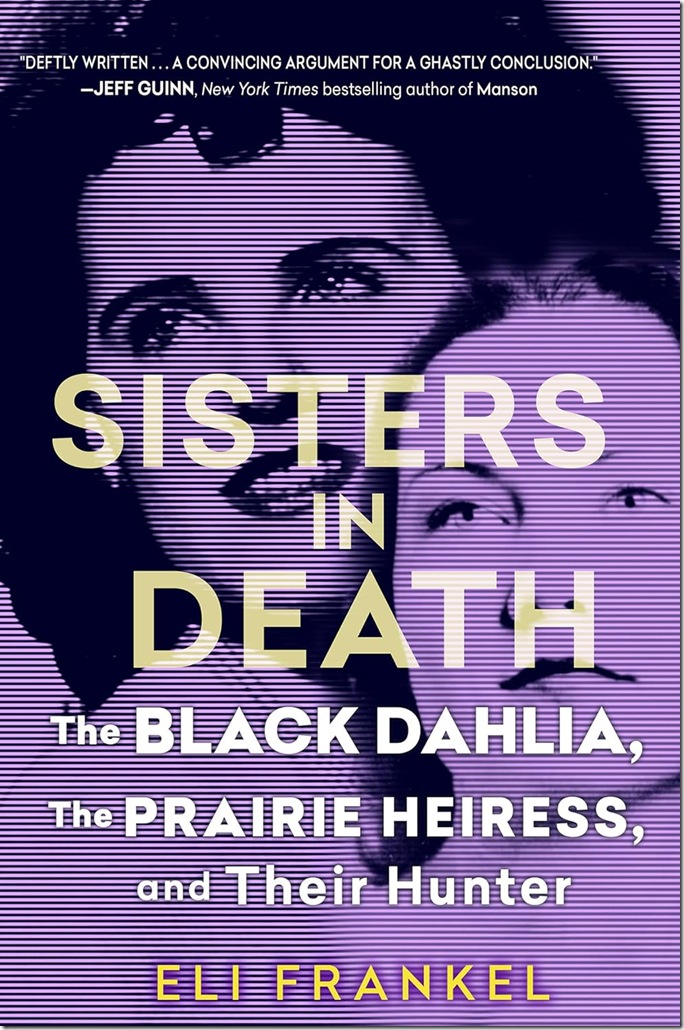
Sisters in Death: The Black Dahlia, the Prairie Heiress, and Their Hunter, by Eli Frankel, Citadel Press, 400 pages, October 28, 2025. $29.
Yet another book that treats the murder of Elizabeth Short as a game of Clue in which an author thumbs through a list of suspects and produces a half-baked “solution” using torturous leaps of logic and fraudulent claims as necessary. A zealous but amateurish project that attempts to link two murders separated by five years and 1,600 miles that have nothing in common, implicating a man who committed neither murder. Only for “true” crime fanatics who are unconcerned with reality.
::
Sisters in Death is evidence of the dismal state of the “true” crime genre (truly there is no bottom to this market) and further proof, if any were necessary, that unsolved murders exert a powerful magnetism on one another in the public imagination. Cold cases separated by years, hundreds of miles and completely different methods miraculously become “just like” one another, the work of a shrewd serial killer who is always one step ahead of the hopelessly incompetent police. At least for the purposes of a devious author who isn’t shy of fabricating facts – and there is something about the Black Dahlia case that fosters lying among writers.
The accused “murderer” in question is Herman Carl Balsiger, who has been linked through crackpot internet theories to the March 9, 1941, killing of Leila Adele Welsh in Kansas City and the January 15, 1947, murder in Los Angeles of Elizabeth Short, better known as the Black Dahlia.
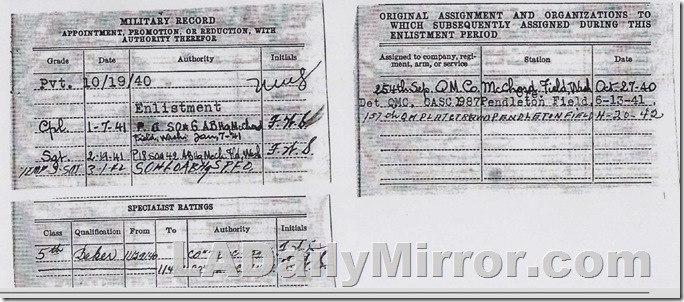
Excerpts from Carl Balsiger’s service records show that he was stationed at McChord Field, Washington, in October 1940, and was reassigned to Camp Pendleton in June 1941, completely covering the date Leila Welsh was murdered. He didn’t do it.
According to March 10, 1941, Kansas City Times and Kansas City Star: On the night of Welsh’s murder, the killer entered her bedroom as she slept, beat her in the head with a hammer and slashed her throat with a butcher knife, which he used to cut away her pajamas and cut “a large piece of flesh from one hip.” He then jammed an old shirt into Welsh’s slashed throat and covered up the body (still in bed) with the sheets. He fled, leaving the hammer at the foot of the bed, the knife stuck in the ground outside the Welsh home, and the piece of flesh 900 feet from Welsh’s bedroom. He also discarded his cotton gloves.
In other words, a blitz attack on a sleeping victim who was found where she was killed; a bloody, disorganized mess with the murder weapons nearby. This is nothing at all like what police found in the case of Elizabeth Short, in which the killer murdered her elsewhere, drained her body of blood, bisected it with surgical skill, and washed and scrubbed it before leaving it in open view on Norton Avenue.
Balsiger’s service records, which I obtained from the National Personnel Records Center in 2017 under a Freedom of Information Act request, show that he was stationed at McChord Field, Washington, from October 27, 1940, to June 13, 1941, when he reported to Camp Pendleton, California, covering the March 9, 1941, date of Welsh’s murder. Frankel must fraudulently claim that Balsiger was assigned to McChord in February 1941 (he was already there) and invent two weeks leave in Kansas City so Balsiger can commit the murder. This is shameful work.
The link to Elizabeth Short’s murder is a bit more grounded in reality in that Balsiger at least knew her, but the extent of the relationship is different from what Frankel claims. Balsiger’s involvement with Elizabeth Short occurred in the few days before she left Hollywood for San Diego in December 1946. Balsiger told investigators he drove her to Camarillo, where he and a partner were opening a business. He brought her and his partner back to Los Angeles the next day and Balsiger put her up in a room. The next day, Balsiger took her to the bus station in Hollywood to go to San Diego. And like almost everyone who encountered Elizabeth Short, he said he never saw her again.
Frankel states with bizarre authority that Balsiger’s name was merely scrawled on a bit on paper included in the items that the killer sent to the Los Angeles newspapers, and doesn’t appear in her address book. (Yes, it does).
Elizabeth Short and Balsiger overlapped at Camp Cooke, California, from June 1, 1943, to August 25, 1943. By this time, Balsiger was a first lieutenant and company commander training with the Sixth Army while she was working at PX-1 and living in a civilian dormitory on base. The camp had a population of 36,000 people (larger than the current population of Beverly Hills) and it is a staggering leap of imagination to assume that everyone knew everybody else.
Frankel’s maneuver is to accept without skepticism an unverified rumor (published in some newspapers at the time and given credence in John Gilmore’s wretched book Severed) that Elizabeth Short shacked up with a soldier known as “Sergeant Chuck,” who was notoriously brutal. According to this never-proved myth, Elizabeth Short reported “Sergeant Chuck” to his commanding officer and “Sergeant Chuck” was sent overseas, providing a motive, at least among armchair sleuths. It should be noted that investigators were never able to locate the mysterious “Sergeant Chuck,” though he lives on in some of the reports from Los Angeles County District Attorney’s Lt. Frank Jemison – which is why one must always be careful about old records.
In Frankel’s “solution,” 1st Lt. Carl Balsiger becomes “Sergeant Chuck.” And although Balsiger’s service records and news accounts establish clearly that he was a baker, Frankel goes off on a claim that Balsiger was a butcher (no, he wasn’t) and that whoever killed Elizabeth Short was most likely a butcher rather than a “very fine surgeon,” as stated by lead Detective Harry Hansen in testimony to the Los Angeles County Grand Jury.
There’s more, but really, this is a book that isn’t worth my eyesight or anyone else’s. I stopped reading when Frankel claimed that the responding officers moved Elizabeth Short’s body, an assertion that has no basis in fact and is demonstrated by the crime scene photos, which are all over the internet.
Otherwise it’s an example of how a zealous author can have some reliable information and interpret it in terrible ways, forcing it to conform to his “solution.”
Oh and in case you’re wondering, Frankel never mentions George Hodel or Steve Hodel, though I get few mentions for my 1997 Los Angeles Times article for the fiftieth anniversary. And it’s clear that Frankel is “quite familiar” with my research, shall we say.
To anyone who knows anything about the Black Dahlia case, there are staggering mistakes on virtually every page. Almost unimaginably bad.

 ladailymirror.com