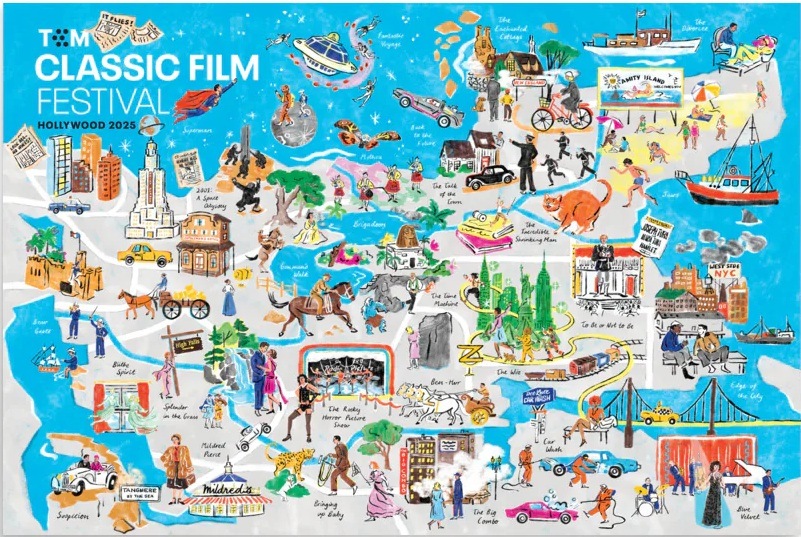
While not quite as elaborate as in past years, the 16th Annual TCM Classic Film Festival still offered a tasty smorgasbord of movies, special events, and programming for classic movie fans. Spread out over four days and multiple venues at the end of April, the festival traveled the globe with its helpings of entertainment and education, meant to draw everyone from classic film fans to social media influencers to celebrity chasers.
Opening night featured travel to a galaxy far, far away with a screening of the seminal “Star Wars Episode V: The Empire Strikes Back,” preceded by introduction and salute to filmmaker George Lucas. High end passholders walked the red carpet along with celebrities before the grand festivities.
As usual, organizers created an elegant throwback in the Roosevelt Hotel’s Club TCM, with the feel of a classic era nightclub or lounge. Oversize portraits of such glamorous stars as Elizabeth Taylor, Gloria Swanson, Norma Shearer, and Paul Newman graced its walls. Display cases featured stylish costumes worn by Joan Crawford in “Mildred Pierce” (1945) and another film, Elizabeth Taylor in “Who’s Afraid of Virginia Woolf” (1966), Michelle Pfeiffer as Catwoman from “Batman Returns” (1992), and a Dolores Del Rio outfit.

For the first time in decades, moviegoers could enjoy the mostly forgotten and little screened technology, VistaVision. Paramount’s answer to Cinemascope, is 35mm negative oriented horizontally in camera, resulting in a larger, higher grained print which was printed down to regular 35mm in order to be shown on regular projectors. Academy Award winning special effects artist and historian Craig Barron and Charlotte Barker, Director of Film Preservation and Restoration at Paramount, gave a detailed history and explanation of the format at the Roosevelt Hotel’s Club TCM and guests could check out the process at the screenings of “We’re No Angels” (1955) and “Gunfight at the O. K. Corral” (1957).
Scheduling choices allowed attendees to literally travel time and space to experience the unknown. Guests could walk with spirits in “Blithe Spirit” (1945) and “Spirited Away” (2001), or even extraterrestrial creatures in “Mothra” (1961) Those looking to journey to the past or future could do the time warp through “The Time Machine” (1960), “The Rocky Horror Picture Show” (1975), “Ben-Hur” (1959), “Earth Vs. the Flying Saucers” (1956), “Back to the Future” (1985), “Blade Runner” (1982), “2001 A Space Odyssey” (1968), and “Brigadoon” (1954).
I suffered from an allergy infection and cold which limited my screenings, which featured classic films with a decidedly prescient look at today’s tumultuous times. Thursday night I attended the wonderful screwball comedy “The Lady Eve” (1941). While returning home from a year’s research trip up the Amazon to study snakes, rich, bumbling Charles Pike (Henry Fonda) meets luscious con artist Jean Harrington (Barbara Stanwyck) and comic escapades ensue. Combining romance with deadpan slapstick pratfalls by Fonda and epic witty wordplay, the film remains timeless even now, enlivened by Sturges’ company of stock players. In this film, unlike today, con players and the super rich alike know when to step away without destroying regular folks in the process.
Ben Mankiewicz led an insightful discussion called “They Don’t Make ‘Em Like they Used To” at Club TCM, discussing the seismic sea change in the quality and quantity of films produced by major studios. While movie production began changing in the late 1940s with the selling off of distribution chains after the Paramount decree and then the rise of free television drastically reducing audiences, studios face even more challenges now. Changing viewing habits with streaming making it easy to skip theatrical screenings, rise of social media, Tik Tok, and the like, threaten to upend film production.
Actor Robert Townsend, professor Miranda Banks, and especially Sony chairman Tom Rothman offered thoughtful commentary on what conglomerates are facing. Rothman stated that while film production and the basic ingredients remain the same now, what has changed is the theatrical experience, making films either culturally relevant or important enought to force people off their butts to drive to a movie theatre. He reminded that only a few films kept classic studios and even today’s multinational conglomerates rolling each year, as the vast majority of films underperformed or sank at the box office. Audiences have changed as well, with a more homogenized audience going virtually every week in past times and a more fractured, slivered populace going in every direction today. Rothman stated its up to audiences to attend movies in theatres to keep thoughtful and adult driven product alive.
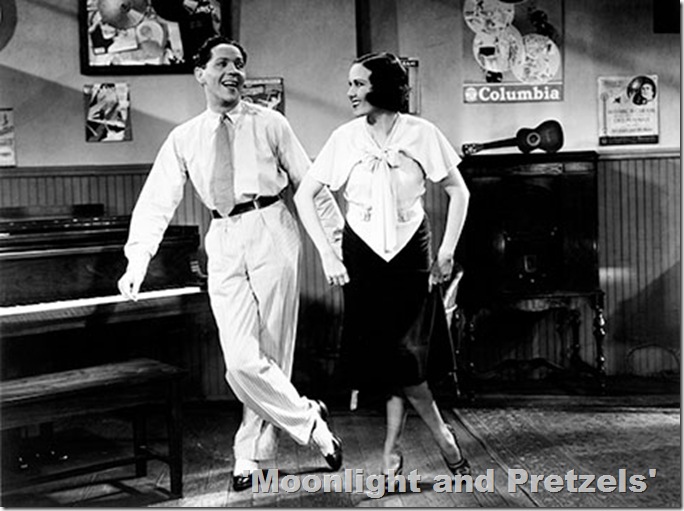
“Moonlight and Pretzels” (1933) was Universal’s poor man’s version of Warner Bros. “42nd Street” (1932). Featuring many of the same elements and designs, the film is a pleasant musical comedy that doesn’t quite hit the mark. Song plugger and vaudeville performer George Dwight (Roger Pryor) takes work in a small town sheet music store run by Sally Upton (Mary Brian) until he gets his big break to compose for Broadway shows. Will his chance to produce his own musical revue survive scheming producers and Damon Runyonesque gamblers?
The sheet music store and even musical sets featured typical arcane subjects and designs of the period: moons, art deco, instruments, food, and even beer. The songs don’t quite jell and the plot gets muddled near the end as it apes many of “42nd Street’s” more successful scenes, especially that film’s “Forgotten Man” number, featuring beautiful silhouettes of scantily clad showgirls. Future film Hitler Bobby Watson plays an effeminate, gum-chewing choreographer who throws around the phrase “She gives me hangnails!” Both William Frawley as his usual irascible character, and Leo Carrillo as a suave if unsophisticated gambler bring comic charm. Veteran silent star Herbert Rawlinson gets a nice supporting part as a slimy gangster.
Dwight’s so-called masterpiece revue, “Moonlight and Pretzels,” is a muddled melange of numbers, showcasing everything from German biergarten to scantily glad showgirls waking up to a song about waking up in time, mixing in lyrics about censorship for their low cut costumes and performing in simple Busby Berkeley-lite choreography. The grand finale of the revue highlights its’ “forgotten men,” the unemployed with holey shoes looking for work thanks to the Great Depression and stock market crash, eerily similar to what may coming in a few weeks. Headlines flash by: “Six Million Unemployed,” “Homelessness Rising,” “Children Hungry.” Franklin Delano Roosevelt’s election promises “Happy Days Are Here Again.”

My final film of the festival was the best: the newly restored 1926 silent film “Beau Geste.” Archivists James Mockoski and Robert Harris have done a masterful job combining three prints and digital cleanup to provide a lovely looking 35mm print of the action classic. Rodney Sauer and the Mont Alto Motion Picture Orchestra provides a moving score, combining rousing marches, exotic Eastern influences, foreboding atmospherics, and lilting family tunes. It offers perfect emotional support to a stimulating, action driven film.
Director Herbert Brenon delivers fine pacing, tight compositions, excellent lighting, and visceral action. Acting is uniformly good, from William Powell’s smarmy Boldoni, to Alice Joyce’s loving aunt, to Norman Trevor’s honorable Major de Beaujolais. Noah Beery’’s villainous Sergeant Lejaune is as venal and sadistic as the current ICE Department. Ronald Colman, Neil Hamilton, and Ralph Forbes bring great chemistry and charm to three loving, rock solid patriots, loyal to friends, family, and country. They are truly the Three Musketeers, one for all and all for one.
Thanks to TCM for screening 35mm, nitrate, and VistaVision prints for the festival, providing a visual and technical education to filmgoers and featuring a diverse slate of films offering something for both cineaste and newbie film fan. They go to the wire to provide both a visual and educational feast for audiences, promoting the joy of classic film.

 ladailymirror.com