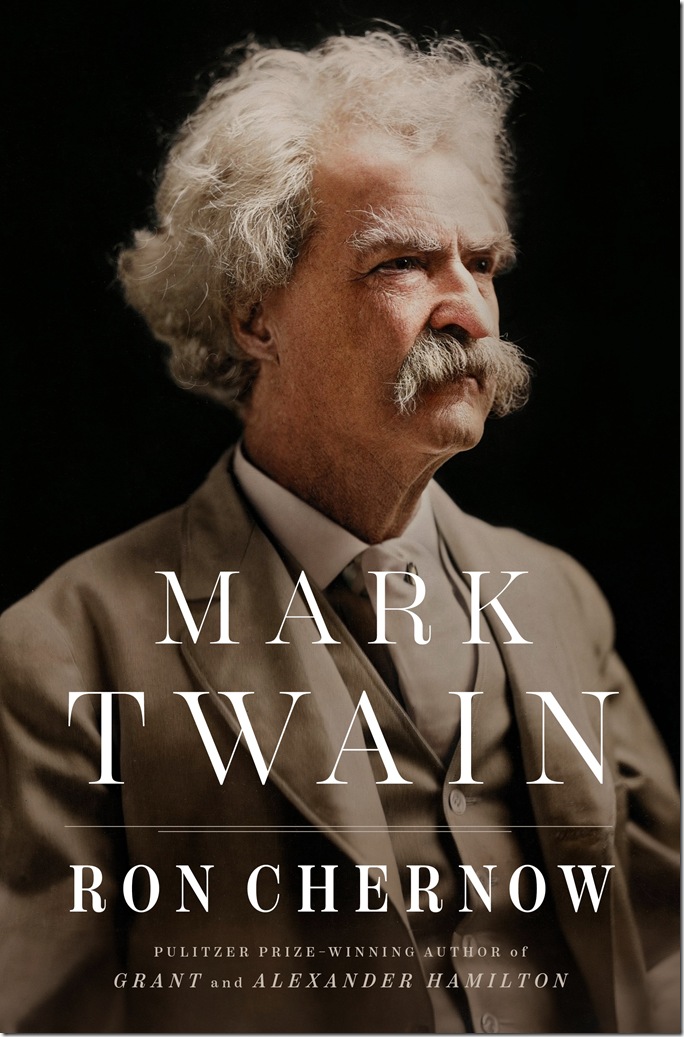
Mark Twain, Ron Chernow, 1,200 pages, Penguin Press, May 13, 2025. $45.
Pulitzer Prize-winning biographer Ron Chernow has compiled an exhaustive volume on Samuel Clemens, who as Mark Twain became one of America’s most beloved humorists and witty observers of the human experience. More of a rigorously researched encyclopedia at 1,200 pages and 3½ pounds, Chernow’s book best serves as an almanac or catalog of Twain’s carefully documented minutia about his life rather than a broad, accessible portrait of the author. Sales prospects should be excellent on this perennially best-selling subject, but recreational reading it is not.
::
Were I a more gifted writer, I would compose a review of Ron Chernow’s Mark Twain in the style of its subject, a man of sharp humor who lampooned prolix writing and loved nothing more than deflating overblown pretensions with a deftly placed barb. In Mark Twain, one of America’s most famous humorists is ill served with a long-winded biography that has a surfeit of details, little humor and less wit.
Above all other things, Twain was a storyteller, and this biography’s main weakness is that it lacks a story. There are people. There are events. There are details. But there is no storytelling.
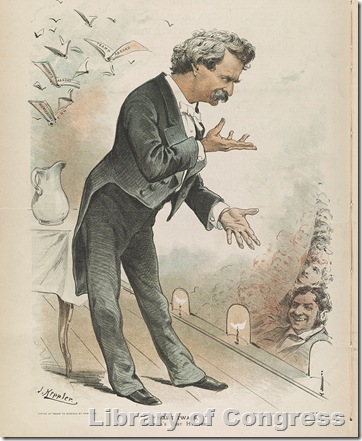 Like all writers, Twain drew on his life for his characters, was a terrible hoarder of every scrap of paper on which he dolloped ink, was insecure about his place among his contemporaries in American literature, and was a dreadful businessman, investing in countless harebrained schemes of the era. Most Twain aficionados already know this, and will presumably be hoping for a grand portrait of the man rather than a laser sharp focus on each brushstroke. At least that was my expectation.
Chernow says his goal was to “capture both the light and the shadow of a beloved humorist,” but the book languishes in the twilight of dull overcast and clouds of gray prose, lost in the endless banalities of daily life, which Twain dutifully recorded.
In his acknowledgements, Chernow says: “Writing a biography is a long, arduous hike to a very high mountain peak” and his ascent of Mount Twain has taken him to the fabulous Twain collection at UC Berkeley’s Bancroft Library (which Chernow accessed remotely during Covid and in person), various museums, and landmarks of Twain’s life in the U.S. and abroad. Chernow’s trek takes him past the deep crevasses and rugged spires of Twain’s staggering output: thousands of letters and articles, dozens of notebooks, unpublished manuscripts and the like to reach the summit.
This is the daunting challenge for any biographer, especially when faced with a subject who documented his life so thoroughly: Confronted with decision of what to keep and what to put aside in the “fine-grained detail” of Twain’s life, Chernow habitually errs on the side of inclusion rather than the sin of omission. It could be cut by half and nothing would be left out.
Because this is an exhaustive “important” biography written in the modern style, it begins with a detailed exploration of the oldest limbs of the Clemens family tree, dating to the 1500s, when a few lines would have sufficed. Even more unfortunate, concise writing is not one of Chernow’s gifts. And the combination is deadly.
Consider Chernow’s leisurely approach to the lineage of Twain’s mother, Jane Lampton:
Her father, Benjamin Lampton, was a prominent local citizen, having served as a lieutenant colonel during the War of 1812. As a skilled brick mason, he had constructed many fine buildings in town.
Chernow’s biography of Twain’s father is even more verbose:
A political Whig, with an abiding faith in internal improvements, he was appointed president in 1837 of the Salt River Navigation Company, assembled to dredge the nearby river and open it to steamboat commerce from the Mississippi River. He was likewise made a commissioner of the Florida & Paris Railroad, both projects wiped out by the panic of 1837 and a dearth of political support.
Nor can Chernow resist a dreadful pun:
Jane Lampton proudly claimed ancestry from the British Lambtons of Durban, giving her a dubious connection to a string of earls.
I assume this is the sign of an editor losing a battle with a writer over a favorite bon mot – at least I hope there was a battle rather than abandonment by an editor in a state of exhaustion. As a reviewer (name forgotten) once said: An editor must dislike a writer very much to let a line like this get through.
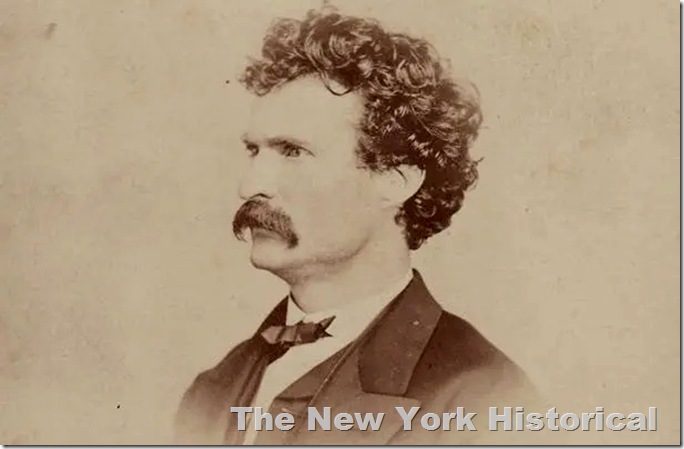
Mark Twain photographed in San Francisco, 1868, courtesy of the New York Historical.
I flipped ahead several hundred pages in hopes that the book would improve. It did not. Instead, the book bogged down in a catalog of what Twain bought while visiting Venice: brass plates, mirrors, a tapestry, oil paintings, brass bowls, an incense burner and a music box.
At a certain point, I realized that the book was never going to improve, but roll on for a bit more than 1,000 pages, followed by 74 pages of end notes, 15 pages of bibliography, and a 35-page index.
As this is a modern biography, Chernow makes a point of bringing contemporary sensibilities to 19th and early 20th century America, with numerous references to “enslaved people.” He grapples with the “N-word problem” (which appears about 15 times) and explores Twain’s now-discomforting late-life interest in college girls in their teens.
Twain, author of the hilarious critique Fenimore Cooper’s Literary Offenses, would surely be aghast at this voluminous tome, and it is notable that Chernow robs Twain’s iconoclastic essay of all life in the retelling. It is an achievement of sorts to turn this lively, inventive writer into a dull and ponderous subject, but Chernow has done it.
In the introduction, Chernow notes that Twain was “a waspish man of decided opinions delivering hard and uncomfortable truths.” The hard and uncomfortable truth is that given the subject, this book should be far better than it is. A major disappointment.

 ladailymirror.com
I’ve worked a couple of times with would-be writers who thought research was an end in itself and their audience would be impressed by as much uninterpreted detail as they could heap on the page. I could never get them to understand that quality always carries more weight than quantity and their job was to explain the subject, not dump raw data on the reader. The equivalent in fiction would be beginners who overdo the exposition of their stories rather than realize that plot only matters if the events are directed toward some emotional resonance.
LikeLike