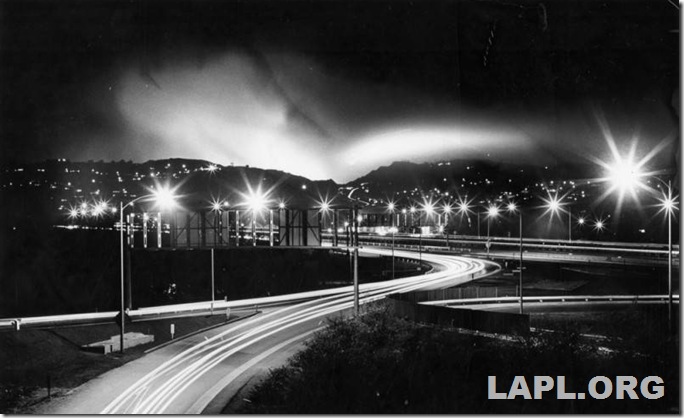
The 1961 Bel-Air fire in a time exposure. Photo by Alan Hyde/Valley Times Collection, courtesy of the Los Angeles Public Library.
Sadness and disbelief pervade Los Angeles looking over the tragic remains of the devastating Palisades and Eaton fires. People have been wondering, how could this happen? It already had, 64 years before in the cataclysmic 1961 Bel-Air fire, which burned more than 4,000 acres and over 450 homes, considered the most disastrous brush fire in Los Angeles history until this week’s blazes.
Dry chaparral, drought, overtaxed water pipes and supplies, narrow, winding canyon roads, rocky terrain, and high winds led to a massive fire that swept from Bel-Air to Mandeville Canyon over 35 hours, mirroring much of what has happened this week. A fire swept Topanga Canyon at the same time, threatening to push through canyons to Malibu and over canyon walls into the San Fernando Valley. Perhaps society should look and learn from its past to try and prevent disasters rather than pointing fingers at politicians and terminology.
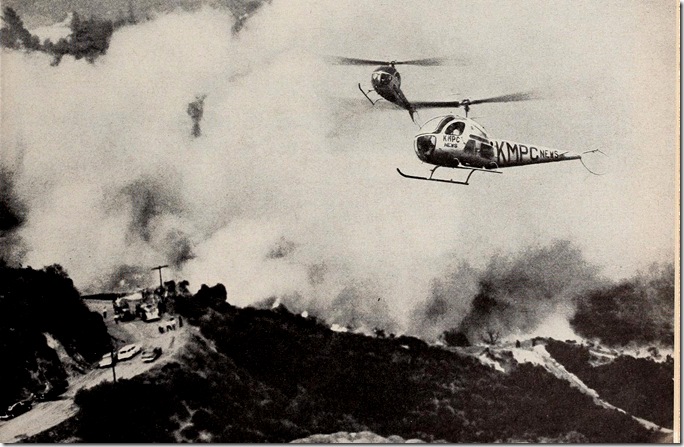
KMPC news helicopters covering the Bel-Air fire, Broadcasting, December 4, 1961.
Brush fires were a constant in 1961 thanks to a years-long drought. As early as January 12, Bel-Air suffered a small brush fire, a tiny foretaste of what faced the neighborhood just months later. Temperatures soared as speeding Santa Ana winds buffeted the area and just a match drop threatened major disaster. Early morning November 6, Los Angeles’ fire companies received word of high fire hazard that day, preparing for possible disaster.
Just minutes later, construction behind producer Keith Daniels’ home accidentally set off the massive blaze. Singer Billy Vaughan stated a bulldozer hit a rock behind the home, shooting off sparks that fell onto nearby brush. Though Daniels attempted to put out the sparks with a water hose, it instead exploded. Flames hopscotched Mulholland Drive to roar down Roscomare and Stone Canyon Roads, eating through brittle brush as it branches out both east and west.
Wind blowing over 50-60 mph and humidity as low to 8-10% pushed frightening flames. As the Los Angeles Mirror described the fight on November 7, “The flames raced towards the houses leaping high into the air and appearing to hurl themselves at the firemen and the houses.” Crews took to roofs to water down homes and raced to push out flames, unable to stop the roaring, wind-driven fire on its path westward. Embers flew for miles because of the hellish winds. Temperatures inside the heat created its own weather, developing a “fire storm,” a wind-driven hurricane similar to those created in atomic explosions or bombing raids, as newspapers reported.
Dry brush and open land fed the conflagration, pushed by high winds westward. More than 3,500 people fled their homes that Monday fearing for their lives, clogging streets. Some even abandoned cars due to stalled traffic, causing further delays. Others attempted to run home to retrieve pets. Most Los Angeles firemen rushed to the area, joined by soldiers and companies in the surrounding area, creating a force of over 1,000 men. Even with 106 fire trucks, 12 airplanes, two helicopters, and 10 bulldozers, the fire burned over 4,000 acres in a day. Water pressure in threatened areas was reduced by residents in adjacent neighborhoods wetting down their lawns and homes in attempts to save them.
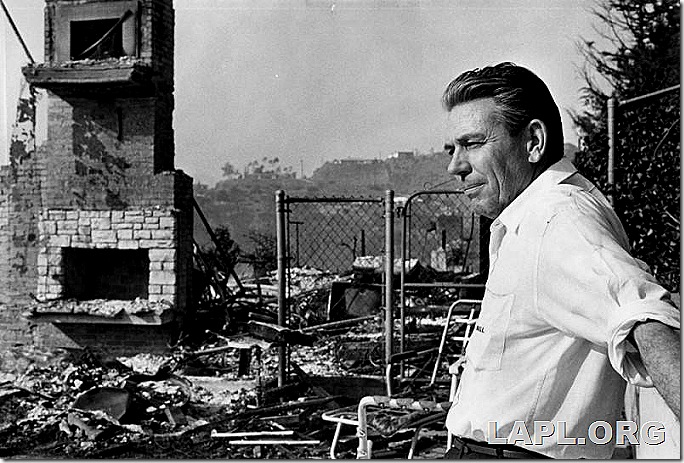
William H. Meadows looks over the remains of his home at 1515 Bel-Air Road, November 8, 1961. Photo by Jon Woods/Valley Times Collection, courtesy of the Los Angeles Public Library.
The fire flew westward south of Mulholland past Bellagio Road, Roscomare Road, and Chalon Road, burning vintage homes, new developments, and mansions. Homes built out of wood framing served as kindling. Water carrying helicopters and air tankers joined the fight, finding it tough going in mph winds. As crews fought the disastrous blaze, an arsonist set off an incendiary device in Benedict Canyon, adding to the misery.
What is now the 405 Freeway provided another catalyst to drive the fire west. Cleared of homes, the fire plowed through the land and construction equipment towards more canyons and homes, charring the landscape as it left a scorched earth path behind it. It picked up speed and strength as it approached Brentwood, jumping lines and canyons, with firemen fearing it would spread as far as Will Rogers State Park and Rustic Canyon. At one point, crews feared the Topanga and Bel-Air conflagrations would merge, exploding in size and power. Dropping fire retardant on Rustic Canyon prevented the two fires from entering Pacific Palisades or Malibu. Flames neared Pacific Palisade’s High School, Elementary School, and Presbyterian Conference Grounds before halting.
In 24 hours, more than 50 firemen and police suffered injuries battling the disaster, with three firemen hospitalized. The UCLA hospital treated 33 people for smoke inhalation and burns. Many pets unfortunately perished, as did wild life left with little cover or protection.
Bel-Air, one of the world’s ritziest communities, was virtually destroyed, leaving behind mostly chimneys, and soot-filled swimming pools in place of the palatial estates and opulent grounds of the exclusive community. Officials estimated property damage as high as s15 million, not including priceless items like jewelry, paintings, antiques, and furs. Brentwood, in the process of turning into another lavish neighborhood, witnessed great damage as well as fires ravished prestigious mansions and vintage bungalows as well as land.
Fire destroyed the homes of such stars as producer Walter Wanger, comedian Joe. E. Brown, actors Burt Lancaster, Zsa Zsa Gabor, Joan Fontaine. Celebrities such as Cary Grant, Kim Novak, Alfred Hitchcock, Marlon Brando, Bobby Darin, Ginger Rogers, Steve Cochran, Greer Garson, Jascha Heifetz, Peggy Lee, and Maureen O’Hara experienced damage to their homes or saw them barely survive. Walt Disney Studios sent two pumpers to Skelton’s five-acres estate, saving the house by pumping water out of the swimming pool.
Former Vice President Richard Nixon climbed the roof of his rented Brentwood abode to douse embers with a garden hose. He later told reporters, “I have seen trouble all over the world, but nothing like this.” Robert Taylor’s Mandeville Canyon ranch home survived the fire as two cowboys on his 113-ranch evacuated eleven horses and two hunting dogs. Firemen fought house by house in the canyon, saving all of its 500 homes.
Fred MacMurray almost suffered injury rescuing his family from flames. The anxious star sped to his home at 4851 Halvern Dr. to rescue his wife, twin daughters, maid, and dogs after hearing about the blaze at a nearby studio. The couple loaded two cars with valuables before driving them to a nearby service station. Returning to the home for a last load, they witnessed flames flying towards their home. Blocked by fire equipment, the couple ran to the house, retrieving their children, dogs, and maid and escaping in a third car just before the fire reached their home, which ended up suffering damage to its roof and upper floor.
Some major sites survived through to miraculous efforts by crews. Firemen took a “last stand” in Mandeville Canyon” as it became encircled by fire on canyon ridges, saving many of the area’s homes. A San Diego construction crew saved Mt. St. Mary’s College from destruction when they turned their 14 5,000 gallon tankers on the blaze when firemen ran out of water. While the Fine Arts Building, convent, and the third floor of the novitiate were destroyed, the college itself survived. Fire crept within a half mile of UCLA Campus.
By the night of November 8, officials declared the fire contained. Winds died, moisture filled the air, and crews devised containment lines that prevented advance of the blaze. Over the next three days, however, winds flare up, reigniting some embers and leading firemen to stand guard and monitor advancement. Ultimately, almost 6,100 acres 484 homes, and 21 outbuildings were ultimately destroyed in the Bel-Air fire, with losses estimated to top $15 million
Mayor Sam Yorty established a board of inquiry to investigate causes of the massive blaze and ways to provide greater protections to hillside dwellers as some water dropping pilots complained they were not deployed early enough. On Thursday, November 16, some proposed regulations were announced by Yorty’s committee, including outlawing shingle roofs, establishing mountain fire districts, creating stiffer parking regulations, fireproofing of stilt-style homes, and clearing brush within 100 feet of structures.
Over time, owners rebuilt, neighborhoods worked together to create a sense of community, and life slowly returned to normal. The city passed many of the investigating committee’s proposals, helping provide a small level of protection in hilly, difficult to reach areas that soon came to be overbuilt with gigantic homes, leading to some of the outcomes experienced this week. Overbuilding in a city still full of 80-100 year old water pipes is a recipe for disaster in a time of growing temperatures, roaring winds, and tougher drought brought on by the exploding effects of climate change.

 ladailymirror.com