
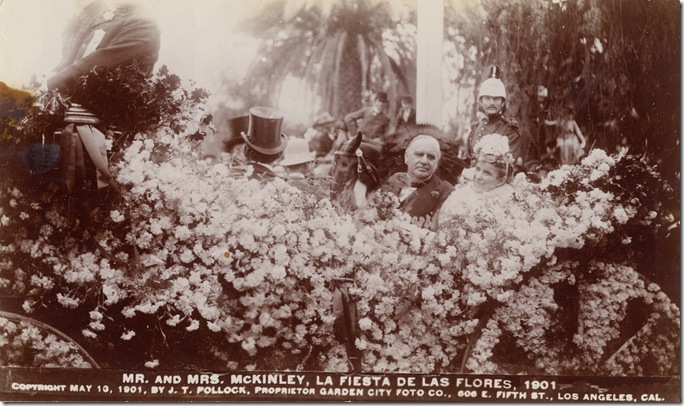
President William McKinley and First Lady Ida McKinley at La Fiesta de las Flores, 1901.
Though founded September 4, 1781 the tiny pueblo of Los Angeles featured little assets to lure large numbers of migrants westward looking to call it home. Population grew slowly for its first 90 years; starting with 44 residents at its founding, the hamlet counted only about 5,700 in 1870. It appeared to have little to offer new residents; located inland, it lacked a harbor, forests, major travel routes, or even much of a river, which appeared mostly as a trickle in dry months and only exploded during immense rains. After the city was connected to the transcontinental railroad in 1876, aggressive booster campaigns doubled or even tripled its population every decade for the next 50 years. One of the most successful ideas, the Fiesta de Las Flores, also known as the Fiesta de Los Angeles, publicized its fertile lands and romantic Spanish history in colorful, extravagant parades which lured tourists to consider residing in the flourishing community.
After a major United States depression in the early 1890s which virtually halted tourism and depressed business around Los Angeles, Max Meyberg, President of the city’s Merchants and Manufacturers’ Association, suggested a grand fiesta in spring 1894 to celebrate the city and its virtues. Owner of the successful crockery store the Crystal Palace, former President of the Metropolitan Loan Association, and Prussian immigrant, Meyberg fell in love with the area after migrating in 1875, and lavishly praised Los Angeles and environs for welcoming him and other strangers to start anew.
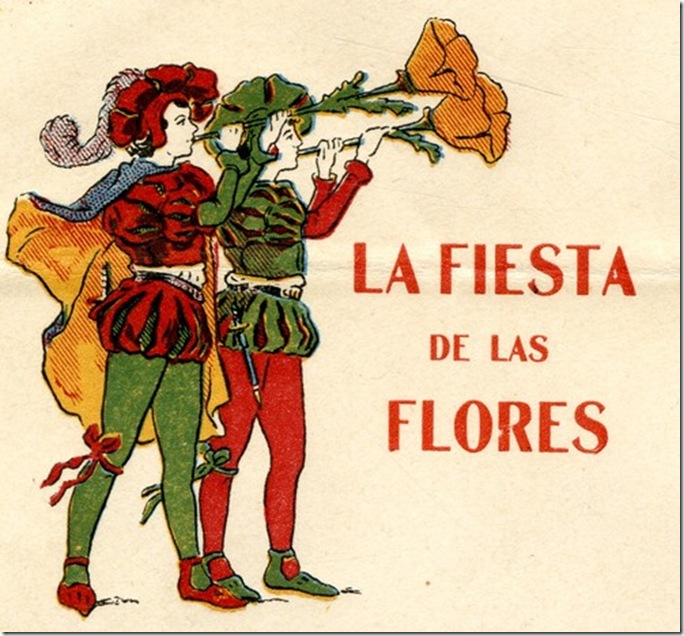
Trademark for La Fiesta de Las Flores, courtesy of the California State Library.
Organized similarly to New Orleans’ Mardi Gras, the event featured multiple parades, grand celebrations, and beautiful women to lure visitors back to the Land of Sunshine and inject money into the economy. Meyberg himself would later write, “I was inspired not only by the Mardi Gras of New Orleans but by a ‘midwinter’ fair being held in San Francisco and with the attractions, taken from the World’s Exhibition of Chicago, drawing crowds of people.”
Massive publicity campaigns promoted the extravagant proceedings across the Southland and the United States.Timed for April to coincide with the glories of spring, the Fiesta embraced and appropriated the area’s Spanish history and its rich, abundant crops in its themes and publicity. Main decorating colors orange, green, and red highlighted popular crops citrus, olives, and grapes, and were later incorporated into the city’s official seal. A highly popular naming contest offering prize money drew hundreds of entrants for a catchy slogan. While Fiesta de Los Angeles officially won, second place winner Fiesta de Las Flores gained more traction thanks to verdant flower and crop displays which demonstrated the area’s reputation as the nation’s breadbasket.
The week-long Fiesta opened with a ceremony featuring beautiful young ladies representing each town in Southern California, followed by a sparkling torchlight parade of flower-festooned buggies, carriages, and horse units later that evening. The main floral parade pushed off on Tuesday morning, ending at Fiesta Park at what is now Grand, Pico, Hope, and Twelth, followed by other parades which commemorated the city’s history, businesses, and crops, along with a children’s mini parade on Saturday.
Business groups representing Chinese and Spanish merchants submitted parade entries, hoping to gain respect and acknowledgment for their contributions to booming Los Angeles, though omitted from helping plan or organize the event. Chinese-Americans carried a colorful mock dragon down the streets as well, dancing underneath. At the conclusion of events, the parade earned a surplus of $900, besides drawing huge amounts of tourists to the sunny city. In 1895, the new organizer Chamber of Commerce renamed the popular event and parades the Fiesta de Las Flores, which more accurately represented both the entrants and subject matter.
In 1901, city officials organized an over-the-top Fiesta in May in honor of President William H. McKinley and wife visiting the city. “Lucky” Baldwin himself participated, riding in his grand coach and entering his prize horse Duke of Norfolk and his entire racing stable. Many prominent officials and residents dressed in period garb in commemoration of previous pioneers.

La Fiesta de las Flores parade down Spring Street, 1903, courtesy of USC Library.
After the city introduced incandescent streetlights in 1903, torchlight processions evolved into twinkling electrical parades, probably the very first held in the United States. Evocative lanterns and moonlight added to the romantic glow of the evening celebrations, casting Los Angeles as heaven on earth. The Los Angeles Express poetically described one of these lush evenings: “last evening the modern magician waved his hand and the business district was transformed into a kaleidoscope of scintillating colors… .” Visiting guests fell in love with the gorgeous city and its evocative dreams, drawing many to move here permanently. Looking to add fabulous luster to the 1906 event, city leaders hired Fawcett Robinson, leading float designer in the United States, to added polished panache.
Audiences and newspapers were overwhelmed, as the Los Angeles Herald on May 22 hyperbolically described an evening display as “Like some great shimmering monster, winding and twisitng its tortuous way through the streets of the Angel City, scintillating with a hundred thousand lights, flashing its soft radiance like the glow of a firefly, a riot of tropical color and splendor, with a scenery of fairy light… .”
Difficult to organize and fund, the Fiesta was discontinued in 1916, only to revived in 1931 for the city’s 150th birthday and drawing more than 300,000. The Motion Picture Industry hosted its own evening blowout Pageant of Jewels at Memorial Coliseum as part of the 10-day festivities. Organized at a cost of $500,000, the elaborate Fiesta de Las Flores earned $3 million in the heart of the Depression, a powerful leadup to hosting the Olympics Games in 1932.
The event disappeared again, only for the city to attempt multiple revivals over the years. In 1972, Los Angeles brightened downtown with a “Festival of Lights” during the energy crisis, but indifferent crowds stayed away, as they did with a recreation of a Fiesta parade a few years later. In the late 1970s, the city hosted L. A. Street Scene, an outdoor food and music festival, which drew crowds until 1986 when financial mismanagement and violence leading to one man’s death and four other seriously injured individuals quickly finished it. The city launched L. A. Fiesta Broadway to celebrate Cinco de Mayo in 1990, formally disbanding it in the 2000s.
Fiesta de Las Flores and other promotional campaigns throughout Los Angeles history promulgated and exploited the city’s Spanish and Mexican past without fully acknowledging, celebrating, or even assisting its Hispanic residents. The popular festivities intended to lure multitudes of Anglo residents to the booming metropolis, with no thought to actually honoring or acknowledging its original founders and residents, or to attracting further Hispanics to an area they helped mold. Its lush decorations and bountiful flowers offered shallow appreciation to Southern California’s actual Native American and Spanish past.

 ladailymirror.com