
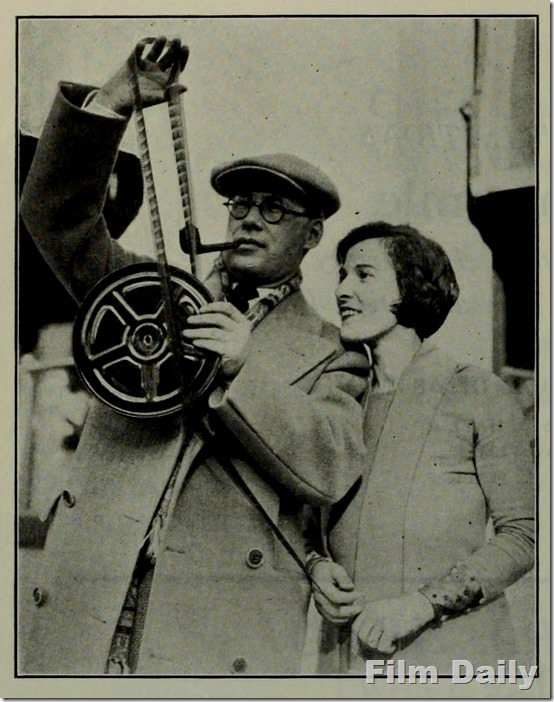
W. Scott Darling and Eleanor Fried Darling, Film Daily, 1926.
Women made the silent film industry the giant success it became during the 1920s. Thanks to their example in uplifting filmmaking, movie attendance skyrocketed among women. To maintain supply for this exploding demand, women were eagerly recruited to maintain production assembly lines. Females also flocked to the industry eager to land high paying jobs to contribute to family budgets, demonstrating their intelligence, quick thinking, and leadership skills both behind and in front of the camera handling anything thrown their way during the middle decade of the silent film period.
While many enjoyed long careers creating movie magic, others retired from the screen as they became wives and mothers, only to find their contributions forgotten. Jill of All Trades Eleanor Fried achieved great success editing, writing, and serving as business manager while single but found herself forced to abandon her career by her new husband, unable to fully fulfill her potential.

Eleanor Fried Darling, Moving Picture World, 1920
Born Eleanor Lena Fried in Grodno, Russia, June 9, 1891 (though other census records use years 1892, 1894, and 1899), she was the second of six children born to Jewish immigrants who fled pogroms looking for freedom and opportunity in America, where they settled in New York City. To help support the family, she began working as a stenographer at a law office in 1910 per census record, perhaps where she learned how to shape and edit stories to their essentials, cutting out waste and emphasizing motivation and character.
According to a 1916 story in trade journal Wid’s Daily, Fried began her film career at United Film Company and Warner Bros. several years before arriving at Universal. Motion Picture News reported in 1914 tht she was a member of Warner’s editorial staff, serving as more a fixer, expertly paring a story to its correct elements just prior to release. “…She assists in passing on all films submitted, and decides how those accepted should be cut and altered to procure the best effects.” Along with those duties, she selected scenes to be reproduced for posters and lobby cards.
Fried moved on to head Universal’s New York editing office in 1916, with the story falsely claiming she was “the only woman film editor in the world…. .” She did not cut entire films for release, but doctored those completed for best effect before their release in theatres. As a 1917 Picture Play story related, all executives attended screenings of first cuts for their comments and reviews, enabling her to put finishing touches on the film “along constructive lines.” In 1917, she moved west to Universal’s main lot in the San Fernando Valley to establish a finishing department, with Frank Lawrence heading the editing department.
Fried began a long association with director Erich von Stroheim in 1919, serving as one of the editors on his directorial debut, “Blind Husbands.” Along with Lawrence, Viola Lawrence, and Grant Whytock, they kept the great visionary in check in his story of a dastardly lieutenant who gets his comeuppance. According to trades, Fried would go on to assist in the editing of all von Stroheim’s Universal films, saying much for both her talent and diplomacy skills working for the artistic but challenging legend.
Perhaps to reward her leadership, outstanding work organizing the finishing department, and successfully working with von Stroheim, Universal named Fried business and location manager for the shooting of a 15 episode Marie Walcamp serial in the Orient in 1919. Balancing a budget of $200,000, Fried also coordinated 19 cast and crew members, managed publicity duties, shipped baggage and equipment, and obtained all filming permits. Many of the trades praised her work, with Motion Picture News titling a story, “Found: A Business Woman.” Though she obtained great publicity upon returning to Los Angeles, she once again settled in as editor and occasional story writer, looking for more opportunity and responsibility. Sadly, Universal let her go in 1923, and she began looking for work, with MGM eventually hiring her as a staff writer.
During her tenure at Universal, Fried somehow met writer W. Scott Darling, perhaps editing one of his films or scripts, as an ad he purchased for a trade magazine salute tor Carl Laemmle seemed to imply. Darling, born in Toronto, Canada in 1898, wrote two-reel scripts perhaps as early as 1914, focusing on slapstick knockabouts for Christie Comedies, before coming to Universal in 1923. After joining the studio, he began directing some of his stories as well, many featuring Arthur Lake. Later in his career, Darling wrote mostly B-movies, including some Charlie Chan scripts, Maria Montez’ “Cobra Woman,” and Laurel and Hardy’s “Jitterbugs.”
Fried and Darling married April 18, 1925, and she became stepmother to his daughter from a previous marriage, Gretchen. By this time, she was working as MGM staff writer. Variety noted in 1927 that she had written the story ”Three” for Lon Chaney in 1927, supposedly his next film after “Mr. Wu.” This is the last byline in which Fried received credit for a creative endeavor. By 1930, the Federal Census and the city directory list her as a housewife in Beverly Hills, as Darling struggled to find footing as a screenwriter.
Finding better opportunity overseas, the family immigrated to London in 1934 for Darling to work as screenwriter for various British Studios and American co-productions. After a year, he returned to the United States, but it appears that Fried remained behind for five years per Census and Naturalization Records. When war threatened in 1940, she returned to the United States, finally becoming a naturalized citizen November 20, 1943. The couple divorced sometime during this period. One newspaper squib in 1950 shows Fried in court with Darling’s current estranged wife, both looking for payment of alimony. Both wives made themselves years younger than they actually were by over 10 years.
Save for these few records, Fried virtually disappears from view after 1934. Did she work in a script or story department of a studio turning out stories, serve as script analyst, or perhaps edit? Per Social Security records, she died in California October 14, 1965.
Like many women in the silent film period, Fried demonstrated great initiative, talent, and ambition, only to be sidetracked by one reason or another from becoming a true leader in the field. She deserves recognition for her accomplishments in making the Hollywood film industry an economic behemoth and cultural touchstone.

 ladailymirror.com