
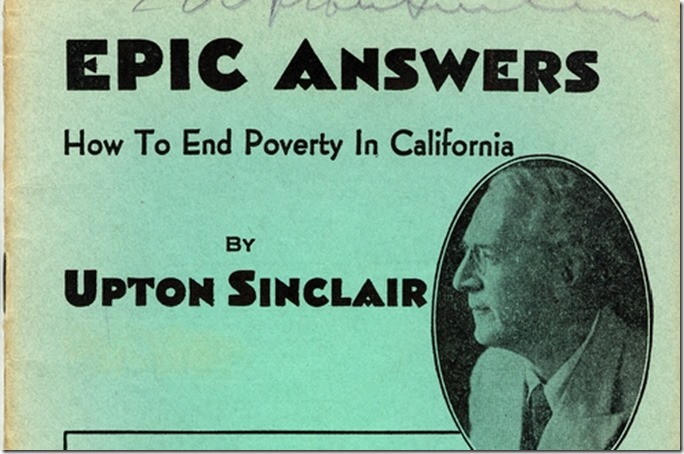
 Epic Answers: How to End Poverty in California.
90 years ago, author and former Socialist Upton Sinclair entered the race for Governor of California as a Democrat, hoping to better the lives of common people and the unemployed. Upset at the idea that taxes would be raised on the wealthy and independent film production would assist the unemployed, rich Hollywood moguls colluded to destroy his campaign with the first use of negative advertising in mass media, setting the stage for what we see today in political campaigns.
The motion picture industry had long profited off of Sinclair and his works. In 1914, his muckraking novel “The Jungle” was adapted into a feature film. Director Alice Guy Blache helmed the 1917 film “The Adventurer,” about a young woman trying to honestly survive in a cold and cruel city. In 1920, Director Jack Conway produced “The Moneychangers” for Benjamin B . Hampton Productions. Most importantly, MGM produced the hard hitting melodrama “The Wet Parade” starring Walter Huston, Robert Young, Neil Hamilton, and a young Myrna Loy, detailing two families’ struggles against demon alcohol during Prohibition. Sinclair specifically wrote the book to demonstrate the deep need for Prohibition, reflecting his father’s and two uncles’ struggles with and later deaths due to alcoholism and its effects on his family.
Thanks to the book’s fame, MGM studio executive Irving Thalberg purchased it for $20,000, though he detested Sinclair’s socialist beliefs and barred him from the lot during its’ production. Most critics, both film and literary, derided the story and its’ focus on Prohibition’s failure because of legal lack of enforcement and the growth of illegal practices, corruption, and gangs due to high demand for alcohol. Perhaps due to personal experience with alcoholism, the film did well at the box office.
Thalberg suggested Sinclair write a script detailing the contrasting lives of the rich and poor, and paying him $10,000. The novelist completed a story which he called “The Golden Spangled Banner,” but never heard back from the producer. Bitter and angry about his treatment, Sinclair penned an unpublished novella called “The Golden Scenario,” revealing the industry’s manipulation of the writing process, turning writer against writer, while exploiting them for ideas. In 1933, the novelist enraged Fox Studios with his biography “Upton Sinclair Presents William Fox,” writing “No melodrama that I have been able to invent has been more packed with crimes and betrayals, perils and escapes, than the story of William Fox.”
This antagonism and conflict with studios would carry over into Sinclair’s race for Governor, especially after the author condemned block booking and blindselling, which disproportionately affected small independent film distributors and exhibitors. Studios looked to maintain their hold over the entire filmmaking process, from creation through release.
The author determined to enter the campaign hoping to improve living and working conditions for struggling workers. Thanks to his popularity as a writer, he possessed high name recognition. Sinclair’s books also offered hope and ideas for bettering society and life in general. The author employed some of these ideas when he penned the pamphlet “I, Governor of California,” to explain his EPIC (End Poverty in California) plan to put people back to work and hopefully end poverty. Several of these ideas included creating scrip, collective bargaining, developing shared co-ops, putting people to work, and “production for use” rather than one to make profit. Sinclair himself defined “production for use”in his autobiography as putting unemployed people to work by opening idle plants to manufacture goods for their own use and then distributing them across the state. He also promoted abolishing sales taxes, considering them regressive.
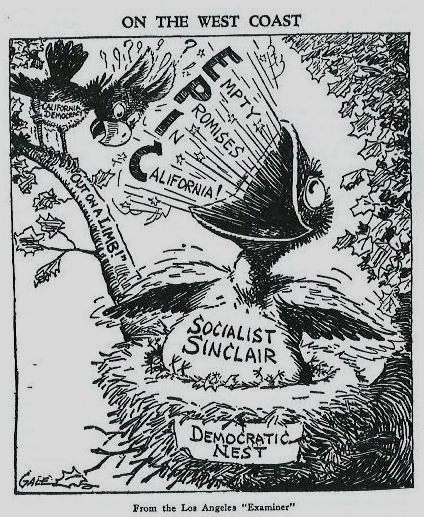
Editorial cartoon by Ted Gale in the Examiner, via the University of Washington.
Middle and lower class voters struggling during the Depression highly approved of the ideas, and the optimistic Sinclair’s popularity swelled. Sinclair overwhelming won the Democratic primary for Governor in spring 1934, and the pamphlet’s sales exploded. Sinclair’s campaign reached average voters through popular activities like rodeos, theatrical productions, barbecues, picnics, athletics, sewing bees, and rallies, with comedian Charlie Chaplin speaking at one. The group even produced a weekly newspaper called The EPIC News, featuring editorials by Sinclair and stories of what average workers could do to advance the cause.
Studio chiefs found themselves incensed in 1934 when Sinclair spoke out and protested the complete monopoly of film production, distribution, and exhibition by film factories. They also detested his call in EPIC (End Poverty in California) for a tax increase on the wealthy and film studios. Most decried in the trades they would move their studios out of state if such a tax was imposed. Joseph Schenck screamed that a win by Sinclair would “spell collapse for the motion picture industry” in Hollywood.
Determined to destroy his campaign, studios and publishers like Harry Chandler conspired to distort and misrepresent his words and message, creating fake news. As Sinclair described, “A big advertising concern….made a careful study of everything I had written and they took passages out of context and even cut sentences off in the middle to make them mean the opposite of what I had written.” These were then printed in large type in newspapers or in pamphlets. Groups like the American Legion, Elks, and other social groups decried his policies and even his character, also manipulating his policies and words.
Thanks to their wide distribution, newsreels employing propaganda by the use of slanted storytelling, false framing, and lies, studio moguls completed their task in derailing Sinclair and his EPIC campaign. Republican Governor Merriam earned reelection by over 200,000 votes. Several trades and newspapers gleefully celebrated the news, with the 1935 Film Year Book playing up the fact that MGM head Louis B. Mayer took a major role in the conspiracy, as did his subordinate Irving Thalberg.
The two determined to employ any means in their arsenal to demolish his campaign. To pad their war chests to decimate the author, studios forced their employees, even stars, to contribute one day’s wages to be dedicated to this manipulative campaign. In October 1934, Thalberg abandoned all principles to create the three-part series of deep fake newsreels entitled “California Election News,” which they forced theatres to carry.
Employing the regular MGM newsreel narrator to lend a hint of authenticity, the newsreels featured disheveled or simple looking actors to portray Sinclair supporters, others pretending to be an armada of homeless hoboes marching on California for Sinclair’s promised policies, another impersonating a raving immigrant praising Sinclair’s “Soviet” policies, and others appearing as vagrants and homeless cheering on the author. The Hollywood Reporter praised their work, saying “This campaign against Sinclair has been and is DYNAMITE. It is the most effective piece of political humduggery that has ever been effected.”
Actors Melvyn Douglas and Fredric March later confronted Thalberg about these deceptive films, calling their implementation “a dirty trick.” The studio executive basically told them that politics was a dirty business and that anything was permissible in order to win. In effect, Mayer and Thalberg introduced negative advertising to destroy a campaign, thereby introducing a practice increasingly the norm in today’s politics.
A publication called “Sodom and Gomorrah in Hollywood” published after the conclusion of the 1934 race wrote about Hollywood’s dishonest and corrosive policies, going on to say, “Interference of official filmdom in the recent gubernatorial campaign in California in behalf of the corrupt, conservative forces was probably the greatest single cause for the defeat of Upton Sinclair.” Harrison Reports would praise Sinclair and his campaign, stating, “Mr. Sinclair may be defeated, but his influence upon the industry’s politics will not be effaced thereby. For so the producers have willed. And those who have lived by the sword must die by the sword.”
This dirty campaign ignited the fury of leftist screenwriters and directors, popularizing liberal policies for decades. Though Sinclair himself lost, fifty other candidates endorsing the EPIC plan, turning California increasingly blue. These candidates turned Sacramento progressive, passing several of the policies promoted by Sinclair, including increased taxes on film studios. After all their bluster and arrogance, no studio abandoned California for another state.
Hollywood’s film studios employed the first truly negative campaign to defeat Upton Sinclair in his race for California Governor in 1934, beginning the use of manipulative propaganda and deep fakes to defeat candidates and policies. Ninety years later we see these smear practices increasingly employed immorally and unethically as cheap fakes, deep fakes, ai generated, and voice manipulation to confuse and enrage voters. May increasing education and knowledge allow better discernment in recognizing authentic, truthful policies, and indignation and destruction of any techniques that demean and demoralize.

 ladailymirror.com